The care of the child and adult with congenital heart disease has undergone remarkable progress in the past few decades. Even the most complex cardiac malformations can now be treated with real optimism for the future. From the early repairs of simple lesions such as atrial and ventricular septal defects to the more complex repairs of tetralogy of Fallot and transposition of the great arteries, to the previously hopeless lesions such as hypoplastic left heart syndrome, the results have steadily improved, and patients previously facing either death or a life burdened by unrepaired congenital cardiac disease can now look forward to a productive life of a good quality.Reference Jacobs, Wernovsky and Elliott 1 , Reference Jacobs, Jacobs and Franklin 2 Unfortunately, the care of the child and adult with congenital heart disease is not the same in all parts of the world, with the progress in care being largely limited to the developed world. Yet every year ∼90% of the more than million children who are born with congenital cardiac disease across the world receive either suboptimal care or are totally denied care. Whereas in the developed world the focus has changed from an effort to decrease post-operative mortality to now improving quality of life and decreasing morbidity, the rest of the world still needs to develop basic access to congenital cardiac care.Reference Tchervenkov, Jacobs and Bernier 3 , Reference Mavroudis and Jacobs 4
On the level of global care of children and adults with congenital cardiac disease throughout the world, many efforts have been made to improve care, to give access to appropriate medical and surgical care, and to promote the highest quality of comprehensive care to all patients with congenital heart disease. Assessment and improvement of quality and outcomes have dominated discussions in the last decade, with multiple ongoing closely related projects: international efforts to standardise the scientific language for congenital cardiac disease and the establishment of the International Pediatric and Congenital Cardiac Code; the establishment of continental multi-institutional databases, such as the Databases of The Society of Thoracic Surgeons and The European Association for Cardio-Thoracic Surgery Congenital Heart Surgery; and the development of complexity stratification and risk assessment for congenital cardiac disease with the Risk Adjustment for Congenital Heart Surgery-1 method and the Aristotle Complexity Score.Reference Jacobs, Mavroudis and Jacobs 5 – Reference Jacobs, Jacobs, Jenkins, Gauvreau, Clarke and Lacour-Gayet 9 The European Association for Cardio-Thoracic Surgery Congenital Database was established with the initial aim of collecting data on the outcomes of Congenital Heart Surgery procedures across Europe and to make possible comparison of results and definition of mortality, morbidity, and risk factors, as well as targeting research activities. Owing to the fact that quality control is especially difficult to achieve in Congenital Heart Surgery and is particularly necessary, considering the potential adverse outcomes associated with complex cases, a complexity-adjusted method named the Aristotle Score (ABC), based on the complexity of the surgical procedures, has been developed by an international group of experts. The Aristotle score was introduced in the European Association for Cardio-Thoracic Surgery and Society of Thoracic Surgeons databases.Reference Jacobs, Jacobs, Mavroudis, Lacour-Gayet and Tchervenkov 10 , Reference O’Brien, Jacobs and Clarke 11 The ABC score allows precise scoring of the complexity for 145 Congenital Heart Surgery procedures. One interesting notion coming out of The European Association for Cardio-Thoracic Surgery Congenital Database project is that complexity is a constant value for a given patient regardless of the centre where he is operated. A validation process evaluating its predictive value is being developed.Reference Jacobs, Jacobs, Jenkins, Gauvreau, Clarke and Lacour-Gayet 9 – Reference O’Brien, Jacobs and Clarke 11
Despite the fact that improvements have been made in the medical care of patients with congenital cardiac disease, including early diagnoses, diagnostic procedures, neonatal care, and intensive care units, surgical procedures are long and difficult and we are still facing a lot of problems in our country, with a major proportion of cardiac surgeries still being performed in referral cardiosurgical centres outside Croatia.Reference Dilber and Malcic 12 , Reference Dilber and Malcic 13
By employing the widely used and accepted methodologies of case-mix complexity adjustment in congenital cardiac surgery, together with collecting data in The European Association for Cardio-Thoracic Surgery Congenital Database, we tried to evaluate our performance, compare our results with those from other centres, and use the ABC scores for a case complexity selection that may have different outcomes in various centres. We tried to use standardised risk scores for the selection of international partners according to evidence-based outcomes for specific defects, which may have very different outcomes in various centres, and finally to develop initiatives, to improve the services provided on a national level, and also to develop cooperation between neighbouring small countries.
Methods
In this report, we analysed outcomes of cardiac surgical procedures performed in our institution between January, 2008 and December, 2011. Information about the patients was obtained from medical records collected by a paediatric cardiologist. Data were collected from the European Association for Cardio-Thoracic Surgery database prospectively representing surgical procedures performed with or without cardiopulmonary bypass. All diagnoses and procedures were coded according the International Paediatric and Congenital Cardiac Code. The primary procedure for an operation is the procedure with the highest Aristotle basic complexity score with two exceptions: in the event of simultaneous bi-directional Glenn and pulmonary artery arterioplasty, the bi-directional Glenn is the primary procedure, and in the event of a primary diagnosis of atrial septal defect, sinus venosus with procedures of partial anomalous venous return repair and atrial septal defect repair patch, the second will be considered the primary procedure. If the two procedures within a given operation share the highest Aristotle basic complexity score, then the procedure designated as primary by the patient will be used. The mortality data are acquired by using a patient admission-based mortality calculation with a numerator of the number of deceased patients and a denominator of the number of cardiac surgical patient admissions. Mortality that occurs for an admission with multiple operations is assigned to the first cardiac operation, that is, the first operation of cardiovascular type with or without cardiovascular bypass, for that admission. This initial cardiac operation of the hospitalisation is considered as the index operation of the hospitalisation. The mortality status at discharge is the chosen measure of mortality for this report. Patients weighing less than or equal to 2500 g undergoing patent arterial duct ligation as their primary procedure will not be included in the mortality calculation because of the fact that most of the deaths in this patient population are multi-factorial and largely unrelated to the surgical procedure in time and by cause.Reference Bove, Francois and De Groote 14 Case-mix complexity adjustment is performed by using the Aristotle basic complexity score that is calculated at the patient admission level. This section contains information on the patient, early mortality, occurrence of post-operative complications, and procedural complexity presented by ABC scores. Together with prospective collection of these data, the data of all patients sent for operation to foreign cardiosurgical centres were recorded.
Results
From January, 2008 to December, 2011, 634 operations were performed. Among them, 380 (60%) were performed in Croatia and 254 (40%) in foreign cardiosurgical centres. All operations performed in Croatia were performed by a cardiosurgical team at University Hospital Zagreb. A smaller percentage of all operations (6% of all) in that period was performed in University Hospital Rijeka partly by the same cardiosurgical team. Only the operations performed in University Hospital Zagreb were included in this report and could be translated to the situation in Croatia.
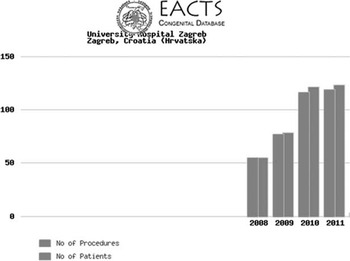
During the 4-year period, the number of operations performed in Croatia showed a linear increase: 55 operations in the year 2008, and 78, 121, and 126 operations performed in 2009, 2010, and 2011, respectively (Fig 1). Along with the increasing number of operations performed in our centre, a significant number of operations was performed in centres in Western Europe, that is, 72/127 (57%), 53/131 (40%), 61/182 (34%), and 68/194 (35%) in 2008, 2009, 2010, and 2011, respectively. Together with the increasing number of cardiac operations performed at University Hospital Zagreb, there is a linear decrease in the number of operations performed in foreign centres. The largest proportion of operations performed abroad, 92% of operations, was performed in two centres that we have cooperated with for a long time, and the remaining were performed in other foreign centres across Western Europe.
Linear increase in the number of operations performed in Croatia.

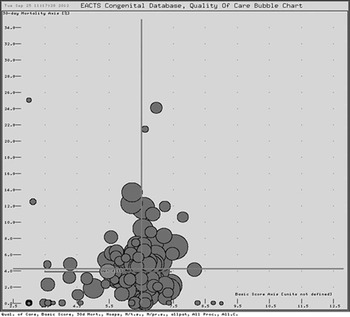
The early mortality rates of operations performed in Croatia were 1.82%, 5.41%, 3.64%, and 3.48% in 2008, 2009, 2010, and 2011, respectively. The increase in the number of operations was followed by a satisfactory low average mortality rate of 3.85%. Figure 2 shows the comparison with other cardiosurgical centres, with the red bubble representing the Croatian average ABC score and early mortality.
Comparison with other cardiosurgical centres, with the red bubble showing the Croatian average ABC score and early mortality.

The mean complexity according to the risk adjustment methodology for cardiac procedures performed in Croatia is 5.77, with no significant changes during the years of study. The mean Aristotle Basic Complexity Score was 5.82, 5.80, 5.83, and 5.64 in 2008, 2009, 2010, and 2011, respectively. The most frequent procedure performed in Croatia was ventricular septal defect repair, followed by atrial septal defect repair, coarctation repair, and modified Blalock–Taussig shunt. The average age at operation in Croatia was 49.2 months, and the mean weight was 17.47 kg. The average length of stay in the hospital for indexed operations is 17.5 days.
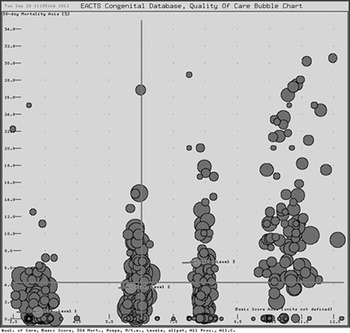
More complex operations, with higher ABC scores (basic score of 6.0–7.9 or the basic level of 2, basic score of 8.0–9.9 or the basic level of 3) correlated strongly with higher early mortality rate. In our case, there is a linear correlation between ABC score and mortality rate, especially observed for more complex operations (Fig 3). The possible explanation for this might be that there is not much experience in dealing with such complex procedures, hence the mortality.
The linear correlation between ABC score and mortality rate; higher ABC scores (more complex operations) were connected with high early mortality.

Between January, 2008 and December, 2011, 254 cardiac operations were performed in cardiosurgical centres in Western Europe. These were more complex operations. The average Aristotle complexity basic score for cardiac procedures performed abroad was 9.1. The most frequent procedure performed abroad was arterial switch followed by Norwood procedure, bi-directional Glenn, atrioventricular canal repair, tetralogy of Fallot repair, and double-outlet right ventricle repair. During these 4 years, there was a decrease in the number of operations being performed in cardiosurgical centres outside Croatia. In the year 2008, 57% of all cardiosurgical operations were performed abroad, 40% in 2009, 34% in 2010, and 35% in 2011.
Together with the increasing number of cardiosurgical operations performed during the 4 years (2008–2011), there is also an increasing number of heart catheterisation interventional procedures that reduced the need for surgical operation.
Discussion
The evaluation of the quality of care delivered to patients with congenital cardiac disease relies heavily on the analysis of outcomes.Reference Jacobs, Wernovsky and Elliott 1 , Reference Jacobs, Jacobs and Franklin 2 , Reference Jacobs, Jacobs, Jenkins, Gauvreau, Clarke and Lacour-Gayet 9 Simple comparisons of overall mortality rates are not useful because of baseline differences in risk among individuals. There is a huge variety of unadjusted mortality rates between centres performing operations of congenital cardiac disease, with a mortality rate ranging from 2.5% to 11.4%.Reference Jacobs, Jacobs, Jenkins, Gauvreau, Clarke and Lacour-Gayet 9 , Reference Jenkins and Gauvreau 15 Earlier reports illustrated well that an unadjusted mortality rate is inadequate for evaluating institution quality and that simple statistics can be misleading. Tremendous progress has been made in the science of assessing the outcomes of the treatments of patients with congenital cardiac disease.Reference Jacobs, Wernovsky and Elliott 1 – Reference Jacobs, Jacobs, Mavroudis, Lacour-Gayet and Tchervenkov 10 Multi-institutional databases have been developed that span subspeciality, geographic, and temporal boundaries. Linking of different databases enables additional analyses that are not possible using the individual data sets alone, and can facilitate quality improvement initiatives. The European Association for Cardio-Thoracic Surgery Congenital Database was established with the initial aim of collecting data on the outcomes of Congenital Heart Surgery procedures across Europe and to make a possible comparison of results and definition of mortality, morbidity, and risk factors, as well as targeting research activities. The Aristotle score has predictive value of in-hospital mortality and is a constant value for a given patient regardless of the centre where he is operated.Reference Lacour-Gayet, Clarke and Jacobs 8 – Reference O’Brien, Jacobs and Clarke 11
The vision of international health-care system remains that every child born anywhere in the world with a congenital heart defect has access to appropriate medical and surgical care of highest quality, from foetus to adulthood. However, in reality, there is a huge variation in the quality of care for patients with congenital heart disease in different countries. In Europe, a pathway for international cooperation in the field of health care is not yet well established, and is highly dependent on national structures. The ABC score as a uniform measure is a great tool in quantifying complexity of cases, which may have different outcomes in various centres. In our case, the ABC score showed a linear correlation with early mortality rate, showing a strong connection with high mortality rates for complex operations with higher ABC score (Fig 3). A possible explanation for this might be that there is not much experience in dealing with such complex procedures, hence the mortality. The ABC score was introduced here as an objective score to identify complex cases that are connected to high mortality by today’s standards of treatment. During the past few decades, survival among children born with even the most complex cardiac defects has increased substantially, and thus from 2005 to 2009 the discharge mortality of index cardiac operations was 4% in the Congenital Heart Surgery Database of the Society of Thoracic Surgeons.Reference Jacobs, O'Brien and Pasquali 16 , Reference Jacobs, Jacobs and Mavroudis 17 With the early mortality rate of 3.85% in Croatia, we approached the high standards of the developed world, with the ABC score as a guide for a case complexity selection, allowing us to decide which cases required to be treated in more developed cardiosurgical centres. The earlier publications showed that variations in outcome were most prominent for the more complex operations.Reference Jacobs, Jacobs and Franklin 2 , Reference Jacobs, O'Brien and Pasquali 16 , Reference Jacobs, Jacobs and Mavroudis 17 Jacobs et alReference Jacobs, O'Brien and Pasquali 16 , Reference Jacobs, Jacobs and Mavroudis 17 also showed that in the case of small-volume hospitals, percentiles calculated directly from the observed event rates are misleading because hospitals with a very small number of patients are likely to have extreme event rates (approaching 0% or 100%). As we presented in our case, ABC scores higher than level 1 (ABC scores higher than 6) have a strong correlation with high mortality rates, and thus helped us as a guide in the everyday practice for a case selection that we have to send away to keep a low mortality rate and to enable a gradual progress of cardiosurgical model in our country.
In Croatia, there are about 4 million people and about 400 patients with congenital heart disease every year. Most of them are treated in one centre because of the need for centralisation to achieve the best possible results, especially in the field of paediatric congenital surgery. There is an increasing number of operations observed during the study years, especially from 2008–2009, because of staffing of our surgical team. In this study, we highlights practical use of ABC score due to the fact that the helped us in the communication with medical authorities, colleagues, patients and their parents as an objective, uniform language for explaining case complexity selection that were sent away for treatment abroad. Here we also showed that the use of standardised risk scores allows selection of international partners according to evidence-based outcomes for specific defects, which may have very different outcomes in various centres. The results of this study might have important implications in the need for centralisation in paediatric cardiac surgery to achieve the best possible results. This study highlights how international cooperation is highly beneficial to provide best practice care for a particular patient population and in particular when it comes to rare diseases in small countries.
The field of paediatric cardiac care has received worldwide recognition as a leader in quality and patient safety and has advocated for system-wide changes in organisational culture.Reference Tchervenkov, Jacobs and Bernier 3 , Reference Mavroudis and Jacobs 4 , Reference Barach, Jacobs, Laussen and Lipshultz 18 The field has many complex procedures that depend on a sophisticated organisational structure, the coordinated efforts of a team of individuals, and high levels of cognitive and technical performance. Factors that influence the team's effectiveness include the performance of individual team members, the equipment they use, established care processes and procedures, and the underlying organisational and cultural factors.Reference deLeval, Carthey, Wright, Farewell and Reason 19 It is difficult to say what factors determine our performance and that is a separate discussion far beyond the scope of this paper. Earlier reports showed that mortality rates between institutions vary, indicating potential modifiable factors related to case volume, experience, and practice variability.Reference Jacobs, O'Brien and Pasquali 16 , Reference Gauvreau 20 , Reference Welke, Diggs, Karamlou and Ungerleider 21 Preventable adverse events may occur related to both technical and non-technical factors associated with decision making.Reference Jacobs, Jacobs and Franklin 2 , Reference Jacobs, O'Brien and Pasquali 16 Several recent studies have demontrated that the majority of hospital adverse events are related to an invasive or surgical procedure and occur predominantly during the intra-operative phase of the procedure.Reference Gawande, Zinner, Studdert and Brennan 22 A landmark study by de Leval et alReference deLeval, Carthey, Wright, Farewell and Reason 19 investigated the role of human factors on surgical outcomes in children who undergo cardiac surgery, specifically using the arterial switch operation as an example of complex, high-risk surgery. They found that, although proper compensation greatly reduced the risk of death, minor events go largely unnoticed by the operating room team and are therefore left uncompensated. Complications result in higher morbidity, long-term disability, decreased quality of life, and increased cost to the health system. The resultant burden on the family, individual, and community is substantial.
Although outcome analysis is potentially dangerous with many implications, centres should not fear the potentially negative consequences of reporting less than stellar results. The aim is to identify the problems and institute improvement initiatives, which can include inter-institutional team visits, mentoring schemes, and educational programmes.Reference Tchervenkov, Jacobs and Bernier 3 , Reference Mavroudis and Jacobs 4 Finally, the results show how risk-adjusted outcomes may be used to develop initiatives, to improve the services provided on a national level and also to develop cooperation between neighbouring small countries.
Acknowledgement
The authors declare that this study has not received any grants, contracts, and other forms of financial support.