


1. Introduction
Politicians, pundits, and political scientists often use the terms ‘left’ and ‘right’ to describe the political orientations and positions of parties, legislators, and candidates (Huber and Inglehart, Reference Huber and Inglehart1995; Benoit and Laver, Reference Benoit and Laver2012; Caughey et al., Reference Caughey, O’Grady and Warshaw2019). In terms of political representation, accurate voter perceptions of parties’ policy positions are necessary for achieving policy congruence and are a prerequisite for responsible party government (Powell, Reference Powell2000; Adams et al., Reference Adams, Ezrow and Somer-Topcu2014). In seeking citizens’ support, politicians use manifestos and speeches to communicate their policy positions to voters, who then use these signals to infer their ideological stances. However, voters may not respond to the ‘objective’ positions of the parties, but rather to the parties’ images and other types of information or shortcuts (Popkin, Reference Popkin1991, Adams et al., Reference Adams, Ezrow and Somer-Topcu2011; Fortunato and Stevenson, Reference Fortunato and Stevenson2013; Adams et al., Reference Adams, Ezrow and Somer-Topcu2014). Thus, voters may possess limited political knowledge, pay little attention to policies, and sometimes fail to ‘correctly’ perceive ‘objective’ party positions (Converse, Reference Converse and Apter1964; Delli Carpini and Keeter, Reference Deli Carpini and Keeter1996). Citizens rely not only on policy-related messages but also on behavioural cues, such as attacks on or cooperation with other parties. These cues signal the relational distance between parties and lead voters to infer policy distance from patterns of interparty conflict and cooperation.
How do voters use politicians’ behaviour as cues to infer their policy positions? To answer this question, we conducted a survey experiment in Japan that focused on politicians’ non-policy characteristics and behaviour: coalition strategies and the tone used when questioning the government. That is, we tested the hypothesis that voters infer a politician’s ideology from their confrontational and cooperative behaviour. Our experimental design has the advantage of simultaneously investigating the effects of several policy issues and non-policy behaviour. Since comparative studies in Europe have primarily relied on observational data, their estimates may be confounded by actual policy positions and other variables because attacking behaviour is usually correlated with policy differences; politicians often attack others to signal their own positions. By contrast, our experimental design can detect the causal effects of politicians’ behaviour irrespective of their policy statements.
Furthermore, our results suggest that voters may view ideological labels differently. Labels other than the left–right dimension are perceived in terms of everyday language usage rather than as political jargon. In Japan, various labels are used in the political landscape. The left–right dimension has long been used to describe political orientations. In addition, the terms ‘conservative’ (hoshu), ‘liberal’ (riberaru), and ‘progressive’ (kakushin) have also been used. Historically, class and cultural divisions have been salient in Japan; however, these divisions have weakened since the recession and the end of the Cold War. Therefore, these labels are not necessarily associated with specific political divisions, and voters may not recognize the dimensions implied by political language. This finding has implications for contemporary Japanese politics. The Japanese party system has been characterized by the one-party dominance of the Liberal Democratic Party (LDP) and opposition party fragmentation (Scheiner, Reference Scheiner2005; Catalinac, Reference Catalinac2025). Even after the mixed-member majoritarian (MMM) system was introduced for lower-house elections, the opposition parties failed to form an enduring alliance. Moreover, the centre-left Constitutional Democratic Party (CDP), a successor to the Democratic Party of Japan, struggled with declining popularity. This study can contribute to understanding the decline of the centre-left opposition in Japan.
In comparative contexts, different uses of ideological labels are common. In Western Europe and other wealthy democracies, political scientists generally see the left–right dimension as related to economic issues (Huber and Inglehart, Reference Huber and Inglehart1995); left-wing parties advocate state interventions in the economy, whereas right-wing parties champion a reduction in the role of the state. Besides the left–right scale, scholars and politicians have used several labels that have substantive meanings compared to left and right; labels such as liberal, social democrat, and progressive are often associated with left-leaning positions. However, citizens have different perceptions of specific labels. For example, the label ‘liberal’ is disliked by US citizens due to historical and political reasons (Ellis and Stimson, Reference Ellis and Stimson2012; Neiheisel, Reference Neiheisel2016). Furthermore, the meanings and perceptions of ideological labels differ across contexts. In addition to the economic left-and-right dimension, another dimension of the policy space has become salient (Kitschelt, Reference Kitschelt1994; Gidron and Tichelbaecker, Reference Gidron and Tichelbaecker2025): the cultural issue dimension. In recent times, left-wing parties in Europe have become more based on the middle class and have adopted ‘cultural liberal’ positions (Gingrich and Häusermann, Reference Gingrich and Häusermann2015; Abou-Chadi and Wagner, Reference Abou-Chadi and Wagner2020). Compared with left–right labels, these ideological labels are widely used and have substantive meanings akin to everyday language. As some politicians use these labels to describe themselves, the perceptual differences among these labels could be important to understanding the ideological spaces in a country. In particular, cultural libertarian positions are called ‘progressive’ (e.g., Abou-Chadi and Wagner, Reference Abou-Chadi and Wagner2020). Our research also intends to contribute to the literature on ideological labels in developed democracies where historical cleavages have weakened, and political conflicts have recently become more complex.
This article is organized as follows. The following section develops our theory and hypotheses. The third section describes the Japanese case and context, the fourth describes the research design, and the fifth section presents our results. The sixth section concludes the paper.
2. Voters’ perceptions about party ideologies
Political parties present policy programmes to attract and inform voters (Adams et al., Reference Adams, Merrill and Grofman2005). They draw up manifestos to present consistent and comprehensive policy positions or to appeal to their core supporters. Ideally, from the perspective of a responsible party government or issue voting, voter choices should be based on party policy positions, with voters being fully informed. ‘Objective positions’, or issues raised by a party, are important influences on voters’ inferences about the party’s policy positions.
Thus, voters often infer the political positions of parties or classify parties as right, left, conservative, social democratic, or liberal on the basis of policy messages.Footnote 1 In other words, voters’ perceptions of a party’s political orientation could be influenced by the content and quantity of party policy messages. For example, parties’ messages emphasizing particular issues can influence voters’ perceptions of their positions; they rely on that issue to infer the party’s position (Wagner and Meyer, Reference Wagner and Meyer2023). When parties avoid an issue, voters do not use it to infer the party’s position on the left–right dimension (Nasr, Reference Nasr2020). Furthermore, when parties appear on TV and in newspapers, voters obtain information on the parties’ positions and form perceptions of their positions through this media exposure (Somer-Topcu et al., Reference Somer-Topcu, Tavits and Baumann2020). In summary, from a policy-centred perspective, voters are responding to the messages, and perceived positions are related to the issues that parties (and politicians) emphasize.
By contrast, given the limits of voters’ information-processing ability, voters often use shortcuts and heuristics (Lupia and McCubbins, Reference Lupia and McCubbins1994).Footnote 2 Although theories of responsible party government assume that voters read and compare parties’ manifestos or consult media outlets to learn about the parties’ positions, they may not read manifestos and rarely pay attention to actual policy positions. Some studies show that voters’ perceptions of party positions are hardly correlated with the ‘objective’ positions in manifestos but rather correlated with party images or broader information (Adams et al., Reference Adams, Ezrow and Somer-Topcu2011, Reference Adams, Ezrow and Somer-Topcu2014).
Furthermore, political parties do not exist in a vacuum; rather, they interact with one another. Voters observe interactions among parties and use them as sources of information. Interactions between parties can affect citizens’ perceptions of the ideological distance between parties by shaping their recognition of ‘relational proximity’. Cooperative party behaviour can influence voters’ perceptions of the ideology of the party. When voters observe close cooperation among parties, they infer their ideological positions from the interactions. Voters track news reports, accurately perceive cooperation between parties, and use it to infer party positions (Santoso et al., Reference Santoso, Stevenson and Weschle2024). In parliamentary systems where coalition governments are the norm, voters use coalition status to infer parties’ positions; coalition partners are seen as ideologically close because they create coalition agreements and legislate and govern together. Close cooperation leads to positional proximity in the eyes of voters (Fortunato and Stevenson, Reference Fortunato and Stevenson2013; Hjermitslev, Reference Hjermitslev2023). Compared to reading manifestos, coalition formation is an available, salient, and low-cost cue for voters to infer parties’ political orientations (Fortunato et al., Reference Fortunato, Silva and Williams2025). The effects are usually asymmetric; the junior partner parties are perceived as close to the political position of the prime minister’s party (Fortunato and Adams, Reference Fortunato and Adams2015). As a result, a compromise among coalition partners may be viewed as a signal of the limited competence of smaller partner parties and may lead to a loss of support among their constituents (Fortunato, Reference Fortunato2021).
Beyond governing, parties can form pre-electoral coalitions, signaling their coalition preferences during electoral campaigns (Golder, Reference Golder2006; Falcó-Gimeno and Muñoz, Reference Falcó-Gimeno and Muñoz2017) and express their cooperation with other parties in the legislative arena by supporting a minority government or co-sponsoring bills.Footnote 3
Attacking other parties is also used by voters to infer the proximity of parties (Adams et al., Reference Adams, Weschle and Wlezien2021). Since opposition parties attack the government to differentiate themselves from government parties (Poljak, Reference Poljak2023; Ishima, Reference Ishima2024), a party’s confrontation with the government may lead voters to perceive it as holding the opposite ideology of the government even if they have a similar orientation. In recent years, populist parties have used distinctive rhetoric to attack governments (De Vries and Hobolt, Reference De Vries and Hobolt2020). Likewise, as coalition partners have to differentiate themselves from the senior partner party, they may use conflictual language in the legislative arena (Martin and Vanberg, Reference Martin and Vanberg2008). While the language style itself does not prime voters’ perceptions of ideological positions, those perceptions can be affected by perceptions of ‘proximity’ among parties.
Based on this theory, we propose the hypothesis that the informal coalition or even potential coalitions also matter for voters’ perceptions: a centre-left party cooperating with a far-left party may be viewed as taking a position similar to that of the far-left party. Although smaller parties are usually perceived in relation to larger ones, ideological purity and polarity could influence this tendency. Thus, we expect cooperation with a fringe party to result in voters projecting the far-left party’s position on the moderate one. A party attacking the government in a harsh tone may likewise be viewed as radical. Thus, the following hypotheses are proposed:Footnote 4
H1 Cooperation among parties affects voters’ perceptions of party positions, regardless of the objective policy positions.
H1a Politicians attacking a right-wing government will be a cue for left-wing parties, regardless of the objective policy positions.
H1b The cooperation of politicians with a left-wing party evokes the politicians’ ideology as leftist, regardless of the objective policy positions.
3. Case selection: the Japanese political situation
In this article, we argue that Japan provides a crucial case for investigating how non-policy behaviours shape ideological perceptions, which could have implications for cross-national comparisons. As the policy space becomes increasingly complex, voters across advanced democracies find it difficult to discern the ‘objective’ positions of parties and instead rely more on non-policy shortcuts. The Japanese party system serves as an illuminating case for estimating the causal effects of such signals due to the entrenched dominance of the LDP and the institutional incentives of its electoral system.
3.1. One-party dominance of the LDP and non-policy cues
In Japan, the LDP has long maintained power and has leveraged its position to secure repeated re-election (Krauss and Pekkanen, Reference Krauss and Pekkanen2010; Catalinac, Reference Catalinac2025). As the long-term dominant party, it is considered the natural party of government regardless of its specific policy positions. Indeed, recent experimental studies demonstrate that Japanese voters do not evaluate the LDP’s policies more highly than those of other parties; rather, they evaluate valence attributes, such as perceived trustworthiness and governing competence (Horiuchi et al., Reference Horiuchi, Smith and Yamamoto2018; Kuriwaki et al., Reference Kuriwaki, Horiuchi and Smith2025). Opposition parties, by contrast, are perceived by voters as extreme and incompetent. Even when opposition parties hold policy positions that are relatively close to those of voters, voters may misperceive their positions. Such perceptions of ideological extremity could, in turn, contribute to the opposition parties’ valence disadvantage (Johns and Kölln, Reference Johns and Kölln2020). Given this context, Japan, characterized by one-party dominance and a weak opposition, is well suited to examining the effects of politicians’ non-policy behaviour on voters’ perceptions of their policy positions.
Furthermore, the electoral systems in Japanese elections can be useful for testing our party-relation hypotheses. The institutional incentives of Japan’s MMM system for the Lower House elections encourage government-opposition conflict and multi-party competition. In particular, the system promotes tactical inter-party coordination, even among ideologically distant parties, making such strategic alliances a familiar feature of elections for Japanese voters (Jang et al., Reference Jang, Crabtree and Golder2022). Compared to pure proportional representation systems, under the MMM system, parties are often compelled to form pre-electoral coalitions to secure victories in Single-Member Districts (Golder, Reference Golder2006). In fact, centre-to-left opposition parties have routinely reshuffled their own cooperative arrangements in their attempts to challenge the LDP. Cooperative strategies are among the most important aspects of their activities. Compared to the opposition side, the LDP-Komeito coalition was stable even though their ideological distance was large; they exchanged their supporter bases (Liff and Maeda, Reference Liff and Maeda2019; Catalinac and Motolinia, Reference Catalinac and Motolinia2021). Collectively, these patterns underscore that in the Japanese context, strategic coordination frequently takes precedence over ideological or policy consistency.
Consequently, given the LDP’s prolonged dominance and the systemic normalcy of inter-party cooperation, Japan offers a fertile ground for observing the impact of non-policy signals, specifically, the rhetoric ‘tone’ and ‘coalition strategies’ examined in this study. This context makes Japan an ideal case for analysing how behavioural cues shape voter perceptions in a valence-driven political environment.
3.2. The dilemma of the centre-left parties
As described in the Introduction, this article focuses on the left side of the ideological space because it has several ideological labels. As in most developed democracies, centre-left parties in Japan are in crisis. The CDP, the country’s centre-left party, was unpopular even though voters do not prefer the conservative LDP’s policy platform (Horiuchi et al., Reference Horiuchi, Smith and Yamamoto2018). The CDP was the largest opposition party, but its popularity has declined in the face of the rise of new challenger parties. One possible explanation for this slump is that the centre-left party is not viewed as moderate, but rather as far-left; using cues from confrontation and coalition strategies, voters may place the centre-left party further to the left than its actual position, which appears in their manifestos.Footnote 5 Our experiments demonstrate this possibility.
4. Research design
Current evidence on voters’ perceptions about parties’ political orientation is mainly drawn from observational cross-national surveys, while several studies have conducted experimental work on the effects of coalition cues (Falcó-Gimeno and Muñoz, Reference Falcó-Gimeno and Muñoz2017; Jang et al., Reference Jang, Crabtree and Golder2022; Hjermitslev, Reference Hjermitslev2023). Compared with these experimental studies, our study focuses on coalition cues and attacking behaviour. Because observational studies rely on real-world political settings, in which coalition strategies, confrontational rhetoric, and policy positions are often confounded, it is difficult to isolate the independent effects of these cues. We therefore use a survey experiment to isolate the effects of interparty cooperation and attacking behaviour while holding policy content constant.
To address this gap, we used a conjoint experiment to untangle the mechanisms underlying voters’ perceptions of ideological labels. Conjoint experiments allow researchers to estimate voters’ multidimensional preferences and sincere opinions (Hainmueller et al., Reference Hainmueller, Hopkins and Yamamoto2014). The advantage of the experimental design is that it requires participants to consider multiple factors simultaneously. The existing research on coalitions has relied mainly on observational survey data, while experiments on political parties’ positions are mainly focused on the component of ideology derived from specific policy positions. Our experiment focused on non-policy behaviour to examine voters’ perceptions.
In the experiment, respondents were required to compare two hypothetical politicians described in news articles. While our hypotheses are concerned with the party level, the experiment is designed at the politician level. Apart from manifestos, political parties themselves cannot ‘speak’ to voters. To test the hypothesis regarding the question tone, we use a realistic situation in which politicians speak on behalf of their parties: debates in the Diet. While the parliamentary debates can be individualistic (Proksch and Slapin, Reference Proksch and Slapin2012), the debates in the Diet are centred on opposition parties’ questions (Smith, Reference Smith, Bäck, Debus and Fernandes2021). As Japanese voters today are likely to vote based on party labels (Akaruisenkyo Suishin Kyokai, 2025), they can infer the party’s ideological orientation from its members’ behaviour.
Each respondent was assigned to one of three groups: left–right, progressive–conservative, or liberal–conservative.Footnote 6 Respondents in each group were asked different questions. If a respondent was assigned to a left–right group, they compared two hypothetical politicians and answered the question, ‘We often use words about politics such as left and right. Which politicians do you consider to be left?’Footnote 7 In other groups, respondents were asked, ‘We often use words about politics such as progressive and conservative. Which politicians do you consider to be progressive?’ (the progressive–conservative group) or ‘We often use words about politics such as liberal and conservative. Which politicians do you consider to be liberal?’ (the liberal–conservative group). Thus, the response format was binary. In this design, we first primed the respondents with the target dimension, and they were asked to choose which profile is relatively more left-leaning (progressive or liberal). The unselected profile is therefore treated as relatively more right-leaning or conservative. Accordingly, this design measures the effects of the attributes on the voters’ relative perceptions of politicians. Respondents were required to choose one politician in each comparison and were required to repeat the task eight times. An example of comparison task is shown in Figure 1.
Screenshot of the transcripts of the experiment: a participant was instructed to compare the left and right news articles and answer which is left (liberal or progressive). The bold texts are randomly changed as shown in Table 1.

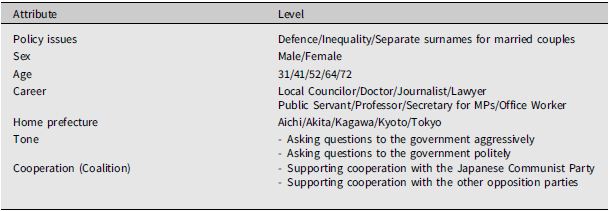
Attributes in the conjoint experiment

Table 1. Long description
A table with two columns: Attribute and Level. The table has 7 rows for attributes and their corresponding levels. Row 1: Policy issues, Defence/Inequality/Separate surnames for married couples. Row 2: Sex, Male/Female. Row 3: Age, 31/41/52/64/72. Row 4: Career, Local Councilor/Doctor/Journalist/Lawyer, Public Servant/Professor/Secretary for MPs/Office Worker. Row 5: Home prefecture, Aichi/Akita/Kagawa/Kyoto/Tokyo. Row 6: Tone, Asking questions to the government aggressively, Asking questions to the government politely, Supporting cooperation with the Japanese Communist Party, Supporting cooperation with the other opposition parties. Row 7: Cooperation (Coalition), Asking questions to the government aggressively, Asking questions to the government politely, Supporting cooperation with the Japanese Communist Party, Supporting cooperation with the other opposition parties.
While Horiuchi et al. (Reference Horiuchi, Smith and Yamamoto2018) and Kuriwaki et al. (Reference Kuriwaki, Horiuchi and Smith2025) explore the effects of policy packages and party labels on candidate favourability in Japanese politics, our outcome variables are the respondents’ perceptions of politicians’ ideological orientations. In addition, compared with Miwa et al. (Reference Miwa, Arami and Taniguchi2023), who examine Japanese voters’ perceptions of the left–right label, our experiment focused on the non-policy characteristics of politicians. As previously stated, when voters are susceptible to political information other than policy issues, their perception of politicians’ ideologies will be influenced by their strategies and other characteristics. Thus, we designed an experiment to detect the effects of non-policy behaviour and the characteristics of politicians.Footnote 8 Jang et al. (Reference Jang, Crabtree and Golder2022) examined the effects of the coalition signal on voters’ perceptions, but they mainly focused on centrist parties, such as Komeito and the Democratic Party for the People. This article compares cooperation with the JCP and cooperation with other moderate opposition parties. These are the main options for the centre-left party in Japan and the most realistic scenarios. Thus, we can examine the effects of these two coalition strategies.Footnote 9
4.1. Ideological labels in Japan
In the context of Japanese politics, considering the ideological labels other than the left–right dimension is important to understand the recent party competition. In particular, politicians present themselves by using several ideological labels, such as liberal and conservative, and citizens also label politicians by using ideological labels.
Political scientists often rely on the unidimensional ‘left–right’ scale to describe political competition (Benoit and Laver, Reference Benoit and Laver2012). Like political scientists, Japanese voters generally recognize this basic spatial anchoring, reliably placing the governing LDP, a centre-right party, and the Japanese Communist Party (JCP), a left-wing party, on opposite poles of the left-right dimension. However, in Japan, as in many other developed democracies, politicians and voters frequently utilize various ideological labels beyond this simple continuum. Particularly in Asia, political competition often unfolds along dimensions distinct from conventional Western axes.
Historically, the Japanese ideological landscape was defined by the ‘conservative’ versus ‘progressive’ cleavage during the Cold War (Kabashima and Takenaka, Reference Kabashima and Takenaka1996). However, as traditional cleavages weakened, the substantive meaning of these labels shifted. Recent studies indicate that younger voters tend to interpret these terms through the lens of everyday language rather than historical political dogma; ‘conservative’ is often perceived as maintaining the status quo, while ‘progressive’ is equated with innovation or a desire for reform (Jou and Endo, Reference Jou and Endo2016). Consequently, the progressive-conservative dimension in contemporary Japan may function more as a signal of one’s attitude towards institutional change than as a measure of traditional left-wing policy preferences.
Furthermore, in the post-Cold War era, centre-left politicians began strategically adopting the ‘liberal’ label to distance themselves from the socialist connotations associated with the ‘progressive’ brand (Jou and Endo, Reference Jou and Endo2016). While the term ‘liberal’ is intended to project an image of moderation, tolerance, and cultural openness, its interpretation remains complex and sometimes diverges from politicians’ intentions.
Given this political environment, relying solely on a single left–right scale risks masking crucial heterogeneities in how voters process these signals. Because labels such as ‘progressive’ (often connoting an anti-status quo stance) and ‘liberal’ (inherently associated with moderation) carry distinct everyday meanings in Japan, even though they are often used by politicians and citizens, the same confrontational behaviour can generate asymmetrical ideological evaluations. By examining these three labels independently, our experimental design provides the analytical leverage to capture how tactical behaviours interact with specific facets of political branding, thereby offering a more precise understanding of voter perceptions.
4.2. Conjoint experiment
Our research sample was recruited through Crowdworks, a Japanese cloud outsourcing service. The survey was conducted from 25 December 2024, to 7 January 2025.Footnote 10 The sample size for the experiment was 1,229.Footnote 11 The flow of the survey and the questionnaire are shown in Appendix (A7).
The politicians’ attributes are listed in Table 1. Respondents read the following hypothetical news article: ‘At yesterday’s Diet debates, [name] from the opposition party, A Party, said [policy] [tone]. This question was centred on the debates. The MP proposed “[coalition strategy]” in the debate within the party. He or she is from [prefecture] and [age]. After graduating from college, he or she became a [profession] and then ran for election from his or her hometown [prefecture]’. We manipulate the bold texts within the parentheses.
Our primary focus was on the tone of questions and cooperation with other parties, which corresponded to testing Hypothesis 1. These serve as non-policy cues for inferring political positions. Tone has two levels: aggressively or politely asking a question of the government. Asking a question aggressively represented an attack on the government; doing so politely represented cooperation. In general, the opposition parties use an aggressive language style, and government party members show cooperative attitudes using gentle and polite words. For example, in a polite tone, a politician says, ‘I would like to hear the Prime Minister’s opinion on the issue’, and in an aggressive tone, they say, ‘(That’s a problem!) What’s your opinion?’ Footnote 12 The coalition strategy has two levels: cooperation with the JCP and cooperation with other parties. The JCP is located on the left fringe of the ideological space; thus, agreeing to form a coalition with the JCP can be a heuristic for identifying left-leaning (liberal or progressive) politicians. The exact texts of the attribute levels are as follows: ‘our party should cooperate with other parties, including JCP’ (Supporting cooperation with the JCP) and ‘our party should cooperate with other opposition parties excluding the JCP’ (Supporting cooperation with the other opposition parties).Footnote 13
We selected policy issues traditionally associated with left-wing positions. The effects of these attributes were estimated within the left-leaning space. Including issues as attributes means we can assume that the effect of cooperation and attack behaviour is independent of the effect of issue positions.Footnote 14 Although the stimuli contain little policy information, these policy issues are important and salient in contemporary Japan. At a minimum, our design allows us to estimate the average effects of tone and coalition strategies conditional on the policy information presented to respondents. Attributes of age and locality (home prefectures) were chosen in a representative manner: Tokyo and Aichi are urban areas, Akita and Kagawa are rural areas, and Kyoto is an in-between area. Career attribute levels correspond to the occupational background hypothesis: professors, doctors, journalists, and lawyers are professional occupations. Gender is manipulated through politicians’ names that are typically perceived as male or female.
4.3. Estimation strategy
We used the following linear regression specification to estimate average marginal component effects (AMCEs) and standard errors clustered at the respondent level:
 ${y_{ijk}} = {X_{ijk}}\beta + {\varepsilon _{ijk}},$
where y ijk is a dummy variable representing respondent i’s response in the jth task for profile k, X ijk is a vector of attributes, and ϵ ijk is a disturbance term. y ijk takes the value 1 if respondents indicate that profile k is left (liberal or progressive), and 0 otherwise. Here, i = 1,2, ···, N, j = 1,2, ···,8, k = 1,2 index respondents, tasks, and profiles within each task, respectively. Our quantity of interest is β, a vector of estimated AMCEs. Standard errors are clustered at the respondent level.
While recent literature recommends correcting for multiple hypothesis testing (Liu and Shiraito, Reference Liu and Shiraito2023), we do not apply any correction, as our main hypothesis of interest is a single one. We show the results with the adaptive shrinkage (Ash) correction in Figure A2, and the main results do not change.Footnote 15
4.4. Measured covariates
To examine the heterogeneity of perceptions, we measured several demographic and political attitude covariates: sophistication (knowledge), self-identified ideology, and gender. These variables, except for knowledge, were measured prior to the experimental part of the survey. The original Japanese and English versions of the survey instruments are shown in Appendix A7.
5. Results
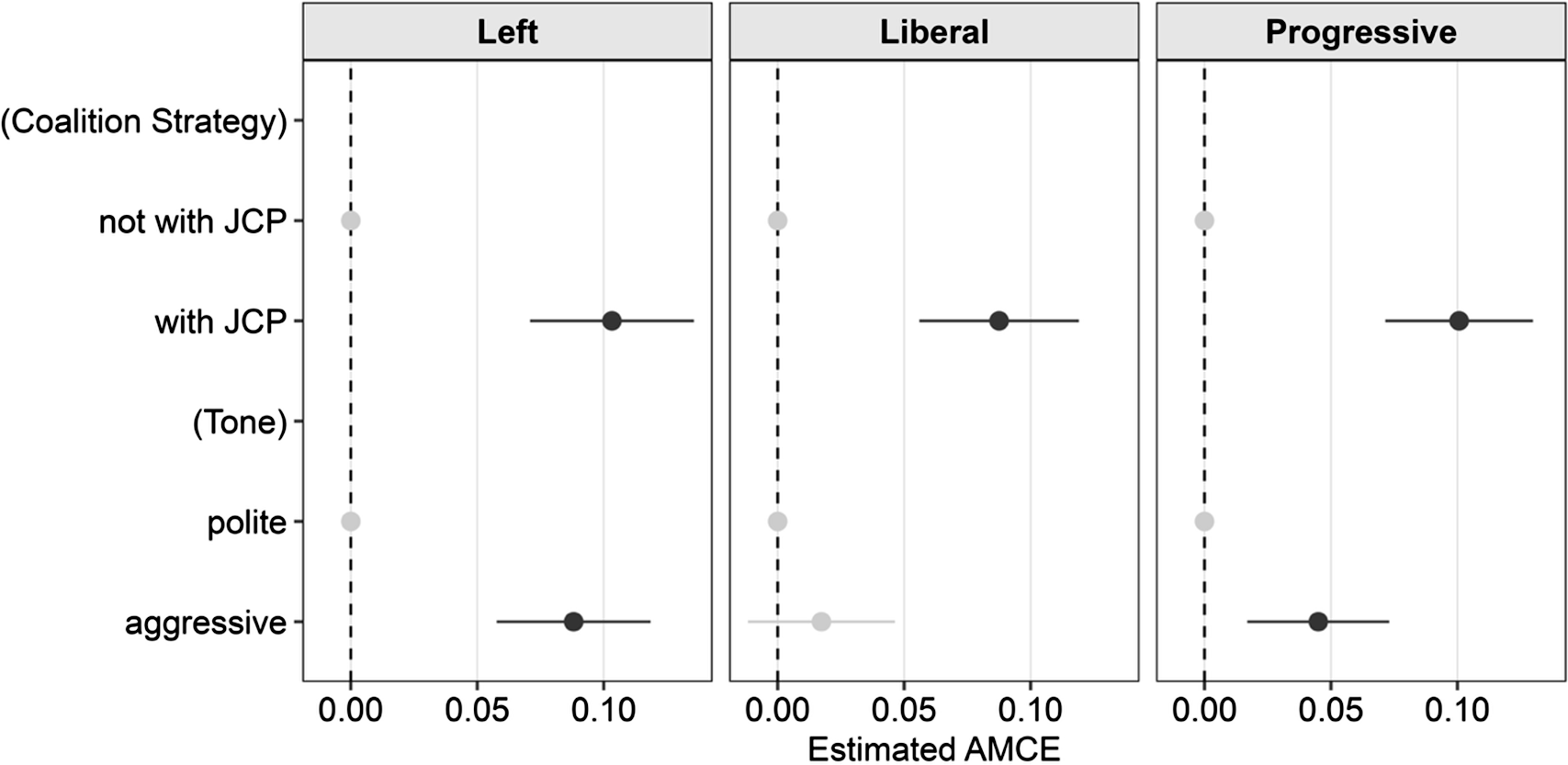
Figure 2 shows the estimated AMCEs with the confidence intervals. Each panel corresponds to one of the dependent variables: left, liberal, or progressive. The figure shows point estimates of each attribute (the points) and their confidence intervals (black bars). Black dots indicate coefficients that are statistically significant at the conventional 5% level, while gray dots indicate non-significant results. The vertical axis lists the attributes and their levels with attribute names shown in parentheses. As AMCEs are the differences from the baseline level of the attribute, points without confidence intervals represent the baseline level. In these cases, each point shows the difference from the baseline.
Estimated AMCEs: the attributes are shown in the vertical axis attribute names are shown in parentheses and levels are shown below the attribute names. Statistically significant results are shown as black points, and grey points are not statistically significant at the 5% level.

The left panel of Figure 2 shows the results when the outcome variable is the respondents’ choice of a candidate seen as left-leaning. We can see the positive and significant coefficients indicating cooperation with JCP and asking questions aggressively affect respondents’ perceptions of which politicians are left-leaning, compared to the baseline – namely, not cooperating with JCP and asking questions politely. In other words, respondents perceived a politician who questioned the government aggressively and cooperated with the JCP as leftist even when the politician raised the same political issue. In the left–right dimension, our expectations were confirmed: voters used interactions between parties to infer a party’s position in the left–right dimension.
The central panel of Figure 2 shows the results for the liberal label. Respondents used coalition strategies with the JCP to infer politicians’ liberal political stances. In contrast to the leftist condition, the respondents did not associate an aggressive questioning style with liberal politicians. This may reflect the perception that ‘liberal’ is associated with tolerance; voters may not view a liberal politician as someone who attacks others. The right panel shows the results for the progressive label. As with the left label, cooperation with the JCP and the tone of questions are heuristics for inferring the progressive label.
Overall, the results are consistent with H1. Confrontation with the government can give voters the impression of a left-wing politician. However, confrontation does not affect the perception of liberal politicians. For respondents, the left-wing and progressive labels were considered hostile. Cooperation with a left-wing party on the fringe of the issue space gives voters an impression of a left-leaning (liberal or progressive) politician, regardless of policy issues.
As a robustness check, we estimated AMCEs after excluding satisficers (Figure A1). The results are broadly consistent with the main analysis, although the effect of tone for the progressive label is no longer statistically significant when satisficers are excluded and Ash correction is applied.Footnote 16
The full results, including other attributes, are shown in Figure A2 in the Supplementary Materials. Regarding policy issues, the selective system of separate surnames for married couples influenced respondents’ choice of liberal labels. As with the liberal label, the issue of separate surnames for married couples affects the likelihood of choosing the progressive label. The progressive label appears to be understood in the way the word ‘progressive’ (kakushin) is used in everyday language. Engagement in cultural and gender-related issues can be viewed as an effort to reform the status quo. Most other attributes, such as locality, professional occupational background, and gender, did not show significant coefficients for any of the dependent variables after p-values adjustment (Figure A3). Voters did not use these characteristics as heuristics to infer politicians’ ideological positions.
Advocating for a selective system of separate surnames for married couples is considered more liberal and progressive than dealing with the defence issue. This may suggest that cultural issues could become important in Japan.Footnote 17 By contrast, locality and occupation do not show significant effects; unlike in Europe and the US, the cultural dimension in Japan may not be aligned with urban–rural conflicts and the post-industrial economy. Nevertheless, given the nature of the conjoint experiment, several pathways of the effects could be blocked (Dafoe et al., Reference Dafoe, Zhang and Caughey2018). In other words, since we specify the policy issues in the experiment, the pathways by which respondents infer specific policy orientations from politicians’ attributes, including gender, profession, and locality, are not testable. More specifically, voters may consider female politicians more likely to support gender issues, but our research design cannot determine such mechanisms.
5.1. Heterogeneity
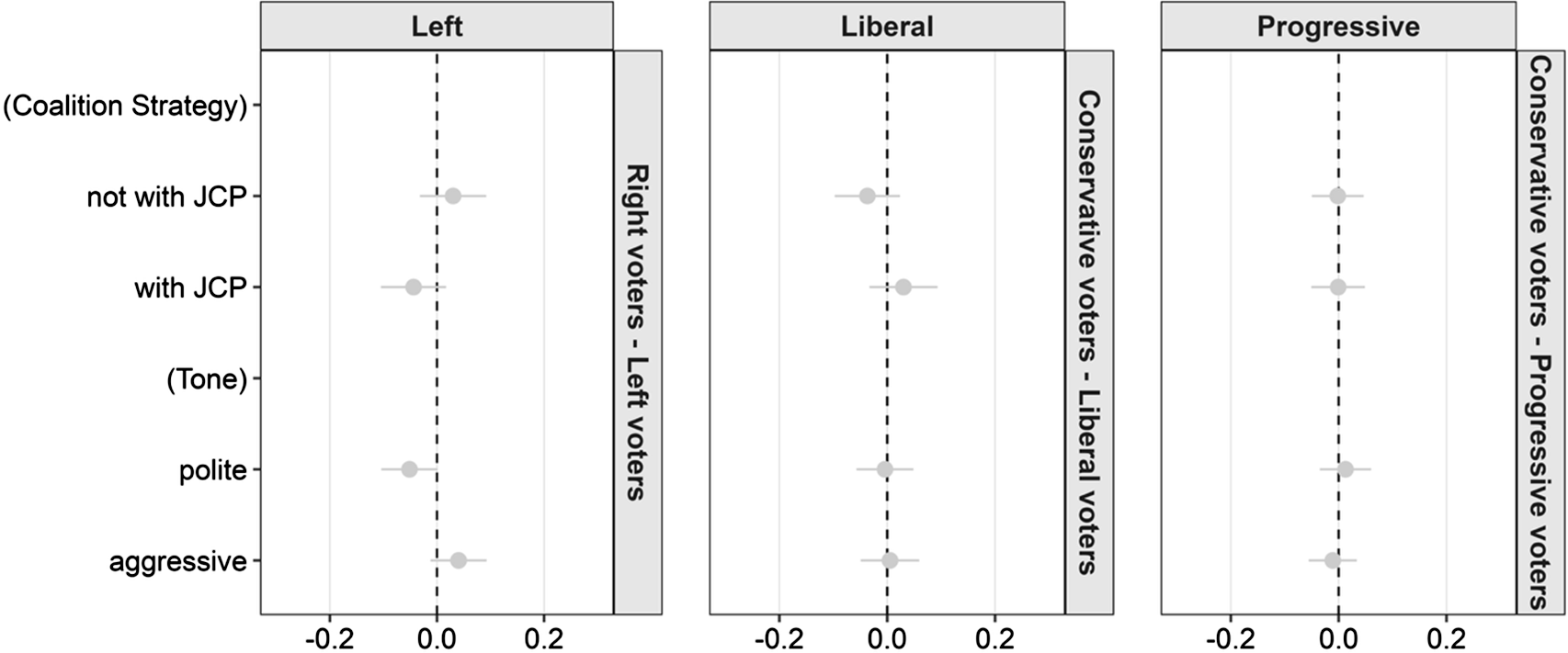
We explored the heterogeneous effects of attributes on perceived ideology, according to voters’ demographic characteristics.Footnote 18 Figure 3 shows the differences in the marginal means between self-identified left- and right-leaning respondents (liberals and conservatives, or progressives and conservatives).Footnote 19 Figure 3 presents the differences in marginal means between the two groups.Footnote 20 Thus, a negative sign indicates larger marginal means for self-identified left-leaning (liberal or progressive) respondents than for right-leaning (conservative) respondents; a positive sign indicates higher marginal means for self-identified right-leaning or conservative respondents than for left-leaning (liberal or progressive) respondents.
Heterogeneity conditional on self-identified Ideology. Each point and bar represents a difference in marginal means estimated from the data. Black points indicate statistically significant at the 5% level.

Regarding Hypothesis 1, the effects of cooperation with the JCP and the tone of questioning were insignificant. In other words, we did not find evidence of heterogeneous perceptions between self-identified left- and right-leaning (liberal and conservative, or progressive and conservative) with respect to politicians’ behaviour. This suggests that the overall effects are not driven by ideological heterogeneity; rather, the effects are universal across all ideological respondents. For self-identified progressives, raising the issue of inequality is a factor in viewing a politician, who may be keenly responsive to economic inequality, as progressive.
6. Conclusion
This study examined the effects of non-policy attributes on Japanese voters’ perceptions of ideological labels. According to our results, voters infer politicians’ ideological positions from their non-policy behaviour. In particular, coalition strategies and confrontations with the government serve as cues for inferring politicians’ ideological labels. In short, voters infer politicians’ ideologies from their behaviour. When politicians and parties try to persuade voters, they must not only send policy-related messages but also show their attitudes and behaviours towards other parties. This finding implies that opposition parties may be seen as more extreme based on their behaviour rather than their actual policy positions.
Furthermore, existing experimental research has primarily focused on voters’ inferences about the ideology of ordinary individuals. For example, Ogura et al. (Reference Ogura, Miwa and Iida2022) conducted a similar experiment in which voters were asked to identify partisanship (Democrat or Republican). Research on political stereotypes also suggests that voters may infer other people’s ideologies from their apolitical characteristics (Scaduto and Negri, Reference Scaduto and Negri2024). Although Hiaeshutter-Rice et al. (Reference Hiaeshutter-Rice, Neuner and Soroka2023) examined US voters’ perceptions of candidates’ partisanship in the context of cultural cues, our study contributes by examining how voters infer politicians’ ideologies outside the US context.
We also examined voters’ perceptions of multiple labels, rather than focusing only on the left–right dimension. Recently, the second dimension, or the cultural issue, has become important, making it important to consider ideological labels other than the left–right dimension. Centre-left parties have relied on middle-class bases (Gingrich and Häusermann, Reference Gingrich and Häusermann2015) and are ‘culturally liberal and progressive’. From a comparative perspective, examining the different labels assigned to left-wing parties could contribute to the literature on the decline of social democracy in Europe. In future research, we aim to uncover associations between issues and different ideological labels. For example, ‘conservative’ is preferred by US citizens (Ellis and Stimson, Reference Ellis and Stimson2012; Grossmann and Hopkins, Reference Grossmann and Hopkins2016), while ‘liberal’ and ‘progressive’ are often seen as everyday adjectives rather than political terms (Jou and Endo, Reference Jou and Endo2016). ‘Liberal’ is associated with tolerance in its original sense (Freeden, Reference Freeden2015), but it does not correspond to a left-leaning position; ‘progressive’ is also seen as innovative.
Our findings have implications for real-world situations. Cooperation with a party on the fringe also increases perceptions of radicalism, even when the party’s actual position is moderate. The difficulty faced by the Japanese centre-left party can be attributed to its behaviour. While dismissive, accommodative, and adversarial strategies may be beneficial in policy competition (Meguid, Reference Meguid2005), attitudes towards political communication could offset these advantages. Attacking the government and cooperating with other parties may shift perceptions of a party’s ‘objective’ positions to perceived extreme positions. This creates another dilemma: opposition parties that do not have electoral and governmental coalition strategies often fail to win against the LDP because of the MMM nature of the electoral system.
Our research has several limitations. First, there is a slight discrepancy between the target and the executed experiment: we indirectly address voters’ perceptions of political parties because our experimental design focuses on individual politicians. Although our design is valid for the inference of party images when voters infer them from the debates in Parliament, future research should directly examine party images themselves. Second, our research only focuses on perceptions of politicians who advocate left-leaning policies. The estimated effects are not independent of policy information; rather, the effects are conditional on left-leaning policies. Citizens’ perceptions of right-wing politicians are unclear. Our research shows that ‘objective left-leaning’ parties can appear more left-leaning by using an aggressive tone and proposing a coalition with the JCP. While our results suggest a dilemma for the centre-left party in Japan, their generalizability to other parties with different policy spaces remains unclear. In future research, we should consider additional policy information, such as advocacy for constitutional revision, to better understand the effects on right-leaning policy issues. Considering the emergence of a radical right-wing populist party in Japan, future research should address parties that criticize the government from the right. Additionally, using other designs, such as grading profiles, may be useful for testing whether the effects are symmetric across the ideological spectrum.
Supplementary material
The supplementary material for this article can be found at https://doi.org/10.1017/S1468109926100449.
Data availability statement
The data are available on the JJPS dataverse at https://doi.org/10.7910/DVN/IXR2EO.
Acknowledgements
This paper was presented at the Association for Asian Studies Annual Conference 2025 and the workshop held at Kyoto University. We appreciate constructive comments from Hilary Holbrow, Takuto Imoto, Yo Nonoyama, Hanako Ohmura, Taka Suzuki, and Kristin Vekasi, as well as from three anonymous reviewers. We used Gemini 3.1 Pro and ChatGPT 5.5 and 5.6 for language editing and translation of survey items. This work was supported by JSPS KAKENHI grant numbers 23K12403, 26K04718, 22J01427, 25K16548, and 22J21283 and by Nomura Foundation (N25-2-L40-013).
Competing interests
There are no competing interests.
Ethical statement
This study was approved by the Institutional Review Board of Kyoto University. The approval number is R6-006. We obtained consent from participants, and the data were collected anonymously.



 Open access

