


Two defining tenets of constitutionalism in the US are that (i) there are relatively entrenched limits on the legislative powers of governmentFootnote 1 and (ii) specific laws can be voided for violating these limits. Judicial review, a preeminent aspect of constitutionalism in the US today, rests on these premises.Footnote 2
Scholars have long recognized that, though it affirmed constitutionalism in the sense of these two tenets, the framing of the US Constitution in 1787 was not the origin of this doctrine in America (McLaughlin Reference McLaughlin1932). Though framing debates make some references to constitutional review of legislation,Footnote 3 they make no pretense to having invented it [nor does the celebrated case of Marbury v. Madison (1803)]. The colonial governments prior to American independence also did not develop these two tenets of American constitutionalism. No colony empowered a court or other body (outside the assembly itself) to review or invalidate statutes relative to colonial charters before independence (Ciepley Reference Ciepley2017; Treanor Reference Treanor2005).Footnote 4
Common arguments about the origins of political institutions in America, and particularly limited government, look to early modern English practice. It is sometimes argued that the English imported key institutions with them to America (e.g., North Reference North1990). Yet neither judicial review nor entrenched limits on legislative power were or are important elements of British constitutionalism, where parliamentary supremacy has held since at least 1,688, and royal prerogative before that. At the time of their inception in the US, no similar constraints operated on the British Parliament.Footnote 5
If constitutional review and external limits on legislation did not originate with the US Constitution, colonial American constitutions, the English Constitution, or the inherent nature of common law, where did they originate? Legal historians have focused on the British imperial constitution—or what Mary Sarah Bilder (Reference Bilder2004) has called “the Transatlantic Constitution” (cf. Greene Reference Greene1963). Under this constitution, colonial assemblies, unlike Parliament, exercised powers pursuant to grants by the Crown. The Crown’s basic problem was to ensure that colonial enactments were beneficial, and not harmful, to the interests of the Crown and empire. To this end, colonial legislation was reviewed by the Crown’s agents, the Board of Trade, and Privy Council in London.
Review was officially rationalized in colonial charters and gubernatorial commissions as legal evaluation for “repugnancy to the laws of England,” including the colony’s own charter (Greene Reference Greene1898). But inevitably, legal evaluation for repugnancy bled into substantive evaluation. Variances from English law could be tolerated as beneficial “divergences,” if local conditions called for them (Bilder Reference Bilder2004). This legislative review was the first exposure of Americans as colonists to externally enforced legal limits on legislative power. Accordingly, historians have identified review by the crown-in-council as the forerunner of the contemporary American practice of constitutional review (Bilder Reference Bilder2004, Reference Bilder2006; Ciepley Reference Ciepley2017; McGovney Reference McGovney1944; Russell Reference Russell1915).Footnote 6
In this paper, I develop a formal model to argue that this forerunner of modern constitutional review emerged from efforts of the British Crown to grapple with an agency problem in imperial governance.Footnote 7 In this model, colonial legislation varies in both substantive quality and “repugnancy to the laws of England.” The Crown wishes to pass “repugnant” legislation only if its substantive value is high (Bilder Reference Bilder2004). The colonial governor—an agent of the Crown in the colony—observes private information about substantive quality (Greene Reference Greene1898; Simpson Reference Simpson1911), and can veto or approve the legislation. Following governor’s approval, the Crown can review the legislation. Review is costly, but may reveal the law’s substantive merits. Based on this information and the observed repugnancy to English law, the Crown may affirm or reverse. If the Crown discovers that the governor approved a substantively bad law, the Crown sanctions the governor (Russell Reference Russell1915).
Colonial assemblies subjected governors to immense pressure to approve legislation, regardless of the metropolitan view of its substantive merits (Greene Reference Greene1963); thus, the governor incurs assembly sanctions for any veto. This generates the agency problem between the Crown and governor: the latter prefers to approve all laws unless it faces the discipline of review. But review is a costly and less informative means for the Crown to discover a law’s merits.
The model provides three major insights about British imperial legislative review. First, a standard finding from hierarchical auditing models (Cameron, Segal, and Songer Reference Cameron, Segal and Songer2000): the governor’s veto decisions never perfectly track the Crown’s interest, because assembly sanctions induce the governor to prefer passing all legislation. However, the threat of Crown legislative review induces the governor sometimes (but not always) to veto substantively bad legislation.
Second, even though the governor does not intrinsically care about legal consistency or “repugnancy,” veto decisions respond to it. In many cases, the governor is more discriminating about substantive quality when a bill is legally inconsistent. Thus, legal review for “repugnancy” can improve the substantive quality of colonial legislation from the Crown’s perspective.Footnote 8
Third, a key determinant of legislative review is the salience that Crown reviewers attach to legal consistency. Increased salience can make the Crown more likely to review laws in depth, which is why the governor restrains approval of substantively undesirable ones. Thus, it improves the substantive quality of colonial law—to a point. If legal consistency is too important, Crown reviewers are so skeptical of colonial laws that they reject them all out of hand, and the governor faces no review discipline. Put differently, in order for review discipline to affect legislative quality, the Crown must necessarily risk some approval of undesirable laws.
To build my argument, I adapt canonical models of ex post review in hierarchies (especially Cameron, Segal, and Songer Reference Cameron, Segal and Songer2000) to the substantive conditions of British imperial governance.Footnote 9 The major differences between my model and theirs (and others in this literature) lie in the payoffs of the players and the extensive form.Footnote 10 First, in my model, the Crown cares about two dimensions of policy (substantive merit and legal consistency), but the governor only cares intrinsically about the former. Second, I assume that governors face pressure from the colonial assembly below for vetoing any policy, but from the Crown above only for approving policies that are undesirable based on their private information. Thus, the governor in my model is not unconditionally reversal-averse.Footnote 11 In addition, the governor cares not only about the outcome of policy but also about who is responsible for it: a veto by the crown does not generate conflict with the assembly, whereas veto by the governor does. Third, in terms of the extensive form, I assume the Crown can sometimes summarily reject policy without review.Footnote 12 I explain the substantive rationale for each of these elements of my model below, after presenting the formalities.
After building the formal model, I discuss the legacy of Crown legislative review for early American thinking about constitutional review. In combination, the model and historical discussion show that a strategic problem in British imperial governance affected the emergence of one of the linchpins of modern constitutionalism. This is important because judicial review is not only a crucial part of the American policy making process but, based in part on the American practice, also has become a key element of the vast majority of constitutional governments in the world (Ginsburg Reference Ginsburg, Whittington, Keleman and Caldeira2008). It is particularly interesting and somewhat ironic that these practices took root in America as attempts by an extractive empire (McCusker and Menard Reference McCusker and Menard1985) to assert control over its periphery. Left as the debris of that empire dismantled, they became building blocks of a new and limited state.
The rest of the paper is organized as follows. In the next section, I review major practices and patterns of legislative review in the first British Empire. Then, I lay out and analyze the formal model, with key results on the disciplining effect of Crown review on the governor. Following this, I discuss the historical legacy of Privy Council legislative review in the early US, particularly the role of this model in shaping proposals for constitutional review at the Constitutional Convention. I conclude with a summary and suggestions for future research.
CROWN REVIEW OF COLONIAL LEGISLATION
As England’s New World colonies (and domestic politics) stabilized in the seventeenth century, institutions emerged in London to monitor and oversee the colonies pursuant to the metropole’s interest. From 1696 to 1791, these duties were shared by the Board of Trade (formally, “Lords Committee of Trade and Plantations”) and the royal Privy Council. The Board included both members of Parliament and the crown’s inner circle of advisors, and focused entirely on colonial matters. The Privy Council comprised the crown’s senior ministers, and in conjunction with the crown itself, formed the kingdom’s central policy-making body.
One of the most important duties of the Board and Privy Council in colonial oversight was review of legislation (Dickerson Reference Dickerson1912). All laws originating in royal colonies were subject to this review upon passage, under charter or commission provisions preventing “repugnancy to the laws of England.” Most of the roughly 8,500 laws passed by future US states during the colonial period were subject to legislative review, with about 500 invalidated by metropolitan authorities in this way (Simpson Reference Simpson1911).Footnote 13
In this process, the Board took first-cut review of colonial laws and issued advisory opinions to the Privy Council, which in turn made a legally binding disposition in the crown’s name. Formal dispositions were communicated to the colony, along with reasons for nullification if applicable. The whole process typically took 1–2 years and sometimes more (Simpson Reference Simpson1911). In practice, the Privy Council almost always followed the Board’s advice (Dickerson Reference Dickerson1912), but most colonial laws were in fact not formally reviewed at all, and instead were left to “lie by,” thus taking effect in the colony without formal approval (Russell Reference Russell1915).Footnote 14 One reason for this is that the Board, and especially Privy Council, were frequently occupied with pressing issues of domestic and imperial politics, and full review of colonial legislation consumed precious time (Dickerson Reference Dickerson1912). In short, review entailed an opportunity cost for the Board and Privy Council.
In legislative review, the Privy Council was a fully political body, open to a panoply of maneuvers including public contestation, petitioning, and lobbying from colonial agents (Carpenter Reference Carpenter2016). This aspect of the Privy Council emerged in the late Stuart period, when legislative review began, and was a marked departure from the suppressive “culture of secrecy” that enveloped the Privy Council (and its closely affiliated body, the Star Chamber) to 1,641 (Zaret Reference Zaret2000). This has important implications for the nature of the review process modeled in the colonies, and the historical contingency in the legacy of Privy Council review for American constitutionalism.Footnote 15 Colonies subject to review by earlier, suppressive incarnations of the Privy Council might not have seen the process as a suitable model for legislative review in a republic. If this is so, then it is crucial that legislative review was executed by the late Stuart Privy Council after its substantial evolution from the Tudor and early Stuart predecessors (cf. Pollard Reference Pollard1923).Footnote 16
Review of colonial legislation in the Board and Privy Council was based on both legal and substantive considerations (Russell Reference Russell1915). The central formula in legislative review was to prevent “repugnancy to the laws of England”—a condition prohibited in every colonial charter or commission—but also to permit salutary “divergences” to address particular situations within a colony (McGovney Reference McGovney1944). This formula required assessment of a colonial law both in terms of its legal position within English law, and the substantive conditions in the colony motivating it. Legal inconsistency could be tolerated, if substantive conditions in the colony rationalizing a law were sufficiently important (Bilder Reference Bilder2004).
For example, colonies were typically starved for cash as a result of mercantilist trade policies. Yet colonial legislation issuing bills of credit was repeatedly nullified by the Privy Council on the grounds of their prohibition in English law; the Crown viewed trade imbalances as a policy goal. However, in times of war, colonial militias required supply, which was provided by colonial legislatures from internal taxes, and colonial credit was often the only way to sustain it. Accordingly, in these circumstances, the Privy Council allowed colonial credit bills to lie by (Russell Reference Russell1915).
Another illustration comes from colonial inheritance law. With land much more plentiful than in England, numerous colonies provided for equal division of land among heirs if an estate holder passed intestate. Metropolitan authorities repeatedly and summarily rejected these laws as contrary to the English custom of primogeniture. After decades of effort by colonial lawyers and lobbyists, the Board and Privy Council recognized that land availability in the colonies rationalized equal division inheritance despite its inconsistency with English law (Bilder Reference Bilder2004; Smith Reference Smith1950).Footnote 17 Thus, colonial legislation at variance with English law was accepted by the Board and Privy Council because of substantive conditions in the colonies.
The crucial assumption behind review for “repugnancy and divergence” was that several organs of law—the laws of England, broadly construed; the charter of the colony itself; the colonial governor’s public commission; and the policy of the empire with respect to trade—took precedence over colonial legislative acts, and thus limited the powers of colonial assemblies. The Privy Council sometimes found these limits (substantive and procedural) in colonial charters, imbuing them with a similar function as a modern American constitution. For example, a Connecticut law against “Hereticks,” which caused issue for Quakers, was invalidated as “contrary to the Liberty of Conscience Indulged to Dissenters by the Charter granted to the Colony” (Russell Reference Russell1915, 148). A New York law granting residents preferential access to fisheries was invalidated as inconsistent with its charter provision that “no subject of England should be debarred from fishing on the sea coast” (ibid.). Several Maryland laws, passed in the absence of a governor or acting governor, were invalidated as contrary to the procedural forms prescribed in its charter (ibid., 145).
Other limits were found in a broad construction of English law and custom. Thus, various colonial laws prescribing excessive and unusual punishments (such as physical dismemberment or death) for minor crimes or crimes against Mosaic law were nullified in Privy Council on the grounds that such severe penalties “were never inflicted by any law in His Majesty’s dominions” and were “contrary to reason and the custom of the Kingdom” (ibid., 144).Footnote 18
Thus, unlike England’s Parliament, the American colonial assemblies were limited and subject to external legal review from the beginning. In this way, a limit on legislative authority provided by specific, entrenched sources (including written documents) was built in to the American colonists’ legislative tradition. This limit is the cornerstone of constitutional review in America, and is unlike any limit operating on the parliament of Britain then or now.
The colonial governor, who was supervised by the Board of Trade, also played an important role in review of colonial legislation. Governors exercised veto power over enactments of colonial assemblies. The crown depended on governors not so much for authority in law, which was in abundant supply on the Board and Privy Council (Simpson Reference Simpson1911). Rather, governors were crucial because they were informed about substantive conditions within the colonies that might rationalize colonial laws (Greene Reference Greene1898). It was both costly and less effective for investigation of these conditions to occur in the distant metropole.
However, the colonial assemblies often had their own designs, and not much concern for repugnancy to the laws of England when colonial conditions called for divergence (Bilder Reference Bilder2004). The assemblies thus exerted great pressure on governors to pass laws they desired, notwithstanding contrary instructions from the Crown (Greene Reference Greene1898). For example, assemblies would withhold the governor’s salary (which it was their obligation to pay) or refuse to pass military supply bills until the governor complied with their wishes (Greene Reference Greene1898, Greene Reference Greene1963).
The Privy Council could apply more significant sanctions, from censure to recall and loss of future opportunities for office, for governors that passed laws clearly detrimental to the empire’s interests (Greene Reference Greene1898).Footnote 19 The Crown’s sanctions were potent, and violations leading to removal were rare. But applying them required Board and Privy Council review to discover a transgression by the governor.
This review discipline often induced governors to veto legislation demanded by the assembly but contrary to the Crown’s interests. Against assembly pressure to pass laws the governor knew the Crown would reject, the governor might “refer to his instructions prohibiting such action, and refuse to pass the desired bill” (Greene Reference Greene1898, 165). Simpson (Reference Simpson1911, 56) summarizes the strategic effect of anticipated legislative review on colonial governors:
The effect which the royal disallowance had upon the colonial governors was very great. The scrutiny with which they inspected colonial laws before signing must have been considerably increased by the knowledge that the matter would be carefully thrashed out by the Board of Trade and they held responsible. Thus, a very considerable indirect influence was exercised over colonial legislation.
On the other hand, governors knew that they might conceal objectionable provisions, and the crown might not review the legislation in any depth, so that the Crown frequently took “no opportunity whatever to pass upon the legislation of a provincial assembly” (Greene Reference Greene1898, 165). Knowledge of this in turn induced governors to approve objectionable legislation in the face of assembly pressure: “the royal restrictions upon the governor’s power to assent to provincial legislation were by no means universally observed, and they often proved ineffective against a strong popular sentiment” (ibid.).
In summary, both the assembly below and the Crown above applied intense pressure on governors to follow their interests in disposing legislation. The Crown’s repugnancy review emboldened the governor to resist the assembly, by raising the chance they would detect capitulation. But this detection was by no means certain. Thus, Governors sometimes bowed to assembly pressure. To show how these patterns interrelate and depend on review for legal repugnancy, I next develop a formal model that reproduces them in equilibrium.
A MODEL OF LEGISLATION AND REVIEW
This section lays out the model of Crown legislative review as an extensive form game. I first present a sparse description of the formalities, and then discuss their substantive interpretation.
Formal Definition
There are two players, the governor G and the Crown C. The colonial assembly A is left implicit and its strategic behavior is not considered here. Assume that A has enacted a policy a = 1; the issue is whether G and C should maintain it, or revert to a status quo a = 0.
There are two dimensions or attributes of policy a = 1, denoted Δ1 ∈ {−1, 1} and Δ2 ∈ {−1, 1}. Here, Δ1 represents the substantive merits of the policy and Δ2 captures broader, imperial-level legal considerations, such as “repugnancy to the laws of England.” Assume that Pr[Δ1 = 1] = δ ∈ (0, 1); its realization is observed by G but only its distribution is known by C. Assume that Δ2 is drawn and fixed at the start of the game and observed by all players. Implicitly, a = 1 is judged relative to a = 0.
The sequence of play is as follows; the full extensive form is depicted in Figure 1. Assume all random variables are statistically independent.
0. Nature draws Δ1, Δ2 for a = 1 and reveals the results as specified above.
1. G upholds (x G = 1) or vetoes (x G = 0).
(a) If G upholds, on to next step.
(b) If G vetoes, a = 1 is rejected, game ends, G is sanctioned κ A by A.
2. If G upholds, C can review (r = 1) or not (r = 0) at cost γ, and learns Δ1 with probability λ.
(a) If Δ2 = −1, or review is informative (Λ = 1), on to next step.
(b) If Δ2 = 1, and either review is uninformative (Λ = 0), or no review is performed (r = 0), a = 1 stands, game ends.
3. C upholds (x C = 1) or vetoes (x C = 0). If review is performed (r = 1), and is informative (Λ = 1), and Δ1 = −1, G is sanctioned κ C by C.
Extensive Form. Nature’s Moves From Root Node Denote (Δ1, Δ2)

C’s review is a function of Δ2, which C observes; it is informative about Δ1. Let Λ ∈ {0, 1} denote whether C learns Δ1, given that review is performed; then Pr[Λ = 1] = λ.
Also, note that a veto by C requires either informative review about Δ1 or legal inconsistency Δ2 = −1. That is, C cannot reject a = 1 without some hard information against it. This is discussed further below.
Let x ∈ {0, 1} denote the colonial policy chosen in this extensive form. If min{x G, x C} = 0, then x = 0; otherwise, x = 1. Let σ ∈ (0, 1) capture the salience of legal relative to substantive issues for C. Ex post utilities are:
 $${U_C} = \left( {{\Delta _1} + \sigma \left( {{{{\Delta _2} - 1} \over 2}} \right)} \right)x - r\gamma ,$$
 $${U_G} = {\Delta _1}x - {x_G}r\Lambda \left( {{{1 - {\Delta _1}} \over 2}} \right){\kappa _C} - \left( {1 - {x_G}} \right){\kappa _A}.$$
Thus, the Crown’s utility is composed of policy payoffs and review costs. When a = 1 is upheld, C obtains utility Δ1 − rγ if Δ2 = 1 (legal consistency of a = 1); and obtains Δ1 − σ − rγ if Δ2 = −1 (legal inconsistency of a = 1).Footnote 20
The governor’s utility is composed of policy payoffs and sanction costs from the Crown or assembly. If G upholds a = 1 (so x G = 1), G incurs a sanction κ C if the Crown reviews the policy, the review is informative, and the policy is substantively undesirable (Δ1 = −1). If G vetoes a = 1 (so x G = 0), G incurs a sanction κ A from the colonial assembly with certainty.
Substantive Discussion
Dimensions of Policy and Information
The substantive dimension Δ1 works as a “state of the world” in typical models of policy making with uncertainty. I assume that, as actors on the ground in the colony, the assembly and governor were better informed than the Crown’s reviewers (Board of Trade and Privy Council) about local conditions and the importance of a given assembly act in light of them (Greene Reference Greene1898; Olson Reference Olson1992). The Crown could acquire information on such factors, but it would take some time, and being filtered through the perspective of other actors such as colonial agents and merchant interest groups (Dickerson Reference Dickerson1912; Russell Reference Russell1915), the information was of uncertain quality. Assuming λ < 1 (probability that C learns Δ1 in review) implies that, even if higher level review is costless (γ = 0), the governor is a better channel of information than Board and Privy Council investigations—if he can be relied on to provide it.Footnote 21
Legal consistency is captured by the second dimension, Δ2. I assume that the Board of Trade and Privy Council had relatively easy access to legal judgments on such considerations (Dickerson Reference Dickerson1912; Simpson Reference Simpson1911), and could share them with governors through instructions and circulars (Labaree Reference Labaree1930). Thus, this attribute is common knowledge.
Legal inconsistency carries a cost σ ∈ (0, 1) for the Crown. This captures that legal inconsistency in the colonies made the empire harder to govern from the center (Russell Reference Russell1915). Reviewing for “repugnancy to the laws of England” ensured that colonies could not use local enactments to evade acts of Parliament (such as the Navigation Acts and trade laws), negate their own charter provisions, or diverge from longstanding English customs (e.g., by enacting strict Mosaic criminal codes). Easy allowance of such laws would have rendered Parliamentary law and colonial charters operable in the colonies only at their own discretion, thus negating the purpose of a charter as a contract between the Crown and colonists or of Parliamentary law as a central coordinating device in the empire. The cost σ captures the tradeoff between local benefits and centralized governance costs of such repugnancy in a tractable, reduced form manner. The Crown and its advisors, but not the governor, were responsible for centralized governance (Greene Reference Greene1898),Footnote 22 so the Crown and advisors, and not the governor, internalize the cost of legal inconsistency.Footnote 23
With σ ∈ (0, 1), the cost of legal inconsistency is always outweighed by high substantive merit, but never by low substantive merit. For example, in time of war, a colonial paper money bill that allows purchase of militia supplies may be very important—even if inconsistent with the laws of England. In this case, the salience of Δ2 is low. But in time of peace, the substantive merit of such a measure is low, so its inconsistency with English law regulating currency looms larger in imperial calculations.
Extensive Form
The extensive form is based on several key institutionalized practices of imperial British governance. First, veto by the Governor ends the game. Instructions required governors only to send approved laws to England for review (Labaree Reference Labaree1930). Veto by the governor prompted no further review.Footnote 24
Second, Crown authorities can nullify a law passed by the governor only with some reason based on that law itself. The reasons are (i) poor substantive merit (Δ1 = −1) and (ii) repugnancy to the laws of England (Δ2 = −1). Thus, the Crown can summarily reject a law without learning Δ1 only if it is legally inconsistent. This assumption reflects the fact that autocratic modes of governance had been rejected by the late Stuart and Hanover periods, as noted above. Summary rejection without any reason is by definition an arbitrary act of suppression. This is not to say that the Privy Council had to explain its reasons to the assemblies (its explanations were usually terse), but it did have to have reasons in view of inevitable public debate and scrutiny.
Sanctions on the Governor
The governor faces a possibility of sanctions inflicted by either the assembly (κ A) or the crown (κ C). The historically interesting cases involve sanction costs κ C > κ A > 1. In this case, Assembly and Privy Council sanctions are strong enough to affect the Governor’s veto decisions.
Assembly sanctions are meted out whenever the governor vetoes a bill. This reflects the widespread practice of colonial assemblies to withhold salary payments and other benefits from governors who did not sign their preferred bills. At the same time, assemblies understood that Crown disposition was not up to the governor and did not hold governors accountable for reversal at this stage (Greene Reference Greene1898; Labaree Reference Labaree1930).
Crown sanctions come only upon discovery that the governor has approved a substantively undesirable bill (in which case it is always reversed). For example, a governor might receive instructions that forbade, “on Pain of Our Highest Royal Displeasure and of being removed from your Government,” approval of laws prejudicial to trading rights of Britons relative to colonists (Greene Reference Greene1898, 242–3). Thus, the punishment was based on the particularities of the bill which the governors were uniquely positioned to observe. On the other hand, governors were not punished by the Crown solely for approving laws that were subsequently reversed on repugnancy grounds (Greene Reference Greene1898; Russell Reference Russell1915). It would have been simple enough to write governors’ private instructions including language about “Our Royal Displeasure” for any disallowed legislation or disallowance for legal repugnancy, but none contain it. This simply reflects Greene’s (Reference Greene1898) point that governors were responsible for management of colonial governance, and not for broader considerations of imperial law that lay within the Privy Council’s domain. For governors to pass a legally repugnant bill did not reflect a failure to perform their duty. Thus in the model, governors do not incur costs simply for higher level reversal; they incur costs for reversal based on considerations they are uniquely positioned to observe on the Crown’s behalf.
ANALYSIS
The key questions for the analysis are: How much information about Δ1 does the governor signal through approval? And how is this affected by a bill’s legal consistency Δ2 and the salience of legal consistency σ to the Crown’s reviewers?
The natural equilibrium concept to investigate these issues is perfect Bayesian equilibrium (PBE), which preserves sequential rationality under incomplete information. Let  ${\phi _{{\Delta _1}}} \equiv \Pr \left[ {{x_G} = 1{\rm{|}}{\Delta _1}} \right]$ denote G’s probability of upholding the colonial legislation for each state Δ1;
 ${\rho _{{\Delta _2}}} \equiv \Pr \left[ {r = 1{\rm{|}}{\Delta _2},{x_G} = 1} \right]$ denote C’s probability of review as a function of its legal consistency Δ2; χ + denote the probability that C upholds when informed of Δ1; and χ − the probability that C upholds when not informed of Δ1. Thus, PBE specifies equilibrium values
 $\left( {\phi _{{\Delta _1} = - 1}^*,\phi _{{\Delta _1} = 1}^*} \right),\left( {\rho _{{\Delta _2} = - 1}^*,\rho _{{\Delta _2} = 1}^*} \right)$, χ*+, and χ*− as functions of the parameters (δ, γ, λ, σ, κ A, κ C). Proofs of all formally stated results are in the appendix.
An immediate result helps to structure the analysis: G always approves substantively good legislation.
Lemma 1. If a law has high substantive merit (Δ1 = 1), G upholds  $\left( {\phi _1^* = 1} \right)$.
Upholding when Δ1 = 1 never leads to sanctions from C, and gives at least a chance of favorable policy benefits. Vetoing always leads to sanctions κ A from the Assembly. So G always upholds a = 1 when it is beneficial on the merits in the colony.Footnote 25 Thus, the only question about G’s strategy is ϕ −1. Say that G separates if ϕ −1 = 0 and G pools if ϕ −1 = 1.Footnote 26
To characterize PBE, best responses of C (about review and approval) and G (about approval) are required.
Crown Disposition: Approve or Reverse?
Consider C’s decision to uphold or reverse the colonial legislation, given approval by G and the results of review by C. First, if C learned Δ1 through its review of legislation, σ < 1 implies that C will uphold if and only if Δ1 = 1 (high substantive merit), regardless of Δ2 (legal consistency).
Second, if C is uncertain of Δ1, its decision depends on the informativeness of G’s strategy, which in view of Lemma 1) is measured by ϕ −1. Define C’s belief Pr[Δ1 = 1|x G = 1] ≡ d. Bayes’s rule yields
 $$d = {\delta \over {\delta + \left( {1 - \delta } \right){\phi _{ - 1}}}},$$
and  ${\mathbb{E}}\left[ {{\Delta _1}{\rm{|}}{x_G} = 1} \right] = 2d - 1$. These values hold both when C reviews but it is uninformative, and when C does not review.
If C is uncertain of Δ1, Crown reversal (x C = 0) is possible if Δ2 = −1 (legal inconsistency). C’s utility from overturning the policy is 0. Its expected payoff from upholding the policy is 2d − 1 − σ. Clearly, this is increasing in the informativeness of G’s strategy, or equivalently, decreasing in ϕ −1. Inserting equation (1) into 2d − 1 − σ indicates that C upholds when Δ2 = −1 and C is uncertain about Δ1 if and only if  ${\phi _{ - 1}} \,\le\, \left( {{\delta \over {1 - \delta }}} \right)\left( {{{1 - \sigma } \over {1 + \sigma }}} \right)$.
Lemma 2. When C is informed of Δ1 through review, C upholds with probability
 $${\chi ^{* + }} = \left\{ {\matrix{ 1 \hfill & {{\rm{if}}\;{\Delta _1} = 1} \hfill \cr 0 \hfill & {{\rm{if}}\;{\Delta _1} = - 1} \hfill \cr} \vskip6pt.} \right.$$
When C is uninformed of Δ1, C upholds with probability
 $${\chi ^{* - }} = \left\{ {\matrix{ 1 \hfill & {{\rm{if}}\;{\phi _{ - 1}} \,\le\, \left( {{\delta \over {1 - \delta }}} \right)\left( {{{1 - \sigma } \over {1 + \sigma }}} \right)\;{\rm{or}}\;{\Delta _2} = 1} \hfill \cr 0 \hfill & {{\rm{if}}\;{\phi _{ - 1}} > \left( {{\delta \over {1 - \delta }}} \right)\left( {{{1 - \sigma } \over {1 + \sigma }}} \right)\;{\rm{and}}\;{\Delta _2} = - 1} \hfill \cr} } \right\vskip9pt.$$
In particular, if
 $$\sigma \,\le\, 2\delta - 1,$$
then C upholds when uncertain about Δ1 for any strategy by G—even full pooling. Say that C is legally flexible if inequality (4) holds, and C is legally fastidious otherwise. Note that legal flexibility is possible only if  $\delta > {1 \over 2}$.
Crown Review: Substantive Merits and Legal Repugnancy
In its decision to review substantive merit Δ1, C faces different tradeoffs depending on legal consistency Δ2. Let  $r_{{\Delta _2}}^*$ denote its optimal review decision.
First, if Δ2 = 1, reversal of the colony’s policy (x C = 0) is only possible if C reviews and it is informative (r = Λ = 1). Thus, the benefit of review is to discover substantively undesirable policies and reverse them. C’s expected utility given no review is  ${\mathbb{E}}\left( {{\Delta _1}{\rm{|}}{x_G} = 1} \right) = 2d - 1$; its expected utility from review is λd + (1 − λ)(2d − 1) − γ. Review is beneficial if γ ≤ λ(1 − d). By equation (1),
 $$r_1^* = \left\{ {\matrix{ 1 \hfill & {{\rm{if}}\;{\phi _{ - 1}} \,\ge\, \left( {{\delta \over {1 - \delta }}} \right)\left( {{\gamma \over {\lambda - \gamma }}} \right) > 0} \hfill \cr 0 \hfill & {{\rm{otherwise}}} \hfill \cr} \vskip9pt.} \right.$$
So, when Δ2 = 1, the value of review decreases as the informativeness of G’s approval increases. If G separates, C is sure of the law’s substantive benefit from G’s approval alone, and there is no point in obtaining information from review.
C’s incentives are similar if Δ2 = −1 and C will uphold in the absence of hard information against the substantive merits (χ*− = 1). The benefit of review is to eliminate bad policies that would be upheld otherwise. C’s expected utility given review is λd(1 − σ) + (1 − λ)(2d − 1 − σ) − γ; its expected utility given no review is 2d − 1 − σ. Review is beneficial if γ ≤ λ(1 − d)(1 + σ). By equation (1),
 $$r_{ - 1}^* = \left\{ {\matrix{ 1 \hfill & {{\rm{if}}\;{\phi _{ - 1}} \,\ge\, \left( {{\delta \over {1 - \delta }}} \right)\left( {{\gamma \over {\lambda \left( {1 + \sigma } \right) - \gamma }}} \right) > 0} \hfill \cr 0 \hfill & {{\rm{otherwise}}} \hfill \cr} } \right\vskip9pt.$$
This case is assured if C is legally flexible (σ ≤ 2δ − 1), but it is also possible if C is fastidious.
Matters are different if C will reverse unless it has hard evidence of substantive merit (χ*− = 0 and Δ2 = −1). In this case, declining to review implies summary reversal of the legislation, yielding expected utility 0. The benefit of review is to prevent summary reversal of good policies, so review gives expected utility λd(1 − σ) − γ. Therefore, if Δ2 = −1 and χ*− = 0,
 $$r_{ - 1}^* = \left\{ {\matrix{ 1 \hfill & {{\rm{if}}\;{\phi _{ - 1}} \,\le\, \left( {{\delta \over {1 - \delta }}} \right)\left( {{{\lambda \left( {1 - \sigma } \right) - \gamma } \over \gamma }} \right)} \hfill \cr 0 \hfill & {{\rm{otherwise}}} \hfill \cr} \vskip9pt.} \right.$$
In this case, the value of review increases as the informativeness of G’s approval increases. Smaller ϕ −1 means summary reversal by C is more likely to be a mistake, so review to prevent this is more beneficial. This case is possible only if σ > 2δ − 1. Thus, a necessary condition for summary reversal is that C is legally fastidious.
An important implication of equations (5)–(7) is that if G separates, C does not review.
Lemma 3. If C’s review is costly (γ > 0) and G separates (ϕ −1 = 0), then C never reviews  $\left( {r_{{\Delta _2}}^* = 0} \right)$.
The only reason for C to review, after G’s decisions are made, is to obtain information about substantive merits Δ1. If G separates, then C is already fully informed, and so never reviews. More generally, C might wish to commit to review in order to impose more discipline on G, but it cannot do so other than to obtain the information that review provides. If that information is not valuable, then C will not review.
In addition, if C’s review cost γ is large enough, then C does not review even if G’s approval is completely uninformative (ϕ −1 = 1).
Lemma 4. If G pools (ϕ 1 = ϕ −1 = 1) and C’s review is sufficiently costly,
 $$\gamma > \left\{ {\matrix{ {\lambda \left( {1 - \delta } \right)} \hfill & {{\rm{if}}\;{\Delta _2} = 1} \hfill \cr {\lambda \left( {1 - \delta } \right)\left( {1 + \sigma } \right)} \hfill & {{\rm{if}}\;{\Delta _2} = - 1\;{\rm{and}}\;{\chi ^{* - }} = 1} \hfill \cr {\lambda \delta \left( {1 - \sigma } \right)} \hfill & {{\rm{if}}\;{\Delta _2} = - 1\;{\rm{and}}\;{\chi ^{* - }} = 0} \hfill \cr} ,} \right.$$
then C never review  $\left( {r_{{\Delta _2}}^* = 0} \right)$.
Since G prefers to avoid review when ϕ −1 > 0, this has important implications for the effect of legal consistency on G’s vetoes, discussed further below.
Governor’s Disposition: Approve or Veto?
G’s decision to uphold or veto, x G(Δ1), balances the expected cost of sanctions from the Assembly below, sanctions from the Crown above, and bad policy. When disposing of legislation, G takes account of C’s best response review and disposition,  $r_{{\Delta _2}}^*,{\chi ^{* + }}$, and
 $\chi^{*-}$. Let ρ denote G’s belief about the probability of review by C and χ denote G’s belief about the probability that C upholds a law given passage by G.
Since G’s best response for Δ1 = 1 is given by Lemma 1, assume that Δ1 = −1. G’s expected utility from x G = 0 is  ${\mathbb{E}}\;U_G^0 = - {\kappa _A}$. G’s expected utility from x G = 1 is (Expected sanction cost) + (Expected policy cost), or −ρλκ C − χ. Furthermore, Δ1 = −1 implies C will reverse G’s approval whenever review occurs and is informative. If there is no review or it is uninformative, then, Lemma 2 indicates that C will uphold if χ*− = 1 but reverse if χ*− = 0. Therefore,
 $${\mathbb{E}}\;U_G^1 = \left\{ {\matrix{ { - \rho \lambda {\kappa _C} - \left( {1 - \rho \lambda } \right)} \hfill & {{\rm{if}}\;{\Delta _2} = 1} \hfill \cr { - \rho \lambda {\kappa _C} - \left( {1 - \rho \lambda } \right)} \hfill & {{\rm{if}}\;{\Delta _2} = - 1\;{\rm{and}}\;{\chi ^{* - }} = 1} \hfill \cr { - \rho \lambda {\kappa _C}} \hfill & {{\rm{if}}\;{\Delta _2} = - 1\;{\rm{and}}\;{\chi ^{* - }} = 0} \hfill \cr} \vskip11pt,} \right.$$
and G will mix in any case such that ρλκ C + χ = κ A.
But if C never reviews, then G always upholds, regardless of the substantive merits. This leads to bad policy when Δ1 = −1, but at least it avoids even greater sanctions from the assembly. In particular, if G can pool without triggering review, then pooling is a best response for G.
Lemma 5. If C never reviews (ρ = 0), then G pools  $\left( {\phi _{ - 1}^* = 1} \right)$.
Equilibrium
How much information can the Crown extract from the governor in the review process modeled here? And how does it comport with the historical patterns laid out above? As is typical in auditing models, C cannot extract full information: there is no separating PBE.Footnote 27 If G’s approval fully reveals substantive quality, then C does not review, but if C does not review, then G approves all legislation to avoid assembly punishment.
However, C’s review can make G’s disposition partially informative in equilibrium. The exact form of these PBEs is specified in the appendix;Footnote 28 some key features are as follows:Footnote 29
Proposition 1. For any level of legal consistency Δ2 and salience σ:
1. If review cost is sufficiently small,
(10)then there is a mixed strategy PBE in which G is more likely to approve substantively beneficial laws $$\gamma \,\le\, \hat{\gamma }\left( {{\Delta _2},\sigma } \right) \equiv \left\{ {\matrix{ {\lambda \left( {1 - \delta } \right)} \hfill & \hskip-2pt{{\rm{for}}\;{\Delta _2} = 1} \hfill \cr {\lambda \left( {1 - \delta } \right)\left( {1 + \sigma } \right)} \hfill & \hskip-2pt{{\rm{for}}\;{\Delta _2} = - 1\;{\rm{and}}\;\sigma \,\le\, 2\delta - 1} \hfill \cr {\lambda \delta \left( {1 - \sigma } \right)} \hfill & \hskip-2pt{{\rm{for}}\;{\Delta _2} = - 1\;{\rm{and}}\;\sigma > 2\delta - 1} \hfill \cr} \hskip-2pt\vskip11pt,} \right.$$$\left( {0 \,\lt\, \phi _{ - 1}^* \lt\, \phi _1^* = 1} \right)$ and C reviews all approved laws with probability 0 < ρ* < 1.
2. If review cost is sufficiently high
$\left( {\gamma > \hat{\gamma }} \right)$, then in any PBE, G approves all laws $\left( {\phi _{ - 1}^* = \phi _1^* = 1} \right)$ and C never reviews (ρ* = 0). With legal inconsistency and a fastidious Crown (Δ2 = −1, σ > 2δ − 1), C summarily rejects colonial legislation; otherwise C summarily approves it.


Thus, the model captures the historical pattern that pressure on governors from assemblies induced them to pass substantively undesirable laws with some frequency, and legislative review could not completely stop this ( $\phi _{ - 1}^* > 0$ in all PBE). However, if C can credibly threaten to review (γ is small enough), then G’s disposition is informative: G is more likely to uphold a substantively good law than a bad one (
 $\phi _{ - 1}^* \lt\, \phi _1^*$ when
 $\gamma \,\le \hat{\gamma }$). This is a disciplining effect of C’s review threat on G, reminiscent of the suggestion by Simpson (Reference Simpson1911) noted above. It is also similar to results in standard auditing games (cf. Cameron, Segal, and Songer Reference Cameron, Segal and Songer2000). The model shows that this effect does not depend on general reversal-aversion for G. The effect holds even if the principal’s discipline is only targeted to official discovery of a specific realization of the agent’s private information.
On the other hand, if C is certain not to review, G pools by approving everything regardless of substantive quality. If C is legally flexible, then all these bills are upheld by C; if C is legally fastidious, they are all reversed. Either way, as suggested by Greene (Reference Greene1898) and noted above, G takes C’s inattention as a green light to mollify assemblies and indiscriminantly approve colonial legislation.
A key question about the benefits of repugnancy review to the Crown is how it affects the substantive quality of legislation approved by the Governor. Let  ${\mathbb{E}}\left( {{\Delta _1}{\rm{|}}{\Delta _2}} \right)$ denote the expected substantive quality of a law upheld by G, as a function of legal consistency Δ2.
Proposition 2. For a given review cost γ,
1. If C is sufficiently flexible
$\left( {\sigma \,\le\, 2 - {1 \over \delta }} \right)$, then legal inconsistency raises the substantive quality of legislation upheld by $G\,\,\left( {{\mathbb{E}}\left( {{\Delta _1}{\rm{|}} - 1} \right) \,\ge\, {\mathbb{E}}\left( {{\Delta _1}{\rm{|}}1} \right)\forall \gamma } \right)$ and (${\mathbb{E}}\left( {{\Delta _1}{\rm{|}} - 1} \right) > {\mathbb{E}}\left( {{\Delta _1}{\rm{|}}1} \right)$ for some γ).2. If C is sufficiently fastidious
$\left( {\sigma > 2 - {1 \over \delta }} \right)$, then legal inconsistency can reduce the substantive quality of legislation upheld by $G\,\left( {{\mathbb{E}}\left( {{\Delta _1}{\rm{|}} - 1} \right) \,\lt\, {\mathbb{E}}\left( {{\Delta _1}{\rm{|}}1} \right)}$ for some γ).


Thus, even though G does not intrinsically care about Δ2, its decision on legislation responds to it with C’s preference if the review cost is small enough. In such cases, a significant effect of Crown legislative review of legally inconsistent legislation in this model is to raise its substantive quality. In this sense, there is a strategic benefit for the crown of instituting review for legislative consistency, even if the crown is interested solely in the substantive quality of legislation.
Intuitively, this occurs because substantive quality and legal consistency are substitutes in the reviewer’s utility. In turn, review induces strategic substitution in G’s decision despite G placing no weight on Δ2.Footnote 30 By the same token, this effect disappears if C is so concerned about legal inconsistency that it does not review at all when Δ2 = −1. In this case, G is more likely to approve a bad law when it is also legally inconsistent. It hastens C’s summary rejection, so that G can approve all laws with impunity.
When colonial and English law do conflict (Δ2 = −1), the salience of legal consistency σ to Crown reviewers has a significant effect on substantive quality. Let  ${\mathbb{E}}\left( {{\Delta _1}{\rm{|}}{\phi ^*}} \right)$ denote the expectation of Δ1, given G’s equilibrium strategy ϕ*.
Proposition 3. For a given review cost γ and Δ2 = −1, the expected substantive quality of legislation,  ${\mathbb{E}}\left( {{\Delta _1}{\rm{|}}{\phi ^*}} \right)$, increases in legal salience up to
 $\sigma = \max \left\{ {2\delta - 1,1 - {\gamma \over {\lambda \delta }}} \right\}$.
This occurs because, provided σ is not too large, increasing it makes C more inclined to review an inconsistent law upheld by G. This threat induces G to veto bad laws more often. Even if the Crown itself did not care about legal consistency Δ2, it would benefit from empowering a reviewer that does. In terms of information extraction from the governor, it is possible that either a legally flexible or fastidious crown reviewer is optimal. But the highest levels of legal salience undermine information extraction from the governor.
Proposition 3 is especially interesting in light of the political character of the later Stuart Privy Council noted above. This body was neither suppressive nor exclusively legal in orientation. Indeed, it had a judicial subcommittee, but did not employ it for legislative review. This result suggests that it may have yielded less information for the Crown about conditions in colonies. It is also interesting in light of findings that contemporary judges typically do not separate law from politics in adjudication. This mix of substantive and legal considerations may cause policy-makers to apply their substantive expertise more often in legislation.
A final tool for the crown to influence the governor is the sanction κ C. When to apply this was the Crown’s decision. It may seem truly strange that C does not sanction G for all reversals, but only for reversals in which substantively undesirable policy is definitively discovered in review. I have argued that this matches the historical practice of sanctions on the governor from the Crown in legislative review, but this does not resolve the theoretical puzzle. Why not simply sanction G for any reversal? This might seem to better align the preferences of G and C. It would also make G reversal-averse in general, matching the assumptions of auditing models in the US judicial system.
It turns out that applying sanctions κ C for any reversal has countervailing effects.Footnote 31 On one hand, for some values of the review cost γ, it makes G’s approval more informative. G no longer prefers to pool  $\left( {\phi _{ - 1}^* = 1} \right)$ at the lowest possible review cost γ, because this would lead to crown veto and costly sanctions. On the other hand, applying κ C for any reversal also creates an inefficiency. This occurs when G expects summary reversal of any upheld policy. Rather than incur κ C under summary veto, G preemptively vetoes and incurs κ A. In these cases, the policy is vetoed under either sanctions regime, but G incurs greater costs when sanctions are applied for any reversal. As σ increases, the information gain shrinks to 0 but the inefficiency grows.
Intuitively, sanctioning only after informative review allows G to shift blame for some vetoes up to C. This has no effect on policy but reduces G’s political conflict with the assembly. While assemblies had potent costs to inflict on governors, they had (outside of rebellion) much smaller costs to inflict on the Crown. For instance, they could remonstrate and petition and lobby the Crown, but they could not withhold its salary. In most hierarchical auditing models, there are no costs on the agent “from below”; in the early British imperial context, they were crucial.Footnote 32
Since the costs of assembly sanctions accrue to the governor, it is natural to ask why the crown would care. The reason is that governors did not exist in a vacuum and were not compelled to serve. In view of a participation constraint for governors, exposing them to costly political conflict with no benefit to the crown would entail either an increase in the governor’s compensation, or a lower quality pool of governors in some sense. While a model with endogenous selection of governors is beyond the scope of this paper, a standard finding in principal-agent models is that the agent’s participation constraint imposes costs on the principal.
HISTORICAL LEGACY IN EARLY AMERICA
The model above demonstrates the value of legislative review to the Crown in addressing an agency problem with colonial governors. To complete the argument of this paper—that a strategic dilemma of imperial governance shaped one of the linchpins of modern American government—it is necessary to show that Crown legislative review informed the expression of judicial review in the Constitution and the early republic. That is the issue in this section.
My argument is that delegates to the Constitutional Convention of 1787 recognized and sought to preserve benefits of Crown review by the Privy Council as an external bound on legislation.Footnote 33 This includes recognition of strategic effects on legislation passed in the first place. However, the mechanisms they proposed were unsatisfactory for political or conceptual reasons. What is known today as judicial review was explicitly discussed as a substitute for these mechanisms that would deliver their benefits without the costs. Moreover, debates on these mechanisms were among the only times that judicial review was discussed in the Convention, and concretely resulted in the Supremacy Clause of the Constitution. Thus, while American judicial review has many origin stories and likely many causes (cf. Bilder Reference Bilder2006; Rakove Reference Rakove1997; Treanor Reference Treanor2005), the model of Privy Council legislative review was one of the contributing factors.
Judicial Review of State Legislation
A significant difficulty in designing American federalism was ensuring consistency between state and federal laws. The device ultimately chosen for this purpose at the Convention was federal judicial review of state legislation, and this hierarchical form of judicial review predominated over coordinate review (of federal laws by the federal judiciary) for over a century in the US (Rakove Reference Rakove1997; Treanor Reference Treanor2005). The path that the Convention took to this form of judicial review began with recognition of the benefits of Privy Council review of colonial legislation.
This issue was raised soon after the Convention began. The Virginia plan introduced by Edmund Randolph on May 29 “resolved…that the National Legislature ought to be impowered…to negative all laws passed by the several States, contravening in the opinion of the National Legislature the articles of Union” (Farrand Reference Farrand1966a, 21). Speaking in support, Charles Pinckney of South Carolina “urged that…under the British government the negative of the Crown had been found beneficial, and the States are more one nation now, than the Colonies were then” (ibid., 164).
James Madison was already convinced of the utility of Privy Council review as a model for bounding state legislation. Before the Convention began, he wrote that “a negative in all cases whatsoever on the legislative acts of the States, as heretofore exercised by the Kingly prerogative, appears to me to be absolutely necessary” (Madison to George Washington, James Madison Letters, April 16, Reference Madison1787, 228). Thus, at the Convention, he seconded Pinckney’s rationale, noting that
Experience had evinced a constant tendency of the States to encroach on federal authority; to violate national treaties; to infringe the rights and interests of each other; to oppress the weaker party within their jurisdictions. The existence of [a negative] would prevent attempts to commit them (Farrand Reference Farrand1966a, 164).
The last sentence specifically anticipates an effect of legislative review on laws passed in the first place, i.e., undesirable laws would be censored by states themselves in anticipation of federal review. This is reminiscent of the strategic effect of Crown review on governors’ vetoes noted by Simpson (Reference Simpson1911) and cited above.
Madison also favorably noted that legislative review “was the practice in the Royal Colonies before the revolution and would not have been inconvenient, if the supreme power of negativing had been faithful to the American interest, and had possessed the necessary information” (Farrand Reference Farrand1966a, 168). He further praised the benefits of legislative review, specifically highlighting its strategic effects on initial enactments:
Its utility is sufficiently displayed in the British system. Nothing could maintain the harmony and subordination of the various parts of the empire, but the prerogative by which the Crown, stifles in the birth every act of every part tending to discord or encroachment. It is true the prerogative is sometimes misapplied thro’ ignorance or partiality to one particular part of ye. empire: but we have not the same reason to fear such misapplications in our system (Farrand Reference Farrand1966b, 28).
The resolution ultimately failed on July 17, though none of delegates objected to the principle of review or the model of the Privy Council. Instead, objections turned on states’ rights, particularly for small states. Gunning Bedford of Delaware averred,
In answer to his colleagues question, where wd. be the danger to the States from this power, would refer him to the smallness of his own State which may be injured at pleasure without redress…Will not these large States crush the small ones whenever they stand in the way of their ambitions or interested views? (Farrand Reference Farrand1966a, 167).
Gouverneur Morris of New York agreed that “the proposal would disgust all the states” (Farrand Reference Farrand1966b, 28).
Crucially, Morris also noted a resolution of the dilemma: “A law that ought to be negatived will be set aside in the Judiciary departmt.” Thus, the purpose of legislative review on the Privy Council model would be effectuated by judicial review. Roger Sherman of Connecticut was more explicit: The congressional power to negative state laws “involves the wrong principle, to wit, that a law of a State contrary to the articles of the Union, would if not negatived, be valid and operative” (ibid., 28). That is, such a law would be automatically null; recognized as such by the judiciary, congressional negative would be unnecessary.
Having opted for judicial instead of Congressional review to supply bounds on state legislatures, the delegates sought firm clarity on this power. This was the origin of the Constitution’s Supremacy Clause (Article VI, Section 2)—the textual foundation of hierarchical judicial review. Immediately after the Congressional negative was defeated, Luther Martin of Maryland moved to include the supremacy clause, which was unanimously approved. In its adopted form,Footnote 34 the Supremacy Clause ensures that state legislation can be invalidated, by either state or federal judges, when inconsistent with the federal Constitution or federal law. Rakove (Reference Rakove1997, 1030) summarizes, “judicial review, conceived as a mechanism of federalism, was…a fundamental element of the original intention of the Constitution, with the Supremacy Clause as its trumpet.”
In short, Convention delegates explicitly noted the benefits of Crown review for keeping colonial legislation within its specified bounds, and proposed this as a model for the US Constitution with respect to state laws. Other delegates objected, not to the principle of review but to the specific device. They argued that judicial review would deliver the benefits, without threatening the balance between the large and small states. To ensure the clarity of this review, they created the supremacy clause.
Judicial Review of Federal Legislation
Madison and his allies were also concerned about the dangers of federal legislative power; thus, they had proposed a device to control federal legislation: a Council of Revision. The proposed council was to combine the president and members of the Supreme Court of the US. It would review federal laws for consistency with the Constitution and the public good, vetoing legislation as necessary.
The proximate model for the federal Council of Revision was a body of the same name in the New York state constitution of 1777. This body, which operated for 44 years, was itself an adaptation of Privy Council legislative review. Hulsebosch (Reference Hulsebosch2005, 177) notes:
The striking feature of the New York process is its familiarity. The Council of Revision reviewed legislation to ensure it was not ‘repugnant’ to state law, a standard reminiscent of that applied by the Privy Council in the colonial period…The Privy Council had disallowed statutes that it believed violated English law…The New York council too could object for constitutional or political reasons.
In this way, the Council of Revision “formed a bridge between the imperial review of colonial statutes and judicial review in the new state” (ibid., 179).
Madison wished to extend that bridge to the federal Constitution. As early as 1785 he wrote:
As a further security against fluctuating & indigested laws the Constitution of New York has provided a Council of Revision. I approve much of such an institution & believe it is considered by the most intelligent citizens of that State as a valuable safeguard both to public interests & to private rights (Madison to Caleb Wallace, James Madison letters, August 23, Reference Madison1785, 178).
This model was introduced in the Convention on May 29 by Edmund Randolph as part of the Virginia plan:
Resolved, that the Executive and a convenient number of the National Judiciary, ought to compose a Council of Revision with authority to examine every act of the National Legislature before it shall operate…and that the dissent of the said Council shall amount to a rejection, unless the Act of the National Legislature be again passed (ibid., 21).
Numerous delegates agreed that an external check on Congress as contained in the Council of Revision was beneficial (Farrand Reference Farrand1966b, 73–6, 78–9). Yet this proposal, too, failed in the Convention. In this case the objections were mainly on the grounds of separation of powers, which would be violated by combining executive and judicial authorities [cf. comments of Elbridge Gerry of Massachusetts (ibid., 75)].
Interestingly, the opposition to the Council of Revision elicited some of the clearest statements about judicial review in the Convention. The delegates again argued that the proposed device was unnecessary to deliver its benefits, because judicial review would suffice. Elbridge Gerry argued that the judiciary’s power of “exposition of the laws…involved a power of deciding on their Constitutionality” (Farrand Reference Farrand1966a, 97). Rufus King of Massachusetts contended that judges would “no doubt stop the operation of such [laws] as shall appear repugnant to the constitution” (ibid., 109). Luther Martin noted that “as to the Constitutionality of laws, that point will come before the Judges in their proper official character. In this character they have a negative on the laws” (Farrand Reference Farrand1966b, 76). And George Mason of Virginia, though defending the Council, agreed that judges, “in their expository capacity” could “declare an unconstitutional law void” (ibid., 78).
In summary, the Convention delegates considered devices to bound legislative power at both the state and federal levels by action of institutions external to the legislature itself. The proposed devices were explicitly fashioned on Crown review of colonial legislation. These devices aroused suspicion, not because the principles of bounded legislation or the analogy to Privy Council review were suspect, but because they ran afoul of other important principles such as states’ rights and separation of powers. The delegates agreed that the benefits could be had by recourse to what is now known as judicial review, without harming these principles.Footnote 35 Judicial review was proposed as the instrument by which the benefits of Privy Council legislative review were preserved in the US.
CONCLUSION
In empowering colonial assemblies, the crown mitigated one agency problem with colonial governors (Gailmard Reference Gailmard2017), but raised another. The British imperial administrative system relied on the colonial governor to reject assembly enactments that were contrary to the crown’s interests. But assemblies inflicted immense political pressure on governors to pass such laws anyway. This created an agency problem between the crown and governor.
I have developed a formal model to argue that review of colonial legislation for consistency with higher law helped to solve this problem. While the crown’s formal authority to review derived from concern over “repugnancy to the laws of England,” review for legal consistency bleeds into substantive considerations. In equilibrium, one dimension affects review on the other, and there is no clear separation between law and substance. Repugnancy review also helps the crown achieve better policy in substantive terms, because it gives the governor discipline to veto substantively bad law despite political pressure from assemblies.
Crown review presupposed that there was a higher body of law that could take precedence over colonial law (Russell Reference Russell1915). Thus, colonial legislatures came of age alongside review of their enactments for consistency with, and possible invalidation from, more fundamental law. For the entire colonial period, legislative power in America never existed without this proto-constitutional review.
Colonists resisted and fought Crown review when colonial assemblies were their only voice in government. But as state builders and constitution framers, many of the same people worried about imprudent actions of unrestrained majorities.Footnote 36 Among many devices proposed at the 1787 Convention to address this problem was review of legislation on Constitutional grounds. Experience with the Privy Council inspired the first proposals for this review under the Constitution. These proposals in turn led to the clearest statements about judicial review offered in the Convention. The institutional raw materials left in the detritus of empire thus formed the building blocks of constitutionalism in the new state.
This paper suggests a number of directions for future research. First, it would be interesting to consider petitions from colonists in an extended model (Carpenter Reference Carpenter2016), both as sources of information about substantive quality and as an influence on the Council’s legal salience. Second, this model has a natural analogy to modern executive politics in the US, where the Office of Information and Regulatory Affairs (OIRA) reviews regulations from federal agencies in both substantive and legal terms. The analogy puts the President in the role of the Crown; OIRA in the role of the Council; agency heads in the role of the governor; and agency staff in the role of the Assembly. It would be interesting to incorporate strategic action by the agency to generate new policy in the first place. Third and most broadly, Crown legislative review was only one part of an interlocking constellation of institutions. These institutions were established for rent extraction from colonies, but the same ones became foundations of a constitutional state. Future research should consider that transition from a political economy perspective. Such analysis would reveal not only the strategic origins of our major institutions in dilemmas of imperial governance, but how to understand the transition from extractive to inclusive institutions in an important case.
APPENDIX A: FORMAL PROOFS
First I prove Lemmas 1–5, then characterize the PBE of interest (Lemmas 6–8), and finally prove Propositions 1–3 from the text.
Lemma 1. If Δ1 = 1, G upholds  $\left( {\phi _1^* = 1} \right)$.
Proof. Note that G never incurs κ C from upholding when Δ1 = 1. Thus, when G upholds, its expected utility is  ${\mathbb{E}}\;U_G^1 = \chi \,\equiv \Pr \left[ {{x_C} = 1{\rm{|}}{x_G} = 1} \right] \,\ge\, 0$. When G vetoes,
 ${\mathbb{E}}\;U_G^0 = - {\kappa _A} \,\lt\, 0$. ■
Lemma 2. When C is informed of Δ1 through review, C upholds with probability
 $${\chi ^{* + }} = \left\{ {\matrix{ 1 \hfill & {{\rm{if}}\;{\Delta _1} = 1} \hfill \cr 0 \hfill & {{\rm{if}}\;{\Delta _1} = - 1} \hfill \cr} \vskip6.3pt.} \right.$$
When C is uninformed of Δ1, C upholds with probability
 $${\chi ^{* - }} = \left\{ {\matrix{ 1 \hfill & {{\rm{if}}\;{\phi _{ - 1}} \,\le\, \left( {{\delta \over {1 - \delta }}} \right)\left( {{{1 - \sigma } \over {1 + \sigma }}} \right)\;{\rm{or}}\;{\Delta _2} = 1} \hfill \cr 0 \hfill & {{\rm{if}}\;{\phi _{ - 1}} > \left( {{\delta \over {1 - \delta }}} \right)\left( {{{1 - \sigma } \over {1 + \sigma }}} \right)\;{\rm{and}}\;{\Delta _2} = - 1} \hfill \cr} \vskip9.5pt.} \right$$
Proof. In each case, C’s utility from x C = 0 is 0.
1. If C observes Δ1 = 1, then its utility from x C = 1 is at least (1 − σ) > 0, so C upholds. If C observes Δ1 = −1, then its utility from upholding is at most −1, so C reverses.
2. If C is uncertain of Δ1, it can reverse only if Δ2 = −1, in which case its expected utility of upholding is E[Δ1|x G = 1] − σ = 2d − 1 − σ. C’s expected utility from reversal is 0. Inserting d from equation (1), 2d − 1 − σ > 0 is equivalent to
${\phi _{ - 1}} \,\le\, \left( {{\delta \over {1 - \delta }}} \right)\left( {{{1 - \sigma } \over {1 + \sigma }}} \right)$. ■

Lemma 3. If γ > 0 and ϕ −1 = 0, then  $r_{{\Delta _2}}^* = 0$.
Proof. If Δ2 = 1, equation (5) indicates that r* = 1 only if  ${\phi _{ - 1}} \ge \left( {{\delta \over {1 - \delta }}} \right)\left( {{\gamma \over {\lambda - \gamma }}} \right)$. If 0 < γ < λ, then
 ${\phi _{ - 1}} = 0 \,\lt\, \left( {{\delta \over {1 - \delta }}} \right)\left( {{\gamma \over {\lambda - \gamma }}} \right)$. If γ ≥ λ, r* = 0 is a dominant strategy for C.
If Δ2 = −1, equation (6) indicates that r* = 1 only if  ${\phi _{ - 1}} \ge \left( {{\delta \over {1 - \delta }}} \right)\left( {{\gamma \over {\lambda \left( {1 + \sigma } \right) - \gamma }}} \right)$. If 0 < γ < λ(1 + σ), then
 ${\phi _{ - 1}} = 0 \,\lt\, \left( {{\delta \over {1 - \delta }}} \right)\left( {{\gamma \over {\lambda \left( {1 + \sigma } \right) - \gamma }}} \right)$. If γ ≥ λ(1 + σ), r* = 0 is a dominant strategy for C. ■
Lemma 4. If ϕ −1 = 1 and
 $$\gamma > \left\{ {\matrix{ {\lambda \left( {1 - \delta } \right)} \hfill & {{\rm{if}}\;{\Delta _2} = 1} \hfill \cr {\lambda \left( {1 - \delta } \right)\left( {1 + \sigma } \right)} \hfill & {{\rm{if}}\;{\Delta _2} = - 1\;{\rm{and}}\;{\chi ^{* - }} = 1} \hfill \cr {\lambda \delta \left( {1 - \sigma } \right)} \hfill & {{\rm{if}}\;{\Delta _2} = - 1\;{\rm{and}}\;{\chi ^{* - }} = 0} \hfill \cr} \vskip11pt,} \right.$$
then  $r_{{\Delta _2}}^* = 0$.
Proof.
1. If Δ2 = 1, equation (5) indicates that r* = 1 only if γ ≤ λ(1 − d). When ϕ −1 = 1, d = δ, so r* = 1 only if γ ≤ λ(1 − δ).
2. If Δ2 = −1, note that χ*− = 1 and ϕ −1 = 1 together imply σ ≤ 2δ − 1. Thus, equation (6) governs C’s best response, and indicates that r* = 1 only if γ ≤ λ(1 − d)(1 + σ). When ϕ −1 = 1, this simplifies to γ ≤ λ(1 − δ)(1 + σ).
3. If Δ2 = −1 and χ*− = 0, equation (7) governs C’s best response, and indicates that r* = 1 only if γ ≤ λd(1 − σ). When ϕ −1 = 1, this simplifies to γ ≤ λδ(1 − σ). Note that λδ(1 − σ) < λ(1 − δ)(1 + σ) if and only if σ > 2δ − 1. ■
Lemma 5. If κ A > 1 and ρ = 0, then  $\phi _{ - 1}^* = 1$.
Proof. From equation (9),  ${\mathbb{E}}\;U_G^1 = - \chi - \rho \lambda {\kappa _C}$ from approval when Δ1 = −1, and
 ${\mathbb{E}}\;U_G^0 = - {\kappa _A}$ from veto when Δ1 = −1. Thus κ A > 1 and ρ = 0 imply
 ${\mathbb{E}}\;U_G^1 = - \chi \ge - 1 > - {\kappa _A} = {\mathbb{E}}\;U_G^0$. ■
The following results present the most informative PBE for each parameter configuration. Define (cf. Proposition 1)
 $$\hat{\gamma }\left( {{\Delta _2},\sigma } \right) \equiv \left\{ {\matrix{ {\lambda \left( {1 - \delta } \right)} \hfill & {{\rm{for}}\;{\Delta _2} = 1} \hfill \cr {\lambda \left( {1 - \delta } \right)\left( {1 + \sigma } \right)} \hfill & {{\rm{for}}\;{\Delta _2} = - 1\;{\rm{and}}\;\sigma \,\le\, 2\delta - 1} \hfill \cr {\lambda \delta \left( {1 - \sigma } \right)} \hfill & {{\rm{for}}\;{\Delta _2} = - 1\;{\rm{and}}\;\sigma > 2\delta - 1} \hfill \cr} \vskip12pt.} \right.$$
Lemma 6. Suppose Δ2 = −1 and σ > 2δ − 1.
1. If
$\gamma \,\le\, \lambda \delta \left( {1 - \sigma } \right) \equiv \hat{\gamma }\left( {{\Delta _2} = - 1,\sigma > 2\delta - 1} \right)$, then in the most informative PBE, $\left( {\phi _1^*,\phi _{ - 1}^*} \right) = \left( {1,\left( {{\delta \over {1 - \delta }}} \right)\left( {{\gamma \over {\lambda \left( {1 + \sigma } \right) - \gamma }}} \right)} \right)$ and ${\rho ^*} = \left( {{{{\kappa _A} - 1} \over {\lambda \left( {{\kappa _C} - 1} \right)}}} \right)$. C reverses a law approved by G if review is informative and Δ1 = −1; C upholds a law approved by G otherwise.2. If
$\gamma > \hat{\gamma }\left( {{\Delta _2} = - 1,\sigma > 2\delta - 1} \right)$, then in the most informative PBE, $\left( {\phi _1^{\rm{*}},\phi _{ - 1}^{\rm{*}}} \right) = \left( {1,1} \right)$ and ρ* = 0. C reverses all laws approved by G.


Proof. First note that σ > 2δ − 1 and γ ≤ λδ(1 − σ) jointly imply  $\left( {{\delta \over {1 - \delta }}} \right)\left( {{\gamma \over {\lambda \left( {1 + \sigma } \right) - \gamma }}} \right) \le \left( {{\delta \over {1 - \delta }}} \right)\left( {{{1 - \sigma } \over {1 + \sigma }}} \right)$, so equation (6) is the relevant best response function. Second, σ > 2δ − 1 implies λδ(1 − σ) < λ(1 − δ)(1 + σ), where the latter is the largest γ such that C reviews under Lemma 4, so C is willing to review for γ ≤ λδ(1 − σ) and
 ${\phi _{ - 1}} \lt \left( {{\delta \over {1 - \delta }}} \right)\left( {{{1 - \sigma } \over {1 + \sigma }}} \right)$. Thus, if γ ≤ λδ(1 − σ), σ > 2δ − 1, and
 ${\phi _{ - 1}} = \left( {{\delta \over {1 - \delta }}} \right)\left( {{\gamma \over {\lambda \left( {1 + \sigma } \right) - \gamma }}} \right)$, then by equation (6), C is indifferent between review and no review, so
 ${\rho ^*} = \left( {{{{\kappa _A} - 1} \over {\lambda \left( {{\kappa _C} - 1} \right)}}} \right)$ is a best response. If C reviews with probability
 $\rho = \left( {{{{\kappa _A} - 1} \over {\lambda \left( {{\kappa _C} - 1} \right)}}} \right)$, then by equation (9), G is indifferent between upholding and vetoing when Δ1 = −1, so
 $\phi _{ - 1}^* = \left( {{\delta \over {1 - \delta }}} \right)\left( {{\gamma \over {\lambda \left( {1 + \sigma } \right) - \gamma }}} \right)$ is a best response.
Second, if σ > 2δ − 1, then ϕ −1 = 1 ⇒ χ*− = 0 by Lemma 2, so γ > λδ(1 − σ) implies ρ* = 0 by Lemma 4, and thus  $\phi _{ - 1}^* = 1$ by Lemma 5.
For C’s approval, note γ ≤ λδ(1 − σ) ⇒ χ*− = 1, and γ > λδ(1 − σ) ⇒ χ*− = 0. Then x C in each case follow from Lemma 2. ■
Lemma 7. Suppose Δ2 = −1 and σ ≤ 2δ − 1.
1. If
$\gamma \,\le\, \lambda (1 - \delta )(1 + \sigma ) \equiv \hat{\gamma }({{\rm{\Delta }}_2} = - 1,\sigma \,\le\, 2\delta - 1)$, then in the most informative PBE, $\left( {\phi _1^{\rm{*}},\phi _{ - 1}^{\rm{*}}} \right) = \left( {1,\left( {{\delta \over {1 - \delta }}} \right)\left( {{\gamma \over {\lambda \left( {1 + \sigma } \right) - \gamma }}} \right)} \right)$ and ${\rho ^{\rm{*}}} = \left( {{{{\kappa _A} - 1} \over {\lambda \left( {{\kappa _C} - 1} \right)}}} \right)$. C reverses a law approved by G if review is informative and Δ1 = −1; C upholds a law approved by G otherwise.2. If
$\gamma > \hat{\gamma }({\Delta _2} = - 1,\sigma \,\le\, 2\delta - 1)$, then in the most informative PBE, $\left( {\phi _1^*,\phi _{ - 1}^*} \right) = \left( {1,1} \right)$ and ρ* = 0. C approves all laws approved by G.


Proof. First, if Δ2 = −1 and σ ≤ 2δ − 1, then  $\left( {{\delta \over {1 - \delta }}} \right)\left( {{{1 - \sigma } \over {1 + \sigma }}} \right) \ge 1$ and only equation (6) governs C’s best response. Thus, if γ ≤ λ(1 − δ)(1 + σ) and
 ${\phi _{ - 1}} = \left( {{\delta \over {1 - \delta }}} \right)\left( {{\gamma \over {\lambda \left( {1 + \sigma } \right) - \gamma }}} \right)$, then by equation (6), C is indifferent between review and no review, so
 ${\rho ^*} = \left( {{{{\kappa _A} - 1} \over {\lambda \left( {{\kappa _C} - 1} \right)}}} \right)$ is a best response. If C reviews with probability
 $\rho = \left( {{{{\kappa _A} - 1} \over {\lambda \left( {{\kappa _C} - 1} \right)}}} \right)$, then by equation (9), G is indifferent between upholding and vetoing when Δ1 = −1, so
 $\phi _{ - 1}^* = \left( {{\delta \over {1 - \delta }}} \right)\left( {{\gamma \over {\lambda \left( {1 + \sigma } \right) - \gamma }}} \right)$ is a best response.
Second, if σ ≤ 2δ − 1, then ϕ −1 = 1 ⇒ χ*− = 1 by Lemma 2, so γ > λ(1 − δ)(1 + σ) implies ρ* = 0 by Lemma 4, and thus  $\phi _{ - 1}^* = 1$ by Lemma 5.
For C’s approval, note χ*− = 1 in all cases, so Lemma 2 implies x C = 1. ■
Lemma 8. Suppose Δ2 = 1.
1. If
$\gamma \,\le\, \lambda \left( {1 - \delta } \right) \equiv \hat{\gamma }\left( {{\Delta _2} = 1, \cdot } \right)$, then in the most informative PBE, $\left( {\phi _1^*,\phi _{ - 1}^*} \right) = \left( {1,\left( {{\delta \over {1 - \delta }}} \right)\left( {{\gamma \over {\lambda - \gamma }}} \right)} \right)$ and ${\rho ^*} = \left( {{{{\kappa _A} - 1} \over {\lambda \left( {{\kappa _C} - 1} \right)}}} \right)$. C reverses a law approved by G if review is informative and Δ1 = −1; C upholds a law approved by G otherwise.2. If
$\gamma > \lambda \left( {1 - \delta } \right) \equiv \hat{\gamma }\left( {{\Delta _2} = 1, \cdot } \right)$, then in the most informative PBE, $\left( {\phi _1^*,\phi _{ - 1}^*} \right) = \left( {1,1} \right)$ and ρ* = 0. C approves all laws approved by G.


Proof. First, if Δ2 = 1, γ ≤ λ(1 − δ), and  ${\phi _{ - 1}} = \left( {{\delta \over {1 - \delta }}} \right)\left( {{\gamma \over {\lambda - \gamma }}} \right)$, then by equation (5), C is indifferent between review and no review, so
 ${\rho ^*} = \left( {{{{\kappa _A} - 1} \over {\lambda \left( {{\kappa _C} - 1} \right)}}} \right)$ is a best response. If C reviews with probability
 $\rho = \left( {{{{\kappa _A} - 1} \over {\lambda \left( {{\kappa _C} - 1} \right)}}} \right)$, then by equation (9), G is indifferent between upholding and vetoing when Δ1 = −1, so
 $\phi _{ - 1}^* = \left( {{\delta \over {1 - \delta }}} \right)\left( {{\gamma \over {\lambda - \gamma }}} \right)$ is a best response.
Second, if γ > λ(1 − δ), then ρ* = 0 for ϕ −1 = 1 by Lemma 4, so  $\phi _{ - 1}^* = 1$ by Lemma 5.
For C’s approval, Lemma 2 implies C will reverse x G = 1 if Δ1 = −1 is discovered in review; otherwise, C cannot reverse in this history. ■
Remark. Two facts imply that these are the most informative PBEs in each case. First, from G’s best response [equation (9)], for given sanctions κ C > 1 and uphold probability χ, G’s utility from approval when Δ1 = −1 is decreasing (and thus informativeness increasing) in C’s review probability ρ. Given assembly pressure from below, G will not reveal information absent a review threat. However, second, in each parameter region of Lemmas 6–8, C cannot commit to review with probability greater than ρ* specified in each case. Indeed, the primary benefit of increasing salience of legal consistency σ is that σ increases C’s incentive to review—until σ is so great that C does not review at all.
With these results, Proposition 1 from the text is straightforward.
Proposition 1. For all Δ1, Δ2, and σ:
1. If
$\gamma \,\le\, \hat{\gamma }\left( {{\Delta _2},\sigma } \right)$, then there is a PBE such that $\phi _{ - 1}^* \lt \,\phi _1^*$ and ρ* > 0.2. If
$\gamma > \hat{\gamma }\left( {{\Delta _2},\sigma } \right)$, then in any PBE, $\phi _{ - 1}^* = \phi _1^* = 1$ and ρ* = 0.


Proof. Part 1 is immediate from part 1 of Lemmas 6–8. Part 2 is immediate from part 2 of these lemmas. ■
Proposition 2. For a given review cost γ,
1. If C is sufficiently flexible
$\left( {\sigma \,\le\, 2 - {1 \over \delta }} \right)$, then legal inconsistency raises the substantive quality of legislation upheld by G(${\mathbb{E}}\left( {{\Delta _1}{\rm{|}} - 1} \right) \,\ge\, {\mathbb{E}}\left( {{\Delta _1}{\rm{|}}1} \right)\forall \gamma$ and ${\mathbb{E}}\left( {{\Delta _1}{\rm{|}} - 1} \right) \,\ge\, {\mathbb{E}}\left( {{\Delta _1}{\rm{|}}1} \right)$ for some γ).2. If C is sufficiently fastidious
$\left( {\sigma > 2 - {1 \over \delta }} \right)$, then legal inconsistency can reduce the substantive quality of legislation upheld by G (${\mathbb{E}}\left( {{\Delta _1}{\rm{|}} - 1} \right) \lt {\mathbb{E}}\left( {{\Delta _1}{\rm{|}}1} \right)$ for some γ).


Proof. Recall that  $\phi _{ - 1}^*\left( {{\Delta _2} = 1} \right) = \min \left\{ {1,\left( {{\delta \over {1 - \delta }}} \right)\left( {{\gamma \over {\lambda - \gamma }}} \right)} \right\}$ by Lemma 8. Note that Lemma 1 implies the expected quality of upheld legislation is
 ${\mathbb{E}}\left( {{\Delta _1}{\rm{|}}{\Delta _2}} \right) = 2d - 1 = {{\delta - \left( {1 - \delta } \right)\phi _{ - 1}^*} \over {\delta + \left( {1 - \delta } \right)\phi _{ - 1}^*}}$, so it is sufficient to show the effect of Δ2 on
 $\phi _{ - 1}^*$.
1. If σ > 2δ − 1 and
$\gamma \,\le\, \hat{\gamma }\left( {{\Delta _2} = - 1,\sigma > 2\delta - 1} \right)$, Lemma 6 gives $\phi _{ - 1}^*\left( { - 1} \right) = \left( {{\delta \over {1 - \delta }}} \right)\left( {{\gamma \over {\lambda \left( {1 + \sigma } \right) - \gamma }}} \right) \lt \phi _{ - 1}^*\left( {{\Delta _2} = 1} \right)$, so ${\mathbb{E}}\left( {{{\rm{\Delta }}_1}{\rm{|}}{{\rm{\Delta }}_2} = - 1} \right) > {\mathbb{E}}\left( {{{\rm{\Delta }}_1}{\rm{|}}{{\rm{\Delta }}_2} = 1} \right)$.


If σ ≤ 2δ − 1 and  $\gamma \,\le\, \hat{\gamma }\left( {{\Delta _2} = - 1,\sigma \,\le\, 2\delta - 1} \right)$, Lemma 7 gives
 $\phi _{ - 1}^*\left( {{\Delta _2} = - 1} \right) = \left( {{\delta \over {1 - \delta }}} \right)\left( {{\gamma \over {\lambda \left( {1 + \sigma } \right) - \gamma }}} \right) \lt \phi _{ - 1}^*\left( {{\Delta _2} = 1} \right)$, so
 ${\mathbb{E}}\left( {{\Delta _1}{\rm{|}}{\Delta _2} = - 1} \right) > {\mathbb{E}}\left( {{\Delta _1}{\rm{|}}{\Delta _2} = 1} \right)$.
If  $\sigma \,\le\, 2 - {1 / \delta }$, note
 $\hat{\gamma }\left( {{\Delta _2} = 1, \cdot } \right) \lt \hat{\gamma }\left( {{\Delta _2} = - 1,\sigma } \right)$. It follows that
 $\gamma > \hat{\gamma }\left( {{\Delta _2} = - 1,\sigma } \right)$ implies
 $\phi _{ - 1}^*\left( {{\Delta _2} = 1} \right) = \phi _{ - 1}^*\left( {{\Delta _2} = - 1} \right) = 1$ by Lemmas 6 and 8, so
 ${\mathbb{E}}\left( {{\Delta _1}{\rm{|}}{\Delta _2} = - 1} \right) = {\mathbb{E}}\left( {{\Delta _1}{\rm{|}}{\Delta _2} = 1} \right)$.
2. If
$\sigma > 2 - {1 / \delta }$, then $\hat{\gamma }\left( {{\Delta _2} = - 1,\sigma > 2\delta - 1} \right) \lt \hat{\gamma }\left( {{\Delta _2} = 1, \cdot } \right)$. If $\hat{\gamma }\left( {{\Delta _2} = - 1,\sigma > 2\delta - 1} \right) \lt \gamma \,\le\, \hat{\gamma }\left( {{\Delta _2} = 1, \cdot } \right)$, Lemmas 6 and 8 give $\phi _{ - 1}^*\left( { - 1} \right) = 1 > \left( {{\delta \over {1 - \delta }}} \right)\left( {{\gamma \over {\lambda - \gamma }}} \right) = \phi _{ - 1}^*\left( 1 \right)$, so ${\mathbb{E}}\left( {{\Delta _1}{\rm{|}}{\Delta _2} = - 1} \right) \lt {\mathbb{E}}\left( {{\Delta _1}{\rm{|}}{\Delta _2} = 1} \right)$.


If  $\sigma > 2 - {1 / \delta }$, it follows from
 $\hat{\gamma }\left( {{\Delta _2} = - 1,\sigma } \right) \lt \hat{\gamma }\left( {{\Delta _2} = 1, \cdot } \right)$ that
 $\gamma > \hat{\gamma }\left( {{\Delta _2} = 1, \cdot } \right)$ implies
 $\phi _{ - 1}^*\left( {{\Delta _2} = 1} \right) = \phi _{ - 1}^*\left( {{\Delta _2} = - 1} \right) = 1$ by Lemmas 6 and 8, so
 ${\mathbb{E}}\left( {{\Delta _1}{\rm{|}}{\Delta _2} = - 1} \right) = {\mathbb{E}}\left( {{\Delta _1}{\rm{|}}{\Delta _2} = 1} \right)$. ■
Proposition 3. For a given review cost γ and Δ2 = −1, the substantive quality of legislation approved by  $G,{\mathbb{E}}\left( {{\Delta _1}{\rm{|}}{x_G} = 1} \right)$, increases in legal salience up to
 $\sigma = \max \left\{ {2\delta - 1,1 - {\gamma \over {\lambda \delta }}} \right\}$.
Proof. Recall that, given Lemma 1, the expected quality of upheld legislation in equilibrium is  ${\mathbb{E}}\left( {{\Delta _1}{\rm{|}}{x_G} = 1} \right) = {{\delta - \left( {1 - \delta } \right)\phi _{ - 1}^*} \over {\delta + \left( {1 - \delta } \right)\phi _{ - 1}^*}}$. Also, note
 $\sigma = 1 - {\gamma \over {\lambda \delta }} \Leftrightarrow \gamma = \lambda \delta \left( {1 - \sigma } \right) \equiv \hat{\gamma }\left( {{\Delta _2} = - 1,\sigma > 2\delta - 1} \right)$ by Lemma 6.
• If
$2\delta - 1 \lt \,\sigma \,\le\, 1 - {\gamma \over {\lambda \delta }}$, then ${\mathbb{E}}\left( {{\Delta _1}{\rm{|}}{x_G} = 1} \right) = {{\left( {1 - {\gamma \over {\lambda \left( {1 + \sigma } \right) - \gamma }}} \right)} \over {\left( {1 + {\gamma \over {\lambda \left( {1 + \sigma } \right) - \gamma }}} \right)}}$ by Lemma 6 (part 1). This is increasing in σ.• If σ > 2δ − 1 and
$\sigma > 1 - {\gamma \over {\lambda \delta }}$, then ${\mathbb{E}}\left( {{\Delta _1}{\rm{|}}{x_G} = 1} \right) = 2\delta - 1$ by Lemma 6 (part 2). This is constant in σ. Note also $2\delta - 1 \lt {{\left( {1 - {\gamma \over {\lambda \left( {1 + \sigma } \right) - \gamma }}} \right)} \over {\left( {1 + {\gamma \over {\lambda \left( {1 + \sigma } \right) - \gamma }}} \right)}}$.• If
${{\gamma - \lambda \left( {1 - \delta } \right)} \over {\lambda \left( {1 - \delta } \right)}} \,\le\, \sigma \,\le\, 2\delta - 1$, then ${\mathbb{E}}\left( {{\Delta _1}{\rm{|}}{x_G} = 1} \right) = {{\left( {1 - {\gamma \over {\lambda \left( {1 + \sigma } \right) - \gamma }}} \right)} \over {\left( {1 + {\gamma \over {\lambda \left( {1 + \sigma } \right) - \gamma }}} \right)}}$ by Lemma 7 (part 1). This is increasing in σ.• If σ ≤ 2δ − 1 but
$\sigma > {{\gamma - \lambda \left( {1 - \delta } \right)} \over {\lambda \left( {1 - \delta } \right)}}$, then ${\mathbb{E}}\left( {{\Delta _1}{\rm{|}}{x_G} = 1} \right) = 2\delta - 1$ by Lemma 7 (part 2). This is constant in σ. Note also $2\delta - 1 \lt {{\left( {1 - {\gamma \over {\lambda \left( {1 + \sigma } \right) - \gamma }}} \right)} \over {\left( {1 + {\gamma \over {\lambda \left( {1 + \sigma } \right) - \gamma }}} \right)}}$. ■


APPENDIX B: SANCTIONS ON G FOR ANY REVERSAL
This appendix analyzes the model in which κ C is applied whenever x G = 1 but x C = 0, i.e., C sanctions for any reversal. The rest of the model is unchanged. Call this model S A. The model of the main text, with sanctions only after Crown review and reversal, is S R.
First consider the effect of S A on best responses.
• S A does not change C’s utility from approval, conditional on Δ2, C’s posterior d, and the informativeness of review Λ. In particular, Lemma 2 shows that for S A, if C discovers Δ1 in review, x C = 1 if and only if Δ1 = 1.
• S A does not change C’s utility of review conditional on Δ2, C’s posterior d, and G’s action x G.
Together with C’s acceptance behavior noted above, C’s review strategy generates an ex ante probability of x C = 1. Denote these probabilities by  ${\chi _{{\Delta _1}}} = \left( {{\chi _{ - 1}},{\chi _1}} \right)$. These acceptance probabilities are a function of Δ1 because C can discover Δ1 in review, and x C is based on that discovery.
• G’s approval if Δ1 = −1: x G = 1 confers
${\mathbb{E}}\;U_G^1 = - {\chi _{ - 1}} - \left( {1 - {\chi _{ - 1}}} \right){\kappa _C} = {\chi _{ - 1}}\left( {{\kappa _C} - 1} \right) - {\kappa _C}$, since crown sanctions are applied whenever x G is overturned. ${\mathbb{E}}\;U_G^0 = - {\kappa _A}$. So G will mix if ${\chi _{ - 1}} = {\hat{\chi }_{ - 1}} \equiv \left( {{{{\kappa _C} - {\kappa _A}} \over {{\kappa _C} - 1}}} \right)$. G will approve for ${\chi _{ - 1}} > {\hat{\chi }_{ - 1}}$ and veto for ${\chi _{ - 1}} \lt {\hat{\chi }_{ - 1}}$.• G’s approval if Δ1 = 1: x G = 1 confers
${\mathbb{E}}\;U_G^1 = {\chi _1} - \left( {1 - {\chi _1}} \right){\kappa _C} = {\chi _1}\left( {{\kappa _C} + 1} \right) - {\kappa _C}$. ${\mathbb{E}}\;U_G^0 = - {\kappa _A}$. So G will mix if ${\chi _1} = {\hat{\chi }_1} \equiv \left( {{{{\kappa _C} - {\kappa _A}} \over {{\kappa _C} + 1}}} \right)$. G will approve for ${\chi _1} > {\hat{\chi }_1}$ and veto for ${\chi _1} \lt {\hat{\chi }_1}$.


PBE places restrictions on the absolute and relative magnitudes of (χ −1, χ 1).
Lemma 9. In any PBE under S A, χ 1 ≥ χ −1 (crown monotonicity).
Proof. Let χ +(Δ1) denote the probability that C approves when informed of the state and the state is Δ1. Let χ − denote the probability that C approves when uninformed of the state. By the law of total probability,  ${\chi _{{\Delta _1}}} = \rho \lambda {\chi ^ + }\left( {{\Delta _1}} \right) + \left( {1 - \rho \lambda } \right){\chi ^ - }$. Since χ +(1) = 1, χ +(−1) = 0, and χ − is not a function of Δ1, it follows that χ 1 ≥ χ −1. ■
Note that for Δ2 = 1, χ − = 1 by construction. For Δ2 = −1, χ − < 1 is possible.
Lemma 10. In any PBE under S A, χ 1 ∈ {0, ρλ, 1}, and χ −1 ∈ {0, 1 − ρλ, 1}.
Proof. From Lemma 9, χ 1 = ρλ + (1 − ρλ)χ −. So ρ > 0 ⇒ χ 1 ≥ ρλ. If Δ2 = −1 and  ${\mathbb{E}}\left[ {{\Delta _1}{\rm{|}}{x_G} = 1} \right] \,\lt\, \sigma$ then χ − = 0, so χ 1 = ρλ. If χ − = ρ = 0, then χ 1 = 0. If either Δ2 = −1 and
 ${\mathbb{E}}\left[ {{\Delta _1}{\rm{|}}{x_G} = 1} \right] \,\ge\, \sigma$, or Δ2 = 1, then χ − = 1, so χ 1 = ρλ + (1 − ρλ) = 1.
Further, χ −1 = (1 − ρλ)χ −. If Δ2 = −1 and  ${\mathbb{E}}\left[ {{\Delta _1}{\rm{|}}{x_G} = 1} \right] \lt \sigma$ then χ − = 0, so χ −1 = 0. If Δ2 = −1 and
 ${\mathbb{E}}\left[ {{\Delta _1}{\rm{|}}{x_G} = 1} \right] \,\ge\, \sigma$, or if Δ2 = 1, then χ − = 1, so χ −1 = 1 − ρλ. If, in addition, ρ = 0, then χ −1 = 1.
Note that χ − = 0 is not possible when Δ2 = 1 by construction.
An immediate implication is that there is no PBE with χ −1 = 1 − ρλ and χ 1 = ρλ. The latter is possible only if χ − = 1, but that implies χ 1 = 1.
Lemma 11. There is no PBE with χ 1 = 1 and χ −1 = 0.
Proof. Suppose χ 1 = 1 and χ −1 = 0. Then  ${\chi _1} > {\hat{\chi }_1}$ and
 ${\chi _{ - 1}} \lt {\hat{\chi }_{ - 1}}$, so
 $\phi _1^* = 1$ and
 $\phi _{ - 1}^* = 0$. But then ρ* = 0 if γ > 0. Then χ 1 = 1 ⇒ χ − = 1 by Lemma 10. But ρ = 0 and χ − = 1 imply χ −1 = 1, a contradiction. ■
Thus, there is no PBE with full separation by Δ1. An immediate implication is that there is no PBE with ρλ = 1, because this implies χ 1 = 1 and χ −1 = 0.
Lemma 12. In any PBE under S A, if χ −1 = 0, then  $\phi _1^* = \phi _{ - 1}^* = 0$.
Proof. Note that  ${\chi _{ - 1}} = 0 \lt {\hat{\chi }_{ - 1}}$, so
 ${\chi _{ - 1}} = 0 \,\Rightarrow\, \phi _{ - 1}^* = 0$.
For χ 1, suppose first that χ 1 = 0. Then,  ${\chi _1} = 0 \,\lt\, {\hat{\chi }_1}$, so
 $\phi _1^* = 0$.
Suppose second that χ 1 > 0. In addition, from Lemmas 10 and 11, χ −1 = 0 implies χ − = 0. But then χ − = 0 ⇒ χ 1 = ρλ, from which χ 1 > 0 ⇒ ρ > 0.
If  $\rho \,\ge {{{\kappa _A} - 1} \over {\lambda \left( {{\kappa _C} + 1} \right)}}$, then
 ${\chi _1} \ge \,{\hat{\chi }_1}$, so
 $\phi _1^* = 1$. But if ϕ −1 = 0 and ϕ 1 > 0, then
 ${\mathbb{E}}\left[ {{\Delta _1}{\rm{|}}{x_G} = 1} \right] \,\ge\, \sigma$, so χ − = 1; thus χ −1 > 0, a contradiction. If
 $\rho \,\lt {{{\kappa _A} - 1} \over {\lambda \left( {{\kappa _C} + 1} \right)}}$, then
 ${\chi _1} \lt {\hat{\chi }_1}$, so
 $\phi _1^* = 0$. ■
Thus, either C must risk approving when Δ1 = −1, or G never approves.
Given these results, for Δ2 = −1, the only PBE-feasible (χ −1, χ 1) pairs are:
1.
$\left( {0,\rho \lambda \lt {{{\kappa _A} - 1} \over {{\kappa _C} + 1}}} \right)$: G preemptively vetoes everything.2. (1, 1): C accepts everything without review.
3. (1 − ρλ, 1): C accepts unless hard evidence of Δ1 = −1, then rejects.

For Δ2 = 1, only (χ −1, χ 1) = (1, 1) or (1 − ρλ, 1) are possible. All other (χ −1, χ 1) pairs violate either Lemma 9, 10, or 11.
Now consider PBE under the incentive feasible (χ −1, χ 1) pairs in turn. Lemma 6 requires significant modification in both parts, but Lemmas 7 and 8 hold without modification under S A.
Lemma 6′. Suppose Δ2 = −1 and σ > 2δ − 1.
1. If
$\gamma \,\le\, {{\lambda \left( {1 + \sigma } \right)\left( {1 - \sigma } \right)} \over 2}$, then in the most informative PBE under S A, $\left( {\phi _1^*,\phi _{ - 1}^*} \right) = \left( {1,\left( {{\delta \over {1 - \delta }}} \right)\left( {{\gamma \over {\lambda \left( {1 + \sigma } \right) - \gamma }}} \right)} \right)$ and ${\rho ^{\rm{*}}} = \left( {{{{\kappa _A} - 1} \over {\lambda \left( {{\kappa _C} - 1} \right)}}} \right)$. C reverses a law approved by G if review is informative and Δ1 = −1; C upholds a law approved by G otherwise.2. If
$\gamma > {{\lambda \left( {1 + \sigma } \right)\left( {1 - \sigma } \right)} \over 2}$, then in the most informative PBE, $\left( {\phi _1^*,\phi _{ - 1}^*} \right) = \left( {0,0} \right)$ and ρ* = 0. C believes Pr[Δ1 = 1|x G = 1] = δ and would reverse any law approved by G.


Proof. Part 1. Note that  $\left( {{\delta \over {1 - \delta }}} \right)\left( {{\gamma \over {\lambda \left( {1 + \sigma } \right) - \gamma }}} \right) = \left( {{\delta \over {1 - \delta }}} \right)\left( {{{1 - \sigma } \over {1 + \sigma }}} \right)$ for
 $\gamma = {{\lambda \left( {1 + \sigma } \right)\left( {1 - \sigma } \right)} \over 2} \lt\, \lambda \left( {1 - \delta } \right)\left( {1 + \sigma } \right)$. For any smaller γ, C is indifferent about review for
 $\left( {{\phi _1},{\phi _{ - 1}}} \right) = \left( {1,\left( {{\delta \over {1 - \delta }}} \right)\left( {{\gamma \over {\lambda \left( {1 + \sigma } \right) - \gamma }}} \right)} \right)$. Therefore,
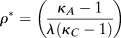 ${\rho ^*} = \left( {{{{\kappa _A} - 1} \over {\lambda \left( {{\kappa _C} - 1} \right)}}} \right)$ and χ − = 1 is a best response for C. This implies
 ${\chi _1} = 1 > {\hat{\chi }_1}$ and
 ${\chi _{ - 1}} = 1 - {\rho ^*}\lambda = {\hat{\chi }_{ - 1}}$. Note also that any
 ${\phi _{ - 1}} > \left( {{\delta \over {1 - \delta }}} \right)\left( {{{1 - \sigma } \over {1 + \sigma }}} \right)$ cannot be optimal since it induces χ −1 = 0 and sanction κ C with certainty. So
 $\left( {\phi _1^*,\phi _{ - 1}^*} \right) = \left( {1,\left( {{\delta \over {1 - \delta }}} \right)\left( {{\gamma \over {\lambda \left( {1 + \sigma } \right) - \gamma }}} \right)} \right)$ is a best response for G.
Part 2. Pr[Δ1 = 1|x G = 1] = δ implies  ${\mathbb{E}}\left[ {{\Delta _1}{\rm{|}}{x_G} = 1} \right] = 2\delta - 1$. Given σ > 2δ − 1, equation (4) implies χ − = 0 is a best response. Further, for Pr[Δ1 = 1|x G = 1] = δ, equation (7) implies that C reviews only if γ < λδ(1 − σ). But
 ${{\lambda \left( {1 + \sigma } \right)\left( {1 - \sigma } \right)} \over 2} > \lambda \delta \left( {1 - \sigma } \right)$, so ρ* = 0. Since ρ* = 0 and χ − = 0, it follows that χ −1 = 0 by Lemma 10, so
 $\phi _{ - 1}^* = \phi _1^* = 0$ by Lemma 12. Then x G = 1 is off the equilibrium path, and Pr[Δ1 = 1|x G = 1] = δ is Bayes consistent.Footnote 37 ■
Thus, Part (1) of Lemma 6 changes under S A. For λδ(1 − σ) < γ ≤ λ(1 − δ)(1 + σ),  $\phi _{ - 1}^* = 1$ is no longer optimal for G. This exposes G to the sanction −κ C with certainty. G prefers to mix when Δ1 = −1, incurring −κ C and −κ A probabilistically, until γ is so large that C will reject without review even when G mixes. Part (2) of Lemma 6 also does not hold under S A: instead of G approving all laws in this case, G vetoes all laws preemptively to avoid crown sanctions.
Under part 1, S A generates more information about Δ1 than S R. Under part 2, S A is inefficient relative to S R. It imposes additional costs on G from assembly sanctions without changing policy outcomes. The reason for the inefficiency is that G cares not only about the disposition of the law and costs of reversal, but about which actor makes a decision to reject. G incurs pressure from A if G itself rejects, but not if C rejects.
Lemma 7′. Suppose Δ2 = −1 and σ ≤ 2δ − 1. Lemma 7 holds under S A.
Proof. Part 1: If (χ −1, χ 1) = (1 − ρλ, 1), then  $\phi _1^* = 1$. Given this, the posterior d is as in equation (1), and C reviews only if
 ${\phi _{ - 1}} \le \left( {{\delta \over {1 - \delta }}} \right)\left( {{{1 - \sigma } \over {1 + \sigma }}} \right)$ and γ ≤ λ(1 − δ)(1 + σ). If σ ≤ 2δ − 1, then
 $\left( {{\delta \over {1 - \delta }}} \right)\left( {{{1 - \sigma } \over {1 + \sigma }}} \right) > 1$, and best responses are as in part 1 of Lemma 7.
Part 2. If (χ −1, χ 1) = (1, 1) (summary approval), G pools on  $\phi _{ - 1}^* = \phi _1^* = 1$. If σ ≤ 2δ − 1 and γ > λ(1 − δ)(1 + σ), χ −1 = χ 1 = 1 is a best response. Thus, part (2) of Lemma 7 holds under both S A and S R. ■
Lemma 8′. Suppose Δ2 = 1. Lemma 8 holds under S A.
Proof. The original proof holds without modification. In particular, χ 1 = 1 under S A, which implies  $\phi _1^* = 1$, and S A does not change C’s best response conditional on Δ2 = 1 and
 $\phi _1^* = 1$. ■
In summary,
• S A and S R generate the same PBE behavior for:
– Δ2 = 1
– Δ2 = −1 and σ ≤ 2δ − 1
– Δ2 = −1, σ > 2δ − 1, and γ < λδ(1 − σ)
– Δ2 = −1, σ > 2δ − 1, and γ > λ(1 − δ)(1 + σ)
• S A elicits more information about Δ1 than S R for
– Δ2 = −1, σ > 2δ − 1, and
$\gamma \in \left( {\lambda \delta \left( {1 - \sigma } \right),{{\lambda \left( {1 + \sigma } \right)\left( {1 - \sigma } \right)} \over 2}} \right] \equiv {\Gamma _ - }$
• S A is inefficient relative to S R for
– Δ2 = −1, σ > 2δ − 1, and
$\gamma \in \left( {{{\lambda \left( {1 + \sigma } \right)\left( {1 - \sigma } \right)} \over 2},\lambda \left( {1 - \delta } \right)\left( {1 + \sigma } \right)} \right] \equiv {\Gamma _ + }$


These regions have width  $\left| {{\Gamma _ + }} \right| = {{\lambda \left( {1 + \sigma } \right)\left( {\sigma - 2\delta + 1} \right)} \over 2}$ and
 $\left| {{\Gamma _ - }} \right| = {{\lambda \left( {1 - \sigma } \right)\left( {\sigma - 2\delta + 1} \right)} \over 2}$. So the inefficiency region is never smaller. For σ > 2δ − 1, the relative width is
 ${{1 + \sigma } \over {1 - \sigma }} > 1$, which is increasing in σ. For σ = 2δ − 1, |Γ+| = |Γ−| = 0. For σ → 1, |Γ−| → 0 and |Γ+| → 2λ(1 − δ).
For the following result, suppose that C internalizes cost ψκ A when G vetoes for γ ∈ Γ+—the case where G’s veto has no effect on policy. This captures, in a reduced form way, that these costs affect the participation constraint of potential governors in a larger model with endogenous recruitment, and this is costly for C. Assume also that γ is uniformly distributed over [λδ(1 − σ), λ(1 − δ)(1 + σ)], the region over which S A changes behavior. Let V(S) denote the expected utility under cost regime S.
Proposition 4. For Δ2 = 1 or Δ2 = −1 and σ ≤ 2δ − 1, V(S R) = V(S A). For Δ2 = −1 and σ > 2δ − 1, there exists  $\hat{\psi } \,\lt\, {1 \over 2}$ such that V(S R) > V(S A) if
 $\psi > \hat{\psi }$. Further,
 $\hat{\psi } \to 0$ as σ → 1.
Proof. V(S R) = V(S A) under Δ2 = 1, and under Δ2 = −1 and σ ≤ 2δ − 1, by Lemmas 7 and 8.
Now assume Δ2 = −1 and σ ∈ (2δ − 1, 1).
For S R, V(S R) = 0, because C summary reverses in this range.
For S A, let V(Γi, S A) denote V’s expected utility under regime S A for γ ∈ Γi, i ∈ {+, −}. Then V(Γ+, S A) = −ψκ A. In this region, G preemptively vetoes under S A to avoid summary veto by C, but then incurs assembly sanctions, a portion of which C internalizes. On the other hand,
 $$V\left( {{\Gamma _ - },{S_A}} \right) = \delta \left( {1 - \sigma } \right) - \mathop \int \nolimits _{\lambda \delta \left( {1 - \sigma } \right)}^{{{\lambda \left( {1 + \sigma } \right)\left( {1 - \sigma } \right)} \over 2}}\left( {\left( {\left( {1 - \delta } \right)\left( {1 - {\rho ^*}\lambda } \right)\phi _{ - 1}^*\left( \gamma \right)\left( {1 + \sigma } \right)} \right) + \left( {{\rho ^*}\gamma } \right)} \right){\rm{d}}F\left( \gamma \right).$$
The terms are as follows. First, if Δ1 = 1, then  $\phi _1^* = 1$ and C always upholds, obtaining utility (1 − σ). This occurs with probability δ. Second, if Δ1 = −1, and G upholds, and C does not review or it is not informative, C obtains utility (−1 − σ). This occurs with probability
 $\left( {1 - \delta } \right)\left( {1 - {\rho ^*}\lambda } \right)\phi _{ - 1}^*$. Third, C incurs cost γ for review, which occurs with probability ρ*.
Combining these, V(S A) = Pr[γ ∈ Γ−]V(Γ−, S A) + Pr[γ ∈ Γ+]V(Γ+, S A) or  $\left( {{{1 - \sigma } \over 2}} \right)V\left( {{\Gamma _ - },{S_A}} \right) + \left( {{{1 + \sigma } \over 2}} \right)V\left( {{\Gamma _ + },{S_A}} \right)$.
If ψ = 0, then  $V\left( {{S_A}} \right) = \left( {{{1 - \sigma } \over 2}} \right)V\left( {{\Gamma _ - },{S_A}} \right) > V\left( {{S_R}} \right) = 0$ for all 2δ − 1 < σ < 1 (otherwise C would not choose to review over Γ−). However, V(Γ−, S A) < δ(1 − σ) and Pr[γ ∈ Γ−] < Pr[γ ∈ Γ+] ∀σ ∈ (2δ − 1, 1). Therefore, V(S A) < 0 = V(S R) for
 $\psi \,\ge\, {{\delta \left( {1 - \sigma } \right)} \over {{\kappa _C}}} \equiv \,\hat{\psi }\left( \sigma \right)$. Since σ > 2δ − 1, it follows that
 $\hat{\psi } \,\lt {{2\delta \left( {1 - \delta } \right)} \over {{\kappa _A}}} \lt {1 \over 2}$,
 ${{{\rm{d}}\hat{\psi }} \over {{\rm{d}}\sigma }} \lt 0$, and
 ${\lim _{\sigma \to 1}}\hat{\psi } = 0$.
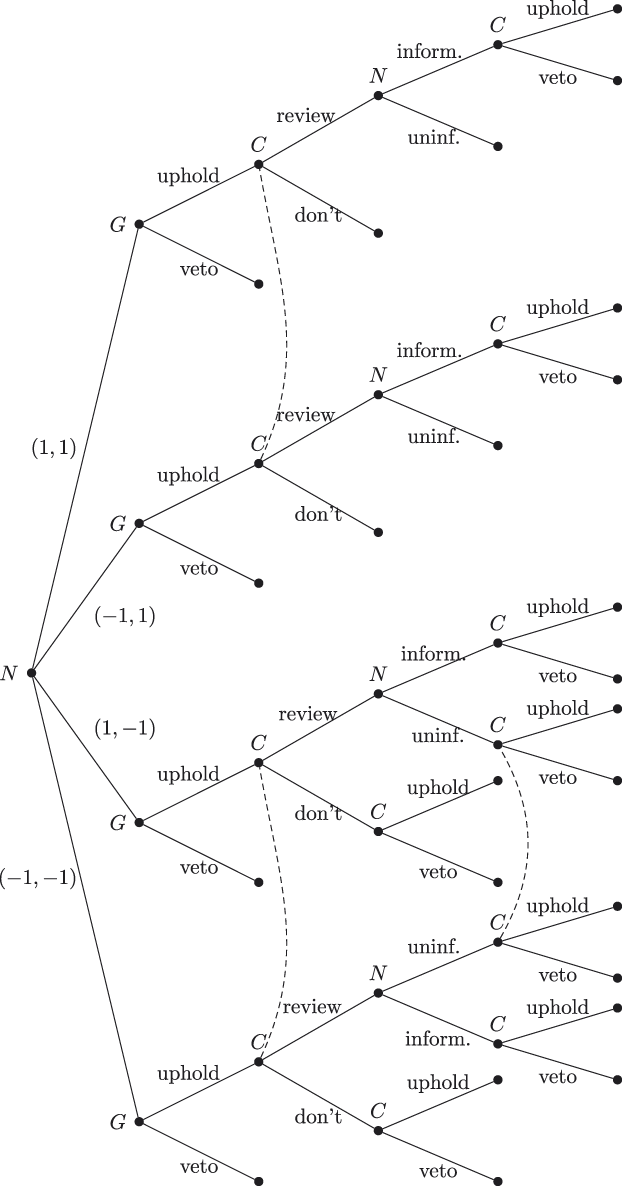



Comments
No Comments have been published for this article.