Introduction
Early-life stress can be defined as exposure to adverse events during childhood that negatively impact emotional or physical well-being to an extent that exceeds an individual’s ability to cope.Reference Gunnar and Quevedo 1 Considerable evidence suggests that such negative experiences are associated with the development of depressive disorders.Reference Kendler 2 – Reference Nestler, Barrot, DiLeone, Eisch, Gold and Monteggia 4 Specifically, early life seems to be particularly sensitive to environmental hardships that increase depression risk.Reference Heim, Shugart, Craighead and Nemeroff 5 Previous research indicates that exposure to early-life adversity may alter neurobiological development, including those regions that regulate responsiveness to reward, which may in turn influence depressive outcomes later in life.
This review will examine the link between early-life adversity and depression. First, we will provide a brief overview of the epidemiology of early-life adversity and depression. Because timing of exposure to these stressors is critically important in depressive outcomes, we will also discuss the issue of sensitive periods, leading to a review of the main neurobiological indices of depression, including the critical role of reward-related neural circuitry and the development of this circuit. Thus, we will attempt to address the underlying neurobiological mechanisms relating early-life adversity to depressive outcomes, specifically as related to reward processing.
Early Adversity and Depression
Early-life adversity encompasses environmental exposure to abuse, neglect, distress, and negative family relations, among other negative experiences during the infancy/toddler period. These adverse exposures occur at every socioeconomic level, across ethnic and cultural lines, and at all levels of education. In the United States alone, more than 3,000,000 reports of child abuse involving more than 6,000,000 youth are reported each year. 6 While the U.S. has one of the highest rates of child maltreatment/neglect among industrialized nations, these numbers only reflect a fraction of domestic early-life adversity exposures. Of note, more than 33% of confirmed cases of maltreatment affect children under 4 years old, while 24% of cases are 4–7 years old, 18% of cases are 8–11 years old, and 16% of cases are 12–15 years old. 7 These statistics suggest that early-life adversity is not uncommon, particularly among young children—an important distinction, as early childhood may represent a period of heightened vulnerability to the negative effects of stress,Reference Gunnar and Quevedo 1 and differential psychological outcomes may be dependent upon the specific timing of exposure.Reference Maercker, Michael, Fehm, Becker and Margraf 8
The scientific literature overwhelmingly demonstrates an association between early-life adversity and depression.Reference Chapman, Whitfield, Felitti, Dube, Edwards and Anda 9 – Reference Agid, Shapira and Zislin 14 Though genetic factors have been shown to influence vulnerability for depression following early-life adversity,Reference Francis, Caldji, Champagne, Plotsky and Meaney 15 twin studies demonstrate that the effects of adverse environments play a substantial role in depressive outcomes beyond the influence of genetics.Reference Kendler, Neale, Kessler, Heath a and Eaves 16 , Reference Romanov, Varjonen, Kaprio and Koskenvuo 17 Clinical evidence highlights a dose-response relationship between early-life adversity and mental health in adulthood,Reference Edwards, Holden, Felitti and Anda 18 specifically with regard to the severity of early-life adversity and lifetime chronic depression.Reference Chapman, Whitfield, Felitti, Dube, Edwards and Anda 9 For example, the risk of depression in persons with multiple early-life adverse experiences is 4 times that of a person who has not experienced early-life trauma.Reference Felitti, Anda and Nordenberg 19 The results from these clinical studies support outcomes that have been reported in epidemiological research. A 17-year longitudinal study examining more than 750 randomly selected children found that adolescents and young adults with a history of childhood maltreatment were 3 times more likely to become depressed compared with individuals without such a history.Reference Brown, Cohen, Johnson and Smailes 10 Thus, vulnerability for depression may increase linearly with both the quantity and severity of adverse experiences, suggesting a possible causal link between early-life adversity and depression.Reference Kendler, Karkowski and Prescott 20
According to the Diagnostic and Statistical Manual of Mental Disorders, Fourth Edition (DSM-IV), depression is characterized by the presence of the majority of 9 symptoms: depressed mood, loss of interest or pleasure, disturbed sleep, disturbed appetite, anxiety, low energy, feelings of guilt or low self-worth, poor concentration, and thoughts about death. 21 While categorical diagnostic systems remain a valuable tool, recent advances in the understanding of psychopathology have given rise to a new multidimensional framework for conceptualizing mental health. The dimensional approach of the Research Domain Criteria (RDoC) matrix,Reference Insel, Cuthbert and Garvey 22 an integrative diagnostic system, suggests that the anhedonic aspects of depression (eg, loss of pleasure), which are a central feature of depression,Reference Chiu and Deldin 23 – Reference Snaith 25 are consistent with dysfunction of the positive valence system, which includes measures of behavioral and neural responsiveness to reward. Thus, alterations in the neural circuitry that supports reward processing may underlie the emergence of depression following early-life adversity.
Of note, early-life adversity is not limited only to vulnerability for depressive outcomes, but instead constitutes a major risk factor for the development of numerous psychological disorders.Reference Cicchetti and Toth 26 – Reference Teicher, Andersen, Polcari, Anderson, Navalta and Kim 30 However the onset for the majority of these disorders occurs during childhood, and precedes the emergence of depressive symptoms not seen until the adolescent period.Reference Letcher, Smart, Sanson and Toumbourou 31 – Reference Mazza, Abbott and Fleming 33 Therefore we will argue that the protracted emergence of depression following early-life adversity may implicate those neural regions that also demonstrate protracted developmental trajectories—one of which is the reward circuit.
The Role of Timing
Because adversity has been identified as a key experiential factor that programs and modifies brain development,Reference Teicher, Tomoda and Andersen 34 , Reference Kaufman, Plotsky, Nemeroff and Charney 35 a comprehensive understanding of the mechanisms involved in depressive outcomes following early-life adversity requires that we evaluate sensitive periods in neural development. Sensitive periods are characterized by periods of neural plasticity during which neural development may be especially vulnerable to environmental influence.Reference Rice and Barone 36 Environmental influence may in turn have profound effects on physical, social, and emotional developmentReference Rice and Barone 36 – Reference Weiss and Wagner 38 ; the brain may be particularly vulnerable to negative experiences, allowing for exaggerated effects of these experiences on neural development.Reference Weiss and Wagner 38 Although childhood maltreatment encompasses a variety of behaviors, we will focus our discussion on caregiver deprivation (ie, maternal deprivationFootnote *)—an unfortunate, yet robust example of early-life adversityReference Gunnar and Fisher 39 —which has been most studied in animal models to allow for translation across studies.
The potential negative impacts of caregiver deprivation are timing-specific. Each neural system has unique sensitive periods, and therefore, exposures to adversity at different ages should lead to differential neuro-behavioral phenotypes. Here we will address time-sensitive alterations in the hypothalamic–pituitary–adrenal (HPA) axis, one of the primary stress axes in mammals.Reference McEwen 40 The HPA axis displays altered function following early-life caregiver deprivation,Reference Loman and Gunnar 41 and this dysfunction has been shown to increase vulnerability to depression.Reference Heim, Newport, Mletzko, Miller and Nemeroff 42 Furthermore, HPA axis dysfunction is particularly prevalent in individuals with anhedonic depression,Reference Gold, Gabry, Yasuda and Chrousos 43 – Reference Pintor, Torres, Navarro, Martinez de Osaba, Matrai and Gasto 45 and thus early-life alterations in HPA function may represent one mechanism by which long-term alterations in neural reward circuitry may occur.
Timing of adverse environmental exposures, in the form of caregiver deprivation, and the function of the HPA axis have been well studied in nonhuman animals. Rodent research has shown that the effects of caregiver deprivation on HPA axis function are dependent on the timing of exposure.Reference Coplan, Smith and Altemus 46 , Reference Van Oers, de Kloet and Levine 47 Rodents separated on the third postnatal day (PND) demonstrated no immediate alterations in HPA function, whereas HPA responsiveness was markedly elevated in those separated on PND11. Additionally, examination of long-term alterations in stress reactivity indicated that rodents separated on PND3 and PND11 showed hyper and hypo HPA responsiveness, respectively, in adulthood.Reference Van Oers, de Kloet and Levine 47 Related work in humans showed that separation from both parents during childhood was associated with increased HPA activation in adulthood, particularly if the separation occurred between ages 2 and 7.Reference Pesonen, Räikkönen and Feldt 48 However, most human studies cannot conclude that their findings are specifically related to the timing of exposure to these adverse experiences. This may be due in part to the fact that most children exposed to early-life adversity continue to be exposed to adverse conditions throughout development. Therefore the unique contribution of early-life adversity to later mental health problems, after taking into account conditions such as family disruptions, persistent poverty, and broader patterns of social and emotional deprivation, remains unclear.Reference Mullen, Martin, Anderson, Romans and Herbison 49
One population that may better articulate the association between early-life adversity and depression is those who experience caregiving deprivation, by virtue of institutional care abroad, and then were adopted by families in the United States. Because previously institutionalized (PI) children often encounter numerous early adverse events followed by a supportive family environment, research on these children may provide information regarding the long-term psychosocial effects of a discrete period of early-life adversity. Youth exposed to this early institutional care exhibit a wide range of psychological outcomes with some children experiencing challenges and others not.Reference MacLean 50 Indeed, families of adopted post-institutionalized children have been shown to provide exceedingly high quality care, including optimal financial and educational resources, nurturing, and emotional supportReference Gunnar, Bruce and Grotevant 51 —all of which are important familial features associated with resilience following early childhood adversity. However, this type of early caregiving experience significantly raises the odds for difficulties in emotional development.
Timing of adoption has emerged as an important variable when considering these outcomes. Pollak et al Reference Pollak, Nelson, Schlaak, Roeber, Wewerka and Wiik 52 found that PI children who were adopted into families after their first birthday had more psychological difficulties, including deficits in learning, memory, and inhibitory control, than children adopted at an earlier age. Similarly, research has shown that PI children who were adopted into families at later ages were more likely to develop behavioral problems, both internalizing and externalizing, when compared to children adopted into families at earlier ages.Reference MacLean 50 , Reference Gunnar and van Dulmen 53 – Reference Zeanah, Egger and Smyke 55 Later age of adoption has also been associated with atypical structural development of limbic regions involved in emotion regulation (eg, the amygdala).Reference Mehta, Golembo and Nosarti 56 , Reference Tottenham, Hare and Quinn 57 The timing of adversity is thus a critical variable when examining neurodevelopment, as outcomes can vary significantly depending on age.Reference Pechtel, Lyons-Ruth, Anderson and Teicher 58 – Reference Andersen and Teicher 60
Ventral Striatum Development, Depression, and Early Adversity
Despite early environmental insults, depression typically does not emerge until the adolescent period,Reference Andersen and Teicher 60 – Reference Raineki, Cortés, Belnoue and Sullivan 63 a relatively late-emerging phenotype as compared to others discussed above. Therefore, deciphering the causal relationship between early-life experiences and later developing depression can prove difficult. By examining the neurodevelopmental mechanisms involved in both early-life adversity and depression, we may begin to develop a framework by which the relationship between early-life adversity and depression is better understood.
Evidence suggests that varied depressive symptoms (ie, poor concentration, thoughts of death) and subtypes (ie, melancholic, seasonal) are likely mediated by different neurochemical mechanisms and may or may not be present in any particular individual with depression.Reference Davidson, Pizzagalli, Nitschke and Putnam 64 – Reference Mayberg, Liotti and Brannan 66 Research has long focused on symptoms of negative affect in depressive outcomes, which implicates dysfunction in neural regions that include the amygdala, hippocampus, anterior cingulate cortex, and prefrontal cortexReference Price and Drevets 67 – Reference Soares and Mann 70 —structures commonly associated with emotion regulation.Reference Johnstone, van Reekum, Urry, Kalin and Davidson 71 , Reference Davidson, Jackson and Kalin 72 While increased negative affect is an established characteristic of depressed individuals,Reference Roberts and Kassel 73 a greater emphasis is now being placed on the anhedonic aspects, or atypical positive reward-related functioning, as an important aspect of depression.Reference Elliott, Sahakian, Michael, Paykel and Dolan 74 – Reference Siegle, Steinhauer, Thase, Stenger and Carter 79 Thus, depression may represent dysfunction in regions implicated in emotion regulation and regions responsible for reward processing, the combined effect of which may reflect the depressive characteristic of concurrent high negative affect and low positive affect.Reference Roberts and Kassel 73
Evidence for the role of atypical positive, or reward-related, processing in depression could implicate dysfunction in the responsiveness of mesolimbic dopamine circuits,Reference Dunlop and Nemeroff 80 which are stress-sensitive,Reference Cabib and Puglisi-Allegra 81 , Reference Pizzagalli 82 as a potential underlying neural mechanism of depression.Reference Hardin, Schroth, Pine and Ernst 83 The ventral striatum, a neural structure within the reward circuit, serves as a primary target of dopamine neuron projections,Reference Sesack and Grace 84 – Reference Robbins and Everitt 87 and, as will be discussed in the following sections, reaches its developmental peak during adolescence. This peak in ventral striatal development coincides with the typical age of onset for depression following early-life adversity,Reference Zeanah, Egger and Smyke 55 , Reference Goff, Gee and Telzer 88 , Reference Bos, Zeanah, Fox, Drury, McLaughlin and Nelson 89 and previous research has shown that dysfunction in this region has been associated with depressive symptoms in this population.Reference Goff, Gee and Telzer 88 , Reference Mehta, Gore-Langton, Golembo, Colvert, Williams and Sonuga-Barke 90 Indeed, research provides evidence for the role of the ventral striatum in reward learning and motivation,Reference Knutson, Adams, Fong and Hommer 91 – Reference Ikemoto and Panksepp 95 and ventral striatum dysfunction has been robustly associated with depression.Reference Dunlop and Nemeroff 80 , Reference Epstein, Pan and Kocsis 96 – Reference Steele, Kumar and Ebmeier 99 Moreover the ventral striatum in healthy individuals has been shown to be highly modulated by the social environmentReference Izuma, Saito and Sadato 100 – Reference Fliessbach, Weber and Trautner 102 ; notably, individuals with depression struggle with social behaviors.Reference Hirschfeld, Montgomery and Keller 103 Though the neural reward system is a highly complex and interconnected circuit involving a network of cortical and subcortical structures,Reference Haber and Knutson 86 given this evidence, we will focus our discussion on the role of the ventral striatum (comprising the nucleus accumbens, ventral caudate, and ventral putamen) within this circuit.
Ventral Striatal Functional Development
Though much of the brain develops before birth and during early childhood,Reference Giedd, Snell and Lange 104 the ventral striatum has been shown to develop in an inverted “U”-shaped pattern, such that the functional development of the striatum peaks in adolescence and then decreases into early adulthood.Reference Ernst, Nelson and Jazbec 105 – Reference Van Leijenhorst, Zanolie, Van Meel, Westenberg, Rombouts and Crone 109 This inverted “U”-shaped pattern seen in the development of the striatum is paralleled by behavioral patterns of increased reward sensitivity during adolescence.Reference Urošević, Collins, Lim, Muetzel and Luciana 108 Importantly, depressive symptoms most commonly emerge during the adolescent period.Reference Andersen and Teicher 60 , Reference Paus, Keshavan and Giedd 62 , Reference Costello, Pine and Hammen 110 , Reference Zahn-Waxler, Shirtcliff and Marceau 111 As depression is being increasingly understood as arising from atypical maturational changes in the brain,Reference Paus, Keshavan and Giedd 62 adolescence may reflect one period during which neural regions implicated in depression are vulnerable to dysregulation as a consequence of their remodeling.Reference Paus, Keshavan and Giedd 62 , Reference Forbes and Dahl 76 Thus alterations in the development of reward-related circuitry may provide one explanation for the emergence of depression in adolescence.
Altered Ventral Striatum Function Following Early Adversity
Given the strong associations found between depression and hypofunctioning in the ventral striatum,Reference Bogdan, Nikolova and Pizzagalli 112 we turn our focus to the ventral striatum’s role in depression following early adversity. In our own laboratory, we have observed that PI youth are at significantly higher risk for depressive behaviors; the risk increases between childhood and adolescence,Reference Goff, Gee and Telzer 88 and this finding is highly consistent with other laboratories.Reference Zeanah, Egger and Smyke 55 , Reference Bos, Zeanah, Fox, Drury, McLaughlin and Nelson 89 This increase in depressive behaviors was associated with hypoactivity in the ventral striatum in the PI adolescentsReference Goff, Gee and Telzer 88 —a neural characteristic that has been demonstrated in other PI groups.Reference Mehta, Gore-Langton, Golembo, Colvert, Williams and Sonuga-Barke 90
There is strong evidence for the role of atypically low ventral striatum activity in depressive outcomes following early-life adversity exposure. Rodents exposed to early adverse experiences have demonstrated altered function of dopaminergic pathways,Reference Powell, Geyer, Preece, Pitcher, Reynolds and Swerdlow 113 – Reference Jones, Hernandez, Kendall, Marsden and Robbins 115 including alterations in the function of the ventral striatumReference Jones, Hernandez, Kendall, Marsden and Robbins 115 , Reference Fulford and Marsden 116 and reduced responsiveness to reward.Reference Lapiz, Mateo, Parker and Marsden 117 Corroborating studies in humans have found that individuals with a history of early-life maltreatment displayed dampened behavioral responsiveness to reward and reduced activation in striatal structures,Reference Dillon, Holmes, Birk, Brooks, Lyons-Ruth and Pizzagalli 118 and that children who experienced early-life adversity in the form of caregiver deprivation exhibit hyporesponsivity in the ventral striatum in response to reward during adolescence.Reference Mehta, Gore-Langton, Golembo, Colvert, Williams and Sonuga-Barke 90 We have similarly found reduced striatal activation to rewarding stimuli during adolescence in PI youth, which was associated with higher levels of depression.Reference Goff, Gee and Telzer 88
Potential Mechanisms Linking Early-Life Adversity and Altered Ventral Striatal Development
While the relationship between deficits in reward-related processing and depression is generally well understood, we know less about the precise neurobiological mechanism that underlies this relationship. One hypothesis suggests that the reduced ability to experience pleasure (anhedonia) is driven by reduced dopaminergic transmission, resulting in hypoactivation of reward-related neural circuits, which include the ventral striatum.Reference Wise 119 Indeed, there is considerable evidence that dopamine plays a core role in the neural reward system.Reference Wise 120 Research in rodents and humans suggests that suppression of dopaminergic neurotransmission mediates the anhedonia of drug withdrawal in addiction,Reference Dackis and Gold 121 – Reference Volkow, Wang and Fowler 125 while other research has suggested that blunted dopamine transmission may serve as a unique biological marker for anhedonia.Reference Di Chiara and Tanda 126 , Reference Willner 127 Dopamine may also specifically mediate the hedonic properties of food, drugs, and other rewards.Reference Wise 120 , Reference Bechara, Harrington, Nader and van der Kooy 128 , Reference Nader, Bechara and van der Kooy 129 Importantly, there is also evidence suggesting that early-life caregiver deprivation alters dopamine function in the ventral striatum.Reference Kehoe, Shoemaker, Triano, Hoffman and Arons 130 – Reference Pruessner, Champagne, Meaney and Dagher 132 Therefore it may be that alterations in dopamine transmission early in life influence later ventral striatum functioning, particularly during the sensitive adolescent period, which serves as the underlying mechanism in adolescent-emergent depression following early-life adversity.
Though the association between early-life adversity and altered function of the ventral striatum is well established,Reference Zeanah, Egger and Smyke 55 , Reference Goff, Gee and Telzer 88 , Reference Bos, Zeanah, Fox, Drury, McLaughlin and Nelson 89 the neurochemical pathways by which early adversity alters ventral striatal development have not yet been well characterized. Nonetheless, there is some evidence that, for those who have experienced early-life adversity, striatal alterations may be the consequence of dysfunction in the HPA axis. Indeed emerging research has linked variation in HPA axis activity with functional and structural differences in striatal regions central to reward processing.Reference Jahn, Fox and Abercrombie 133 – Reference Pruessner, Dedovic and Pruessner 135 As discussed earlier, much attention has focused on the ability of early-life adversity to atypically program the HPA axis.Reference Heim, Newport, Mletzko, Miller and Nemeroff 42 , Reference Tarullo and Gunnar 136 Following early adversity, dysregulation of the HPA axis results in persistent dysregulation of glucocorticoid secretion, which has been causally linked to depression.Reference Heim and Nemeroff 13 , Reference Carroll, Curtis and Mendels 137 , Reference Holsboer 138 Of note, the psychosocial effects of HPA dysfunction differ across development. Research in rodents has demonstrated that early-life neglect–induced HPA alterations may result in numerous social behavior deficits, though specific depressive-like behaviors do not emerge until the adolescent period,Reference Raineki, Cortés, Belnoue and Sullivan 63 which may reflect the delayed impact of these alterations on reward-processing. That is, given the adolescent emergence of ventral striatum reactivity, we would anticipate the cascading effect of HPA axis dysregulation to be observed at that time.
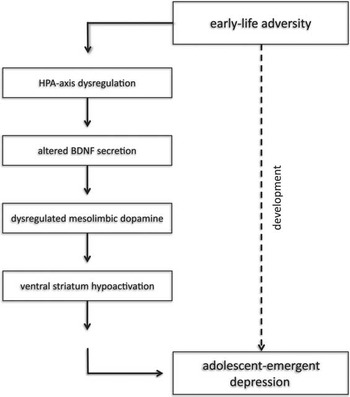
Here we propose a potential mechanism by which HPA axis dysfunction following early-life adversity may in turn alter ventral striatum function in adolescence. In rodents, the effects of HPA dysfunction specific to striatal development have been investigated via exposure to both early-life adversity and direct glucocorticoid injection. Results showed that increased glucocorticoid exposure early in life resulted in volumetric reductions of the nucleus accumbens,Reference Martínez-Téllez, Hernández-Torres, Gamboa and Flores 139 , Reference Leão, Sousa, Oliveira, Silva, Almeida and Sousa 140 a substructure of the ventral striatum, as well as decreased density in mesolimbic dopamine receptorsReference Biron, Dauphin and Di Paolo 141 , Reference Barrot, Marinelli, Abrous, Rougé-Pont, Le Moal and Piazza 142 in the nucleus accumbens. Additionally, rodents exposed to early caregiver deprivation showed reduced dopamine function in the striatum during adulthood.Reference Andersen, Lyss, Dumont and Teicher 143 The relationship between glucocorticoids and dysfunction of the striatum may also involve the activity of brain-derived neurotrophic factor (BDNF), the neurotrophin that serves as the key regulator of the mesolimbic dopamine pathway.Reference Küppers and Beyer 144 – Reference Cordeira, Frank, Sena-Esteves, Pothos and Rios 146 It has been hypothesized that specific adverse effects of glucocorticoids may involve attenuation of BDNF expression or signaling.Reference Smith 147 Indeed, caregiver deprivation has been shown to induce long-term changes in BDNF expression in the striatum,Reference Lippmann, Bress, Nemeroff, Plotsky and Monteggia 148 and reductions in BDNF have been strongly associated with depression in adulthood.Reference Lee and Kim 149 – Reference Karege, Perret, Bondolfi, Schwald, Bertschy and Aubry 154 Thus, it may be that early-life adversity results in HPA axis–induced glucocortiocoid secretion, which influences reductions in BNDF. These alterations in turn compromise the function of the mesolimbic dopamine system early in life, which results in hypoactivation of the ventral striatum to reward—a hallmark of anhedonic depression—during the adolescent period (Figure 1).
Illustration of the proposed model demonstrating a neurobiological mechanism by which early-life adversity may result in adolescent depression.

Conclusions
Previous research has established the role of stress, anhedonia, and dopamine on depressive outcomes,Reference Pizzagalli 82 , Reference Pechtel and Pizzagalli 155 and has laid the groundwork for characterization of potential mechanistic links between early-life adversity and ventral striatal hypofunction during adolescence, which will be an important step toward understanding how early experiences increase the risk for later depression. While the antecedents of depression are complex and not fully understood, there is increasing evidence to suggest that the association between early-life adversity and depression in later life is largely mediated by stress-induced alterations to the ventral striatum. Due in part to sensitive periods in neural plasticity, evidence suggests that early life is a time of particular vulnerability, and the timing of adverse environmental experiences is critical for depressive outcomes. Neurobiological research indicates that changes in the development of neural mechanisms that influence reward processing may impact depression risk later in life. In adults, typical development of the reward circuit results in activation of the ventral striatum, serving to mediate balanced reward-seeking behaviors. However, in cases of atypical development of neural reward circuitry, imbalances in striatal activation may result in psychopathological outcomes, such as anhedonia, a common symptom seen in depressed individuals. These findings may help to further elucidate the mechanisms underlying dysfunction in this circuitry that may result in psychopathological outcomes in both clinical and developmental populations.
Disclosures
Nim Tottenham and Bonnie Goff have nothing to disclose.