Implications
Feeding has high economic and environmental costs in poultry production. The present work shows that a diet offered in a simplified form, as a mixture of sorghum whole grains and protein-rich pellets, did not reduce the performance of growing geese compared with a complete pelleted diet. Therefore, such a feeding strategy offers interesting prospects for a more sustainable rearing method. Indeed, it could reduce the manufacturing processes and thus the economic and environmental impacts of goose feeding while improving the social acceptability of breeding systems by feeding the birds with a diet considered as more natural.
Introduction
To be more sustainable, livestock productions must improve their economic, social and environmental performance. Modifications in feeding strategies, both in the choice of raw materials and/or feed presentation, appear to be relevant to this goal. Indeed, the feed represents the greatest part of the economic and environmental costs of poultry rearing (Boggia et al., Reference Boggia, Paolotti and Castellini2010). The use of local whole grains has been of interest to reduce the feed costs caused by transport, handling and processing (Dozier et al., Reference Dozier, Behnke, Kidd and Branton2006). Additionally, it addresses consumer demand for more ‘natural’ feeding systems (Gabriel et al., Reference Gabriel, Mallet, Leconte, Travel and Lalles2008). Several studies have demonstrated the possibility and value of using non-pelleted feeds (crushed, mashed or whole grains) in poultry feeding (Jahan et al., Reference Jahan, Asaduzzaman and Sarkar2006; Gabriel et al., Reference Gabriel, Mallet, Leconte, Travel and Lalles2008; Mirghelenj and Golian, Reference Mirghelenj and Golian2009). For example, the use of whole wheat has been shown to improve performance (Gabriel et al., Reference Gabriel, Mallet, Leconte, Travel and Lalles2008) partly due to an increase in the gizzard development (Forbes and Covasa, Reference Forbes and Covasa1995). Most of the work has been carried out on broilers, and most of the time, the grains used were wheat or maize. Data on other poultry such as geese (Auvergne et al., Reference Auvergne, Leprettre, Lavigne, Babilé and Dubois2006 and Reference Auvergne, Lavigne and Dubois2008; Lu et al., Reference Lu, Kong, Wang, Yang, Zhang and Zou2011) and other grains such as sorghum are scarce.
Sorghum (Sorghum bicolor) had not been used in poultry feeding for many years because its grain contains tannins, which reduce its digestibility and thus the performance of birds (Elkin et al., Reference Elkin, Freed, Hamaker, Zhang and Parsons1996; Nyachoti et al., Reference Nyachoti, Atkinson and Leeson1997). However, today, several sorghum varieties are tannin-free and could be used in bird feeding (Gualtieri and Rapaccini, Reference Gualtieri and Rapaccini1990; Selle et al., Reference Selle, Cadogan, Li and Bryden2010). This cereal has nutritional characteristics similar to those of maize (Sauvant et al., Reference Sauvant, Perez and Tran2004) but is more drought-resistant (Farré and Faci, Reference Farré and Faci2006). This could reduce the environmental impacts of bird feeding by reducing the need for irrigating the crop.
Whole grains can be used in three ways: (i) ‘choice feeding’, in which the whole cereal and the protein-rich complement (pelleted or as whole grains) are given in two separate feeders (Pousga et al., Reference Pousga, Boly and Ogle2005); (ii) ‘sequential’ feeding, in which the whole cereal and the protein-rich complement are given in the same feeder but at different times of day (Bouvarel et al., Reference Bouvarel, Vallée, Lescoat, Ferreira, Chagneau, Constantin and Leterrier2008; Umar Faruk et al., Reference Umar Faruk, Bouvarel, Meme, Rideau, Roffidal, Tukur, Bastianelli, Nys and Lescoat2010); and (iii) as a ‘loose mixture’, in which the whole cereal and the protein-rich complement are mixed in the same feeder (Yo et al., Reference Yo, Siegel, Guerin and Picard1997). The loose mixture is a solution easier to implement (Forbes and Covasa, Reference Forbes and Covasa1995). It assumes that individual birds will eat the correct quantities of each component (whole grains and protein-rich pellets) to obtain a balanced diet that meets their nutritional requirements.
This trial aimed to study the effects of three methods of diet presentation (pellets, coarse-ground meal or a mixture of sorghum whole grains and protein-rich pellets) on the performance of growing geese.
Material and methods
Birds and feeding programme
This trial was carried out at the Goose Breeding Station (Coulaures, Dordogne, France). At 1 day of age, 360 goslings (males and females, type Maxipalm®) were randomly allocated to nine pens of 40 birds and were fed a pelleted diet (nitrogen-corrected apparent metabolizable energy, AMEn 11.70 MJ/kg, 18 g/kg CP; manufactured by DFP Nutraliance, Saint-Ybard, Corrèze, France). At 42 days of age, birds were divided into three groups (three pens of 40 birds each), differing only in the form of feed given until 98 days of age. The diet contained 500 g tannin-free sorghum/kg (Argence® variety) and met the nutrient requirements of growing geese (National Research Council (NRC), 1994). The diet composition is shown in Table 1.
Ingredients and chemical composition of the experimental feed

AMEn = nitrogen-corrected apparent metabolizable energy.
1Vitamins, A: 9990 UI/kg; D3: 1998 UI/kg; E: 10.0 UI/kg; B1: 2.0 mg/kg; K3: 1.0 mg/kg; B2: 2.5 mg/kg; B5: 5.1 mg/kg; B6: 1.0 mg/kg; PP: 24.9 mg/kg; B9: 0.3 mg/kg; choline: 300 mg/kg. Oligo elements, Cu: 9.3 mg/kg; FE: 29.0 mg/kg; I: 0.99 mg/kg; Co: 0.16 mg/kg; Mn: 70 mg/kg; Zn: 47 mg/kg; Se: 0.20 mg/kg; clay (sepiolite): 2 g/kg.
2AMEn, calculated from Fisher and Mc Nab (Reference Fisher and Mc Nab1987).
In the Control group (n = 120), the birds received the diet in the form of a complete pelleted feed. In the CG group (n = 120), feed was given as a complete coarse-ground meal. In the M Group (n = 120), birds received a mixture containing 500 g/kg of sorghum whole grains (AMEn 14.80 MJ/kg, 8.5 g/kg CP) and 500 g/kg of protein-rich pellets (AMEn 10.40 MJ/kg, 21.6 g/kg CP).
In France, geese are mainly reared for fatty liver production. Therefore, the feeding programme of growing geese was intended to prepare the birds for force-feeding (Guéméné and Guy, Reference Guéméné and Guy2004). For this purpose, birds were fed a restricted diet from 56 to 98 days of age, to progressively adapt them to take in large amounts of food in a short period. The feeding programme we used has been previously described by Leprettre et al. (Reference Leprettre, Babilé, Auvergne, Dubois, Manse and Verdier1997). Birds were fed ad libitum from 42 to 56 days of age and then had controlled access to food: 12 h a day from 56 to 63 days of age, 3 h a day from 63 to 70 days of age and 2 h a day from 77 to 98 days of age.
Housing and management conditions
Birds were housed in pens of 19 m2 containing 40 birds (20 males and 20 females). The pens were equipped with two drinkers, three feeders and outdoor access (91.5 m2/pen). Geese had outdoor access between 0700 and 1800 h from 49 to 98 days of age. The room temperature was maintained at 28°C during the first week after hatching and was subsequently gradually reduced to 22°C at 49 days of age, after which no heat was provided.
Measurements and analytical methods
Birds were weighed individually at 42, 56, 70, 84 and 98 days of age after 18 h of fasting. Feed intake per pen was measured weekly. In the M group, the contents of the feed refusal, that is, the amounts of uneaten sorghum whole grains and protein-rich pellets, were also measured. Mortality was recorded daily. In geese, sexual maturity occurs at 12 and 14 weeks in females and males, respectively. Therefore, 12 birds per group (six of each sex) were slaughtered at 84 and 98 days of age to study gizzard development and carcass traits according to the WPSA method (World's Poultry Science Association, n.d.). The full weights of gut (small intestine, duodenum, jejunum, ileum and caecum), gizzard, liver, carcass (eviscerated carcass with skin) and abdominal fat were measured as well as breast and thigh weights (without skin and subcutaneous fat). The geese were slaughtered at the Goose Breeding Station according to the European council regulations (EC, 2009).
The chemical composition of the experimental feed was analysed by Lara Europe Analyses (Toulouse, Haute-Garonne, France) and is reported in Table 1. Particle size (Table 2) was measured using successive sieves with decreasing mesh on dry material for the coarse-ground meal or wet material for the complete or the protein-rich pellets (Lebas and Lamboley, Reference Lebas and Lamboley1999).
Particle size (%) in the diet given to the birds in the three groups

C = control; CG = coarse-ground meal; M = mixture (in this group, the diet offered contained 500 g/kg protein-rich pellets and 500 g/kg sorghum whole grains).
Statistical analysis
Data were analysed using the GLM procedure of MINITAB (2000). Feed intake and feed conversion ratio were analysed including the experimental group in the model. Live weight (LW), average daily gain and carcass composition were analysed including group, sex and their interaction in the model. When the interaction group × sex was significant, the data were analysed within each sex. Means between treatments were compared using the Bonferroni test. Mortality was analysed using the χ 2 test. Differences were treated as significant when P ⩽ 0.05.
Results
Physical characteristics of the experimental diets
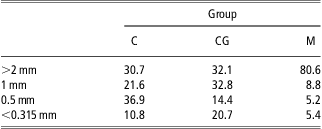
The diameter of pellets was similar in the diet offered to the birds of the Control and M groups (4.23 ± 0.14 and 4.23 ± 0.10 cm; P > 0.05) but they were longer in the complete pellets than in the protein-rich ones (10.03 ± 2.24 and 9.00 ± 2.24 cm, respectively; P < 0.001). The diameter of sorghum whole grains was 3.25 ± 0.84 cm. The proportion of large particles (>2 mm) was higher in the feed given to the birds of the M group than of the Control and the CG groups (80.6%, 30.7% and 32.1%, respectively; Table 2) due to the inclusion of 500 g/kg sorghum whole grains. Conversely, for the same reason, the proportion of small particles (<0.5 mm) was less in the feed given to the M group (10.6%). Because of the coarser crushing, the proportion of small particles was lower in the feed offered to the CG birds (35.1%) than in that offered to the Control group (47.7%).
Sorghum whole grains and feed intake
In the M group, over the entire period, intake of protein-rich pellets and sorghum whole grain in the M group was similar (9465 and 9428 g/goose, P > 0.05).
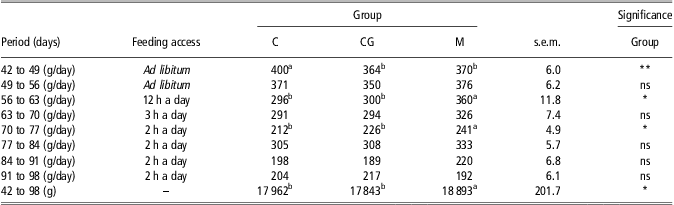
From 42 to 49 days of age, the feed intake was 9% higher in the Control group than that in the two other groups (P < 0.01; Table 3). From 70 to 77 days, this phenomenon was reversed: feed intake was higher in the M than that in the Control and CG groups (+12% and +6%, respectively; P < 0.05). During the last 3 weeks (77 to 98 days), the feed intake was similar in the three groups (P > 0.05). Over the entire period, the total feed intake was about 1000 g higher when feed was given as a mixture of whole grains and protein-rich pellets than as complete pellets or as a coarse-ground meal (P < 0.05).
Feed intake during the experimental period

C = control; CG = coarse-ground meal; M = mixture containing protein-rich pellets and sorghum whole grains; s.e.m. = standard error of the mean.
**P < 0.01; *P < 0.05; ns, P > 0.05.
a,bWithin a row, means with no common superscript differed significantly (P < 0.05).
Bird growth and mortality
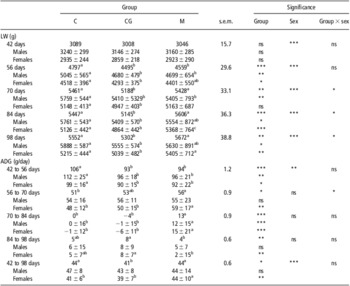
Mortality rates during the trial were similar in the three groups (4.5%, P = 0.44). At 56 days of age, the LW of geese was lower in the CG and M groups than that in the Control group (−6.30% and −4.96%, respectively; P < 0.05). From 70 days, geese were lighter in the CG group than in the other groups (P < 0.01; Table 4).
Changes in LW and the ADG during the experimental period

LW = live weight; ADG = average daily gain; C = control; CG = coarse-ground meal; M = mixture containing protein-rich pellets and sorghum whole grains; s.e.m. = standard error of the mean.
***P < 0.001; **P < 0.01; *P < 0.05; ns, P > 0.05.
a,bWithin a row, means with no common superscript differed significantly (P < 0.05).
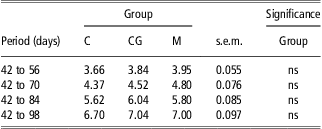
Between 42 and 56 days, geese gained more weight in the Control than in the CG and M groups (+11%, P < 0.001). From 70 days, growth was slow due to feed restriction. Between 70 and 84 days, birds gained weight only in the M group (+13 g/day), whereas they stabilized or lost weight in the Control and CG groups (0 and −4 g/day, P < 0.05; Table 4) as a result of the change in feed intake described previously. Between 84 and 98 days, geese fed the coarse-ground meal gained significantly more weight than those fed the mixture of sorghum whole grains and protein-rich pellets (8 and 4 g/day, P < 0.05; Table 4). However, this did not compensate for the growth retardation due to low feed intake at the beginning of the trial and birds of the CG group were the lightest at the end of the trial (P < 0.01). However, in the M group, a higher feed intake from 63 days of age enabled the birds to fully compensate for their initial delay and they had a weight similar to that in the Control group at the end of the trial (Table 4). Throughout the experimental period, geese gained more weight in the Control and M than in the CG groups (+3 g/day, P < 0.05; Table 4) but there were no significant differences in the feed conversion ratio between groups (Table 5).
Feed conversion ratio during the experimental period

C = control; CG = coarse-ground meal; M = mixture containing protein-rich pellets and sorghum whole grains; s.e.m. = standard error of the mean.
ns, P > 0.05.
Sex had a significant effect on LW at the end of the experiment because the males were 7% heavier than the females (Table 4).
The interaction between group and sex was significant for the average daily gain between 56 and 70 days and LW from 70 to 98 days of age. Irrespective of the sex, birds of the CG group were always lighter than the Control group (Table 4). In the M group, the performance differed between males and females. For males, the average daily gain between 56 and 70 days was similar between the three groups (55 g/day; P > 0.05). For females, birds of the M group gained more weight than those in the Control and CG groups (+19% and +15%, respectively; P < 0.01). Such a difference between sexes from 56 to 70 days explains the higher LWs of females in the M group than in the CG group. In contrast, LWs of the males of the M group were not significantly different from those of the CG group (Table 4).
Body traits
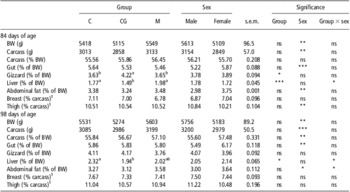
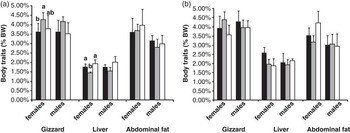
At 84 days of age, the gizzard was heavier in the CG birds than in the Control and M groups (+14% and +13.5%, P < 0.05), whereas the liver weighed less in the CG birds than in the other groups at 84 (P < 0.001) and 98 days of age (P < 0.01; Table 6). However, the interaction between group and sex was significant for the liver weight at 84 and 98 days of age. At 84 days, the liver was lighter in the CG females than in the Control and M females (−19% and −29%, respectively, P < 0.05; Figure 1), whereas the liver weight was similar between groups in males (1.78% of BW; P > 0.05). At 98 days of age, the interaction between group and sex was significant for liver and abdominal fat weight, but analysis of data within sex showed no significant difference between groups (Figure 1).
Geese carcass composition at 84 and 98 days of age (six birds per sex, group and stage)

C = control; CG = coarse-ground meal; M = mixture containing protein-rich pellets and sorghum whole grains; s.e.m. = standard error of the mean.
1Muscles and bones without skin and subcutaneous fat.
***P < 0.001; **P < 0.01; *P < 0.05; ns, P > 0.05.
a,bWithin a row, means with no common superscript differed at P < 0.05.
Gizzard, liver and abdominal fat development (% BW) at 84 (a) and 98 (b) days of age in birds of the C (control; black), CG (coarse-ground meal; grey) and M (mixture containing protein-rich pellets and sorghum whole grains; white) groups for males and females. a,bMeans with no common superscript differed at P < 0.05 (within group and sex).

The other body traits were similar in the three groups at both slaughter stages.
Sex had a significant effect on several body traits. Males had a higher carcass weight, but a lower gut and abdominal fat weight than females at 84 and 98 days of age (Table 6).
Discussion
In this work, sorghum was used to study the influence of feed form on the growth, gizzard development and carcass traits of growing geese. The results showed that (i) a change in the feed form alters the feed intake and hence the growth and body composition of the birds, (ii) separation of the sources of energy and proteins enables the birds to adapt their ingestion to the change in their nutritional needs and (iii) the feed form influences the body traits slightly.
We also observed a sexual dimorphism as previously described in geese by Guy et al. (Reference Guy, Baéza, Salichon, Juin and Rousselot-Pailley1998). In fact, sexual dimorphism in geese leads to a higher growth rate and an earlier age at sexual maturity in females. These phenomena may explain the sex effects and the interactions sex × group we observed.
Hughes (Reference Hughes1984) suggested that when poultry are given a choice, feed intake results from a compromise between the nutritional needs of the bird and the relative palatability of the food. In the present work, the geese were given a pelleted feed before the trial, from 1 to 42 days of age. During the first week of the trial (42 days), the birds given a non-pelleted feed had a lower feed intake. Indeed, Mirghelenj and Golian (Reference Mirghelenj and Golian2009) observed a lower intake with a mash diet than a pelleted diet in broilers. Similar results have been reported in geese (Leprettre et al., Reference Leprettre, Dubois, Lavigne and Babilé2000; Auvergne et al., Reference Auvergne, Leprettre, Lavigne, Babilé and Dubois2006 and Reference Auvergne, Lavigne and Dubois2008) and the authors concluded that geese preferred large particles (>2 mm). However, we observed a slight sorting phenomenon for the birds receiving whole grains at the beginning of the trial. This behaviour has been previously observed in turkeys during periods of feed transition (Lecuelle et al., Reference Lecuelle, Bouvarel, Chagneau, Lescoat, Laviron and Leterrier2010). This can be explained by the time needed for birds to adapt to a new feed differing in colour, texture, size and flavour from the feed given before the experimental period. However, at the end of the trial, the intake of sorghum whole grains increased in geese receiving the mixture. Indeed, the protein needs decreased with age in birds and it has been shown that birds can naturally equilibrate their diet (Emmans, Reference Emmans1991; Covasa and Forbes, Reference Covasa and Forbes1994; Forbes and Shariatmadari, Reference Forbes and Shariatmadari1994). It was found that in a choice-feeding trial offering protein-rich pellets and whole cereals, broilers progressively increased their intake of whole grains with increasing age to meet their decreasing protein needs (Leeson and Caston, Reference Leeson and Caston1993).
In the present study, we observed a close relation between the changes in LW and feed intake, both phenomena affecting the body composition. The lower feed intake at the beginning of the trial for birds given the coarse-ground meal or the mixture of protein-rich pellets and sorghum whole grains led to a lower LW. The higher intake of sorghum whole grains compared with protein-rich pellets in the M group at the end of the trial did not affect the muscle development (breast and thigh). Several studies have shown that whole grains increase gizzard development (Gabriel et al., Reference Gabriel, Mallet, Leconte, Travel and Lalles2008; Lu et al., Reference Lu, Kong, Wang, Yang, Zhang and Zou2011). This effect is mainly attributed to the greater size of food particles ingested (Carré, Reference Carré2000). In contrast, in the present study, a higher gizzard development was observed at 84 days of age in the geese fed the coarse-ground meal, while this food had the lowest particle size. We observed no effect of whole grain intake on gizzard development at either 84 or 98 days of age. Therefore, the effects of particle size on gizzard development seem to depend on grain type as reported by Amerah and Ravindran (Reference Amerah and Ravindran2008) on broilers.
As a whole, feed efficiency was not modified and no adverse effect was observed in birds fed with whole grains. Salmonella contamination has been reported as an important problem in non-pelleted food (Jones, Reference Jones2011). Chemical products (formic and propionic acids) could reduce this problem but we did not use them in the present study and we observed no problems. The present results suggest that a high proportion of sorghum whole grains can be mixed loosely with protein-rich pellets without affecting the productive efficiency, as observed with wheat in broilers (Rose et al., Reference Rose, Fielden, Foote and Gardin1995) or laying hens (Blair et al., Reference Blair, Dewar and Dowine1973).
Conclusions
The present results showed a significant influence of the feed form on goose growth. Feed intake of birds decreased after a feed change during the time necessary to adapt to a new colour, size and hardness of food. The use of a coarse-ground meal leads to reduced performance at 14 weeks of age and should be avoided. However, at the end of the growing period, birds showed similar performance when they received a mixture of sorghum whole grains and protein-rich pellets instead of a completed pelleted feed. Thus, such a simplified diet offers interesting prospects for a more sustainable feeding strategy in goose rearing. Using locally grown grains, such a practice could decrease the economic and environmental costs of goose feeding, reducing the transport and crushing processes and improving the social acceptability by feeding the birds with a diet considered as more natural.
Acknowledgements
The authors thank C. Pautot, H. Manse, C. Bannelier, D. Merilloux, D. Plassard, E. Cazenave and B. Dubois for their technical help.