INTRODUCTION
Tourism is the largest international export earner, and one of the world's most important sources of employment (WTO [World Tourism Organization] 2006). It represents the largest business sector in the world economy, employing 230 million people, generating more than US$ 6.5 trillion in economic activity, and accounting for over 10% of the gross domestic product worldwide (TIES [The International Ecotourism Society] 2006). In 2008, there were 922 million international tourism arrivals (WTO 2010a). Though the economic crisis in 2009 brought about the first decline in tourism since 2001, further growth is predicted (WTO 2010b).
However, as this industry continues to grow, its impacts will not always be positive. Negative environmental impacts of tourism are well documented (Brohman Reference Brohman1996; Ceballos-Lascurain Reference Ceballos-Lascurain1996; Duffus Reference Duffus1996; Stonich Reference Stonich1998; Orams Reference Orams2000; Backman & Morais Reference Backman, Morais and Weaver2001; Buckley Reference Buckley and Weaver2001; Sirakaya et al. Reference Sirakaya, Jamal, Choi and Weaver2001; Müllner et al. Reference Müllner, Eduard and Wikelski2004; UNEP [United Nations Environmental Programme] 2010a). Tourism has also been linked to negative social and cultural impacts (Boo Reference Boo1990; Brandon Reference Brandon1996; McLaren Reference McLaren1998), and economic leakages commonly occur, thus limiting the benefits to local communities (Backman & Morais Reference Backman, Morais and Weaver2001; Fennel Reference Fennell2008). For example, the UNEP (2010b, para. 5) states, ‘of each US$ 100 spent on a vacation tour by a tourist from a developed country, only around US$ 5 actually stays in a developing-country destination's economy’. Many tourism operations contribute minimally to local development, with local people receiving few benefits (Jacobson & Robles Reference Jacobson and Robles1992; Healy Reference Healy1994; Bookbinder et al. Reference Bookbinder, Dinerstein, Arun, Cauley and Arup1998; McLaren Reference McLaren1998; Stone & Wall Reference Stone and Wall2004), and conservation benefits may be ‘at the cost of the socioeconomic well-being of local residents’ (Charnley Reference Charnley2005, p. 80).
There is a growing interest in the concept of ecotourism, as a new way to think about tourism development that has the potential to limit the social and environmental costs of tourism while emphasizing the benefits (Fennell Reference Fennell2008; Weaver Reference Weaver2008). Ecotourism has a variety of definitions, from simply being considered a synonym for nature-based tourism, where the traveller is specifically visiting nature to enjoy and learn about the natural attributes of the area (Boo Reference Boo1990), to much more complex and value-laden meanings, like Martha Honey's (Reference Honey2008) seven part definition of ecotourism, which includes providing direct financial benefits for conservation and for locals, as well as supporting human rights and democratic movements. The most widely accepted and general definition of ecotourism is ‘responsible travel to natural areas that conserves the environment and improves the well-being of local people’ (TIES 2010, home page). This definition alludes to tourism's potential to help provide a diversity of environmental and social benefits. However, since there is no internationally agreed standard for ecotourism, much of what is marketed as ecotourism remains so only in name, while contributing minimally to conservation or improving the lives of local people (Charnley Reference Charnley2005). The concept of ecotourism provides general themes that can be used to evaluate tourism in terms of conservation and community benefits, but research must measure these constructs to determine the extent to which businesses are actually benefiting conservation and the local community, and hence achieving the objectives of ecotourism.
Additionally, tourism, whether it is couched within the ecotourism construct or not, is an economic industry. Although there are a variety of different means to achieve conservation and social objectives, market-driven approaches, which fit within capitalist western models of growth and development, are receiving increasing attention (Cater Reference Cater and Higham2007; Neves-Graca Reference Neves-Graca2004); ecotourism is one such approach. The importance of profitability and success are critical factors often excluded from the debates and discussions regarding the goals of ecotourism. Nevertheless, commercial success is often cited as an important determinant of sustainable behaviour. Tourism businesses can only provide benefits to conservation and local communities if they are commercially successful (Tisdell Reference Tisdell1998; McKercher Reference McKercher and Weaver2001). Like any business, tourism businesses must be able to afford the costs of environmental and social responsibility. In fact, one researcher even goes so far as to state that ‘socially desirable behaviour will cease as soon as it becomes uneconomic’ (Stormer Reference Stormer2003, p. 288). Additionally, tourism businesses must be able to compete with other more resource consumptive alternatives (McKercher Reference McKercher and Weaver2001; Kiss Reference Kiss2004). Given this market context, many tourism businesses do not take on the added ‘costs’ of environmental and social responsibility, and often fail to actively plan for providing environmental and social benefits (Neves-Graca Reference Neves-Graca2004). The objectives of this research are to measure these constructs, and determine if relationships exist between business success and these defining characteristics of ecotourism.
Previous research investigated the relationship between commercial success and responsible behaviour. However, the results have been inconclusive, inconsistent and conflicting. Results from some studies support a positive relationship between commercial success and responsible behaviour (Bowman & Haire Reference Bowman and Haire1975; Parket & Eilbirt Reference Parket and Eilbirt1975; Sturdivant & Ginter Reference Sturdivant and Ginter1977; McGuire et al.1988), while others support a negative one (Vance Reference Vance1975; Baron Reference Baron2007), and still others report no clear relationship at all (Abbott & Monsen Reference Abbott and Monsen1979; Arlow & Cannon Reference Arlow and Cannon1982; Cochran & Wood Reference Cochran and Wood1984; Aupperle et al. Reference Aupperle, Carroll and Hatfield1985; Ullmann Reference Ullmann1985; Owen & Scherer Reference Owen and Scherer1993). Although a considerable amount of research examines this relationship across many industries within the context of developed countries, little research investigates this association with regard to tourism businesses in developing countries. Additionally, little research investigates the performance of entrepreneurs in the tourism industry (Learner & Haber Reference Lerner and Haber2001; Kirsten & Rogerson Reference Kirsten and Rogerson2002). This study addresses this gap.
In order to analyse commercial success and business performance, both subjective and objective performance data are recommended (Brush & Vanderwerf Reference Brush and Vanderwerf1992; Matear et al. Reference Matear, Osborne, Garrett and Gray2002; Sin et al Reference Sin, Tse, Yau, Lee and Chow2002; Haber & Reichel Reference Haber and Reichel2005; Coviello et al. Reference Coviello, Winklhofer and Hamilton2006). However, it can be difficult to obtain objective financial performance data (Cragg & King Reference Cragg and King1988; Haber & Reichel Reference Haber and Reichel2005), because small firms are often unwilling to share such information (Sapienza et al. Reference Sapienza, Smith and Gannon1988; Covin & Slevin Reference Covin and Slevin1989; Coviello et al. Reference Coviello, Winklhofer and Hamilton2006). Objective data are often found to be inaccurate (Dess & Robinson Reference Dess and Robinson1984; Coviello et al. Reference Coviello, Winklhofer and Hamilton2006), and since such data are typically not made available to the public (Covin & Slevin Reference Covin and Slevin1989; Coviello et al. Reference Coviello, Winklhofer and Hamilton2006), it can be difficult or impossible to verify the accuracy of the information (Covin & Slevin Reference Covin and Slevin1989; Haber & Reichel Reference Haber and Reichel2005). Therefore, subjective data are frequently used as a proxy, and a considerable amount of research supports the validity and reliability of subjective business owner reported performance measures (Venkatraman & Ramanujam Reference Venkatraman and Ramanujam1987; Brush & Vanderwerf Reference Brush and Vanderwerf1992; Coviello et al. Reference Coviello, Winklhofer and Hamilton2006). Moreover, subjective data are found to strongly correlate with objective performance measures (Dess & Robinson Reference Dess and Robinson1984; Venkatraman & Ramanujam Reference Venkatraman and Ramanujam1986; Coviello et al. Reference Coviello, Winklhofer and Hamilton2006).
Commercial success or business performance is also recognized as being multidimensional (Lumpkin & Dess Reference Lumpkin and Dess1996; Lerner & Haber Reference Lerner and Haber2001; Reichel & Haber Reference Reichel and Haber2005). Therefore, research investigating only one performance measure, such as profitability, can be misleading (Lumpkin & Dess Reference Lumpkin and Dess1996; Haber & Reichel Reference Haber and Reichel2005). Instead, to more accurately capture a concept like commercial success, various performance measures should be employed (Cooper et al. Reference Cooper, Gimeno-Gascon and Woo1994; Kalleberg & Leicht Reference Kalleberg and Leicht1991; Westhead et al. Reference Westhead, Wright and Ucbasaran2001).
Another consideration in measuring commercial success is long-term versus short-term performance. Again, past research recommends using a combination of both long- and short-term measures (Haber & Reichel Reference Haber and Reichel2005, Reference Haber and Reichel2007). To obtain reliable and valid measures of business performance and commercial success, we employed the use of long-term and short-term objective performance measures, and short-term subjective performance measures.
When measuring conservation benefits, ecological indicators, such as biodiversity, species abundance, species richness, population fecundity or harvest level are often used (Jury et al. Reference Jury, Makhoba and Siebert2007; Garcia-Charton et al. Reference Garcia-Charton, Pérez-Ruzafa, Marcos, Claudet, Badalamenti, Benedetti-Cecchi, Falcón, Milazzo, Schembri, Stobart, Vandeperre, Brito, Chemello, Dimech, Domenici, Guala, Diréach, Maggi and Planes2008), but these require extensive ecological research that was beyond the scope of this study. Past research used the distribution of income from tourism to gauge community benefits (van Kooten Reference van Kooten2008), however, instead of using ecological or economic data, this research assessed conservation and community benefits using owner-reported behaviour. For the purposes of this study, community and local were defined as being within the country of Costa Rica or as being a Costa Rican national, respectively.
A commonly used method for investigating individual environmentally and socially responsible behaviour is self-reporting (Buka & Birdthistle Reference Buka and Birdthistle1999; Steinheider et al. Reference Steinheider, Fay, Hilburger, Hust, Prinz, Vogelgesang and Hormuth1999; Syme et al. Reference Syme, Nancarrow and Jorgensen2002; Thogersen Reference Thogersen2009). Self-reporting has been used to explore behaviour in a variety of different fields, such as health and psychology (Norris et al. Reference Norris, Kitali and Worby2009; Smith et al. Reference Smith, Terry, Manstead, Louis, Kotterman and Wolfs2008; Vogt et al. Reference Vogt, Hall, Hankins and Marteau2009). Although there is evidence that self-reported data can introduce bias or contribute to an overestimation of behaviours (Burnett Reference Burnett2009), particularly those believed to be viewed in a favourable light by the researchers, we took several measures to limit bias and overestimation of the reporting of conservation and community benefits.
Costa Rica is the best-known nature-based tourism destination in the world (Weaver & Schluter Reference Weaver, Schluter and Weaver2001; Honey Reference Honey2008). More than two million tourists visit Costa Rica every year (ICT [Costa Rica Tourism Board ICT] 2010a), mostly for its rich biodiversity and varied natural resources. The country's well-established system of national parks and protected areas cover >25% of its area and offer many nature-based tourism opportunities. Although Costa Rica's economy historically was based on agriculture, during the last few years tourism has earned more than any single export crop (ICT 2010b). In 2008, international tourism generated US$ 2.14 billion in revenue, an increase of >11% from 2007 (ICT 2010a). Costa Rica thus offers a unique opportunity to examine the success of tourism as a market-driven approach to achieving conservation and community benefits.
This research examines multiple dimensions of commercial success and their relationship to various conservation behaviours, as well as behaviours that benefit local people, by addressing the following questions: is commercial success in tourism ventures associated with conservation behaviour, and is the commercial success of these businesses associated with the provision of benefits to local communities? The first hypothesis was that commercially successful tourism entrepreneurs will provide more benefits to conservation than less successful entrepreneurs, while the second was that commercially successful tourism entrepreneurs will provide more benefits to local communities than less successful entrepreneurs. We also aimed to identify conservation behaviours and local community benefits most associated with commercial success.
METHODS
We identified nature-based tour operators and agencies offering tours and travel services in Costa Rica. We surveyed business owners or managers to determine their level of commercial success, their conservation behaviour, and the activities they engage in that benefit local communities and residents, using a cross-sectional research design and a purposive cluster sampling approach. Sample study areas (clusters) were selected after preliminary surveys of 36 San José operators and agencies, and after contacting the ICT and several other tour associations, including Canatur and the Costa Rica Tour Operator Association (ACOT). We identified six major tourism clusters. The remainder of the study's sample was selected from these areas: (1) Central San José, (2) Tamarindo, on the north Pacific Coast, (3) La Fortuna, at the base of the Arenal Volcano, (4) Monteverde, with its famous cloud forest reserves, (5) Quepos, the gateway to the popular Manuel Antonio National Park, and (6) Puerto Viejo, a small Caribbean town sandwiched between a national park and a wildlife refuge on the Caribbean coast.
We made an inventory of tour operators (businesses that organize and run tours) and agencies (businesses that sell tours operated by others) at each sample site. All, or almost all operators and agencies were inventoried and surveyed in each tourism cluster, with the exception of San José. Since there are hundreds of operators and agencies in this metropolitan area, we focused on operators and agencies located in central San José, which represents the most significant tourism area in the city. Quantitative data were collected through surveys conducted in Spanish in June and July of 2006. The final sample size for the study was 167 surveys out of 194, a response rate of 86%.
Questionnaire development
Measuring commercial success
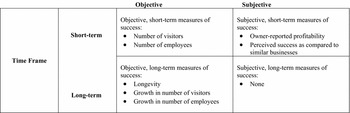
Seven variables were selected to measure performance or commercial success (Fig. 1): length of time in business, number of visitors served over the past 12 months, number of employees, growth in the number of visitors and growth in the number of employees over the past five years, owner-reported profitability, and perceived success as compared to other similar businesses. These variables measure both long- and short-term business performance, using both subjective and objective measures (Van de Ven et al. Reference Van de Ven, Hudson and Schroeder1984; Lumpkin & Dess Reference Lumpkin and Dess1996).
Matrix for success variables (from Haber & Reichel Reference Haber and Reichel2005).

Measuring conservation behaviour and community benefit activities
Conservation and community benefit variables were identified from past research, from existing certification programmes, and by contacting relevant experts in the field of ecotourism, including nature-based tourism entrepreneurs in Florida (He et al. Reference He, Chen, Liu, Bearer, Zhou, Cheng, Zhang, Ouyang and Liu2008; Jin et al. Reference Jin, Wang and Liu2008; Oikonomou & Dikou Reference Oikonomou and Dikou2008). Experts were asked to list all the possible ways in which tourism businesses could benefit conservation or the local community. All responses and variables were compiled and used to measure and assess conservation and community benefits. In total nine conservation benefit variables and 13 community benefit variables were identified. Likert scales were used to assess the owner-reported frequencies with which each business participated in various activities that provide conservation and community benefits. These benefits included providing environmental education to visitors, supporting conservation groups and initiatives, reducing, reusing and/or recycling, providing environmental or conservation training for employees, employing local people, making contributions to the development of local infrastructure, educating local people, and purchasing local supplies.
In an effort to limit bias and overestimation of the reporting of conservation and community benefits, the questionnaire was designed to collect a variety of different types of business information, and therefore the main focus of the questionnaire was not the collection of data related to the provision of benefits; this was addressed in the final section of the questionnaire. Hence, participants had no reason to believe that researchers were looking for positive reporting with regard to the benefit behaviours, but were rather investigating tourism businesses more generally. The results of this study confirmed this; for eight of the nine conservation benefit variables, and eight out of the 13 community benefit variables, more than 40% of business owners reported to never, seldom, or sometimes practise these behaviours. This diversity in per cent distributions demonstrates that owners were not unwilling to report that they provided few or no benefits to conservation and communities, and hence this shows that self-reported measures probably provided an accurate assessment of owner behaviour. However, we recognize that the absence of additional measures beyond owner self-reporting is a limitation of this study.
Sample description
Forty-two per cent of businesses surveyed operated out of San José, compared to 8.6% in Tamarindo, 16.7% in La Fortuna, 14.2% in Monteverde, 13% in Quepos and 3.7% in Puerto Viejo. Sixty-four per cent of businesses were corporations, whereas 21.7% were sole proprietorships and 9.3% were partnerships. Eighty-two per cent of the sample offered tours and travel services only in Costa Rica, compared to 18% of operators and agencies that offered tours and services in Costa Rica and elsewhere. On average, tourism businesses had been in operation for 9.1 years, had 13.9 employees, and had served 6324 customers over the last 12 months. There was no significant difference in the level of commercial success of San José businesses compared to businesses operating in other areas of the country, except with regard to the length of time they had been in business and the number of visitors they had served over the past year. San José operators on average had been in business longer than businesses in other areas (12 years versus 7.2 years) but had served fewer visitors (2678 visitors versus 8847 visitors).
Business owners or entrepreneurs were 57.6% male, 26.1% female and 16.3% were male/female partnerships. Fifty-seven per cent of entrepreneurs were Costa Rican, with USA nationals comprising the second largest nationality group at 17.2%. The sample's average Costa Rican tourism entrepreneur was a highly-educated married Costa Rican male in his early 40s.
Data analysis
Data violated the assumptions of normality, so Spearman correlations were used to test the hypotheses. Each of the seven success variables was correlated with each of the nine conservation and 13 community benefit variables, to identify specific relationships between success and conservation and community benefit activities. In order to understand entrepreneurs' overall behaviour towards conservation and communities, two indices were calculated by averaging the nine conservation variables into one conservation index score (α = 0.81), and averaging the 13 community benefit variables into one community benefit index score (α = 0.86).
RESULTS
Commercial success and conservation behaviour
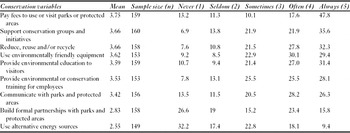
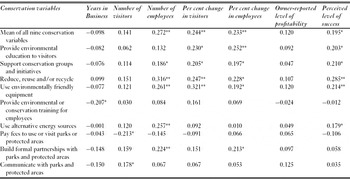
Most of the success and conservation variables demonstrated that commercially successful tourism entrepreneurs provided more benefits to conservation than less successful entrepreneurs (Tables 1–2). Several commercial success variables were correlated with the conservation index (Spearman rank p ≤ 0.05) (Table 3). The number of employees, the percentage change in number of visitors and employees, and the business's perceived level of success relative to other similar businesses were all positively correlated with the conservation index. Only the length of time in business, the number of visitors served over 12 months, and the owner-reported level of profitability were not correlated with the conservation index (Table 3). Overall, there was support for commercial success and the provision of conservation benefits being positively related to one another.
Mean and per cent distribution of conservation variables.

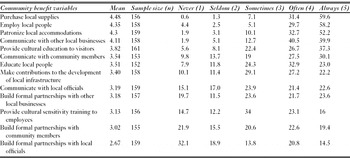
Mean and per cent distribution of community benefit variables.

Correlation coefficients for commercial success and conservation variables. **Correlation is significant at the p = 0.01 level (2-tailed). *Correlation is significant at the p = 0.05 level (2-tailed).

When examined independently, four conservation behaviours (providing environmental education to visitors, supporting conservation groups and initiatives, reducing, reusing and recycling, and using environmentally friendly equipment) were positively correlated with growth (both in terms of visitors and employees) and perceived business success (relative to other similar businesses). Additionally, three of these same conservation behaviours (supporting conservation groups and initiatives, reducing, reusing and recycling, and using environmentally friendly equipment) were also positively correlated to the size of a business (measured by the number of employees).
Commercial success and community benefits
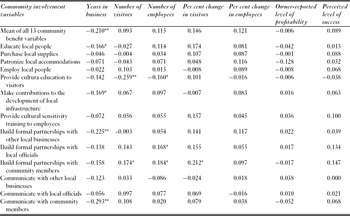
That commercially successful tourism entrepreneurs provide more benefits to local communities than less successful entrepreneurs was scarcely supported by the data. Only one commercial success variable (length of time a business had been in operation) was negatively correlated (Spearman p < 0.01) with the index for community benefits/involvement (Table 4). The longer a business had been in existence, the less involved it was in the local community. None of the other six commercial success variables were significantly related to the community benefits index.
Correlation coefficients for commercial success and community benefit/involvement variables. **Correlation is significant at the p = 0.01 level (2-tailed). *Correlation is significant at the p = 0.05 level (2-tailed).

Only two community benefit variables (building formal partnerships with local officials and building formal partnerships with community members) were positively correlated with any of the commercial success variables (Table 4). These community benefit variables were related to the size of a business (the number of visitors and the number of employees) and the growth of the business, in terms of the per cent change in the number of visitors served. Of the 13 community benefit variables, six were not significantly correlated with any of the seven commercial success variables. Another five community involvement variables (educating local people, providing cultural education to visitors, making contributions to the development of local infrastructure, building formal partnerships with other local businesses, and communicating with community members) were negatively correlated to the various commercial success variables. In general, the results of this study demonstrate there is not a positive relationship between commercial success and the provision of community benefits.
DISCUSSION
A relationship existed between commercial success and conservation behaviour, but commercial success was not associated with providing benefits to, or being involved with the local community.
In general, as Costa Rican tourism businesses become more successful, they are more likely to perform behaviours that benefit conservation. For example, supporting conservation groups and initiatives, reducing, reusing and recycling, and using environmentally friendly equipment were correlated with the size, growth and perceived relative level of success of the business as compared to similar businesses. Essentially, these three behaviours require either direct financial costs or the use of employees' time to conduct these activities. As businesses grow and succeed, they are better able to perform these behaviours, especially if they have staff available to lead and conduct these efforts. In fact, results show that increases in the number of employees and the per cent change in employees and visitors were directly related to these behaviours.
Although there are a variety of reasons why entrepreneurs decide to practise these behaviours, providing benefits to conservation might actually help businesses succeed commercially. The typical Costa Rican nature-based tourist expects, and might even demand, that operators and agencies provide tours and services that benefit conservation. The most frequently significant conservation behaviours related to commercial success are actions that are both the most visible, or obvious to customers, and the simplest to perform. Meeting these customer demands and expectations would then lead to greater commercial success. This rationale easily fits within the market driven perspective as described by Cater (Reference Cater and Higham2007), and shows that the tourism businesses surveyed in this study believe these conservation behaviours have an economic value. However, the provision of benefits to local communities could be under appreciated, or not widely recognized by nature-based tourists, leading to a less direct relationship between commercial success and the provision of community benefits. As the social objectives of ecotourism are made more apparent to tourists, the relationship between commercial success and community benefits could become more closely linked.
Although this study did not find a relationship between commercial success and the provision of benefits to local communities, the data revealed that the vast majority of tourism businesses surveyed do provide benefits to local communities regardless of their level of commercial success. In the case of certain community involvement variables (purchasing local supplies, employing local people, patronizing local accommodations and communicating with other local businesses), the percentage of businesses that often or always practise these behaviours exceeded 80% (Table 2). For the remainder of the 13 community benefit variables, at least 35% of businesses reported they often or always practised these behaviours (Table 2). Therefore, although there was not a link between community involvement and commercial success, most tourism businesses reported that they provided some of these benefits regardless of their level of commercial success.
Since Costa Rica does not have a large indigenous community, and its government has been fairly stable and democratic for decades (Honey Reference Honey2008), local residents are accustomed to market-driven approaches to economic development, and are trained and prepared to work in the tourism industry. Therefore, new and developing tourism businesses can rely on local residents for labour and local businesses for supplies, which could mean that it makes sense to remain local, regardless of whether or not it results in improved commercial success.
Although the results of this study were clear, there are several important limitations. As a result of the difficulties noted by past research in obtaining accurate data regarding revenue and profitability (Cragg & King Reference Cragg and King1988; Sapienza et al. Reference Sapienza, Smith and Gannon1988; Covin & Slevin Reference Covin and Slevin1989; Dess & Robinson Reference Dess and Robinson1984; Haber & Reichel Reference Haber and Reichel2005; Coviello et al. Reference Coviello, Winklhofer and Hamilton2006), we used the number of visitors as a proxy for revenue, and measured profitability on a five-point owner-reported Likert scale. However, there could be problems inherent in these choices, particularly since owner-reported profitability was the only dimension of commercial success not found to be significantly related to any of the nine conservation or 13 community benefit variables (Tables 3 and 4).
Another significant limitation of this study is that only self-reported data was gathered from business owners. We did not attempt to verify or triangulate this information with other sources. This study could be improved by the use of additional methods, such as participant observation, and visitor, community or employee surveys to verify the information provided by the business owners. Future research should address this need.
CONCLUSIONS
The commercial success of tourism businesses in Costa Rica is more strongly tied to the provision of conservation benefits than to that of community benefits. Although this might not hold true in other parts of the world, our study shows that Costa Rican tourism businesses can be successful and work to conserve the environment, a major premise of the ecotourism concept. However, our results, and the Costa Rican example in general, might not be applicable to other developing countries and communities where market-based strategies, such as tourism, are not accepted methods for conservation and community development, and therefore may be inappropriate for improving community well-being (Neves-Graca Reference Neves-Graca2004; Cater Reference Cater and Higham2007). Tourism's role as a conservation and development tool must be re-examined throughout the world, and different methods should be used to evaluate whether tourism can achieve the conservation and development objectives of local people. In a country like Costa Rica, which has a long history of using tourism as a conservation and community development tool, this study showed that tourism can benefit the environment and local people.
ACKNOWLEDGEMENTS
We thank all the Costa Rican tour operators and agencies that participated in the study, Marianne Schmink, Robert Buschbacher, and Mickie Swisher for their guidance and support during the research project, the University of Florida's Center for Latin American Studies and the Tropical Conservation and Development Program for providing financial support for summer field work, and the School of Natural Resources and Environment for the graduate assistantship that made this work possible.