In Japan, the life convalescence of children with congenital cardiac disease has improved remarkably. Hence, there are thought to be more than 400,000 adults living with congenital cardiac disease, and this number is increasing by an estimated 5% per year.Reference Niwa1, Reference Niwa2 However, this means that the number of children with physical disability resulting from congenital cardiac disease is also increasing, and these children experience difficulties in school and social life. For adult patients with congenital cardiac disease, social independence is a major issue.
Congenital cardiac disease is present from birth. Therefore, patients have encountered stress related to the disease from childhood. Moreover, they have to keep dealing with such stress through their lives.
The present study of adolescents with congenital cardiac disease focuses on the sense of coherence and also on illness cognition, which influences the way in which patients manage their lives and cope with treatment.
Sense of coherence is a concept based on the theory of salutogenesis. It explains why people in stressful situations stay well and are even able to flourish.Reference Antonovsky3 It can be thought of as the ability to cope with stressors or the ability to keep one’s health. It is composed of three elements: comprehensibility, manageability, and meaningfulness. Comprehensibility: a belief that things happen in an orderly and predictable fashion and a sense that you can understand events in your life and reasonably predict what will happen in the future. Manageability: a belief that you have the skills or ability, the support, the help, or the resources necessary to take care of things, and that things are manageable and within your control. Meaningfulness: a belief that things in life are interesting and a source of satisfaction, that things are really worth it, and that there is good reason or purpose to care about what happens. Sense of coherence is formed by positive human experiences and can be reinforced by the successful experience of processing stress.
Illness cognition is a person’s perception of the consequences of a disease and their beliefs about that disease. Illness cognition in adolescents with congenital cardiac disease has six components: (a) hardships resulting from restrictions and limitations of illness; (b) positive acceptance of one’s illness; (c) the desire to be understood by others; (d) anxieties about the state of the disease and possibility of death; (e) not wanting people to know of one’s disease; and (f) not wanting to take a burden on one’s body. Participants with more severe conditions score higher in (a), (c), (d), and (f) than those with milder conditions, whereas high school students score higher than junior high school students in (c) and (f).Reference Nio4
This study aimed to identify the influence of background factors and illness cognition on the sense of coherence in junior high school and high school students with congenital cardiac disease. The broader aim was to identify methods of support for strengthening the sense of coherence.
Participants and methods
Participants
Participants comprised junior high school and high school students with congenital cardiac disease, adolescents with congenital cardiac disease (n = 534), and without congenital cardiac disease, healthy adolescents (n = 406), aged 12–18 years.
Data collection
The study was conducted in 2006. The following data were collected:
• Basic attributes: Age, school year, and sex.
• Disease-related attributes: Type of congenital cardiac disease, presence and type of cyanosis, co-morbidities, medication use, number of hospitalisations, number of operations, classification on the school life management guidance list, and ability to take part in physical education.
• Sense of coherence: This was measured using the Japanese version of the 13-item Sense of Coherence Questionnaire for children; the reliability and validity of this questionnaire have been demonstrated.Reference Sakano, Togari and Yamazaki5 Permission for use was granted by the creator of the questionnaire. This questionnaire consists of 13 items applicable to children. It was developed based on two scales. One of them is age-adopted sense of coherence scale by Torsheim,Reference Tosheim, Aaroe and Wold6 which was modified from the sense of coherence-13 for adults developed by Antonovsky.Reference Antonovsky3 The other is a Japanese 29-item version for the elementary school upper grades modified by Hayashi,Reference Tosheim, Aaroe and Wold6 which was made from the sense of coherence-29 for adults developed by Antonovsky.Reference Hyashi, Kobayashi and Yamazaki7 It was translated into Japanese with some changes in phrasing related to the cultural context. Accuracy of the translation was confirmed by testing the questionnaire on a junior high school student who had English as their native language but who had Japanese parents who back-translated the 13 translated items.
The questionnaire has the following sections: (a) comprehensibility (five items), (b) manageability (four items), and (c) meaningfulness (four items). Each item was scored on a 5-point scale from “almost never” (1) to “almost always” (5). The total score and sub-scores for comprehensibility, manageability, and meaningfulness were calculated.
• Illness cognition: A 34-item illness cognition questionnaire for which reliability and validity had been demonstrated was used.Reference Nio4 The original questionnaire has 55 items, and the present 34 were chosen according to factor analysis – principal factor method, promax rotation – with a factor loading of 0.4 as the cut-off. Internal consistency was evaluated with Cronbach’s α, and the coefficient of correlation was calculated by test–retest reliability. The questionnaire contained the following sections: (a) hardships resulting from restrictions and limitations of illness (10 items), (b) positive acceptance of one’s illness (11 items), (c) the desire to be understood by others (five items), (d) anxieties about the state of the disease and the possibility of death (three items), (e) not wanting people to know of one’s disease (three items), and (f) not wanting to take a burden on one’s body (two items). Each item was answered on a 5-point scale. Only adolescents with congenital cardiac disease were asked to complete this questionnaire.
Questionnaires were mailed to the adolescents with congenital cardiac disease identified by branch offices of a patient self-help group. Participants completed the forms at home, sealed them, and then sent them back to the researcher. The questionnaires that were sent to healthy adolescents were either mailed back by the participants or collected in a classroom box, depending on the instructions of the school principal.
Data analysis
We investigated the relationship between the sense of coherence, basic and disease-related attributes, and illness cognition in healthy adolescents and those with congenital cardiac disease. Statistical analysis comprised Mann–Whitney U tests or Kruskal–Wallis tests, with Bonferroni’s correction for multiple comparisons. p < 0.05 was taken to indicate statistical significance. SPSS 16.0J for Windows was used for statistical interpretation. The following points were investigated:
• The influence of background factors on the sense of coherence in adolescents with congenital cardiac disease.
• The difference in the sense of coherence between healthy adolescents and adolescents with congenital cardiac disease.
• The influence of illness cognition in the sense of coherence in adolescents with congenital cardiac disease.
Ethical considerations
A letter requesting participation in the investigation was attached to the questionnaire. This was addressed to the legal guardians too, because the participants were 18 years old or younger.
The letter explained the purpose and methods of the investigation, the investigation contents, that participants could participate of their own free will and had the right to withdraw at any stage of the investigation, anonymity of responses, that data would be used only for the study purpose, that contents identifying an individual would not be published, and that personal data would be destroyed after the end of the study.
Return of the questionnaire was considered to indicate consent to participate. This study was approved by the medical ethics committee of the Medical Department, Osaka University, Japan.
Results
Participant background
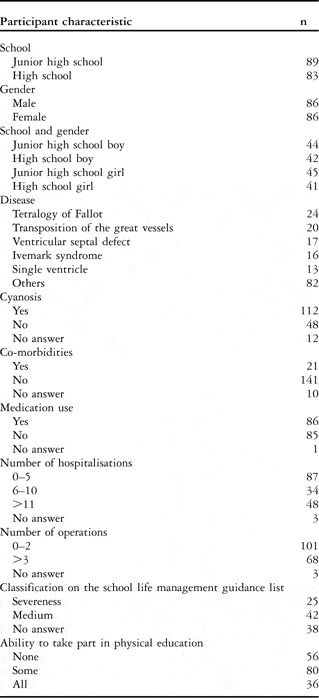
A total of 193 adolescents with congenital cardiac disease participated, response rate was 36.1%, of which 21 forms with incomplete data were excluded. Therefore, data from 172 participants were analysed. The average age was 14.7 plus or minus 1.7 years.
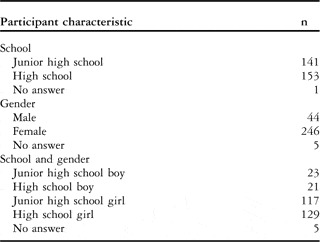
A total of 295 healthy adolescents participated, response rate was 73.6%, and all responses were analysed. The average age was 14.7 plus or minus 1.8 years. Tables 1 and 2 show participant background.
Characteristics of participants with congenital cardiac disease (n = 172).

Characteristics of healthy participants (n = 295).

Internal consistency among the sense of coherence
Score consistency was evaluated using Cronbach’s α. In the congenital cardiac disease group, Cronbach’s α was as follows: total, 0.85; comprehensibility, 0.74; manageability, 0.70; and meaningfulness, 0.70. In the healthy group, Cronbach’s α was as follows: total, 0.80; comprehensibility, 0.80; manageability, 0.61; and meaningfulness, 0.68.
Influence of background factors on the sense of coherence in adolescents with congenital cardiac disease
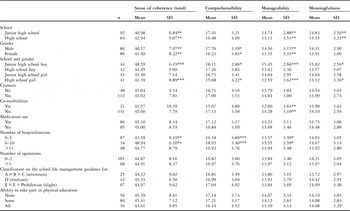
With regard to basic attributes – age, school year, and sex – junior high school students scored higher than high school students for total sense of coherence, manageability, and meaningfulness. Boys scored higher than girls for total sense of coherence, comprehensibility, and manageability, and junior high school boys scored higher than high school girls for all sections.
With regard to disease-related attributes, those with no co-morbidities scored higher for manageability. Those who were hospitalised six to ten times scored higher than those who were hospitalised zero to five times for total sense of coherence, comprehensibility, and manageability (Table 3).
Influence of background factors on sense of coherence in adolescents with congenital cardiac disease.

Mann–Whitney U test, Kruskal–Wallis test, revision by Bonferroni’s inequality in multiple comparison. *p < 0.05, **p < 0.01, ***p < 0.001
Differences in the sense of coherence among healthy adolescents and those with congenital cardiac disease
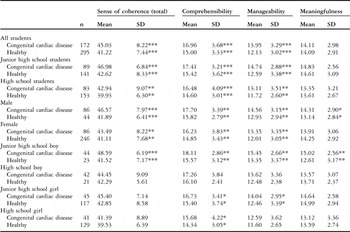
When the congenital cardiac disease group and healthy group were compared, the congenital cardiac disease group scored higher for total sense of coherence, comprehensibility, and manageability. This was true for all students, junior high school students, high school students, boys, girls, and junior high school boys. Furthermore, with boys and junior high school boys, the congenital cardiac disease group scored higher for meaningfulness. With junior high school girls, the congenital cardiac disease group scored higher for comprehensibility and manageability. For high school boys, no significant differences were apparent (Table 4).
Sense of coherence in adolescents with and without congenital cardiac disease.

Mann–Whitney U test. *p < 0.05, **p < 0.01, ***p < 0.001
Relationship between illness cognition scores and sense of coherence scores in adolescents with congenital cardiac disease
Participants with congenital cardiac disease were divided into two groups for illness cognition above and below the average, respectively; the former of which is called high-score group, and the latter is called low-score group. The sense of coherence score was compared in these two groups.
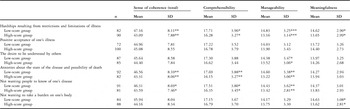
Illness cognition scores were significantly related to sense of coherence scores as follows: low scores for “hardships resulting from restrictions and limitations of illness” were significantly related to higher scores in all sense of coherence elements; lower scores for “the desire to be understood by others” were associated with significantly higher scores for “manageability”; and low scores for “anxieties about the state of the disease and the possibility of death” and “not wanting people to know of one’s disease” were related to significantly higher scores for total sense of coherence, comprehensibility, and manageability (Table 5).
Difference in the sense of coherence score according to illness cognition score.

Mann–Whitney U test. *p < 0.05, **p < 0.01, ***p < 0.001
Discussion
Influence of background factors on the sense of coherence in adolescents with congenital cardiac disease
For several coherence elements, boys scored higher than girls, and junior high school students scored higher than high school students.
Okamoto noted that decision-making in adolescence is important with regard to choice of occupation, marrying, and becoming a parent.Reference Okamoto8 On entering high school, students are confronted with many decisions and this process can be difficult. Adolescents with congenital cardiac disease must make choices that take into consideration their physical ability both now and in the future. A low total sense of coherence score may be exhibited by those adolescents who feel their future is compromised because of their cardiac defect.
When examining sex differences, the sum total of sense of coherence, comprehensibility, and manageability scores for boys was higher than for girls. Britta and MonicaReference Britta and Monica9 found that sense-of-coherence scores for 14- to 15-year-old girls were lower than for boys. Secondary sex characteristics develop much sooner in girls than in boys. Women with congenital cardiac disease experience an underlying sense of being, “at war” with or living against their bodies.Reference Gantt10 Body image issues may be exacerbated in adolescent girls with congenital cardiac disease because of scars as a result of multiple procedures. These stresses may reduce the sense of coherence in adolescent girls. Body image may not be an issue for adolescent boys. They may be more optimistic than girls and therefore score higher on sense-of-coherence questionnaires.
Co-morbidities and the number of hospitalisations had a significant influence on the sense-of-coherence scores. Co-morbidities were associated with a lower score for total sense of coherence and manageability. This may be because the life restrictions by these co-morbidities interfered with the ability to deal with stress. However, manageability scores were higher for those with six to ten hospitalisations compared with those with zero to five, suggesting that moderate stress promoted manageability.
None of the other background factors were shown to influence the sense of coherence in this study. Hence, disease severity does not seem to influence the development of the sense of coherence. As congenital cardiac disease is present from birth, patients tend to develop a sense of normalcy in coexisting with a disease in the long term. For example, patients make statements such as “life with the disease is just my life”, “Generally, I am the same as other people”, “The disease is one’s characteristic”, and “I am normal”.Reference Nio and Fujiwara11–Reference Takahashi13
In addition, disease severity is determined objectively and differs from the subjective perception of health. A previous study showed that recognition of health and the burden of symptoms are not related to the disease state as evaluated by a doctor. Instead, these aspects seem to be strongly related to the degree to which the disease interferes with social relationships.Reference Kendal, Lewin and Parsons14 Therefore, the sense of coherence is determined from feelings of restrictions and limitations from illness rather than from disease severity. Adolescents with congenital cardiac disease may think that they have mild disease compared with others.Reference Nio4 This may prevent them from taking the disease seriously. It may be a characteristic of congenital diseases that affirmative psychological ability is not affected by disease severity.
Differences in the sense of coherence among healthy adolescents and adolescents with congenital cardiac disease
This study showed that the sense of coherence was higher in the congenital cardiac disease group than in the healthy group. Adolescents with chronic illness experience ongoing stress in their daily lives. In particular, they feel stresses related to physical limitations by the disease and medical treatment.Reference Nakamura, Kanematsu and Takeda15 It seems that the sense of coherence is reinforced through successful processing of these stresses. These findings are similar to those from studies of resilience; students with congenital cardiac disease have greater resilience than healthy students.Reference Nio16
Congenital cardiac disease patients often require repeated hospitalisations and multiple operations. Sense of coherence has been conceptualised as the ability to tackle stress in a positive manner so that stressors promote personal growth. It is influenced by human experience, in other words by interacting with the environment, and it is learned and formed. It therefore seems that experiencing illness as a part of life can positively influence personal growth. However, it means that they must be able to make sense of their world.
Relationship between illness cognition and sense of coherence in adolescents with congenital cardiac disease
Those who scored high for “hardships resulting from restrictions and limitations of illness” scored poorly for all sense-of-coherence elements. Moreover, those who scored high for “anxieties about the state of the disease and the possibility of death” scored poorly for total sense of coherence, comprehensibility, and manageability.
In adolescence, school and peers are the main focus of life. Restrictions and limitations posed because of illness decrease the feeling of a meaningful life. Congenital cardiac disease is present from birth. Parents are the recipients of the explanation of their child’s illness. If this information is not passed on to the adolescent at the appropriate stage of development, the adolescent may experience anxiety about the state of their condition. They cannot then make sense of their world and this will reduce the comprehensibility and manageability elements.
Those who scored high for “the desire to be understood by others” scored poorly for manageability, and those who scored high for “not wanting people to know of one’s disease” scored poorly for total sense of coherence, comprehensibility, and manageability.
IshikawaReference Ishikawa17 has shown that there is a relationship between self-disclosure and social support. Those who scored low for “not wanting people to know of one’s disease” can freely discuss their illness with friends, and this is likely to result in greater social support and the sense of having enough resources, including friendships, to deal with life. Conversely, those scoring high for “the desire to be understood by others” are unlikely to obtain enough social support. In this way, it seems that lack of support from others decreases manageability.
Methods of supporting sense of coherence in adolescents with congenital cardiac disease
Those who scored low for “hardships resulting from restrictions and limitations for illness”, “anxieties about the condition of disease and the death”, or “not wanting people to know of one’s disease” tended to have higher sense-of-coherence scores. This indicates that supporting the development of sense of coherence may promote affirmative illness cognition. A study investigating illness cognition and resilience in the same group of participantsReference Nio18 showed that the sense of “I am” (internal strength) was high in those who scored poorly for “hardships resulting from restrictions and limitations for illness”, “anxieties about the condition of disease and the death”, and “not wanting people to know of one’s disease”. Hence, supporting the development of the sense of coherence may promote this personal internal strength.
Sense of coherence in adolescents with congenital cardiac disease was higher than that in healthy adolescents, reflecting the fact that the sense of coherence is strengthened by repeated successful experiences in handling stress. This may be similar to the situation in patients with type 1 diabetes mellitus who must confront various problems from later in childhood and are thought to deal well with psychological problems in adolescence.Reference Yokota and Matsuura19 This indicates the importance of dealing with stressors in the illness experience. Therefore, efforts to remove stressors by overprotection are not necessary. Instead, we should keep an eye on children who are attempting to deal with stressors by themselves and offer help if required.
Children and adolescents with congenital cardiac disease have poorly developed self-efficacy and self-concept.Reference Gantt10, Reference Salzer-Muhar, Herle and Floquet20 The present finding of a strong sense of coherence seems to contradict this, but it can be understood as follows. Self-efficacy and self-concept consist of trust in oneself. Although the sense of coherence relies on trust in the environment, including the social support network, family, and peer group,Reference Ishikawa17 it is a concept connected with “interaction with and dependence on the environment”. In adolescence, which is the transition from childhood to adulthood, factors important in reinforcing the sense of coherence are school life, family life, and social support.Reference Kamiduka, Kobayashi and Yamazaki21
For young people with congenital cardiac disease, support and understanding from parents, friends, and teachers are crucial.Reference Kendall, Sloper and Lewin22 The amount of required social support is related to the extent of self-disclosure.Reference Ishikawa17 It is therefore important that adolescents with congenital cardiac disease feel supported and cared for by their parents, family, friends, and teachers.
Limitations
Participants in this study were members of a patient self-help group; therefore, awareness of the disease was high. Research into those who are not members of such groups will be necessary in future. In addition, this study had no comparison group for illness cognition. Therefore, it is hard to determine whether illness cognition was adequately assessed with regard to the specific characteristics of adolescents with congenital cardiac disease. Inclusion of a group with another chronic disease will be necessary in future research.
Conclusion
• Sense of coherence was higher in boys than girls and in junior high school students than high school students.
• Sense of coherence was higher in students with congenital cardiac disease than in healthy students.
• With regard to illness cognition, low scores for “hardships resulting from restrictions and limitations of illness”, “the desire to be understood by others”, “anxieties about the condition of disease and the death”, and “not wanting people to know of one’s disease” were related to a high sense of coherence.
This study expanded on and revised part of my doctoral dissertation submitted to the Course of Health Science, Graduate School of Medicine, Osaka University. This dissertation was presented at the 27th Academic Conference of the Japan Academy of Nursing Science in 2007.