Introduction
The beginning of the end of the Age of Exploration may be traced to the last decades of the nineteenth century. The last “blank spaces of the earth” were, at the time, the object of intensive geographic prospections and of reclamations by European and U.S. powers. The period saw the heightening of the race for territories and resources, such as the so-called scramble for Africa. Across the planet, this competition brought a series of cycles of extractive booms, many of them brutal. The period was marked by an international “open door” policy, understood as “free access” to natural resources, driven especially by the United States and the UK.Footnote 1 Its protagonists were not metropolitan States and their armies; they were, instead, a series of companies that, following the model of colonial concerns such as the East India Co. or the VOC,Footnote 2 were incorporated in order to “open up” fresh lands and resources to civilization (that is, to capital). This gave rise to a new type of corporation that, following the lead of the pioneering railway companies, were no longer tied to a single goal or a particular place. They operated all over the planet, relieved of the restrictions of the borders of old colonial territories, and behaving as though these regions were the natural extension of their metropolitan territories.Footnote 3
South America was not the exception. From the Compañía Francesa del Río Sinú in northern Colombia to the Sociedad Exportadora de Tierra del Fuego in Patagonia, companies mushroomed, seeking to exploit different types of charters and concessions for the use of the soils and resources in “uncultivated” lands. This process was simplified by the predominance of ideas of economic deregulation, by virtue of which states (both the powerful imperial States and the “weak” and willing ones of the then current and old colonies) enabled both investment (through questionable financial instruments) and the operation of these companies in their extractivist activities without considering their social or environmental costs.
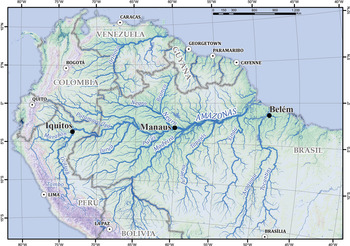
In this article, I trace the case of one of these companies, the Peruvian Amazon Co., incorporated in 1908 as a financial instrument to extract rubber, one of the most promising materials of the time and a central commodity for the automotive industry—in turn, one of the most innovative and iconic of the modern world. Its business was to extract and export “wild rubber” from an extensive section of the Amazon: the Putumayo region, located in the interfluves of the Caquetá, Putumayo, and Amazon rivers in the present-day territory of Peru and Colombia, at the time in dispute between the two countriesFootnote 4 (see maps 1 and 2). Despite the fact that the extraction of natural rubber in the Amazon has been the object of great interest, perhaps because of what Fifer considers its “innate dramatic quality, [and its] extraordinary touches of the bizarre,”Footnote 5 the case of Putumayo has been rendered invisible in the history of the industry,Footnote 6 as it has been thought of as an exceptional caseFootnote 7 that can be readily ignored.
To explore it, I turned to a primary source: the ethnographic account of the experience of the extraction, gathered in situ, by Roger Casement (1864–1916). This Irishman, an officer of the British diplomatic service, was stationed as consul general in Rio de Janeiro when the foreign office entrusted him to write a report on the conditions surrounding the production of wild rubber in Putumayo. By then, Casement was already a notorious figure,Footnote 8 as he had carried out similar research in the Free State of the Congo—the name given by Leopold II of Belgium to the large territory that he managed as his private warren—in which he exposed “the slavery, mutilation, and torture of natives in the rubber plantations.”Footnote 9
Both his field journal and his report to the British ParliamentFootnote 10 constitute a privileged source. Although their central purpose was to report on the brutal conditions of Putumayo, which he considered as a “crime against humanity”; Casement (henceforth RC) does not focus exclusively on its horror. Rather, he brings forth a detailed depiction of the company’s everyday practices, shedding light on the connection between the two. Based on direct observation, interviews, and life stories, his account can be considered an ethnographic document, in that he seeks to approach what “specific people say, what they do, what is done to them” and what this experience means to them, configuring what ethnographers call a “thick description.”Footnote 11 By inserting in my text a collage of Casement’s observations, I will explore the two issues I address in this article: the role of credit and debt in the operation of the company and in Putumayo’s wild rubber economy, and the social relations they made possible; and the meaning of forced credit for those involved in the extractive process.
After situating rubber in the context of the global economy, in the second part of this article I will present, through Casement’s account, a general description of the everyday operation of the Peruvian Amazon Co., showing how its organization did not depend on technology or on infrastructure but, rather, on the flow of merchandise credit. The third part will focus on its credit/debt practices. I will discuss debt-peonage as the form of labor privileged by the wild rubber industry in the Amazon and show how it works when indigenous peoples and their territories are involved, as was the case in Putumayo. I will argue that the concept of debt-peonage is misleading in this situation, as it obscures both the conditions and the relations into which the Indians, as a society, were forced. I will highlight how debt constituted both physical and symbolic violence, and show how credit and debt, usually considered to be one of the engines of capitalism, were here at the core of a system that was not only opposed to the market logic, but also to the possibility of developing a modern local economy.
This “counter fetishist” perspective, to use Coronil’s term,Footnote 12 is essential to reflect on the new extractivist boom experienced by Africa, Asia, and Latin America today. The case of Putumayo, as a particularly painful paradigmatic example, may serve a comparative function with the new “resource frontiers,” opened since the late twentieth century by corporate transnationalism. It may also broaden the perspective of the enterprises involved in extractive economies that have to “deal” with indigenous populations, as it shows the extent of its social and cultural implications. Unravelling its basic forms may thus contribute to the identification of the continuities and ruptures of the extractivist model that has always been at the core of global capitalism.
Where Rubber Meets Road
Rubber (or latex) is a substanceFootnote 13 that can be obtained from many plants of different genera or families. In many regions around the world, it has historically been used for various purposes. Among Amazonian peoples, it is still used today to make a great variety of everyday artifacts (some surprising, like mirrors made with very thin polished layers of rubber). At the end of the eighteenth century, it began to be tested for its waterproof properties.Footnote 14 The problem of wild rubber was initially its sensitivity to temperature changes that altered its shape and consistency. In 1839, Charles Goodyear developed “vulcanization,” a process that modifies its chemical composition so that it could withstand extreme temperatures. Thus, natural rubber was used to produce hosepipes, waterproofing materials, shoes, soles, gaskets for steam engines, and electrical cable and wire insulations, among other products. The second technical innovation was introduced by John Dunlop, who, in 1888, invented the inflatable shock-absorbing tire. This was crucial in the popularization of the bicycle that, in turn, was the trigger for the “rubber boom.” In 1895, Michelin introduced a new tire for cars that took the demand to unexpected heights, especially after Ford popularized the automobile with the introduction of his Model T in 1908, making it affordable for middle-class pockets.
The demand for rubber shot up after 1890 to maintain the factories of companies such as Michelin in France (1889), Pirelli in Italy (1872), Dunlop in Great Britain (1889), and Goodyear (1898) and Firestone (1900) in the United States. These were considered as being among the leading companies of the Second Industrial Revolution, characterized by the mass production of standardized goods through economies of scale and the application of science and technology in the creation of new processes, products, and components. Although rubber was soon employed for multiple uses and applications in various industrial processes—such as the automated rubber assembly line itself (invented by Ford in 1913), machine belting and tubing, electrical and telecommunications networks—the driver of its monumental demand was, undoubtedly, the automobile industry and the lifestyle it evoked.
From 1870 to 1914, the countries of the Amazon basin (see map 1) produced around 70 percent of the wild rubber supplyFootnote 15 (different species of the Hevea genus, mainly H. brasiliensis, known as “Para fine rubber,” considered of the best quality and productivity).Footnote 16 When European commercial establishments attempted to acquire vertical control on the production of wild rubber in the Amazon, the main obstacle they came up against were groups of local merchant-barons or patrones who controlled the flow of wild rubber through chains of credit/debt relations. They soon realized that “capital alone would not permit them to pre-empt [these] local traders, since they frequently dominated local politics”Footnote 17 and, in many cases, the international policies of their countries. European and North American capitalists therefore developed an association scheme with the local merchant-barons by creating firms such as the Peruvian Amazon Co.Footnote 18 as financial instruments. These companies operated through a system that adopted various formsFootnote 19 and involved different indigenous populations, caboclos or mestizos, and dispossessed peasant-settlers in the main production zones of the “rubber rivers” in the Amazon and the Upper Orinoco.Footnote 20 The extracted rubber converged in the axis made up of three entrepôt cities along the course of the Amazon: Iquitos, Manaus, and Pará (today Belem), its main export center where it embarked toward the different routes of the Atlantic. This is why, although it also came from the Amazonian territories of Peru, Ecuador, Colombia, and Bolivia,Footnote 21 the statistics show only Brazil as the main exporter of wild rubber in the world.
The Amazon basin. Authors: Margarita Serje and Fernando Salazar.

With the emergence of rubber consumption associated with the automotive industry, Brazilian exports to the United States (soon consolidated as the most important rubber market) increased from 200 tons in 1830 to 17,000 in 1890.Footnote 22 By then, not only had rubber prices risen considerably, but, in response, rubber plantations began to be established in Asia. A few years earlier (in 1876), H. Wickham, a British explorer, had pirated Hevea brasiliensis seeds from Santarem in Pará to Kew Gardens in England.Footnote 23 The seedlings were subsequently sent to India, Ceylon (today Sri Lanka), Indonesia, and Malaysia. At this point, when prices were rising and the demand seemed to be insatiable, the British and the Dutch set the power of their imperial States into operation and mobilized both their sources of capital and their vast colonial reserves of a captive and cheap labor force to create a low-cost plantation industry which gave rise to what today has been characterized as a “rubber cluster” in Southeast Asia. Singapore became the epicenter of the plantations in Peninsular Malaysia and on the island of Sumatra, at the time under the colonial rule of the British and the Dutch respectively.Footnote 24
The year 1909 saw the beginning of the arrival of substantial volumes of rubber from Asian plantations, and it became evident that either the price of the extraction of “wild rubber” would drop or it would be displaced. To “produce” at a lower cost was imperative to competing in the new international environment. By 1914, when the First World War broke out, “unlike any of the other primary export products from tropical trees, rubber came to be considered a “strategic material” in the minds of American military and foreign policy planners. … The materials designated as strategic were primarily metals, but they included petroleum and rubber. From World War I on, rubber imports were assigned an importance not given to any other tropical crop.”Footnote 25 This consolidated the longevity of the merchant-barons and their system in the “rubber rivers” of the Upper Amazon, which survived well into the 1940s despite the fact that the market percentage it retained steadily diminished.Footnote 26
The Peruvian Amazon Co.
The twentieth century began with rumors in the international press about the exploitation of “natives” in wild rubber extraction: first in Congo, with Leopold II under the watchful eye of rival powers in Europe, then in Putumayo, where the existence of a “British-owned Congo” was reported Footnote 27 under the rule not of a despot but of an English company that had colonial subjects among its workers, doomed, together with the native population, to abuse and mistreatment. The British foreign office decided to create a commission to investigate, between 1910 and 1911, the operation of the Peruvian Amazon Co. and designated Roger Casement as one of its members, together with Henry Gielgud, the company’s secretary; Walter Fox a botanist, specialized in rubber, who had been superintendent of the Penang Botanic Gardens (Malaysia); Louis Barnes, an expert in tropical agriculture with experience in Africa and South America; Seymour Bell, a merchant, and Colonel Reginald Bertie of the Royal Welsh Fusiliers.Footnote 28 As revealed by the composition of the team, the mission had an explicitly commercial purpose. However, secretly, it had a second objective that RC was in charge of and that had been concerted between the Anti-Slavery and Aborigines Protection Society and the British foreign office: that of exploring the social conditions surrounding rubber extraction. Thus, Casement’s participation in the commission had what would today be considered a humanitarian objective, as it sought to investigate the “treatment of British colonial subjects and native Indians employed in the collection of rubber in Putumayo.” The commission’s double nature (commercial and humanitarian) is reflected in Casement’s report in which, as well as uncovering the brutality of the exploitation, he provides a blunt description of the concrete practices through which the business operated. Although RC’s report on Putumayo has been read fundamentally as an exposure of the atrocities carried out by the rubber barons and considered mainly a testimonial of their “culture of terror” and its “spaces of death,”Footnote 29 here I will attempt to lift this veil of horror in order to gather his methodical description of what he called the “rubber system.”
The company in question originated from the Peruvian firm Arana Hnos., a venture created to supply the early “white” settlers in the Putumayo around 1886. These had prospered “not without bloodshed and many killings of the Indians, into a widespread series of Colombian settlements along the banks of the Caraparaná and Igaraparana, and even in the country stretching between the latter river and the Japura, and on the upper waters of the Cahuinari” (9:28).Footnote 30 It is estimated that by 1901, there were fifty-two Colombian rubber warehouses or barracones between the Caquetá and Putumayo rivers.Footnote 31 Commerce with these settlers was based on a chain of credit/debt, euphemistically known as a “system of dealings” in which a credit in the form of merchandise was advanced. The merchandise was transported by river in steam-powered crafts, making investment in navigation crucial. The supplier delivered a down payment in-kind which had to be paid back in the future, also in-kind, with rubber. The prices, terms, and interest rates of the down payment were established by the provider himself, thus “getting the person working for you into your debt and keeping him there” (8:10–11). The whole assemblage of the rubber businesses depended fundamentally on these “dealings.”
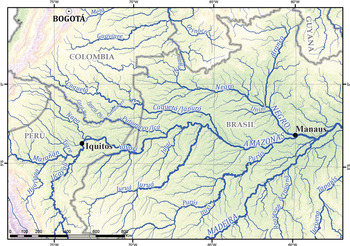
In contrast to other areas in the Amazon where laborers were mainly migrant workers from other regions, in Putumayo and, more generally, in the Upper Orinoco and the Amazon/Rio Negro macro basins—an area usually referred to as Northwest Amazonia (see map 2)—there was a strategic advantage constituted by the large Indian population that had not been decimated by the advances of slave traffickers and Luso-Brazilian settlers of the seventeenth and eighteenth centuries. Given that forest Indians have traditionally been represented in Western imaginary as the archetype of the savage, they had to be “civilized.”Footnote 32 That is, they were to be “conquered” in order to appropriate “anything their forest and their labor could produce for the market.”Footnote 33
Northwest Amazonia. Authors: Margarita Serje and Fernando Salazar

Arana Hnos. was able to stop acting “merely as an intermediary” once they acquired “possession of the majority of the Colombian undertakings in these regions. These transfers were sometimes effected by sale and purchase and sometimes by other means” (8:10). Needless to say “the Indians went along with the trading establishments” (9:28). With this move, the company reached a turning point and consolidated as an economy of scale rationalizing the extraction, transport, and trade of rubber in this vast rainforest area. To make its operations more efficient, Arana Hnos. hired two hundred men from Barbados (the “British colonial subjects” object of the commission’s report) to serve as overseers. It was already customary in the region to import laborers from Barbados,Footnote 34 many of whom came from the construction of the Panama Canal. By 1906, the company had become the main rubber trader in Iquitos, with over a third of the exports leaving from this port via the Amazon River to Antwerp, Liverpool, Le Havre, and New York, the main rubber ports at the time. Once it was positioned as the main rubber exporter of the Peruvian Amazon, Arana turned to London to capture British capital, and, in 1907, created the Peruvian Amazon Rubber Co., which changed its name to Peruvian Amazon Co. in 1908. The new company bought the Arana Hnos. shares and constituted itself as a limited company, registered in London, with English directors and shareholders, capital of one million pounds, and Arana as operations manager—operations that RC describes in detail, showing their spatial and temporal organization.
The company had two headquarters on the Amazon River: one in Manaus, in charge of the commercial side of the business (acquisitions and merchandise imports and rubber exports); and the other in Iquitos, the operations headquarters for the Putumayo region, where it had thirty stations with ports and barracones (that served as housing, offices, and warehouses). These were organized as a hierarchical network of collection and supply points, distributed in two “districts”: La Chorrera on the Igaráparaná and El Encanto on the Caráparaná, the main tributaries of the Putumayo. In each district, there was a central station that controlled a number of “dependent stations, termed locally as ‘sections,’ which, with further branch dependencies of their own, collect, through the neighboring Indians, as much India-rubber as these people can be forced or induced to gather. The rubber so collected is transported, partly by water and partly by land, on the backs of the Indians, about every three months to La Chorrera, whence it is shipped in one of the company’s vessels to Iquitos” (8:9).
The rhythm of the stations and their dependent “sections” was established by the moments of the rubber collection process known as the puestas, “literally a setting down of the rubber, [that] took place every fifteen or, perhaps, twenty days, according to locality.… When the full quantity of, say, five ‘puestas’ had been thus brought in, the whole rubber-working population of the section—men, women, and children—were marched down with this ‘fabrico’ [either] to La Chorrera” (9:49) or El Encanto. “A ‘fabrico’ of rubber would represent anything from 50 kilog. up from each Indian, according to his capacity to gather it …, sometimes “even up to 80–100 kilog., more than could be carried by a single individual. In such a case the Indian would have his wife and children to help in carrying it” (9:51).
More importantly than the rubber trees, the real nucleus of this setup was Indian labor. The true attraction “was not so much the presence of the scattered Hevea braziliensis trees throughout this remote forest as the existence of fairly numerous tribes of docile, or at any rate of easily subdued, Indians” (8:9–10). Their task was to locate and tap the rubber trees, which implied making incisions in the bark from where the latex flows, which then coagulates naturally forming long strips of rubber that are then washed to eliminate impurities and rolled into bundles, known as bolachas. The company’s “laborers” were therefore the Indians, who were “bound” through a process known as the conquista, which was achieved by means of human hunting expeditions or correrías, in which “the civilised appropriated them to their own exclusive use along with the rubber trees that might be in the region they inhabited” (8:10). The conquista commodified the Indians, turning them into available and disposable raw material, “not by persuasion, or supported by the offer of barter-goods in exchange for what was required of the Indian, but enforced upon him, his wife, and children by absolutely illegal and often terrifying methods” (8:9). Casement characterizes it as a “system of armed extortion” (8:9).
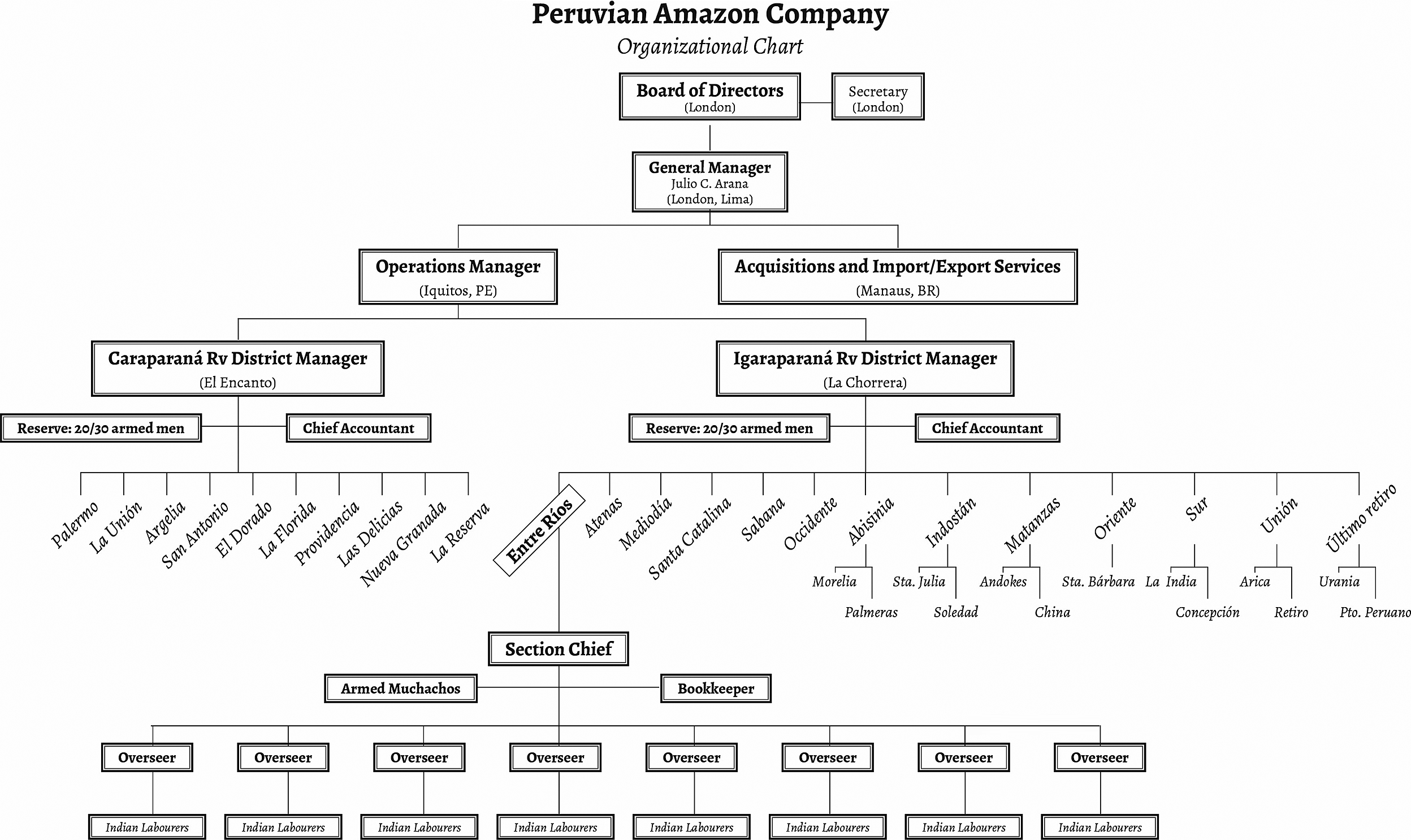
When RC describes the company’s organizational structure, he reveals that it was not just about Indians and patrones. The company had a pyramidal organization chart with the managers in Iquitos and Manus at the top, followed by their main agents (among which there were various kinship relations): the managers of the two districts and the “section chiefs.” In each station, a group of “white” or “rational” employees worked as overseers, among which were Peruvian mestizos and the “blacks” imported from Barbados (see figure 1). It is worth noting that salaries were paid in-kind as advances in merchandise, and “the remuneration of the chief of section was … a percentage on the quantity of rubber he could obtain from his section and send to Chorrera” (9:86, 9:32). Besides, “every so-called civilised employee receives from the agent of the company, on arrival, an Indian woman to be his temporary ‘wife’ … Indian women were kept in stock at each station” (8:16) for this purpose.
Peruvian Amazon Co. Organizational Chart showing stations, substations, and their internal organization (through the example of Entre Rios Station). Casement estimated 1,500 “Indian laborers” working in the five stations he visited.
Sources: Casement, Correspondence Putumayo; Domínguez and Gómez, Economía. Authors: Margarita Serje and Manuel Salazar.

Given that the company’s productivity was based on the coercion of the Indians, all “civilized” employees “were armed with Winchester rifles, and never moved a step from their station without their rifle” (9:36). Hand in hand with the overseers, a number of Indians, known as muchachos, worked in all the stations. “Those young men—sometimes boys or cholitos—were being trained to oppress their countrymen in the interests of the ‘caucheros,’ [and] were generally … used in acts of terrorization in another district over people who were not their immediate kinsmen” (9:31). According to Casement, “The fighting strength [of a station] was composed of eleven armed ‘blancos’ (some of them ‘mestizos’ or half-breeds) regularly engaged as a civilised salaried staff, and of twelve armed native Indians who in the first instance were press-ganged, and were not paid any regular or moneyed wage at all. The total armed force engaged in coercing the Indians in the ten sections might therefore be put at 100 ‘blancos’ or ‘racionales’ (of whom fifteen were Barbados men at the time I visited the country), and possibly 200 armed ‘muchachos’ with an additional reserve force of from 20 to 30 ‘blancos,’ and plenty of guns and ammunition available at La Chorrera” (9:33).
As Casement suggests, these men were all both victimizers and victims of the company’s abuses: “I could come to no other conclusion than that the men were controlled by a lawless organization, lawless from top to bottom; that they had been put to wholly illegal work, and deliberately made in to criminals” (AJ:155).
The company worked as a hybrid system. Whereas it had a central office responsible for general strategy and the allocation of capital, dividing the operating responsibility geographically, the success of the “system” depended on the balance between tightening the reins of the “employees” and ceding quotas of power to ensure partnerships. This game defined the hierarchical structure of the Peruvian Amazon Co. as an unstructured vertical system in which each instance subcontracted the following instances in the extractive chain. This kind of outsourcing was attained by means of future contracts, financed through credit in the form of merchandise, which, in the case of the district and section bosses, included bonuses for a percentage of the delivered product. The headquarters of local operations in Iquitos gave credit to the district managers, who gave it to the section chiefs, who, in turn, gave it to the “employees” and overseers. The particularity of this loan pyramid lays in the fact that it was supported by entire (indebted) indigenous communities.
The Forced Credit/Debt System
In the public act of the incorporation of the Peruvian Amazon Co. in 1908, Arana stated “that there were then 40,000 Indian ‘labourers’ dwelling within the area of his Putumayo enterprise” (9:25). He considered the Indians part of the company’s tacit capital, and the title “labourers” was but a smokescreen. The “dealings” with the Indians were especially brutal, because “a cacique or ‘captain’ might be bought over to dispose of the labour of all his clan” (9:27), and furthermore “the payments made to the Indians for the rubber they were compelled by this lawless organisation to furnish were as capricious as were the names of the sections. No fixed or recognised scale of payments or of rubber values seem to have anywhere existed” (9:48). As Casement points out, “the principle here is that the Indian having accepted an advance must work it off. He is a ‘debtor’; in Putumayo a compulsory debtor, for he could not evade the next ‘fabrico’ by rejecting this advance” (9:49).
Once slavery was abolished in America, this system of advancing credit to former slaves, Indians, and peasants, largely known as “debt-peonage,” was legalized as a mechanism to bind them as labor force.Footnote 35 This practice constituted the basis of the competitiveness and profitability of the main export products in the Andean-Amazon region. Although the concept of “debt-peonage” has been used generically, it is important to point out that this type of “prepaid labor” has variations. The first, found in the Andean region and the Amazon piedmont, sought to force members of peasant families who owned small plots of land to work as peons in mines and plantations, establishing different forms of patriarchal relationships with them.Footnote 36 This type of relationship entailed not only coercive, but also consensual arrangements. The central characteristic of this variation was that the peasants, who received advances in merchandise or cash, retained a certain autonomy to the extent that they had access to land. Despite the fact that, in the long term, this variation of debt-peonage tends to the dispossession of peasant families and the concentration of land, it is still prevalent in many parts of Latin America. This form of debt-peonage was found in some of the rubber rivers of the lower Amazon, where a peasant form of settlement had been consolidated by caboclos.Footnote 37
The second variation of debt-peonage is characteristic of “resource frontiers,” that is, of areas that “open up” as fronts where commodities are extracted for the international market. Until the mid-twentieth century, it was considered that the main obstacle to the exploitation of promising resources in the Amazon region was the shortage of hands. So, with the lure of easy wealth and secure employment, adventurers and itinerant workers were attracted to the region. Merchandise credit was the mechanism that allowed them to “hitch” this mobile population, made up of single men or landless families, forcing them to pay the debt in labor or in produce, thus constituting a system of forced labor, which Knight calls “servile and coercive peonage.”Footnote 38 Perhaps the most vivid description of this system is given by José Eustasio Rivera in his novel on rubber, La Vorágine. Footnote 39 It foreshadows what is known today as “new slavery,” retaining millions of “illegal” laborers, refugees, and immigrants.Footnote 40
This is the form of debt-peonage to which the supervisors and chiefs of section were subjected, as were the Barbadians and the other “white” employees of the Peruvian Amazon Co., who “nominally, were well paid with from 5l. to Ql. per month, but this pay given with one hand was generally taken back with the other, for the prices at which they were forced to satisfy their necessities from the company’s stores ate up each month’s and even several months of their earnings before they became due.… Accounts are falsified, and men are kept in what becomes a perpetual state of bondage” (8:18). The objects of the debts were mainly “indispensable articles of food or clothing, things that the working man could not do without. These are all sold at prices representing often, I am convinced, 1,000 per cent, over their cost prices or prime value” (8:16).
These two variations of debt-peonage must be distinguished from the practice known as conquista of Indians, which appeared in the northwestern Amazon at the beginning of the nineteenth century. Despite the fact that this relationship has also been characterized as debt-peonage, the use of this concept is misleading, given that it obscures the true dimension of what exactly this type of debt implies for the Indians, as it goes far beyond labor and surplus value extraction (as debt-peonage is usually conceptualized)Footnote 41 as I will argue below.
Credit as Conquest
It is important to begin by pointing out that—contrary to the common sense notion of Amazon Indians as small and disperse communities, with rudimentary technologies and social and economic forms of life restricted by the harsh conditions of their wild environment—recent studies (ethnology, ethnohistory, archaeology, ecology) have shown the dimension and complexity of the Amazonian aboriginal societies. These groups have been socially and politically organized as horizontal units that shape a macroregional system of large multiethnic and multilingual confederations.Footnote 42 They interconnect by means of a series of ritual and marriage exchange circuits, and of long-distance trade networks, which began to form during the first millennium CE and which have since connected the region with the Caribbean, the Andes, and the Pacific.Footnote 43 Since the sixteenth century, this network of river and land routes was used—and in many cases co-opted—by Europeans. The Amazon was never remote, or wild, or uninhabited.
The beginning of the nineteenth century witnessed a new breed of traders setting sail along the Amazonian rivers, interested in extracting a series of products from the tropical rainforest that found a niche in the global market that included, besides animal skins, bird feathers and heron plumes, what at the time were known as drogas do sertâo: sarsaparilla (Smilax aspera), coca (Erythroxylum coca) quinine (Cinchona officinalis), piassava palm (Leopoldina piassava), cocoa (Theobroma cacao), and balata (Manilkara bidentata), among many others. The most successful of them were to become patrones who, in addition to investing in the import and export business, served as civil and military authorities.Footnote 44
Given the abundance of land and forest resources they imagined available in this vast region, they needed to find a way to exploit indigenous labor at a time when both Indian tribute and slavery were being abolished in the nascent South American nations. It was therefore a question of finding a scheme that would allow them to obtain the right to the land and the work of the Indians. The solution they found was credit.
It was a question of indebting, not individuals, but entire “tribes” in order to subjugate them through a process conceived of as conquista: a term that clearly exposes the nature of the relationship, revealing the fact that it gave continuity to what De las Casas termed the “destruction of the Indies.” That is, the enslavement of the Indians through the appropriation of their bodies and their lives, the exploitation of their territories and landscapes, and the extermination of their forms of social and ecological life. It was used without euphemisms both in the colloquial and in the official company language, in whose ledgers a heading appears for “gastos de conquistación [sic]” as “expenditure of a capital nature incurred in reducing Indians to subjection.”Footnote 45 Contrary to the debt-peonage relationship, the conquista involved not only the individual’s or the family’s workforce, but the entire society and its institutions through both physical violence (the forced displacement of entire communities, the brutalizing labor of men, women, and children, the concubinage of young women, the recruitment of children as torturers) and multiple forms of symbolic violence that shattered their forms of sociability. Indebtedness was for the Indians a lot more than a labor relation.
Debt as Physical Violence
The most conspicuous aspect of the credit system installed by the company was its physical violence. However, it is important to note that the violence at work was not the “irrational” and indiscriminate violence of the fifteenth-century conquest, but rather a violence that was “rational,” that had a specific function in terms of the company’s productivity. Its employees, who were, in practice, the private militia of the Peruvian Amazon Co., used terror to preserve the extractive accounting system and were in charge of increasing, in each “puesta,” the quota of rubber extracted in each “section”: “If at these ‘puestas’ the quantity brought by an individual was insufficient, he (or she, as the case might be) was flogged or otherwise punished in order to stimulate him to greater exertion before next ‘puesta’ (9:49).
Debt was therefore a mechanism that maintained a sort of pushing system, which was the great innovation in the productivity of the slave plantations of the cotton frontier of the southern United States.Footnote 46 In the pushing system, the slaves were bound to a cycle in which every time they reached stability in the fulfilment of a harvest quota, they had to increase it, or were subjected to torture. This “pushing” of quotas was permanent, regardless of the cost to the slaves. Similarly, in Putumayo, increased productivity did not occur through technical innovation, but through the bodies and lives of the Indians, with the same “incentive”: that of torture. The balconies of the barracones publically displayed the two key instruments: the stocks and the whip. This violent work incentive (which, as Baptist observes, contradicts the argument of Adam Smith, according to whom “free labor” is more productive) reveals the rational and instrumental nature of the company’s system as an institution of slavery. In his travel journal, RC points out that “there were no labourers—there was no industry in Putumayo. It was simply a wild forest inhabited by wild Indians, who were hunted like wild animals and made to bring rubber by hook or by crook, and murdered and flogged if they didn’t. That was the system” (AJ: 149).
As Casement notes in his journal, “Poor Indians! Everything they like, everything that to them means life, and such joy as this dim forest at the end of the world can furnish, is not theirs, but belongs to this gang of cut-throat half castes.” It had been appropriated “not by a government, as in the case of the Congo Pillage, but by an association of vagabonds, the scum of Peru and Colombia, who have been assembled here by Arana Bros. and then formed in to an English Company with a body of stultified English gentlemen—or fools—or worse—at their head” (AJ: 144). Perhaps, with this statement, Casement summarizes the node of the system that threatened not only the lives and bodies of the Indigenous communities, but also their history, their landscape, and ecology (the “dim forest”).
The fact itself that rubber had been characterized as a “wild” resource scattered throughout the forest, a product of nature and not of culture, obscures the true dimension of the dispossession. The forests of Northwest Amazonia are not “natural” or pristine; they are the product of the aboriginal management of the environment, as evidenced by the anthropogenic origin of its soils and of its botanical composition. The indigenous societies that have historically inhabited the region developed complex agricultural and forestry systems, invisible until recently to the economic and agricultural sciences. Rather than “preserve” the forest, they in fact produce and reproduce it through a cultivation system that involves multiple species, creating a temporal continuum between the plantation and the forest.Footnote 47 The forest can thus be seen as an enormous cultivated garden that results from the specific management of its different areas, constituting a mosaic of diverse plant associations. The most prominent of these are manchales or areas where certain species concentrate due to human intervention. It was precisely the concentrations of rubber or siringa (a forest-cultivated species with a ceremonial function in marriage exchanges)Footnote 48 that were exploited.
The company thus became the agent of a process of “mass destruction.” This notion, proposed by LeCain,Footnote 49 refers to the effects of the extraction of the formidable quantities of essential raw materials on which mass production and mass consumption depend. In some way, the expansion of capitalism itself depended, from its beginnings, on the establishment of different systems of mass destruction (more than on “creative destruction,” as famously stated by Schumpeter), especially when we consider the history of the so-called resource frontiers. Although LeCain associated the systems of mass destruction fundamentally with large-scale mining, the extraction of renewable raw materials, which introduce landscape and ecosystem-scale transformations, or the implementation of plantations for the global market that turn tropical forests into single-species deserts, also constitute processes of mass destruction. In the case of Putumayo, the Indian landscape and its ecology was bled dry in the same way rubber trees were “bled” for latex. The bodies and lives of the Indians, their communities, their forests, and their way of life constituted the “externalities” of the production of “natural” rubber as a commodity.
Debt as Symbolic Violence
The notion of debt resonates with the system of agreements and alliances which lies at the base of any social contract, conceptualized by Marcel Mauss as a “total system of obligations,” as it involves all dimensions of social life (religious, moral, economic, aesthetic).Footnote 50 In the case of the people of Putumayo (the Andoque, Bora, Muinane, Huitoto, Ocaina, Miraña), the everyday reproduction of the community occurs through collective work, ceremonies, and rituals in which the exchange of certain goods has a central role in accordance with the ethics of the gift, as a social obligation. It is substantiated through the exchange of words, gestures, rituals, and “mediating” goods such as casabe (cassava bread), coca, and ambil (tobacco resin), to which the Indians added—as soon as traders appeared on the scene—certain “white” objects such as cigarettes or batteries.Footnote 51
Transactions of everyday goods and services between individuals are clearly marked off from the ceremonial exchanges between communities acting as units. They are fundamentally a device of sociability and, as such, they rest on trust and have no set times or rates of exchange.Footnote 52 They are nonetheless considered part of the system of obligations, and thus, entering into trade means entering a system of reciprocal ties between creditors and debtors.
Perhaps the most obvious form of symbolic violence enacted by the debt to which the Indians were subjected was the perversion (not without sarcasm) of this system of obligations. For the company, not only was the community as a whole liable for a debt against everyday goods—mostly trinkets, judging by the accounts revised by Casement—but “each chief of section put his own value on the rubber his Indians brought in, and paid them according to this arbitrary scale. He fixed the quantity of rubber for each article offered as ‘pay’ or ‘advance,’ and equally fixed the quantity of rubber each man must supply to make up each ‘fabrico’”(9:50). One of RC’s witnesses “had seen an Indian receive a tin bowl as payment for an entire ‘fabrico’ (which might be put at possibly 80 Kilog.), which he had thrown on the ground and left behind him in disgust” (9:50).
The principle of the obligation introduced by the company’s credit was based on a fiction of objectivity expressed by the monetary value arbitrarily attributed to the “advance.” Given that merchandise, not cash, was the preferred form of credit,Footnote 53 money did not circulate directly. In fact, the few coins that appeared did so more as objects imbued with magic: Casement tells us he “met numbers of Indian women who wore coins strung round their necks as ornaments” (9:50), probably to counteract the power and negative influence of the patrones, much in the same way as the shamans wear jaguar-fang necklaces. However, the language of money prevailed and was gathered in account books as a way to transform the relation of coercion “into an impersonal arithmetical issue.”Footnote 54
The symbolic violence inherent in this credit system resided not only in the way it perverted the indigenous system of obligations by inserting it into a new regime of value,Footnote 55 but in its systematic deceit, in “the falsehood of its formal truthfulness.”Footnote 56 Forced credit and physical violence acquire here the appearance of a legally and institutionally sanctioned practice. Debt and the company’s accounting books served most effectively to give the whole business its outward appearance of legality and business credibility. Here, as in slave plantations, “accounting complemented violence and terror binding multiple strategies into a rationalized web of control.”Footnote 57 The “objectivity” implicit in the debt accounting system—which constituted the central mechanism of the company’s productive process, the bulk of its investment, and the basis of its profitabilityFootnote 58—was intended to equate terror with administration, slavery practices with the instrumental logic of the business and its capacity. This equation was the key for creating “normal conditions”: a sense of normality that granted the tacit acceptance and the active cooperation of all the actors involved (in Putumayo, but also in Iquitos and Manaus and in Lima and Bogotá as much as in London).
This false objectivity, which constituted the source of the business’s legitimacy, was sustained by “language rules,”Footnote 59 whereby the prescribed code names for slavery, torture, and murder were peonage (“a system widely used in the Americas, even with whites”); protection (because the company’s arsenal guaranteed “the Indians could not make war from tribe to tribe as they used to before”); or conquista, using the meaning officially attributed to the word—“teaching the Indians how to dress, how to feed and how to work.”Footnote 60 Hence the absurd and hallucinatory character of its ruthless logic.
Perhaps nowhere was the company’s politics of deception more obvious than in the compulsive gambling over the debts. RC reports that “it is clear that in many cases the duties of the chief accountant must have largely consisted in debiting and crediting in the company’s ledgers the gambling debts contracted between the company’s various employees.… Articles of clothing were pledged; everything, in fact, that an employee actually possessed would go until the loser had nothing left.…” (8:17). This unending gambling habit evinces the capricious and somehow phantasmagorical nature of the debt, which forcibly bound the men to the company. They knew they had nothing to lose because a debtor’s account was never closed, for those who entered the ledger were never to leave it.
In his journey through Putumayo, RC complained that the members of the commission with whom he travelled, “one minute, seem to have been able to perceive the ‘system for what it was’—that is, as a criminal system—and the next reverted to thinking of it as a commercial operation like any other.”Footnote 61 In fact, the official commission report ended up focusing on commercial and financial issues, thus privileging its instrumental dimension: “What saves us is efficiency, the devotion to efficiency,” as expressed by Conrad in Heart of Darkness.
The instrumental character of the “conquest” made it possible to reformulate its logic in the liberal terms of the expansion of industry and international trade. In this way, destruction and cruelty were politically and economically legitimized in the name of civilization. Arana and his foremen represented the vision of the urban, modernizing elites, who consider (even today) “teaching Indians how to work” and exploiting their lands and resources without regard as a civilizing labor. This made the horrors in which they participated on a daily basis appear as “less of an evil, since they are inflicted upon a people without culture,” a people without history.
In fact, the system implemented by the Peruvian Amazon Co., was considered the “only method of subduing the Montaña,”Footnote 62 given that “the tribes in their unconquered state were of no use to anyone—they weren’t any use to the white man and before anything could be got out of their rivers they had to be conquered and made to work” (AJ: 78). When RC asks whether “the Peruvian government looks on with approval?” they answer “Of course. It is the only way the tribes can be civilised” (AJ: 79). Arguing that the rubber trade was synonymous with “national progress,” the slave barracks were considered a true “patriotic enterprise,” a civilizing force for good, whose goal was to rid the Indians of their cannibal and savage condition and turn them into productive subjects. Years later, Arana based his defense during the “Putumayo scandal” on the argument that he was haciendo patria (founding the fatherland) and exercising national sovereignty over a region in dispute. This is not far removed from the statement made by Charles Wilson, president of General Motors and U.S. Defense Secretary (1953–57), affirming that “what is good for our country, is good for General Motors and vice versa.” In this order of things, the company was the State, and the State was at the service of the company and not the citizens (in this case, the Indians).
When Casement arrived in La Chorrera on September 24, 1910, he reported in his journal that there was “an atmosphere of crime, suspicion, lying, and mistrust in the open, and in the background these revolting and dastardly murders of the helpless Indians” (AJ: 124). This generally accepted “atmosphere,” in which normality and cruelty coexisted, prevailed in this vast territory under the control of the Peruvian Amazon Co. in which, de facto, the Peruvian State had delegated its presence. The company was not only the law of the land, it was, ultimately, the law: “Putumayo is a ‘sealed book’ even in Iquitos—it is amazing how everyone nearly is either afraid or ‘in the swim.’ No vessels of any kind come or go to that river save the launches of the Company—or those of the government which are practically the same thing” (AJ: 106).
By describing the everyday practices of the company and revealing the real conditions behind the production of “wild rubber,” Casement draws back the veil of deceit that covers the company’s practices, recognising the system “for what it is.” In the same way as he did when referring to the Congolese, he asks, “What has civilization meant for [the Indians]? A horror—smoking rifles and pillaged homes—with their fathers murdered, their mothers raped, and children enslaved.”Footnote 63
Despite the persistent resistance of the Indians through different means—from the contempt with which they discarded the trinkets offered as payment, or the use of coin necklaces, to fleeing, and armed resistance,Footnote 64 and, more than anything, through their obstinate survival—the regime was so terrifying that still today, the mere mention of rubber sparks, among the hundreds of Indians who survived the holocaust,Footnote 65 “the anger and tears” produced by this “history of orphanage,” characterized by generalized social loss: “the loss of clan leaders, the loss of the heads of ceremonial careers,”Footnote 66 the loss of their forests, and of their way of life.
Conclusion
Based on the ethnography of the extractive practices of the Peruvian Amazon Co. traced by Casement, I have discussed the social relations behind a very profitable venture established to extract and export “wild” rubber in the Amazon. Its success did not depend in any way on technological development or product improvement; in fact, the only innovation had been that of the forced credit/debt system geared toward the “conquest” of the Indians. The only investment required in terms of infrastructure was the setting up of shoddy barracones and the acquisition of a fleet of river steamers and launches,Footnote 67 which travelled upriver carrying weapons, ammunition, and trinkets and travelled downstream with rubber. British capital was invested mainly in weapons and merchandise whose distribution transformed the slave barracks scattered throughout the forest into the warehouses of a renowned British commercial company.
In order to discuss how the relations between capitalists, supervisors and company agents, and “native laborers” are based on the perverse rationality of forced credit, I presented the two variations of debt-peonage used in the Amazon region associated with the exploitation of wild rubber, distinguishing them based on the workers’ access—or not—to land for their subsistence. I argued that the concept of “debt-peonage” is deceptive when indigenous peoples and their territories are involved, as the Indians were forced not only as individuals into a labor relation, but as a society, into a process of social, cultural, and environmental mass destruction, which the Indians conceptualize today as generalized loss.
Casement’s ethnographic narrative permitted me to discuss how debt is in this case constitutive of both physical and symbolic violence. The pretext of debt was used as a mechanism that maintained a pushing system, increasing productivity through the bodies and lives of the Indians, who were subjected to the most brutal work conditions, with the women systematically raped and young boys recruited as torturers. However, debt also perverted the system of obligations that has historically been the foundation of the complex Amazonian societies, by introducing a fiction of objectivity expressed in the monetary value arbitrarily attributed to the merchandise advanced as credit. This fiction served the function of equating and conflating torture with the instrumental logic of the business, creating the “normal conditions” that enabled the participation and the tacit consent of both the national Peruvian society and the international business community.
This company exemplified a type of financial scheme in which European or U.S. capitalists associated with local merchant-barons (famed for their squandering and flamboyance) through the incorporation of companies that became the norm in the “rubber rivers.” Their power was maintained, either by co-opting the State or by substituting it and implementing their own forms of private justice. Arana in the Putumayo River (like Suárez in the Beni, Fitzcarrald in the Madre de Dios, or Funes in the Atabapo, to mention just a few examples) used the economic profitability of the rubber business to consolidate his control: he was appointed Mayor of Iquitos in 1902; he served as president of the chamber of commerce and member of the departmental board, and later (after the “Putumayo scandal”) as senator of the Republic of Peru. He used his position to implement policies to keep afloat the declining economy of wild rubber and to keep “his territory” under Peruvian sovereignty. His realpolitik was consolidated by British capital and his power to distort reality, the company’s politics of deception, was legitimized by the idea of civilization, making its horrors appear as almost justifiable, for they were inflicted upon peoples without culture.
Credit and debt have been considered one of the engines of capitalism, because they incentivize the development of a more commercial, rational attitude on the part of the debtors, and exert pressure for increasing production and improving monetary cost-benefit conditions through technological innovation, therefore stimulating economic growth.Footnote 68 In this case, we only see its dark side. Credit and debt here, besides being fundamentally opposed to the market logic, did not imply the development of a new modern local economy. It became, instead, a device of violence that, paradoxically, in the name of civilization and progress, strangled local production and exchange networks.
This case sheds light on the way in which industrialization developed not only based on innovation, connectivity, and the sophistication of markets, but also on slavery and dispossession. Although automobiles are thought of as a symbol of individual freedom, there is nothing further from the truth in the case of the extraction of “wild rubber,” one of its main raw materials. The “free opening of the rivers and resources” to international trade (one of the central flags of the “Age of Empire”) implied the alienation of the very world that was the basis of the social reproduction of the Indian societies, as the creation of financial instruments such as the Peruvian Amazon Co. allowed and legitimized the direct investment of capital not only in enslavement, but also in genocide. The company stands out as a blatant expression of market deregulation, freedom of capital, and depersonalization of exchange in capitalism, depoliticizing the social relations it produced and dismissing all moral and environmental considerations.
The irony is that the Indians, invariably represented as savage cannibals, understood the credit system forced onto them by the company as a cannibalistic practice, and the patrones as treacherous predators luring people in with shining coins and baubles: “Their arsenal of stocks, flagellations, tortures, assassinations, epidemics, [appeared as] proof of the rampant nature of these jaguars of the merchandise,”Footnote 69 of their savagery and devouring appetite.