Significant outcomes
1. Lower plasma oxytocin (OT) and arginine-vasopressin (AVP) levels in schizophrenia patients than in healthy controls (HC);
2. OT plasma levels associated with severe life events and fewer important attached persons; and
3. OT plasma levels associated with negative symptoms of schizophrenia.
Limitations
1. Intake of atypical antipsychotic drugs might have affected OT and AVP plasma levels.
2. Results might be gender related and cannot be transferred to female patients; and
3. OT levels in plasma should be compared with levels in cerebrospinal fluid.
Introduction
In 1908, Eugen Bleuler, who coined the term ‘schizophrenia’, described autistic symptoms as so-called core symptoms of schizophrenia (Reference Bleuler1). Today, the core symptoms of schizophrenia are considered to include positive and negative symptoms and cognitive impairment, and the autistic symptoms of schizophrenia are indicated rather by the following items on the Positive and Negative Syndrome Scale (PANSS) (Reference Kay, Fiszbein and Opler2): poor attention, preoccupation, difficulty in abstract thinking, stereotyped thinking, disturbance of volition, and hallucinations (Reference White, Harvey, Opler and Lindenmayer3). Schizophrenia often begins with prodromal symptoms such as preoccupation and isolation. Impaired social functioning (Reference Couture, Penn and Roberts4), emotional deficits (Reference Tremeau5), and a reduced Theory of Mind (Reference Brune6) then later characterise schizophrenia patients over the course of the disease. It is important to gain an understanding of impaired social functioning in schizophrenia and the underlying neurobiological mechanisms, because social outcomes are more strongly affected in schizophrenia patients than vocational or residential outcomes, and because real-world social outcomes are mostly predicted by blunted affect and passive-apathetic social withdrawal (Reference Leifker, Bowie and Harvey7).
The closely related neuropeptides and social hormones OT and AVP both modulate social interactions in humans (Reference Donaldson and Young8) and therefore are attractive candidates for involvement in the pathogenesis of schizophrenia. OT is known to facilitate ‘trust’ behaviour (Reference Kosfeld, Heinrichs, Zak, Fischbacher and Fehr9) and the ability to detect subtle emotional cues from pictures of eyes (Reference Domes, Heinrichs, Michel, Berger and Herpertz10), whereas AVP seems rather to be associated with male-typical social behaviours such as reproduction, aggression, and territoriality (Reference Donaldson and Young8,Reference de Vries11). OT and AVP are synthesised in magnocellular neurons in the paraventricular and supraoptic nuclei of the hypothalamus and are processed along the axonal projections to the posterior lobe of the pituitary, where they are stored in secretory vesicles and released into the peripheral circulation. In addition, OT and AVP are released from dendrites into the extracellular space, resulting not only in local action but also in diffusion through the brain to reach distant targets in the periphery (Reference Ludwig and Leng12).
Several studies suggest the hypothesis that alterations in the OT and AVP system contribute to the social deficits and disabling cognitive and motivational impairment in patients with schizophrenia and that administration of OT and AVP may have clinical benefits. However, results are still inconclusive: Regarding the OT system, some studies initially reported elevated plasma OT-neurophysin or cerebrospinal fluid (CSF) OT levels in schizophrenia patients compared with HC (Reference Beckmann, Lang and Gattaz13,Reference Legros, Gazzotti and Carvelli14), whereas other authors found no alteration in CSF levels in schizophrenia patients compared to HC (Reference Glovinsky, Kalogeras, Kirch, Suddath and Wyatt15,Reference Sasayama, Hattori and Teraishi16). Goldman et al. (Reference Goldman, Marlow-O'Connor, Torres and Carter17) found decreased plasma OT only in schizophrenic patients with polydipsia and hyponatremia: Blunted plasma OT levels in schizophrenic patients were associated with a low performance in a facial affect rating task. In another study, endogenous reactivity of the OT system within a trust-related interpersonal interaction did not show differences between schizophrenic patients and HC, but decreased trust-related endogenous release of OT was associated with negative symptoms in the patient group (Reference Keri, Kiss and Kelemen18). Other recent studies gave further evidence for an association between OT levels and clinical symptoms in schizophrenia. OT blood levels were inversely correlated with symptom severity in women with schizophrenia (Reference Rubin, Carter, Drogos, Pournajafi-Nazarloo, Sweeney and Maki19), but not in men; pro-social behaviour and higher OT levels were correlated in both sexes (Reference Rubin, Carter, Drogos, Pournajafi-Nazarloo, Sweeney and Maki19). In a very recent study, Rubins et al. (Reference Rubin, Carter and Bishop20) found a correlation between higher plasma OT levels and greater positive symptom severity. However, within another previous sample Rubins found no significant difference in plasma OT between acutely ill, unmedicated first-episode schizophrenia patients and HC and no association with clinical symptoms and cognition (Reference Rubin, Carter and Bishop21). Another study found a negative correlation between CSF OT and the negative PANSS subscale in male patients with schizophrenia (Reference Sasayama, Hattori and Teraishi16). Therefore, schizophrenia patients might benefit from OT treatment, and the question of a therapeutic use is gaining increasing interest. Antipsychotic-like effects have been attributed to endogenous OT or systemically administered OT in several different animal models relevant to schizophrenia (Reference Caldwell, Stephens and Young22–Reference Lee, Brady, Shapiro, Dorsa and Koenig24), and two older clinical trials already demonstrated therapeutic effects of OT administration in patients with schizophrenia (Reference Bujanow25,Reference Bakharev, Tikhomirov and Lozhkina26). Recent studies replicated these results: The adjunctive application of intranasal OT in 15 schizophrenia patients significantly reduced PANSS scores, the greatest reduction being in negative symptoms (Reference Feifel, Macdonald and Nguyen27). Moreover, Feifel et al. (Reference Feifel, Macdonald, Cobb and Minassian28) reported positive effects of OT administration on cognition in schizophrenia patients. Modabbernia found that PANSS positive, negative, and global symptoms improved after OT administration (Reference Modabbernia, Rezaei and Salehi29), and Pedersen et al. (Reference Pedersen, Gibson and Rau30) found that psychotic symptoms decreased and social cognition improved after OT administration. A single intranasal application of OT improved performance in a higher-level social cognition task in schizophrenia patients (Reference Davis, Lee and Horan31). Another study showed that the hormone improved fear recognition among schizophrenia patients and HC whose baseline performance was below the median; this improvement was regardless of the individuals’ psychiatric status, and OT did not differentially affect emotion recognition in patients and HC in this cohort (Reference Fischer-Shofty, Shamay-Tsoory and Levkovitz32). A recent study explored whether 10 or 20 IU of intranasal OT reverses the impaired discrimination of facial affect in schizophrenia patients and found improved emotion recognition after 20 IU OT in polydipsic relative to non-polydipsic patients but worse emotion recognition after 10 IU in both patient groups (Reference Goldman, Gomes, Carter and Lee33).
Several authors have found evidence of AVP alterations in schizophrenia patients, although first studies could not find differences in CSF AVP between schizophrenia patients and HC (Reference Beckmann, Lang and Gattaz13). However, Goldman et al. (Reference Goldman, Robertson and Hedeker34) found elevated plasma AVP levels in schizophrenic patients with polydipsia. Neuroleptic drugs normalised psychotic symptoms and AVP plasma levels in schizophrenia patients (Reference Peskind, Raskind, Leake, Ervin, Ross and Dorsa35,Reference Raskind, Courtney and Murburg36). In contrast, very recent studies found lower plasma AVP levels in schizophrenia patients than in HC (Reference Rubin, Carter and Bishop20,Reference Rubin, Carter and Bishop21); higher AVP levels were associated with greater positive symptom severity in female patients (Reference Rubin, Carter and Bishop21). Rubins et al. even found lower AVP levels in relatives of schizophrenia patients and therefore suggested AVP levels as a potential marker of biological vulnerability for psychosis (Reference Rubin, Carter and Bishop20). Some evidence for a therapeutic potential of AVP in schizophrenia patients was given by Bramilla et al. and Hosseini et al., both of whom found a positive effect of intranasal administration of the AVP analogue desmopressin on (especially negative) symptoms (Reference Brambilla, Bondiolotti and Maggioni37,Reference Hosseini, Farokhnia and Rezaei38). Moreover, these results are underlined by results on AVP-deficient Brattleboro rats. These rats have many features of schizophrenia, and these features can be improved by antipsychotic administration (Reference Feifel and Priebe39,Reference Cilia, Gartlon, Shilliam, Dawson, Moore and Jones40).
Taken together, many studies report about AVP and OT system alterations in schizophrenia and about the therapeutic use of AVT and OT. Because results are still controversial and inconsistent, more investigations are needed to understand the association between alterations in this hormone system and schizophrenia.
Aim of the study
Most studies about alterations in the OT and AVP system in schizophrenia patients are in acute patients, and few studies evaluate the association between clinical characteristics and AVP in schizophrenia and the correlation with OT. Therefore, we investigated whether young men with schizophrenia show alterations in both plasma OT and plasma AVP levels compared with HC and evaluated whether male schizophrenia patients with higher scores for ‘autism’ PANSS items show lower OT and AVP levels than male schizophrenia patients without such ‘autism’ symptoms.
Methods
Setting/participants
Forty-one men with a Diagnostic and Statistical Manual of Mental Disorders-IV (DSM-IV) (41) diagnosis of schizophrenia, confirmed by a Structured Clinical Interview for DSM-IV, were enroled and compared with 45 HC 1–1 matched exactly for sex and age and approximately for intelligence quotient. As we were interested in a ‘non-acute’ schizophrenia sample with no predominating positive symptoms, the patients were clinically stable and the main inclusion criteria were a maximum PANSS score of 70, a maximum Clinical Global Impressions-Severity (CGI-S) score of 4 (moderately ill) at the time of enrolment, and age 18–30 years. Thirty-six patients were stabilised on atypical antipsychotics (aripiprazole, clozapine, olanzapine, quetiapine, risperidone, or ziprasidone), and three patients were not taking antipsychotic medication. Patients had to stay on stable pharmacological treatment throughout the examination period (8 days), that is, dose or medication type could not be changed. Exclusion criteria included neurological diseases, head trauma, and substance abuse; drug screening was used to exclude substance abuse. Patients and HC were in a relaxed state at the time of blood sampling, and the room temperature was held at 21°C/70°F.
The study was approved by the ethics committee of the Ludwig Maximilian University, and written informed consent was obtained from all participants before study inclusion.
Laboratory procedures
Blood samples were collected between 08:00 a.m. and 09:00 a.m. on two different days (day 1, day 8); EDTA tubes containing aprotinin 400 IU/ml blood were used to avoid hormone degradation. Samples were kept on ice for up to 1 h until centrifugation at 1500×g for 15 min at 4°C. Supernatants were collected and stored at −80°C for a maximum of 6 weeks until being assayed.
Plasma OT and AVP were assessed with commercially available ELISA immunoassay kits (Catalogue number: ADI-900-153, Enzo Life Science, Lausen, Germany) according to the method of Taylor et al. and the supplier’s instructions. Briefly, to determine OT the samples were diluted fivefold to avoid matrix effects, and the assay was performed on 100 µl. Analyses were performed in triplicates. The intraassay coefficient of variation (CV) was 14.9%, and the interassay CV, determined across 10 separate runs, was 18.95%.
To determine AVP, the samples were diluted twofold, and the assay was performed on 100 µl. The intraassay CV was 5.9%, and the interassay CV, determined across 10 separate runs, was 13.2%.
Assessment instruments
Schizophrenia psychopathology was assessed with the PANSS (Reference Kay, Fiszbein and Opler2); and disease severity, with the CGI scale (Reference Guy42). PANSS items were divided into positive, negative, and global domains. Moreover, we subdivided by the factor autistic preoccupation according to the factor analyses by White et al. (Reference White, Harvey, Opler and Lindenmayer3). The factor autistic preoccupation is defined by the six PANSS items poor attention (G11), preoccupation (G15), difficulty in abstraction (N5), stereotyped thinking (N7), disturbed volition (G13), and hallucinations (P3). All ratings were performed by the same experienced senior psychiatrist (S.D.) on day 8. Sociodemographic characteristics were recorded; they included information about childhood, severe life events, number of important attached persons, social network, and partnerships.
Statistical methods
The amount of OT and AVP measured at both collections was investigated for stability and outliers, and the mean level from the two measurements was used in subsequent analyses. This was warrantable procedure as both OT and AVP levels were consistent across the two measurements: OT levels did not differ significantly between the two measurements in either patients (mean OT1: 254.96 pg/ml, mean OT2: 256.27 pg/ml; U=0.641; p=0.521) or HC (mean OT1: 378.86 pg/ml, mean OT2: 373.06 pg/ml; U=0.356; p=0.722). AVP levels also did not differ significantly between the two measurements in either patients (mean AVP1: 50.62 pg/ml, mean AVP2: 48.07 pg/ml; U=0.089; p=0.930) or HC (mean AVP1: 65.41 pg/ml, mean AVP2: 59.62 pg/ml; U=1.406; p=0.160). OT levels correlated positively between the two measurements in the patient group (ρ=0.859; p<0.001*) and in the control group (ρ=0.963; p<0.001*). AVP levels correlated positively between the two measurements in the patient group (ρ=0.747; p<0.001*) and in the control group (ρ=0.857; p<0.001*).
Because of the skewed distributions of OT and AVP, the rank-based Wilcoxon–Mann–Whitney test was used to compare patients and HC. With respect to sociodemographic variables χ2, Student’s t and Wilxocon–Mann–Whitney tests were applied in accordance with each variable’s scale.
The association between OT, AVP, and PANSS items or subscores as well as other clinical and demographic factors in patients was evaluated with Spearman’s correlation coefficient. We used the sum of the six PANSS items (poor attention, preoccupation, difficulty in abstraction, stereotyped thinking, disturbed volition, and hallucinations) of the autistic preoccupation factor as the composite score for autistic symptoms (Reference White, Harvey, Opler and Lindenmayer3). Furthermore, we performed a linear regression analysis with OT and AVP as the independent (predictor) variable and PANSS scale scores as the dependent (outcome) variable to identify the set of variables (sociodemographic and related to the PANSS) that best described the levels of OT and AVP in patients.
The predetermined α level was 0.05. In light of the exploratory nature of the study, we did not perform corrections for multiple testing. All analyses were carried out with SPSS software version 17 for statistical analyses and the graphics were generated with the statistical software environment R 2.13.2 (43).
Results
Demographics
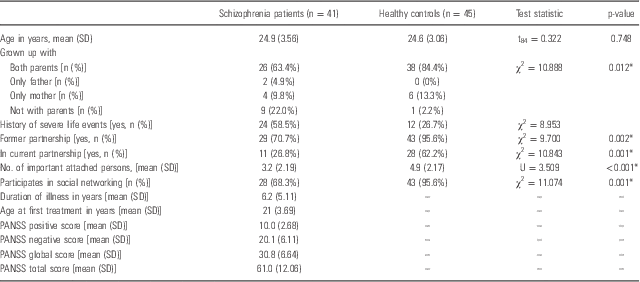
The schizophrenia patients and HC did not differ with regard to age (schizophrenia patients: 24.9±3.56 years, range 18–30; HC: 24.6±3.06 years, range 19–30). The patients’ mean duration of illness was 6 years (6.2±5.11 years, range 0–20). In the whole group of patients, the PANSS positive score was 10.0±2.68 (range 7–15); the PANSS negative score, 20.1±6.11 (7–30); the PANSS general score, 30.8±6.64 (17–44); and the overall PANSS total score, 61.0±12.06 (34–82). The PANSS autistic preoccupation score was 12.7±4.13 (6–20). Thirteen patients (33%) were being treated with one antipsychotic; 21 (54%), with two antipsychotics; and 2 (5%), with three antipsychotics. Three patients (8%) were not taking antipsychotic medication and data were missing for two patients.
The schizophrenia patients had grown up significantly more often with only one parent or not with their parents (χ21=4.893; p=0.027*) and more often reported a severe life event (χ21=8.950; p=0.003*) compared with HC. The patients reported significantly more often having no former or current partnerships (χ21=17.628; p<0.001*). The schizophrenia group had significantly fewer (3.2±2.19, range 0–10) important attached persons than the HC (4.9±2.19, range 2–10; U=3.479; p<0.001*). Social networking, for example, Facebook, was used less frequently by the schizophrenia patients (68% vs. 93%, χ21=8.883; p=0.003*). Sample characteristics are shown in Table 1.
Sample characteristics

PANSS, Positive and Negative Syndrome Scale.
Oxytocin and arginine-vasopressin
The schizophrenia patients had significantly lower plasma OT levels (median 225.70 pg/ml) than the HC (median 292.60 pg/ml; U=2.754; p=0.006), see Table 2. AVP levels showed a similar trend, with lower levels in the patient group (median 45.48 pg/ml in schizophrenia patients and median 55.36 pg/ml in HC; U=1.946; p=0.052; see Figs 1 and 2 and Table 2). Severe life events (U=−2.757; p=0.006*) and fewer important attached persons (ρ=−0.278; p=<0.010*) were associated with lower OT levels. Moreover, lower OT levels correlated with growing up with only one parent or without parents (Kruskal–Wallis Test: χ23=13.098; p=<0.001*). Higher OT levels were found in participants who had grown up with both parents. OT plasma levels did not correlate with being in a former or current partnership or with social networking. OT levels did not differ significantly between patients treated with one antipsychotic agent and those treated with more than one antipsychotic agent (U=0.016; p=1.000) and did not correlate with the number of antipsychotics (ρ=−0.016; p=0.923).
Distribution of mean oxytocin levels in schizophrenia patients and healthy controls.
Distribution of mean argenine vasopressin levels in schizophrenia patients and healthy controls.
OT and AVT levels (pg/ml) in male schizophrenia patients (n=41) and healthy controls (n=45). Samples were obtained on two days

1st Qu., 1st quartile; 3rd Qu., 3rd quartile; IQR, interquartile range; Max., maximum; Min., minimum.; OT, oxytocin; AVP, arginine-vasopressin.
Within the patient group, we found a negative association between the PANSS negative scale score and OT levels (ρ=−0.413; p=0.007*): Patients with a high PANSS negative scale score had lower plasma OT levels. However, this was not the case for the PANSS positive or general scale score, neither of which correlated with OT levels. The most dominant ‘autistic’ symptoms ‘preoccupation’ (G15; ρ=−0.537; p<0.001*), ‘emotional withdrawal’ (N2, ρ=−0.531; p<0.001*), and ‘passive/apathetic social withdrawal’ (N4, ρ=−0.509; p=0.001*) were negatively correlated with OT levels (Fig. 3). Regression analysis with OT as the independent (predictor) variable and PANSS negative scale score as the dependent (outcome) variable showed a significant association (β: −0.420; t 1=−2.894; p=0.006*). The effects remained significant even after controlling for antipsychotics, age, life events, and important attached persons, none of which was a predicting variable. OT levels did not predict the PANSS positive or general score.
Correlation of Positive and Negative Syndrome Scale (PANSS) items with oxytocin Several PANSS autistic items correlated with oxytocin levels: emotional withdrawal (N2); passive/apathetic social withdrawal (N4); preoccupation (G15).
OT levels did not directly correlate with AVP levels in either the patient group (ρ=0.082; p=0.614) or the HC group (ρ=0.055; p=0.717).
AVP levels did not correlate with the PANSS subscale scores or with life events, former or current partnerships, social networking, or the number of important attached persons, and regression analysis revealed no predictive value for clinical symptoms. Schizophrenia patients with former relationships showed higher AVP levels than patients without former relationships (U=1.978; p=0.048*). AVP levels did not differ significantly between schizophrenia patients treated with one antipsychotic agent and those treated with more than one antipsychotic agent (U=1.161; p=0.257) and did not correlate with the number of antipsychotics (ρ=0.157; p=0.346).
Discussion
The young men with schizophrenia showed lower OT and AVP plasma levels than the HC. As our measurements were taken on two different days and no additional tests were performed on these days, the levels represent the basal hormone state of patients and controls. Patients showed lower social functioning – defined by fewer attached persons, fewer former and current partnerships, and less use of social network – than HC. Moreover, patients had more severe life events and had more often grown up with only one parent or no parents.
Most of the other previous studies focused on OT with regard to the performance of schizophrenia patients in social tests. Kéri et al. (Reference Keri, Kiss and Kelemen18) found a significant difference in OT levels between their mixed-sex, chronic schizophrenia group and HC only after a trust experiment. However, baseline hormone changes seem particularly relevant with regard to possible new treatment options for schizophrenia. First studies have tested whether adjunctive OT treatment improves schizophrenia symptoms. Positive effects have been demonstrated for overall symptoms (Reference Bujanow25–Reference Feifel, Macdonald and Nguyen27,Reference Modabbernia, Rezaei and Salehi29,Reference Pedersen, Gibson and Rau30), cognition (Reference Feifel, Macdonald, Cobb and Minassian28), social cognition (Reference Pedersen, Gibson and Rau30,Reference Davis, Lee and Horan31), and emotion recognition (Reference Goldman, Gomes, Carter and Lee33). One study found the greatest effects in a reduction of negative symptoms (Reference Feifel, Macdonald and Nguyen27).
Our study found that OT was significantly associated with the PANSS negative symptom score. This finding is in line with the results from Kéri et al. (Reference Keri, Kiss and Kelemen18), who also found significant associations between low OT levels and PANSS negative symptoms. It is in line also with a previous investigation by Sasayama et al. (Reference Sasayama, Hattori and Teraishi16), who found a negative correlation between CSF OT and the negative PANSS subscale in male patients with schizophrenia. Our finding that OT was strongly associated mainly with the ‘autistic’ PANSS items, such as preoccupation, emotional withdrawal, and passive/apathetic social withdrawal, indicates that a subgroup of schizophrenia patients with predominantly negative symptoms may show the most changes in OT metabolism and supports our hypothesis that the ‘autistic’ symptoms of schizophrenia are associated with an alteration in the metabolism of the ‘attachment’ hormone. Moreover, we found an association between lower OT levels and fewer important attached persons and growing up without both parents, which might define social functioning. The hypothesis is underlined by previous findings of blunted plasma OT levels in schizophrenic patients and an association with a low performance in emotional recognition, an autistic symptom (Reference Goldman, Marlow-O'Connor, Torres and Carter17), although these effects were found only in patients with neuroendocrine dysfunction (polydipsia hyponatremia). Further studies on OT as a potential treatment option in schizophrenia, especially for negative and autistic symptoms, should be performed in this subgroup of patients.
Previous findings on the AVP system and schizophrenia are much more limited. In an earlier study, polydipsic hyponatremic schizophrenia patients showed enhanced AVP and hypothalamic pituitary adrenal axis responses to stress that appeared attributable to anterior hippocampal dysfunction (Reference Goldman, Marlow-O'Connor, Torres and Carter17). In contrast, very recent studies demonstrated lower AVP levels in schizophrenia patients than in HC (Reference Rubin, Carter and Bishop20,Reference Rubin, Carter and Bishop21). Higher AVP levels were associated with greater positive symptom severity in female schizophrenia patients (Reference Rubin, Carter and Bishop21). Less is known about the association between negative symptoms and AVP levels, but recent studies demonstrated positive effects on negative symptoms in schizophrenic patients after intranasal administration of an AVP analogue (Reference Brambilla, Bondiolotti and Maggioni37,Reference Hosseini, Farokhnia and Rezaei38). In our study, we found no association between AVP levels in schizophrenia patients and symptom severity of positive, negative, or autistic symptoms. However, we found lower AVP plasma levels in male schizophrenia patients than in HC. This finding is in line with results of previous studies (Reference Rubin, Carter and Bishop20,Reference Rubin, Carter and Bishop21). Therapeutic use of AVP might be discussed for schizophrenia patients – even though we found no direct correlation between AVP levels and clinical symptoms assessed by the PANSS – because recent studies found many features of schizophrenia in AVP-deficient (Brattleboro) rats (Reference Feifel and Priebe39,Reference Cilia, Gartlon, Shilliam, Dawson, Moore and Jones40) and intranasal administration of an AVP analogue was found to have a positive effect on negative symptoms in schizophrenia patients (Reference Brambilla, Bondiolotti and Maggioni37,Reference Hosseini, Farokhnia and Rezaei38). Future studies should focus on measurements of other AVP-related symptoms like aggression, social cognition, and emotion recognition, because these symptoms might not have been appropriately reflected by the PANSS.
Our study may be limited by the fact that we did not ask about sexual activity, which has been reported to affect OT (Reference Salonia, Nappi and Pontillo44). However, we measured the hormones on two different days (days 1 and 8), and the findings showed nearly the same levels and no significant difference. Another limitation is that our results might be gender related and cannot be transferred to female patients. We chose to study men because they show less variation in hormone levels. Most of the patients were on a stable therapeutic dose of one or two antipsychotic agents; the number of antipsychotic agents used for treatment had no effect on the OT plasma level. This is in line with the finding of previous studies that neuroleptic drugs did not affect CSF OT levels in schizophrenic patients (Reference Glovinsky, Kalogeras, Kirch, Suddath and Wyatt15). However, intake of atypical antipsychotic drugs still might have affected OT and AVP plasma levels. So far, it is unclear whether and how atypical antipsychotic drugs affect the OT and AVP system. For example, studies have found an increase and a decrease in OT levels related to dopaminergic active drugs (Reference Galfi, Janaky and Toth45–Reference Uvnas-Moberg, Alster and Svensson47). Therefore, results should be confirmed in a drug-free sample to exclude medication effects on hormone levels. Antipsychotics have been found not to stimulate vasopressin release directly, but they may stimulate it indirectly (Reference Raskind, Courtney and Murburg36). Moreover, OT plasma levels may not be representative for OT levels in the CSF. Therefore, future studies comparing plasma and CSF levels are required. Last, beside alterations in OT metabolism, many roads could lead to decreased plasma OT levels, including decreased OT synthesis, mRNA expression, translation, and others.
Taken together our results are in line with previous findings of lower OT and AVP levels in schizophrenia patients than in HC and an inverse correlation with symptom severity (Reference Sasayama, Hattori and Teraishi16–Reference Rubin, Carter and Bishop21). However, some studies did not observe such differences (Reference Beckmann, Lang and Gattaz13,Reference Glovinsky, Kalogeras, Kirch, Suddath and Wyatt15,Reference Sasayama, Hattori and Teraishi16,Reference Rubin, Carter and Bishop21) or even demonstrated opposite results (Reference Beckmann, Lang and Gattaz13,Reference Legros, Gazzotti and Carvelli14,Reference Goldman, Robertson and Hedeker34). This discrepancy might have different reasons. First, comparability of the different studies is difficult, because cohorts are inhomogeneous with respect to gender (male, female, or mixed gender samples) and method of measurements (plasma or CSF). Moreover, acute psychotic illness might have affected results in some samples, because greater positive symptoms were related to higher plasma OT levels (Reference Rubin, Carter and Bishop20) and higher AVP levels (Reference Rubin, Carter and Bishop21) in acute schizophrenia patients. Therefore, lower OT and AVP plasma levels might be specifically associated with negative symptoms and autistic symptoms in schizophrenia. If so, OT differences indicate that there might be a disruption in the ability of physiological levels of OT to modulate social cognition in schizophrenic patients. Our results provide further support for an association between social deficits (represented by PANSS autistic symptoms and negative symptoms) and lower OT levels in schizophrenia. Moreover, they support the hypothesis that decreased AVP levels might be a marker of biological vulnerability for psychosis, as previously suggested (Reference Rubin, Carter and Bishop20).
We hope that this study will contribute to the future therapeutic potential of OT and AVP in schizophrenia (Reference Macdonald and Feifel48). Current treatment options for the negative and autistic symptoms of schizophrenia are very limited and often unsatisfactory for the patient. Therefore, especially the subgroup of schizophrenia patients with these symptoms might eventually profit from new or additional treatment options with hormones.
Acknowledgments
The authors thank Karin Neumeier and Sylvia de Jonge for their contributions to the laboratory work and Jacquie Klesing, Board-certified Editor in the Life Sciences (ELS), for editing assistance with the manuscript. Sandra Dehning and Simone Ruf contributed substantially to the conception and design of the study; to data acquisition, analysis, and interpretation; and to drafting the article. They gave final approval of the version to be published. Tobias Notz contributed substantially to the acquisition of data and reviewed the article critically as regards important intellectual content. He gave final approval of the version to be published. Kristina Henning-Fast, Dominik Meissner, Anna Buchheim, Brigitta Bondy, and Norbert Müller contributed substantially to the conception and design of the study and reviewed the article critically as regards important intellectual content. They gave final approval of the version to be published. Andrea Jobst, Sebastian Meyer, and Peter Zill contributed substantially to data analysis and interpretation and reviewed the article critically as regards important intellectual content. They gave final approval of the version to be published.
Financial Support
None.
Conflicts of Interest
None.
Ethical Standards
The authors assert that all procedures contributing to this work comply with ethical standards of the relevant national and institutional committees on human experimentation and with the Helsinki Declaration of 1975, as revised in 2008.