

1. Introduction
Research on imitation and language development has a long history (Kymissis and Poulson Reference Kymissis and Poulson1990).Footnote 1 Imitation has been analyzed at different linguistic levels, such as phonology, word learning, syntax, and pragmatics (Fraser et al. Reference Fraser, Bellugi and Brown1963, Macken Reference Macken1975, Clark Reference Clark1977, Goldinger Reference Goldinger1998, Clark Reference Clark2007). Imitation has been argued to have a number of diverse functions (Speidel and Nelson Reference Speidel and Nelson1989), such as providing a pragmatic function (Clark Reference Clark2007), as a means of internalizing language (Saville-Troike Reference Saville-Troike1988), or with different functions across development (Lewis, Reference Lewis1936/1999). Imitation is such a pervasive behaviour in early development that it has been argued to be an innate ability (Meltzoff Reference Meltzoff, Hurley and Chater2005), involving dedicated mirror neuron systems (Rizzolatti and Arbib Reference Rizzolatti and Arbib1998, Vihman Reference Vihman, Stamenov and Gallese2002). Notwithstanding the wealth of research on imitation, the topic of imitation has received little attention in the past 50 years. This reflects the shift away from behaviourist theories (Skinner Reference Skinner1957, Olmsted Reference Olmsted1971) to generativist theories (Chomsky Reference Chomsky1957, Reference Chomsky1959), although Chomsky himself did acknowledge that imitation does play a function in language acquisition (Speidel and Nelson Reference Speidel and Nelson1989: 14). Moreover, within the body of research on imitative speech in language development that does exist, little work on imitation has examined the relative influence of phonological, lexical, and phonetic (output) factors on children's imitative speech. Our current research provides a corpus analysis of new words presented by parents to their children between the ages of 1;0 and 2;11, and examines different variables as possible predictors for patterns in children's imitative speech.
Young learners have substantial receptive knowledge about the phonological and grammatical structures of their language even before they begin producing speech (Werker and Curtin Reference Werker and Curtin2005, Curtin and Zamuner Reference Curtin and Zamuner2014). However, in typical language development, learners move beyond their initial comprehension skills to both comprehend and express language. We approach imitation as it relates to speech production and language acquisition. When children imitate, they produce speech. We investigate imitative speech productions for insights into children's developing language system, specifically, the relationship between language development and phonological, lexical, and articulatory factors. In the next section, we review the role that these factors have been found to play in previous research, focusing on children under 3 years of age.
2. Phonological, lexical, and phonetic factors in language development
Research on phonological, lexical, and phonetic (output) factors in language development spans the period in development before the onset of speech production to a stage where children have acquired productive language (approximately 3 to 4 years of age). One approach has been to examine the types of words that infants and young children can recognize or learn in a controlled experimental setting. There is also research using non-word repetition and picture-word elicitation tasks, to examine topics such as vocabulary development, production accuracy, and variability (e.g., Hoff et al. Reference Hoff, Core and Bridges2008, Johnson and Zamuner Reference Johnson, Zamuner, Blom and Unsworth2010, Sosa and Stoel-Gammon Reference Sosa and Stoel-Gammon2012, Macrae Reference Macrae2013, Zamuner and Kharlamov Reference Zamuner, Kharlamov, Lidz, Synder and Pater2016). Other studies take a longitudinal approach, examining the words that are added to children's vocabulary over time based on spontaneous speech samples or lexical normative data (e.g., Maekawa and Storkel Reference Maekawa and Storkel2006, de Bree et al. Reference de Bree, Zamuner, Wijnen, Kager, Grijzenhout and Sebregts2014). We focus our discussion on these types of longitudinal research.
There has been a recent focus on phonological and lexical factors in language development, highlighted in a number of review articles (e.g., Saffran and Graf Estes Reference Saffran and Estes2006, Stoel-Gammon Reference Stoel-Gammon2011, Curtin and Zamuner Reference Curtin and Zamuner2014). One commonly investigated phonological factor is phonotactic probability, which refers to the likelihood that sounds will occur in a given environment. Infants are better at learning words with common phonotactic patterns (Gonzalez-Gomez et al. Reference Gonzalez-Gomez, Poltrock and Nazzi2013, though see Storkel Reference Storkel2009). Commonly investigated lexical factors are Word Length in phonemes and Neighborhood Density, which refers to the amount of phonemic overlap a word has with other words in the lexicon. Children are more likely to learn shorter words and words that reside in dense phonological neighbourhoods (Stoel-Gammon Reference Stoel-Gammon and Paul1998; Coady and Aslin Reference Coady and Aslin2004; Storkel Reference Storkel2004, Reference Storkel2006; Maekawa and Storkel Reference Maekawa and Storkel2006).
Turning to phonetic factors, it has been argued that there is a tight link between articulation and development (Rvachew Reference Rvachew1994, Vihman Reference Vihman and Foster-Cohen2009). Researchers are beginning to investigate whether infant speech perception involves articulatory and sensorimotor representations, before the onset of meaningful speech (DePaolis et al. Reference DePaolis, Vihman and Keren-Portnoy2011, Yeung and Werker Reference Yeung and Werker2013, Bruderer et al. Reference Bruderer, Danielson, Kandhadai and Werker2015). This is relevant for the emergence of speech production because the findings suggest that these representations are an early and integral part of language processing. There is continuity across the sounds found in infants’ babbling repertoires and their first words (Vihman et al. Reference Vihman, Macken, Miller, Simmons and Miller1985) and there is evidence in early child language for some children displaying lexical selection and avoidance (Ferguson and Farwell Reference Ferguson and Farwell1975, Leonard et al. Reference Leonard, Schwartz, Folger, Newhoff and Wilcox1979, Schwartz and Leonard Reference Schwartz and Leonard1982, Vihman et al. Reference Vihman, DePaolis, Keren-Portnoy, Bavin and Naigles2016). Schwartz and Leonard (Reference Schwartz and Leonard1982) found that young children were more likely to imitate new words that contain sounds IN rather than OUT of the child's own production repertoire. However, the stimuli were confounded with other phonological and lexical factors. For example, the OUT words /uʃuʃ, ozotʃ/ contain infrequent English phonemes, have few phonological neighbours, have a less frequent English syllable structure, and have a less typical English stress pattern, etc. Thus, it is difficult to ascertain whether imitation patterns reported in Schwartz and Leonard's experiment stem from the child's own articulatory abilities or from other factors. Lexical avoidance and selection can be captured by an ‘articulatory filter’ (Vihman Reference Vihman1993, Vihman et al. Reference Vihman, DePaolis and Keren-Portnoy2014, Vihman Reference Vihman2017), which hypothesizes that sounds that the learner has produced are more salient in the learner's input (also see Stoel-Gammon Reference Stoel-Gammon2011 for her discussion of an auditory–articulatory loop). The result is that words consisting of produced sounds are facilitated by the learner's previous production experience, which in turn supports the memory, recognition, and learning of word forms with those segments (Keren-Portnoy et al. Reference Keren-Portnoy, Vihman, DePaolis, Whitaker and Williams2010).
A subset of work has looked at a combination of phonological, lexical, and phonetic factors in children's vocabulary development. Maekawa and Storkel (Reference Maekawa and Storkel2006) performed backward regression analyses on longitudinal production data from three children in the CHILDES database between the ages of 1;4 and 3;1. Word length was a predictive factor for all children (children produced shorter words before longer words); however, phonotactic probability (PP), neighbourhood density (ND), and word frequency varied in their predictability across the children. They also found that for one child, a significant predictor for vocabulary development was the normative production accuracy for the words’ final consonants (but not the words’ initial consonants). That is, early-acquired words were more likely to contain final consonants that 3-year-olds typically produce accurately (based on norms established by Smit et al. Reference Smit, Hand, Freilinger, Bernthal and Bird1990). This is similar to the approach taken in the current study; however, we examine individual children's own production accuracy rather than using normative data. Carlson et al. (Reference Carlson, Sonderegger and Bane2014) conducted a study on longitudinal production data from 64 children between the ages of 1;2 and 4;2, and analyzed which factors, such as Age, Word Frequency, Word Length, Neighbourhood Density, Phonotactic Probability (but no phonetic factors), were significant predictors of when a new word entered the children's productive vocabularies. They found that the words that emerged in children's productive vocabulary were those that sounded similar to other words (high neighbourhood density), but which did not have a lot of interference from other words in the lexicon. Carlson et al. measured interference by two variables called ‘clustering coefficient’ and ‘coreness’. These measurements are argued to reflect lexical access during speech production.
Theories vary in the relative weight that is given to phonological, lexical, and phonetic (output) factors in language development, with phonetics typically having a more peripheral role. Exemplar Theories and Usage-Based Models propose that speech output representations are integrated into phonological and lexical representations (Pierrehumbert Reference Pierrehumbert2003, Sosa and Bybee Reference Sosa, Bybee and Ball2008, Munson et al. Reference Munson, Edwards, Beckman, Cohn, Fougeron and Huffman2011, Sosa and Stoel-Gammon Reference Sosa and Stoel-Gammon2012). In these models, the development of phonological, lexical, and phonetic representations is multidirectional, as all form part of the long-term representations. Acoustic-motor representations are the focus of the newly developed A-Map Model, which highlights the importance of the child's own articulations in language development (McAllister Byun et al. Reference McAllister Byun, Inkelas and Rose2016). While the A-Map Model was developed specifically to account for child-specific phonological patterns, the model can be adopted to make predictions for language development. Central to the A-Map Model is “the pressure to match adult productions of a given word […] and the pressure to attempt a pronunciation that can be realized reliably” (McAllister Byun et al. Reference McAllister Byun, Inkelas and Rose2016: 2). Given these pressures, one would predict that children would be more likely to produce and/or learn words that contain sounds that the child has previously produced accurately, because these items would both match the adult target and be more reliably produced by the child.
3. Corpus study
The broad aim of this research was to examine what children imitate, for insights on the developing language system. The more specific aim was to examine the relative contribution of phonetic factors on children's speech, while taking into account phonological and lexical factors. We conducted an analysis of imitation on longitudinal data from the Providence Corpus from CHILDES (MacWhinney Reference MacWhinney2000, Demuth et al. Reference Demuth, Culbertson and Alter2006). Following Clark (Reference Clark2007), we identified syntactic frames in which parents made direct offers of new words to their children. For example, ‘It's called a kid’ (Mother to daughter Lily, aged 1;5.21). Each direct new offer was coded for whether it was imitated by the child and for a number of predictor variables: phonological, lexical, and phonetic factors (phonetic was defined as children's sound inventory and children's production experience with the sounds in the direct new offers). Binary hierarchical logistical regressions were used to determine which variables were significant predictors for whether children would imitate a direct new offer, after taking into account the control variable of chronological age.
3.1 Methodology
Analyses were done on corpora of five mother-child dyads (Alex, William, Lily, Naima, and Violet), from monolingual English-speaking children from the Providence Corpus (MacWhinney Reference MacWhinney2000, Demuth et al. Reference Demuth, Culbertson and Alter2006). These data comprise spontaneous speech collected between the ages of 0;11 and 4;0, and were typically collected bimonthly. Separate analyses were done for each child, and analyses were restricted to nouns, as done by Maekawa and Storkel (Reference Maekawa and Storkel2006), Zamuner (Reference Zamuner2009b), among others. Each session was analyzed to identify new words, which were defined as words not produced during the previous recording sessions by either the child or other people present. The set of new words from each session was then re-checked to ensure that the words did not appear in any previous transcript in the singular or plural form. Each new word was also checked to ensure that the child did not first produce the word before the direct offer within the concurrent session.
The context for each new word was then coded, by checking the CHAT transcript for whether the new word was presented as a direct offer. Direct offers were defined by syntactic frames identified in Clark and Wong (Reference Clark and Wong2002), for example, “What is /what's …?, This is…, That is /that's…, and This is /that's called…” (Clark and Wong Reference Clark and Wong2002: 185). Direct offers also included new words that were presented in isolation, for example, when a parent labeled an item in a book or in the immediate environment. The coding for the final set of direct new offers was additionally verified by checking the audio-video recordings. A subset of the words that were identified as direct new offers from the CHAT transcript were removed from the analyses after watching the audio-video recordings for a variety of reasons: for example, multiple people speaking at the same time; exchange was between two adults; mother talking to herself. In a few cases, words were excluded because the immediate context indicated that a word was not new to the child, such as discussing an event that occurred the day before. The final set of direct new offers were considered “unlikely to be already known to the child” based on the fact that the words did not previously appear in the corpus (Clark Reference Clark2007: 164). Direct offers of new words were restricted to those that occurred in sentence-final position, to ensure that the new words were, relatively, of the same prominence. Past research has found that direct offers of new words are more likely to occur in sentence-final position (Clark and Wong Reference Clark and Wong2002). Each direct new offer was coded for whether the child imitated the direct new offer (107 imitated, 454 not imitated), either immediately (n = 104) or within the next five conversational turns (n = 3). Six additional responses by the children were coded as unintelligible. Direct new offers that were coded as not imitated included a variety of responses, such as acknowledgments, continuation or change of the topic. See Clark (Reference Clark2007) who examines the pragmatic function of these different type of responses.
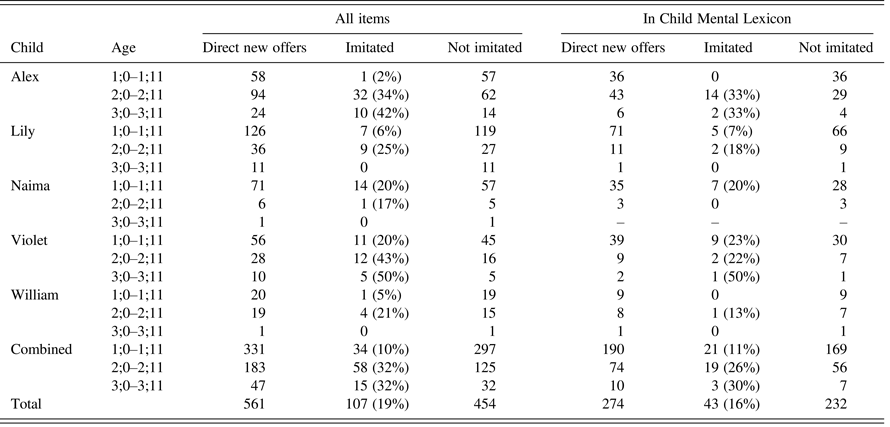
One difficulty in using spontaneous speech is that it can contain infrequent words, which can skew the results. To control for this, the direct new offers were searched for in the Child Mental Lexicon (Storkel and Hoover Reference Storkel and Hoover2010), an English-language on-line corpus of child spoken language (4,832 types, 1,028,417 tokens). The assumption was that words found in the Child Mental Lexicon are more representative of child language. For example, some direct new offers not found in the Child Mental Lexicon were dowel (Naima 1;6.4), reflection (Alex 1;11.27), and pimientos (Lily 2;9.18). While the analyses focus on the subset of words found in the Child Mental Lexicon, when the analyses were repeated with the full set of direct new offers, similar results were found. Table 1 presents the number of direct new offers for each of the five children, broken down by chronological age, and whether or not the words were found in the Child Mental Lexicon.
Direct new offers in the Providence Corpus, analyzed by child, child's age, and child's response. Computed for all direct new offers and subset of items found in Child Mental Lexicon

The imitation rates by children in the Providence Corpus are lower (19%) than those reported by Clark (Reference Clark2007), who found that children imitate direct offers of new words on average of 54% of the time. Clark (Reference Clark2007) also reported that parents presented direct offers of new words in phrases 81% of the time, and as isolated words 19% of the time. In our data, direct new offers in phrases accounted for 54% of the new words, and those presented as isolated words accounted for 46% of the new words. Differences in imitation rates and the context of direct new offers could stem from situation contexts which vary across the recordings, such as playing games, meal times, and reading books. Data collection from the Providence Corpus was less dense after 3;0 (Table 1). For this reason, only the data from children between the ages of 1;0 and 2;11 were used for the analyses. A list of the direct new offers is given in Appendix A. The following sections contain analyses that examine phonological, lexical, and phonetic (output) variables, to determine which variables were significant predictors for whether a child imitated a direct new offer.
3.2 Expressive language measures
Imitation has been linked to other skills, such as chronological age and vocabulary growth (Snow Reference Snow, Speidel and Nelson1989, Masur and Eichorst Reference Masur and Eichorst2002). Five measures of each child's expressive language development were calculated. Cumulative type and token counts for each child's productive vocabulary were calculated for each session using the ‘freq’ command in CLAN (Computer Language Analysis program), transformed to logarithm form (Expressive Vocabulary Type, Expressive Vocabulary Token). Each child's consonant phoneme inventory was calculated using the phoneme accuracy tool in the Phon software <https://www.phon.ca>, Rose et al. Reference Rose, MacWhinney, Byrne, Hedlund, Maddocks, O'Brien, Wareham, Bamman, Magnitskaia and Zaller2006, Rose and MacWhinney Reference Rose, MacWhinney, Durand, Gut and Kristoffersen2014). This tool provides a list of the child's phoneme inventory, the phonemes’ frequency, and how many times the phonemes were produced accurately. As with children's productive vocabulary, each child's phoneme inventory was calculated cumulatively, for example, at session 1, then at session 1 and 2 combined, etc. The Accurate Consonant Inventory measure was based on the number of accurately produced phonemes in the child's inventory, and a phoneme had to occur only a single time to be included. The measure Accurate Consonant Inventory 10 provided a more conservative estimate, which required that a phoneme be produced accurately a minimum of 10 times. We also calculated phoneme inventories independent of accuracy (e.g., a production of ‘bottle’ as ‘mottle’ could count as an instance of the child producing an /m/); however, these measures very quickly reached a ceiling and were not informative. Lastly, the child's mean length of utterance (MLU) was calculated for each session.
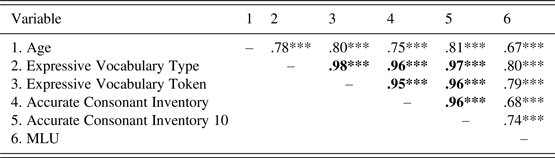
Correlations between chronological age (referred to as ‘age’ from this point forward) and the Expressive Language measures are given in Table 2. There were significant correlations between age and all measures. In addition, there were strong correlations (over .85) between expressive vocabulary and the children's accurate consonant inventories. This is problematic for the logistic regressions used in the following analyses, because of high multicollinearity. Therefore, only MLU and Accurate Consonant Inventory 10 were used in the analyses. It is important to keep in mind that because of the strong correlations, Accurate Consonant Inventory 10 cannot be interpreted as referring only to the size of the child's accurately produced phoneme inventory; this is because the variable overlaps with other measures of expressive language.
Correlations among Age and Expressive language measures (N = 264); correlations over .85 are in bold

*p < .05 (two-tailed), **p < .01 (two-tailed), ***p < .001 (two-tailed), using Bonferroni adjusted alpha levels for multiple comparisons
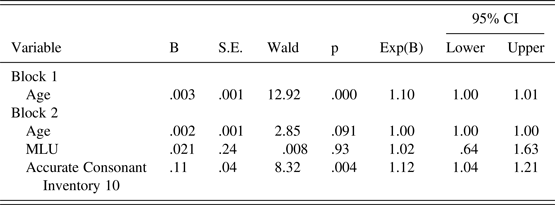
Binary hierarchical logistical regressions were used for the analyses. Control variables are added in Block 1 and predictor variables are added in Block 2 (Reed and Wu Reference Reed and Wu2013). A significant change in the model between Blocks 1 and 2 indicates that the predictor variables improves the membership of the dependent variable, after taking into account the control variable. The goal was to determine whether, after controlling for participants’ age, Accurate Consonant Inventory 10 and/or MLU significantly accounted for whether children would imitate a direct new offer. The standard errors of the independent variables were below 2, indicating that there was no evidence of multicollinearity. The full model was statistically significant (χ2(2, N = 164) = 7.75, p < .05) and explained 13% of the variance (Nagelkerke R 2) (Table 3). After controlling for age, only Accurate Consonant Inventory 10 was a significant predictor for distinguishing between the direct new offers that children did and did not imitate (χ2(1, N = 164) = 8.32, p < .01). The value of Exp(B) or the Odds Ratio implies that direct new offers were 1.12 times more likely to be repeated by children with larger accurate phoneme inventories. The same results were found when Accurate Consonant Inventory 10 was replaced by Expressive Vocabulary Type. The analyses were also run using the full set of direct new offers with the same results as when based on the subset of words found in the Child Mental Lexicon.
Binary hierarchical logistic regression models predicting probability of child imitating direct new offer, age, and expressive language measures

Block 1: Nagelkerke R 2 = .08, χ2 = 13.10, df = 1, p < .001; Block 2: Nagelkerke R 2 = .13, χ2 = 7.75, df = 2, p < .05.
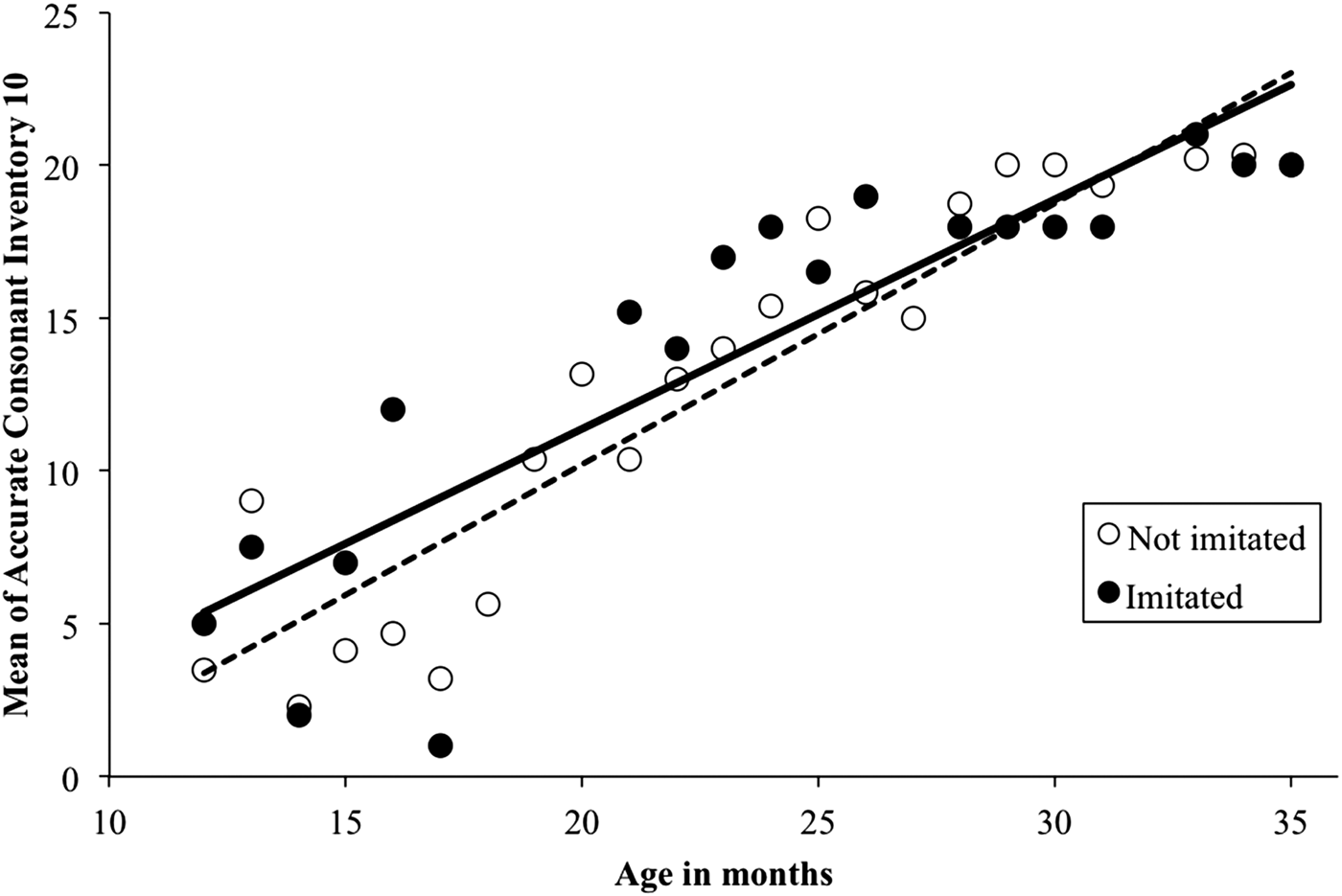
The relationship between children's age in months, Accurate Consonant Inventory 10, and children's imitation of direct new offers is illustrated in Figure 1. Children were more likely to imitate a direct new offer as the size of their accurately produced consonant inventory grew larger.
Relationship between direct new offers imitated, children's age in months, and Accurate Consonant Inventory 10

3.3 Target word measures
The second set of analyses examine whether children were more likely to imitate direct new offers based on the words’ phonological and lexical properties, using values obtained from the Child Mental Lexicon (Storkel and Hoover Reference Storkel and Hoover2010). This child-based corpus was used because comparative analyses have found differences in phonological and lexical patterns between child- and adult-based corpora (Storkel and Hoover Reference Storkel and Hoover2010). The four Target Word measures were all based on logarithm forms and were as follows: Word Length, Phonotactic Probability, Neighbourhood Density, and Word Frequency. Word Length in phonemes and ND were chosen because they have been established in the literature as being significant predictors of vocabulary development (Storkel Reference Storkel2004, Stokes Reference Stokes2010, Carlson et al. Reference Carlson, Sonderegger and Bane2014). We also included phonotactic probability because it has been shown to be a factor in the accuracy of children's speech productions (e.g., Zamuner et al. Reference Zamuner, Gerken and Hammond2004, Munson et al. Reference Munson, Kurtz and Windsor2005, Zamuner Reference Zamuner2009a), though the factor has been less predictive in analyses of children's vocabulary growth (Maekawa and Storkel Reference Maekawa and Storkel2006, Carlson et al. Reference Carlson, Sonderegger and Bane2014). Lastly, word frequency was included in the analyses. While lexical frequency has been shown to be a significant factor in phonological acquisition (Ota and Green Reference Ota and Green2013), the expectation was that this would not be a significant predictor of children's imitative speech. This is because all of the direct new offers were new to the children, within the context of the recording sessions.
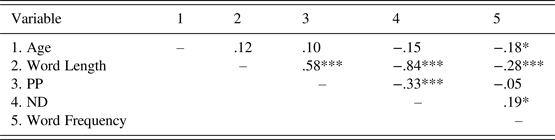
Correlations between the Age and the Target Word measures are provided in Table 4. Age was not significantly correlated to any of the Target Word measures; however, the high correlation between Word Length and ND is problematic due to high multicollinearity. In fact, a binary hierarchical logistical regression analyses that included both Word Length and ND variables gave a standard error above 3 for Word Length, indicating multicollinearity. Therefore, only the ND measure was used, while keeping in mind that this variable is highly correlated with, and cannot be isolated from, Word Length.
Correlations among Age and Target Word measures (N = 264)

*p < .05 (two-tailed), **p < .01 (two-tailed), ***p < .001 (two-tailed), using Bonferroni adjusted alpha levels for multiple comparisons
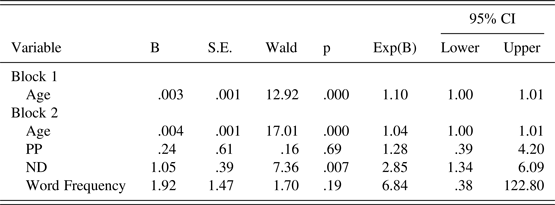
A binary hierarchical logistical regression was used to assess whether characteristics of the Target Word predicted whether children would imitate a direct new offer, after controlling for participants’ age (Table 5). There was no evidence of multicollinearity. The full model was statistically significant, accounting for 15% of the variance (Nagelkerke R 2). After controlling for age, the variable ND was a significant predictor for the direct new offers that children imitated (χ2(1, N = 164) = 7.36, p < .01). The value of Exp(B) for the variable ND Log implies that direct new words were three times more likely to be imitated when the word had more phonological neighbours. However, recall that ND was highly correlated with Word Length, and the effect can therefore not be uniquely attributed to ND. When the same model was run with Word Length in place of ND, the results were the same.
Binary hierarchical logistic regression models predicting probability of child imitating direct new offer, Age, and Target Word measures

Block 1: Nagelkerke R 2 = .08, χ2 = 13.10, df = 1, p < .001; Block 2: Nagelkerke R 2 = .15, χ2 = 10.53, df = 3, p < .05.
As expected, Word Frequency was not a significant predictor of children's imitations of direct new offers. The same results were found when running correlations and regression analyses using the full set of direct new offers, as when using only those words found in the Child Mental Lexicon.
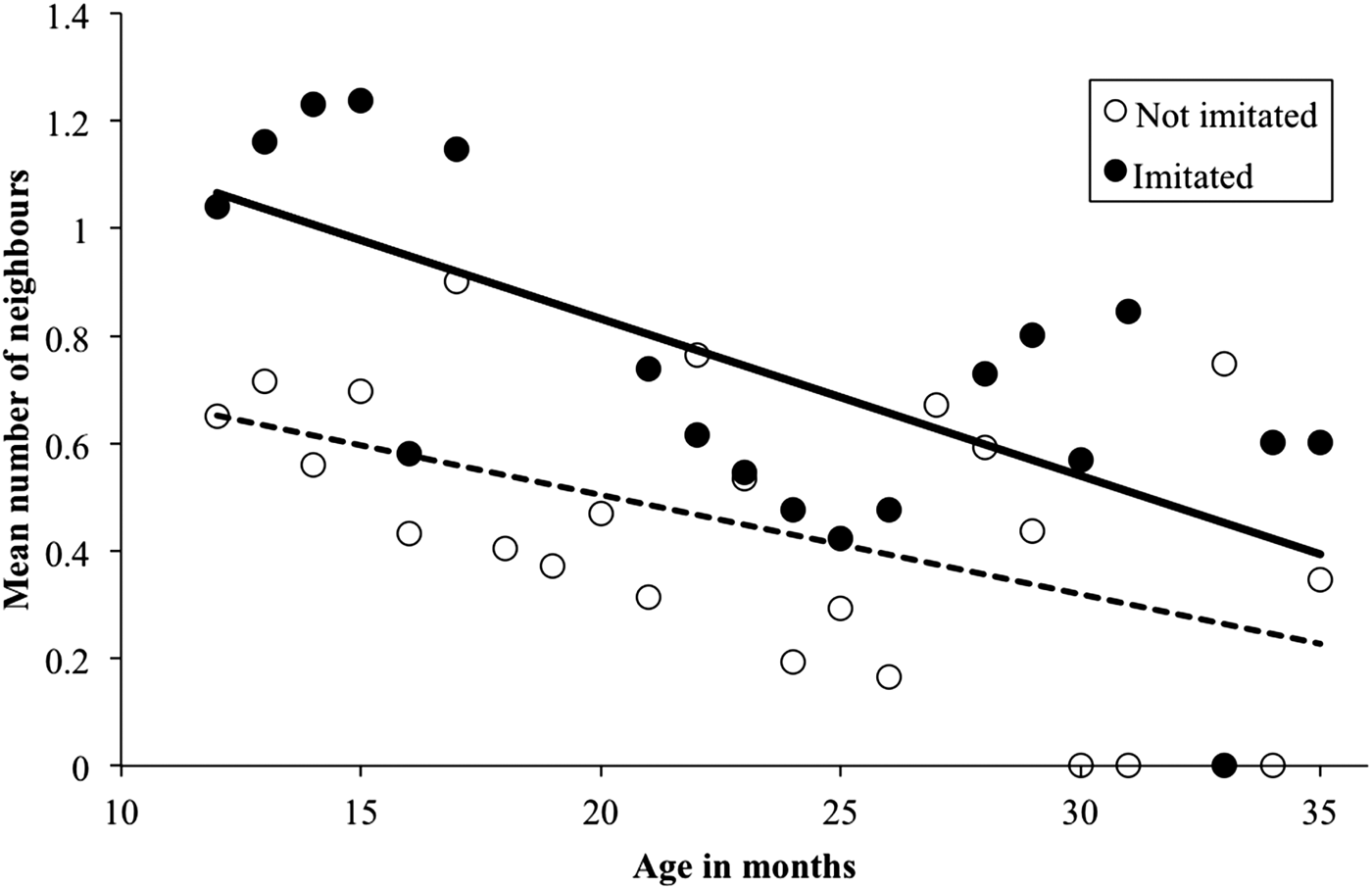
The relationship between children's age in months, the target word's ND, and whether or not children imitated the direct new offer is provided in Figure 2. Children were more likely to imitate a direct new offer when it had a higher ND.
Relationship between direct new offers imitated, children's age, and ND of target word

3.4 Target word production experience
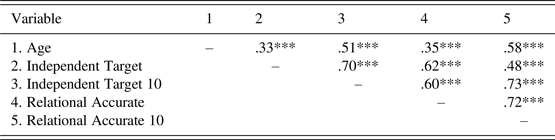
The third analysis focused on children's production experience with the consonants in the direct new offers, to determine whether children were more likely to imitate direct new offers that contained sounds the children had previously produced. Each child's experience producing the consonants in the direct new offers was measured, using the phoneme accuracy tool in Phon. The child's production experience was evaluated independently of the child's accuracy (Independent Target, Independent Target 10), and relative to how accurately the child had produced those sounds (Relational Accurate, Relational Accurate 10). For Independent Target and Relational Accurate, a consonant had to occur only once to be counted, and the more conservative estimates of Independent Target 10 and Relational Accurate 10 (which was a measure of children's overall language, i.e., the size of the child's accurate phoneme inventory), required that a consonant occur at least 10 times. To illustrate, take the direct new offer peacock (Naima, 1;0;14), with three consonants: /p, k, k/. The /p/ had not yet occurred in Naima's productive vocabulary up to this point in the database, and /k/ occurred in 15 of her words, of which /k/ was produced accurately seven times. Therefore, both the Independent Target and Independent Target 10 cells equaled .66 (two of the three consonants appeared in her target words). For Relational Accurate, the cell also equaled .66 (two of the three consonants appeared accurately at least once in her productive vocabulary); however, Relational Accurate 10 equaled zero, because none of the consonants had been produced accurately by Naima 10 times or more. It is possible to conduct a more nuanced analysis of segmental accuracy, taking into account whether a child produces segments accurately, or makes substitutions or deletions. It is also possible to take positional effects and complexity into account when coding for accuracy. For example, for the word peacock, one could code for whether Naima had any words in her lexicon in which /p/ was produced correctly in word-initial position, in singleton onsets. Our initial goal was to analyze the data taking into account prosodic position and complexity; however, the coding became too fine-grained for the dataset, so we decided to code the data on a broader level. Table 6 provides the correlations between age in days and the target word production variables. All variables were significantly correlated with each other, though no correlations were over .85.
Correlations among Age and Target Word Production Experience measures (N = 264)

*p < .05 (two-tailed), **p < .01 (two-tailed), ***p < .001 (two-tailed), using Bonferroni adjusted alpha levels for multiple comparisons
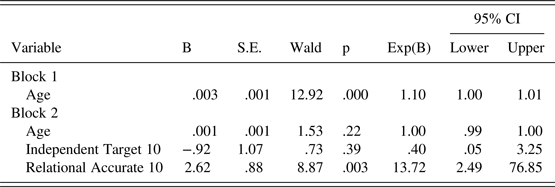
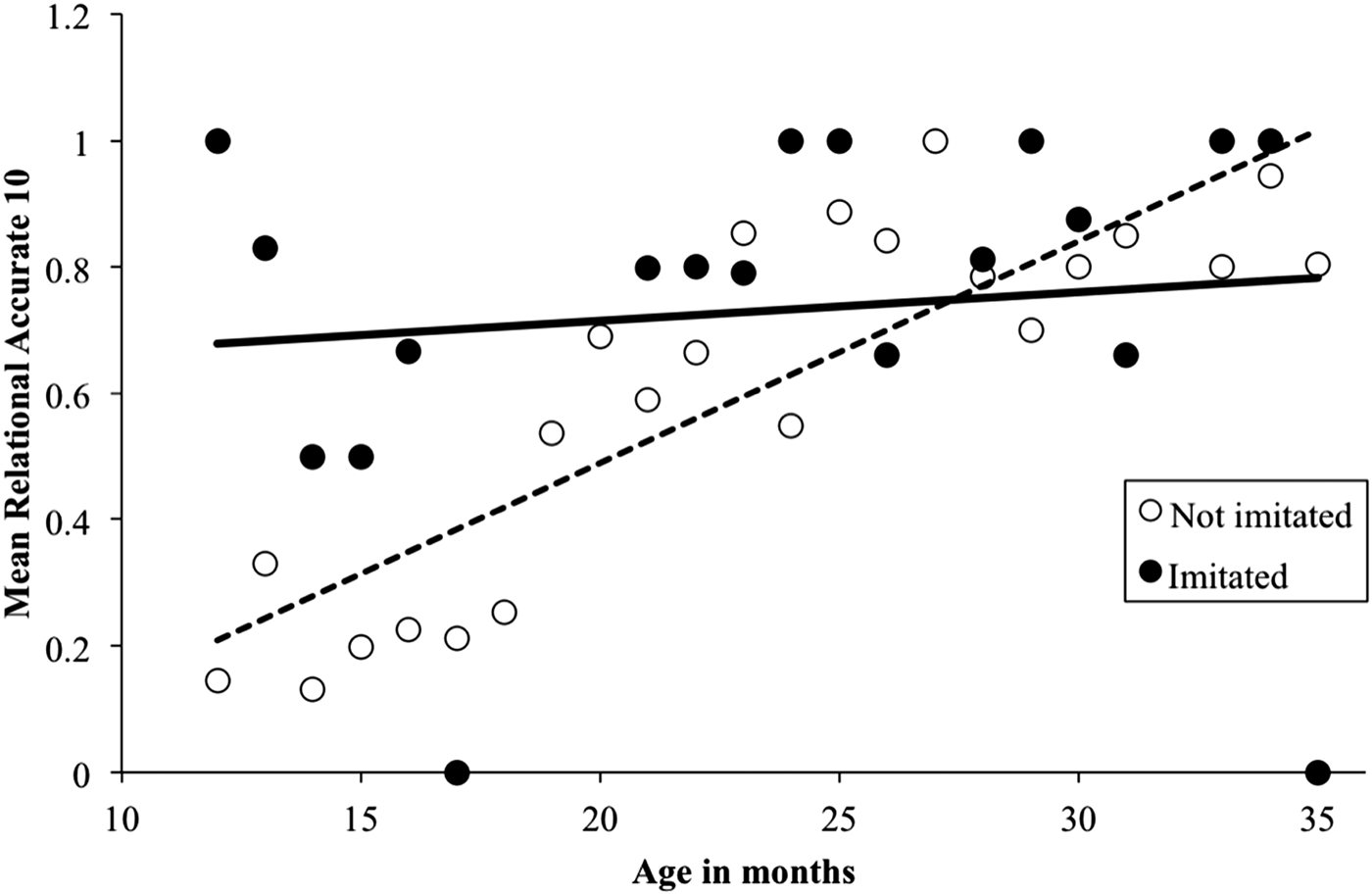
A binary hierarchical logistical regression was used to assess whether the child's production experience with the consonants in the target word predicted whether the child would imitate a direct new offer, after controlling for children's age (Table 7). No outliers were detected, and there was no evidence of multicollinearity. The full model was statistically significant and explained 17% of the variance (Nagelkerke R 2). After controlling for Age, the variable Relational Accurate 10 was a significant predictor for distinguishing between the direct new offers that children did and did not imitate (χ2(1, N = 164) = 8.87, p < .01). The value of Exp(B) for Relational Accurate 10 indicates that direct new words were 14 times more likely to be repeated when they consisted of consonants that the child had produced accurately at least 10 times previously. The same analyses were conducted using the full set of direct new offers, with the same results.
Binary hierarchical logistic regression models predicting probability of child imitating direct new offer, age, and child production experience

Block 1: Nagelkerke R 2 = .08, χ2 = 13.10, df = 1, p < .001; Block 2: Nagelkerke R 2 = .17, χ2 = 13.71, df = 2, p < .001.
The relationship between children's age in months, Relational Accurate 10 (average accuracy of children's production for the consonants in the direct new offer), and whether or not children imitated the direct new offer is shown in Figure 3. Children were more likely to imitate a direct new offer when it contained more consonants that the child had accurately produced at least 10 times before.
Relationship between direct new offers imitated, children's age, and Relational Accurate 10

3.5 Combined measures
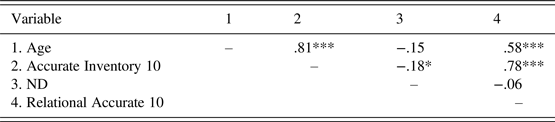
The last analysis combined the significant predictor variables from the previous analyses: Accurate Inventory 10, which was a measure of children's overall language (size of the child's accurate phoneme inventory), ND, and Relational Accurate 10. Correlations among the variables are given in Table 8. There were significant correlations between many of the variables, though none were over .85.
Correlations among age and all measures, subset of words (N = 264)

*p < .05 (two-tailed), **p < .01 (two-tailed), ***p < .001 (two-tailed), using Bonferroni adjusted alpha levels for multiple comparisons
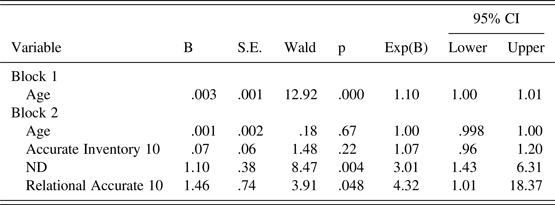
Finally, we assessed a combination of the predictor variables, after controlling for participants’ age (Table 9). The model was run with outliers removed that had standard residuals of ±2.58; however, this did not improve classification by more than 2%, so the original model with all data was used. There was no evidence of multicollinearity. The full model was statistically significant (χ2(3, N = 164) = 22.13, p < .001), explaining 22% of the variance (Nagelkerke R 2). After controlling for age, the variables ND (χ2(1, N = 164) = 8.47, p < .01) and Relational Accurate 10 (χ2(1, N = 164) = 3.91, p < .05) were significant predictors for distinguishing between the direct new offers that children did and did not imitate. Direct new offers were three times more likely to be imitated when the word resided in a denser phonological neighbourhood, and direct new offers were four times more likely to be imitated when the target word contained phonemes that the child had previously produced accurately. The variable Accurate Inventory 10 was not a significant predictor when the other variables were included in the model.
Binary hierarchical logistic regression models predicting probability of child imitating direct new offer, age, and all measures

Block 1: Nagelkerke R 2 = .08, χ2 = 13.10, df = 1, p < .001; Block 2: Nagelkerke R 2 = .22, χ2 = 22.13, df = 3, p < .001.
The combined models were run with Inventory 10 replaced by Expressive Vocabulary Type and with ND replaced by Word Length, with the same results. The same analyses were also conducted using the full set of direct new offers with partially different results. The full model was significant, χ2(3, N = 514) = 29.34, p < .001, explaining 24% of the variance (Nagelkerke R2). After controlling for age, the variable ND was a significant predictor (χ2(1, N = 164) = 11.35, p < .001), but Relational Accurate 10 only approached significance (χ2(1, N = 164) = 3.26, p = .071). Lastly, the variable Accurate Inventory 10 was significant (χ2(1, N = 164) = 4.92, p < .05).
3.6 General perceptual or articulatory ease
One important remaining question is whether it is the child's own production accuracy that is predictive of which words they imitate, or whether children's imitation patterns reflect more general perceptual or articulatory ease. To test for this possibility, we coded the initial and final consonants of the direct new offers with the percentage of children who accurately produced the consonants at age 3, using normative data from Smit et al. (Reference Smit, Hand, Freilinger, Bernthal and Bird1990). We then performed two additional logistic regressions to determine whether, after controlling for age, normative data for initial and final consonant accuracy was a significant predictor of whether children would imitate a direct new offer. There were no significant effects for either the initial or the final consonant.
4. Discussion
This study analyzed children's imitation of direct new offers from longitudinal production data. First, we found an increase in the number of direct new offers that children imitated between 1 and 2 years of age. We then examined a variety of predictor variables: the child's productive language maturation (Expressive Language Measures), phonological and lexical characteristics of the direct new offers (Target Word Measures), and lastly phonetic (output) factors which were measures of the child's production experience with the sounds in the direct new offers (Target Word Production Experience). When analyzing the measures separately, all had significant predictors for children's imitations. For the Expressive Language Measures, the size of the child's consonant inventory was a significant predictor of imitation rates (though this could not be attributed solely to consonant inventories, because it was highly correlated with vocabulary size). When examining the phonological and lexical properties of the target words (Target Word Measures), the target word's ND was a significant predictor of children's imitations (though again, ND was highly correlated with Word Length). In addition, the child's own production experience with the sounds in the direct new offers (Target Word Production Experience), was a significant predictor of children's imitations. When all variables were combined, Target Word and Target Word Production Experience were significant predictors of, but not the measure of, Expressive Language.
What emerges is that both the properties of a word and the child's own accuracy in producing the words’ sounds predicts whether or not the word is imitated. These results are in line with previous findings, which found that the child's age, word length, and ND are all significant predictors of children's productive vocabulary development (Stoel-Gammon Reference Stoel-Gammon and Paul1998, Maekawa and Storkel Reference Maekawa and Storkel2006, Carlson et al. Reference Carlson, Sonderegger and Bane2014). Our findings are different from those of Maekawa and Storkel (Reference Maekawa and Storkel2006), who found that for one of the three children examined, a significant predictor for the child's productive vocabulary development was the words’ final (but not initial) consonant accuracy at age 3, based on normative data from Smit et al. (Reference Smit, Hand, Freilinger, Bernthal and Bird1990). Our primary analyses differed from Maekawa and Storkel's in that we examined the child's own production accuracy with all of the consonants in the direct new offers, rather than based on normative data of the initial and final consonants. When we analyzed imitation patterns using normative data for initial and final consonant accuracy, these were not significant predictors for whether children would imitate a direct new offer. Thus, our data suggest that it is the child's own production experience with the sounds of a word that predicts the child's imitation patterns. However, the effects of perceptual salience and ease of articulation on children's imitative speech are worth examining in more detail in the future.
Our findings are also in line with studies of lexical selection and avoidance at the earliest stages of speech production (Ferguson and Farwell Reference Ferguson and Farwell1975, Leonard et al. Reference Leonard, Schwartz, Folger, Newhoff and Wilcox1979, Schwartz and Leonard Reference Schwartz and Leonard1982, Vihman et al. Reference Vihman, DePaolis, Keren-Portnoy, Bavin and Naigles2016, Vihman Reference Vihman2017). It has been suggested that these effects are strongest when children have a small productive vocabulary, that is, under 50 words. It is possible that the effects found in our study were driven by the earliest stages, when children had fewer than 50 words in their vocabulary. To test for this possibility, we restricted the data to when children's productive vocabulary was over 50 words and redid the analyses. After controlling for age, we found that there were no longer any significant Expressive Language predictors on children's imitation rates. However, we did find the same significant effects with the Target Word and Target Word Production Experience measures (also see Storkel Reference Storkel2006 for analyses of data beyond 50 words). Thus, the findings held that the properties of a word and the child's own accuracy in producing the words’ sounds were significant predictors of children's imitations beyond the 50-word stage.
These findings can be captured by models in which representations have multiple dimensions, and in which phonetic details are stored bundled together with semantic and other lexical information. In Exemplar and Usage-Based Theories of speech perception and speech production (e.g., Goldinger Reference Goldinger1998, Pierrehumbert Reference Pierrehumbert2003, Sosa and Bybee Reference Sosa, Bybee and Ball2008), the speaker keeps track of instances of a particular input to create an exemplar cloud. Each token leaves a unique memory trace, which includes detailed perceptual and conceptual information. In perception, traces are activated according to their similarity to the input stimulus. The average features of the traces with the highest activation provide the meaning to the incoming token (Goldinger Reference Goldinger1998). In speech production, a trace is selected randomly from the exemplar cloud and the target for production is a weight of the surrounding exemplars (Pierrehumbert Reference Pierrehumbert2003). The assumption is that the production and perception system are closely tied together. Imitation has been conceptualized as pattern matching, which describes the learner's ability to match and to detect differences between their vocal productions and the target (Olmsted Reference Olmsted1971, Locke Reference Locke1983, Vihman Reference Vihman1993). The recently developed A-Map Model (McAllister Byun et al. Reference McAllister Byun, Inkelas and Rose2016) captures this notion of pattern matching. We see this model as making the logical prediction that children would be more likely to learn words that they are able to produce accurately, because these words would have the least amount of pressure for both matching the adult target and for the child to produce the words reliably (also see McAllister and Tessier Reference McAllister Byun and Tessier2016).
While naturalistic studies provide a large-scale overview of development, they may miss crucial data and may not contain certain words or structures. Future studies could be conducted to control the structures of the new words presented to children, while measuring which words are imitated; furthermore, to measure whether the words that are imitated are subsequently learned better. This type of controlled approach is seen in the literature on the production effect, where a subset of words are produced by participants during training (akin to imitation) and another subset of words are not produced. In most cases, adults’ and children's production leads to better recall and recognition of items (e.g., MacLeod et al. Reference MacLeod, Gopie, Hourihan, Neary and Ozubko2010, Icht and Mama Reference Icht and Mama2015, Zamuner et al. Reference Zamuner, Morin-Lessard, Strahm and Page2016). However, the effect of production is not always systematic. A reverse production effect has also been documented, where there is an advantage in recall and recognition for items that are not produced during training. The reverse production effect has been found both with adults (Kaushanskaya and Yoo Reference Kaushanskaya and Yoo2011) and with children (Zamuner et al. Reference Zamuner, Morin-Lessard, Strahm and Page2015, Zamuner et al., Reference Zamuner, Strahm, Morin-Lessard and Pagein press). In sum, the effects of production appear to be subject to task-, attentional-, linguistic-, and experience-related factors (Zamuner et al. Reference Zamuner, Yeung and Dumos2017). Controlled studies would also allow us to address issues of individual variability. A shortcoming of our corpus analyses is that the data were not dense enough to analyze each child separately. To know how generalizable the results are, we want to know whether the effects described in this research are similar across children or whether their relative weighting varies by child. The same questions can also be asked about whether the results are generalizable across different languages. Lastly, it is important to point out that the selection of variables used in hierarchical logistic regression analyses can impact the results, given that one has to decide which variables to include in the analyses (Reed and Yu Reference Reed and Wu2013). As this is one of the first studies to apply these analyses to examine phonological, lexical, and phonetic factors in children's imitative speech, it can serve as a comparison for future research on language development.
Corpora and Databases
Providence Corpus: drawn from CHILDES (Child Language Exchange System) database <https://childes.talkbank.org/>.
Child Mental Lexicon online <http://wordlearning.ku.edu/child-calculator>.
Phon software <https://www.phon.ca>.
Appendix: Token list of direct new offers between 0;11 and 2;11, found in Child Mental Lexicon. Words appear multiple times if they were direct new offers to more than one child.