1. Introduction
Ophiolite complexes are considered to have been accreted onto continental margins before or during an orogeny (Juteau & Maury, Reference Juteau and Maury2012). The diverse mineralogy, geochemical compositions and structural characteristics of ophiolites have led to different hypotheses for their origin. The mid-ocean-ridge basalt (MORB) chemical composition of the modern oceanic crust is different from most of the exposed ophiolitic lavas on land with supra-subduction composition (Stern & Bloomer, Reference Stern and Bloomer1992; Robertson, Reference Robertson2002; Dilek, Reference Dilek, Dilek and Newcomb2003; Dilek, Furnes & Shallo, Reference Dilek, Furnes and Shallo2007; Shervais et al. Reference Shervais, Kimbrough, Renne, Hanan, Murchey, Snow, Schuman and Beaman2007; Dilek & Furnes, Reference Dilek and Furnes2009; Juteau & Maury, Reference Juteau and Maury2012). Geochemical studies and reconstruction of ophiolitic crustal sequences provided information about the opening and closure of fossil oceanic crust which accreted onto continental margin.
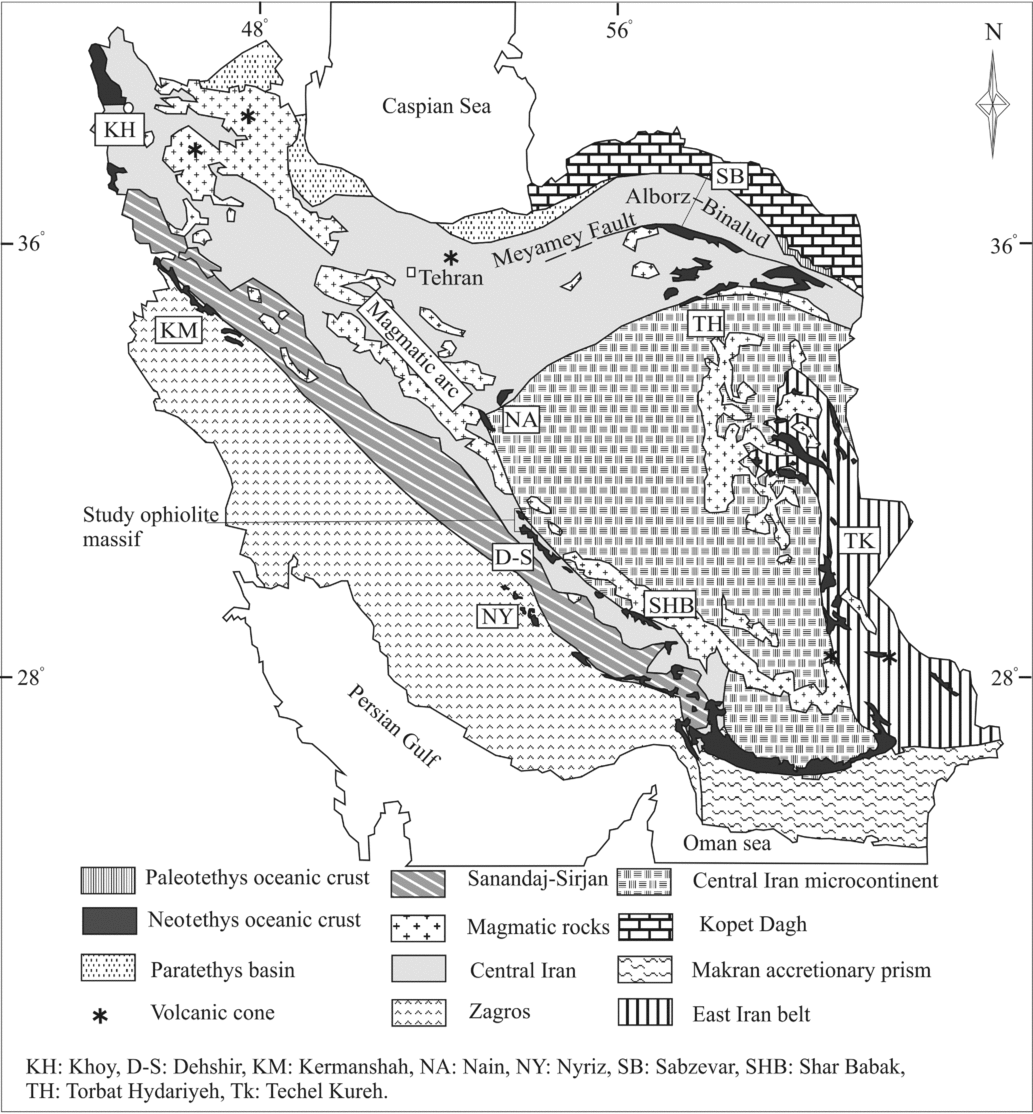
The ophiolitic remnants of Iran, related to the Paleotethys and Neotethys oceans, occur as scattered, tectonized and more or less metamorphosed exposures along the border of main structural zones (Fig. 1). The ophiolite complex described in this article, exposed south of Dehshir town, is part of the various ophiolitic massifs that are exposed along the WSW margin of the Central Iran microcontinent (Fig. 1), including the ophiolites of Nain, Dehshir and Baft-Balvard (Stöcklin, Reference Stöcklin, Burke and Drake1974). In the classification of Iranian ophiolites proposed by Knipper, Ricou & Dercourt (Reference Knipper, Ricou and Dercourt1986), the Dehshir ophiolites fall into Group 7 (Central Iran) ophiolites. They outcrop between the Makran–Zahedan ophiolites in the east (Group 8) and the Peri-Arabic ophiolitic crescent (Group 4) in the West (Knipper, Ricou & Dercourt, Reference Knipper, Ricou and Dercourt1986).
Distribution of ophiolitic assemblages and complexes of Iran, from the 1:1000000 magmatic map of Iran (Emami, Sadeghi & Omrani, Reference Emami, Sadeghi and Omrani1993) and from the sedimentary-structural map of Iran (Aghanabati, Reference Aghanabati2004) showing the location of the study area (D-S).

Davoudzadeh (Reference Davoudzadeh1972) described the north Nain ophiolite as a coloured mélange that was thrust onto the Eocene Akhoreh Formation flysch and Miocene sediments. The 1:250000 Abadeh Geological Quadrangle (Amidi et al. Reference Amidi, Aghanabati, Taraz and Nabavi1983) and the 1:100000 Dehshir Geological Quadrangle (Rowshan Ravan, Sabzehei & Nazemzadeh Shoaii, Reference Rowshan Ravan, Sabzehei and Nazemzadeh Shoaii1997) were published by the Geological Survey of Iran, in which various ophiolitic units were introduced. Soltanmohammadi, Rahgoshay & Khalatbari Jafari (Reference Soltanmohammadi, Rahgoshay and Khalatbari Jafari2009) studied the geochemistry and petrogenesis of the Khabr–Marvast ophiolitic crustal sequence, concluding that all the volcanic rocks of their studied area indicate a subduction-related magmatism. Shafaii Moghadam et al. (Reference Shafaii Moghadam, Whitechurch, Rahgoshay and Monsef2009) related the formation of the Nain–Baft Ophiolitic Belt to a context of back-arc basins. In the stratigraphic column of the Dehshir Ophiolite, they omitted the presence of a diabase sheeted dyke complex of weherlitic intrusions and post-ophiolitic quartz diorite-quartz monzodiorite dykes. Shafaii Moghadam, Stern & Rahgoshay (Reference Shafaii Moghadam, Stern and Rahgoshay2010) and Shafaii Moghadam & Stern (Reference Shafaii Moghadam and Stern2011) related the formation of the Dehshir Ophiolite to a context of forearc basins. In the stratigraphic column of the Dehshir Ophiolite, Shafaii Moghadam, Stern & Rahgoshay (Reference Shafaii Moghadam, Stern and Rahgoshay2010) and Shafaii Moghadam & Stern (Reference Shafaii Moghadam and Stern2011) included a diabase sheeted dyke complex as a small lithological unit at the base of the extrusive sequence. Mehdipour Ghazi, Moazzen & Rahgoshay (Reference Mehdipour Ghazi, Moazzen and Rahgoshay2011) attributed arc and MORB-like geochemical affinities to the gabbros, diabases of the sheeted dykes complex and pillow lavas of the Nain Ophiolite. Shafaii Moghadam, Corfu & Stern (Reference Shafaii Moghadam, Corfu and Stern2013) reported U–Pb zircon ages for the tonalites, plagiogranite veins and gabbro-diorite of the Dehshir Ophiolite and for the tonalitic dykes, amphibole gabbros and isotropic gabbros of the Nain Ophiolite, suggesting that both ophiolite massifs were formed at c. 103–101 Ma ago (the Nain Ophiolite being one million years older than the Dehshir Ophiolite).
2. Purpose and methodology
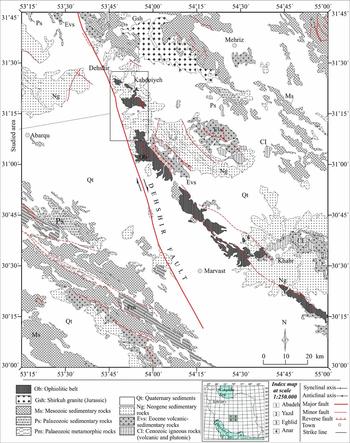
The Dehshir Ophiolitic Belt that occurs along the southwestern margin of the Central Iran microcontinent comprises, from north to south, the Dehshir and Khabr-Marvast ophiolitic massifs (Fig. 2), connecting to the northwestern Shahr-e-Babak ophiolitic massif. The Dehshir ophiolitic massif (studied in this manuscript) is located in the northernmost part of the Dehshir Ophiolitic Belt.
Simplified geological map showing the location of the Dehshir ophiolitic massif located in the northern section of the Dehshir Ophiolitic Belt and the surrounding rocks based on data from the 1:250000 geological maps of Abadeh (Amidi et al. Reference Amidi, Aghanabati, Taraz and Nabavi1983), Yazd (Nabavi et al. Reference Nabavi, Iwao, Tatevosian, Valeh, Haghipour, Pelissier and Bolurchi1972), Eglid (Hushmandzadeh et al. Reference Hushmandzadeh, Aghanabati, Ohanian, Sahandi, Taraz, Azarm, Soheili and Hamidi1981) and Anar (Soheili & Yugoslavian groups, Reference Soheili1981).

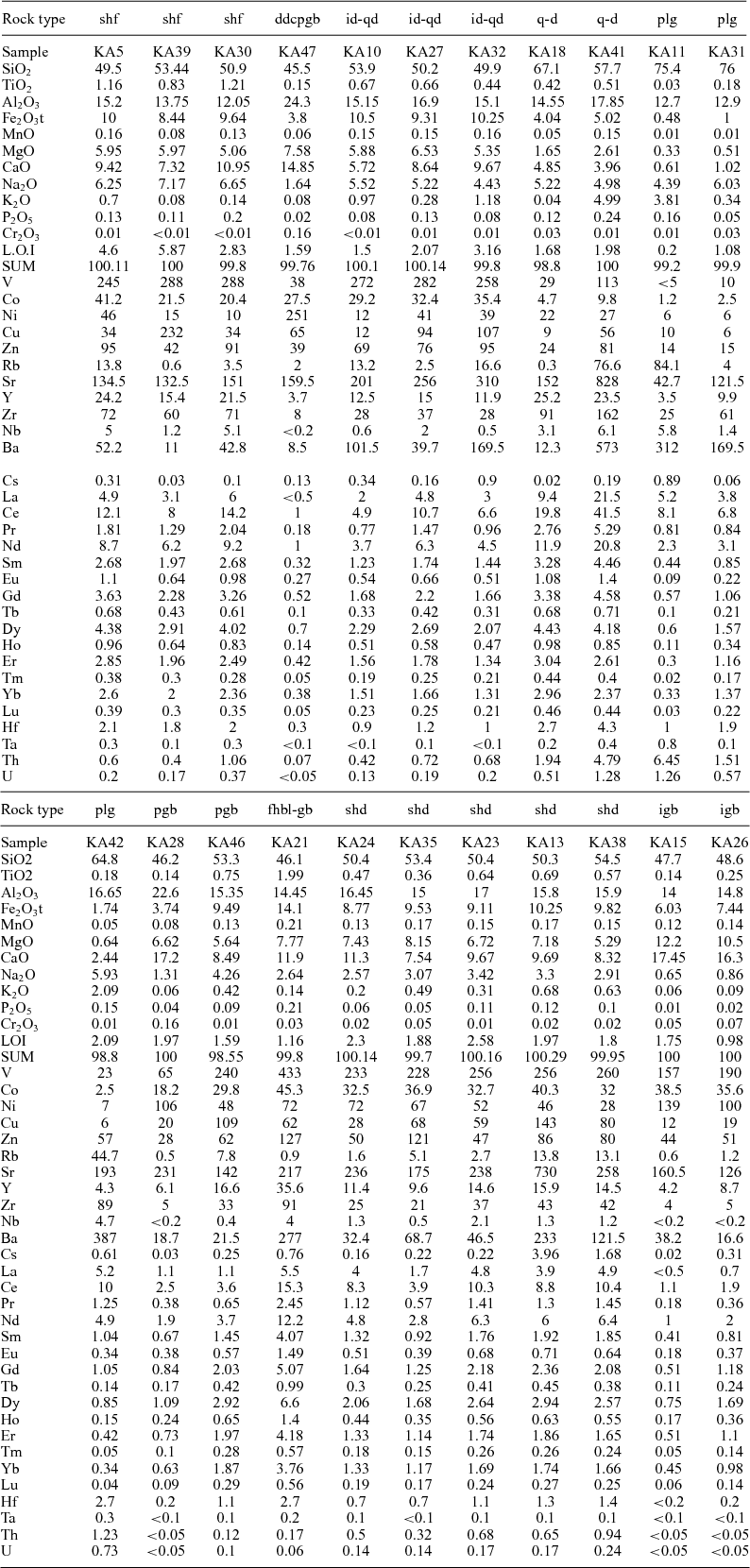
Previous geochemical investigations of the Dehshir Ophiolitic Belt focused on the southern ophiolitic massifs. The absence of geological and geochemical data for the ophiolitic crustal rocks of the northern part of Dehshir Ophiolitic Belt (Dehshir massif) has led us to undertake a comprehensive geological and geochemical study of this area. Field mapping was performed using the 1:250000 and 1:50000 ASTER and SPOT satellite imageries and 1:50000 topographic maps and aerial photographs. After preparing thin-sections and their petrographic study, 22 samples from the ophiolitic crustal rocks were selected to determine their geochemical characteristics and tectonomagmatic setting. The samples were sent to the ALS laboratory in Toronto, Ontario, Canada where they were analysed for major and trace elements (Ba, Sr, Y, Zr and Zn) via inductively coupled plasma atomic emission spectrometry (ICP-AES) and other trace elements (including rare Earth elements or REEs) by inductively coupled plasma mass spectrometry (ICP-MS). The ICP-AES analysis used c. 0.1g rock powder that was first mixed with 0.9g lithium borate in a carbon crucible and then melted in a furnace at 1100°C for 30minutes. The fused glass samples were dissolved (using a magnetic stirring device) in 100mL of 1% HNO3 solution with Ge as an internal standard. The ICP-MS analysis of the trace elements used 0.1g rock powders that were dissolved in a mixture of HF, HCl and HNO3 in screw-top Teflon vials. An internal standard solution containing indium was then added, and the spiked sample dissolution was diluted with 1% HNO3. The internal standard was used for monitoring drift in mass response during measurement. The geochemical results are given in Table 1.
Geochemical data of the major (%) and minor elements (ppm) in the studied samples.

Abbreviations: shf: sheet flow; ddcpgb: diabase dyke cut by pegmatite gabbro; id-qd: isolated diabase quartz diabase; q-d: quartz diorite; plg: plagiogranite; pgb: pegmatite gabbro; fhbl-gb: foliated hornblende gabbro; shd: sheeted dyke; igb: isotropic gabbro.
3. Geology
The Upper Cretaceous Iranian ophiolites represent the remnants of the Neotethys Ocean that are exposed along the major structural zones of Central Iran, Sannadaj–Sirjan, Zagros, the East Suture Zone and the southeastern flysh zone (Stöcklin, Reference Stöcklin1968; Khalatbari Jafari, Babaie & Gani, Reference Khalatbari Jafari, Babaie and Gani2013; Khalatbari Jafari, Babaie & Mirzaie, Reference Khalatbari jafari, Babaie and Mirzaie2013) which are located in the Alpine–Himalayan Orogenic Belt (e.g. Dilek, Reference Dilek, Dilek and Newcomb2003).
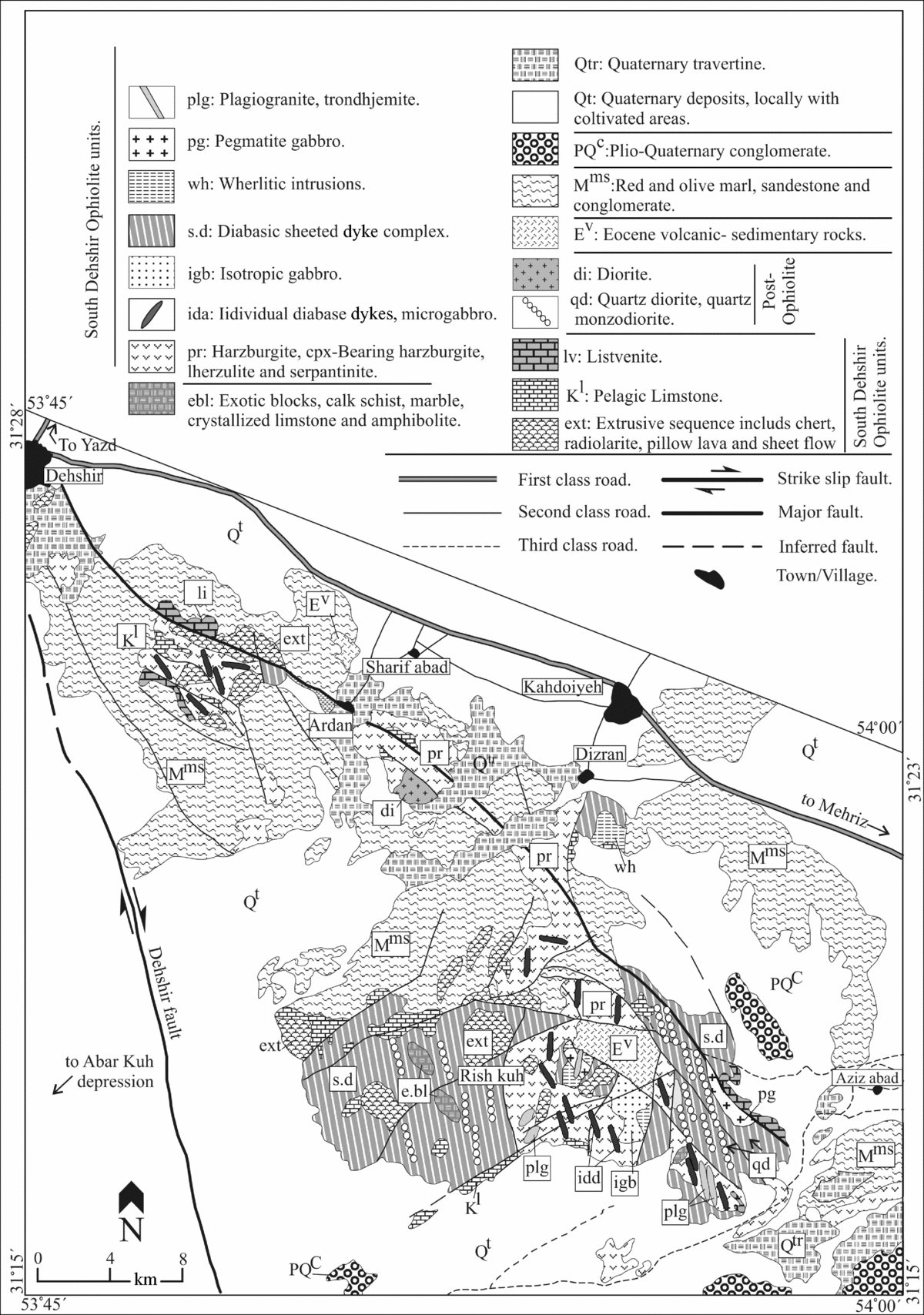
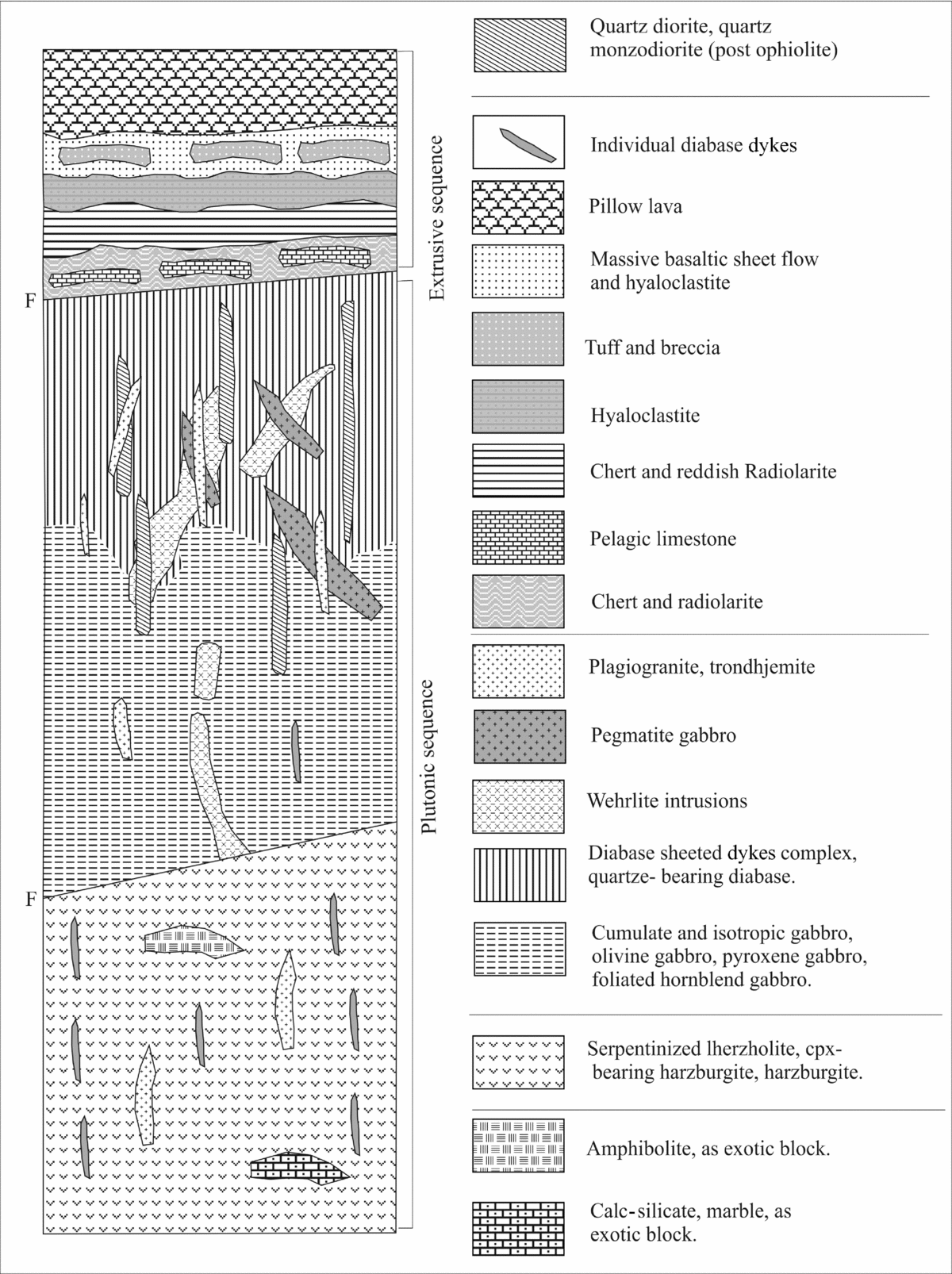
The studied ophiolite massif exposed to the south of Dehshir town between longitudes 53°45′E and 54° 00′E and latitudes 31°15′N and 31° 28′N is part of the southwestern segment of the Dehshir–Shahr Babak Ophiolitic Belt (Fig. 1) that occurs along the southwestern margin of the Central Iran microcontinent (Stöcklin, Reference Stöcklin1968; Khalatbari Jafari, Babaie & Gani, Reference Khalatbari Jafari, Babaie and Gani2013; Khalatbari Jafari, Babaie & Mirzaie, Reference Khalatbari jafari, Babaie and Mirzaie2013) (Fig. 1). This ophiolite is bordered to the west by the Dehshir Fault to Dasht-e-Abar Kuh, and to the east by Eocene volcanic-sedimentary rocks and Neogene sedimentary rocks (Figs 1, 3). A detailed geological map of the south Dehshir region at a scale of 1:25000 is provided in Figure 3. Despite the tectonized contacts between the various lithological units of the South Dehshir Ophiolite, it is possible to reconstruct its internal organization in a schematic ‘stratigraphic’ column (Fig. 4). The ophiolitic assemblage comprises remains of the mantle and a crustal sequence, including plutonic, hypabyssal and extrusive rocks (Figs 3–7). Given that the south Dehshir rocks have not gone through regional metamorphism and do not exhibit foliations or lineations, the term ‘coloured mélange’ as defined by the Penrose Committee (Anonymous, 1972) does not apply to them.
New compiled and detailed geological map of the south Dehshir region at the scale of 1:25000.

Schematic stratigraphic column showing the different lithological units of the extrusive and intrusive sequences of the South Dehshir Ophiolite.

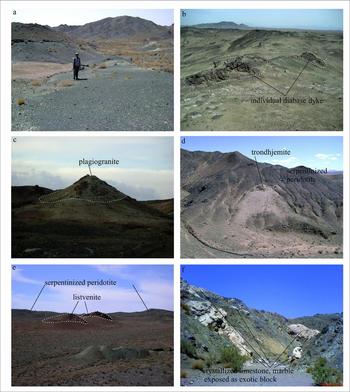
Field pictures showing different ophiolitic units in the Dehshir area. (a) An outcrop of peridotite exposed west of the Ardan village; (b) individual diabase dyke cutting across peridotite; (c) plagiogranite body cutting across the peridotites south of Kamar Chah Sorkh; (d) trondhjemite body cutting across the mantle peridotites west of Rashkoiyehe farm; (e) outcrop of listvenite east of Kamarchah Sorkh; and (f) sheared exotic blocks of calc-silicates and marbles, included in the peridotites.

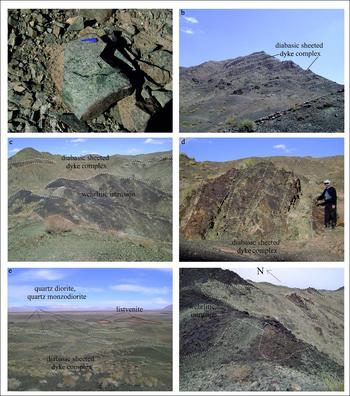
Field pictures showing different lithological units in the Dehshir area. (a) Foliated hornblende-bearing gabbro in Kamarchah Sorkh; (b) diabase sheeted dyke complex in Kuh-e-Osalmon; (c) dark wehrlite-olivine websterite intrusions cutting across the diabase sheeted dyke complex east of Rish Kuh; (d) close-up of the diabase sheeted dykes east of Rish Kuh; (e) outcrops of grey–green amphibole-bearing quartz diorite cutting across the diabase sheeted dyke NE of Kamarchah Sorkh; and (f) wehrlitic intrusions with an approximate north–south trend cutting isotropic gabbro.

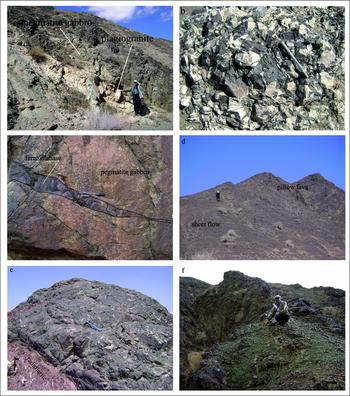
Field pictures showing different lithological units in the Dehshir area. (a) Wehrlitic intrusions east of Rish Kuh cut across the diabase sheeted dyke complex, and are themselves cut by grey pegmatite gabbro and light-coloured plagiogranite dykes; (b) close-up of pegmatite gabbro east of Rish Kuh; (c) diabase, as the last magmatic phase in the intrusive crustal sequence, cuts across pegmatite gabbro NW of Kuh-e-Osalmon; (d) a general view of the extrusive sequence including pillow basalts and sheeted flows SE of Rish Kuh; (e) a close-up view of the extrusive sequence in Ardan village where radiolarites lie below pillow lavas; and (f) ocean floor alteration and extensive epidotization of the extrusive sequence in Rish Kuh.

The mantle sequence comprises serpentinized peridotites including harzburgites, cpx-bearing harzburgites and serpentinized lherzolites (Fig. 5a). The mantle peridotites are cut by individual diabase dykes (Fig. 5b) and by plagiogranite-trondhjemite intrusions (Figs 5c, d). Rodingite (in lesser extent), carbonate listvenite dykes commonly cut across this mantle sequence (Fig. 5e). There are sporadic distributions of amphibolites and crystallized limestones and marble as exotic blocks (Fig. 5f). The source of these calc-silicate exotic blocks, marbles and amphibolites is unknown.
The crustal sequence is divided into a plutonic-hypabyssal section and an extrusive section. There is no evidence for the presence of layered gabbros in the plutonic section. The base of the plutonic part of the crustal sequence in the south Dehshir massif is composed of isotropic gabbros, comparable to the upper-level gabbros of the standard crustal sequence in the Oman Ophiolite, for instance (Nicolas & Boudier Reference Nicolas and Boudier2009). Shafaii Moghadam et al. (Reference Shafaii Moghadam, Whitechurch, Rahgoshay and Monsef2009) provided a K–Ar age of 93.8Ma for an amphibole gabbro from the southern part of the Dehshir Ophiolite Belt. The upper part of the gabbroic sequence is characterized by the scarce presence of a magmatic foliation (Fig. 6a), making the transitions to the extended hypabyssal diabase sheeted dyke complex (Fig. 6b–d). These dykes are oriented north–south with a few degrees of inclination to either the east or west. The crustal sequence is cut across by wehrlitic and olivine-websteritic intrusions (Fig. 6c, f), showing a general orientation consistent with that of the dyke complex, subsequently cut by pegmatite gabbro dykes (Fig. 7a, b). Mafic ferro-diabase dykes are the late magmatic phase, cutting across the pegmatitic gabbros (Fig. 7c). The whole ophiolitic crustal sequence is cut by various post-ophiolite amphibole-bearing quartz-diorite intrusions (Fig. 6e).
The extrusive part of the crustal sequence (Fig. 7d–f) rests over a sedimentary sequence made of dark cherts to red radiolarites, with radiolarian and sponge spicule microfauna at the base (Fig. 7e). Palaeontological investigations in the radiolarites have yielded a Late Cretaceous age. Palaeontological investigation of the pelagic limestone at the top of the extrusive sequence produced the following microfaunna of Late Cretaceous age (Zohreh Sohrabi, unpublished report of GSI, 2010): Globotruncana arca, Gansserina gansseri, Globotruncana ventricosa, Glonita sabspinosa, Glonita stuarti, Rosita contuse, Globotruncanella citae, Oligosteginidea and Radiolarian.
The extrusive sequence consists of hyaloclastites, hyaloclastic breccias and tuffs overlain by an assemblage of sheet flows and pillow lava flows. Hyaloclastites and red radiolarite with carbonate cement occur among the pillow lava. The extrusive rocks are locally extensively altered by secondary minerals such as epidote and chlorite (Fig. 7f). Eocene volcanic-sedimentary rocks, Eocene andesitic lava and ignimbrite are tectonically juxtaposed against the pillow lavas to the east of the study area. Eocene microfauna are reported in the 1:100000 geological map of Dehshir from the lenses of Nummulite-bearing limestones inside the Eocene volcanic-sedimentary rocks (Rowshan Ravan, Sabzehei & Nazemzadeh Shoaii, Reference Rowshan Ravan, Sabzehei and Nazemzadeh Shoaii1997). Younger Pliocene–Quaternary conglomerate and sandstone rest over all these rocks with an angular unconformity.
4. Petrography
4.a. Mantle rocks
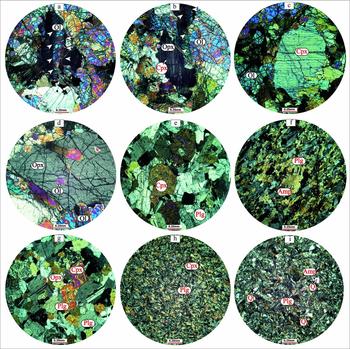
Petrographic investigation shows that the peridotites are extremely serpentinized. Porphyroclastic lherzolites and cpx-bearing harzburgites have coarse-grained olivine, orthopyroxene and clinopyroxene porphyroclasts. Whereas olivine porphyroclasts show kink bands (Fig. 8a), the orthopyroxenes exhibit both undeformed and deformed shapes. The undeformed orthopyroxenes contain thin clinopyroxene exsolution lamellae (Fig. 8b) along the (100) cleavage. The deformed orthopyroxenes show undulose to rolling extinction. The clinopyroxene porphyroclasts (Fig. 8c) are locally rounded within a finely granulated olivine matrix. The deformed clinopyroxenes show undulose and bent extinctions. The deformed pyroxene and kink-banded olivine crystals are evidence for crystal plastic deformation at high temperature in the mantle (Nicolas, Reference Nicolas1989; Juteau & Maury, Reference Juteau and Maury2012). The formation of undeformed fine-grained olivine and pyroxene, accompanied by various deformed minerals (Fig. 8d), may be related to melts passing through the mantle wedge above the subducted slab (Munter & Piccardo, Reference Munter, Piccardo, Dilek and Newcomb2003).
Selected photomicrographs showing: (a) olivine with internal kink structures in harzburgite; (b) thin clinopyroxene lamellae within orthopyroxene; (c) a large undeformed clinophyroxene in lherzolite; (d) fine olivine inclusion without kink structure within an orthopyroxene (coarse-grained deformed olivine crystals shown at bottom); (e) pyroxene gabbro; (f) foliated hornblende gabbro with hetradcumulate texture; (g) orthopyroxene in gabbro; (h) fine-grained diabase; and (i) diabase with fine-grained quartz.

4.b. Gabbroic sequence
Isotropic gabbros include olivine gabbros (Fig. 8e), pyroxene gabbros and foliated amphibole-bearing gabbros (Fig. 8f) with cumulative textures. The anhedral olivine is the product of a first crystal generation, and shows a kink band which could be related to viscous deformation due to crystal packing during the compaction process (Hunter, Reference Hunter and Cawthorn1996). The presence of olivine inclusions among orthopyroxenes (enstatite) suggests that orthopyroxene formed during early stages of crystallization immediately after olivine (Fig. 8g). Plagioclase (bytownite-labradorite), clinopyroxene (diopside) and green amphibole are the other rock-forming minerals in gabbros. Due to the presence of clinopyroxene inclusions in plagioclase and plagioclase inclusions in clinopyroxene, both mineral phases were presumably contemporaneous. Hornblende gabbros contain large crystals of green hornblende overprinting previous minerals and forming a heteradcumulate texture (Fig. 8f). The absence of orthocumulate textures (currently found in closed magma chambers) and the abundance of mesocumulate, adcumulate and heteradcumulate textures typically found in open magma chambers (Hunter, Reference Hunter and Cawthorn1996; Winter, Reference Winter2001; Juteau & Maury, Reference Juteau and Maury2012) suggests that the isotropic gabbros of the South Dehshir Ophiolite were formed in an open magma chamber, as observed in various cumulate rocks of supra-subduction ophiolites (Hunter, Reference Hunter and Cawthorn1996; Winter, Reference Winter2001; Juteau & Maury, Reference Juteau and Maury2012). A unit of foliated gabbros constitutes the top of the plutonic sequence in the Dehshir Ophiolite, lying over the isotropic gabbros. This is also the cause of the Sabzevar Ophiolite (area north of Garagoli; Khalatbari Jafari, Babaie & Mirzaie, Reference Khalatbari Jafari, Babaie and Gani2013) in the upper part of the plutonic sequence. These rocks might have formed as a result of compaction of the cumulate pile, expelling an excess of intracrystalline (and hydrated) fluids as proposed by Kocak et al. (Reference Kocak, Isik, Arslan and Zedef2005) in their study of the hornblende gabbros exposed at the top of a cumulative gabbro sequence in Anatolia, central Turkey. Alternatively, it is possible that the hornblende gabbro originated by partial melting of a hydrous peridotite source, an idea that requires further field and laboratory works.
4.c. Sheeted dyke complex
The sheeted dyke complex exhibits diabase to phyric textures within a diabase matrix (Fig. 8h); it also has quartz-bearing diabase compositions (Fig. 8i). The phenocrysts include altered plagioclase, clinopyroxene and olivine. The plagioclase phenocrysts are altered to saussurite, chlorite, epidote, clay materials and occasionally albite. Clinopyroxene is replaced by tremolite-actinolite, chlorite, Ti–Fe oxides and hornblende. The plagioclases in the matrix display both fresh and altered crystals similar to the plagioclase phenocrysts. The clinopyroxenes in the matrix are almost entirely replaced by tremolite-actinolite, chlorite, epidote, opaque minerals and hornblende. In some cases, the accessory minerals and sphene microcrystals are present. In the quartz-bearing diabases, quartz occurs as anhedral minerals and as inclusion within other minerals (Fig. 8i).
4.d. Late magmatic intrusions
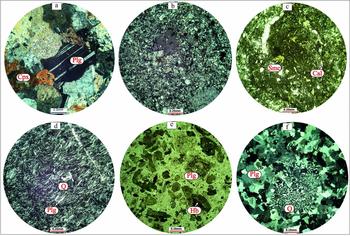
The wehrlitic and olivine webstrite intrusions are formed of olivine and diopside with variable amounts of orthopyroxene. These rocks display intense oxidation and serpentinization. The pegmatite gabbros have olivine gabbro and pyroxene gabbro compositions. Olivine gabbro is fresher, and includes coarse-grained olivine crystal with internal kink bands, calcic plagioclase, clinopyroxene and occasionally orthopyroxene. Olivine is absent from the pyroxene gabbro (Fig. 9a). Plagiogranites display phyric textures with a microcrystalline matrix (Fig. 9b) or granular texture. Na-rich plagioclase and quartz occur both as phenocrysts and in the matrix.
Selected photomicrographs showing: (a) pegmatite gabbro; (b) phyric plagiogranite in microcrystalline matrix; (c) replacement of volcanic glass by calcite and smectites; (d) a fluidal microlitic texture in a sheet flow; (e) amphibole-bearing quartz diorite; and (f) trondhjemite with graphic texture.

4.e. Volcanic sequence
Hyaloclastic breccias and tuffs have basaltic to andesitic-basaltic compositions. Tuffs display hyaloclastic to lithoclastic textures. The plagioclase and pyroxene grains are extensively altered, and the lithic fragments are often oxidized. Smectites (Fig. 9c), chlorite and veins filled with albite and calcite are notable.
Pillow basalts seldom display phyric textures and often exhibit intersertal texture. The volcanic glass is entirely replaced by smectites (Fig. 9c). The minerals in the pillow basalt show two generations. The first generation includes clusters of plagioclase and pyroxene crystals, formed in the magma chamber prior to the eruption of lava. The second generation consists of plagioclase microlites and fine-grained clinopyroxene and smectitized volcanic glass that formed just after the lava emplacement on the seafloor. The sheet flows have andesitic compositions and exhibit fluidal to microlitic textures (Fig. 9d).
4.f. Post-ophiolitic dykes
Amphibole-bearing quartz-diorites – quartz-monzodiorites show phyric texture with a microcrystalline matrix. Plagioclase and green hornblende (Fig. 9e) phenocrysts cover c. 45% of the thin-section. The matrix contains plagioclase and hornblende minerals as well as quartz microcrystals and extremely argillic K-feldspars (Fig. 9e). A few thin-sections of quartz monzodiorite display granular to micrographic textures (Fig. 9f). The thin-sections of calc-schist show the porphyroclastic texture. Epidote, muscovite and fine-grained carbonate and quartz form the foliation. Listvenite is mostly formed from carbonate and quartz.
5. Geochemical data
The results of chemical analyses of 22 samples are given in Table 1. Alteration, indicated through the petrographic study, has affected the ophiolitic sequences to varying extents and probably accounts for the high loss-on-ignition (LOI) values in the geochemical analyses (Table 1). Because of the cumulate character of gabbroic samples, we did not plot them on binary and tectonomagmatic diagrams.
5.a. Geochemical classification and nomenclature
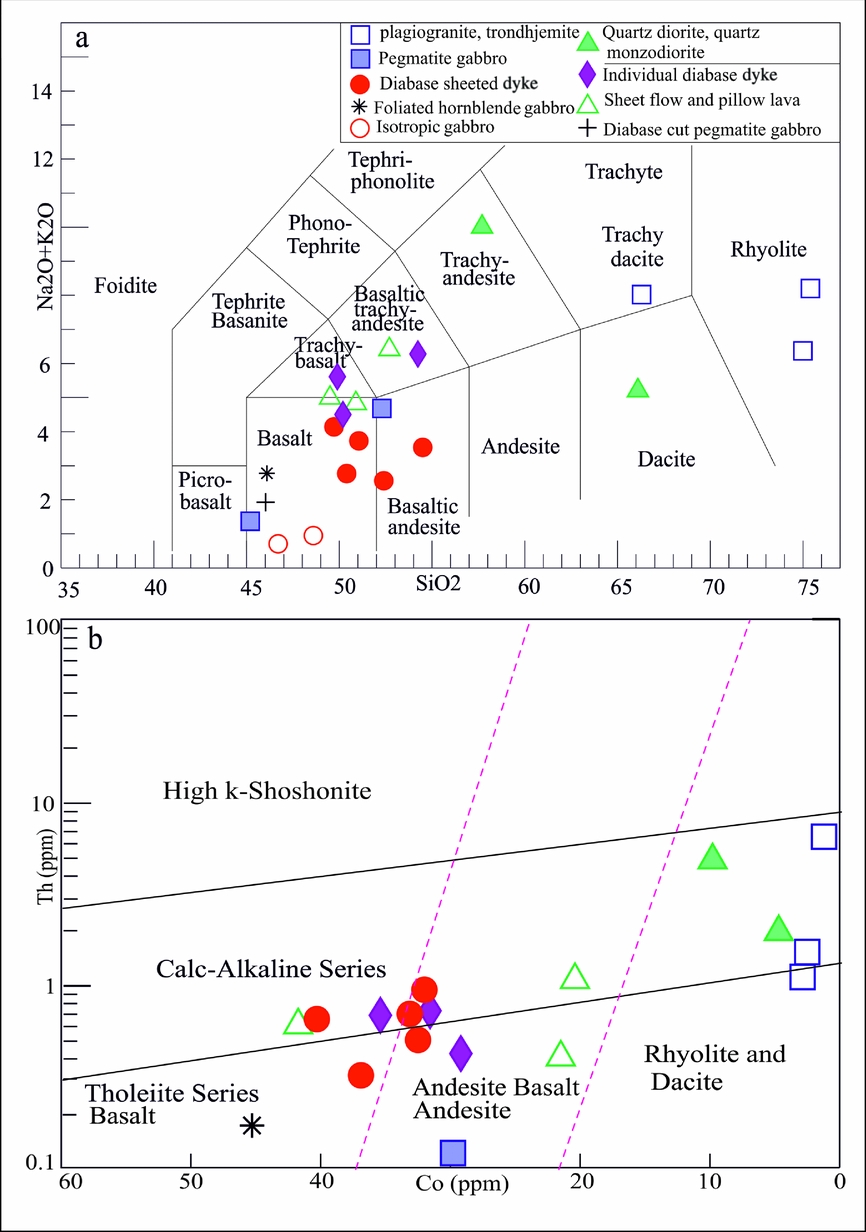
Samples of the crustal rocks of the South Dehshir Ophiolite were plotted in the Na2O+K2O v. SiO2 classification diagram (Fig. 10a) of Le Bas et al. (Reference Le Bas, Le Maitre, Streckeisen and Zanettin1986). Isotropic gabbros and foliated hornblende gabbros plot in the basalt field; diabase sheeted dykes plot in the basalt to basaltic andesite fields; sheet flows, pillow lavas and individual diabase dykes plot within the basalt-trachy basalt to basaltic trachy andesite fields; and plagiogranite-trondhjemites plot in the fields of rhyolite to trachy dacite. Post-ophiolitic quartz-diorites – quartz-monzodiorites plot within the fields of dacite to trachy andesite.
Classification of the studied rock samples based on the (a) Le Bas classification diagram (Le Bas et al. Reference Le Bas, Le Maitre, Streckeisen and Zanettin1986) and (b) Hastie et al. (Reference Hastie, Kerr, Pearce and Mitchell2007) diagram.
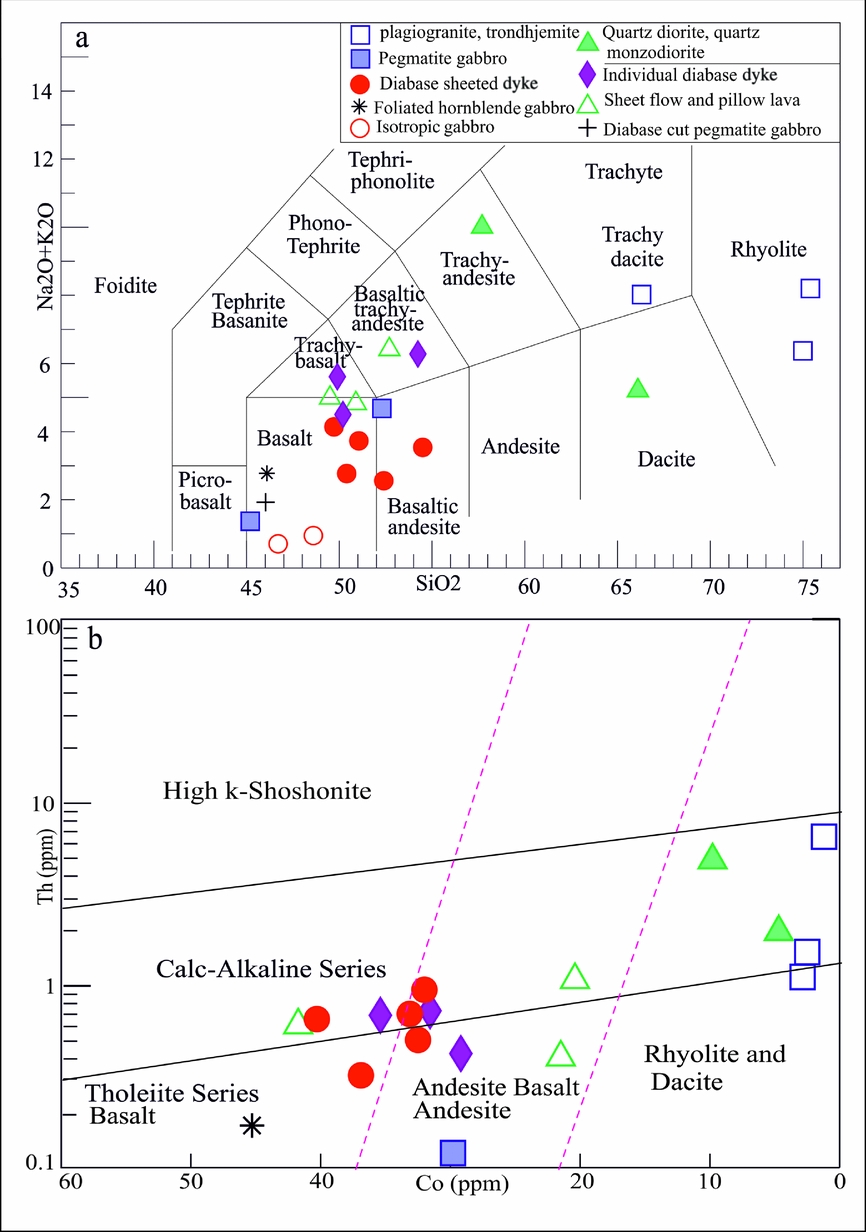
In Figure 10b, the fields of tholeiite and calc-alkaline series are distinguished from the high-K-shoshonite field (Co v. Th of Hastie et al. Reference Hastie, Kerr, Pearce and Mitchell2007). In this diagram, the samples of diabase sheeted dykes and individual diabase dykes are distributed between the basaltic, andesite basalt and andesite fields in both tholeiitic and calc-alkaline magmatic trends. One sample of sheet flow plots in the tholeiite basalt field, whereas the two other plot in the tholeiitic and calc-alkaline andesite basalt to andesite fields. The plagiogranite-trondhjemite samples plot in the calc-alkaline rhyolite and dacite fields. Post-ophiolitc quartz diorites and quartz monzodiorites plot in the calc-alkaline rhyolite and dacite fields (Fig. 10b). Foliated hornblende gabbros plot in the tholeiite series basalt field, and one sample of pegmatite gabbro plots in the andesite basalt and andesite field. Probably because of the lower content of Th, the other samples of gabbro plot outside of the diagram.
5.b. Binary diagrams
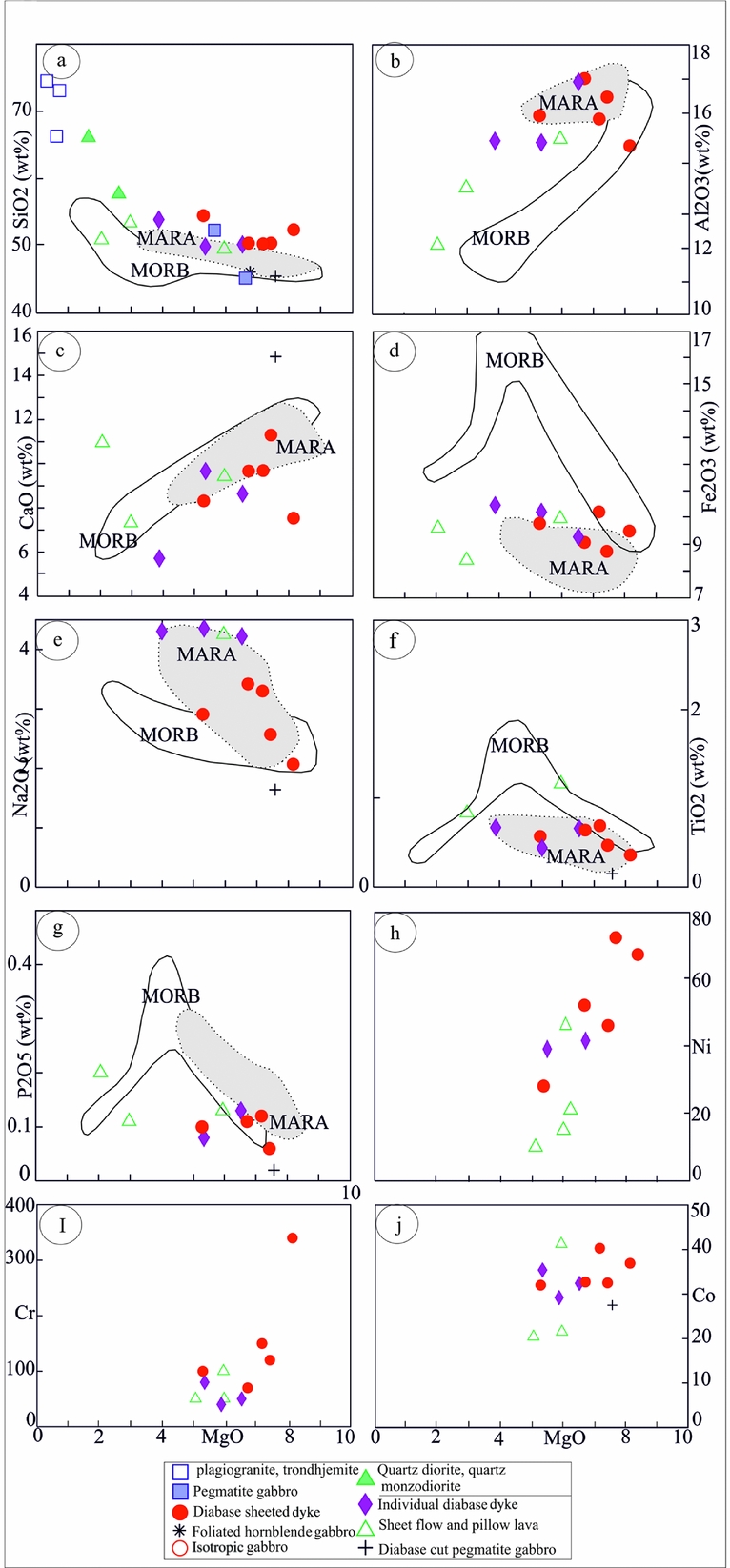
Figure 11 shows the binary diagrams of the MgO v. a set of major and minor elements: SiO2, Al2O3, CaO, Fe2O3, Na2O, TiO2, P2O5, Ni, Cr and Co. The fields for the average MORB and Mariana Back-arc Basin (MARA) are added to these diagrams to evaluate the role of subduction components (fluid-melt) in the generation of the crustal rocks of South Dehshir Ophiolite (Hawkins & Melchior, Reference Hawkins and Melchior1985; Hochstaedter et al. Reference Hochstaedter, Gill, Kusakabe, Newman, Pringle, Taylor and Fryer1990). Figure 11 shows compositional trends of crustal rocks of the South Dehshir Ophiolite samples. The plagiogranite samples plot away from the hypabyssal and lava samples, outside of the diagram except for those in Figure 11a. The cumulate gabbroic samples are not plotted. The compositional trends of the crustal rocks of the South Dehshir Ophiolite displayed on selected binary variation diagrams are consistent with their mineralogical compositions and exhibit compositional variations due to magmatic differentiation (Fig. 11a–j). In the diabase and lava samples, the ratios of the SiO2, Na2O, TiO2 and P2O5 oxides correlate negatively with MgO whereas the ratios of Al2O3, CaO, Ni, Cr and Co correlate positively. These trends do not follow the MORB-type tholeiitic trends (characterized by a strong enrichment in Fe–Ti) but follow the classical calc-alkaline evolution, normally due to the presence of an important fraction of fluids in the magma.
Selected binary diagrams of MgO v. major-minor elements (wt%) of the crustal rocks of the South Dehshir Ophiolite. Indian MORB (MORB in diagrams) and Mariana Back-arc Basin (MARA) are included for comparison. The Indian MORB data are from Rehkämper & Hofmann (Reference Rehkämper and Hofmann1997) and Mahoney et al. (Reference Mahoney, Graham, Christie, Johnson, Hall and VonderHaar2002), and the MARA data are from Turner & Hawkesworth (Reference Turner and Hawkesworth1997) and Tian et al. (Reference Tian, Castillo, Hawkins, Hilton, Hanan and Pietruszka2008).
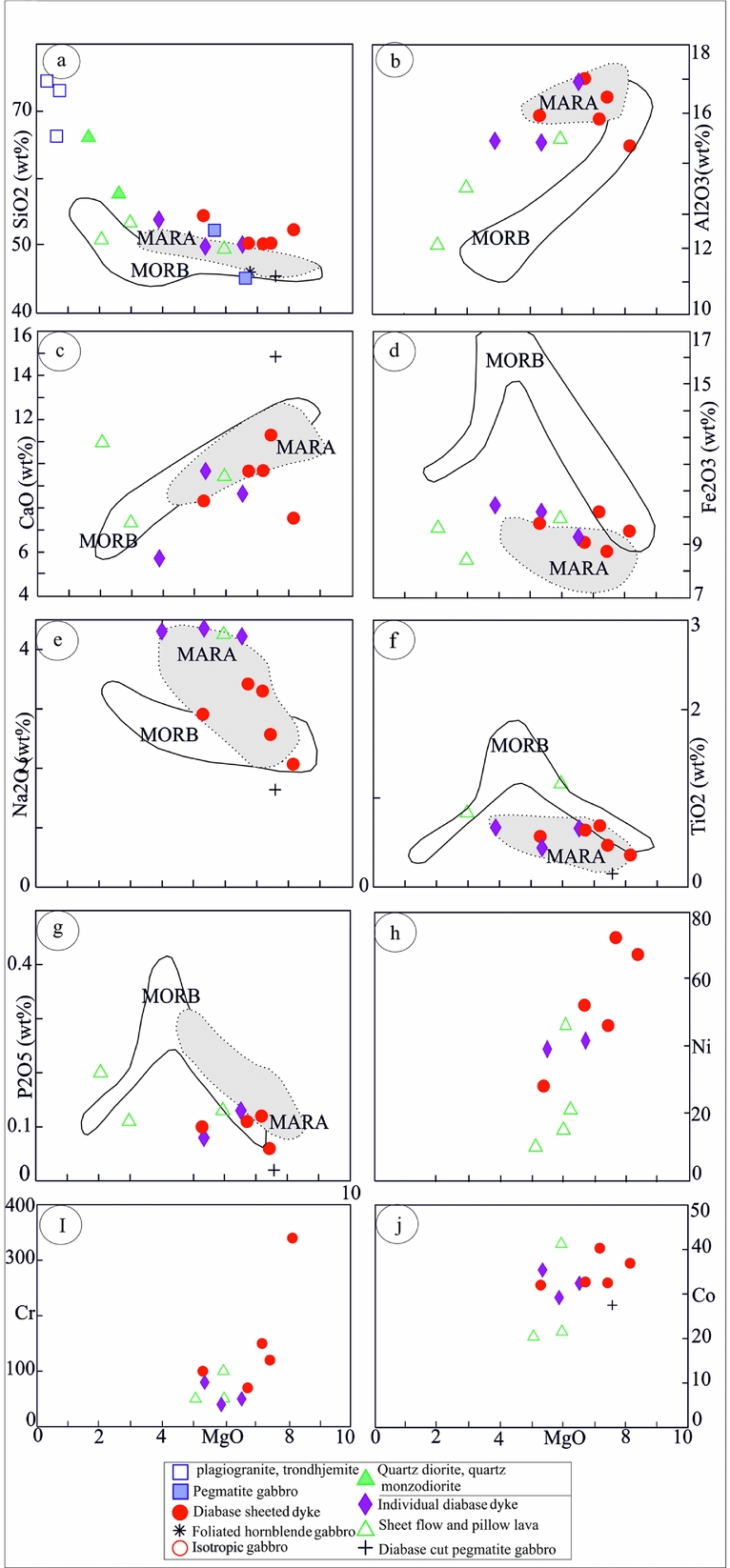
In the MgO v. Al2O3 diagram (Fig. 11b), we notice that the high contents of Al2O3 in the diabase samples do not evolve while MgO is decreasing (as the lavas of the MARA field do, given for comparison). On the contrary, the Al2O3 contents in the three lava samples decrease with decreasing MgO, showing a strong positive correlation between both oxides as occurs for MORB. However, the contents of Al2O3 in the lava remain higher than 12.4%, which is higher than MORB values (Hawkins & Melchior, Reference Hawkins and Melchior1985; Michael & Chase, Reference Michael and Chase1987).
Increasing the amount of water in basaltic lava or in the mantle during partial melting prevents or delays the crystallization of plagioclases (Michael & Chase, Reference Michael and Chase1987), which in turn causes an increase in Al contents of magma in arcs. This may be the reason why the Al2O3 contents in the diabase and lava samples from the crustal sequence of South Dehshir Ophiolite, similar to the arc lavas, are higher compared to those in MORBs.
In summary, these correlation and systematic compositional variations imply that the continuous separation of Fe–Ti oxides (and also pyroxenes and amphiboles) in the presence of a fluid phase played an important role in the evolution of the crustal rocks of the South Dehshir Ophiolite, which follow clearly a calc-alkaline trend during their magmatic differentiation. This explains why the samples logically cluster around the MARA field on the MgO v. SiO2, Al2O3, Fe2O3 and TiO2 plots (Fig. 11a, b, d, f).
5.c. Tectonomagmatic diagrams
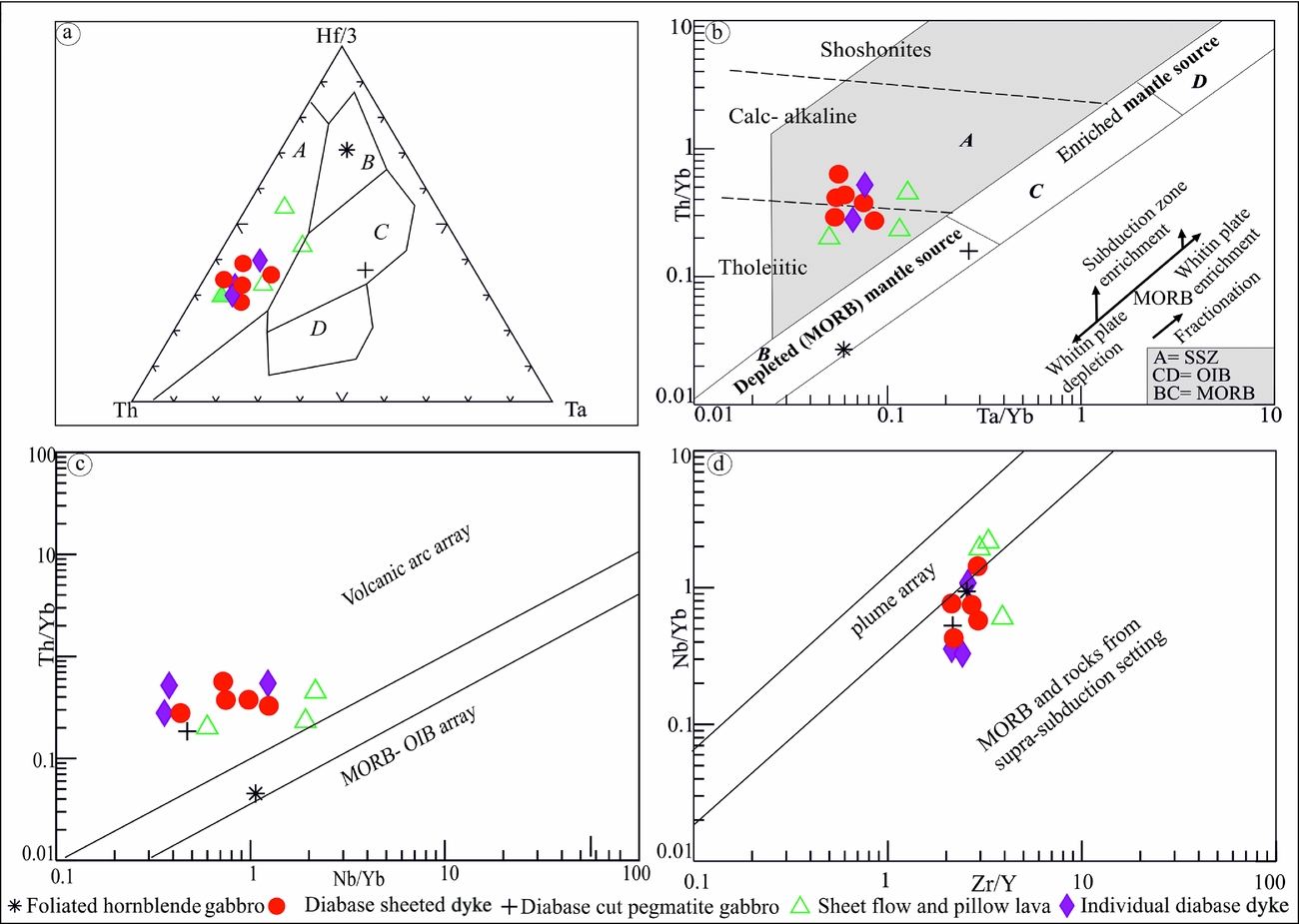
The applied tectonomagmatic diagrams are shown in Figure 12. Tectonomagmatic diagrams using incompatible elements, such as the ternary plot of Ta–Th–Hf (Wood, Reference Wood1980; Fig. 12a), are preferred to those using major elements. This diagram is used for distinguishing the supra-subduction zone (SSZ) ophiolites from the MORB ophiolites due to the high content of Th in the SSZ lavas (Juteau & Maury, Reference Juteau and Maury2012). In this diagram, fields B and C represent MORB; field A represents supra-subduction zone basalts; and fields C and D represent ocean-island basalts (OIB). All analyses of the crustal sequence of the South Dehshir Ophiolite plot in the supra-subduction zone field in this diagram (field A). Figure 12b shows the Ta/Yb v. Th/Yb diagram, proposed by Pearce (Reference Pearce and Thorpe1982) and modified by Pearce (Reference Pearce, Dilek and Newcomb2003). Tholeiitic, calc-alkaline and shoshonite fields on this diagram are extracted from Faustino et al. (Reference Faustino, Yumul, Dimalanta, de Jesus, Aitchison and Tamayo2006). Samples from the diabase sheeted dykes and individual diabase dykes and lavas plot in the tholeiitic and calc-alkaline fields. In the Nb/Yb v. Th/Yb diagram (Fig. 12c) (after Pearce, Reference Pearce2008), all samples of lavas, diabase sheeted dykes and individual diabase dykes plot in the volcanic arc array. In the Zr/Y v. Nb/Y diagram (Fig. 12d) (after Fitton et al. Reference Fitton, Saunders, Norry, Hardarson and Taylor1997), the majority of the samples plot in the field of MORB and rocks form supra-subduction setting; some of the diabase and lava samples cluster towards the boundary of the plume array however (Fig. 12d), suggesting an eventual contribution of local mantle plumes.
Tectonomagmatic setting of the crustal rocks of the South Dehshir Ophiolite. (a) Th–Hf/3–Ta (Wood Reference Wood1980). (b) Th/Yb v. Ta/Yb diagram proposed by Pearce (Reference Pearce and Thorpe1982) and modified by Pearce (Reference Pearce, Dilek and Newcomb2003). Tholeiitic, calc-alkaline and shoshonite fields of this diagram are extracted from Faustino et al. (Reference Faustino, Yumul, Dimalanta, de Jesus, Aitchison and Tamayo2006). (c) Th/Yb v. Nb/Yb diagram after Pearce (Reference Pearce2008). (d) Nb/Yb v. Zr/Y diagram after Fitton et al. (Reference Fitton, Saunders, Norry, Hardarson and Taylor1997).

In summary, the geochemical patterns deduced from the above tectonomagmatic diagrams indicate clearly that the crustal rocks of the South Dehshir Ophiolite display the geochemical characteristics of a subduction-related magmatism developed in a supra-subduction zone.
5.d. REE patterns and multi-element spider diagrams
The spider diagrams normalizing the analytical data to those of standard global values yield important information about magmatic processes. In this paper the geochemical data are normalized to the values of the primitive mantle and chondrites (Sun & MacDonough, Reference Sun, McDonough, Saunders and Norry1989; Figs 13, 14). The fields for the average forearcs and back-arcs are from Nicholson et al. (Reference Nicholson, Black and Picard2000).
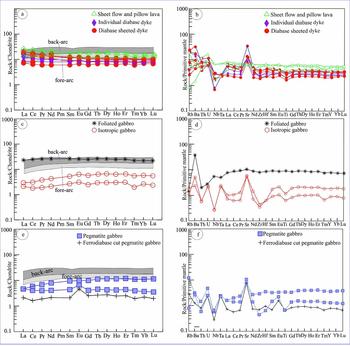
REE patterns normalized to the chondrite values, and spider diagrams normalized to primitive mantle values of Sun & Mcdonough (Reference Sun, McDonough, Saunders and Norry1989) for (a, b) sheet flows and pillow lavas, diabase sheeted dykes and individual diabase dykes; (c, d) isotropic gabbros and foliated gabbros; and (e, f) pegmatite gabbros and ferrodiabase cutting pegmatite gabbros. The average fields of forearc and back-arc are drawn using data from Nicholson et al. (Reference Nicholson, Black and Picard2000).

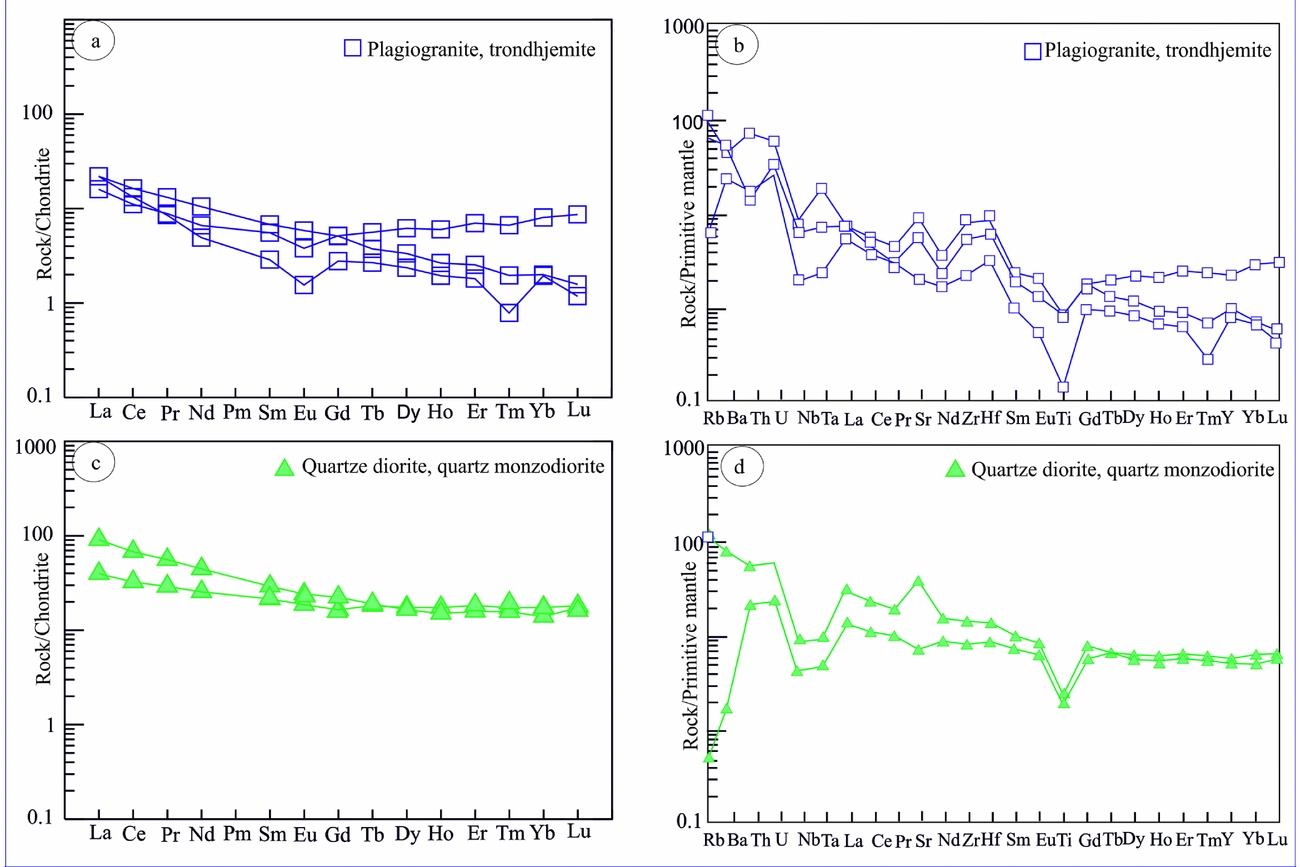
REE patterns normalized to the chondritic values and spider diagrams normalized to primitive mantle values of Sun & Mcdonough (Reference Sun, McDonough, Saunders and Norry1989) for (a, b) plagiogranites-trondhjemites and (c, d) post-ophiolitic quartz-diorites – quartz-monzodiorites.
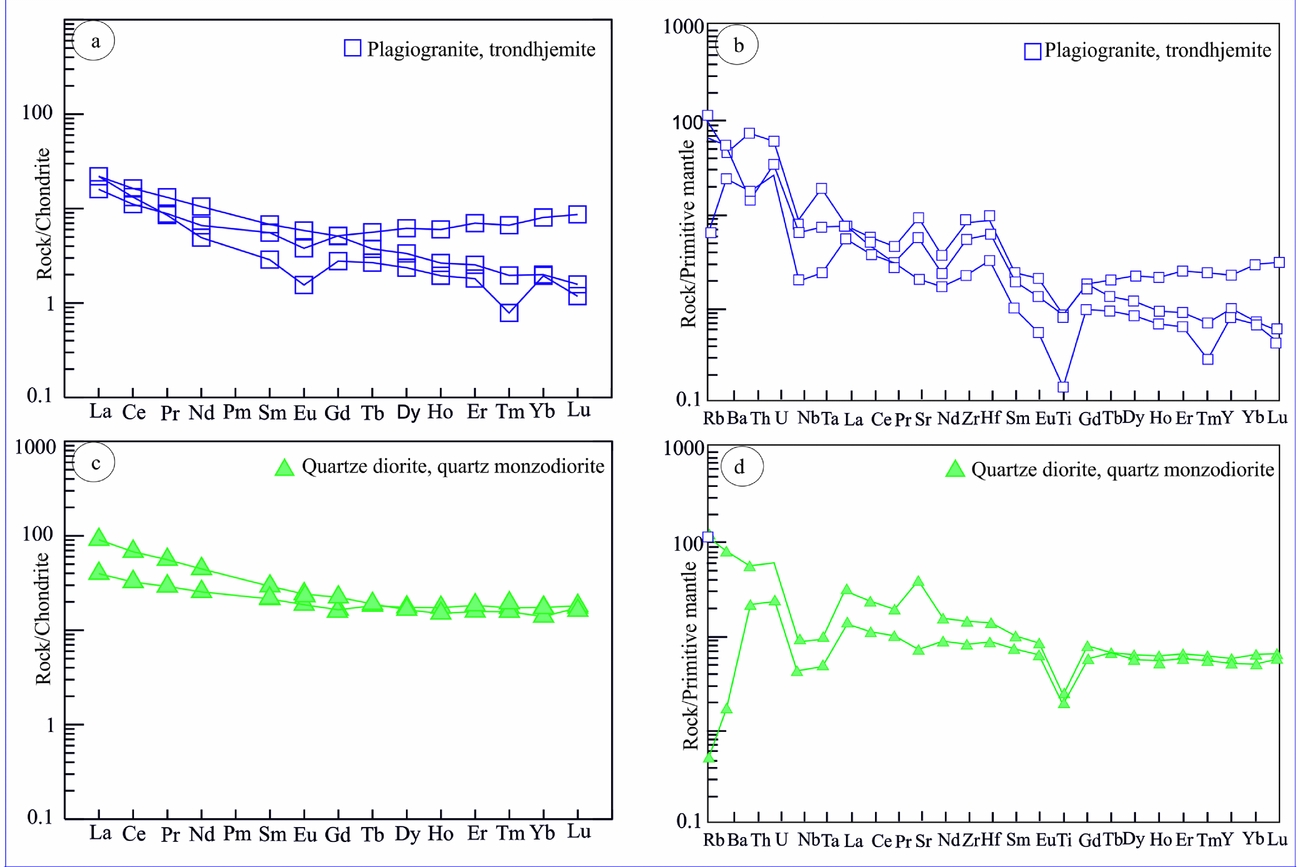
The rare Earth elemental patterns for extrusive, hypabyssal and plutonic rocks normalized to the chondrite values of Sun & McDonough (Reference Sun, McDonough, Saunders and Norry1989) are shown in Figures 13a, c, e and 14a. The multi-elemental spider diagrams of extrusive, hypabyssal and plutonic rocks normalized to the primitive mantle values of Sun & McDonough (Reference Sun, McDonough, Saunders and Norry1989) are shown in Figures 13b, d, f and 14b.
-
1. Lava and diabase dyke: Both lithological units exhibit very similar REE patterns (Fig. 13a). The REE patterns are quite flat, enriched by a factor of 10 times that of the LREE chondrites, with a very smooth positive slope from heavy to light REEs (HREE–LREE; LREE slightly steeper from Sm to La). These REE patterns resemble those of enriched MORBs. However, the multi-element spider diagrams (Fig. 13b) show clear, large negative anomalies in Nb in all the diabase samples and in at least one lava sample. All diabase samples also show a strong positive anomaly in Sr and a small negative anomaly in Ti. We note that the patterns of an isolated dyke sample are extremely similar to those of the diabase sheeted dykes.
-
2. Gabbros: The patterns of the isotropic gabbros and of the foliated gabbro (Fig. 13c) are spectacularly different. While the isotropic gabbros are clearly cumulate rocks, with very low contents in REE and incompatible elements, the foliated gabbro sample is richer in incompatible elements than the lavas and dykes and exhibit a totally flat REE pattern (at around 20 times the LREE chondrites). The same contrast appears in the multi-element spider diagrams (Fig. 13d), where the isotropic gabbros remain quite below the lavas and dykes (Fig. 13b) but exhibit the same negative and positive anomalies than them. By contrast, the foliated gabbro sample remains flat and does not show any positive or negative anomaly.
-
3. Intrusive rocks. (a) Pegmatite gabbro: The three samples have low contents in REE and incompatible elements, and rather flat REE patterns (Fig. 13e). In the spider diagram, they exhibit the same typical negative anomalies in Nb, Zr and Ti and a strong positive anomaly in Sr (Fig. 13f) than the diabase dykes. (b) Plagiogranites: They show typical calc-alkaline patterns (Fig. 14a), with the significant Nb and Ti negative anomalies indicating a subduction environment (Fig. 14b).
-
4. Post-ophiolitic intrusive rocks: The quartz diorites and quartz monzodiorites also exhibit typical calc-alkaline patterns (Fig. 14c), with the Nb–Ta and Ti negative anomalies (Fig. 14d).
In summary, most of the multi-elemental spider diagrams and REE patterns display positive anomalies of large-ion lithophile elements (LILEs; e.g. Th, Rb) and negative anomalies of Nb. In the majority of patterns, Ti and Zr also display slight to clear depletion; these are characteristic features of magmatism associated with subduction zones and ophiolites formed in a supra-subduction zone (McCulloch & Gamble, Reference McCulloch and Gamble1991; Stern & Bloomer, Reference Stern and Bloomer1992; Miller, Goldstein & Langmuir, Reference Miller, Goldstein and Langmuir1994; Rayan et al. Reference Rayan, Morris, Tera, Leeman and Tsvetkov1995; Turner & Hawkesworth, Reference Turner and Hawkesworth1997; Robertson, Reference Robertson2002; Dilek Reference Dilek, Dilek and Newcomb2003; Beccaluva et al. Reference Beccaluva, Coltorti, Giunta and Siena2004; Saccani & Photiades, Reference Saccani and Photiades2004; Dilek, Furnes & Shallo, Reference Dilek, Furnes and Shallo2007; Dilek & Furnes, Reference Dilek and Furnes2009; Juteau & Maury, Reference Juteau and Maury2012).
Enrichment in Th, Ba, Rb and U relative to the high-field-strength elements (HFSE) and heavy rare Earth elements (HREE) suggest the effect of subduction components (fluid-melt) from the subducting slab and their influence in the partial melting of the mantle wedge above the subducting slab (Arculus, Reference Arculus1994; Keppler, Reference Keppler1996; Elliott et al. Reference Elliott, Plank, Zindler, White and Bourdon1997; Stern et al. Reference Stern, Kohut, Bloomer, Leybourne, Fouch and Vervoot2006; Tian et al. Reference Tian, Castillo, Hawkins, Hilton, Hanan and Pietruszka2008).
5.e. Subduction components
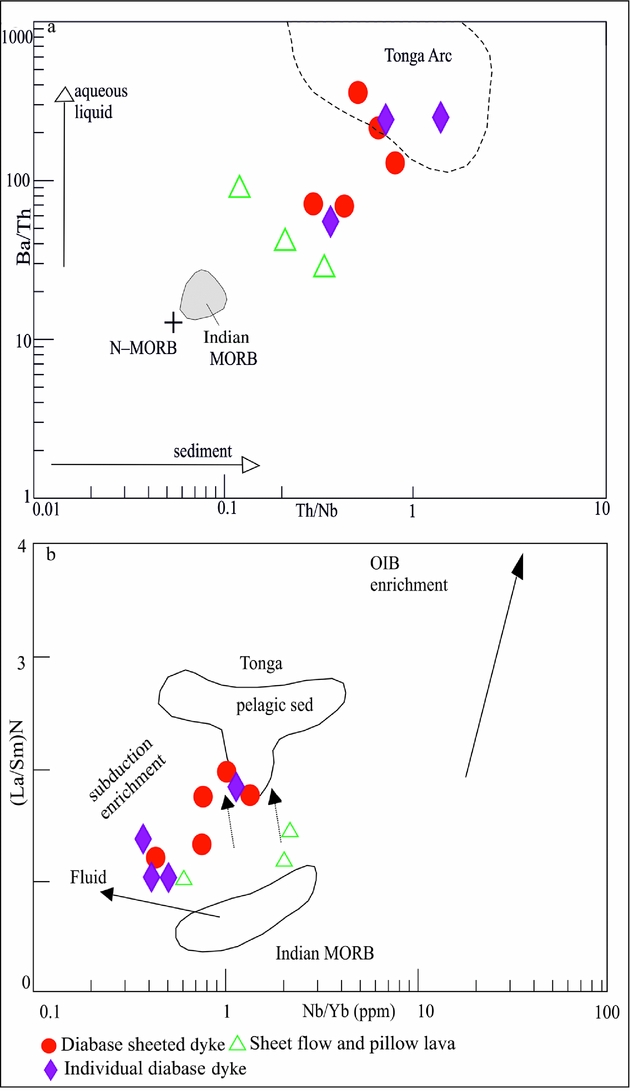
Geochemical investigation and elemental behaviour highlight the significant roles of both magmatic differentiation and subduction zone components (fluid-melts) in the generation of the crustal rocks of South Dehshir Ophiolite. The ratios of incompatible elements such as Ba, Nb and Th are helpful for understanding the role of the subduction zone components. Ba could be mobile in a wide range of temperatures and distributed with hydrous fluids. Th is immobile or shows low mobility in low-temperature fluids, but shows compound affinity at high temperatures during partial melting of sediments above the subducting slab (Keppler, Reference Keppler1996; You et al. Reference You, Castillo, Gieskes, Chan and Spivack1996; Niu & Batiza, Reference Niu and Batiza1997; Hermann, Reference Hermann2002). Nb is often immobile (Tian et al. Reference Tian, Castillo, Hawkins, Hilton, Hanan and Pietruszka2008). In Figure 15a the samples plot away from the Indian MORB and cluster towards the Tonga arc field on the Th/Nb v. Ba/Th diagram (Tian et al. Reference Tian, Castillo, Hawkins, Hilton, Hanan and Pietruszka2008), demonstrating the effect of the subduction components (Pearce & Peate, Reference Pearce and Peate1995; Pearce et al. Reference Pearce, Stern, Bloomer and Fryer2005). In the same figure, a few of the diabases show a higher concentration of Th as compared to the other samples. This could be explained by the involvement of the melt released from the partial melting of sediments above the subducted slab.
(a) Elemental ratios of Ba/Th v. Th/Nb (Tian et al. Reference Tian, Castillo, Hawkins, Hilton, Hanan and Pietruszka2008). The fields of Indian MORB and Tonga Arc are from Pearce & Peate (Reference Pearce and Peate1995) and Pearce et al. (Reference Pearce, Stern, Bloomer and Fryer2005). (b) (La/Sm)N v. Nb/Yb (Tian et al. Reference Tian, Castillo, Hilton, Hawkins, Hanan, Aaron and Pietruszka2011).
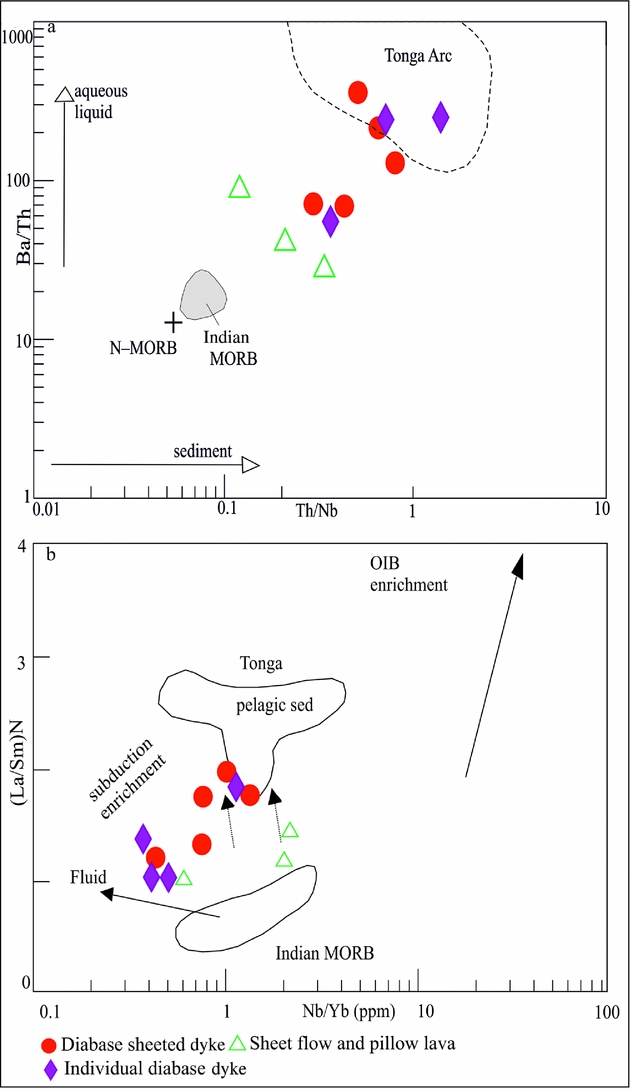
In Figure 15b, most samples plot away from the MORB array and cluster in the supra-subduction field on the chondrite-normalized Nb/Yb v. (La/Sm)N diagram (Tian et al. Reference Tian, Castillo, Hilton, Hawkins, Hanan, Aaron and Pietruszka2011), demonstrating evidence for the effect of the fluid and melt components that originated from the subducted slab. Consequently, the geochemical investigation of the South Dehshir Ophiolite crustal rocks reveals evidence for the contribution of both fluids and melts released from the subducted slab.
6. Conclusion
The South Dehshir Ophiolite, located along the southwestern margin of the Central Iran microcontinent, includes both a mantle and a crustal sequence. The mantle sequence contains serpentinized lherzolites and cpx-bearing harzburgites with mantle deformation structures, which are cut by individual diabase dykes. The plutonic part of the crustal sequence comprises olivine gabbros, pyroxene gabbros and foliated hornblende gabbros. The hypabyssal part includes an extensive diabase sheeted dyke complex, cut by wehrlite-olivine websterites, pegmatitic gabbros and plagiogranites-trondhjemites. The diabase sheeted dykes and the intrusive bodies of wehrlite and plagiogranite are roughly north–south trending, suggesting an east–west-aligned opening of the oceanic basin where they formed. The extrusive section is formed by sheet flows and pillow lava flows, associated with the microfauna of red chert-radiolarites and pelagic limestones of Upper Cretaceous age. The ophiolitic sequences are cut by younger quartz-diorite to quartz-monzodiorite intrusions.
The various tectonomagmatic and multi-elemental diagrams show that the crustal rocks of the South Dehshir Ophiolite exhibit tholeiitic and calc-alkaline magmatic trends, which are characteristic of the supra-subduction zone ophiolites. Systematic compositional variations in the diabases and lavas imply that magmatic differentiation of pyroxene, amphibole and Fe–Ti oxides played an important role in the evolution of the crustal rocks of the South Dehshir Ophiolite. Although magmatic differentiation was important in the evolution of the crustal rocks of the South Dehshir Ophiolite, it was not the only process that formed these rocks. It seems that the studied samples are polygenetic and demonstrate compositions which cannot be explained by magmatic differentiation only. On binary diagrams the studied samples plot away from the MORB field and cluster towards the arc field.
Almost all of the REE patterns of diabase and lava samples normalized to the chondrite values of Sun & Mcdonough (Reference Sun, McDonough, Saunders and Norry1989) exhibit a flat linear profile with various enrichments of around 10 times that of the LREE chondrite level, suggesting a spinel-bearing mantle source. The minor enrichment of the LILE (Rb, Ba, Th, La and Sr) relative to the HFSE (Nb and Ta) in most patterns normalized to the primitive mantle values of Sun & Mcdonough (Reference Sun, McDonough, Saunders and Norry1989) and slight depletion of Ti and Zr in some patterns also confirm the effect of subduction components derived from the partial melting of the subducted slab.
The elemental behaviour of Nb, Ba and Th and the ratios of Nb/Yb and (La/Sm)N in the samples of the crustal rocks of South Dehshir Ophiolite display evidence for the contribution of both fluids and melts released from the subducted slab. The REE patterns of some lava, diabase and hornblende gabbro samples display higher enriched chondrite patterns, close to OIB patterns. It is possible that local mantle plumes or asthenospheric flows that moved up through weak zones of the subducted slab affected the partial melting of the mantle wedge above the slab.
It appears that diverse magmatic processes were responsible for the generation and evolution of the crustal rocks of the South Dehshir Ophiolite. A depleted mantle wedge above the subducted slab was probably the primary source of the studied ophiolitic crustal rocks. Although partial melting of the depleted mantle wedge produced the parental magma of the crustal rocks of the South Dehshir Ophiolite, subduction components released from the partial melting of the subducted slab and eventually local mantle plumes were also involved and mixed with the products of the partial melting of the mantle wedge, leading to the observed diversity in the chemical composition of the south Dehshir crustal rocks. Even though magmatic differentiation of the clinopyroxene, amphibole and Fe–Ti oxides was important in the generation of the crustal rocks, the contributions from the subduction components (fluids and melts) released from the subducted slab were more important.
Acknowledgements
We thank professor Thierry Juteau for his thorough and constructive review of the original manuscript, which led to the significant improvement of the paper.