In times when museums and archives face huge financial, socio-economic and digital challenges, collaboration makes a lot of sense. Nowadays, managing heritage does not mean looking back nostalgically, but instead looking at the present and into a future that is becoming more and more digital. Materials kept in various fashion archives inspire future collections and support cultural production, such as exhibitions, new collections, fashion films or other projects. Disseminating the knowledge preserved in these heritage collections via the internet unlocks the value and enables the reuse of fashion materials.
The expectations and demands of our current and future users are high, and perhaps too big to deal with as individual, often small-scale, institutions. Developing a shared approach and establishing a network of related partners is a first, but a very crucial, step. Therefore, one of the main achievements of Europeana Fashion is that it has succeeded in establishing a common ground that addresses the needs and problems of our project partners.
Past: the definition of the Europeana Fashion project (2012–2015)
Europeana Fashion started on 1 March 2012, and was funded as a project under the European Commission's Competitiveness Innovation Program (CIP), under the objective Aggregating Content for Europeana Footnote 1 . The project featured 22 partners from 12 European countries and received a three-year grant to build a thematic aggregator for fashion content to be provided to Europeana. In the following sections, the three main concepts from the funding objective will be explained – namely, aggregation, content and Europeana.
-
• Aggregation: the process of content aggregation could be defined as bringing together data from different sources and structuring them according to one shared data model. In the case of Europeana Fashion, this implies getting metadata records from more than 20 different institutions’ legacy databases and subsequently translating them via a data model to make the content accessible on a shared platform.
-
• Europeana: Europeana.eu is an initiative of the European Union and refers to an internet portal that acts as an interface to more than 50 million books, paintings, films, museum objects and archival records that have been digitized throughout Europe. More than 3500 institutions across Europe have contributed to Europeana. These range from major international names like the Rijksmuseum Amsterdam, the British Library or the Louvre, to regional archives and local museums from every member state of the European Union.
-
• (Digital) Content: fashion is an important part of our European cultural heritage: it permeates different spheres of our life, economy, society and culture. It relates to the individual as well as to the society. It is a consumer good but is also a form of art, creativity and craftsmanship that should be preserved and known to a broader audience.
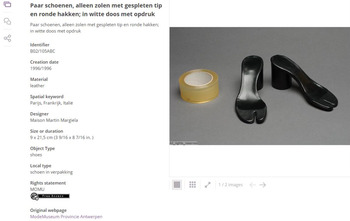
At the beginning of the Europeana Fashion project in 2012, fashion as a cultural theme was not well represented in Europeana and it was the ambition of the Europeana Fashion consortium, which included some of the most renowned fashion collections in Europe, to provide a collection of 700,000 digital records to Europeana. A single record is the combination of a metadata record accompanied by a digital object. The metadata record describes the properties (e.g. designer, material, size, place of production, etc.) of the digital object (which can be an image, audio, video or a text file).
Fig. 1.Example of a MoMu-record.


Europeana Fashion aggregates digital records from prestigious European museums such as Les Arts Décoratifs in Paris, or London's Victoria and Albert Museum, but also from important fashion house archives, such as Missoni, Pucci, Salvatore Ferragamo, and the photo-archive of Catwalk Pictures. The records include digital pictures from historical dresses to accessories, drawings, magazines, sketches, photos, videos, fashion catalogues, etc.
Main achievements of the Europeana Fashion project
The Europeana Fashion aggregator, data model and thesaurus
The ambition of the Europeana Fashion consortium was to build a thematic fashion aggregator capable of representing data in a granular way, to reflect the versatility of fashion as a medium. MINT was used as the (technical) aggregation platformFootnote 2 . MINT is an open source, web-based platform developed by the National Technical University of Athens, one of the technical partners in our project consortium. MINT has been widely used in many other Europeana projects, mostly by users with little technical background but plenty of knowledge about their metadata (e.g. librarians, archivists, registrars).
The MINT platform allows the deployment and operation of different aggregation schemes (thematic or cross-domain; international, national or regional) and corresponding access rights. Registered partners can upload their metadata records into MINT in order to manage, aggregate and publish their collections.
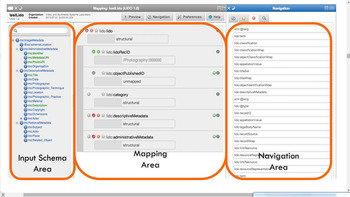
Screenshot of MINT.

After uploading a dataset in MINT, content providers need to align their data with a common standard. In the case of Europeana Fashion, this meant mapping the source metadata schema to ‘our’ EDM-fp standardFootnote 3 . EDM-fp stands for the Europeana Data Model – fashion profile, developed to ensure the adequate representation of fashion heritage, which can be different in kind and nature from more classical heritage content. Therefore, a generic model was designed, based on the Europeana Data Model (EDM), that reflected the complexities of fashion content types and relations and facilitates interoperability and ingestion into the Europeana database.
Users mapped their metadata with the help of a visual mappings editor – allowing for drag-and-drop or simple input operations which were then translated to the corresponding code. The mappings editor visualized both the input and target metadata schema (EDM-fp). MINT's preview functionality allows the content partners to check how the records look on the actual website. After the final checks by the content provider, the final step in this workflow took place: the effective publication of the data on the Europeana Fashion live portal: www.europeanafashion.eu.
One of the main challenges in thematic aggregation is that the coherence of content could be lost due to multiple concepts, heterogeneous nomenclatures, and different languages. This obstacle was tackled by developing a multilingual thesaurus for the fashion domain. In order to ensure maximum synergy with existing vocabularies, our thesaurus was based on the Art and Architecture Thesaurus (AAT) from the Getty InstituteFootnote 4 . However, the Europeana Fashion Thesaurus also required more specific and further refined concepts in order to be able to fully represent the collections of our content partners.
The fashion thesaurus, by the end of the project in 2015, included a total of 1,089 concepts, comprising six main facets: costume concepts (303 concepts), accessories (271 concepts), contextual objects (40 concepts), communication and events (103 concepts), materials (235 concepts) and techniques (137 concepts). It was our ambition to translate every concept in the 11 languages of the partners and it was completed up to 92.30%, the missing translations are mainly in Portuguese and Spanish. The complete fashion thesaurus has been published as Linked Data and is available to third partiesFootnote 5 .
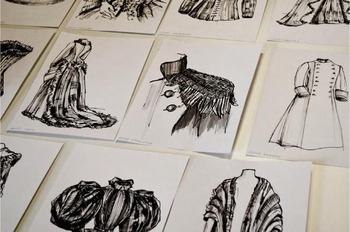
Thanks to a collaboration with a student from the Antwerp Fashion Academy, David Ring, the thesaurus has been illustrated. Each of the concepts at object level, is illustrated with a sketch. The illustrations have been uploaded to Wikimedia Commons, the media platform of Wikipedia, and have been made available under the CC0 licence to promote the sharing and re-use of the fashion taxonomyFootnote 6 .
Europeana Fashion thesaurus drawings by David Ring on Wikimedia Commons.

The thesaurus was integrated into the Europeana Fashion portal, enabling multilingual searches of Europeana Fashion. For example, when a user looks for ‘broek’, which is the Dutch term for ‘trousers’, the results will show Dutch records that match ‘broek’, but also the equivalent content in ten other languages.
Europeana Fashion portal
The large amount of content harvested from numerous providers presents a unique opportunity to disclose this high-quality material via a dedicated web portal www.europeanafashion.eu. The portal was developed based on input from user and focus groups and expert reviews and resulted in different versions of the Europeana Fashion portal. During two iterations the project's leaders and technical coordinators fine-tuned and finalized the definitive layout and functionalities of europeanafashion.eu.
In December 2014, the final version of the Europeana Fashion portal was launched online. This version features various improvements, including a themes section showing selections of images from the collections on the homepage. These thematic selections were curated by an internal team and are intended to show the best and the most interesting content that users can find in the vast collections of Europeana Fashion. The selections feature not only nice pictures but also the ones that are not always easily discoverable by searching the portal; they highlight popular themes and also some of the more unusual ones, revealing the diverse and curious content in Europeana Fashion.
Europeana Fashion also invested substantially in promoting its content via different social media channels and through various posts on its dedicated blogpageFootnote 7 . The project reaches followers through networks like Facebook, Pinterest and, our most successful social media channel, Tumblr. Each month one of the partners curates an online exhibition in Tumblr.
Success factors: Fashion edit-a-thons and MUSE award
An edit-a-thon is an event where editors get together to write and/or improve a specific topic or type of content in Wikipedia. Europeana Fashion has organized 12 fashion edit-a-thons across Europe and published an online handbookFootnote 8 on how to organize fashion edit-a-thons in GLAMs (Galleries, Libraries, Archives, Museums). The GLAMwiki handbook facilitates the organization process and outlines the basic issues and requirements to realize an edit-a-thon. It leaves room for local organizers to experiment with existing routines and adapt them to local situations.
The American Alliance of Museums awarded Europeana Fashion a MUSE Award, officially presented in April 2015Footnote 9 . The award recognizes outstanding achievement in GLAM media and is presented to institutions or independent producers who use digital media to enhance the GLAM experience and engage audiences.
Europeana Fashion network and conferences
Europeana Fashion organized three, well-attended, international conferences in Florence (2013), London (2014) and Antwerp (2015). The conferences dealt with themes that were considered crucial for handling digital fashion heritage. They were also a great opportunity to highlight the achievements of the Europeana Fashion project, and to establish a network where fashion heritage partners could meet, interact and be informed.
The end of the project in 2015
It is common for European projects to be reviewed by a commission of international experts and the Europeana Fashion project received an ‘excellent’ grade from its jury. This meant that the project achieved all of its targeted goals and sometimes even exceeded expectations. One of the areas where Europeana Fashion delivered a better result than expected was the number of new (content) partners. We expanded our network with ten new partners, all delivering additional content.
Life after the Europeana Fashion project – where are we now?
Fortunately, Europeana Fashion did not come to an end after the three-year funding by the CIP program. Two noteworthy initiatives have proven to be crucial for sustaining the Europeana Fashion initiative.
The Europeana Fashion International Association
In August 2014, the Europeana Fashion International Association (EFIA) was established under Italian Law and funded through annual fees from its members, which are the Europeana Fashion supporting partners. With this initiative, Europeana Fashion became a legal entity. EFIA was established as a non-profit organization that would maintain the project's technical infrastructure and ensure the sustainability of the Europeana Fashion initiative after the end of the CIP project. EFIA also hopes to participate in new project proposals under European and national calls.
The Digital Service Infrastructure Project: The continuation of Europeana Fashion as an Expert Hub
In 2014, the Europeana Foundation, which is the legal entity behind the Europeana initiative, submitted a project proposal for another European funding programme called the Connecting Europe Facility (CEF): Access to digital resources of European heritage (‘Europeana’) Footnote 10 . The project was approved and starting from May 2015, Europeana was funded as a Digital Service Infrastructure (DSI). The core objectives for the Europeana DSI are to establish a shared technical infrastructure and create value for its partners, improving data quality, opening the data, and strengthening the Europeana ecosystem.
The EFIA is a partner in this DSI proposal in the capacity as a thematic aggregator for the fashion domain. The Europeana DSI allows Europeana Fashion to sustain and expand the actual network and also perform specific activities. Europeana Fashion focuses on targets such as the maintenance and development of the aggregation infrastructure, ingesting new fashion content, improvements to existing content and metadata, as well as continuing its existing training and networking activities.
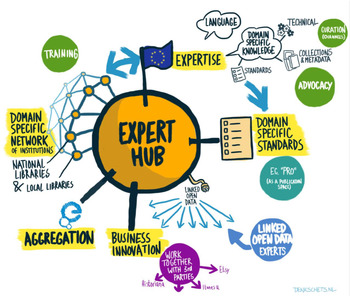
EFIA has become an expert hub for Europeana. Under the umbrella of Europeana, the expert hubs – both subject and national aggregators or platforms – form a network of support and collaboration to provide value to Europe's memory institutions and citizens: a web, not a pyramid … This will enable them all to get the most out of their data.
Expert Hub.Footnote 11

Improvement of data quality under the Europeana DSI
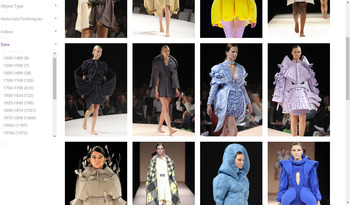
As an Expert Hub, Europeana Fashion has made substantial efforts towards data improvement and enrichment. For instance, at the end of the CIP project in 2015, it remained impossible to search through the 700,000 fashion artefacts by date. This most wanted functionality was difficult to realize because of the diversity of the way dates are recorded. Dates provided by content partners had to conform to the ISO 8601 formatFootnote 12 , with the most commonly accepted notations as YYYY, YYYY-MM-DD, YYYY/YYYY and YYYY-MM-DD/YYYY-MM-DD. However, many records still use different date patterns, so Europeana Fashion decided to incorporate ‘regular expressions’ to the mappings that still needed to be fixed to conform to the accepted notation. Through these and a few conditional mappings, dates like “XVI secolo” or “circa 1950” were translated to normalized forms like “1500–1599” and “1950”. Based on the results, a filter has been built on the portal's search interface that offers date ranges adapted to the fashion sphere: decades of the 20th century, quarters for the 19th, fifty years for the 18th century, etc.
Screenshot from the Europeana Fashion website with expanded Date filter.

Another filter, for designer, was refurbished. The field used for this filter contained a wide variation of names, many of which referred to the same person/brand. In the normalizing process, which mainly considered fashion designers and brands, these names were loosely aligned to reflect only the legal names of the designers or brands. Now a user looking for André Courrèges’ work, will not have to search for Courrèges, André, for Andres Courreges or for Courrëges. One name in the filter brings the end-user to every item tagged with each one of these variations.
Europeana Fashion portal continues as a thematic channel of Europeana
In 2016 the Europeana Foundation re-designed its portal Europeana.eu and renamed it Europeana Collections. On this new portal a family of thematic collections, such as Europeana Music or Europeana 1914–1918, take the users on a journey through particular topics. Europeana Fashion is another thematic collection on the site and, from April 2017, users of www.europeanafashion.eu will be redirected to the Fashion site on ‘Europeana Collections’. All existing Europeana Fashion content will be available through this new fashion channel.
Our ‘own’ portal will not be shutdown, but it will change name to Modepedia (www.modepedia.eu) and it will keep on working, focusing on crowdsourcing campaigns for metadata enrichment and to experiment with new ways of content re-use in different scenarios, acting as a sort of lab to try out new tools and applications.
The new Europeana.eu Fashion collection landing page focuses on promoting editorial content and encourages users to browse content. Editorial co-ordination will be managed by the EFIA, with a newly-developed editorial strategy. The main activity will be to select new themes based on recent events and trends happening in the fashion world. Each month, a new theme will be introduced based on all the content published in the blog. The various stories told by the content are aimed at enriching our understanding of fashion as it cuts across geographies and chronologies. Our blog allows us to articulate our take on the topic with two to three entries per week. Facebook, Twitter and Instagram follow the theme and either publish the entries on the blog, or propose images that are linked to the ideas discussed in the blog posts. Pinterest functions as the archive of the images used on the various platforms. At the end of each month, a pin-board is created, where all the content are stored for future references and possible creative re-use.
Given the success of our Tumblr blog, we decided to approach it with a different strategy: each month we invite one of our partners to take over our Tumblr page and curate a virtual exhibition. The exhibition, which usually is based on the partner's most recent or successful events, is a tool that allows us to get new and sometimes unpublished content.
Another tool we recently developed is a bi-weekly newsletter, in which we showcase the most interesting and meaningful objects in the collection, reconstructing their biographies to make it available also to a non-expert audience.
The Europeana Fashion network under the Europeana DSI
As mentioned at the beginning of the article, establishing a network of fashion heritage institutions probably was the most important target for Europeana Fashion. Over the past two years, functioning as an expert hub and with a consortium of more than 40 partners, Europeana Fashion has strengthened and enlarged its network. Currently Europeana Fashion has aggregated more than 860,000 records and we are still counting… In the future, we expect to continue to further grow our partner base and aggregate new content from their collections as well as new content from our ‘old’ partners. Through our activities and training, we not only aim to improve the quantity of our content, but also its quality and usability, and we are looking towards participation in future projects/funding programs, like Horizon2020 and Creative Europe.