Though research on emotions, and specifically on disgust, has experienced a considerable growth of research from 1990 on (Rozin, Haidt, & McCauley, Reference Rozin, Haidt, McCauley, Lewis, Haviland-Jones and Barrett2008), little research has been devoted to other emotions (e.g., being moved; Seibt, Schubert, Zickfeld, & Fiske, Reference Seibt, Schubert, Zickfeld and Fiske2017). This happens to be particularly the case with an emotional experience, which is sometimes described in English as having one’s teeth set on edge. In fact, a survey of literature only reveals two previous studies on this experience, both conducted by Delin and Winefield in the seventies (1973, 1977), as well as a recent study by Schweiger Gallo, Fernández-Dols, Gollwitzer, and Keil (Reference Schweiger Gallo, Fernández-Dols, Gollwitzer and Keil2017). In the first of Delin and Winefield’s studies, the authors applied a questionnaire to almost 400 participants and asked them to describe situations or events which set their and others teeth on edge. Results revealed that the phenomenon either referred to a situation which involved an unpleasant sensation (e.g., feeling nylon), or to an unpleasant emotional state derived from the interpretation of the stimuli (e.g., having the teeth set on edge by somebody who does not listen). Recently, Schweiger Gallo et al. (Reference Schweiger Gallo, Fernández-Dols, Gollwitzer and Keil2017) addressed whether grima, the proposed term for this aversive experience in Spanish, refers to an independent emotion concept. They found that grima and disgust (i.e., asco) differed both with respect to its typical elicitors and physiological concomitants, with grima referring mainly to hearing (e.g., noise of chalk) and touching (e.g., scratching or touching with fingernails) and the physical reactions of shivering and goose bumps. Interestingly, their results also revealed that neither English nor German speakers use a specific term to characterize the aversive reaction to stimuli associated to grima.
To the best of our knowledge, only these studies have focused on this concept: The antecedents, feelings, physiological, and behavioral responses associated to this experience are under-researched, and the boundaries and limits between grima and disgust remain to be explored. In fact, as Tolin, Woods, and Abramowitz (Reference Tolin, Woods and Abramowitz2006) pointed out, “accepted measures of disgust sensitivity might confound disgust with other forms of aversion” (p. 30). Given the apparent risk of confounding these two aversive emotional experiences, focusing on their delineation seems warranted.
The Prototype Approach to Emotion Concepts
In order to deepen into the internal structure of grima as compared to disgust, a prototype approach rather than the classical view of emotions was deemed as appropriate. As compared to the classical approach to emotion concepts, the prototype approach does not assume emotion concepts to be universal (see Russell, Reference Russell1991). Specifically, Rosch’s prototype theory (e.g., 1973) states that many concepts are organized around prototypes rather than a number of sufficient and necessary defining attributes. The underlying idea is that membership in a category is determined by resemblance and thus members vary in the degree to which they are members (e.g., Russell, Reference Russell1991). What is more, the border between categories is fuzzy; there are no sharp boundaries which separate members from nonmembers.
The prototype approach has revealed itself to be effective in showing that emotion concepts such as love and commitment (Fehr, Reference Fehr1988), emotion (Fehr & Russell, Reference Fehr and Russell1984), anger (Russell & Fehr, Reference Russell and Fehr1994), and more recently modesty (Gregg, Hart, Sedikides, & Kumashiro, Reference Gregg, Hart, Sedikides and Kumashiro2008) and gratitude (Lambert, Graham, & Fincham, Reference Lambert, Graham and Fincham2009) do not inevitably conform to certain necessary and sufficient attributes, but are prototypically organized. Therefore, prototype theory seems to be well-suited to assess the internal structure of grima. Furthermore, prototype theory is expected to allow for exploring the boundaries between emotion concepts such as grima and disgust.
The Present Research
Though the studies by Schweiger Gallo et al. (Reference Schweiger Gallo, Fernández-Dols, Gollwitzer and Keil2017) suggest that grima is an independent everyday emotion concept, they also raise two main concerns. In Schweiger Gallo et al.´s Study 2 (2017), participants were asked to generate the features relative to the definition, elicitors, and physical reactions when experiencing grima and disgust. The comparison of the features of grima and disgust revealed that the features related to the moral domain, as well as smells, animals, food, and sense of touch of objects differed significantly from each another. Given also the finding that English and German speakers refer to the elicitors of grima using the label of disgust/Ekel, the degree to which the two everyday concepts can be differentiated remains to be clarified. Indeed, both grima and disgust might differ with respect to the extent to which their features belong to the core or to the periphery of the underlying everyday emotion concept, making necessary delineating its internal structures in order to shed light into its content.
Second, and also related to the first concern, is the clarification of the extent to which the constitutive features of disgust and grima overlap. In fact, Schweiger Gallo et al. (Reference Schweiger Gallo, Fernández-Dols, Gollwitzer and Keil2017) suggest that some elicitors are unique of grima, whereas they also found some overlap between the set of elicitors of grima and disgust, thus raising doubts about the specificity of the grima elicitors. In order to address these concerns about the distinctive character of grima and disgust, the present research focuses on the comparison of the everyday concepts of grima and disgust.
As compared to the studies by Schweiger Gallo et al. (Reference Schweiger Gallo, Fernández-Dols, Gollwitzer and Keil2017), where participants were given the term of grima, we first wondered how Spanish speakers refer to this experience in a free labeling task. Therefore, Study 1 addressed whether or not Spanish speakers spontaneously produce a single term to label the experience allegedly referred to by grima. As previous research has shown that the typical examples of grima are often associated to disgust in cultures other than the Spanish one (Schweiger Gallo et al., Reference Schweiger Gallo, Fernández-Dols, Gollwitzer and Keil2017), we further focused on the comparison of grima with asco by analyzing the internal structure of the everyday concepts of grima and disgust, and by assessing the perceived centrality and periphery of the features of each of them. In particular, we attempted to characterize the degree of prototypicality of given features of grima and disgust.
Across these two studies, we specifically predicted that Spanish speakers would be able to accurately distinguish between grima and disgust. Moreover, we hypothesized that both emotion concepts are not identical and thus that certain features would be seen as more prototypical (central) to each of the concepts. In all, we surveyed the everyday conception of grima in Spain by mapping its internal structure and by delineating it from another common aversive emotion, disgust.
Study 1: Labelling the Experience in Spain
In Study 1, we wondered which term is used specifically to refer to the teeth set on edge phenomenon. We addressed this question by following two approaches: on the one hand, we used the Internet search engine Google to search web pages from Spanish language sources for the teeth set on edge experience, yielding 113,000 results from web pages in Spanish. We focused on the first 150 entries and found that two synonyms, grima and dentera, were used to refer to this experience. On the other hand, we also referred to the example of scratching with the fingernails on a slate, as it is frequently mentioned as a characteristic example of having the teeth set on edge (Webster’s New World College Dictionary, 2010). Thus, we gave participants an example of the teeth on edge phenomenon and, in a second step, also the proposed labels for this experience.
Method
Participants. Two samples of Spanish volunteers contributed data. The first sample comprised 82 high school students, while the second consisted of 50 university students. Two participants, a Latin-American and an Italian, were excluded since they reported not knowing the phenomenon. The mean age was 16.12 years (SD = .64) and 21.29 years (SD = 1.54) for the high school students and university students, respectively. In all, the sample consisted of 77 women and 53 males.
Materials and Procedure. First of all, participants were given an example of having the teeth set on edge – scraping a fingernail on the blackboard or a plate with a fork- and asked how they would define that sensation. On the free labeling task, participants were allowed to use any emotion label they chose. The next questions assessed whether participants knew grima and dentera. Finally, we asked participants which of both terms was more frequently used.
Results and Discussion
Almost all participants were familiarized with grima: When asked whether they were familiarized or not with the term, 97% reported knowing the experience of grimaFootnote 1. Importantly, only 2% of the participants were not familiarized with the concept of grima. In line with these results, 69% of the participants finally reported using the expression grima. Further, more than twice as much participants freely described the sensation of scraping a fingernail on the blackboard or a plate with a fork as grima (44%) either alone or in combination with another expression. Participants also referred to the physical manifestation of the experience by mentioning shiver (repelús and escalofríos; 9% and 13%, respectively), defined their sensation as unpleasant (6%) and reported feeling indifference (5%). Thus, based on these data, we based on the term grima in the proposed research.
Study 2: Assessing the Internal Structure of Grima and Asco
As disgust (and its German equivalent term, Ekel) has been found to be assimilated to grima in Germany and the US (Schweiger Gallo et al., Reference Schweiger Gallo, Fernández-Dols, Gollwitzer and Keil2017), Study 2 systematically addressed the characteristic features of both grima and disgust. Study 2 was therefore expected to shed further light into the internal structure of grima and disgust. It aimed at assessing which features of grima and disgust are considered as being more prototypical and thus more central of each of the experiences. Moreover, this study was expected to help gaining insights into the degree to which some attributes are shared between both grima and disgust or are unique to any of them, as well as providing further evidence to rule out alternative explanations in terms of grima referring to the same experience than disgust. Therefore, we based on previous prototype research (e.g., Hurtado de Mendoza, Fernández-Dols, Parrott, & Carrera, Reference Hurtado de Mendoza, Fernández-Dols, Parrott and Carrera2010; Russell & Fehr, Reference Russell and Fehr1994) and analyzed the internal structures of grima and disgust by assessing the degree of typicality of their features.
Method
Participants. One-hundred and ninety-six Spanish speakers (46 % males) with a mean age of 30.44 years (SD = 13.22) participated. Of these, 97 completed the questionnaire containing features of grima and 99 the questionnaire with features of disgust.
Materials and Procedure. Participants filled out a forced-choice questionnaire with 31 items on either disgust or grima which comprised three main groups of statements, referring to physical symptoms, situations, and the definition of grima or disgust. As compared to previous research, where participants rated the typicality of the constitutive features mentioned for two emotion concepts (e.g., shame and vergüenza in Hurtado de Mendoza et al., Reference Hurtado de Mendoza, Fernández-Dols, Parrott and Carrera2010), the present study included both a subset of features belonging to both grima and disgust, as well as a subset of features which characterized specifically grima or disgust. The first 14 statements relied on the constitutive features mentioned by at least 9% of the respondents in Schweiger Gallo et al.’s second study (2017) for both grima and disgust. The cut-off of 9% was introduced in order to equal the items for disgust, since a greater scientific literature was available for this latter emotion. We also included representative sentences of the main theoretical approaches in the (scarce) emotion literature on grima/teeth set on edge phenomenon: “Feel of velvet”, “nearly being involved in a car crash”, “someone picking his nose”, “it sickens me”, and the “sound of a shovel on concrete” were taken from Delin and Winefield (Reference Delin and Winefield1977), and shuddering, tremble, and tense, as well as the item “people not listening to what is said and believing that they know it all” from Delin and Winefield (Reference Delin and Winefield1973). Finally, we added six sentences taken from the literature on disgust (Haidt, McCauley, & Rozin, Reference Haidt, McCauley and Rozin1994; Rozin, Haidt, & McCauley, Reference Rozin, Haidt, McCauley, Dalgleish and Power1999) representing death (“dead body”), body products (“vomits”), food (“eat food that has been bitten by an unsavory person”, “rotten food”), sex and socio-moral disgust (“pederasts and pedophiles”), and poor hygiene (“lack of hygiene”). In addition, the questionnaire on disgust included examples related to gore (“any situation with blood”), interpersonal contamination (“wear clothing used previously by a stranger”), and its physiological signature nausea. Finally, we also incorporated an item referring to bad taste (“something with a bad taste”). Participants were asked to rate if the statements were good or poor examples on a scale ranging from 0 (“extremely poor example”) to 10 (“extremely good example”). The terms were listed in a random order.
Results
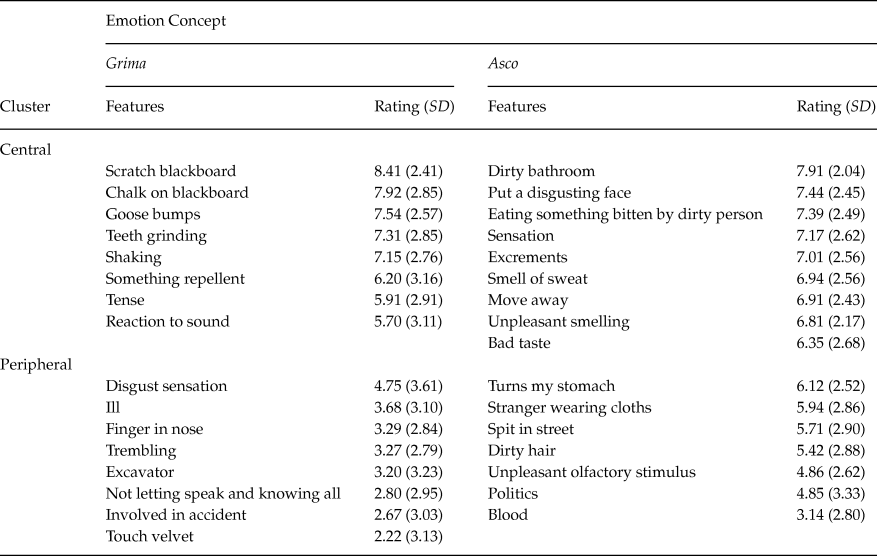
Centrality ratings of grima and disgust. Based on a median split of the ratings (Fehr, Reference Fehr1988), those features with ratings higher than 5.16 were considered central of grima. This procedure yielded 14 central features, with the characteristic examples of “noise of a chulk on a blackboard” and “scraping fingernails on a blackboard” being rated as the most typical features (see Table 1). The physical manifestation of goose bumps was also judged to be among the most typical features of the category. The examples taken from the literature on the teeth set on edge phenomenon (Delin & Winefield, Reference Delin and Winefield1973), i.e., “feel of velvet”, “nearly being involved in a car crash”, “people not listening to what is said and believing that they know it all”, and the “sound of a shovel on concrete” were all considered the least typical features. For disgust, the features with ratings higher than 6.23 (i.e., 14 features) were considered central. These included “dirty bathrooms”, “eating something bitten by a dirty person”, as well as the physical manifestation of putting a disgusting face. On the other side, “any situation with blood”, “politicians”, “unpleasant smelling stimulus”, “dirty hair”, and “seeing people spitting in the street” were rated as being the least typical features.
Mean Centrality Ratings of the Features of Grima and Asco/Disgust Clustered by Prototypicality (Study 2)

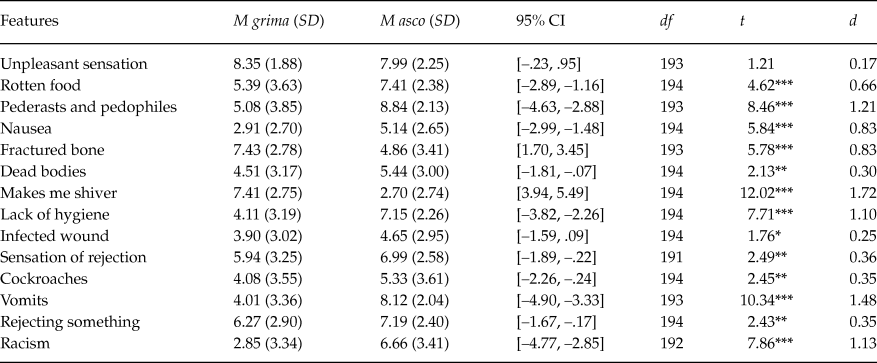
Comparing grima and disgust. Specific comparisons revealed significant differences between the typicality ratings elicited by grima and disgust in twelve out of the fourteen shared features (see Table 2). In fact, “grima/ disgust is an unpleasant sensation” was the only statement for which no significant difference was found. The kinds of disgust elicitors that have been conceptualized as the origin of disgust in the literature (foods, body products, and animals; Rozin et al., Reference Rozin, Haidt, McCauley, Dalgleish and Power1999) were associated to disgust, as compared to grima. This was the case for rotten food, vomits, and cockroaches. Consistent with research highlighting the animal-origin of disgust, poor hygiene (i.e., lack of hygiene) and death (i.e., dead bodies) were also considered as being more prototypical of disgust than of grima. Importantly, the physiological signature of nausea was also associated with disgust. The moral offenses, namely the features of pederasts and pedophiles and racism, as well as the features of sensation of rejection and rejection of something, were considered as more typical of disgust than grima. In contrast, fractured bones and shivering were rated as being remarkably more typical of grima than disgust.
Mean Differences between the Features of Grima and Asco/Disgust (Study 2)

Note: * p < .10; ** p < .05; *** p < .01.
Discussion
As shown by the present research, the features of grima and disgust hold very different degrees of typicality. Not surprisingly, the noises produced by a chulk or fingernails on a blackboard stood out as central features of grima. The situations taken from the disgust literature (i.e., rotten food, pederasts and pedophiles, dead body, lack of hygiene, and vomits) did all differ significantly between disgust and grima. In this vein, rotten food, which, according to the literature, belongs to the domain of food and constitutes a predominant characteristic feature of disgust, was indeed rated as being highly prototypical of disgust and thus confirms its centrality as an emotion which protects from the oral incorporation of contaminated or offensive food (Rozin & Fallon, Reference Rozin and Fallon1987). The statements referring to socio-moral violations revealed, also in line with the literature on disgust, that pederasts and pedophiles and racism were rated as provoking disgust, while not evoking characteristically grima. Another feature, the fractured bone, which could be regarded as representing envelope violations in disgust, was, however, found to be central to grima, but not disgust. This points to the need to incorporate the notion of grima into emotion research in order to avoid mapping into a different concept when measuring any of them.
Noteworthy, these results also point to the importance of shivering and goose bumps as characteristic physical manifestations of grima, as compared to disgust. Indeed, the physical manifestation of goose bumps was also judged to be among the most typical features of grima. In contrast, nausea was confirmed to be significantly more characteristic of disgust than grima. Thus, the present results indicate that grima and disgust do not refer to the same experience. Our assumption that both grima and disgust are conceptually different experiences, whose shared features hold different degrees of typicality, is thus supported.
General Discussion
Hearing the scratch of a fork on a plate, touching velvet, biting into cotton... The present studies delineated the contents and structure of this experience, which is labeled in Spanish as grima. Results revealed both similarities and differences between grima and disgust (i.e., asco, the common translation for disgust in Spanish). Both were found to be unpleasant sensations which involve rejection action tendencies on a behavioral level. However, while in the case of disgust, the focus is on the mouth, grima is associated physiologically to shivers and goose bumps.
The basis for the rejection of grima-eliciting stimuli seems not to be based on knowledge of either the nature or origin of the stimuli and the stimuli seem not to be regarded as being offensive and contaminating, as is the case with disgust (e.g., Rozin et al., Reference Rozin, Haidt, McCauley, Lewis, Haviland-Jones and Barrett2008). In fact, elicitors from the moral domain (pederasts/pedophiles and racism), as well as from the food (rotten food) and poor hygiene differed significantly between disgust and grima. Thus, the current research suggests that the everyday concepts of grima and disgust do not refer to the same experience, be it with regards to their elicitors, nor to the physiological reactions (e.g., shivering in grima vs. nausea in disgust). Our research is in line with previous research on emotions questioning the existence of a limited number of basic emotions and the assumption that other emotions are just the outcome of a combination of basic emotions. Here, a prototype approach (e.g., Fehr & Russell, Reference Fehr and Russell1984; Russell, Reference Russell1991) proved useful in allowing analyzing the content and internal structure of grima and disgust.
Recurring to the metaphor of a poker game, Russell (Reference Russell2009) describes the constitutive affective and cognitive components of what we call “emotion” as poker cards. A particular hand is a pattern of cards and whereas some patterns have no name within the rules of poker, some patterns (a pair, a straight), do. For some reason, Spanish speakers have a name (grima) for a particular combination of emotion components (hand of cards) whereas, in other languages, there is no name for it. Intriguingly, some participants in Study 1 described the sensation of scraping a fingernail on the blackboard or a plate with a fork referring to the physical manifestation of the experience (repelús and escalofríos), which is in line with Schweiger Gallo et al.’s observation (2017) that German speakers, who lack an equivalent term for grima, sometimes use the physiological concomitant to refer to the corresponding affective reaction (Schauder).
A broader psychological map of negative emotional experiences: Future prospects and implications
Within an extensive program of research on the emotion of disgust, Paul Rozin and his colleagues (e.g., Rozin, Haidt, & McCauley, Reference Rozin, Haidt, McCauley, Lewis and Haviland1993, Reference Rozin, Haidt, McCauley, Dalgleish and Power1999, Reference Rozin, Haidt, McCauley, Lewis, Haviland-Jones and Barrett2008) have contributed to the study of disgust by identifying nine domains of disgust elicitors, which include goods or potential foods; body products (e.g., vomit, feces); certain animals; certain sexual behaviors (e.g., with animals); contact with death or dead bodies (e.g., touching a corpse); violations of the exterior envelope of the body (e.g., deformity, gaping wounds); poor hygiene (e.g., dirt, body odor); interpersonal contamination (involves rejecting social contacts, such as those for intimate contact) and moral offenses (e.g., hypocrites and racists). Out of these domains of disgust elicitors, four kinds of elicitors (inappropriate sex, poor hygiene, death and violations of the exterior envelope of the body) have been included in a broader category of animal-reminder disgust (Rozin et al., Reference Rozin, Haidt, McCauley, Dalgleish and Power1999), whereas foods, body products, and animals have been conceptualized as the prototype and origin of disgust (i.e., core disgust; Rozin et al., Reference Rozin, Haidt, McCauley, Dalgleish and Power1999). The original protection of the mouth (i.e., core disgust) has evolved culturally and expanded to the whole body and later extended to a protection of the soul (e.g., Rozin et al., Reference Rozin, Haidt, McCauley, Lewis, Haviland-Jones and Barrett2008).
One of these elicitors of disgust, blood or body boundary violations, has recently attracted attention. Next to the function of protection of the soul (e.g., Rozin et al., Reference Rozin, Haidt, McCauley, Lewis, Haviland-Jones and Barrett2008), blood or body boundary violations have been related to the pathogen-avoidance function of disgust (Oaten, Stevenson, & Case, Reference Oaten, Stevenson and Case2009) and thus to the protection from the risks of infectious disease (Curtis, Aunger, & Rabie, Reference Curtis, Aunger and Rabie2004; Curtis & Biran, Reference Curtis and Biran2001). However, research has found that blood or body violations evoke different affective responses than reactions to elicitors of core disgust (Shenhav & Mendes, Reference Shenhav and Mendes2014): whereas core disgust led to decreases in normal gastric activity, painful-injury disgust decelerated heart rate and increased parasympathetic response. Kupfer (Reference Kupfer2018) has recently suggested that disgust towards injuries is related to unpleasant vicarious experiences based on empathy rather than serve a pathogen-avoidance function. In line with these results, while participants in the current research clearly described the feelings evoked by a fractured bone as grima rather than as disgust, an infected wound was related to both grima and disgust, albeit with a marginal significance.
Thus, though the feelings to an injury are usually equated to the feelings of disgust, they may not relate to the pathogen-avoidance function of disgust. One possible explanation for the relationship of injuries and disgust focuses on the lack of an English word for this feeling, thus causing people to rely on the closest term available (Kupfer, Reference Kupfer2018). Interestingly, one intriguing finding of earlier grima research was that accidents and physical damage were reported to elicit grima (Schweiger Gallo et al., Reference Schweiger Gallo, Fernández-Dols, Gollwitzer and Keil2017). Thus, Spanish speaking people may refer to the disgust evoked by injuries with the distinctive, folk-emotion term of grima. However, English and German speakers, who lack an equivalent term for grima, label the experience to grima-eliciting stimuli as disgust (Schweiger Gallo et al., Reference Schweiger Gallo, Fernández-Dols, Gollwitzer and Keil2017). It may thus be the case that people refer to the feelings evoked by injuries as disgust when they do not have a different word for it. Though a profound examination of the relationship between grima and blood or body boundary violations exceeds the current research, this intriguing suggestion deserves attention in future investigations, as does the relationship between disgust and responses to pathogens.
Further, given that grima has been reported to be elicited mainly by auditory stimuli, one might suspect that grima is a mere sensory experience or a pain response rather than an emotional experience. Preliminary evidence for the assumption that grima is more than a mere reaction to shrill sounds or visual experiences such as bright lights has been presented in a recent conceptual replication (Schweiger Gallo, Rodríguez Monter, Álvaro, & Fernández-Dols, Reference Schweiger Gallo, Rodríguez Monter, Álvaro and Fernández-Dols2018), where participants mentioned remembering previous situations in which they experienced grima as a characteristic feature of emotional episodes of grima. Thus, this finding suggests that grima has also an ideational component, which may cause individuals to experience grima when thinking about elicitors of grima. Further evidence for the involvement of cognitive processes in grima has been provided by previous research showing that grima is amenable of self-regulation (Schweiger Gallo et al., Reference Schweiger Gallo, Fernández-Dols, Gollwitzer and Keil2017): Only those participants who formed either a goal intention or an implementation intention to down-regulate their grima feelings before listening to pleasant, unpleasant, grima- and disgust-evoking stimuli were able to selectively down-regulate grima. Finally, Schweiger Gallo et al. (Reference Schweiger Gallo, Fernández-Dols, Gollwitzer and Keil2017) also report participants to consider grima as being an emotion even to a greater extent than disgust. Although future research might further dig into the evolutionary function and distinctiveness of grima, the present research adds to previous investigations addressing the cognitive, affective, and behavioral processes of grima and pointing to grima as a native everyday concept of emotion.
Future research might benefit from a more granular approach to the aversive reactions underlying a range of negative affective experiences, and from comparing grima-elicitors vis-à-vis more complex, semantic, or multisensory stimuli that elicit disgust. The fact that there might be related, but different emotional experiences with specific associated antecedents and physiological responses suggests a need in extending some traditional emotion concepts and re-considering them as emotional episodes which are based on a common affective reaction with similar, but not identical profiles. In fact, past research on disgust could have been tapping two differentiated emotional experiences when assessing disgusting experiences. This might be the case, for example, for some elicitors of pathogen disgust. Thus, future research could profit from clearly delineating whether a given aversive stimulus evokes grima or disgust, as this could lead to the revision or even the development of new measures of these experiences. In fact, as pathogen disgust has important implications in health psychology, as well as in public health policy (Tybur, Lieberman, & Griskevicius, Reference Tybur, Lieberman and Griskevicius2009), a precise delimitation of the experiences associated with specific aversive stimuli seems desirable in order to design more effective measures and interventions.
There are not only theoretical, but also practical reasons for deepening into the experience of grima. Here, the implications for mental health and person’s well-being have to be highlighted. As with phobias, people who experience this phenomenon may avoid specific stimuli such as surfaces or objects. Marks (Reference Marks1987), for example, describes several cases in which touch aversions affected everyday routines and made people having to wear a glove when playing tennis or not entering a room with a new carpet because of an aversion to fuzzy textures. The present research is also important for disentangling the role of grima in psychological disorders, such as obsessive-compulsive disorders. Here, disgust sensitivity has been found to predict contamination fear (for example, Cisler, Reardon, Williams, & Lohr, Reference Cisler, Reardon, Williams and Lohr2007; Olatunji, Sawchuk, Lohr, & de Jong, Reference Olatunji, Sawchuk, Lohr and de Jong2004) and to be positively correlated with obsessive-compulsive disorder (Muris et al., Reference Muris, Merckelbach, Nederkoorn, Rassin, Candel and Horselenberg2000). Therefore, it is imperative to delimit which emotional experience is specifically felt in order to allow the clinician focus on it. Future research, both clinical and emotion psychology, might therefore be informed by the present research.
As for now, these results support the assumption that Spanish speakers identify grima as an experience on itself. It also illustrates that the approach of examining language, as well as physiological and behavioral responses with respect to everyday concepts is productive in characterizing specific aspects of emotional reactivity.