


Introduction: accessible CBT – why does it matter?
The Improving Access to Psychological Therapies (IAPT) website information on ‘Equality Legislation’ (IAPT, 2011) reminds us that the Equality Act 2010 outlines public organizations’ duty to promote equality and reduce inequalities across ‘protected characteristics’. These include age, disability, gender, sex and sexual orientation, marital status, pregnancy and maternity, race (ethnic origin and nationality), religion and belief (including non-belief). Equality objectives and published information will allow monitoring of organizations’ ability to ‘promote equality’ and ‘eliminate discrimination, harassment and victimization’. IAPT highlights links between equalities, human rights and social justice which IAPT services support
by expanding access to NICE approved psychological therapies across all communities, particularly for people that are at higher risk of developing poor mental health due to social, economic and health inequalities (IAPT, 2011).
Accessible CBT is a key component of addressing health inequalities and diversity. The main UK professional body for accrediting training and practice of CBT in its recent Mission Statement and Values and Vision includes:
• fairness and parity for members and public;
• accessibility;
• fostering creativity and diversity within a CBT framework (BABCP, 2011).
In two consecutive editions of CBT Today in 2011, ten articles or news items were published covering diversity and accessibility issues and CBT. These addressed adaptations to CBT for people with learning disabilities (Grant, Reference Grant2011, report of Singh's mindfulness conference presentation), older adults (Green, Reference Green2011), veterans (Kitchiner, Reference Kitchiner2011), Tyson's work with men (May, Reference May2011), people who are lesbian, gay, bisexual and transgender (Murphy, Reference Murphy2011), a person with Asperger's (O'Connell, Reference O'Connell2011), work in Tanzania (Stone, Reference Stone2011), and working with the Yemeni community in Sheffield (Woolsey, Reference Woolsey2011). Yet despite high levels of psychological needs being identified, there is evidence of reduced access to psychological services for people with diverse needs. For example, Green (Reference Green2011) reports that 3% of referrals to an IAPT service were for older people when population estimates suggest 12–15% would be referred; Kitchiner (Reference Kitchiner2011), May (Reference May2011) and Murphy (Reference Murphy2011) report, respectively, that veterans, men and people who are lesbian, gay and transgender may not present themselves as in need of input for psychological or emotional difficulties.
By contrast, in two editions of the Journal of Behavioural and Cognitive Psychotherapy (2011/2012), among 19 papers only four were on a non-working-age adult population and there were none on people with disabilities. Ability, literacy and language skills are exclusion criteria in most studies. Where this is not specified, it would appear from the method and measures that people with cognitive impairments would be unlikely to be included. Disability gets no mention. The exclusion of people with disabilities is of particular concern for all professions, their journals and reports, all of which should be addressing diversity.
Evaluation of ‘equality of access, experience and outcome from the IAPT programme in the North West of England’ (Buffin et al. Reference Buffin and Ahmed N, Singh2009) showed poor reach to older people and those who spoke languages other than English. But disability did not even feature in the equality monitoring. While practice examples of working with people from diverse backgrounds may be increasing, in research disability is often overlooked or used as an exclusion category.
Barriers to access for marginalized or ‘socially excluded’ groups are wide ranging (as identified in the CBT Today articles and the Buffin et al. report cited above). They include lack of knowledge, inaccurate and unhelpful attitudes and beliefs among referrers, service users and professionals, and services not set up for people with diverse needs (physical location, how inclusive they are across gender, culture, class, disability and mode of delivery). Specific suggestions of how to adapt CBT to increase accessibility for older adults, people with learning disabilities and young children show ‘transferable skills’ and ‘core competences’ (such as visual components, involving carers) which might be more usefully considered as ‘cross-care group’. ‘Core skills’ of adapting and simplifying CBT for people with a range of needs associated with disability are essential for people with cognitive impairments and/or learning difficulties and disabilities. Currently, almost 20% of the population are aged <18 years, 18% are aged >65 years (and rising) and learning difficulties or disabilities are hugely under-recognized (Simonoff et al. Reference Simonoff, Pickles, Chadwick, Wood, Maney, Karia and Iqbal H, Moore2006). Therefore, all practitioners, trainers, and supervisors of CBT need core skills in addressing diversity issues including cognitive impairments, learning difficulties and disabilities.
Factors that may impair or reduce cognitive functioning and, therefore, affect accessibility to CBT are numerous and include learning disabilities; pervasive developmental disorders (such as autistic spectrum disorders or Asperger's syndrome) and/or severe trauma and neglect; neurological disorders [such as epilepsy, stroke, head injury, attention deficit hyperactivity disorder (ADHD), dementia]; and there are impairments associated with ageing. Sensory impairments; literacy and/or language difficulties can all impair cognitive functioning. Mental health problems, such as anxiety and depression, can be associated with concentration difficulties; psychosis with reasoning biases, attention, and working memory problems. Medication for both mental and physical health is also known to interfere with cognitive abilities.
Cognitive impairments are frequently undiagnosed in the general population (Simonoff et al. Reference Simonoff, Pickles, Chadwick, Wood, Maney, Karia and Iqbal H, Moore2006). When cognitive impairments are diagnosed (e.g. learning disabilities) then mental health problems often go undetected and/or untreated. Reasons for this include lack of awareness, staff attitudes, gaps in service provision and diagnostic overshadowing (Hatton, Reference Hatton2002). Conversely, in adult mental health services, behaviours associated with cognitive impairments (such as memory difficulties) frequently get wrongly misattributed to ‘personality’ or ‘motivation’ and suitable adaptations to interventions are not considered.
This paper summarizes evidence for accessible, adapted CBT and illustrates the use of standard, adapted and personalized CBT techniques and resources.
What evidence is there for ‘accessible’ CBT?
There is a growing literature on adaptations to improve accessibility of CBT for people with cognitive impairments, learning difficulties/disabilities and/or neurodevelopmental disorders. The research includes case studies, case series, controlled studies and some randomized controlled trials. Studies have shown CBT can be effective with people with learning disabilities (e.g. Stenfert-Kroese et al. Reference Stenfert-Kroese, Dagnan and Loumidis1997; Lindsay et al. Reference Lindsay, Neilson, Lawrenson, Stenfert Kroese, Dagnan and Loumides1997; Willner, Reference Willner2007; Dodd et al. Reference Dodd, Joyce, Nixon, Jennison and Heneage2011) and autism spectrum disorders (ASD) (Attwood, Reference Attwood2004; Russell et al. Reference Russell, Jassi, Fullana, Mack, Johnston, Heyman, Murphy and Mataix-Cols2013) and with children as young as 3 years (e.g. Stallard, Reference Stallard and Graham2005, Scheeringa et al. Reference Scheeringa, Weems, Cohen, Amaya-Jackson and Guthrie2011) and adults with dementia (e.g. Laidlaw et al. Reference Laidlaw, Thompson and Gallagher-Thompson2004; Charlesworth & Reichelt, Reference Charlesworth and Reichelt2004) if highly visual, concrete materials are used and concepts simplified.
Adapted CBT (Arundine et al. Reference Arundine, Bradbury, Dupuis, Dawson, Ruttan and Green2012) for people with acquired brain injury showed improvements on measures of psychological distress and community integration which were maintained at 6 months follow-up. Ramsay (Reference Ramsay2010) demonstrated how CBT was adapted for adults with ADHD using the ‘executive dysfunction’ model, highlighting the need ‘to make CBT ‘sticky’ so that people can remember and implement coping strategies in the appropriate context’ (p. 41). There have also been studies of adaptations to CBT to increase effectiveness for people with severe mental health problems including psychosis and cognitive impairments (e.g. Leggett, Reference Leggett1997; Collerton & Dudley, Reference Collerton and Dudley2004; Wragg & Whitehead, Reference Wragg and Whitehead2004; Kirkland, Reference Kirkland2005; Haddock et al. Reference Haddock, Lobban, Hatton and Carson2004; Favrod et al. Reference Favrod, Linder, Pernier and Navarro Chafloque2007; Barrowcliff, Reference Barrowcliff2008).
Illustrations of accessible CBT
The development of skills, guidance and resources for ‘accessible’ CBT in the NHS Trust the authors worked in included continuing professional development events (psychology ‘care group specific’ and multidisciplinary), working groups developing practice guidance and resources for CBT with people with learning disabilities and multidisciplinary training. This allowed the integration of a range of evidence-based literature and resources including CBT with children and young people, people with learning disabilities, working age and older adults, neuropsychological and neurodevelopmental disorders and collective ‘practice-based evidence’.
The development of a ‘cross-care group’ CBT peer supervision group allowed the sharing of skills, competencies, experience, knowledge and ideas across traditional care groups. This enhanced accessibility and clinical effectiveness of working with people with cognitive impairments who are too often excluded from therapy provision. Below are illustrations of ‘accessible’ CBT showing how core elements and skills of CBT have been used in creative ways, adapting standard approaches and personalizing or individualizing them to increase accessibility.
The materials are drawn from three anonymized cases in Holmes et al.'s (Reference Holmes, Rossiter, Jennison and Nixon2011) poster ‘Adapting CBT for psychosis: creative ways with cognitive impairments’. Here, the focus is on general principles and techniques for adapting CBT for people with cognitive impairments, learning disabilities and/or neurodevelopmental disorders. The illustrations reflect issues associated with difference in age (Sam 14, Jenny 28, David 66 years), disability, gender, ethnicity, immigration and culture, spiritual beliefs, context (community and family home, residential care, national specialist in-patient assessment and treatment unit), mental health difficulties (anxiety, depression, anger, self-harm, post-traumatic stress disorder, psychosis), duration of difficulties (4–52 years), referral source (school, psychiatrist, court disposal) and complex psychosocial difficulties (abuse, bereavement, bullying, carers with severe mental health problems, poverty, isolation). In drawing attention to this diversity, we hope to demonstrate the breadth of application of adapted CBT and draw out general themes. This increases the opportunity to consider a wide range of diversity needs while predominantly focusing on reducing exclusion and increasing effectiveness of CBT with people with cognitive impairments.
Below are illustrations of some useful assessment and intervention approaches and materials:
(1) Standard techniques are ways of working that might be used with anyone irrespective of difficulties. If these are found to be ineffective or inappropriate, then further adaptation and/or personalization would be tried. (See below for illustrations.)
(2) Adapted techniques are commonly using simplified language and concepts, increased pictorial or visual representation and metaphor to increase engagement, understanding and effectiveness of assessment and intervention. These would be used if standard techniques were not effective.
(3) Individualized/personalized techniques give greater emphasis to specific difficulties a person presents with. They are used when standard and adapted techniques do not work. They may be used to increase engagement with anyone.
What are the common features of CBT approaches adapted for people with cognitive impairments?
These include ‘visual’ resources used to explore feelings vocabularies and physical signs, psycho-education, and socialization to the CBT model. Formulations and interventions for anxiety, low mood, anger, intrusive thoughts, dreams and voices enhanced with visuals are described below. Models we have drawn on include cognitive and cognitive-behavioral models of depression (Beck et al. Reference Beck, Rush and Shaw1979; Fennell, Reference Fennell, Hawton, Salkovskis, Kirk and Clark1988), anxiety (Beck et al. Reference Beck, Emery and Greenburg1985; Clark Reference Clark, Hawton, Salkovskis, Kirk and Clark1988), and trauma (Ehlers & Clark, Reference Ehlers and Clark2000). The primary model used for understanding ‘psychotic’ experiences is described by Garety et al. (Reference Garety, Kuipers, Fowler, Freeman and Bebbington2001) and by Morrison and colleagues (Morrison, Reference Morrison2001; Morrison et al. Reference Morrison, Renton, French and Bentall2008) as a cognitive model characterized by appraisal of experiences maintaining distress, reasoning biases, hyper-vigilance and increased emotional arousal. In addition, we integrated ideas from stress-vulnerability (Zubin & Spring, Reference Zubin and Spring1977), and normalization models (Romme & Escher, Reference Romme and Escher1989, Reference Romme and Escher2000) and the cognitive model described by Freeman (Reference Freeman2007). Carr's (Reference Carr2006) integrative, developmental and contextual approach was used to inform assessment, formulation, intervention and evaluation.
All CBT is, to an extent, adapted to the client and their needs. For example, exploring and challenging negative automatic thoughts is not a theoretical construct, but rather linked to clients own idiosyncratic negative automatic thoughts. How this is done is bound to be different for each person. Typically CBT places greater reliance on written materials rather than pictorial and has an underlying assumption of cognitive ability and psychological flexibility. The skills required to increase accessibility build on standard approaches which ‘may’ be used with all, and extends evidenced-based and individualized approaches to improve the reach to people with disabilities and diverse needs.
Accessible CBT: illustrations of assessment
Standard approaches
This includes interviews with the person, their family and staff (residential, community, school); file search for history and initial hypothesizing; voices diaries and activity monitoring; feelings thermometers (O'Neill, Reference O'Neill1999; Stallard, Reference Stallard2002), Beliefs about Voices Questionnaire (Chadwick et al. Reference Chadwick, Lees and Birchwood2000) and joint assessments with other services such as the Early Intervention in Psychosis Service and Child & Adolescent Mental Health Service.
Evidence-/practice-based adapted approaches
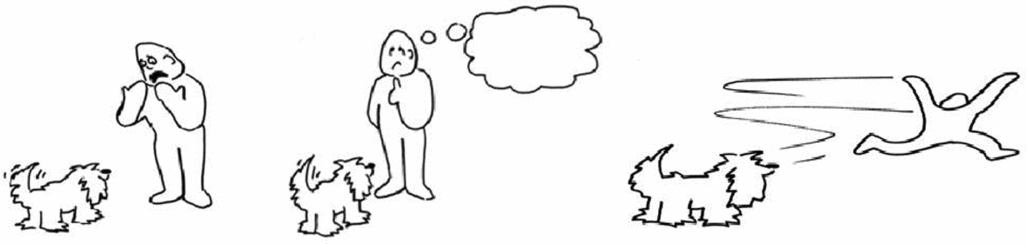
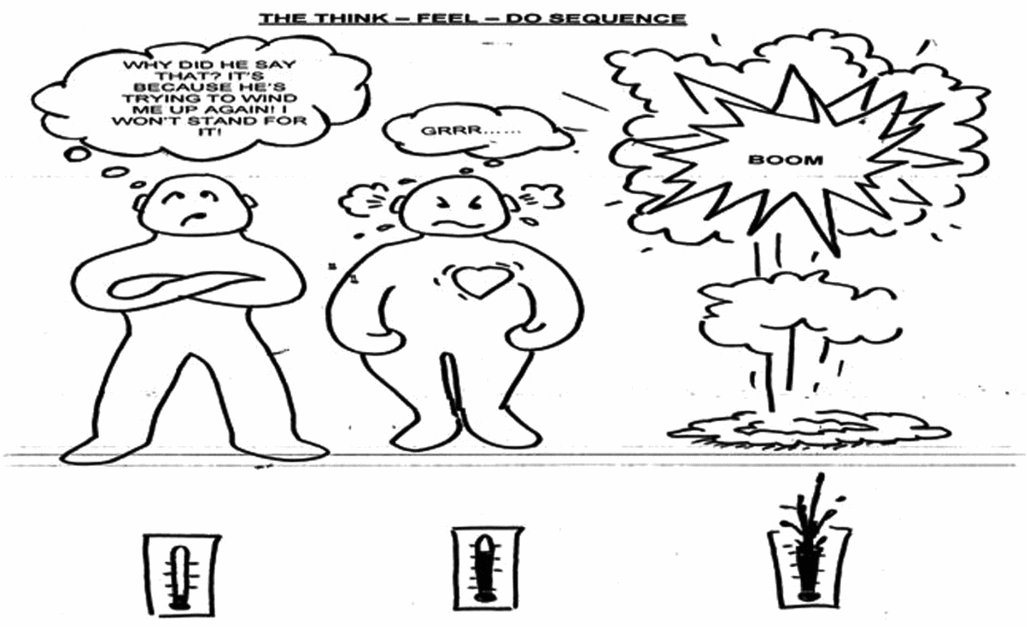
Visual resources and practice ‘tips’ were collated from evidence-based sources or developed locally. Visual resources were developed or adapted by the therapist with the individual. Line drawings (see Figs 1 and 2), and photographs were particularly useful in assessing the person's naming and understanding of feelings, thoughts-feelings-behaviour links and the role of negative automatic thoughts which can lead to adapted thought records based on Beck et al. .'s (Reference Beck, Rush and Shaw1979) cognitive model. Figure 1 shows an example from scenarios suggested by Reed & Clements (Reference Reed and Clements1989). Figure 2 shows a completed example of a ‘Think-Feel-Do’ cartoon sequence for ‘wind-up’ thoughts. O'Neill (Reference O'Neill1999, 2006) gives examples of coping ‘Think-Feel-Do's’ and blank versions to identify individuals ‘own unhelpful and helpful ‘Think-Feel-Do's’. In addition to line drawings and photographs [e.g. from the Learning Development Aids Emotions pack (LDA, n.d.) or the Department for Children, Families and Schools' Social and Emotional Aspects of Learning (SEAL), 2005], we have used clips from ‘soaps’ and visual assessment material of situation-based feelings (Howlin et al. Reference Howlin, Baron Cohen and Hadwick1999). Simplified ‘feelings body map’, ‘How you feel’, ‘thought bubbles’ were developed for both distressing events and for calm or coping events. Family and/or staff assisted with recording with these tools. For joint assessment appointments with other services, we prepared and brought the visual materials to aid communication and comprehension and socialize to the CBT model for clients and carers.
David's assessment – James and the dog visual.

Sam's assessment. Example of ‘Think-Feel-Do’ assessment/psychoeducation (blank versions are used for assessing an individual's physical signs, thoughts, feelings and behaviours). [Taken from Managing Anger, O'Neill (Reference O'Neill1999).]

Individualized/personalized approaches
These were used to improve both communication and engagement. Figure 3 shows an individualized format for recording feelings, situations and thoughts used with Jenny and completed with staff support. This is a personalized version of a ‘Voices diary’ as might be used in CBT for psychosis (Garety et al. Reference Garety, Kuipers, Fowler, Freeman and Bebbington2001; Morrison, Reference Morrison2001; Morrison et al. Reference Morrison, Renton, French and Bentall2008).
Jenny's personalized feelings, situations and thoughts monitoring.
This helped distinguish different content and types of Jenny's ‘voices’ or ‘thoughts’. Some were ‘third person’ and seemed to relate to ‘replaying’ abuse; some were ‘first person’ and seemed an ‘internalization’ of these abusive messages and her experiences. In the work with Sam, photos of churches and priests were used to assess the nature and intensity of current and past distress and associated thoughts, dreams, voices and beliefs, along with a card sort for sorting pictures into OK/not OK, and a ‘thermometer’ card sort (low, medium, high) for rating intensity of distress.
Formulations were developed, shared and explored using visual representations and included ‘Circles of Worry’ and ‘Circles of Coping’; Kirkland's (Reference Kirkland2005) visual formulation framework developed from the case series of Haddock et al. Reference Haddock, Lobban, Hatton and Carson2004 with circles containing individuals’ antecedents, beliefs and consequences. The circles can be expanded/reduced to illustrate changes in degree of feeling and/or certainty in the belief(s). Personalized pictorial ‘narrative’ formulations were developed to match individual's information processing styles, strengths and weaknesses.
Accessible CBT illustrations of interventions
Standard approaches included ‘listening to’ and demonstrating therapist belief in the description of childhood experiences; exploring cultural issues (voices often contained racial comments), psycho-education to the CBT model, feelings, thoughts and ‘voices’ and normalization of experiences. A variety of relaxation strategies (trial and practice in sessions, compact discs (CDs) and a prompt sheet made for home use) were used along with activity scheduling and environmental changes to reduce triggers. Behavioural experiments were designed collaboratively to test ideas such as control over ‘voices’ and thoughts. In addition, family, school and network meetings were held to share assessment, formulation, planning, trialling interventions and maintaining effective ones. These interventions are ‘standard’ in that, while any approach should be tailored to ability and communication levels, personal history and current context, interests, and goals, the techniques could be used with anyone. They may need to be further adapted as below with more visual material to promote and prompt change and its generalization and maintenance if necessary.
Evidence-/practice-based adapted approaches used include normalization of physical, emotional, behavioural and cognitive experiences and general and specific ‘trauma’ memories (Ehlers & Clark, Reference Ehlers and Clark2000) tailored to the client's communication style and level. The use of metaphors, such as thoughts such as CDs playing which can be changed or have their volume reduced was useful. Evidence for thoughts and thinking traps were identified, alternative explanations and coping thoughts developed. A simplified version with visual materials and distraction calming techniques drawn from Leggett's (Reference Leggett1997) case description such as naming objects in the room, physical exercise and sub-vocal speech/singing and from dialectical behaviour therapy (Linehan, Reference Linehan1995) with activities across all sensory systems were explored and practised. This led to a personalized visual calming prompt/recipe sheet (see Fig. 4). The use of music such as recording personalized selections for self-calming, feeling happier, getting motivated has been popular and effective.
David's calming activities.
Personalized approaches: included pictorial formulation and visual psycho-education, e.g. about possible origins of ‘voices’ (death of close relative with strong religious faith, bully at school instructing Sam to harm priests and burn churches). This led to development of a coping plan for ‘voices’ which included limiting time spent alone, a visual prompt for family not to question Sam if he wanted to be in same room with them but not talk, watching comedy and nature programmes not horror movies, and rehearsing alternative thoughts from a personalized prompt sheet (see Fig. 5).
Sam – example of personalized psychoeducation/therapy.
An individualized formulation of Sam's ‘dream’-like experience and rescripted ‘dream’, with a safe ending was made into ‘cartoon’ format to increase the likelihood of remembering and recall. This helped reduce his distress.
Personalized coping books were developed for David containing simple and visual information about mental health problems (Morrison et al. Reference Morrison, Renton, French and Bentall2008), and for Jenny – ‘Miss Can't and Miss Can’ (for depression) and ‘Miss Frazzle and Miss Calm’ (for anxiety and anger). These used her own artwork and a personally generated ‘guardian angel’ cartoon character (see Fig. 6).
First page of Jenny's ‘Miss Can't, Miss Can’ personalized coping.
Personalized coping plans and booklets were shared with family and staff to enhance generalization and effectiveness.
Outcomes were measured using self-report, family and staff report, behavioural observations and simplified diaries, visual ratings for standardized measures, and ‘quizzes’. As our illustrations represent ‘composite’ service-users to maintain anonymity, no individual outcome data is reported. Improvements reported and/or observed included:
• Reduction in symptoms – such as anxiety and depression, distress about and frequency of voices, and reduction in medication.
• Successful use of some coping strategies, increased knowledge and understanding.
• Improvements in social inclusion and skills, for example, making new friends/reconnecting with old friends, going on the bus for the first time, and shopping independently, increased engagement in structured activities, increased independence in accommodation, commencing a supported apprenticeship.
Issues, implications and recommendations
Published studies and these illustrations demonstrate that CBT can be made accessible and effective for people with cognitive impairments. As cognitive impairment is a fundamental aspect of our equality and diversity agenda, we must all work to improve our practice in this area. Adaptations to meet the information processing and neuropsychological deficits in attention, comprehension, memory sequencing, planning and organizing include:
• Individualizing assessment and intervention with visual, concrete materials.
• Use of prompt materials between sessions.
• Plan for shorter more frequent sessions.
• Plan carefully for maintenance and generalization.
• Working within the person's belief system.
• Increased involvement with carers, sharing formulation, and intervention strategies to support the person between sessions to maximize engagement and generalization.
• Considering contextual and systemic issues including access to CBT for carers with their own difficulties arising from depression or anxiety.
Difficulties that can arise with ‘labelling’, for example, ‘thoughts’ may be described as ‘voices’, or ‘memories’ or as ‘hallucinations’ can arise for all; however, how these are discussed is crucial. Experiences may be described which remain permanently unclear as to whether they are actual experiences. But these can all be addressed by taking an open-minded, non-judgemental stance, and working within a person's belief system. The use of visual and concrete media can assist communication, comprehension and containment of complex and/or distressing psychological phenomena. Working with carers and staff to assist them in supporting this approach is essential.
Making CBT accessible does not mean abandoning what we know works – the same principles, models and treatment protocols are used as for ‘standard’ populations with individual formulations derived from the same models. What is adapted are the methods/media used for formulating with and applying these models and techniques. Westbrook et al. (Reference Westbrook, Muella, Kennerley, McManus, Mueller, Kennerley, McManus and Westbrook2010), makes this point succinctly and calls it ‘the golden rule’ – i.e. when confronted with a problem in therapy, you should use the CBT model to understand the problem and develop solutions.
Therapists need to attend to their own attitudes and beliefs as well as those of service users, staff and carers. Hopelessness can be associated with diagnosis, with traumatic life histories or life events. As therapists, we can feel inadequate, unprepared and/or unsupported. Using the strategies for increasing accessibility of CBT along with attitudes of hopeful, optimistic concern can create more constructive, resilient and effective approaches.
Some association between verbal ability and ability to engage in CBT has been reported with people with learning disabilities (Rose et al. Reference Rose, Loftus, Flint and Carey2005; Joyce et al. Reference Joyce, Globe and Moody2006) and with children and young people (Sams et al. Reference Sams, Collins and Reynolds2006; Berry & Cooper, Reference Berry and Cooper2012). Although cognitive abilities may be a significant contributor to ability to engage with CBT, services may overlook this aspect. Alternatively, services and professionals may give an over-simplistic response of ‘well, CBT won't work for X’. Studies and our clinical experience show that by attending to a range of cognitive and information processing factors including memory, comprehension, attention, and sequencing, adaptations such as those illustrated above can be made which enhance the accessibility of CBT for people with cognitive impairment.
There are service-wide implications including pre- and post-qualification training and supervision. Creating networks across traditional care-group boundaries can help cross-fertilization of experience, skills, resources and resource development. The assumption of ‘need to’, and ‘skills for’ adapting psychological treatments to increase accessibility is vital across all services. Currently this may be restricted to some specific-care groups such as learning disability rather than recognizing the ‘cross-care group’ and ‘core competencies’ needed for adapted/accessible CBT. In our NHS Trust, knowledge and practice benefited from a ‘cross-care group’ CBT and psychosis peer supervision group across Child and Young People, Working Age Adults, and Learning Disabilities.
At a national level, course curricula, trainers and supervisors need to include accessible and adapted CBT within teaching on diversity issues. This should include disability and cognitive impairment, to meet the equality agenda. Ability to adapt CBT needs to be recognized as a core competence and essential set of skills rather than an ‘add-on’ to traditional CBT training for all service provision and for developments such as IAPT and New Ways of Working.
Working with people from diverse backgrounds is central to the provision of effective psychological interventions. It is crucial that professionals are competent and confident in individualized approaches to assessment, formulation and intervention not only ‘manualised’ therapy. We need to ensure that difference; diversity and complexity are appropriately assessed and incorporated into intervention. Diversity should not be a ‘tick box’ exercise. It is an important theme to revisit throughout the journey of assessment and intervention. Adapting CBT is possible, can lead to change for people using services and increases CBT's accessibility for people who might otherwise be marginalized and unable to engage in psychological intervention. In summary, our message for making CBT accessible for people with disabilities arising from cognitive impairments, learning disabilities and/or neurodevelopmental disorders is ‘You can do it!’
Summary
This paper has:
• Shown why accessible CBT matters for people with cognitive impairments, learning disabilities and/or neurodevelopmental disorders to address health inequalities and diversity, enhance effectiveness and meet requirements of equality legislation. Evidence has shown barriers such as low referral rates, inadequate/inaccurate knowledge and attitudes of referrers, professionals and service users. Demographics show that people who use services are very likely to have some cognitive impairment, learning disability/difficulty and/or neurodevelopmental disorder.
• Synthesized some of the evidence base for adaptations to increase accessibility of CBT from research with children, people with learning disabilities, neurodevelopmental disorders such as ASD and ADHD and people with dementia.
• Illustrated the use of both standard, adapted approaches and personalized practical adaptations to increase accessibility of CBT through the use of visual, simplified assessment and intervention resources.
• Signposted relevant evidence-based practice and practice-based evidence for accessible CBT across the lifespan and various cognitive impairments and made recommendations for training and supervision.
Acknowledgements
The support of the Surrey and Sussex NHS Library Service, and Holly White, Psychology Assistant, with revisions, are gratefully acknowledged.
Declaration of Interest
None.
Learning objectives
(1) To show why accessible CBT matters for people with cognitive impairments, learning disabilities and/or neurodevelopmental disorders to address health inequalities and diversity, enhance effectiveness and meet requirements of equalities legislation.
(2) To summarize some of the evidence base for adaptations to interventions which make CBT accessible.
(3) To illustrate clinical adaptations to increase accessibility of CBT through three case descriptions and examples of ‘accessible’ assessment and intervention resources.




Comments
No Comments have been published for this article.