Children undergoing surgery for congenital cardiac disease are at risk of developing arrhythmias in the early post-operative period.Reference Valsangiacomo, Schmid and Schupbach1 As a result, temporary pacing wires are routinely placed onto the epicardial surface of the heart during surgery, thus permitting rapid treatment of any postoperative abnormalities of rhythm. In addition, the pacing wires can be used to record atrial electrograms, thus aiding in the diagnosis of arrhythmias, should they occur after surgery. A number of complications associated with epicardial pacing wires have been reported, including problems with wires left in place for prolonged periods of time, such as an increased risk of infection,Reference Hastings and Robicsek2 transmyocardial migration of the pacing wires and cardiac perforation, complications associated with the removal of epicardial leads, including bleeding, cardiac tamponade,Reference Gal, Chaet and Novitzky3, Reference Johnson, Brown and Alligood4 ventricular arrhythmias,Reference Carroll, Reeves and Andersen5 and retention of the pacing wires,Reference Gentry and Hassan6, Reference Bolton and Mayer7 and problems with poor sensing or capture, including a deterioration of function on a daily basis.Reference Elmi, Tullo and Khalighi8
There are no guidelines in routine use regarding the optimal time for the removal of epicardial pacing wires following cardiac surgery. The purpose of our study, therefore, was to describe the use of temporary pacing following cardiac surgery, to establish the length of time pacing wires were left in place post-operatively, and to determine the incidence of complications associated with their use.
Methods
Patients
We conducted a prospective study of all patients who underwent open heart surgery at Great Ormond Street Hospital during a two month period between May and July 2002, and at The Royal Brompton Hospital over five months between June and November, 2004. Patients who did not have temporary pacing wires placed during surgery were excluded from the study. We also excluded patients undergoing cardiac or heart-lung transplantation. We recorded data on diagnosis, use of pacing wires, timing of removal, and complications on a daily basis from the case notes, intensive care unit summaries, and nursing charts during the period of study. We took the first 24 hours after the surgical procedure as the first day.
Follow-up
Patients were followed daily from the time of surgery to the day of discharge from the hospital.
Statistical analysis
Continuous variables are expressed as median values and ranges, while categorical data is expressed as percentages.
Results
Demographics
A total 141 operations were performed on 140 patients, with epicardial pacing wires placed at the time of surgery. We excluded 1 patient since his procedure included the placement of permanent epicardial wires for pre-existing variable heart block. Another patient, who underwent two interventions, had the second procedure excluded from analysis as at the time of the second procedure he was paced for complete heart block arising from the first operation. At Great Ormond Street Hospital, epicardial pacing wires placed in 30 patients after surgery between May and July 2002. Over the period between June and November 2004, 110 patients underwent open heart surgery with placement of epicardial pacing wires at the Royal Brompton Hospital. In both institutions, a similar spectrum of cardiac surgery was performed. At Great Ormond Street Hospital, it was not routine practise to insert pacing wires during the closure of atrial septal defects within the oval fossa, as happened on 6 occasions. At the Royal Brompton Hospital, pacing wires were inserted in all the children undergoing open heart surgery.
Timing of removal of the wires
In patients who did not require permanent pacing, the wires remained in place for a median of 4.5 days, with a range from 1 to 23 days. The patient whose wires were removed at 23 days had no intra-operative or post-operative abnormality of rhythm, and there was no electrophysiological reason for the delay in removing the pacing wires.
Use of pacing wires
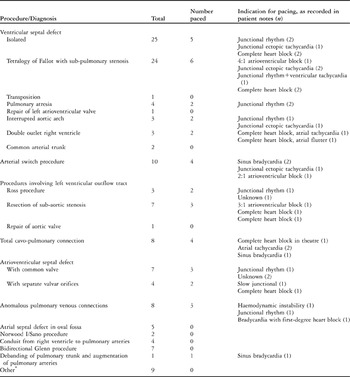
Of the patients, 100 (72%) did not require pacing at any point postoperatively, whilst 39 (28%) patients were paced. Table 1 shows the procedures performed on the 39 patients who required pacing, along with the indications for pacing. In 10 of the 39 patients, pacing took place only within the first 24 postoperative hours, while 29 required pacing to be continued beyond the first 24 hours. Only one patient who was not paced within the first 24 hours required pacing subsequently. This patient had been in an abnormal nodal rhythm in the first 24 hours.
Procedures performed on patients requiring post-operative pacing and indications for pacing.

*Repair of coarctation of the aorta in 1; resection of right ventricular outflow tract in 2; RVOT reconstruction in 1; central shunt in 2; double switch in 1; repair of anomalous origin of the left coronary artery from the pulmonary trunk in 1, and repair of mitral valve in 1.
In 4 patients, 10% of those requiring pacing, a permanent pacemaker was implanted prior to discharge from hospital. The details of these patients are shown in Table 2. In two patients, implantation of the permanent pacemakers was delayed beyond normal practice, due to the need for extracorporeal membrane oxygenation in one, and a prolonged period of intensive care in the other.
Procedures performed on patients requiring permanent pacemaker insertion and indication for pacing.

One patient was readmitted in complete heart block 26 days following surgical repair of an atrioventricular septal defect with common valvar orifice and both atrial and ventricular shunting. He had been in sinus rhythm when discharged from hospital, and presented to his local hospital in complete heart block 26 days after surgery. On review of his post-operative course, we noted that a brief episode of 2:1 block had been recorded in the operating theatre, and that had not required pacing, but no further disturbance was noted in conduction, so he had been discharged from hospital on the 17th day following surgery. The pre- and post-operative electrocardiograms were comparable, with the exception of a prolonged QRS duration following repair of the atrioventricular septal defect. Of note was that no patient in sinus rhythm, and not requiring pacing in the first 24 hours, needed pacing before discharge from hospital.
Complications
One patient in our study was pyrexial, and we observed pus on the wires upon their removal. This patient developed endocarditis, albeit that the pacing wires were not thought to be the source of infection, as a histological specimen taken at the time of surgery suggested pre-operative endocarditis.
Problems related to the use of the pacing wires occurred in 6 more patients. In 3, in whom atrial pacing was required, this proved impossible to achieve. In 1, only a ventricular wire was in place, the second patient had inadequate atrial capture from a single atrial wire, and in the third patient, it proved impossible to achieve atrial capture using two wires. Discharge was delayed in 2 further patients due to late removal of wires, while the final patient, who was anticoagulated, the International Normalised Ratio was too high to allow safe removal of the wires, thereby delaying their removal.
Discussion
Our study shows that, in children undergoing open heart surgery, those in established sinus rhythm for the first 24 hours post-operatively do not require new pacing after this time. At the current time, as far as we are aware, there are no clear guidelines on the optimal time for removal of epicardial pacing wires post-operatively, and practice varies widely between different institutions. In general, the wires are removed on the fourth or fifth post-operative day. In our units, their removal is generally performed on the ward by the nursing staff following sedation of the child with oral morphine, and occasionally oral or intra-nasal midazolam. There are advantages in removing wires in the first few postoperative days in a patient who is stable whilst the child is still on the intensive care unit. First, the procedure could be timed with the removal of chest drains, which usually occurs one or two days after surgery, therefore avoiding two separate procedures requiring sedation. Secondly, there are potential complications associated with leaving wires in place for prolonged periods. These include deterioration in function of the wires,Reference Elmi, Tullo and Khalighi8 increased risk of their retention,Reference Gentry and Hassan6 and infection.Reference Hastings and Robicsek2 Thirdly, early removal of pacing wires may promote earlier discharge from hospital.
The main concern preventing early removal of wires is the risk of post operative arrhythmia. This is a frequent occurrence following surgery for congenital cardiac disease, and an important potential cause of morbidity and mortality.Reference Valsangiacomo, Schmid and Schupbach1, Reference Pfammatter, Bachmann and Wagner9 Risk factors for arrhythmias following cardiac surgery in children include low body weight, longer duration of cardiopulmonary bypass, higher complexity of the surgical procedure, and cyanosis.Reference Valsangiacomo, Schmid and Schupbach1, Reference Bolton and Mayer7 A recent prospective study of 310 children undergoing open heart surgery reported an incidence of postoperative arrhythmia of 27%.Reference Pfammatter, Bachmann and Wagner9 This figure is similar to the combined incidence of temporary pacing in our studies.
An important consideration following completion of total cavo-pulmonary connections with an extracardiac conduit is that there is no venous access to the atrial chambers. Although we did not encounter any late arrhythmias in patients who were in sinus rhythm for the first 24 hours in this group, larger studies are needed to evaluate the safety of early removal of pacing wires in this population, as their anatomy precludes transvenous pacing in the event of post-operative arrhythmias, although trans-oesophageal pacing remains an option.
Although complications related to the removal of temporary epicardial pacing wires, including a risk of bleeding and cardiac tamponade, have been reported,Reference Gal, Chaet and Novitzky3–Reference Elmi, Tullo and Khalighi8 these were not encountered in our study. The practice in both units is to check the coagulative profile in patients on anticoagulants prior to the removal of wires. In addition, the cardiac rhythm is monitored at the time of removal, and an echocardiogram is performed following removal to exclude the presence of a pericardial effusion.
The occurrence of complete heart block as a late complication following cardiac surgery has previously been described.Reference Villain, Ouarda, Beyler, Sidi and Abid10 In one study, patients having complete atrioventricular block for more than 48 hours post-operatively, and an electrocardiogram showing a mean frontal QRS axis that was different to the pre-operative axis, and/or a long PR interval, were shown to be at increased risk of developing late onset complete heart block.Reference Villain, Ouarda, Beyler, Sidi and Abid10
Our study has its limitations. We did not record the presence or absence of arrhythmia or conduction disturbance in the operating theatre, which may affect the occurrence of postoperative arrhythmia. In addition, the time to discharge from hospital was not recorded, and therefore the delay in discharge caused by late removal of pacing wires cannot be quantified in comparison with those patients in whom removal had been timely. In the patients whose discharge was delayed, nonetheless, this was due to the delay in removal of the pacing wires, and there were no other outstanding issues preventing their discharge from hospital.
In conclusion, we believe that our prospective study incorporating patients from two centres is the largest report on the use of pacing wires in children undergoing cardiac surgery. In our population, no patient who was in established sinus rhythm for the first 24 hours post-operatively required pacing prior to their discharge from hospital. We suggest, therefore, that it may be safe to remove pacing wires after 24 hours in stable patients who are in established sinus rhythm, and who have not required pacing within the first 24 hours following surgery.