Introduction
The pea leaf weevil, Sitona lineatus (L.), is periodically a significant pest of pea, Pisum sativum L., throughout Europe (Jackson, Reference Jackson1920) and North America (Bright, Reference Bright1994; Vankosky et al., Reference Vankosky, Dosdall and Carcamo2009, Reference Vankosky, Carcamo, McKenzie and Dosdall2011). Introduced from Europe, this insect was first discovered in the Pacific Northwest region of North America in 1936 (Downes, Reference Downes1938) and later found in the pea-producing Palouse region of eastern Washington and northern Idaho in the early 1970s (Fisher & O'Keeffe, Reference Fisher and O'Keeffe1979b). Adult weevils migrate to pea fields from overwintering hosts, such as alfalfa as temperature and photoperiod increase in the spring (Fisher & O'Keeffe, Reference Fisher and O'Keeffe1979b). Adults feed on newly emerging pea plants and females oviposit on the soil near the root collar. Newly emerged larvae move into the soil and feed on the root nodules formed by the symbiotic bacterium Rhizobium leguminosarum (Johnson & O'Keeffe, Reference Johnson and O'Keeffe1981). Both immature and adult stages can cause significant damage to pea plants resulting in yield losses (Williams et al., Reference Williams, Schotzko and O'Keeffe1995; Lohaus & Vidal, Reference Lohaus and Vidal2010).
A shift in tillage practices has occurred in the Palouse region of the US Pacific Northwest where some growers have moved from conventional-tillage to reduced-tillage, including no-tillage practices. Conventional-tillage methods incorporate previous crop residue into the soil through initial plowing and additional cultivations. Conventional tillage has been used to effectively reduce pest and weed populations in high-yield systems (Stinner & House, Reference Stinner and House1990). However, conventional-tillage agriculture also exacerbates soil erosion and can result in long-term site degradation (Veseth, Reference Veseth1999). The Palouse region is a rolling hill landscape with deep soils of silt loam texture that are formed in loess (Umiker et al., Reference Umiker, Johnson-Maynard, Hatten, Eigenbrode and Bosque-Pérez2009) and is extremely vulnerable to erosion under increased use and tillage (Busacca et al., Reference Busacca, Cook and Mulla1993). No-tillage methods typically leave more than 70% of the soil undisturbed and the previous crop residue primarily intact by drilling through the residue to plant (Veseth, Reference Veseth1999). This reduces the amount of machine passes to accomplish planting. No-tillage methods can also reduce soil erosion and sedimentation of water (Zuzel, Reference Zuzel1994), increase carbon sequestration (Robertson et al., Reference Robertson, Paul and Harwood2000) and promote increased biodiversity (Stinner & House, Reference Stinner and House1990; Hatten et al., Reference Hatten, Bosque-Pérez, Labonte, Guy and Eigenbrode2007).
The Palouse landscape is a matrix of agricultural crops, including wheat and cool-season legumes, interlaced with a network of patches and corridors that potentially allow source populations of pea leaf weevil to overwinter. Corridors of native and non-native vegetation potentially provide a conduit for crop pests and beneficial arthropods to move to agricultural fields as crop cover changes. Weevil populations overwinter in alfalfa, prairie remnants, forested hilltops and urban areas (Hanavan, Reference Hanavan2008). Overwintering pea leaf weevils are quite polyphagous (Bright, Reference Bright1994), but larvae require root nodules associated with leguminous plants to complete their life cycle. Pea leaf weevil is capable of completing its life cycle on leguminous hosts in non-agricultural systems (Hanavan et al., Reference Hanavan, Bosque Pérez and Schotzko2008b), but in the Palouse agricultural crops such as pea are their main host (Schotzko & O'Keeffe, Reference Schotzko and O'Keeffe1986). Previous research conducted in on-station research plots of pea in Idaho demonstrated that, compared to no-tillage plots, conventional-tillage plots had increased aerial and ground adult pea leaf weevil colonization, crop feeding damage and adult emergence (Hanavan et al., Reference Hanavan, Bosque Pérez, Guy, Schotzko and Eigenbrode2008a, Reference Hanavan, Bosque Pérez, Schotzko and Eigenbrode2010; Hatten et al., Reference Hatten, Dahlquist, Eigenbrode and Bosque-Pérez2010). Pea is an important rotational crop in the Palouse; however, the influence of tillage regime on pea leaf weevil population densities and crop damage has not been examined in commercial pea fields in this region.
This is the first study to examine pea leaf weevil biology and crop damage in large-scale replicated comparisons of commercial fields of pea employing conventional-tillage or no-tillage practices in the Palouse region. Our objectives were: (i) to determine if pea leaf weevil aerial adult colonization and/or ground colonization differ in commercial pea fields that utilize conventional-tillage vs. no-tillage; (ii) to determine if there are differential densities of immature pea leaf weevil in pea fields under conventional-tillage vs. no-tillage; (iii) to assess subsequent adult pea leaf weevil emergence from pea fields under these two tillage regimes; and (iv) to examine if feeding damage by pea leaf weevil on pea differs between the two tillage regimes. Directional flight traps were used to intercept colonizing weevils near field borders to examine whether differential colonization was occurring between tillage regimes. Ground colonization was assessed using pitfall traps to measure pea leaf weevil activity-densities throughout crop development. Linear crop and soil samples were also collected to monitor adult and immature pea leaf weevil densities. Adult emergence was assessed using cone emergence traps, and plant damage ratings were made to examine potential crop damage differences between the two tillage regimes.
Materials and methods
Study area and management practices
The study was conducted on commercial farms in Latah and Nez Perce Counties, Idaho, and Whitman County, Washington, in the Palouse region of the USA Pacific Northwest. Four conventional-tillage and four no-tillage pea fields were sampled per year during 2006 and 2007. All fields were >20ha in size, at least 3km apart and managed under a three-year rotation of winter wheat, spring wheat and a spring legume, with spring pea always planted in the year following spring wheat. All no-tillage fields and three conventional-tillage fields were planted with spring pea cultivar Aragorn and the fourth conventional-tillage field was planted with cultivar Columbian during both study years. The plant phenology and susceptibility to pea leaf weevil of these cultivars are similar, and thus results were not expected to be significantly altered by this cultivar difference. All no-tillage fields were established for more than five years prior to this investigation. Due to annual crop rotation, the 2007 spring pea fields were located where the 2006 spring wheat fields were, resulting in eight different fields per tillage regime sampled over the course of the study. The same growers made available pea fields for research during both study years.
Information on management practices was obtained via conversations with growers and a written survey. In 2006, conventional-tillage fields were planted by growers on 25 and 27 April, 2 and 5 May and no-tillage fields were planted on 5, 7, 9 and 10 May. In 2007, conventional-tillage fields were planted on 22, 23 and 30 April and 1 May, and no-tillage fields were planted on 6, 8 (two fields) and 10 May. Two conventional-tillage fields were chiseled in the fall and harrowed in the spring, and the other two conventional-tillage fields were harrowed in the spring followed by two cultivations before planting during each year. A roller was used on all conventional-tillage fields following planting. All no-tillage fields were planted with drills that went directly into the stubble and had no further cultivation or site preparation during both study years. Two conventional-tillage fields were treated with Pursuit (AI = pendimethalin), Headline (AI = pyraclostrobin), Assure (AI = quizalofop-ethyl), Mustang (AI = dimethylcyclopropanecarboxylate) and Dimethoate (AI = dimethoate); and the other two conventional-tillage fields were treated with Basagran (AI = bentazon), Pursuit, Roundup (AI = glyphosate), Mustang and Dimethoate in 2006 and 2007. All four no-tillage fields were treated with Roundup, Mustang and Dimethoate in 2006 and Roundup and Mustang in 2007. The herbicides Pursuit, Assure and Roundup and the fungicide Headline were applied as part of site preparation to target weeds and fungi during crop emergence. The insecticides Mustang, Dimethoate and Basagran were used to target the pea aphid, Acyrthosiphon pisum (Harris), and all conventional-tillage and no-tillage fields were insecticide-treated. All pesticides were applied by growers at commercially recommended rates.
Aerial and ground adult pea leaf weevil colonization and density
Bi-directional flight interception traps (Chapman & Kinghorn, Reference Chapman and Kinghorn1955; Hanavan et al., Reference Hanavan, Bosque Pérez, Guy, Schotzko and Eigenbrode2008a) were used to capture colonizing adult pea leaf weevil in flight during spring movement from overwintering sites to newly planted spring pea fields. A box frame was constructed out of wood, standing 2.4m in height by 0.6m in width, with fiberglass screen (14 by 16 gauge mesh) fastened to the upper 0.9m of the frame, the optimal capture height for dispersing adult pea leaf weevil (Fisher & O'Keeffe, Reference Fisher and O'Keeffe1979b). A screen mesh was used instead of Plexiglas to reduce visual detection by the insects and to permit airflow (Noronha & Cloutier, Reference Noronha and Cloutier1999), thereby increasing trapping efficiency (Boiteau, Reference Boiteau2000). Although screen traps, such as those used in the experiments, are visible to insects, leading to some avoidance, they have a 60% capture efficiency for small hard-shelled insects (Boiteau, Reference Boiteau2000). Thus, they are useful for comparing relative densities of flying insects (Southwood & Henderson, Reference Southwood and Henderson2000). Two 0.6-m by 15-cm by 10-cm fiberglass troughs with closed ends served as collection trays and were anchored directly below and on each side of the screen. Approximately 1.8l of propylene-glycol-based antifreeze were used to fill the collection trays. One flight trap was placed along each of the four cardinal points of each field (four traps per field) and positioned two meters into the pea fields from the outermost crop row. Trap contents were collected weekly and collection troughs were refilled with antifreeze. All adult pea leaf weevils were taken to the laboratory where they were identified, counted and preserved. Flight trap means were expressed as pea leaf weevil per trap per field.
Pitfall traps were used to measure adult pea leaf weevil activity-density in each pea field over time (Thomas & Sleeper, Reference Thomas and Sleeper1977; Hanavan et al., Reference Hanavan, Bosque Pérez, Guy, Schotzko and Eigenbrode2008a). Traps consisted of a 280-ml plastic cup with a 256-ml plastic cup placed within it, flush with the soil surface and filled with 130ml of propylene glycol-based antifreeze. Two omni-directional pitfall traps (Southwood & Henderson, Reference Southwood and Henderson2000) were placed on a transect perpendicular from the center of each of the four flight traps at distances of 30m and 60m from each flight trap. This resulted in eight pitfall traps per field. Pitfall traps were emptied weekly, antifreeze was replaced and insects collected were brought to the laboratory, identified and counted. Trap means were expressed as pea leaf weevil per trap per field. Pitfall trapping provides a relative measure of activity-density, because trapping rates depend upon both density and activity of organisms (Hatten et al., Reference Hatten, Dahlquist, Eigenbrode and Bosque-Pérez2010). Pea leaf weevil activity-density was sufficient to meet our study objective to compare relative densities of these insects under the two tillage regimes. Additionally, previous mark-release-recapture studies (Hatten et al., Reference Hatten, Dahlquist, Eigenbrode and Bosque-Pérez2010) conducted using pitfall traps in pea fields in the Palouse have shown that pea leaf weevil recapture rates are similar in conventional-tillage and no-tillage fields, indicating that this sampling method does not introduce any treatment-related biases associated with insect activity.
Linear meter soil samples (Schotzko & Quisenberry, Reference Schotzko and Quisenberry1999; Hanavan et al., Reference Hanavan, Bosque Pérez, Schotzko and Eigenbrode2010) were collected over two dates each in 2006 and 2007 to measure absolute pea leaf weevil densities in order to complement relative activity-density measurements made with pitfall traps. Ten random samples were collected in a haphazard manner from each field on 15 and 29 May 2006 and 10 and 30 May 2007. A row of soil and plant material 30cm in length by 10cm in width (300cm2) was collected for each sample using a plastic pitcher, and the material was placed in paper bags and brought to the laboratory for processing. The soil from each sample was run through a series of graduated sieves that removed the largest particles, reducing the amount of material processed (Aeschlimann, Reference Aeschlimann1979; Schotzko & Quisenberry, Reference Schotzko and Quisenberry1999). Adult pea leaf weevils were counted, sex was determined (Bright, Reference Bright1994) and the male:female ratio calculated by treatment.
Immature pea leaf weevil densities and assessment of root nodule development
Densities of immature pea leaf weevil were measured through a series of soil cores, 833cm3 each (Hanavan et al., Reference Hanavan, Bosque Pérez, Schotzko and Eigenbrode2010), collected using a soil core sampler (Pedigo, Reference Pedigo2006). Ten random samples were collected in each of the eight fields on 12 June and 2 July 2006 and 12 June and 3 July 2007 to assess larval and pupal densities. Soil core samples were taken directly over the top of the nearest available pea plant in order to collect root and root nodules of the plant (Aeschlimann, Reference Aeschlimann1986). Root systems collected within each core were given a rating of ‘low’ when plants had sparse to no visible root nodules or ‘high’ when nodules covered the majority of the root system (Hanavan et al., Reference Hanavan, Bosque Pérez, Schotzko and Eigenbrode2010). All samples were stored at 5 °C and taken back to the laboratory and processed using a floating technique described by Schotzko & Quisenberry (Reference Schotzko and Quisenberry1999) and Hanavan et al. (Reference Hanavan, Bosque Pérez, Schotzko and Eigenbrode2010) in order to separate weevils from the soil and plant debris. Immature pea leaf weevils per core were counted and recorded. Larval and pupal counts were combined and collectively referred to as immature pea leaf weevils.
Adult pea leaf weevil emergence
Three screen cone emergence traps (Throne et al., Reference Throne, Robbins and Eckenrode1984; Zeiss et al., Reference Zeiss, Brandenburg and Van Duyn1993; Hanavan et al. Reference Hanavan, Bosque Pérez, Schotzko and Eigenbrode2010) were placed directly over pea plants in each field on 1 July of each study year and monitored every 24h for the first three days, and subsequently every 48h for newly emerging pea leaf weevil adults. Emergence traps were constructed using steel cylinders, 30.5cm × 30.5cm, with an aluminum screen (14 × 16mesh) cone (60cm radius) sealed to the top of the frame and an 80-ml collection vial fastened to the top of the cone. Traps were placed 20m inwards from the field margin and spaced 20m apart. Field margins were randomly selected for each field. Each trap was submerged approximately 7cm beneath the soil surface to eliminate the chance for pea leaf weevils and potential predators to enter the trap. All Sitona spp. specimens were collected from the vial with an aspirator to allow storage and subsequent species identification and counting in the laboratory. Traps were left in the field until all traps were consistently recording zeros or crop harvest took place.
Crop emergence and feeding damage
Crop emergence dates were determined when the first true leaves of newly planted pea plants were visible above the soil surface on approximately one half of each commercial field. Ten observations were made per field using a 0.6-m stick randomly placed along crop rows throughout the field. Cereal residue was temporarily moved away from each sample point in no-tillage fields in order to detect recently emerged plants. Evidence of pea leaf weevil feeding (‘U’-shaped notches cut along leaf margins) was recorded for each field weekly from early May until early June of each year. Feeding damage was measured for the first three nodes of each leaflet on 40 plants per field using a 0–4 rating scale, where 0 = least and 4 = the most severe level of notching (Cantot, Reference Cantot1986).
Data analysis
A repeated measures analysis of variance (ANOVA) using PROC GLM (SAS Institute, 2004) was used to model the effect of tillage on both aerial and ground colonization, and emergence of adult pea leaf weevils in commercial conventional-tillage and no-tillage pea fields. A single factor analysis of variance (ANOVA) using PROC GLM (SAS Institute, 2004) was used to test the effect of tillage on adult and immature pea leaf weevil densities. Pea leaf weevil adult emergence was analyzed using repeated measures ANOVA. All insect data were log(x + 1) transformed to meet the assumptions of ANOVA. A Tukey-Kramer honestly significant difference (HSD) test (P < 0.05) was used to test treatment differences in mean initial adult, larval and immature (larvae and pupae combined) densities and subsequent adult emergence. Colonizing adult pea leaf weevil data and subsequent adult emergence data were expressed as number of pea leaf weevil perm2 and compared by tillage treatment. This allowed a relative comparison between colonizing adults and the emerging new generation (Hanavan et al., Reference Hanavan, Bosque Pérez, Schotzko and Eigenbrode2010). Differences in pea leaf weevil notching damage between treatments were compared using t-tests (SAS Institute, 2004).
Results
Aerial and ground adult pea leaf weevil colonization and density
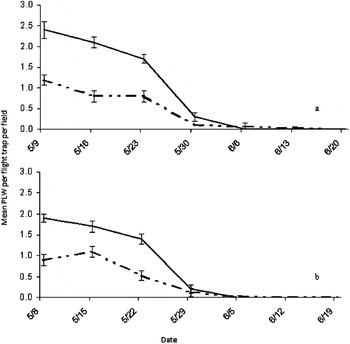
The average number of adult pea leaf weevil captured in flight interception traps, was greatest in early May during both study years. Significantly greater mean pea leaf weevil densities were recorded in conventional-tillage pea fields compared to no-tillage fields on both years (fig. 1). There was a significant interaction between tillage treatment and date during 2006 (F=29.06; df = 6, 18; P < 0.001) and 2007 (F = 13.88; df = 6, 18; P < 0.001). An ANOVA of each individual week revealed significantly more adult pea leaf weevils captured in conventional-tillage than no-tillage fields in 2006 during 9 May (F = 35.45; df = 1, 3; P < 0.001), 16 May (F = 11.05; df = 1, 3; P = 0.03) and 23 May (F = 17.44; df = 1, 3; P < 0.001) and in 2007 during 8 May (F = 26.37; df = 1, 3; P < 0.001), 15 May (F = 8.88; df = 1, 3; P = 0.01) and 22 May (F = 5.64; df = 1, 3; P = 0.02). No significant differences in adult pea leaf weevil densities were detected between tillage treatments by the end of May on either year. Flying adults were captured throughout June during 2006 with means of less than one pea leaf weevil per flight trap, while aerial activity ceased by the second week of June during 2007.
Mean (±standard error) catch per bi-directional flight trap of adult pea leaf weevil (PLW) moving through the air into commercial fields of spring pea grown using conventional-tillage (CT) and no-tillage (NT) practices in Idaho and Washington State during the (a) 2006 and (b) 2007 growing seasons ( , CT;
 , NT).

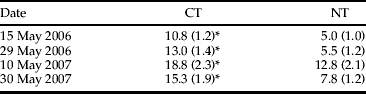
Linear soil samples detected significantly more adult pea leaf weevils in conventional-tillage than no-tillage fields in 2006 during 15 May (F = 11.88; df = 1, 3; P = 0.001) and 29 May (F = 17.44; df = 1, 3; P < 0.001) and in 2007 during 10 May (F = 4.00; df = 1, 3; P = 0.05) and 30 May (F = 7.90; df = 1, 3; P = 0.01) (table 1). The male:female ratio was 1.7:1.0 and 1.4:1.0 in conventional-tillage and no-tillage fields, respectively on 15 May 2006, and 1.0:1.4 and 1.0:1.1 in conventional-tillage and no-tillage fields, respectively on 29 May 2006. The male:female ratio was 1.1:1.0 and 1.4:1.0 in conventional-tillage and no-tillage fields, respectively, on 10 May 2007 and 1.0:2.5 and 1.0:1.8 in conventional-tillage and no-tillage fields, respectively, on 30 May 2007. These ratios indicate greater numbers of colonizing adult males than females in early-May with a shift towards more females than males in late-May. While the number of females was similar between tillage treatments in the first sample, during the second sample there was a greater proportion of females in conventional-tillage compared to no-tillage fields.
Mean (±SE) absolute adult pea leaf weevil densities per 0.3m of soil in conventional-tillage (CT) and no-tillage (NT) peas planted in Idaho and Washington State.
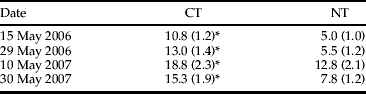
An asterisk indicates significant differences (P < 0.05) between tillage treatment means.
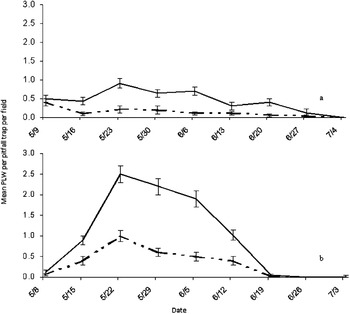
Adult pea leaf weevil ground activity-density peaked in the third week of May during both study years (fig. 2). Mean numbers of pea leaf weevil per trap were greater from mid-May to mid-June in 2007 than during the same periods in 2006 on both tillage treatments (fig. 2). There was a significant interaction between tillage treatment and date during 2006 (F = 5.58; df = 8, 24; P < 0.001) and 2007 (F = 24.92; df = 8, 24; P < 0.001). An ANOVA for each individual week during 2006 revealed significantly more adult pea leaf weevils captured in conventional-tillage than no-tillage fields on 16 May (F = 10.92; df = 1, 3; P = 0.002), 23 May (F = 21.73; df = 1, 3; P < 0.001), 30 May (F = 14.84; df = 1, 3; P < 0.001), 6 June (F = 33.95; df = 1, 3; P < 0.001) and 20 June (F = 4.75; df = 1, 3; P = 0.01). The same analysis for 2007 showed significantly more pea leaf weevils captured in conventional-tillage fields on 15 May (F = 11.35; df = 1, 3; P < 0.001), 22 May (F = 54.84; df = 1, 3; P < 0.001), 29 May (F = 69.91; df = 1, 3; P < 0.001), 5 June (F = 48.31; df = 1, 3; P < 0.001) and 12 June (F = 17.93; df = 1, 3; P < 0.001). There was no significant difference in pea leaf weevil activity-density between conventional-tillage and no-tillage fields during July or August in either study year.
Mean (±standard error) catch per pitfall trap of adult pea leaf weevil (PLW) moving along the soil surface in commercial fields of spring pea grown using conventional-tillage (CT) and no-tillage (NT) practices in Idaho and Washington State during the (a) 2006 and (b) 2007 growing seasons (, CT; , NT).

Immature pea leaf weevil densities and assessment of root nodule development
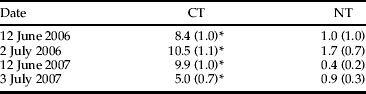
Significantly more pea leaf weevil larvae were collected in conventional-tillage fields than in no-tillage fields in the soil core samples taken on 12 June 2006 (F = 114.10; df = 1, 3; P < 0.001) and 12 June 2007 (F = 247.58; df = 1, 3; P < 0.001) (table 2). No pupae were collected in the June 2006 or June 2007 samples from either tillage treatment. Significantly more immature pea leaf weevils (larvae and pupae combined) were collected in conventional-tillage than in no-tillage fields later in the growing season (table 2) [2 July 2006 (F = 118.69; df = 1, 3; P < 0.001); 3 July 2007 (F = 46.02; df = 1, 3; P < 0.001)].
Mean (±SE) absolute immature pea leaf weevil densities per 833cm3 of soil in conventional-tillage (CT) and no-tillage (NT) peas planted in Idaho and Washington State.
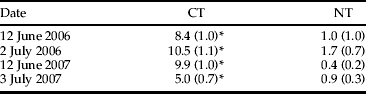
An asterisk indicates significant differences (P < 0.05) between tillage treatment means.
Pea plant roots in conventional-tillage fields had significantly more root nodules (df = 3; P < 0.001) than roots in no-tillage fields in 2006 (df = 3; P < 0.001) and 2007 (df = 3; P = 0.02). Approximately 70% of the root nodule ratings for conventional-tillage fields were in the high category compared to 40% of the no-tillage nodule ratings for the 12 June 2006 sample. Similar differences were detected in the 12 June 2007 samples with approximately 80% of the conventional-tillage nodule ratings in the high category compared to 55% of the no-tillage nodule ratings. There were no significant differences between tillage treatments in root nodule ratings for the July samples in 2006 or 2007.
Adult pea leaf weevil emergence
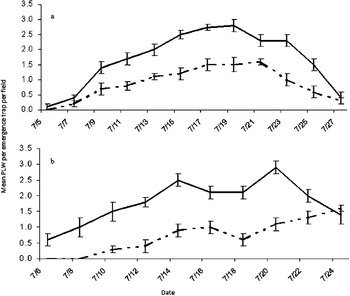
A repeated-measures ANOVA showed a significant interaction between tillage treatment and date for pea leaf weevil emergence during 2006 (F = 4.16; df = 11, 33; P < 0.001) and 2007 (F = 9.92; df = 9, 27; P < 0.001) (fig. 3). In 2006, the cumulative number of adult pea leaf weevil captured in the emergence traps in conventional-tillage was 1010 compared with 311 in no-tillage fields (F = 18.34; df = 1; P = 0.02). In 2007, the cumulative number of adult pea leaf weevil captured in emergence traps in conventional-tillage was 986 compared with 201 in no-tillage fields (F = 26.39; df = 1; P = 0.01). Conventional-tillage fields had the earliest pea leaf weevil emergence during both years, with first emergence recorded on 5 July 2006 and 6 July 2007, whereas initial emergence in no-tillage fields was recorded on 6 July 2006 and 9 July 2007. Emergence results are consistent with the observed greater pea leaf weevil colonization of conventional-tillage fields as indicated by the absolute adult and immature pea leaf weevil densities in conventional-tillage. Each of the four conventional-tillage fields had greater daily and seasonal emergence than the four no-tillage fields during both study years.
Mean (±standard error) adult pea leaf weevil (PLW) emergence per trap per day from commercial pea fields grown using conventional-tillage (CT) and no-tillage (NT) practices in Idaho and Washington State in during the (a) 2006 and (b) 2007 growing seasons (, CT; , NT).

A comparison between colonizing adults and the emerging new generation of pea leaf weevil was made to determine potential differences between tillage treatments. On average, there were 11 adult pea leaf weevils perm2 during initial adult colonization and 16 adult pea leaf weevils perm2 during peak emergence in conventional-tillage compared to five and nine adult pea leaf weevils perm2 colonizing and emerging, respectively, in no-tillage fields in 2006. This indicates that for every colonizing adult, 1.5 pea leaf weevils emerged from conventional-tillage and 1.8 from no-tillage fields in 2006. In 2007, there were 19 colonizing and 18 emerging adults perm2 in conventional-tillage fields compared to 13 adults perm2 and seven adults perm2 colonizing and emerging, respectively, in no-tillage fields. Thus, for every colonizing adult, one weevil emerged from conventional-tillage and 0.5 weevils emerged from no-tillage fields in 2007. In 2006, four of the 16 colonizing adults perm2 in conventional-tillage and three of the five colonizing adults perm2 in no-tillage were female. The adjusted ratio of initial female densities and emerging adult pea leaf weevil perm2 indicates that four females perm2 in conventional-tillage fields resulted in 16 adults perm2 and three females perm2 in no-tillage fields resulted in nine adults perm2. In 2007, eight of the 19 colonizing adults perm2 in conventional-tillage and five of the 13 colonizing adults perm2 in no-tillage were female. The adjusted ratio of initial female densities and emerging adult pea leaf weevils perm2 shows that eight females perm2 in conventional-tillage fields resulted in 18 adults perm2 and five females perm2 in no-tillage fields resulted in seven adults perm2. Thus, the realized fecundity of colonizing pea leaf weevil in conventional-tillage in 2006 (4) and 2007 (2.3) was higher than in no-tillage fields in 2006 (3) and 2007 (1.4).
Crop emergence and feeding damage
Planting of pea fields took place on average eight and 11 days earlier in conventional-tillage compared to no-tillage fields in 2006 and 2007, respectively. Pea emergence in conventional-tillage fields averaged 10.8 days and 9.8 days from sowing in 2006 and 2007, respectively. Pea emergence in no-tillage fields averaged 11.3 and 10.8 days from sowing in 2006 and 2007, respectively. Conventional-tillage-grown pea plants were visible immediately upon emergence from the soil whereas residue in no-tillage fields made young plants less visible, effectively creating differences in plant appearance between tillage treatments. Pea leaf weevil notching was immediately evident upon first emergence of conventional-tillage-grown peas. Pea leaf weevil notching was first noted in no-tillage-grown peas at the three- and four-node stage. Pea plants in conventional-tillage had significantly greater pea leaf weevil notching than plants in no-tillage fields in 2006 (P = 0.03) and 2007 (P = 0.01) (table 3). Nonetheless, levels of plant notching in general were low. It is possible that insecticide applications could have suppressed pea leaf weevil, partly explaining the relative low levels of weevil damage we observed. However, since insecticides were applied to all fields sampled, it is unlikely that they influenced response patterns of pea leaf weevil to tillage.
Mean (±SE) pea leaf weevil feeding damage notching score in conventional-tillage (CT) and no-tillage (NT) peas planted in Idaho and Washington State.

Notching was assessed for the first three nodes of each leaflet using a 0–4 rating scale where 0 = least and 4 = the most severe level of notching, a modification of the scale by Cantot (Reference Cantot1986). First notch was recorded on 6 May and 18 May 2006 on CT- and NT-grown pea, respectively, and 12 May and 24 May 2007 on CT- and NT-grown pea, respectively. An asterisk indicates significant differences in notch score between tillage treatments (2006, P = 0.03; 2007, P = 0.01).
Discussion
Our results demonstrated greater early season colonization and ground activity-density by adult pea leaf weevil in large-scale commercial pea fields grown under conventional-tillage compared to fields under no-tillage. This confirms earlier findings observed in smaller-scale, on station field trials that examined different tillage regimes (Hanavan et al., Reference Hanavan, Bosque Pérez, Guy, Schotzko and Eigenbrode2008a; Hatten et al., Reference Hatten, Dahlquist, Eigenbrode and Bosque-Pérez2010). The differences in pea leaf weevil colonization densities are likely associated with differences in crop emergence, phenology and host plant location during peak aerial movement of adult weevils in early spring. In the Palouse region, commercial conventional-tillage fields dry up faster in the spring and are accessible earlier for growers to plant. No-tillage fields typically have lower surface soil temperatures than conventional-tillage fields early in the season (Fuentes et al., Reference Fuentes, Flury, Huggins and Bezdicek2003; Hatten, Reference Hatten2006), and the increased residue in no-tillage fields holds surface moisture longer than conventional-tillage fields (Brust, Reference Brust1991). As a consequence, no-tillage fields are planted later resulting in later crop emergence and plant development. In the fields examined, pea plants grown under conventional-tillage emerged earlier than plants in no-tillage fields and were available in greater numbers during peak pea leaf weevil flight from overwintering sites, which occurs in early to mid May (Fisher & O'Keeffe, Reference Fisher and O'Keeffe1979b; Hanavan et al., Reference Hanavan, Bosque Pérez, Guy, Schotzko and Eigenbrode2008a). On average, the combination of earlier planting dates and more rapid emergence of plants grown under conventional-tillage resulted in plants sown under no-tillage lagging in emergence by 8.5 and 12 days, in 2006 and 2007, respectively, compared to conventional-tillage-sown plants. We recognize that due to the later planting dates of no-tillage fields the direct effects of no-tillage on weevil colonization could be confounded with planting date effects. However, in smaller-scale, on station trials conducted in the Palouse, greater pea leaf weevil colonization of conventional-tillage fields has been observed compared to no-tillage fields planted on the same date (Hanavan et al., Reference Hanavan, Bosque Pérez, Guy, Schotzko and Eigenbrode2008a; Hatten et al., Reference Hatten, Dahlquist, Eigenbrode and Bosque-Pérez2010), suggesting the effects observed in the present study are likely due to tillage differences. Additional experiments are required to simultaneously study the separate effects of planting date and tillage regime on pea leaf weevil colonization of large-scale commercial pea fields.
The observed greater densities of pea leaf weevil in conventional-tillage fields suggest that weevils were responding to visual or olfactory cues associated with the emergence of the crop (Prokopy & Owens, Reference Prokopy and Owens1983). Plant apparency is likely lower in no-tillage fields (Hanavan et al., Reference Hanavan, Bosque Pérez, Guy, Schotzko and Eigenbrode2008a) as cereal residue in such fields could create visual barriers (Kostal & Finch, Reference Kostal and Finch1994), while pea leaf weevils search for newly developing pea plants. Wheat stubble in no-tillage systems has interfered with colonizing Phyllotreta cruciferae on cruciferous crops (Milbrath et al., Reference Milbrath, Weiss and Schatz1995) and potentially could interfere during pea leaf weevil colonization of pea fields. Indeed, crop residue in no-tillage fields made emerging pea seedlings less visually apparent than seedlings in conventional-tillage fields during our crop emergence assessments, accentuating the effect of earlier plant emergence in conventional-tillage fields. The earlier plant emergence combined with increased plant apparency in conventional-tillage fields resulted in earlier resource availability for herbivore colonization.
Ground activity-density of adult pea leaf weevil peaked at the time aerial activity began to decline on both years. While the relative densities of adult pea leaf weevil were different between the aerial and ground trapping methods, trends were similar with greater densities in conventional-tillage than no-tillage pea fields during the early part of the growing season.
Immature pea leaf weevil densities were consistently greater in conventional-tillage than in no-tillage fields in mid-June for both years. Our findings also showed that root nodule abundance was lower in no-tillage than in conventional-tillage fields, where nodules covered the majority of the root system in plants. The cooler soil temperatures in fields under no-tillage (Fuentes et al., Reference Fuentes, Flury, Huggins and Bezdicek2003; Hatten, Reference Hatten2006) likely delayed root nodule formation (Zhang & Smith, Reference Zhang and Smith1994). Similarly, the greater levels of stored nitrogen in no-tillage fields (Doran, Reference Doran1987; Franzluebbers et al., Reference Franzluebbers, Hons and Zuberer1995) could have resulted in an overall reduction in root nodule size and abundance (Vankosky et al., Reference Vankosky, Carcamo, McKenzie and Dosdall2011). First-instar pea leaf weevil larvae are known to search for root nodules shortly after hatching (Fisher & O'Keeffe, Reference Fisher and O'Keeffe1979a). Previous studies have shown significant first instar mortality of pea leaf weevil (Hamon et al., Reference Hamon, Allen-Williams, Lee and Bardner1984) and other Sitona species (Quinn & Hower, Reference Quinn and Hower1986). First-instar pea leaf weevil larvae could be especially vulnerable to a lag in nodule development and reduced abundance and size of nodules in no-tillage fields. The lesser availability of root nodules at the time of pea leaf weevil larval emergence could have resulted in reduced host finding during the initial search for plant material by first-instars and potentially caused greater mortality of weevil larvae in no-tillage fields (Hanavan et al., Reference Hanavan, Bosque Pérez, Schotzko and Eigenbrode2010). Our results are consistent with previous findings, showing that population levels of Sitona spp. are influenced by the availability of root nodules (Quinn & Hower, Reference Quinn and Hower1986; Hanavan et al., Reference Hanavan, Bosque Pérez, Schotzko and Eigenbrode2010).
The cooler, wetter microclimate in no-tillage fields also could have had a direct negative effect on immature pea leaf weevil, causing greater mortality. The lower soil temperatures may lead to prolonged egg hatch (Lerin, Reference Lerin2004), which could increase the risk of mortality during a vulnerable developmental stage (Hanavan et al., Reference Hanavan, Bosque Pérez, Schotzko and Eigenbrode2010). Other factors, such as increased abundance of predators (Brust, Reference Brust1991; Hatten et al., Reference Hatten, Bosque-Pérez, Labonte, Guy and Eigenbrode2007) or pathogens, might also cause greater immature pea leaf weevil mortality in no-tillage fields.
Our observations and those of Hanavan et al. (Reference Hanavan, Bosque Pérez, Schotzko and Eigenbrode2010) indicate that the realized fecundity of pea leaf weevil is greater in conventional-tillage than in no-tillage pea fields. This is potentially the result of increased egg production by weevils, greater survival of immature stages, or both factors combined, in conventional-tillage compared to no-tillage fields (Hanavan et al., Reference Hanavan, Bosque Pérez, Schotzko and Eigenbrode2010). Additional research is needed to better define the relative contribution of these factors to the increased realized fecundity of pea leaf weevil in conventional-tillage.
The emergence of new generation adult pea leaf weevil was significantly greater from conventional-tillage compared to no-tillage pea for both years. Greater adult emergence rates in part reflect the greater numbers of colonizing adults in conventional-tillage compared with no-tillage fields. Increased colonizing adult mortality in no-tillage fields also could affect subsequent adult emergence. In the Palouse region, Poecilus scitulus LeConte, P. lucublandus Say and Pterostichus melanarius (Illiger) are dominant carabids in pea fields (Hatten et al., Reference Hatten, Bosque-Pérez, Labonte, Guy and Eigenbrode2007), and these species have been observed to consume adult pea leaf weevil in laboratory experiments (Hanavan, Reference Hanavan2008). Higher densities of P. lucublandus were observed in no-tillage compared to conventional-tillage pea fields by Hatten et al. (Reference Hatten, Bosque-Pérez, Labonte, Guy and Eigenbrode2007) at periods when adult weevils are colonizing the crop in the Palouse.
The significantly lower and delayed feeding damage we observed in no-tillage-grown peas suggests that these plants partly escape damage from pea leaf weevil during the critical early stages of plant development. The first few weeks after planting are critical for establishment of the pea crop, and pea leaf weevil feeding damage at this time can cause significant yield reduction and economic loss (Williams et al., Reference Williams, Schotzko and O'Keeffe1995). Our findings are consistent with Dore & Meynard (Reference Dore and Meynard1995), who showed that late-planted pea fields exhibited reduced pea leaf weevil attack. No-tillage agriculture introduces a lag in field accessibility for growers and ultimately causes a delay in planting dates that results in reduced pea leaf weevil colonization and plant damage. Early season availability of food resources in conventional-tillage fields and a lag in access to no-tillage fields shows the potential for no-tillage systems to alter the synchrony between colonizing adult pea leaf weevil and the availability of spring pea. Reduced pea leaf weevil colonization and damage in no-tillage fields likely decreases the economic losses associated with this pest. Additional studies are required, however, to assess the economic benefits that would be attributable directly to pea leaf weevil control through the use of no-tillage practices.
No-tillage practices, along with many other benefits, are effective at minimizing pea leaf weevil infestation and damage of pea. In the Palouse, annual yields of spring pea grown under no-tillage increase to levels equal or greater than conventional-tillage levels after three years of adoption (Guy & Cox, Reference Guy and Cox2002). This yield effect combined with lower pea leaf weevil infestation and damage should stimulate more growers to adopt no-tillage practices.
Acknowledgements
We thank William Price for assistance with statistical analysis, Sanford Eigenbrode for productive discussions, Dennis Schotzko, Libby Driebergen and Phil Mattern for technical support and the pea growers for providing access to their fields and management information. We are grateful to the USDA-Solutions to Environmental and Economic Problems (STEEP) program and the University of Idaho for funding this research. This is a publication of the Idaho Agricultural Experiment Station.