INTRODUCTION
Bovine tuberculosis (bTB), caused by Mycobacterium bovis, is an important zoonotic disease affecting many mammal species, and mainly spreads via aerosol transmission (Skuce et al. Reference Skuce, Allen and Stanley2012). The World Health Organisation (WHO, 2012) identified bTB as one of the eight worldwide neglected zoonoses needing urgent attention, especially in developing countries. The disease is endemic in sub-Saharan African cattle (de Garine-Wichatitsky et al. Reference de Garine-Wichatitsky, Caron, Kock, Tschopp, Munyeme, Hofmeyr and Michel2013), and cattle are the main host for M. bovis (Cosivi et al. Reference Cosivi, Grange, Daborn, Raviglione, Fujikura, Cousins, Robinson, Huchzermeyer, Kantor and Meslin1998). A wide range of domestic and wildlife mammals, but also humans can be infected with bTB (Munyeme et al. Reference Munyeme, Muma, Skjerve, Nambota, Phiri, Samui, Dorny and Tryland2008). Although control programmes have eliminated or nearly eliminated this disease from domestic animals in some developed countries, bTB is still widespread in Great Britain, Ireland, New Zealand and many developing countries, especially in Africa (Renwick et al. Reference Renwick, White and Bengis2007; Humblet et al. Reference Humblet, Boschiroli and Saegerman2009). In fact, bTB is an important public concern, and can cause economic losses due to livestock deaths, product reduction and trade restrictions (Humblet et al. Reference Humblet, Boschiroli and Saegerman2009).
Africa is recognized as a hotspot for biodiversity, but is suffering from rapid and extensive loss of that diversity (Myers et al. Reference Myers, Mittermeier, Mittermeier, Da Fonseca and Kent2000; Olff et al. Reference Olff, Ritchie and Prins2002; Gorenfloa et al. Reference Gorenfloa, Romaineb, Russell, Mittermeierc and Walker-Painemilla2012; Di Marco et al. Reference Di Marco, Boitani, Mallon, Hoffmann, Iacucci, Meijaard, Visconti, Schipper and Rondinini2014). The continent is also a hotspot for emerging infectious diseases as illustrated by emergence of Ebola, HIV/AIDS, MERS, among others (Morens et al. Reference Morens, Folkers and Fauci2004). As biodiversity loss is thought to be a major explanatory factor of the increase in emergence of infectious diseases (Keesing et al. Reference Keesing, Belden, Daszak, Dobson, Harvell, Holt, Hudson, Jolles, Jones, Mitchell, Myers, Bogich and Ostfeld2010; Ostfeld and Keesing, Reference Ostfeld and Keesing2012; Huang et al. Reference Huang, de Boer, van Langevelde, Xu, Ben Jebara, Berlingieri and Prins2013), it is key to investigate the links between biodiversity, and biodiversity loss on the patterns of infectious diseases in Africa. Recently, several studies have shown that a reduction in biodiversity may increase the prevalence and transmission of diseases (Keesing et al. Reference Keesing, Belden, Daszak, Dobson, Harvell, Holt, Hudson, Jolles, Jones, Mitchell, Myers, Bogich and Ostfeld2010; Cardinale et al. Reference Cardinale, Duffy, Gonzalez, Hooper, Perrings, Venail, Narwani, Mace, Tilman and Wardle2012; Johnson et al. Reference Johnson, Preston, Hoverman and Richgels2013; Myersa et al. Reference Myersa, Gaffikin, Golden, Ostfeld, Redford, Ricketts, Turner and Osofsky2013; Civitello et al. Reference Civitello, Cohen, Fatima, Halstead, Liriano, McMahon, Ortega, Sauer, Sehgal, Young and Rohr2015). The two alternative hypotheses are the dilution and the amplification effect (Keesing et al. Reference Keesing, Holt and Ostfeld2006; Huang et al. Reference Huang, de Boer, van Langevelde, Xu, Ben Jebara, Berlingieri and Prins2013; Hofmeester et al. Reference Hofmeester, Coipan, van Wieren, Prins, Takken and Sprong2016). The dilution effect predicts that species diversity decreases pathogen prevalence through mechanisms such as decreased host density, reduced encounters between hosts, or reduced host survival (Keesing et al. Reference Keesing, Holt and Ostfeld2006; Huang et al. Reference Huang, de Boer, van Langevelde, Xu, Ben Jebara, Berlingieri and Prins2013; Johnson et al. Reference Johnson, Preston, Hoverman and Richgels2013). In contrast, the amplification effect predicts increased pathogen prevalence with greater species diversity, through increased encounters between hosts, or through the presence of secondary hosts (LoGiudice et al. Reference LoGiudice, Ostfeld, Schmidt and Keesing2003; Keesing et al. Reference Keesing, Holt and Ostfeld2006). A recent review of the relationships between species diversity and diseases reported dilution effects in up to 80% of the studies examined, and amplification effects in 12% of the studies (Cardinale et al. Reference Cardinale, Duffy, Gonzalez, Hooper, Perrings, Venail, Narwani, Mace, Tilman and Wardle2012; Ostfeld and Keesing, Reference Ostfeld and Keesing2012). Despite the fact that the dilution effect occurs far more frequently than the amplification effect, our knowledge of which specific systems conform to the dilution effect and the mechanisms underlying the effects of diversity, is incomplete (Ostfeld and Keesing, Reference Ostfeld and Keesing2012; Randolph and Dobson, Reference Randolph and Dobson2012; Huang et al. Reference Huang, de Boer, van Langevelde, Xu, Ben Jebara, Berlingieri and Prins2013; Johnson et al. Reference Johnson, Preston, Hoverman and Richgels2013; Miller and Huppert, Reference Miller and Huppert2013; Ostfeld, Reference Ostfeld2013; Hofmeester et al. Reference Hofmeester, Coipan, van Wieren, Prins, Takken and Sprong2016). Understanding the underlying mechanisms how the risk of disease relates to the level of biodiversity is important, both for predicting disease dynamics in the context of global biodiversity decline, and to provide valuable insights into successful control measures.
Most studies that examine the diversity–disease relationship focus principally on species richness as a measure of biodiversity (Keesing et al. Reference Keesing, Holt and Ostfeld2006). In fact, biodiversity can be measured in many different ways, as the number of species (species richness), the distribution of individuals over species (species evenness), or a combination of richness and evenness, as represented by diversity indices such as the Shannon index (Magurran, Reference Magurran1988; Tucker and Cadotte, Reference Tucker and Cadotte2013). Many studies have argued that species richness and evenness are two independent indices (Sheldon, Reference Sheldon1969; Smith and Wilson, Reference Smith and Wilson1996; Gosselin, Reference Gosselin2006; Symonds and Johnson, Reference Symonds and Johnson2008), and suggest treating them separately (Magurran, Reference Magurran1988; Legendre and Legendre, Reference Legendre and Legendre1998). Ostfeld and Keesing (Reference Ostfeld and Keesing2000) stated that encounter rate is proportional to the distribution of hosts. Thus, evenness which measure how evenly the individuals are distributed in the community among different species may be most appropriate measure of biodiversity to explain disease risk, because of power to detect the probability of encounter between pathogens and each host species. Thus, despite many studies of the relationship between diversity and diseases, evaluating the effects of different diversity metrics on disease risk has proven to be rare (Chen and Zhou, Reference Chen and Zhou2015). Thus, these different metrics of diversity may have different predictive powers for predicting disease risk in the target population. Here we tested for the effect of different diversity metrics on bTB risk in cattle.
Several recent studies suggest that the occurrence of particular species in the animal community may play an important role in disease risk, and in determining whether biodiversity amplifies or dilutes the infectious disease (Fenton and Pedersen, Reference Fenton and Pedersen2005; Keesing et al. Reference Keesing, Belden, Daszak, Dobson, Harvell, Holt, Hudson, Jolles, Jones, Mitchell, Myers, Bogich and Ostfeld2010; Hamer et al. Reference Hamer, Chaves, Anderson, Kitron, Brawn, Ruiz, Loss, Walker and Goldberg2011; Johnson et al. Reference Johnson, Preston, Hoverman and Richgels2013, Reference Johnson, Ostfeld and Keesing2015; Oda et al. Reference Oda, Solari and Botto-mahan2014). This effect of a particular species on pathogen transmission is known as the identity effect (Hantsch et al. Reference Hantsch, Braun, Scherer-Lorenzen and Bruelheide2013; Huang et al. Reference Huang, Xu, van Langevelde, Prins, ben Jebara and de Boer2014, Reference Huang, van Langevelde, Estrada-Peña, Suzán and de Boer2016). Generally, the identity effect on pathogen transmission can be observed in two different situations (Huang et al. Reference Huang, van Langevelde, Estrada-Peña, Suzán and de Boer2016). One is that a key species with particularly high or low reservoir competence may be present in communities when species diversity increases. The other situation is where a species can affect vector abundance (either positively or negatively) (Huang et al. Reference Huang, van Langevelde, Estrada-Peña, Suzán and de Boer2016). To our knowledge, the generality of this pattern for directly transmitted or aerosol-borne diseases, such as bTB, has not been established. Thus, understanding the identity effect is an important step in being able to understand the expected impacts of biodiversity loss on disease dynamics. In Africa, buffalo (Syncerus caffer), greater kudu (Tragelaphus strepsiceros) and lechwe (Kobus leche; Cosivi et al. Reference Cosivi, Meslin, Daborn and Grange1995) have been identified as maintenance hosts and implicated in the transmission of M. bovis. Warthog (Phacochoerus africanus) are also thought to be a potential reservoir for this bacteria in Africa (Tschopp, Reference Tschopp, Zinsstag, Schelling, Waltner-Toews, Whittaker and Tanner2015). The presence of species such as the greater kudu and warthog are likely to affect the type of encounters with cattle, which could then alter the relation between biodiversity and disease risk. We thus tested for the existence of an identity effect of greater kudu and warthog. We predict that bTB risk increased with the occurrence of maintenance host species.
Currently, livestock and wild herbivores graze together in many arid and semi-arid rangelands of Africa, with much resource use overlap, as livestock species are ecologically similar, with similar resource requirements as several wild herbivore species (Prins, Reference Prins, Prins, Grootenhuis and Dolan2000; Sitters et al. Reference Sitters, Heitkönig, Holmgren and Ojwang2009). Overlapping space use can lead to interspecific interactions, and stimulate the spread and prevalence of many diseases (Riley et al. Reference Riley, Hadidian and Manski1998), as most pathogens are able to cross-infect multiple host species. Hence, in areas where wildlife and livestock co-occur, pathogens can emerge and establish in these sympatric host populations (Gortazar et al. Reference Gortazar, Ferroglio, Hofle, Frolich and Vicente2007). For example, foot and mouth disease, rabies, anthrax, brucellosis and bTB have all been shown to be reciprocally transmissible between livestock and wildlife (Frohlich et al. Reference Frohlich, Thiede, Kozikowski and Jakob2002; Artois, Reference Artois2003; Ward et al. Reference Ward, Tolhurst and Delahay2006; Cooper et al. Reference Cooper, Scott, de la Garza, Deck and Cathey2010; Proffitt et al. Reference Proffitt, Gude, Hamlin, Garrott, Cunningham and Grigg2011). In this context, resource use overlap between host species can play an important role in pathogen transmission by increasing contact rates and environmental exposure to the agent (Roper et al. Reference Roper, Garnett and Delahay2003; Böhm et al. Reference Böhm, Hutchings and White2009). How habitat use by hosts affects direct and indirect interactions among hosts is fundamental in understanding multi-host disease transmission (Cooper et al. Reference Cooper, Scott, de la Garza, Deck and Cathey2010), and is critical for designing scientifically sound disease control strategies (Hudson et al. Reference Hudson, Rizzoli, Grenfell, Heesterbeek and Dobson2002). Nevertheless, the role that spatial interactions between livestock and wildlife host play in disease transmission remains mostly unknown (Böhm et al. Reference Böhm, Hutchings and White2009; Martin et al. Reference Martin, Pastoret, Brochier, Humblet and Saegerman2011; Tschopp, Reference Tschopp, Zinsstag, Schelling, Waltner-Toews, Whittaker and Tanner2015). For instance, habitat and water resources use overlap may stimulate bTB transmission through increasing wildlife maintenance host–cattle contact, such as observed in and around Awash National Park, Ethiopia, where large numbers of livestock share their habitat with wildlife particularly during the dry season when resources are scarce. We therefore also tested whether habitat use overlap between wildlife maintenance host (greater kudu and warthog) and cattle increased bTB prevalence. Beside the role of host community composition and resource overlap, a positive effect of host (e.g. cattle) densities (Humblet et al. Reference Humblet, Boschiroli and Saegerman2009; Dejene et al. Reference Dejene, Heitkönig, Prins, Fitsum, Daniel, Zelalem, Kelkay and de Boer2016) has also been associated with bTB transmission risk. We also tested whether cattle densities were positively correlated with bTB incidence in cattle.
STUDY AREA
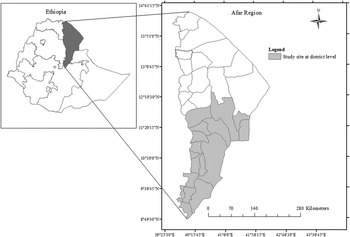
We carried out a cross-sectional study in Awash National Park and in the neighbouring Afar Region, Ethiopia. Awash National Park (9°20′N, 40°20′E) is situated in the Ethiopian Rift valley and had an elevation of 960–1050 m above sea level (Fig. 1). It is covered in semi-arid savanna. The Afar region is found in the northeastern part of Ethiopia (between 8°49′ to 14°30′N latitude and 39°34′ to 42°28′E longitude; Fig. 1) with an area of about 70 000 km2 (CSA, 2008). It is characterized by an arid and semi-arid climate with low and erratic rainfall, with a mean annual rainfall of 500 mm in the semi-arid western escarpments, decreasing to 150 mm in the arid zones to the east. Study sites were included due consideration of variation in wildlife–livestock interactions, concentrations of livestock and wildlife, and the presence of common grazing and water resources (for details see Dejene et al. Reference Dejene, Heitkönig, Prins, Fitsum, Daniel, Zelalem, Kelkay and de Boer2016).
Map of the study area, the Afar Region in Ethiopia (small inset) and 17 districts (larger map). The location of Awash National Park in the South is indicated by the cross-hatched area.

METHODOLOGY
Study design
A cross-sectional multi-stage sampling was used to select study villages with ‘sub-region’ as the highest level followed by ‘district’ (n = 17; Fig. 1), and ‘sub-district’ (n = 34) at the lowest level. Study animals were obtained using a three-stage random sampling procedure. The village within the sub-district was regarded as the primary unit, the herd as secondary unit and individual animal as tertiary unit, following the method of Dejene et al. (Reference Dejene, Heitkönig, Prins, Fitsum, Daniel, Zelalem, Kelkay and de Boer2016). The desired sample size, which gave us a total of 2550 animals, was calculated following the method of Dejene et al. (Reference Dejene, Heitkönig, Prins, Fitsum, Daniel, Zelalem, Kelkay and de Boer2016). Tuberculin skin testing was performed using Purified Protein Derivative (supplied by Prionics Lelystad B.V, Lelystad, The Netherlands) to identify bTB-positive animals following the method of Dejene et al. (Reference Dejene, Heitkönig, Prins, Fitsum, Daniel, Zelalem, Kelkay and de Boer2016).
Dung counts
Plots for dung counts were established using stratified random sampling. First, sub-districts were stratified according to vegetation type. 204 plots (six in each of the 34 sub-districts) of 100 × 100 m2 were laid out randomly in these vegetation types and were GPS geo-referenced. In each plot, we surveyed 50 transects of 100 m length and 2 m wide, and counted dung piles. Each pile of dung was attributed to a locally available wildlife species based on the size, shape and form of the pellets by using Stuart and Stuart (Reference Stuart and Stuart2000), and with the help of experienced local trackers. The relative abundances of wild herbivores were estimated based on the frequency of fecal droppings found in the plot transects following Vicente et al. (Reference Vicente, Segalés, Balasch, Plana-Durán, Domingo and Gortázar2004). We divided each 100 m transect into 10 sectors of 10 m length. We defined sign frequency as the average number of 10-m sectors with the presence of wild herbivores droppings. Based on these frequencies, we calculated for each of the species the frequency-based indirect index (FBII):
 $${\rm FBII} = \displaystyle{1 \over n}\mathop \sum \limits_{i = 1}^n s_i$$
where s i is the number of sign-positive sectors in the ith 100 m transect (i.e. S i varies between 0 and 10), and n is the number of 100 m transects considered (i.e. n = 50 for each plot; Vicente et al. Reference Vicente, Segalés, Balasch, Plana-Durán, Domingo and Gortázar2004).
Ethical statements
This study was approved by Haramaya University, Ethiopia (Reference number HUP14/559/15).
Statistical analysis
For each sub-district Pianka's Niche Overlap, mammalian species richness (S), mammalian species diversity (H′) and mammalian species evenness (J′) were calculated. Habitat use overlap between cattle and greater kudu was calculated according to Pianka's Niche Overlap (Pianka, Reference Pianka1973). This index varies from 0, no overlap, to 1, complete overlap.
 $$O_{\,jk} = \displaystyle{{\mathop \sum \nolimits p_{ij}p_{ik}} \over {\sqrt {\mathop \sum \nolimits p_{ij}^2 \mathop \sum \nolimits p_{ik}^2}}} $$
where O jk is the overlapping index between species j and k, and p ij and p ik being the proportions of use of habitat i by the species j and k.
Shannon's diversity index (H′) was used to estimate mammalian species diversity as
 $$H{\rm ^{\prime}} = - \mathop \sum \limits_{i = 1}^S p_i\ln p_i$$
where p i is the proportion of species i, and S is the number of species (Hill, Reference Hill1973).
Pielou's index was used to estimate mammalian species evenness (Hill, Reference Hill1973), which is most widely used in ecology (Zhang et al. Reference Zhang, John, Peng, Yuan, Chu, Guozhen and Shurong2012).
 $$J{\rm ^{\prime}} = \displaystyle{{H{\rm ^{\prime}}} \over {{\rm ln}(S)}}$$
where H′ represents the Shannon diversity index, and S is the total number of species observed. Biodiversity metrics were calculated using package vegan of R v3.2.0 (Oksanen et al. Reference Oksanen, Guillaume, Roeland, Pierre, Minchin, O'Hara, Simpson, Peter, Henry, Stevens and Helene2016).
Generalized Linear Mixed Models (GLMM, family = Poisson) using package lme4 were used to examine the effects of predictors on the sub-district bTB incidence (SI- Table 1). Prior to developing our candidate models, we performed one-by-one univariate analyses to identify potential spatial risk factors, using the number of bTB-infected animals as dependent variable. Predictor variables with P < 0·25 recognized as potential spatial risk factors (Huang et al. Reference Huang, de Boer, van Langevelde, Xu, Ben Jebara, Berlingieri and Prins2013), and subsequently used to construct multiple regression models. For highly correlated independent variables, only the one causing the largest change in the Log-Likelihood added to the final global model to avoid multi-collinearity, which was assessed by using variance inflation factors. The final variance inflation factor values were all <5 and confirmed the absence of collinearity among variables. From the global model, candidate models constructed using delta AIC (<5), with the best approximating candidate model having the lowest delta AIC, as described in Burnham and Anderson (Reference Burnham and Anderson2002). Model averaging was used to construct the final model based on the lowest Akaike weights of the different candidate models (Anderson et al. Reference Anderson, Burnham and Thompson2000). In this analysis, we treated district as a random effect to account for repeated sampling. We carried out all analyses in R v3.2.2 (R Core Team, 2015).
RESULTS
Pielou's species evenness (J′) and Shannon's species diversity (H′) varied between 0·46–0·90 and 0·72–2·05, respectively. Habitat use overlap between cattle and kudu varied from 0, no overlap to 0·95, high overlap. The highest Pianka's Niche Overlap index between warthog and cattle was 0·84. Relative abundances of kudu and warthog ranged from 0 to 0·93 and 0 to 0·79, respectively (SI-Table 2).
Univariate analyses
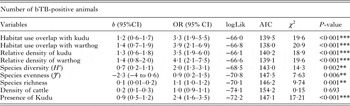
Based on the results of the univariate analyses, we identified seven out of eight variables as potential risk factors, namely, mammalian species richness, Pielou's species evenness (J′), Shannon's species diversity (H′), habitat use overlap between cattle and greater kudu, habitat use overlap between cattle and warthog, relative density of greater kudu, and relative density of warthog (Table 1). Surprisingly, density of cattle was not associated with the number of bTB-infected cattle in the sub-district (Table 1).
Results of the one-by-one GLMM analysis of all variables and summary statistics (regression coefficient b with 95% confidence intervals, odds ratio (OR) with 95% confidence intervals, χ 2 and P-value) for all predictors against sub-district (n = 34) number of bTB-positive animals from the likelihood ratio test (logLik = log likelihood) and AIC value

Kudu = greater kudu; *P < 0·05; **P < 0·01; ***P < 0·001.
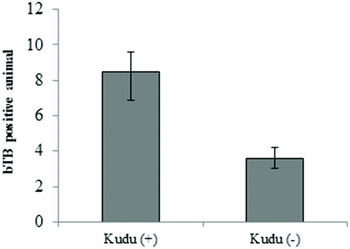
Communities that contained greater kudu had a significantly higher bTB incidence than communities without greater kudu (Fig. 2; b = 0·9, 95% CI = 0·5–1·2; OR = 2·4, 95% CI = 1·6–3·5; P < 0·001).
Effects of the presence of a particular host species, greater kudu, on the number bTB-positive animals at the sub-district level (n = 34). Data shown are means with the 95% confidence intervals

The Spearman's correlation matrix showed that species richness was strongly correlated with Shannon's species diversity index. Habitat use overlap between cattle and warthog, relative density of greater kudu, and relative density of warthog were strongly correlated with habitat use overlap between cattle and greater kudu (r > 0·7; SI-Table 3). Therefore, we only included the latter two variables and species evenness in the multiple variable model to avoid collinearity.
Multiple variable analyses
Variables included in the multiple variable analysis were Pielou's species evenness, Shannon's species diversity and habitat use overlap between cattle and greater kudu (SI-Table 4).
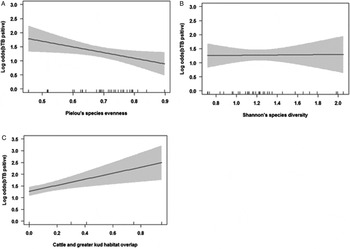
The results of model averaging showed always a negative relationship between Pielou's species evenness and the number of bTB-positive cattle, but we did not find a significant relationship between Shannon's species diversity and the number of bTB-positive cattle, although the effect of species diversity was always positive in the models. In addition, our analysis also identified habitat use overlap between cattle and greater kudu as a significant risk factor for the number bTB-positive cattle in the sub-districts (Table 2; Fig. 3).
GLMM results of the effects of explanatory variables on the number of bTB-positive cattle at the sub-district level (log odds scale) in relation to Pielou's species evenness (A), Shannon's species diversity (B) and resource overlap between greater kudu and cattle (C).

Summary statistics of the final model, obtained through model averaging, with regression coefficient (b ± SE), Odds Ratio (OR, 95% confidence interval) and P-value from the likelihood ratio test for the effect of species evenness (J′), species diversity (H′) and cattle-greater kudu habitat use overlap on the number of bTB-infected Ethiopian cattle in the sub-districts (n = 34)

Kudu = greater kudu; *P < 0·05; **P < 0·01; ***P < 0·001.
DISCUSSION
Our study showed that the bTB infection rate was negatively associated with mammalian species evenness (J′), in line with our predictions derived from the dilution effect hypothesis. However, contrary to our expectation we did not find a significant relationship between mammalian species diversity (H′) and the number of bTB-infected cattle. There was also a positive effect of habitat use overlap between cattle and greater kudu on bTB incidence in cattle. As proposed by Ostfeld and Keesing (Reference Ostfeld and Keesing2000), if the encounter rate is proportional to the distribution of the host species, species evenness would seem most appropriate for disease risk, because evenness, not richness, would capture the probability of encounter between pathogens and each host species (Ostfeld and Keesing, Reference Ostfeld and Keesing2000; Chen and Zhou, Reference Chen and Zhou2015). Our study detected a dilution effect of Pielou's species evenness on the risk of bTB prevalence, an influential aerosol-borne disease. This dilution effect is possibly explained by encounter reduction, in that the addition of alternative hosts may decrease the risk of pathogen transmission by reducing encounter rates between susceptible and infected hosts (Keesing et al. Reference Keesing, Holt and Ostfeld2006; Chen and Zhou, Reference Chen and Zhou2015). In pastoral areas of East Africa, the distribution and abundance of large grazers is negatively associated with the presence of cattle (Voeten and Prins, Reference Voeten and Prins1999; de Leeuw et al. Reference de Leeuw, Waweru, Okello, Maloba, Nguru, Said, Aligula, Heitkonig and Reid2001; Bonnington et al. Reference Bonnington, Weaver and Fanning2007). For instance, de Leeuw et al. (Reference de Leeuw, Waweru, Okello, Maloba, Nguru, Said, Aligula, Heitkonig and Reid2001) observed a significant reduction of species such as Oryx, gerenuk and gazelle in the presence of cattle in Kenya (de Leeuw et al. Reference de Leeuw, Waweru, Okello, Maloba, Nguru, Said, Aligula, Heitkonig and Reid2001), and Odadi et al. (Reference Odadi, Young and Okeyo-Owuor2007) found that the preference of foraging habitat for cattle was lower in the presence of wild grazers (Odadi et al. Reference Odadi, Young and Okeyo-Owuor2007). Many mammal species that can be infected by bTB are spillover or dead-end hosts and do not transmit the pathogen efficiently (Corner, Reference Corner2006; Renwick et al. Reference Renwick, White and Bengis2007). The presence of these non-competent or spillover mammalian species might act as barriers to cattle herd movement and distribution, and reduce encounter rates among cattle herds by changing the grazing behaviour and habitat preference (e.g. avoidance of sites contaminated by feces or different preferences for feeding patches). Such an ‘encounter reduction’ (Keesing et al. Reference Keesing, Holt and Ostfeld2006) might lead to decreased probabilities of bTB infection risk, although the exact mechanism behind these correlations needs more attention.
We did not detect significant effects of host species diversity (H′) on the bTB infection level. The lack of a significant association between host species diversity and disease risk might occur because the index we chose, the Shannon index, stresses the number of species and presence of rare species (McGarigal and Marks, Reference McGarigal and Marks1994; Haines-Young and Chopping, Reference Haines-Young and Chopping1996; Riitters et al. Reference Riitters, Wickham, Vogelmann and Jones2000; Magurran, Reference Magurran2004). Thus, this metric might fail to weigh in the specific importance of particular species that are not rare, which might be addressed better by focusing on the effects of host identity (Hamer et al. Reference Hamer, Chaves, Anderson, Kitron, Brawn, Ruiz, Loss, Walker and Goldberg2011). Moreover, studies also criticizing the dilution effect argued that pathogen transmission might increase in high-diversity communities (Randolph and Dobson, Reference Randolph and Dobson2012; Wood and Lafferty, Reference Wood and Lafferty2013; Huang et al. Reference Huang, van Langevelde, Estrada-Peña, Suzán and de Boer2016) due to the increased chance of including a particular species that has a positive effect on pathogen transmission (Hantsch et al. Reference Hantsch, Braun, Scherer-Lorenzen and Bruelheide2013, Reference Huang, Xu, van Langevelde, Prins, ben Jebara and de Boer2014). For instance, a recent study on bTB suggested that the presence of buffalo increased disease risk due to its high bTB competence (Huang et al. Reference Huang, van Langevelde, Estrada-Peña, Suzán and de Boer2016). Power and Mitchell (Reference Power and Mitchell2004) also demonstrated how the identity effect of particular host species influence the diversity–disease relationship, and found that more diverse systems had higher rates of infection (i.e., amplification effect), because these species rich assemblages contained highly competent reservoir hosts (Power and Mitchell, Reference Power and Mitchell2004). Bouchard et al. (Reference Bouchard, Beauchamp, Leighton, Lindsay, Belanger and Ogden2013) found that the occurrence of white-tailed deer (Odocoileus virginianus), an important host for adult ticks, increase the abundance tick and thus increased the risk of tick-borne diseases (Bouchard et al. Reference Bouchard, Beauchamp, Leighton, Lindsay, Belanger and Ogden2013). Similarly, we found that the presence of greater kudu and habitat use overlap between cattle and greater kudu was positively associated with the number of bTB infection. In Africa, species habitat use such as of greater kudu is not strongly affected by cattle presence (Prins, Reference Prins, Prins, Grootenhuis and Dolan2000), because kudus are almost exclusively browsers and the kudu-cattle dietary niche overlap is relatively small (Fritz et al. Reference Fritz, De Garine-Wichatitsky and Georges1996). High habitat use overlap between cattle and kudu could increase encounter rates between them and create a positive identity effect of kudu on transmission of bTB, as a known wildlife bTB reservoir host. On the contrary, the presence of opossums created a negative identity effect on tick abundance (Keesing et al. Reference Keesing, Brunner, Duerr, Killilea, LoGiudice, Schmidt, Vuong and Ostfeld2009). Thus, high species diversity may amplify or dilute pathogen prevalence depending on the occurrence of a particular species. If the occurrence of the particular species had a negative identity effect, it may enhance the strength of the negative diversity–disease relationship; when the identity effect is positive, it may weaken the negative diversity–disease relationship and lead to a dilution effect (Huang et al. Reference Huang, van Langevelde, Estrada-Peña, Suzán and de Boer2016). Another example is the influence of warthogs, which are predominantly grazers and compete with cattle for high-quality food in African savannas (Treydte et al. Reference Treydte, Bernasconi, Kreuzer and Edwards2006). The species is also recognized as hosts for ticks, which are vectors of various diseases, including African Swine Fever in eastern Africa (Osofsky et al. Reference Osofsky, Cleaveland, Karesh, Kock, Nyhus, Starr and Yang2005). Thus, livestock keepers tend to avoid the areas that are used by warthog for fear of diseases (Maleko et al. Reference Maleko, Mbassa, Maanga and Sisya2012). This could decrease the encounter rate between cattle and warthog, and lead to a non-significant identity effect on bTB transmission. This might be the reason for a non-significant negative diversity–disease relationship. We recognize that our conclusions are based on correlative studies and that further studies with experimental manipulation, including host behaviour change and contact rates among hosts are required to thoroughly test this hypothesis. However, our results are a necessary first step towards understanding the role of community structure on bTB risk and identifying the underlying mechanisms.
In addition to direct transmission, which requires close contact between host species, indirect transmission via environmental contamination is also possibility for bTB transmission. In the north and northeastern part of Awash National Park, particularly in the northern part of the Park at the hot spring and kudu valley areas, it is common to observe livestock grazing in close proximity with kudu during the dry season. Mycobacterium bovis has been detected in environmental samples in East Africa (Roug et al. Reference Roug, Clifford, Mazet, Kazwala, John, Coppolillo and Smith2014), and experimental studies have confirmed that the bacteria can survive for multiple days outside hosts (Fine et al. Reference Fine, Bolin, Gardiner and Kaneene2011). Kelly and Collins (Reference Kelly and Collins1978) suggested that the major factors influencing survival of the bacteria in soil is soil temperature and moisture, as high temperature causes desiccation, and negatively influence survival of the bacteria. Environmental persistence of M. bovis has been proposed to play a role in the transmission of bTB in the UK (Courtenay et al. Reference Courtenay, Reilly, Sweeney, Hibberd, Bryan, Ul-Hassan, Newman, Macdonald, Delahay, Wilson and Wellington2006). Wetlands or humid areas are also potential risk factors, and areas around pounds are generally moister, with greater amounts of shade, which are favourable conditions for M. bovis survival (Jackson et al. Reference Jackson, De Lisle and Morris1995). In Africa, flooding or soil humidity have also been suggested as propagating factors for M. bovis in the environment, as demonstrated in Tanzania (Cleaveland et al. Reference Cleaveland, Shaw, Mfinanga, Shirima, Kazwala, Eblate and Sharp2007) and Zambia (Munyeme et al. Reference Munyeme, Muma, Samui, Skjerve, Nambota, Phiri, Rigouts and Tryland2009) by creating favourable conditions for M. bovis survival. The humid marsh–shrub wetland habitat near the hot-spring and kudu valley of Awash National Park and the surrounding water holes may act as potentially high-risk areas for M. bovis infection, as these areas are generally moist, with greater amounts of shade. Hence, the correlation of habitat use overlap between greater kudu and cattle with bTB infection in the GLMM analyses might not tell the whole story, as the underlying reasons for this correlation is that it is possible that environmental transmission occurs among African wildlife and livestock. These uncertainty and complex eco-epidemiological scenarios and possible confounding factors require further investigation of the transmission network.
Our results highlight aspects of mammalian species evenness and spatial differences in species assemblage that are likely to affect the risk of disease. Our results support the idea that a greater mammalian species evenness acts as a buffer against disease outbreaks. Our findings also demonstrate that the presence of a particular reservoir hosts can affect the diversity–disease relationship. Hence, it is a prerequisite to understand the identity effect, and predict future outbreaks and minimize the risk of disease transmission. Ecologists, epidemiologists and policy makers need to understand the complex interactions among potential host species to identify risk factors for disease transmission and identify efficient management actions. In order to improve this understanding, further ecological and epidemiological research on disease transmission and contact networks is required.
SUPPLEMENTARY MATERIAL
The supplementary material for this article can be found at https://doi.org/10.1017/S0031182016002511.
ACKNOWLEDGEMENTS
We thank Haramaya University for the logistical support. We thank Richard S. Ostfeld for his valuable comments on the manuscript. We are also indebted to all field and laboratory staff who worked with us during tuberculin testing, habitat survey and laboratory work. Finally, we are grateful to all herders and herd owners who collaborated with us during the interviews and bTB testing.
FINANCIAL SUPPORT
Financial support from NUUFIC is gratefully acknowledged.