Human learning is largely based on analogical thought. In other words, when we face the new and unknown, we tend to compare it to a body of concepts we have already assimilated with memories of past experiences to process it in terms of what is already known (Godelier Reference Godelier1985:370; Martínez González Reference Martínez González2007:189–190). Given the complexity and abstraction inherent to conceptions of deities in polytheistic cultures, we often find a tendency to “translate” foreign gods in terms of the qualities of the divinities themselves.
To the best of our knowledge, the ancient Babylonians were the first to propose equivalences between the deities of different groups and languages—for example among Sumerian and Akkadian gods. In some lists, each god is represented in three columns: the Sumerian name, the Akkadian name, and the functional definition of the deity. For the Cassite period (sixteenth–thirteenth centuries bc) “There is an explanatory list of gods that gives divine names in Amoritic, Hurritic, Elamic, and Cassitic as well as Sumerian and Akkadian” (Assman Reference Assman, Budick and Iser1996:25, 306, n. 1). These documents confirm the Babylonian notion according to which peoples from highly differentiated political and cultural systems venerated the same gods under different names. This process shows the recognition of the religions of others translated through processes of intercultural translatability.Footnote 1
A similar attitude appears in the writings of Herodotus (fifth century bc). His work names fifty-seven gods—from thirteen different peoples and seventeen foreign languages—for which he proposes Greek equivalents. The Hellenic traveler had no doubt that, “only one company of gods actually exists behind the widely divergent customs and ideas of the many peoples who worship them” (Linforth Reference Linforth1926:13 [see also Lattimore Reference Lattimore1939]).
A more recent example of this phenomenon may be found in nineteenth-century accounts on Afro-American santería in Florida. When black slaves were forbidden from continuing to venerate their ancient divinities, they “translated them” into the Catholic calendar of saints' days, which did not entail any loss of their original identity. And so, the deity responsible for venereal and skin diseases could be Babalu Aye or Saint Lazarus; the owner of paths could be Eleguá or the Santo Niño de Atocha (Holy Child of Atocha); the lightning god could be Changó or Saint Barbara, to name only a few (Fernández Cano Reference Fernández Cano2008:200, 308).
As other polytheistic groups, the people of Mesoamerica probably shared this type of logic. To date, specialists have devoted little attention to the subject and sources are scarce and dispersed. Nevertheless, evidence suggests that the indigenous people of this region of study not only adopted and adapted “foreign” deities into their pantheon, but that they also recognized the equivalence between their gods and those of other groups.Footnote 2
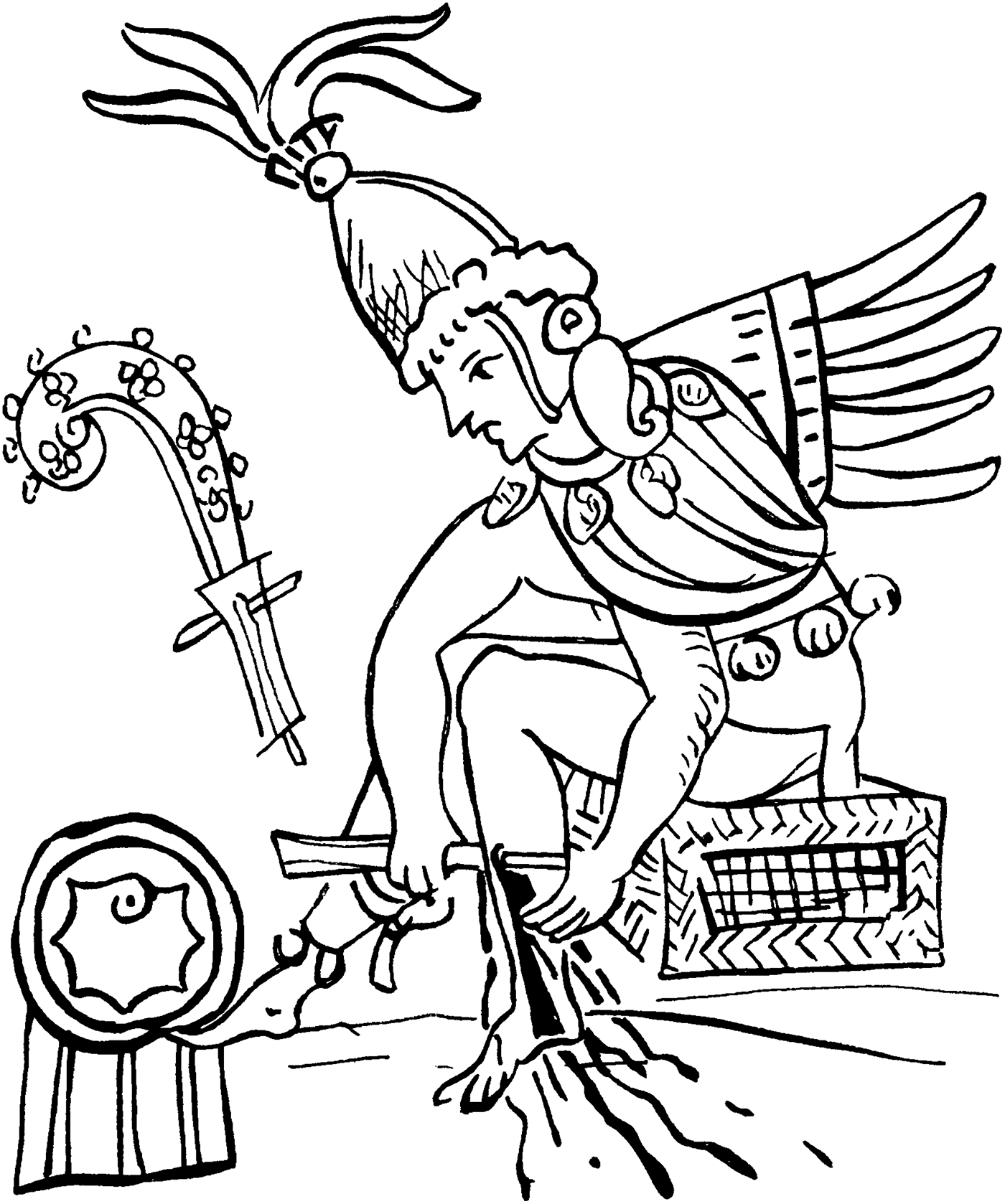
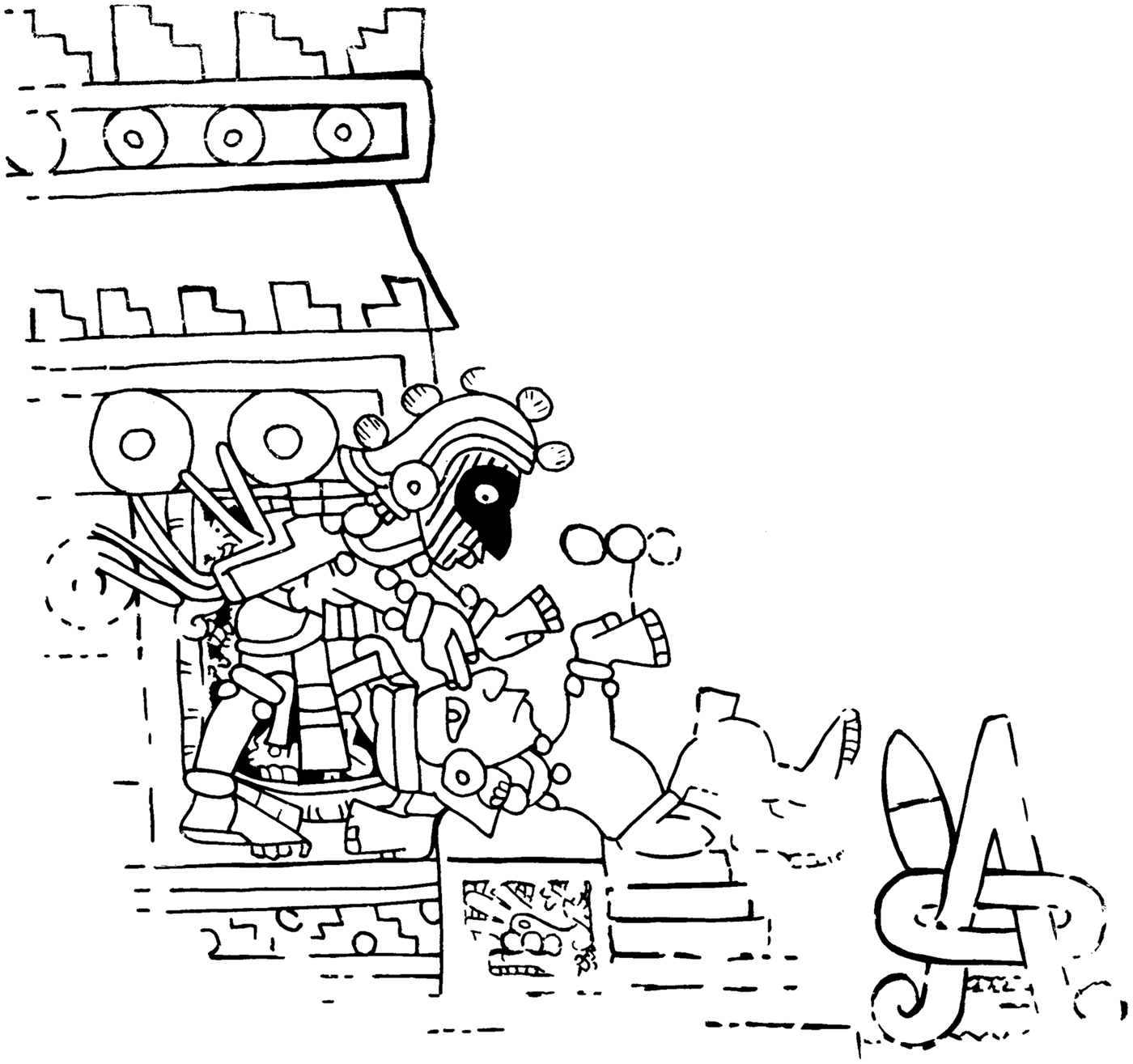
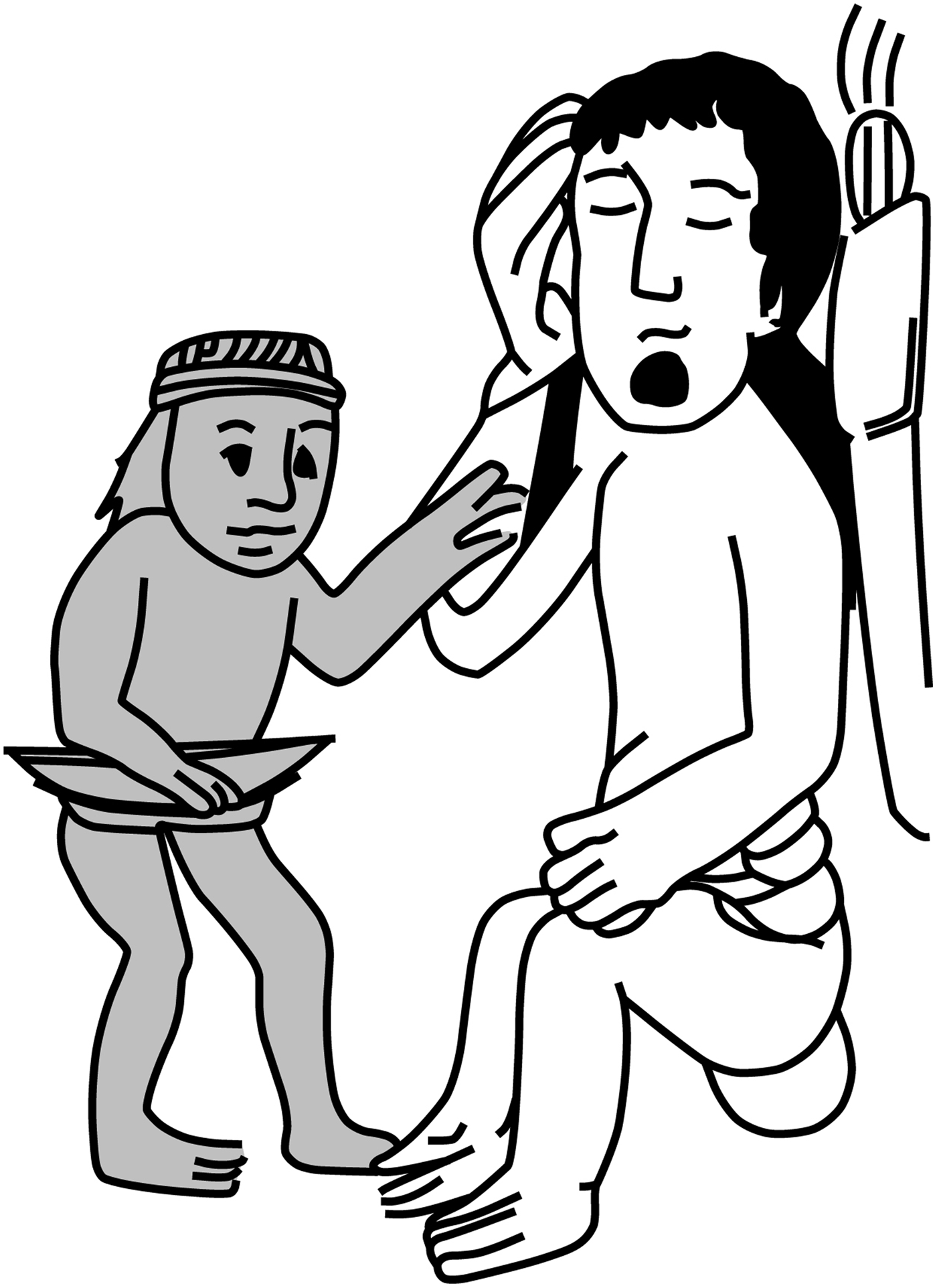
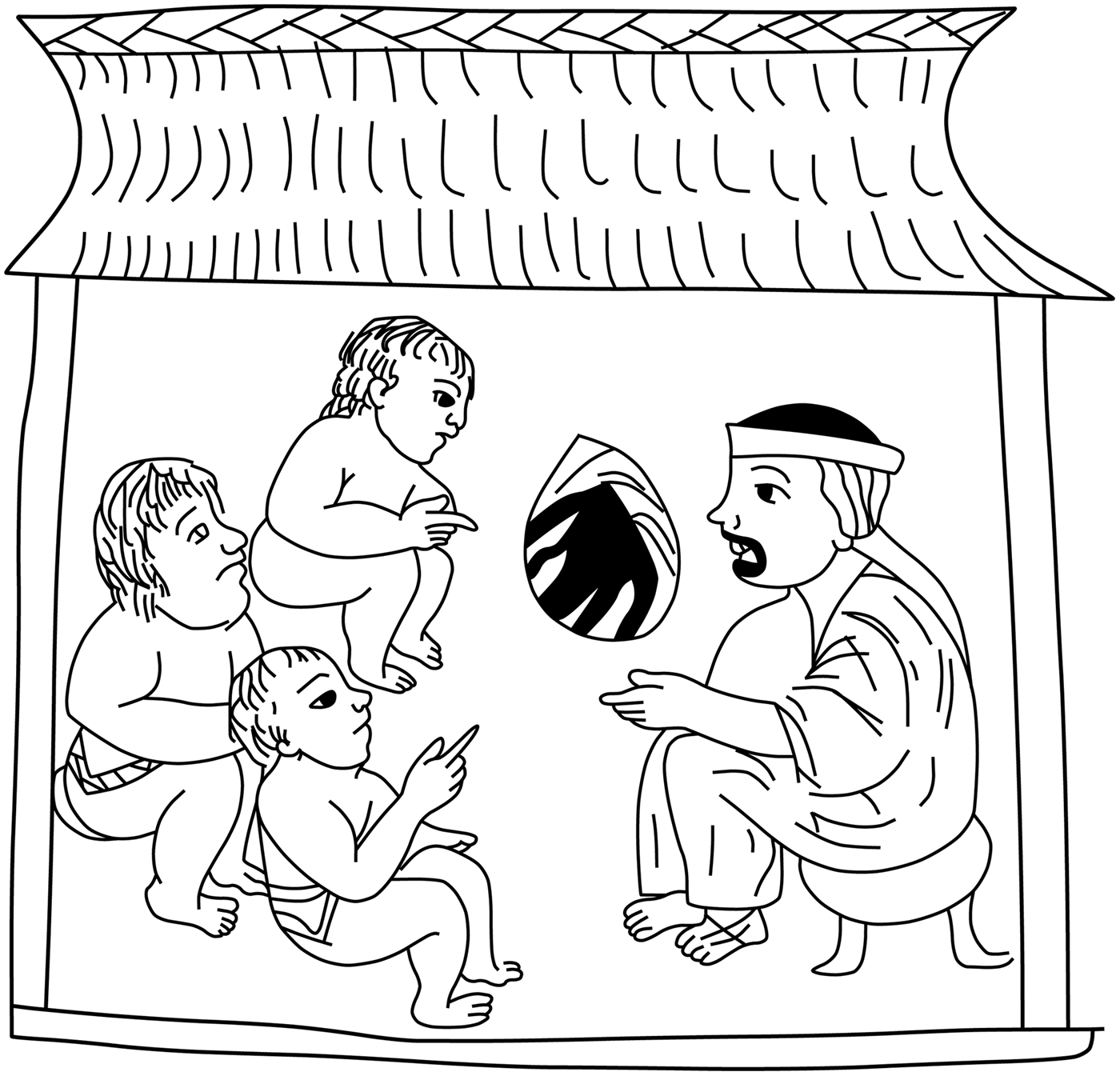
Amazed by the large number of divine names among the indigenous population, one sixteenth-century chronicler wrote: “These gods had these and many others names, because depending on what they understood or what they attributed to them, this gave rise to their names, and each group gave them different names, because they spoke different languages, and so [each deity] had many names” (García Icazbalceta et al. Reference García Icazbalceta1941:210). The Nahua informants of Franciscan Fray Bernardino de Sahagún (Reference Sahagún, Anderson and Dibble1950–1981:10:189) explicitly stated that Taras, the patron god of the P'urhepecha, was called Michoacatl in Nahuatl and was the god of the Chichimecs. In his Spanish version Sahagún (Reference Sahagún, Austin and Quintana2000:2:972), in turn, claimed “this Taras in the Mexican language is called Mixcoatl, who was god of the Chichimecs” (Figure 1). Concerning this same deity, Sahagún's informants (Reference Sahagún, Anderson and Dibble1950–1981:2:137) regarded him as the god of the Otomís in another part of the Códice Florentino: “the god of the Otomi, who was named Mixcoatl (in inteouh otomj: in mjtoaia Mixcoatl).” It is striking to find the Ñañuh name of this god in Fray Alonso Urbano's (Reference Urbano and Acuña1990 [1605]:f. 249v) trilingual Spanish-Nahuatl-Otomí dictionary: “E ttaxãcacquengüy” is translated as “White Serpent Cloud” (Carrasco Reference Carrasco1998:24–25). Shifting our attention to Guatemala, an interesting passage from the Anales de los cakchiqueles (Recinos Reference Recinos1950:79) states: “Straight away Gagavitz [leader of the Cakchiquels] left; it was truly terrible when they saw him cast himself into the water [Lake Atitlan] and turn into Zutzucumatz.” Adrián Recinos (Reference Recinos1950) regards the name Zutzucumatz as “an error in copying,” and he proposes it be read as Q'ukumatz, “Feathered Serpent”. In contrast, René Acuña (Reference Acuña1978:16, n. 3) translates “Zutzu cumatz” as “Cloud Serpent.”, a translation also used by Maxwell and Hill (Reference Maxwell and Hill2006:105) in their new edition and translation of this source. Another classic example of a deity known by different versions of his name in various languages is the famed “Feathered Serpent”: Quetzalcoatl in Nahuatl, Koo Sau in Mixtec, Kukulkan in Yucatec Maya, and Q'ukumatz in K'iche’ Maya; we will return to this god shortly.
Mixcoatl, god of hunting and the Chichimecs (Atlas de Durán, in Durán Reference Durán, Romero and Camelo1995:2:Plate 14). (Drawing by Elbis Domínguez).

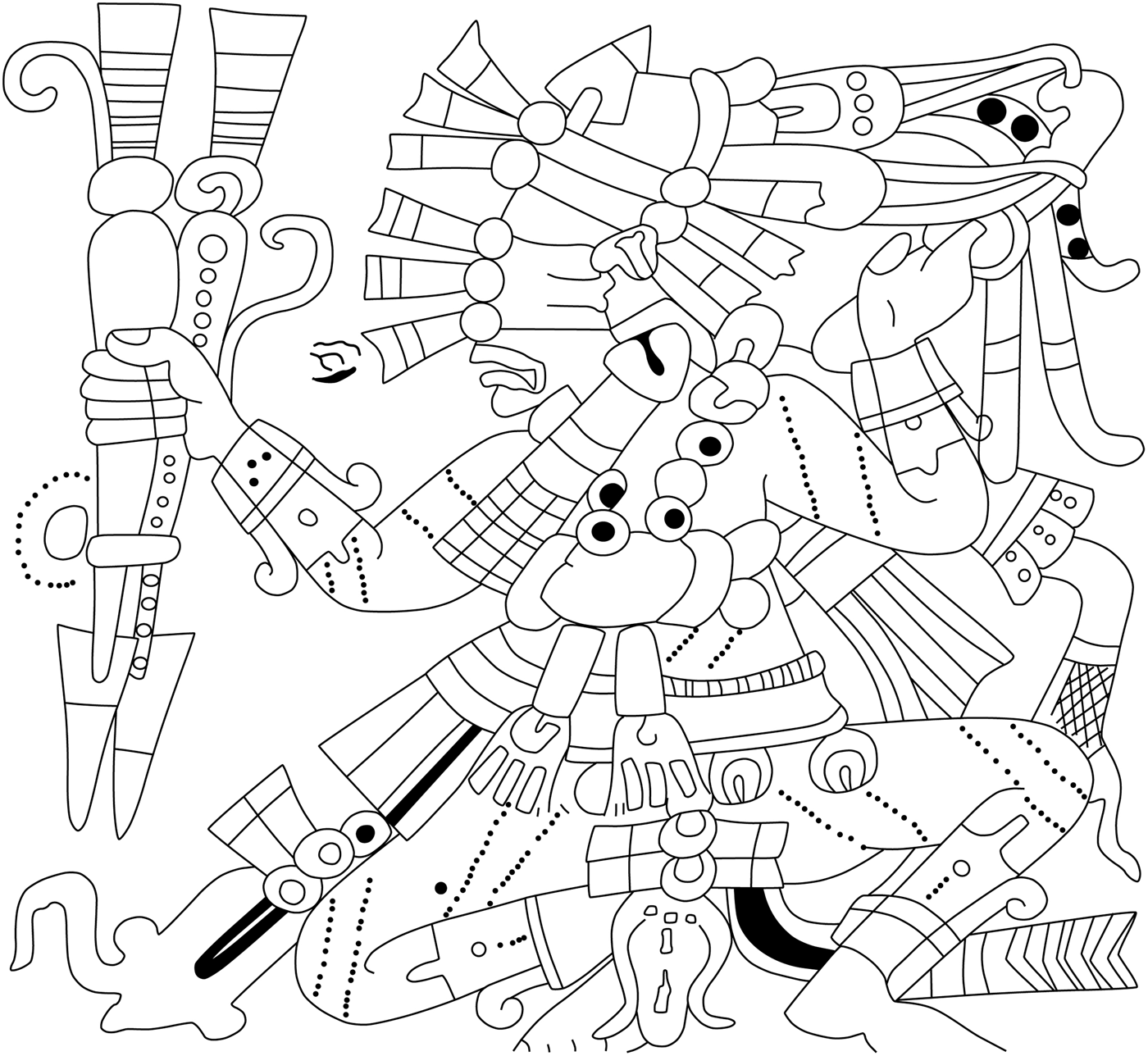
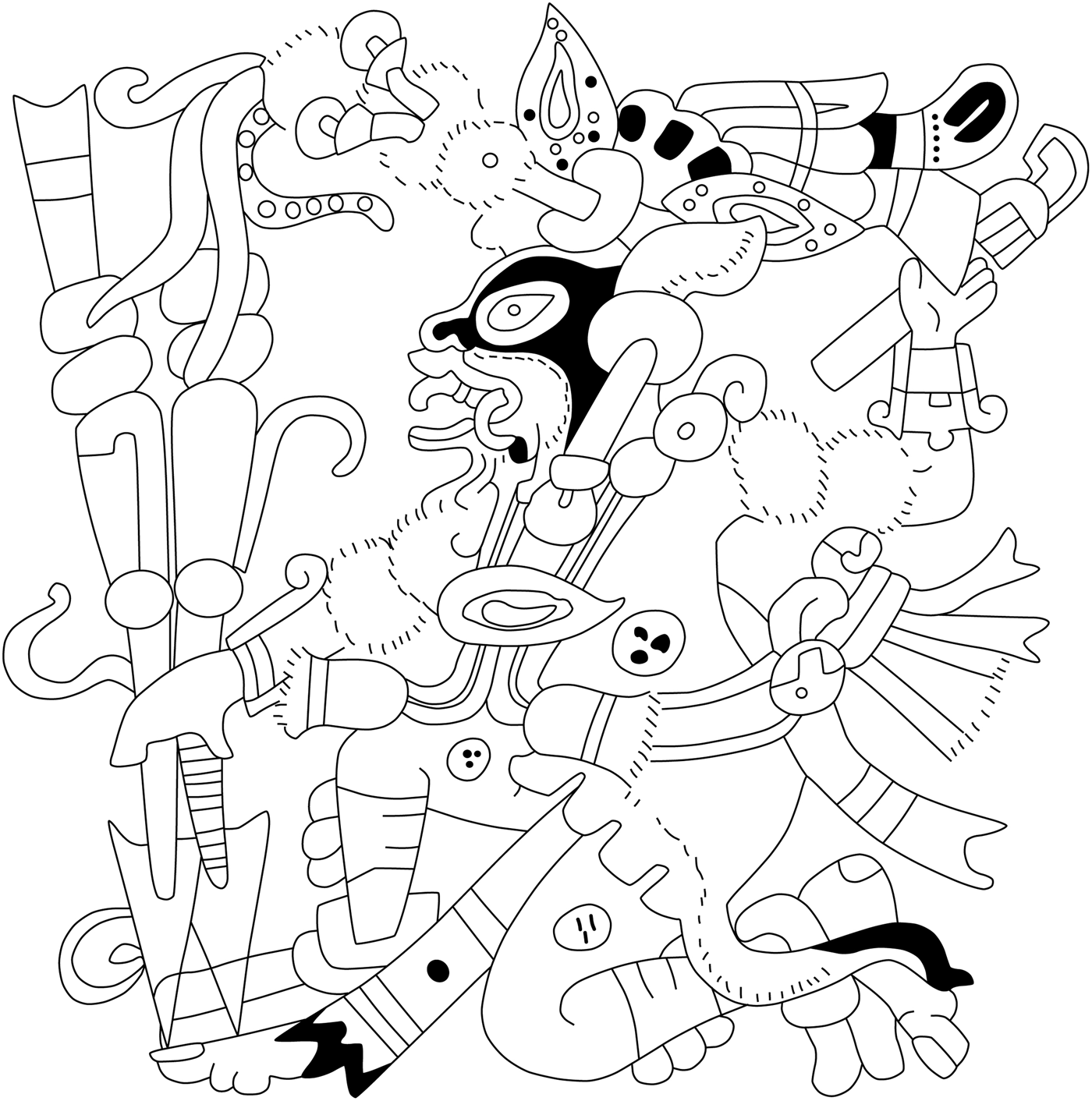
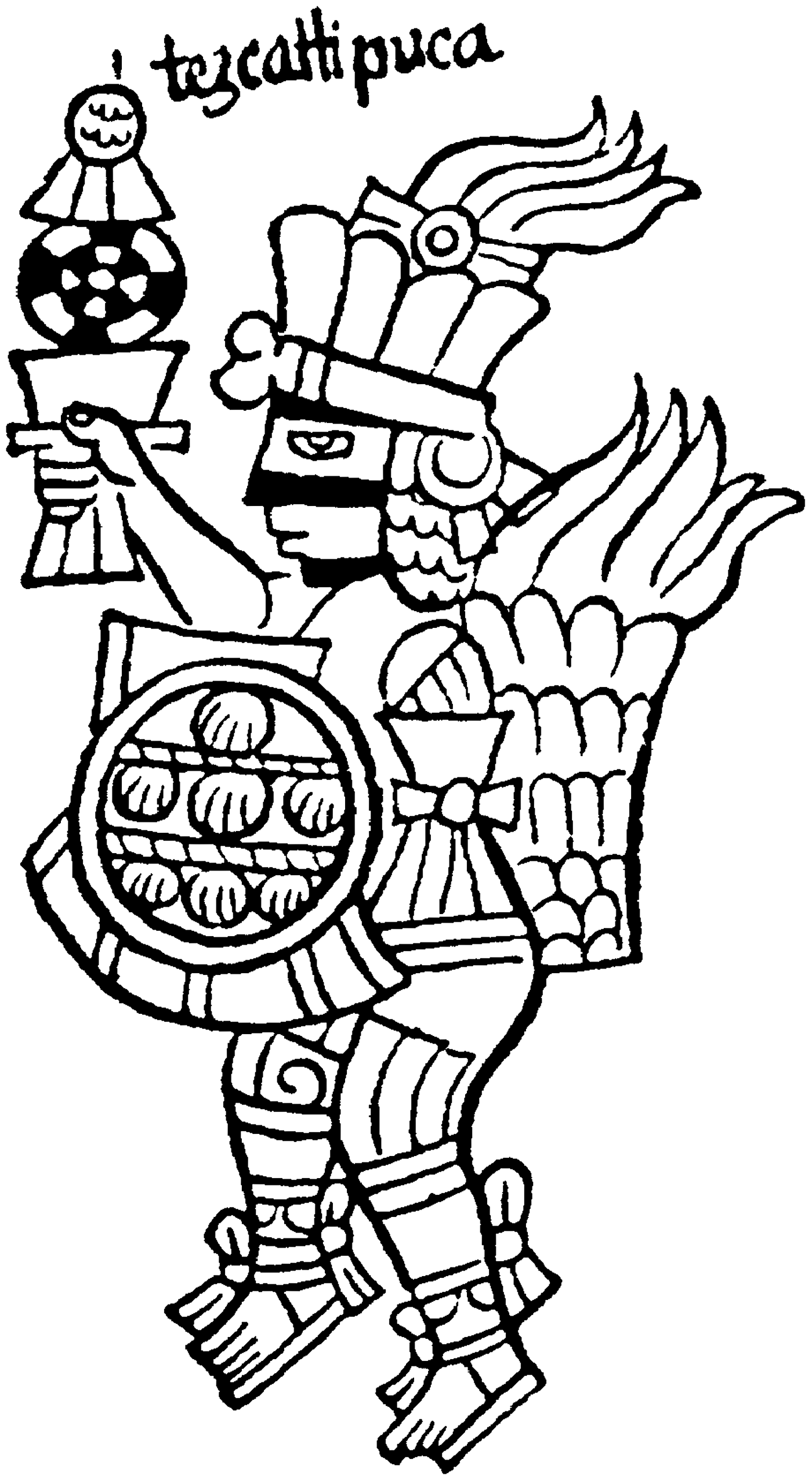
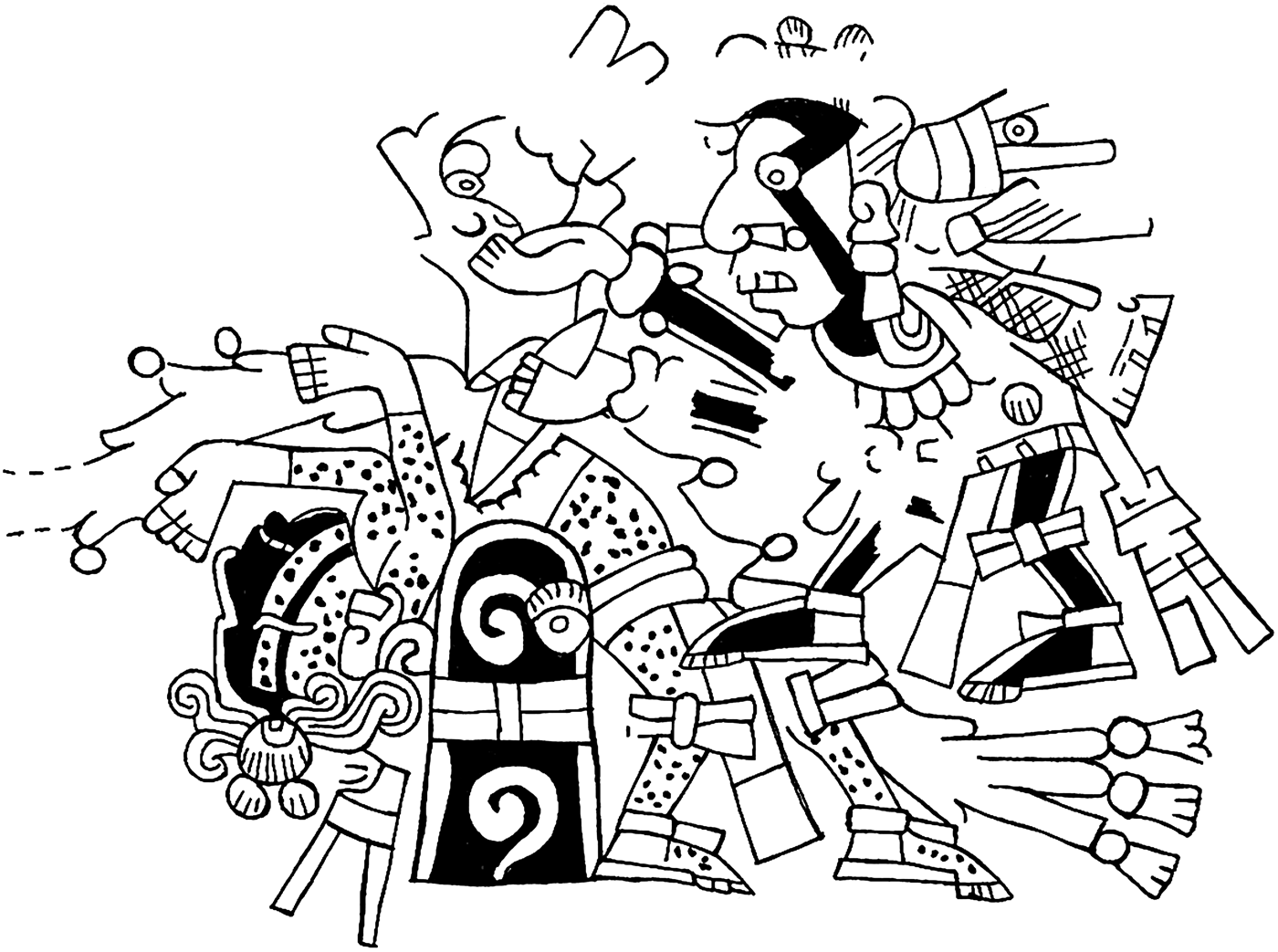
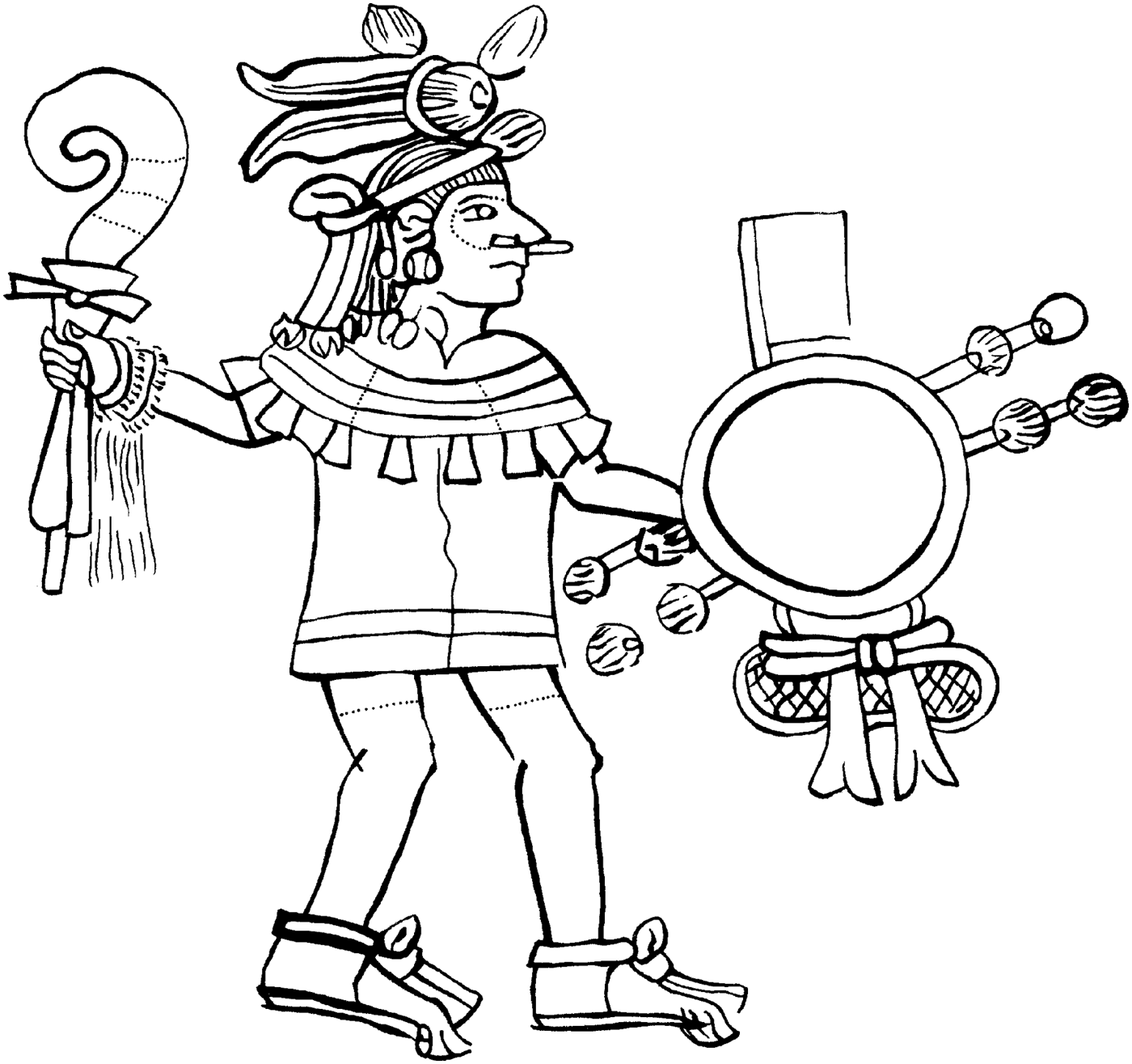
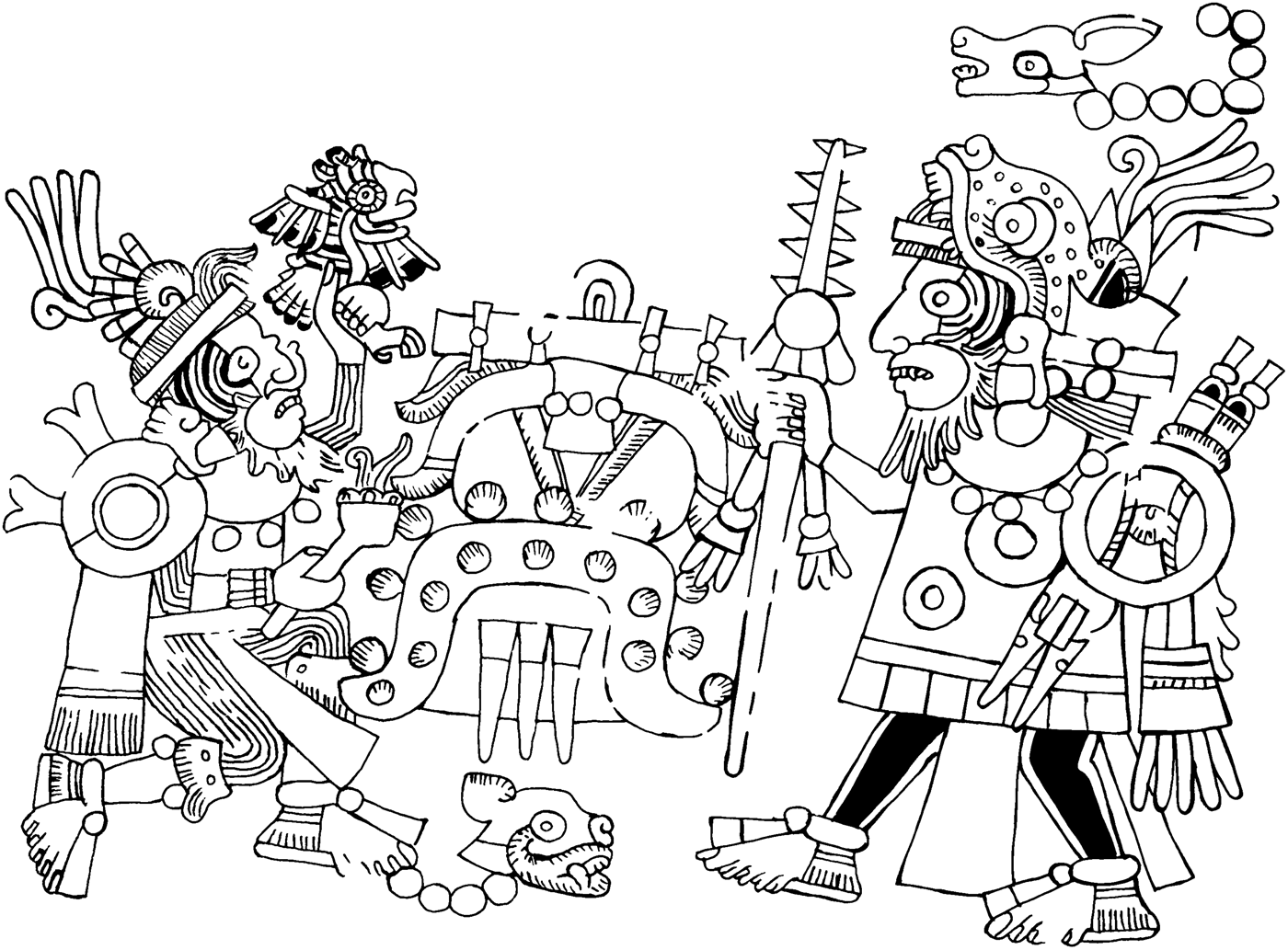
Along with these examples of translated names of gods, it is worth introducing another exciting possibility of studying this subject in pre-Hispanic documents found in the Maya area. To begin with, in the recent work of Alfonso Lacadena (Reference Lacadena, Vail and Hernández2010: 389–390), after noting the presence of a figure that wears the buccal mask associated with Ehecatl on Seibal Stela 19, he identified the Nahuatl name of this deity—e-je-ke—in an inscription (C1) carved on Stela 13 from the same site: “In any case, the e-je-ke spelling might reflect the way that Nahua eheca(tl) sounded to a Maya scribe and was thought to be written.” Another fascinating case is the section known as the Venus table in the Dresden Codex, where five deities appear, two of which display iconographic features similar to those of gods from the central highlands (Seler Reference Seler and Bowditch1904 [1898]; Reference Seler1963a [1904]:1:251–252; Thompson Reference Thompson1985 [1950]:219–220; Reference Thompson and Santana1988 [1972]:167–170). One of them has been identified as Tezcatlipoca-Ixquimilli-Itztlacoliuhqui (Thompson Reference Thompson and Santana1988 [1972]:169) and the other as Xiuhtecuhtli (Taube and Bade Reference Taube and Bade1991) (Figures 2 and 3). What is particularly interesting in this case is that the “foreign” gods are designated by a group of Maya glyphs that give their names in Nahuatl. In fact, Berthold Riese (Reference Riese1982) proposed reading the name of the deity identified as Tezcatlipoca-Ixquimilli as Acatonal, “Reed Day (Name)” or Ceacatonal “1 Reed Day,” while Gordon Whittaker (Reference Whittaker1986) read it as Cactonal, “Sandal Day (Name),” which would be equivalent to the sign “Lizard.” The name of the god in plate 48 would be Tawiskal(a), equivalent to Tlahuizcalpantecuhtli (Taube and Bade Reference Taube and Bade1991:14; Whittaker Reference Whittaker1986:57). Finally, the name of the god depicted in plate 49 has been interpreted as Tesawiteutl, in other words as Tetzauhteotl (Whittaker Reference Whittaker1986:58), or more convincingly as Chak Xiw(i)tei, “a close gloss for the Nahuatl name Xiuhtecuhtli” (Taube and Bade Reference Taube and Bade1991:18). The latter authors add: “Thus not only does the Dresden figure display the turquoise iconography of Xiuhtecuhtli, but he is also termed ‘red (or great) Xiuhtecuhtli.’” Therefore, in two cases, the gods from the central highlands were represented with their own iconography and their Nahuatl names expressed in Maya glyphs. In this process of integrating foreign gods, their names were preserved; they were not translated, but rather transcribed into the Maya language through the Maya writing system.Footnote 3 The case of the god known as Tawiskal(a)-Tlahuizcalpantecuhtli is slightly different, because his iconography has nothing to do with the Venus god in the Borgia group manuscripts (Figure 4). Was he a Maya god who was given a Nahuatl name for the Venus and warrior context surrounding him?
Tezcatlipoca-Ixquimilli-Itztlacoliuhqui in the Dresden Codex (Thompson Reference Thompson1983:50). (Drawing by Elbis Domínguez).
Xiuhtecuhtli in the Dresden Codex (Thompson Reference Thompson1983:49). (Drawing by Elbis Domínguez).
Maya god Tawiskal(a) [Tlahuizcalpantecuhtli] in the Dresden Codex (Thompson Reference Thompson1983:48). (Drawing by Elbis Domínguez).
Whatever the case may be, the naming of deities in this section of the Dresden Codex can be compared to the names of Nahuatl origin of some gods in the Popol Vuh: Chimalmat (“Shield Bearer”), Cipacna (“Cipactonal”?), Nacxitl (“Four Foot”), Quitzalcuat (“Quetzalcoatl”), and Yolcuat (“Yolcoatl,” a name for Quetzalcoatl) (Campbell Reference Campbell, Carmack and Santos1983).Footnote 4 Furthermore, although the name Cipacna has been related to the Nahuatl sign for the day name cipactli—represented by a crocodile in codices—the first part of this name, “Cipac [Dhipaak],” is probably of Huastec origin (Ochoa Reference Ochoa2003:76–77).Footnote 5 Similarly, one of the names of the Aztec goddess Tlazolteotl, Ixcuina, has been identified as a Huastec name that means “Lady Cotton” or “Goddess of Cotton” (Lehmann Reference Lehmann1938:77, n. 3; Sullivan Reference Sullivan and Boone1982:12).
After the arrival of the Spaniards, the indigenous population tended to adapt to Christian ideas by integrating European entities into their own ideology. Therefore, the conquerors were seen as “gods” on earth (Sahagún Reference Sahagún, Anderson and Dibble1950–1981:12:21; Alcalá Reference Alcalá and Mendoza2008:f. 53);Footnote 6 cattle as quinametin giants (Garibay Kintana Reference Garibay Kintana1967:21); angels as “gods of the airs” (Muñoz Camargo Reference Muñoz Camargo and García1998:148), clouds (Ruiz de Alarcón Reference Ruiz de Alarcón, Andrews and Hassig1984:43), or lightning (Garibay Kintana Reference Garibay Kintana1967:51); saints as gods (Serna Reference Serna1892:281); and the friars were compared to the dead (Alcalá Reference Alcalá and Mendoza2008:f. 43v), “wizards” (La Rea 1996:121), or chichimicli [tzitzimime] (González Obregón Reference González Obregón1912:20). In fact, we know of the existence of processes of assimilation of divine Christian figures with autochthonous gods, for example in Guatemala, “It so happened in that Kingdom shortly after they were conquered, that hearing of the lives of Christ and Our Lady, of Saint John the Baptist and Saint Paul, and others that the Fathers taught them, a pseudo-prophet Mexican Indian arose who taught that Huhapú was God and that Hununapú was the son of God Xuchinquezali (which is Mexican) and Aquiexquic Saint Mary, Vaxaquicab Saint John the Baptist, Huntihax Saint Paul, which caused such a commotion among the Indians that [Christianity] was on the verge of being lost, because [the people] came to imagine that our Holy Gospel had nothing new to say, that they already knew it and much work was done to rectify this and is still the focus of work and will continue to be worked on” (Ximénez Reference Ximénez1929:1:57).Footnote 7 Now then, these processes of adopting Christian entities on the part of indigenous groups represented complex phenomena that cannot be reduced to a simple integration of external elements. In fact, as noted by Allen J. Christenson (Reference Christenson2001: 214) in the case of the Tz'utujil Mayas of Santiago Atitlán, “The Maya do not passively adopt foreign intrusions imposed on them but select those aspects of Western culture that complement their own unique worldview.”
On the other hand, it is important to analyze how the Spaniards, upon their arrival in the Americas, interpreted the cultural elements they encountered based on their own vision of the world. What is remarkable is that, because they came from a monotheistic tradition, they did not attempt to translate the indigenous deities in terms of their own belief system. Instead they made use of pagan divinities from Classical Antiquity—which we might call the etic comparativism of indigenous polytheism.Footnote 8
Numerous Spanish chroniclers, from Fernández de Oviedo, Bartolomé de las Casas, Alonso de Zorita, to Juan de Torquemada and others, equated Mesoamerican gods with deities from the Greco-Roman pantheon. Recognizing that ancient peoples and the ancestors of the Spaniards themselves had practiced polytheism, this perspective sometimes served as a means of “pardoning” the indigenous people for their idolatry (Lupher Reference Lupher2006). Fray Bernardino de Sahagún (Reference Sahagún, Austin and Quintana2000:1:69, 71, 80, 82) traced similar associations: “Huitzilopochtli was another Hercules … Tezcatlipoca, another Jupiter … Chalchiuhtlicue is another Juno … Tlazolteotl is another Venus,” and so forth (Figure 5).Footnote 9 Finding particular inspiration in the notion of the Roman gods recorded in Saint Augustine's The City of God, Sahagún used this model to present the organization of the Mexica pantheon in his work (Olivier Reference Olivier2010a).Footnote 10
Huitzilopochtli, patron god of the Mexicas, “another Hercules” (Sahagún Reference Sahagún1979. Vol. 1, Book 1:10). (Drawing by Elbis Domínguez).
In the same way the missionaries had to make use of their knowledge of the gods of antiquity to try to understand the Mexica pantheon, a century later those who made incursions into remote regions had to turn to the Aztec religion to comprehend what they were discovering. In this regard, the comments of chroniclers Pedro Ponce (Reference Ponce1892:5), Alonso de La Rea (1996:71–74), and Isidro Félix de Espinosa (Reference Espinosa and León1945:29) characterizing the Tarascan patron god as Huitzilopochtli are enlightening.Footnote 11
Obviously these coincidences have not gone unnoticed by modern scholars. Instead of using iconographic similarities and parallel functions in written sources as a foundation, Eduard Seler (Reference Seler and Bowditch1990–1998 [1888]), Nicolás León (Reference León1934:160), José Corona Núñez (Reference Corona Núñez1957), and others set about the task of “identifying” Zapotec, Maya, Cora, Tarascan, and Huastec deities under their better known Nahua names.Footnote 12
What emerges from these examples is that the search for divine equivalences on the part of polytheistic peoples implies a degree of recognition of the religion of the other as being on equal footing. At the same time, it could be postulated that beyond a certain Mesoamerican cultural homogeneity, the possibility of “translating” the deities from one pantheon into another attests to an ongoing exchange of information between groups. Therefore, to evaluate the degree of intelligibility among pre-Hispanic K'iche’, Tarascans, and Nahuas, here we will seek to define whether Tohil and Curicaueri—the tutelary gods of the K'iche’ and Tarascans, respectively, known from relatively abundant written sources—had some sort of equal among the gods of the central highlands.Footnote 13
Our study focuses on the end of the Postclassic period (AD 1350–1519), a time of the consolidation of the Mexica, K'iché, and Tarascan states in a context of constant political, commercial, and intellectual interaction that became even more accentuated (Smith and Berdan Reference Smith and Berdan2003: 181–221). Although we might use some iconographic sources, most of our material of study is composed of sixteenth- and seventeenth-century sources written in Spanish and in indigenous languages that require judicious philological and historical assessment, a subject that we will return to below.
Tohil
The K'iche’ Maya Popol Vuh recounts the deeds and misfortunes of an array of supernatural characters and has provided fertile ground for comparative work, especially with material from the central highlands.Footnote 14 Many of these studies have focused on the first part of the Popol Vuh. The adventures of the hero twins Hunahpu and Xbalanque in particular have been discussed by a number of scholars. Some of the debates surrounding these twins relate to their astronomical identities. After their triumph over the lords of Xibalba, “Then they [Hunahpu and Xbalanque] arose as the central lights. They arose straight into the sky. One of them arose as the sun, and the other as the moon” (Christenson Reference Christenson2007:191). But, J. Eric S. Thompson (Reference Thompson and Blanco1986:287–288, 431, 436) earlier rejected the validity of this passage. He maintained that for the Mayas the Moon was a female deity and proposed identifying Xbalanque with the Sun and Hunahpu with the planet Venus. Other authors have offered diverse arguments, identifying the twins with the Sun and Moon, and have disputed which of the pair—Hunahpu or Xbalanque—was the day or night star.
This polemic raises doubt over the validity of information in the Popol Vuh. Assessing its value as source, opinions vary and at times are diametrically opposed: some such as Dennis Tedlock (Reference Tedlock1985), Miguel Rivera Dorado (Reference Rivera Dorado2000), and Allen J. Christenson (Reference Christenson2007) argue for the fully indigenous character of the Popol Vuh, which they maintain was inspired by ancient codices. On the other hand, René Acuña (Reference Acuña1998) regards it as the work of a Dominican friar, aware of indigenous traditions, but who included profound modifications in his text based on the Bible. The diverse published translations of the Popol Vuh offer significant variants and differences, some of which we will cite.
Although many comparative studies have focused on the “mythological” part of the Popol Vuh, one particular passage has also been the source of considerable comment when it comes to the “historical” portion. It reads: “Even though Tohil is his name, he is the same as the god of the Yaqui people, who is named Yolcuat and Quitzalcuat” (Tedlock Reference Tedlock1985:183).Footnote 15 To the best of our knowledge, at least seven gods have been proposed by different scholars as Nahua equivalents of Tohil: Quetzalcoatl (based on the information in the Popol Vuh), Tlaloc, Tonatiuh, Xiuhtecuhtli, Tezcatlipoca, Huitzilopochtli, and Mixcoatl.
Before addressing these proposals, it is worth beginning with a brief description of Tohil: the patron god of the K'iche’, Tohil was above all the deity of the Cavec lineage. He often appears accompanied by Auilix and Hacavitz, deities of the Ilocab and Tamub lineages. Yet, the Popol Vuh (Christenson Reference Christenson2007:231) states that, “Tohil is the sole name for the god of the three groups of K'iche’ people.”Footnote 16 The three gods appear as “three boys.” It also mentions that Tohil could be represented by a deer or deerskin. Among Tohil's powers are his ability to trigger rainfall, mist, and hail. He is also said to be the inventor of fire. In fact, this “invention” is closely related to the appearance of human sacrifice. At the same time, Tohil demands his followers perform autosacrifice. A warrior god, Tohil inspires and protects his followers during wars and receives the hearts of enemies. He also appears in the Título de Totonicapan sponsoring a nose perforating rite.
Each of these traits, attributes, and functions of Tohil merits a careful comparison with similar elements associated with deities in the central highlands. Unfortunately in this regard, we lack iconography from depictions of the god Tohil for comparative studies with that of Nahua gods.Footnote 17
Tohil, the Young God
What draws our attention is the author of the Popol Vuh's insistence on the youth of the three patron gods of the K'iche’: “Tohil, Auilix, and Hacavitz had the appearance of three boys when they went out walking” (Christenson Reference Christenson2007:239); “They had a youthful appearance when they saw them, when they came to burn offerings before them” (Tedlock Reference Tedlock1985:185). It is a feature linked to several deities in central Mexico. In fact, the term telpochtli, “youth,” was one of the names for Tezcatlipoca (Olivier Reference Olivier2003: 25–28; Sahagún Reference Sahagún, Anderson and Dibble1950–1982:2:127; Sahagún 1985:22–23) (Figure 6). Describing the feast day of Teotl Eco, “god's arrival,” Sahagún's informants (Reference Sahagún, Anderson and Dibble1950–1982:2:127) mention that Telpochtli was the first to arrive; in fact, “he indeed still was a youth; he was still strong; he had calves [to his legs]. For this reason he arrived first” (ca oc telpochtli, oc chicaoac, tlacçani, cotze: ipampa in achto oalaci). According to the description recorded by Diego Durán (Reference Durán, Romero and Camelo1995:2: 157–158) of the same veintena, Huitzilopochtli was the first to reach the city of Mexico-Tenochtitlan. Similarly, we cannot overlook the young warrior Quetzalcoatl, who appears as the vigorous avenger of the death of his father in numerous accounts (Graulich Reference Graulich1997a:180–187).
Telpochtli, the “youth,” was one of the names of Tezcatlipoca (Sahagún Reference Sahagún1993:f. 261r). (Drawing by Rodolfo Ávila).
The common feature of all deities is their warrior identity. Tohil participates in the military victories of his people and his youth reflects the bravery of his followers. The Popol Vuh and El Título de Yax (Carmack and Mondloch Reference Carmack and Mondloch1989:77) tell of how before a battle the K'iche’ spoke with fear to their god: “Then also they entreated Tohil with their thoughts: ‘What if we should die? What if we are defeated?’ they asked. Thus their hearts wept before the face of Tohil. ‘Do not mourn. I am. You shall use these against them’” (Christenson Reference Christenson2007:249). With the help of their patron god, the K'iche’ were able to defeat their multiple enemies and to do away with many of them. When their bitter enemies, the Cakchiquels, tell of how the K'iche’ warriors attacked them, they say, “they brought their god Tohohil [Tohil]” (Anales de los cakchiqueles, in Recinos Reference Recinos1950:105–106; Maxwell and Hill Reference Maxwell and Hill2006:197). In this respect, Tohil resembles Huitzilopochtli, as both leaders of pilgrimages of their “chosen” people and conquerors whose destiny was to be founders of great empires. It is important to recall the role of Mixcoatl as a guide and conqueror during the Toltec migrations and that of Tezcatlipoca in the movement of the Acolhuas of Tezcoco.
Notwithstanding, a significant difference distinguishes these brave characters. Tohil, Auilix, and Hacavitz rejected the temptations of the two virgins who appeared before them when they were bathing. In contrast, deities such as Mixcoatl, Tezcatlipoca, and Quetzalcoatl assumed their virility and “sinned” with women, which brought about their fall and even their death (Graulich Reference Graulich1997a; Olivier Reference Olivier2003). On the other hand, Huitzilopochtli would seem closer in this regard to the K'iche’ patron god. Yet, Fernández de Oviedo (Reference Fernández de Oviedo1945:X:104) states a virgin dreamed she had relations with Huitzilopochtli and became impregnated with Guatezuma. Nothing is said of any punishment for the god who paid her a nocturnal visit …
Tohil and Sacrifices
A warrior deity, Tohil is obviously linked to the practice of human sacrifice.Footnote 18 The K'iche’ deity demands human hearts in exchange for fire: “Do they not want to give the breast beneath their shoulders and their armpits? Do they not desire in their hearts to embrace me—I, Tohil?” (Christenson Reference Christenson2007:216).Footnote 19 The sacrifice of prisoners to Tohil's statue is mentioned by chroniclers such as Fray Francisco Ximénez (Reference Ximénez1929:1:74) who describes his temple in Utatlán:Footnote 20 “Tied up in this way, facing the idol, they cruelly opened the victim's breast, according to their histories: ‘they gave people their breast and armpits.’ They opened them and removing the heart, they offered it to the idol, thus preserving its natural warmth, because it was so near they could offer the blood before it cooled.” For the central highlands, the deities most closely related to Tohil when it comes to the ritual sacrifice of war captives are precisely the young gods mentioned above. Tezcatlipoca is the god who introduced human sacrifice to Tollan (Sahagún Reference Sahagún, Anderson and Dibble1950–1981:3: 25–32). As for Huitzilopochtli, it is said he sacrificed his sister Coyolxauhqui and her siblings the Centzon Huitznahua, the “four hundred southerners” or stars, and ate their hearts in Coatepec “and thus was established the practice of sacrificing men and opening their breasts to remove their hearts in order to offer them to the devil” (Durán Reference Durán, Romero and Camelo1995:1:77; translation from Durán Reference Durán and Heyden1994:28). Both Tezcatlipoca and Huitzilopochtli shared with Tohil close ties to human sacrifice. This connection also applies to Mixcoatl, who plays a major role in the origin myth of sacred warfare to provide nourishment with the hearts and blood of captives sacrificed to the Sun and Earth (García Icazbalceta et al. Reference García Icazbalceta1941:216–217; Bierhorst Reference Bierhorst1992b:149–151).
What of Quetzalcoatl's connection to human sacrifice and its identification with Tohil? Before examining this question, it should be clarified that Tohil appears as the deity who starts autosacrifice by declaring before his devotees: “You shall first give thanks. You shall carry out your responsibilities first by piercing your ears. You shall prick your elbows. This shall be your petition, your way of giving thanks before the face of god” (Christenson Reference Christenson2007:219). Sources attributing the origin of these practices to the Topiltzin Quetzalcoatl are well known (Sahagún Reference Sahagún, Anderson and Dibble1950–1981, 3:14–15; Bierhorst Reference Bierhorst1992a:29–30) (Figure 7).Footnote 21 However, the Historia de los mexicanos por sus pinturas (García Icazbalceta et al. Reference García Icazbalceta1941:216) states it was Camaxtli-Mixcoatl who “did penance taking agave thorns and drawing blood from his tongue and ears, and therefore they were accustomed to drawing blood from such places with these thorns when they asked the gods for something.” Returning to Quetzalcoatl and human sacrifice, Mary Preuss (Reference Preuss1988:59) regards this association of Tohil with human sacrifice as a contradiction of a possible identity with Quetzalcoatl, a deity opposed to these practices. Indeed, the priest king of Tollan: “it is told and related that many times during the life of Quetzalcoatl, sorcerers tried to ridicule him into making the human payment, into taking human lives. But he always refused. He did not consent, because he greatly loved his subjects, who were Toltecs” (Bierhorst Reference Bierhorst1992a:31). But Quetzalcoatl's attitude is surrounded by a broad mythical context, as demonstrated by Michel Graulich (Reference Graulich1997a:187–206), in which Tollan took on a status equivalent to the paradise of Tamoanchan, where sacrifice was useless. In fact, other sources offer an image of Quetzalcoatl that has little to do with a peaceful penitent: in his struggle to get revenge on those who killed his father Mixcoatl, the young Quetzalcoatl comes to Mixcoatepec, and “Then he seizes Zolton and Cuilton. Then the animals blow [on the fire]. Then they sacrifice them. They cover them with hot pepper, cut up their flesh a little. And after they've tortured them, they cut open their breasts” (Bierhorst Reference Bierhorst1992b:154) (Figure 8).Footnote 22 And so we can find two deities in the central highlands, Quetzalcoatl and Mixcoatl, related to autosacrifice and human sacrifice, most probably with a role equivalent to Tohil's among the K'iche’.Footnote 23
Topiltzin Quetzalcoatl was attributed with the origin of autosacrifice (Sahagún Reference Sahagún1979. Vol. 1, Book 3:f. 10r). (Drawing by Rodolfo Ávila).
Quetzalcoatl performing sacrifice by heart extraction (Codex Borgia, in Seler 1963:42). (Drawing by Rodolfo Ávila).
Tohil and Fire
In this regard we cite a passage from the Popol Vuh (Christenson Reference Christenson2007:213–214): “They did not have fire, only Tohil. This was the god of the nations when fire was first created.” A downpour, probably caused by Tohil himself, put out the fire of the tribes. The K'iche’ asked Tohil for his help: “'Very well. Do not mourn,’ said Tohil. Then he brought forth fire. He twist drilled inside his shoe.” This is an event of supreme importance, as attested to by other sources such as El Título de Totonicapan (Carmack and Mondloch Reference Carmack and Mondloch1983:176–177) and El Título de Ilocab (Carmack and Mondloch Reference Carmack and Mondloch1985:239).
In another study, the connection between Tohil and Tezcatlipoca has been emphasized, particularly for the unusual way he ignites fire (Olivier Reference Olivier2003:239–240; see also Himelblau Reference Himelblau1986:6–7). Furthermore, there is a relationship between his foot, the production of fire, and Tezcatlipoca who sometimes appears with the water/fire glyph in place of his foot (Quiñones Keber Reference Quiñones Keber1995:f. 3v). It is worth adding that the Historia de los mexicanos por sus pinturas (García Icazbalceta et al. Reference García Icazbalceta1941:214–215) tells how, “the second year after the flood, Tezcatlipoca left his name and changed [it] to Mixcoatl … and drew fire from the sticks they were accustomed to using, and it was the beginning of making fire from flints which are some sticks that have a heart.” Thus, he was a deity who adopted the name of another to create new fire: both of these gods could be equated with Tohil.Footnote 24
As we have maintained, mythical acts of creation are often repeated in Mesoamerica: example Fray Juan de Torquemada (Reference Torquemada and León-Portilla1975–1983:1:116) narrates an episode from the Mexica migration. Two bundles appeared on the journey; one contained a beautiful greenstone and the other two sticks. The Tlatelolcas took possession of the bundle with the jewel, while the Tenochcas kept the one with the sticks: their guide Huitziton, Huitzilopochtli's representative, “took [the sticks] and made fire with them, which caused great admiration among all of those present, because never before had they seen such a thing and this is how the invention of fire in this way became known from here.” Additionally, Tezcatlipoca, Mixcoatl, Huitzilopochtli, and even Quetzalcoatl have connections with the creation of fire. In fact, the latter, according to the Leyenda de los Soles (Bierhorst Reference Bierhorst1992b:154) lit new fire for the first time on Mixcoatepec.
Thus the list of gods who were creators of fire is fairly long, in addition to the actual numen of fire, Xiuhtecuhtli, whose warrior characteristics might also coincide with those of Tohil.Footnote 25
Tohil, Water and Rain
We have seen that Tohil put out the fire of the tribes with a heavy shower, which is not surprising given that his name means “Storm” (Edmonson Reference Edmonson1971:162). In fact, toh, the root of this name, is translated as “storm” in Fray Francisco Ximénez's K'iche’-Spanish dictionary (Reference Ximénez and de Santa María1985:f. 177, p. 541). According to Campbell (Reference Campbell, Carmack and Santos1983:83) toj has its origin in a proto-Mixe-Zoque word tu:h which means “to wet,”Footnote 26 while Tedlock (Reference Tedlock1985:365) believes “Toh may be related to Cholan tohokna, ‘the way in which clouds join’ and tohmel, ‘thunder.’” This connection between the K'iche’ god and atmospheric phenomena is also illustrated in the Anales de los Cakchiqueles (Maxwell and Hill Reference Maxwell and Hill2006: 51): “Then we asked among ourselves: ‘Where did you save ourself ?’ we said to K'eche’ people. ‘Thundering and sliding, I went to the sky. Just into the sky, I went to save myself,’ he said. Thus this one was named Tojojil.” This passage forms part of a section in the Anales de los Cakchiqueles that discusses the origin of the names of the gods of different groups, in which that of the K'iche’ people is clearly linked to thunder.Footnote 27 Moreover, toh is a day name in the K'iche’ calendar, the equivalent of the day atl, “water,” in the Nahua calendar (Thompson Reference Thompson1985[1950]:77–78). In fact, on other occasions, the K'iche’ patron god is attributed with falling water from the sky, for example when he protects his people from enemies: “None of the nations could see, because there would form clouds, there would form dark rain, there would form mud, and there would form drizzling rain” (Popol Vuh in Christenson Reference Christenson2007:238). Tohil's ties with rain led Eduard Seler (Reference Seler and Bowditch1990–1998 [1888]:1:149) to claim “that it is [Tohil] the veritable representative of the Yucatec Chac, the Mexican Tlaloc, who was honored by the Quichés as their national god.” Furthermore, we will see that the deer was Tohil's animal double and Tlaloc is precisely the patron deity of the day sign mazatl or deer (Codex Borgia, in Seler Reference Seler1963b [1904]:12). Some elements make it possible to associate deer and rain. For instance, an entry in Thomas de Coto's (Reference Coto and Acuña1983:281) Cakchiquel dictionary reads: “they tend to also call the hurricane or ríatin quhay … and because the little deer takes pleasure in the water in these first downpours, they call them ríatin al queh.” In this vein, what is noteworthy is the well-known page that represents the flood from the Dresden Codex (Thompson Reference Thompson and Santana1988:74) that shows water flowing from the mouth of a serpent-crocodile that has deer hooves.Footnote 28 In the Codex Féjérvary-Mayer (Seler Reference Seler1901–1902:26), Tlaloc appears seated facing a deer that has been sacrificed or is on the verge of being sacrificed, as suggested by its position (Figure 9). As for Chac, his Maya counterpart, different animals are said to be sacrificed in his honor, including deer (Relación geográfica de Xocen in de la GarzaReference de la Garza1983:226).
Tlaloc seated before a deer (Seler Reference Seler1901–1902:26). (Drawing by Elbis Domínguez).
For authors such as Recinos (Reference Recinos1986:176), Bricker (Reference Bricker1981:148–149), and Nicholson (Reference Nicholson2001[1957]:176–177), Tohil's association with water does not impede his identification with Quetzalcoatl, a god linked to water and fertility. Sahagún's informants (Reference Sahagún1993:267r) mentioned Quetzalcoatl in the group of the tlaloque, who were diminutive rain gods. Another deity connected with rain is Mixcoatl: his name “Cloud Serpent,” speaks for itself and he wears an insignia, the xonecuilli, which is a symbol of lightning (Beyer Reference Beyer and de Leonard1969:506–508; Anders and Jansen Reference Anders and Jansen1996:Ff. 42r; Sahagún Reference Sahagún, Anderson and Dibble1950–1981:1:32) (Figure 10). Thus, the veintena of Quecholli dedicated to Mixcoatl included “The Striking of the People by the Lightning Rays of Mixcoatl (temixcovatlatlavitecoya),” which was probably a type of sacrifice (Sahagún Reference Sahagún and Sullivan1997:64). Finally, another striking feature is that both Tohil and Camaxtli-Mixcoatl conjure a mist to fall on their enemies to ensure their certain victory (Popol Vuh, in Christenson Reference Christenson2007:214, 238–239; Muñoz Camargo Reference Muñoz Camargo and García1998:103).
Mixcoatl wears the xonecuilli, lighting symbol (Anders and JansenReference Anders and Jansen1996:f. 42r). (Drawing by Rodolfo Ávila).
Tohil and the Deer
A fundamental element that could be highly useful for a proper identification of an equivalent of Tohil in the pantheon of the central highlands that has not been sufficiently taken into account is Tohil's animal double or nahualli, which is a deer.Footnote 29 The key passage from the Popol Vuh reads as follows, when the gods Tohil, Auilix, and Hacavitz say: “Do not reveal us to the tribes when they search for us. They are truly numerous now, so don't you let us be hunted down, but rather give the creatures of the grasses and grains to us, such as the female deer and female birds. Please come give us a little of their blood, take pity on us. And leave the pelts of the deer apart, save them. These are for disguises, for deception. They will become deer costumes, and so also they will serve as our surrogates before the tribes. When you are asked: ‘Where is Tohil?’ then you will display the deer costumes before them, and without revealing yourselves” (Tedlock Reference Tedlock1985:185). In other words, the gods entreat their followers for offerings of blood from hunted animals and at the same time for deerskins, which they will use to represent them. Also it expresses the will of the gods to remain concealed, a detail that we will return to later. The text continues with the description of a hunt and the blood offering that is made to the “stone of Tohil or Auilix” that speaks after that. It specifies that the same ritual be done “before the deerskin” and that “There was a deerskin for each one of the gods, which was displayed there on the mountain” (Tedlock Reference Tedlock1985:186). This passage is of particular importance for an understanding of Tohil. So, it is necessary to review the translations of other specialists. In fact, using the translation of Burgess and Xec (Reference Burgess and Xec1955), Mary Preuss (Reference Preuss1988:58) proposes that Tohil was represented by a “stuffed deer,” which spoke to the people after it was smeared with blood. It brings to mind modern myths from several indigenous groups today in which the hero twins kill the lover of their own grandmother, who is a deer; then they fill him with wasps and other poisonous animals to confuse the old woman (Chinchilla Mazariegos Reference Chinchilla Mazariegos2011:155–167). Other translators, such as Recinos (Reference Recinos1986[1947]:125–126) and Edmonson (Reference Edmonson1971:187), speak of a “deerskin” (q'u keh). We saw that Tedlock (Reference Tedlock1985:185)—whose translation was cited at the beginning of this paragraph—opted for “deer costume,” while Acuña, in an unpublished translation of this passage proposes “deer cape.”Footnote 30 The latter explanation refers us to a number of representations of individuals dressed as deer who appear on Maya painted ceramic vessels (Chinchilla Mazariegos Reference Chinchilla Mazariegos2011).
A key element to express the deity's presence—the deer, its skin, or a costume made of it—represents the god Tohil, surely as his animal double. In fact, the author of the Popol Vuh states that the skin was kept as a “substitute,”Footnote 31 “surrogate,”Footnote 32 “symbol,”Footnote 33 or “alter ego”Footnote 34 of the god, which suggests that it could have served as part of a sacred bundle, which the Nahuas called tlaquimilolli and the K'iche’, pisom g'agal. This interpretation would explain the recommendations of K'iche’ deities who insist before their followers on the need to remain hidden: “Do not reveal us to the tribes when they search for us” (Tedlock Reference Tedlock1985:185). In fact, sacred bundles consisted of objects associated metaphorically or metonymically with deities wrapped in manta (cloth) or skin, which were only opened on rare occasions (Olivier Reference Olivier, Guernsey and Reilly2006) (Figure 11). Furthermore, the double representation of the K'iche’ gods suggested by the text of the Popol Vuh—“idols” of stoneFootnote 35 and a sacred bundle—is an extremely common phenomenon in Mesoamerica, where deities were commonly represented simultaneously as statues and wrapped symbolic objects that form sacred bundles (Olivier Reference Olivier, Guernsey and Reilly2006). In fact, Christenson (Reference Christenson2007:235) opted to translate in this way the fragment that concerns us: “When you are asked, ‘Where is Tohil?’ It will be the deerskin bundle that you shall show them.” We will return to Tohil's sacred bundle shortly.
Scene of sacred bundle veneration (Anders, Jansen, and Pérez Jímenez Reference Anders, Jansen and Jímenez1992:52). (Drawing by Rodolfo Ávila).
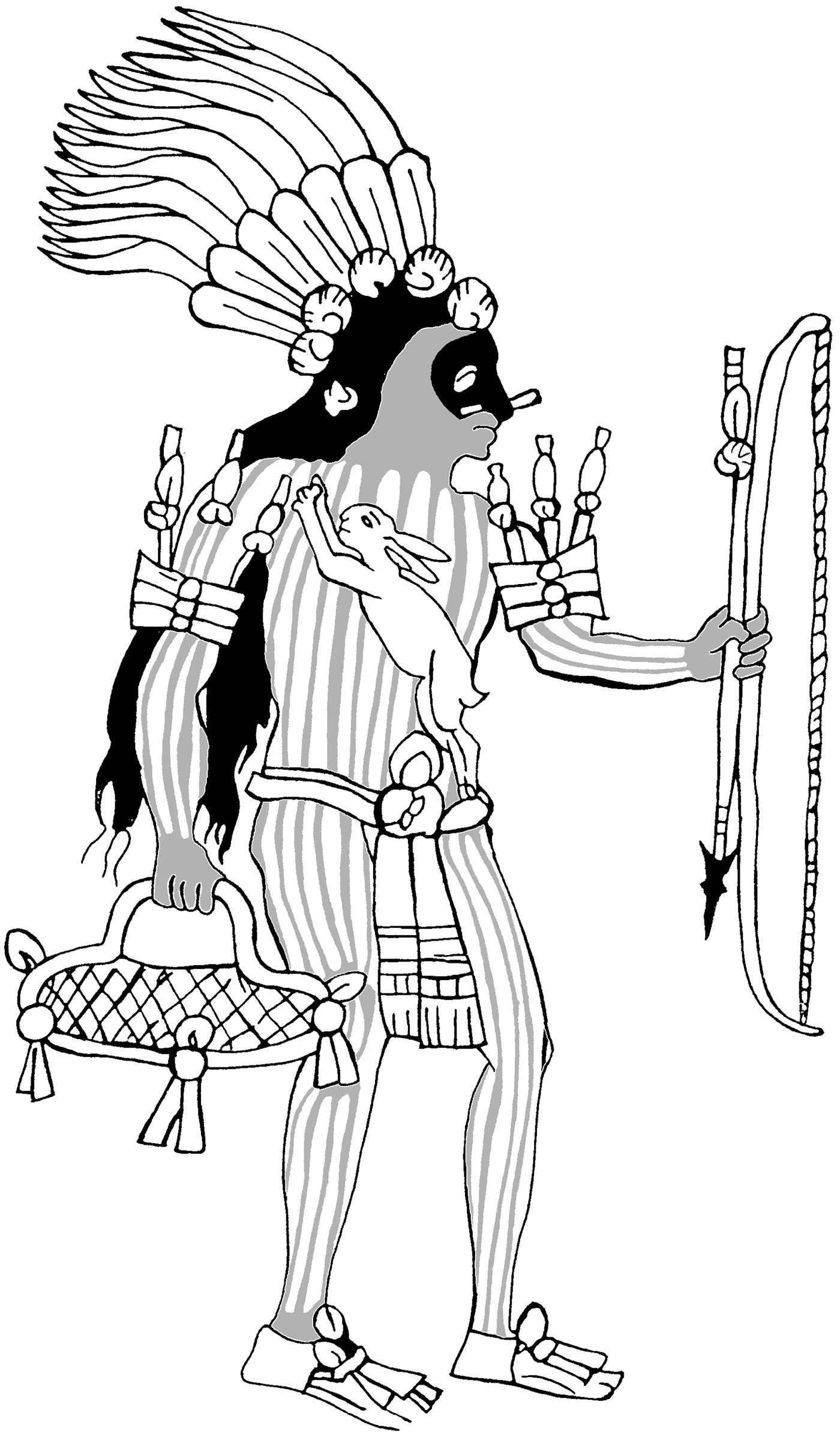
First it is worth examining other deities linked to deer in central Mexico. To the best of our knowledge, gods such as Huitzilopochtli, Tezcatlipoca, and Quetzalcoatl have only minor ties with deer. For example, Tezcatlipoca's insignia includes a deer hoof tied to his leg (Durán Reference Durán, Romero and Camelo1995:2:48). We have seen that Tlaloc as patron of the day sign “deer” has a connection with this animal. Another god similar to Tohil also shares a privileged connection with the deer: Mixcoatl. Many elements reveal these ties: in the iconography of this hunting god his face paint includes black circles around his eyes (Codex Borgia, in Seler Reference Seler1963b [1904]:15, 25, 50, etc.) (Figure 12). This same mask is mentioned by Sahagún's informants (Reference Sahagún, Anderson and Dibble1950–1981:11:15) in connection with the deer called tlamacazcamazatl, probably the deity's double. A myth in the Relación de Michoacán (Alcalá Reference Alcalá and Mendoza2008:f. 41) might confirm the nexus between Mixcoatl and the deer. The account explains how a character called Cupanzieeri was defeated and sacrificed on the ballcourt in the presence of Achuri Hirepe, lord of the underworld. His son, Sirata Tapezi, was able to defeat Achuri Hirepe and he took his father back to earth. Frightened by quails, Cupanzieeri was transformed into a deer. The relationship between this myth, the Popol Vuh, and Quetzalcoatl's feats has been noted by several scholars.Footnote 36 According to this mythic schema, Cupanzieeri could be identified with Mixcoatl, the father of Sirata Tapezi-Quetzalcoatl. Obviously the transformation of Cupanzieeri-Mixcoatl into a deer is important. What's more, we know that during the veintena of Quecholli in honor of Mixcoatl in the central highlands, a ritual hunt was conducted, after which the deer captured were sacrificed in honor of “Cloud Serpent,” probably as his animal doubles (Sahagún Reference Sahagún, Anderson and Dibble1950–1981:2:134–140; Durán Reference Durán, Romero and Camelo1995:2:79–88). Finally, Mixcoatl's sacred bundle or tlaquimilolli is described as, “Mixcoatl's manta [cloth] and deerskin” (García Icazbalceta et al. Reference García Icazbalceta1941:224). Therefore, the possibility that the skin of the deer, Tohil's double, had been used to form part of his sacred bundle, his pisom c'acal, takes on particular significance. Perhaps allusion is made to this bundle in the Historia quiché de Don Juan de Torres (Recinos Reference Recinos1957:37), when it states: “Later there was the deer skin (r'ismal queh), according to what they said.” Even today in Santiago Atitlán the people continue to venerate sacred deerskin-covered bundles, which have been linked to the ancient veneration of Tohil (Christenson Reference Christenson2001:154–172).
Mixcoatl with black mask (Codex Borgia, in Seler 1963:25). (Drawing by Rodolfo Ávila).
Tohil and the Nose Perforation Rite
Perforating the nasal septum in rites of investiture for nobles or rulers was widespread throughout Mesoamerica. A number of sources, particularly from the central highlands, attest to this practice, particularly for the Puebla-Tlaxcala region and for the Mixteca where it was represented in several codices (Olivier Reference Olivier, Luján and Olivier2010b:463–464; Reference Olivier2015:514–583). For Guatemala, we cite a brief description in the Anales de los Cakchiqueles (Recinos Reference Recinos1950:67): “They came before Mevac and Nacxit who was in truth a great king. Then they feted him and Ahauh Ahpop and Ahpop Qamahay were elected. Then they dressed them, they perforated their nose, and they gave them their offices and flowers called Cinpual.”Footnote 37 Nacxit is one of Quetzalcoatl's names and we know this deity is connected to the enthronement of rulers, particularly in Cholula (Alvarado Tezozómoc Reference Alvarado Tezozómoc and Orozco1980:691; Relación geográfica de Cholula in Acuña Reference Acuña1985:130–131). Having one's nose perforated was a mark of prestige and distinction throughout Mesoamerica. Fray Bartolomé de Las Casas (Reference Las Casas and O'Gorman1967:2:501) states that in the K'iche’ kingdom, “the sign of the king of Utatlán's superiority over the others is having his nose perforated, which was not permissible for any other individual.” Fortunately we have additional observations in the Título de Totonicapán (Carmack and Mondloch Reference Carmack and Mondloch1983:195–196): “the great danceFootnote 38 of Tohil was held in the month of Ts'iqu'n K'ij. The thirteen parcialidades [extended kin groups] arrived here in Quiche.” This is followed by a description of the nose-perforating ceremony: “The lords who had two pallium were perforated and cut with: the black and yellow stones, the bloodletter, the red stick, the deer tail, the bracelet, the eagle and jaguar claws, the shells, the red tobacco, the heron feathers, and the various precious stones. They used precious stones to close the noses of the Ajpop and Ajpop C'amjá, who were opened and perforated here in Quiche.”
This remarkable testimony has been the focus of considerable attention.Footnote 39 We highlight some common points between these rites and others from the central highlands. Fray Toribio de Benavente or Motolinía (Reference Benavente or Motolinía and O'Gorman1971:339–344) describes the same ceremony for the regions of Tlaxcala, Huexotzinco, and Cholula: The future tecuhtli was led to the summit of the temple where he venerated Camaxtli, the Tlaxcaltec name for the god Mixcoatl, then “the same principal minister of the temple came and with an eagle talon and with a thin jaguar bone as an awl, they perforated above his nostrils, and in each part they made a small hole, and there they put small stones of black jet … When his entire penitence was finished, later they put in some turquoise or emerald stones, or some grains of gold as big as the heads of thick pins, that were no larger than the holes, and with that everyone knew he was a ruler.” This provides a better understanding for the presence of the “eagle and jaguar claws” in the list of objects mentioned in El Título de Totonicapán.Footnote 40
Another point of particular interest is the veintena when the ceremony took place among the K'iche’: the month of Ts'iqu'n k'ij, equivalent to the veintena of Quecholli among the Nahuas (Carmack and Mondloch Reference Carmack and Mondloch1983:17). It is highly significant that the principal deity honored in central Mexico during this feast was Mixcoatl, “Cloud Serpent.”Footnote 41 Moreover, this god is closely connected to rites of accession to power, as we saw in Motolinía's description. Furthermore, in Mixtec codices, the figure responsible for perforating the nose of future rulers is attired as the god Mixcoatl (Caso Reference Caso1960:9, Reference Caso1966:13; Nowotny Reference Nowotny1961:15; Olivier Reference Olivier2015:514–583) (Figure 13).
Nose perforation right in the Mixtec zone (NowotnyReference Nowotny1961:15). (Drawing by Rodolfo Ávila).
Tohil, Quetzalcoatl, and Mixcoatl
This brief survey in search of Nahua equivalents to the god Tohil makes it clear that the problem is complex and the possibilities in central Mexico are numerous. Therefore, any type of assimilation between a deity from a specific indigenous group and another from another one must be weighed judiciously. In fact, Mesoamerican gods share many features, so they can be easily confused, and myths often attribute the same feats or creations to several deities. In the case of Tohil, his diverse attributes and functions appear in conjunction with other numens from central Mexico. As a result of the identification given in the Popol Vuh and by scholars who supported that hypothesis, it is worth returning briefly to the ties between Tohil and the “Feathered Serpent.” Despite apparently shared points—both deities appear as young warriors, creators of fire connected to rain, practices of autosacrifice, human sacrifice, and rites of accession to power—two arguments make it possible, in our opinion, to reject the gloss from the Popol Vuh. The first point has been argued by René Acuña (Reference Acuña1998:70–71, n. 22): “The narrator forgets, or never knew, that Gucumatz [Q'ukumatz] was the Quiche translation of the Nahuatl name of Quetzalcoatl. Therefore, if Gucumatz [Q'ukumatz] is the symbolic or metaphoric name of the Creators, how can we explain, between verses 6073–88, that Quetzalcoatl was the name that Tohil, the usurper of the Creator was given in Tula?” Even though Acuña's argument is phrased within the framework of his theory, which tends to minimize knowledge of the indigenous religious that the author of the Popol Vuh might have had, it is important to raise the following question: In fact, if the K'iche’ venerated a deity whose name is translated as “Feathered Serpent,” why assimilate their patron god to the Nahuatl equivalent of a deity already present in their own pantheon? What's more—as a second argument against the identification of Tohil with QuetzalcoatlFootnote 42—what draws our attention is the absence of ties between the Feathered Serpent and the deer, Tohil's animal double. Therefore, we propose that the god Mixcoatl, the deity that displays the most elements in common with Tohil, is the Nahua equivalent of the patron god of the K'iche’.Footnote 43
Curicaueri
Given that no Tarascan texts have come down to us on the pre-Hispanic period, nor do we have any pre-conquest pictorial documents, the most important source we have to date for the study of Tarascan deities is the Relación de Michoacán —o Relación de las creencias y ritos y población y gobierno de los indios de la Provincia de Michoacán—(hereinafter RM, Alcalá Reference Alcalá and Mendoza2008), originally written in Spanish but based on descriptions in an indigenous language known as P'urhe. Almost the entire section that dealt with the “most important gods” is precisely the part that has been lost; therefore, it is extremely difficult to try to “identify” the P'urhepecha pantheon when all we have are a list of names and isolated bits of information.Footnote 44 Furthermore, because the P'urhe language has phonemes that were not recorded in the sixteenth century and the lack of rigorous orthographic rules for Spanish at that time, more often than not the names of deities must be reconstructed on the basis of glosses that, based strictly on their pronunciation, have no meaning.
Although it is generally accepted that at least the names are indeed derived from indigenous deities, some scholars have doubted the authenticity of the data in this source. Félix Ramírez (Reference Ramírez1956:23), for example, reaches this extreme conclusion after stating that, with the exception of Curicaueri and Cuerauaperi, “the other deities that figure in the Relación de Michoacán were invented by the Spanish friars and chroniclers.”
As one might expect, the lack of information has given rise to highly forced “identifications.” For instance, those of José Corona Núñez (Reference Corona Núñez and de Antropologia1948:143) stand out; he claimed, “Tarascan religion, with slight variations, is in all ways similar to the religious works of the most advanced cultures of Mesoamerica.” In response to this sort of abuse, a group of researchers then postulated the unique character of Tarascan religion and culture to the extent that they refused to engage in even the slightest comparison. This situation, together with a poor understanding or P'urhepecha morphology, produced equally aberrant interpretations;Footnote 45 Helen Pollard Perlstein (Reference Pollard Perlstein and Boehm1994:224), for example, stated that “apparently ‘dualism’ was never a principal part of ordering among the Tarascans … The principal gods of central Mexico were in no way the focus of veneration … There was no god [like] Tlaloc among the Tarascans … There was no Quetzalcoatl.”
In order to ensure that we are studying more than a mere word, we have chosen Curicaueri for our comparative exercise. Although he is a little known deity, he is clearly the god who appears most frequently in the Relación de Michoacán.Footnote 46
Before becoming the patron god of the Tarascan nation, Curicaueri was the god of the Uacusecha-Chichimecs. After he revealed himself on a mountain known as Zacapu, he guided his people to the basin of Patzcuaro to show them, through some figures on the rocks, the location of their final settlement. During the migration, he received firewood and deer as offerings, fused with the god Uazoricuare of Naranjan, and protected his adepts, inflicting illness upon his enemies. Once the conquest of Michoacán was consolidated, this deity became the representative of the ruler and lineage in power. He was a warrior god who demanded the sacrificial hearts of his people's adversaries and autosacrifice from those who sought his favors. In dreams or at night, he appeared before men in the shape of an eagle or a young warrior to communicate his intentions.
Starting with the analysis of these characteristics, we will now seek to discern if a deity in central Mexico could have been his equivalent.
Curicaueri the Young Warrior
Even though in most cases it is almost impossible to determine the age of Tarascan gods, the fact that Curicaueri is referred to as “our grandson” seems to be a fair indication of his youthful status (Alcalá Reference Alcalá and Mendoza2008:f. 37). What's more, unlike the wrinkled visage of Xaratanga, in one of the extremely rare representations of the deity, he is seen as a young warrior with his body tinted black (Alcalá Reference Alcalá and Mendoza2008:f. 122v) (Figure 14), mirroring the practice of his chosen people, the Uacusecha (Alcalá Reference Alcalá and Mendoza2008:f. 94). Obviously, it is possible that some of the divinities with a lined face and projecting fangs that appear in part three of the Relación (Alcalá Reference Alcalá and Mendoza2008:f. 35v) were in fact Curicaueri. But in P'urhepecha iconography wrinkles do not necessarily indicate old age; figures not said to be old appear as wrinkled, and a number of the elderly do not display lines marking their faces (Alcalá Reference Alcalá and Mendoza2008:f. 39, 108v, 113v, 32, 35v, 1, 123v, 71).
Curicaueri, Uacusecha god (Alcalá Reference Alcalá and Mendoza2008:f. 122v). (Drawing by Elbis Domínguez).
Just as Tezcatlipoca, Mixcoatl, Quetzalcoatl, and Huitzilopochtli, Curicaueri is clearly a warrior god to whom “the gods of the sky said to him how he had to be king and that he had to conquer all the land” (Alcalá Reference Alcalá and Mendoza2008:f. 6). Like these Nahua deities, he was the patron god of the Uacusecha and he led the pilgrimage from Zacapu to Tzintzuntzan and he chose, through signs on the rocks, the spot where the Tarascan lords had to settle (Alcalá Reference Alcalá and Mendoza2008:f. 72v). His bellicose character is also expressed by illnesses he inflicted on the enemies of the Chichimecs, as well as by the fact that, prior to their introduction, the autochthonous people of Naranjan seemed to be unaware of the bow and arrow (Alcalá Reference Alcalá and Mendoza2008:f. 66–66v, 97).
Obsidian was one of the principal raw materials for the production of weapons; thus, the representation of his sacred bundle with a black stone nucleus appears to allude to a bellicose identity (Alcalá Reference Alcalá and Mendoza2008:f. 118) (Figure 15). A Mexica deity closely linked to this material is Tezcatlipoca; he possessed an obsidian mirror and was sometimes known as Itztli, the Nahuatl name for this volcanic stone. Itztli also sometimes appears in codices as an oversize anthropomorphic flint blade, which reveals the complexity of the ties between this god, flint, and obsidian (Olivier Reference Olivier2003:107–123). Hummingbird on the Left (Huitzilopochtli) is clearly associated with flint, as indicated by his calendrical name, Ce Tecpatl, “One Flint” (Sahagún Reference Sahagún, Anderson and Dibble1950–1981:4:77). However, the West Mexican version of Huitzilopochtli seems to share the connection with obsidian together with Curicaueri. About Xitomatl, a cacique from Cutzatalan (Jalisco), it is said that, “he and his family alone had an idol that was the most important, called Huitzilopoch, which means Itztlacateotl [man-god-obsidian] in Mexican” (Tello Reference Tello1968:1:195).
Curicaueri as obsidian core (Alcalá Reference Alcalá and Mendoza2008:f. 118). (Drawing by Elbis Domínguez).
The document makes no mention as to whether Curicaueri ever “sinned” with a goddess or whether he had a wife. The fact that his followers are constantly presented as chaste penitents suggests he was not a “sinner” (Alcalá Reference Alcalá and Mendoza2008: f. 106). The deity did indeed receive some women, but the one who had relations with them was the cazonci—the deity's representative on earth (Alcalá Reference Alcalá and Mendoza2008: f. 12).
Curicaueri and Sacrifice
Unlike claims made in connection with other Mesoamerican deities, Curicaueri is not said to have invented human sacrifice; in fact, the RM suggests that when the Uacusecha agreed to offer deer to their deity, the autochthonous population was already performing rites of human sacrifice. This is a trait that, at least for a while, Curicaueri shared with Quetzalcoatl (see above). Contrary to the case of Mixcoatl (Olivier Reference Olivier, Luján and Olivier2010b:455), the actual sacrifice of deer is not described for Curicaueri; instead, according to the Relación de Michoacán (Alcalá Reference Alcalá and Mendoza2008:f. 64), his followers only gave him the skins of animals that had already been hunted so they could be used to cover him—“it is not skin nor is it used as skin but rather as blankets, because we cut and softened them and wrap our god Curicavéri in them.” On the other hand, deer were indeed sacrificed to the god Urendecauecara of Curinguaro (Alcalá Reference Alcalá and Mendoza2008:f. 88v).
The first Chichimec sacrifice appears in a farce of a hunt in which the priest Nacá, who had originally been invited to follow the prey, ends up being shot with an arrow, killed in the temple, and later consumed in a ritual banquet. This episode marks the transition between the rituality of hunting peoples and the adoption of wholly Tarascan practices (Alcalá Reference Alcalá and Mendoza2008:f. 65–67, 11v, 82v–83v). From this time forward, there are mentions of military incursions specifically dedicated to obtaining sacrificial victims for Curicaueri, and even flowery wars with neighboring towns aimed towards the exchange of captives (Pereira Reference Pereira, Luján and Olivier2010:247–272; Martínez González Reference Martínez González2009a:32–37).
What stands out from the limited data available on Tarascan ritual practices is a fiesta called Sicuíndiro, “where one is flayed,” in honor of Curicaueri and Cuerauaperi. Although the ritual was somewhat more complex, for now what interests us is that the temples of the Uacusecha patron god were renovated on such occasions and the skin of sacrificial victims was worn by individuals called hauiripicípecha, who in a sort of ritual game “followed people, men and women, and cut their hair with local blades” (Alcalá Reference Alcalá and Mendoza2008: f. 10, 14v, 96). This sort of practice also took place during the ceremony of Cuingo, probably dedicated to the sea god and cited in the trial of the cazonci in relation to the idols Uricuaro, Charchuy, and Xornacusi (Alcalá Reference Alcalá and Mendoza2008:f. 134v; Escobar Olmedo Reference Escobar Olmedo1997:68, 89, 94, 102). Both the practice of flaying and the playful aspect of the celebrations bear a certain resemblance to the better known Mexica rituals of Tlacaxipehualiztli and Ochpaniztli (Wohrer Reference Wohrer1999–2000). Thus, one might postulate the existence of a connection between Curicaueri and Xipe Totec. The problem is that, as far as we know, in Michoacán at the time of contact, the belief in this deity had not been recorded. Furthermore, his sole possible representation, a copper mask with closed eyes and lengthwise seams lacks the most characteristic element of the Mexica god: the skin of the flayed sacrificial victim overlaying the wearer's skin (Pastrana Reference Pastrana Flores1999; Sanjuan Reference Sanjuan Perez2011:79).
Nonetheless, we should bear in mind that as a harvest fiesta, Tlacaxipehualiztli celebrated the triumph of the rising Sun over the beings of the night, the Moon and the four hundred huitznahua (southerners); therefore, its symbolism was full of allusions to the warrior star Huitzilopochtli (see Graulich Reference Graulich1982). On the other hand, flaying war captives was also performed in Tlaxcala in honor of Camaxtli-Mixcoatl (Muñoz Camargo Reference Muñoz Camargo and García1998:101–102). At the same time, Camaxtli-Mixcoatl was also known as Tlatlauhqui Tezcatlipoca, who was identified with Xipe Totec (García Icazbalceta et al. Reference García Icazbalceta1941:209; Durán Reference Durán, Romero and Camelo1995:2:103). Roskamp (Reference Roskamp2010a:69–78) presents evidence on Tlatlauhqui Tezcatlipoca among the Nahuas of Michoacán and suggests this deity might also have been present among the P'urhepecha.
Curicaueri and Fire
According to Corona Núñez (Reference Corona Núñez1957:13), Curicaueri “was equivalent to Huehueteotl of the Mexicans: the Old God.” To a large extent, this interpretation was derived from the author's translation of the deity's name; “curi: fire and caheri: large”. According to Monzón's (Reference Monzón2005:143) analysis, however, “Etymologically Curicaueri or Curicuaueri could be interpreted as a sequence of two words: the noun ueri and the adjective curica … The noun ueri is interpreted as … ‘he who comes out’ … The adjective curica and the noun curicua are composed of the verbal root curi. From the verb curicani ‘to make fire’ … The spelling Curica ueri would be translated as ‘he comes out making fire’ … ‘the fire that comes out burning’” (Warren Reference Warren1991:2:119). A second argument supporting this identification is that the main offering to the Uacusecha god was firewood for his bonfire. Nevertheless, this type of offering was not exclusively given to Curicaueri, but also to Uréndequauécara, Cuerauaperi, Xaratanga, Querenda Angapeti, the fire god, the god of the underworld, the gods who made the sky, those of the four parts of the world, and those of the right and left hands (Alcalá Reference Alcalá and Mendoza2008:Ff.s. 14, 32v, 34, 64, 79v, 89, 101v, 111v, 123v). Therefore, if there are more references to offerings of firewood to the Chichimec patron god, it is simply because the RM refers primarily to this group.
Huehueteotl (Old Fire God) sculptures have been found in Michoacán, but these date to an earlier phase, and because little is known of Curicaueri iconography, we lack evidence that could link the two deities (Carot and Hers Reference Carot, Hers, Bonfiglioli, Gutiérrez and Olavaria2006:52). In fact, according to Espejel Carbajal (Reference Espejel Carbajal2008:2:77–78), “in the Hiripan [one of the founding heroes of the Tarascan kingdom] text he is described as someone who seemed to be [a] lord with a ‘garland’ of white hide and a small lipplug,” a description that clearly does not resemble the typical traits of the central Mexican fire god.
Based on the deity's igneous character, Seler (Reference Seler and Jerónimo2000:223) proposed identifying Curicaueri with the Sun. The RM says the deity's parents were in the sky and the Chichimecs of Michoacán were known to have venerated the Sun; however, the association between the Uacusecha patron god and the Sun is not mentioned explicitly in any historical document (Alcalá Reference Alcalá and Mendoza2008: f. 130v; Relación de la provincia de Acámbaro in Acuña Reference Acuña1987:63).
Curicaueri and Water
According to the account in the second part of the Relación de Michoacán, Curicaueri appeared for the first time on a mountain near Lake Zacapu and, at the end of his pilgrimage, he decided to settle on a hill near Lake Pátzcuaro (RM f. 62v, 72v).Footnote 47 Beyond this detail, nothing seems to connect the Uacusecha patron god and water; even the foundational story suggests that aquatic environments were so alien to his followers that in the beginning, they were not familiar with fish.
In addition to its flamboyant hair, the supposed statue of Curicaueri in the Museo Regional de Michoacán has protruding teeth or fangs, large round earflares, and round goggles, features that are fairly close to those of the storm god Tlaloc of the central highlands. In Janitzio, Gómez Mussenth (Reference Gómez Mussenth2010:92, 139) has recorded some motifs carved in rock that resemble the goggles of the central Mexican rain god. Yet, there is no evidence to date that the petroglyphs and the sculpture are connected to Curicaueri. In fact, both the figure's short skirt and kneeling pose suggest the statue in the Museo Regional actually represents a female instead of a male.Footnote 48
Curicaueri's Nahualli
There are no clear indications of the existence of a pre-Hispanic P'urhepecha belief in a nahualli or animal spirit double. In iconography some figures are rendered with animal heads—particularly coyotes—and sixteenth-century sources mention several zoomorphic “idols.” Some ancient and modern ritual practitioners are said to have the power to change from human to animal form at will. But, to date there is no evidence for the notion of a preferably animal entity so closely linked to the destiny of men that its death would imply the demise of its human counterpart (Martínez González Reference Martínez González2009b:213–262).
During the Chichimec period, Curicaueri was often covered with deerskin. Considering that the nahualli was intimately linked to the notion of a “covering” or “disguise,” the deer might have served as his double; therefore, the Tarascan deity might be close to Mixcoatl and Tohil (Martínez González Reference Martínez González2006:95–106). Nonetheless, to the best of our knowledge, Curicaueri never assumed the form of the deer, and as soon as sedentary customs were adopted, animal skins were soon replaced by cotton clothing (Alcalá Reference Alcalá and Mendoza2008: f. 11v). Thus, deerskin attire would seem to be more indicative of Chichimec identity than Curicaueri himself. What's more, the deer and conflicts associated with its hunting were closely linked to the pilgrimage myths of other Mesoamerican peoples, beginning with the Mixcoatl cycle down to K'iche’ traditions (Alcalá Reference Alcalá and Mendoza2008:f. 64–65v; Bierhorst Reference Bierhorst1992b:152–153; Título de Totonicapan in Carmack and Mondloch Reference Carmack and Mondloch1983:188).Footnote 49
Curicaueri assumed the form of an eagle when he appeared before one of the wives of the lord of Ucareo as an omen of the arrival of the Spaniards: “on the road she came across an eagle that was white and had a large wart on its forehead. And the eagle began to whistle and ruffle its feathers and with its large eyes, they said [it] was the god Curicaveri” (Alcalá Reference Alcalá and Mendoza2008: f. 36v). It is highly likely that this same eagle was the one that guided the kings Harame, Vacuitiusticátame, Tzitzispadáquare, and Punquaihancha during the migration described in the Códice Plancarte (Núñez 1959:9). Appropriately, they offered the Uacusecha patron god the feathers of white birds. While Tariácuri's nephews and son—heirs of the kingdom of Michoacán—received an obsidian knife that represented the god “they set off with their knife and passed the lake and began to make a temple and a priests' house and what they called the house of the eagle and a granary for the knife that the god Taríacuri gave them” (Alcalá 2008Ff.s. 16v, 118v). Finally, the fact that the Chichimecs of Michoacán call themselves Uacusecha, “eagles,” might indicate that this animal was not only associated with their patron god, but that it was also a sort of collective nahualli.
The association of the eagle with the Sun is well documented for Mexica contexts. But, just as Ucareo's wife was transported by Curicaueri transformed into an eagle to attend the meeting of the gods on the hill called Xanóata hucazio, the mexica leader Huitzitl—who would later be converted into Huitzilopochtli—was transformed into an eagle to meet with the gods in Huey Colhua (del Castillo Reference del Castillo and Linares1991:150–151).
Curicaueri and Royal Power
There is no relationship between Curicaueri and the nose perforation rite for the simple reason that this practice was unknown in ancient Michoacán. Yet, this deity is indeed linked to the possession of royal insignia, such as lipplugs, earflares, and bracelets (Alcalá Reference Alcalá and Mendoza2008: Ff.s 77v, 21, 85).Footnote 50 In fact, in plate 25v of the Codex Telleriano Remensis (Quiñones Keber Reference Quiñones Keber1995), the opposition between the Chichimec Mexican and the man from Michoacán is made clear by the attire of animal skin versus cotton and their respective ornaments—lipplug and noseplug.
As noted above (Martínez González Reference Martínez González2009c:53–76), in the Relación de Michoacán, the patron god of the Uacusecha seems to parallel that society's existence. The qualities of the group are attributed to the influence of their protector deity, while the people's history and destiny are described as those of the deity himself. Even the physical appearance of the collectivity emulates the representation of their tutelary god. The discovery of the patron god marks the beginning of a specific group, while its loss results in their subjugation or destruction. Also acting as a guide and representative of the occupied territory, the god is presented as a sort of supernatural double of the community akin to a metaphorical memory of the events that affected the group to which he corresponds.
The relationship this god establishes with the people is not equal for each member, however. Thus, it is Ticatame, the original caudillo—the ancestor of all Uacusecha rulers—who enters in direct contact with the deity and obtains Curicaueri's favors. Although the legacy seems to have some social value, the constant updating of the original meeting plays a fundamental role in the legitimate acquisition of power to rule. It is the sovereign who establishes the connection with the god, but as a representative of the community, it extends to all members of society. Thus, because the cazonci occupies the place of the deity, he has a double function by signifying the deities before the people and the people in the face of the supernatural realm. The lord is concerned with both maintaining social order—through rules and punishment—and perpetuating cosmic order—through the organization of periodical sacrificial-offertory rites. Under these conditions, it is not surprising that in his capacity as intermediary, the ruler is said to be able to communicate with the gods.
Among the Nahuas, Quetzalcoatl is intimately linked to royal power;Footnote 51 similarly, Tezcatlipoca is the god most frequently invoked in rites of Mexica accession and the king appears in several rituals as his representative (Pomar Reference Pomar and Acuña1986:56; Sahagún Reference Sahagún, Anderson and Dibble1950–1981:6: passim; Olivier Reference Olivier2003). Several sources also state the huey tlatoani (emperor) personified Huitzilopochtli—a deity quite close to Tezcatlipoca—when he assumed royal office. As the patron of the nation, the ruler served as Huitzilopochtli's representative before the people; therefore, the king or tlatoani became the “likeness of our god Huitzilopochtli” (Durán Reference Durán, Romero and Camelo1995:1:97, 105–106, 467; Torquemada Reference Torquemada and León-Portilla1975–1983:1:201; Graulich Reference Graulich1998).
Curicaueri, Mixcoatl, and Huitzilopochtli
Returning to the possible identification of Curicaueri with Mixcoatl, both deities are associated with pilgrimages and are envisioned as young warriors; however, the Uacusecha patron deity only appears to be temporarily linked to the deer, and once sedentary life begins, the sacrificial role of hunting seems to be replaced by warfare.Footnote 52 It has been proposed elsewhere (Olivier Reference Olivier, Luján and Olivier2010b:470; Reference Olivier2015:645) that the reason the Mexicas identified Mixcoatl with the Tarascan deity is that, as the first prototypical god of their adversaries—and particularly, of the Tlaxcaltecas—he ended up being applied to the rest of their enemies.
Nevertheless, we would now like to explore another possibility. Sahagún's informants never refer to Curicaueri; instead they mention a god, named Taras, whom they identify with Mixcoatl or Michoacatl, a deity that does not figure in any other source on Michoacán. It would have been difficult for the Nahuas to have invented the name of the Tarascan numen given that their language lacks “r.” To the best of our knowledge, the only deity with a similar name is Tarés Vpeme, who like Tezcatlipoca has only one leg as a result of a transgression (Alcalá Reference Alcalá and Mendoza2008: f. 111v); however, tharesï means “idol” in general and the P'urhepecha had many of them (Warren Reference Warren1991:2:557). Curicaueri is the migrant solar deity and patron of the ruling lineage, but there were other groups—perhaps in closer contact with the Mexicas—who might have had Taras as a patron god. If Taras came from tharesï it might be any deity and would not in any way contradict the identification between Taras and Mixcoatl or Huitzilopochtli.
On the other hand, a larger number of coincidences exist between Curicaueri and Huitzilopochtli. In both cases, they are young warriors who guided their respective people from their place of origin to their location of their final settlement. The two gods share solar attributes and may appear on earth as eagles. Moreover, both deities are associated with rulership. The practice of flaying does not have a special connection with Huitzilopochtli, nor is there any evidence that of the five gods who were presented with flayed sacrificial victims in Michoacán, Curicaueri has any special predilection for flaying. The question of obsidian is problematic, but at least some of the regional versions of the Mexica patron god were indeed linked with this volcanic stone. Therefore, our conclusion would be that in general terms, Ponce (Reference Ponce1892), La Rea (Reference La Rea and Escandón1994), Espinosa (Reference Espinosa and León1945), Seler (Reference Seler and Jerónimo2000), and León (Reference León1934) were not mistaken in identifying Curicaueri as equivalent to Huitzilopochtli.
Some data suggest that the similarity between both deities was not by chance. Even Tello (Reference Tello1968:1:29–30) seems to indicate that the Mexicas introduced the veneration of this deity to the region:
[The group] came through Guáscatos, Pénjamo, Numarán, [and] Conguripo until it saw Lake Tzintzontzan, where they were received without resistance by the Tarascans, and the idol made them friends … They were in this province for two years, with the affection of the Tarascans, to whom they spread idolatry that they had not used until that time. As practitioners of idolatry, the devil said to the Mexicans that they were a large family, and that it would be better for some of them to move away, the most civilized, and that they became a big family so that they stay with their friends the Tarascans, who as uncivilized people needed someone to teach them how to govern their republic and the practice of idolatry, and because they were in agreement, they appointed a noble Mexican Indian of great talent as cacique and lord called Tzilantzi, who, with those of his family, settled the city of Huitzitzila, which is now called Tzintzontza … the Mexicans forgot their language and from this cacique Tzilatzi descended the lords and kings of Michoacán.
In the first decades of the colonial period, the indigenous people from other groups tended to blame the Mexicas for the invention of idolatry (Olivier Reference Olivier2003:161). But, in this case, there is some indication that the chronicler's opinion was not entirely unfounded.
In fact, the multiethnic composition of the Tarascan state is well-known. Ancient sources tell that when the Uacusecha settled in the Pátzcuaro basin, there were already Nahuas groups living there (Alcalá Reference Alcalá and Mendoza2008: f. 63). According to other accounts, the Nahuas and P'urhepechas left the mythical Chicomoztoc together, guided by Huitzilopochtli, to go their separate ways when they reached the lake zone of Michoacán (Durán Reference Durán, Romero and Camelo1995:1:72; Muñoz Camargo Reference Muñoz Camargo and García1998:64–67). Even some archaeological remains suggest that those Mexican and Michoacán groups, who had migrated at the end of the Preclassic toward the north, undertook their return to the West in the Early Postclassic (Carot and Hers Reference Carot, Hers, Bonfiglioli, Gutiérrez and Olavaria2006:47–82). The recent translation of the “Memoria de don Melchor Caltzin,” which highlights the role of twenty Nahua merchants in the foundation of Tzintzuntzan-Huitzilan, shows that at the time of contact with the Spaniards, there were still Nahua-speaking groups in the Tarascan capital (Monzón et al. Reference Monzón Cristina and Warren2009:31–34). In a recent study, Hans Roskamp (Reference Roskamp2010b) makes use of multiple sources, both from Michoacán and central Mexico, to propose the Nahuas were a strong presence in the heart of the Tarascan empire and in fact they exerted a major influence on its origin and configuration.
None of these elements allows us to conclusively determine whether Curicaueri was of Mexica descent or if, on the contrary, Huitzilopochtli came from the Michoacán pantheon. What is certain is that all of these data point to a common origin.
Tohil and Curicaueri
Given the distance separating the two regions of study, there has been little comparison of Maya and P'urhepecha cultures.Footnote 53 As a result of the sparse evidence of contact between the two regions, a shared origin for their deities is rarely postulated. Despite considerable discussion of the enduring core of the Mesoamerican worldview (López Austin Reference López Austin, Broda and Báez-Jorge2001), the vast majority of the interpretations of contrasts tend to assume the Mexicas were the starting point.
The exercise that we have undertaken here shows the considerable number of similarities between Tohil and Curicaueri. They are both young, chaste, warrior gods who led their respective peoples on adventures that resulted in the consolidation of kingdoms. Both were closely connected to fire, deer, and royalty. It can even be said that there are more similarities than differences between them, because to date we have not found any greater divergence than Curicaueri's association with the eagle and that of Tohil with rain.
Swadesh (Reference Swadesh1966) noted the existence of linguistic ties between the language of Michoacán and those in the Maya area. Beyond this rather weak connection, there does not seem to have been greater communication between these two zones.
What we find is that Púrhepecha and K'iché used similar models in the construction of their respective patron gods, who were very probably shared by other imperialistic societies. In other words, more than being a matter of shared deities, it would seem that perception itself required from the representative gods a series of minimum qualities that helped to exalt the image of the group.
FINAL REMARKS
More and more, archaeologists and historians are starting to realize the importance of interethnic exchange in Mesoamerica. In fact, we know of the multiethnic character of many Mesoamerican cities; Teotihuacan was one of the most emblematic examples. Therefore, documentary evidence attests to the incorporation and adaptation of foreign deities in different Mesoamerican pantheons, depending on processes of re-functionalization within their own vision of the world. What's more, these processes not only arose in the pre-Hispanic period, but they also played a fundamental role when the indigenous peoples were subjugated, and in response they adopted and adapted the “Christian pantheon” after the conquest.
By focusing on Tohil and Curicaueri, we have illustrated how specific cultures—the K'iche’ and Tarascan—conceptually ordered groups of shared qualities to construct images of their patron deities. In this framework, the phenomena of “translations” of gods strongly drew our attention. Returning to the myth of the transformation of Cupanzueri into a deer—a myth in which the participants have P'urhepecha names—according to the Relación de Michoacán, this account was told by Nahuas from the central highlands who explained the arrival of the Spaniards mounted on “deer” to the cazonci (Alcalá Reference Alcalá and Mendoza2008: f. 41). In other words, the Tarascans translated an account of Nahua origin in terms of their own pantheon, an account that most likely already had an equivalent in their mythology.
Therefore, the similarities we examined among the K'iche’, P'urhepechas, and Nahuas reveal a structure of shared thought in conceptions of deities that might reflect inter-ethnic exchange, as well as the possibility of a common ancient “polytheistic mould,” perhaps related to a remote, mythologized “Toltec past.” Whatever the case may be, we believe the function of comparative work—in addition to seeking “identities” between gods in different pantheons—must take into account the recognition of shared elements that make information exchange between different groups possible. Studies in this vein continue to be infrequent, but we believe that as new research sheds light on lesser known pantheons, we will be able to gain clearer insight into the different mechanisms that operated in inter-ethnic communication in pre-Columbian times.
In fact, beyond the cultural unity and shared vision of the world that characterized the area known as Mesoamerica (Kirchhoff Reference Kirchhoff1943; López Austin Reference López Austin, Broda and Báez-Jorge2001), the capacity to establish equivalences among the gods of diverse groups is characteristic of polytheistic groups in general (Assman Reference Assman, Budick and Iser1996). Hence arises the possibility of extending this type of analysis beyond Mesoamerican frontiers to recognize relationships with other indigenous groups in North and South America, and finally to undertake comparisons with other polytheistic systems in the world (Detienne Reference Detienne2000; Olivier Reference Olivier2014–2015). This would lead to a better understanding of shared points, as well as the specificities of Mesoamerican pantheons.
RESUMEN
Si bien sabemos que fue frecuente en Mesoamérica la adopción de deidades extranjeras en los distintos panteones, menos conocidos son los procesos de ‘traducción’ de los dioses ajenos en función de las cualidades de las propias divinidades. En este artículo, analizamos el grado de inteligibilidad existente entre k'iche’, p'urepechas y nahuas prehispánicos, a partir del estudio de los dioses tutelares Tohil y Curicaueri y de sus posibles equivalentes en el panteón del altiplano central. Encontramos que la búsqueda de homólogos divinos por parte de los pueblos mesoamericanos implica, más allá de una homogeniedad cultural, un intercambio constante de informaciones, así como el reconocimiento de la religión del otro en pie de igualdad, lo que constituye una característica de los pueblos politeístas en general.
ACKNOWLEDGMENTS
This article, along with the editions we utilized for discussing both Popol Vuh and Relación de Michoacán, were translated from Spanish by Debra Nagao.