Machine milking of small ruminants is characterised by a high frequency of teatcup attachment, removal, slippage and fall-off, which allows large amounts of air to enter the milking machine installation (Le Du, Reference Le Du1985). In addition, given the low milk production of these animals, a high milking performance (number of animals milked per worker and hour) is required. These two points are precisely what prompted milking material companies to design devices to limit, automatically, air intake during voluntary or accidental manipulation of the milking clusters. To this end, mechanisms known as automatic valves have been installed at the teatcup ends (Billon et al. Reference Billon, Fernández, Ronningen, Sangorgi and Schuiling2002; ISO 3918, 2007), which automatically opens the vacuum to the liner when putting on and shuts it when the teatcup falls-off, or if the operator removes the teatcup by force without previously cutting off the vacuum.
The presence of automatic valves in the teatcups should make milking easier and quicker, as they avoid the task of opening the vacuum from the claw, the need to come immediately in the event of a teatcup fall-off, or having to cover one teatcup when milking an animal with a single functional gland. Likewise, the minimum effective reserve for milking in the installation should be lower, as the valves reduce the intakes of air in teatcup attachment and accidental fall-off. However, according to ISO 5707 (2007) the differences are small, because in order to calculate the minimum effective reserve the air intakes by the valves (when the teatcups are not fitted to the teats: from 20 to 60 l/min for each milking cluster; Billon et al. Reference Billon, Fernández, Ronningen, Sangorgi and Schuiling2002) must be counted.
Moreover, the presence of automatic valves could have, a priori, a negative effect on the health status of the udder. If the automatic valves cause milk retention at the teatcup outlet, it might favour reverse flow of milk towards the teat, which would increase the risk of bacteria colonising the teat end (Billon et al. Reference Billon, Sauvee, Menard and Gaudin1998). Likewise, although there are different models of teatcups and automatic valves (Hubert et al. Reference Hubert, Poulet and De Crèmoux2015), it is common practice among farmers not to cut off the vacuum prior to removing the clusters, as they usually force the intake of air through the liner mouthpiece to trigger the automatic valve. So, the doubt remains whether the vacuum fluctuation generated in the teat for this abrupt cluster removal is sufficiently important to encourage the installation of intramammary infections (IMI), linked with the known ‘impact’ (Thiel et al. Reference Thiel, Cousins, Westgarth and Neave1973; O'Shea et al. Reference O'Shea, O'Callaghan, Walsh and O'Shea1984; Mein et al. Reference Mein, Reinemann, Schuring and Ohnstad2004; Mein, Reference Mein2012) or ‘reverse pressure gradient’ (Rasmussen et al. Reference Rasmussen, Frimer and Decker1994) phenomena.
Although teatcups with automatic valves are often used on small ruminant farms scarcely any information is available on their efficacy in milking. So, the present study addresses the hypothesis that using teatcups with automatic valves, without cutting off the vacuum prior to cluster removal, increases the risk of mastitis on goats. In addition, it also studies its effect on other variables: milk production and composition, teat tissue condition and milk emission kinetics in goat milking.
Material and methods
Experimental design
The experimental protocols were approved by the Committee of Ethics and Animal Welfare of the Universitat Politècnica de València and followed the Spanish Royal Decree 1201/2005 on protection of animals used for scientific purposes (Boletin Oficial del Estado, 2005).
Two experiments were carried out on the Murciano–Granadina breed goat herd of the Universitat Politècnica de València. The first evaluated the mastitis incidence, milk yield and composition, SCC, liner slip/teatcup fall-off and macroscopic changes of teats (visible lesions or alterations). Teat thickness changes and milk emission kinetics were assessed in the second experiment.
First experiment
Forty-six goats (16 primiparous and 30 multiparous) without intramammary infection that had been milked with clusters without automatic valves for a pre-experimental period of 8 ± 2 d postpartum were used. These animals were split into two groups (n = 23) according to lactation number, production level and milk flow, and each group was assigned at random to milking with teatcups fitted with automatic valves (teatcups A) or without (teatcups B), over a 20-week experimental period. The milking order in both groups was alternated each week. As in a previous work (Manzur et al. Reference Manzur, Díaz, Mehdid, Fernández and Peris2012), strategies were applied to increase teat exposure to pathogens during milking throughout the experimental period: (a) teats were not post-dipped with iodine; (b) each day, infected goats were milked before milking each experimental group, or milk from infected goats was introduced in the teatcups before milking the experimental goats.
In the pre-experimental period, the following variables were monitored twice in each animal: milk yield and composition, liner slip/teatcup fall-off, SCC (per udder and per gland), visual teat condition, bacteriological analysis (per gland) and milk flow.
In the experimental period, all these variables were recorded weekly, except for bacteriological analysis of the glands (bi-weekly records). Likewise, towards the middle of this period, vacuum measurements around the teat for one day's milking were recorded.
Second experiment
Fifty-four Murciano–Granadina goats in the fourth month of lactation were used. The experiment lasted three weeks: a 1-week pre-experimental period and a 2-week experimental period, in a crossover design (2 × 2). In the pre-experimental period, the goats were all milked with teatcups B (without automatic valves) and machine milk production and milk flow rate were recorded on two consecutive days. In line with these two variables, the animals were divided into two groups, randomly assigning one of the two treatments (teatcups A or B) for 7 d. In the last 2 d of this period, the teat thickness changes after milking and milk emission kinetics were recorded in each animal. Treatments (teatcups A and B) for the two groups of 27 goats were then exchanged for another 7-d period, recording the same variables on the last 2 d.
Milking routine and material
Animals were always milked once a day (8·30) following a routine that included machine stripping and manual cluster removal. To carry out this latter operation, in teatcups B the vacuum was cut off beforehand from the claw, whereas in teatcups A air was allowed to enter by the liner mouthpiece (thumb pressure on the lip, with twisting and pulling on the teatcup), after which the automatic valve sealed off the vacuum. Post-dipping with iodine (0·15%, Proactive Plus, DeLaval, Drongen, Belgium) took place in the pre-experimental period (1 week) of the first experiment and throughout the second experiment.
The milking parlour (2 × 12) had 6 clusters and a mid-line pipeline. All the cluster components were from Delaval Agri (Tumba, Sweden). Teatcup A, with automatic valves, was the Almatic™ G50-R and Teatcup B was the Almatic™ G10-R, without automatic valves. Clusters used with both teatcups had the same short milk tubes (diameter 9·4 mm), short pulsation tubes (diameter 7·8 mm) and claws (TF80). Other milking machine characteristics were already described in Manzur et al. (Reference Manzur, Díaz, Mehdid, Fernández and Peris2012).
Variables measured
In the first experiment, milk yield and milk fraction yields (machine milk [MM] and machine stripping milk [MSM]) were monitored with milk jars (Esneder, Ind. Berango, Spain), while in the second experiment the emission kinetics were recorded with electronic milk meters (MM25SG, De Laval Agri, Tumba, Sweden). In the latter case, the following variables were calculated: (a) Milk volume (ml); (b) average milk flow (ml/min) during first minute of milking and in MM fraction; (c) maximum milk flow (ml/min), with readings every 2 s; (d) time (s): time to reach the maximum flow rate and total milking time.
Milk composition (fat, protein, lactose and dry matter; g/kg) and SCC (cells/ml) were analysed in 40 ml milk (MM + MSM) from each animal, taken straight from the milk jars. In addition, SCC was analysed in 20 ml of milk from each gland, obtained by manual milking before teatcup attachment. These analyses were performed using automated equipment (composition: MilkoScan FT120; SCC: Fosssomatic 5000; Foss Electric Hillerød, Denmark).
At each record in both experiments, the number of animals that had suffered liner slip (abrupt air intake via liner, without it becoming detached from the udder) or teatcup fall off was recorded.
The methodology used to record other variables (bacteriological sampling and analysis; teat end vacuum; teat condition) have been described in Manzur et al. (Reference Manzur, Díaz, Mehdid, Fernández and Peris2012).
Statistical analysis
First experiment
In the experimental period, milk production and composition variables were analysed using a repeated measures statistical model with the following effects: teatcup, goat (as random), day, teatcup × day interaction and covariable (for each goat, average for the two pre-experimental records). SCC data were log10-transformed (Ali & Shook, Reference Ali and Shook1980) and were analysed with above model, but without considering the covariate. These statistical analyses were performed according to Littell et al. (Reference Littell, Henry and Ammerman1998), using PROC MIXED (SAS, 2002).
Teat end vacuum variables were analysed with PROC GLM (SAS, 2002) using a model with the following effects: teatcup, milking unit nested to teatcup, milking condition (teatcups plugged, milking with high flow, milking with zero flow), teastcup × milking condition interaction. Teatcup fall-off and intramammary infection rates were statistically analysed by X 2 test using PROC FREQ (SAS, 2002).
Second experiment
Teat thickness changes and milk emission kinetics variables were statistically analysed with PROC GLM (SAS, 2002) using a model with the following effects: teatcup, teat (teat thickness change variables) or animal (emission kinetics variables), experimental period and day nested to experimental period.
Results
Teat end vacuum
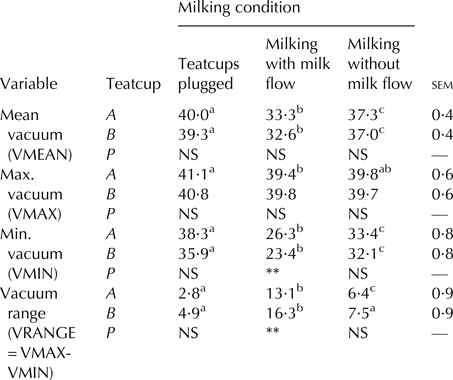
The teatcup type did not significantly affect the average vacuum (VMEAN) or maximum vacuum (VMAX), but had a significant influence on minimum vacuum (VMIN, P < 0·05) and the vacuum range (VRANGE: maximum-minimum; P < 0·05). Moreover, the milking conditions (teatcups plugged, milking with milk flow, milking without milk flow) significantly affected the 4 cited variables, whereas the teatcup × milking conditions interaction was not significant for any of these variables.
Teatcups without automatic valves (B) presented lower VMIN values than those with automatic valves (A), the differences being more acute when there was milk flow during milking (VMIN: 26·3 and 23·4 kPa, in teatcups A and B, respectively; P < 0·01; Table 1). This VMIN trend would explain why VRAN tended to be higher in the valveless teatcups, with significant differences again being found only in milking conditions with flow (13·1 and 16·3 kPa in teatcups A and B, respectively; P < 0·01). Moreover, the effect of the milking conditions was similar to that described by Manzur et al. (Reference Manzur, Díaz, Mehdid, Fernández and Peris2012).
Teat-end vacuum (kPa) variables in teatcups with automatic valves (A) and without automatic valves (B) under different milking conditions †

† For each milking condition, average of 6 records in 6 different clusters, with 5 pulsation curves by record
** P < 0·01; NS, not significant (P > 0·05)
a,b,cMeans within a row with different superscripts differ (P < 0·05)
Mastitis incidence
In the first two months of the experimental period, the incidence of IMI per gland was significantly higher (P < 0·05) in the group of animals milked with teatcups A (6 of 46; 13%) than in the group milked with teatcups B (1 of 46; 2%). However, in the remaining 12 weeks of the experiment, the same number of glands with new IMI (n = 7) appeared in both groups of animals. Considering the total experimental duration, the IMI incidence per gland was 28% (13 of 46) in the group milked with teatcups A and 17% (8 of 46) in the group milked with teatcups B, although the differences did not reach significance (P > 0·05). The IMI appeared in goats of all ages (1st, 2nd and ≥3 lactations) and with similar frequency in the right and left glands. The majority of new infections (17 of 21; 81%) were caused by coagulase-negative staphylococci, whereas the remaining IMI were caused by Streptococcus spp. (2 cases) and Gram-negative bacilli (2 cases). Mastitis was clinical in only one case, with the infected gland drying out completely in less than 7 d. In the rest, mastitis were subclinical, persistent and generally causing significant elevations of SCC (more than one million cells/ml) until the end of lactation. In this regard, we should emphasise that the mean SCC of all the glands which remained healthy throughout the experiment was 129 × 103 cells/ml.
During the experiment, we also identified a total of 7 glands in which the SCC increased by over 1·700 × 103 cells/ml persistently at several consecutive weeks, although bacteriological analysis failed to isolate any bacteria. If we also take into account those glands supposedly affected with mastitis, the total mastitis incidence per gland in the first two months of the experiment was 17% (8 of 46) and 2% (1 of 46) for teatcups A and B, respectively (P < 0·05), whereas the overall rates for the experiment were 37% (17 of 46) and 24% (11 of 46) for teatcups A and B, respectively (P > 0·05).
Production, composition, SCC and teatcup fall-off
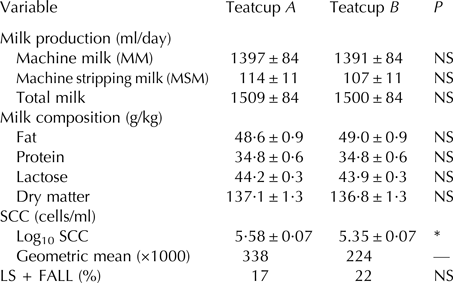
Milk production (Machine milk, MM; Machine stripping milk, MSM; Total milk) and milk composition (fat, protein, lactose and dry matter) did not differ significantly between the two experimental lots (Table 2). Record Day factor significantly affected all the cited variables except for MSM, but the Teatcup × Day interaction had no significant effect on any of these variables.
Means (±se) of milk production and composition and somatic cell count (SCC), and frequency of liner slip + teatcup fall-off (LS + FALL), in two groups of 23 goats milked with teatcups with automatic valves (A) and without automatic valves (B) during a 20-weeks experimental period (20 records)

** P < 0·05; NS, not significant (P > 0·05)
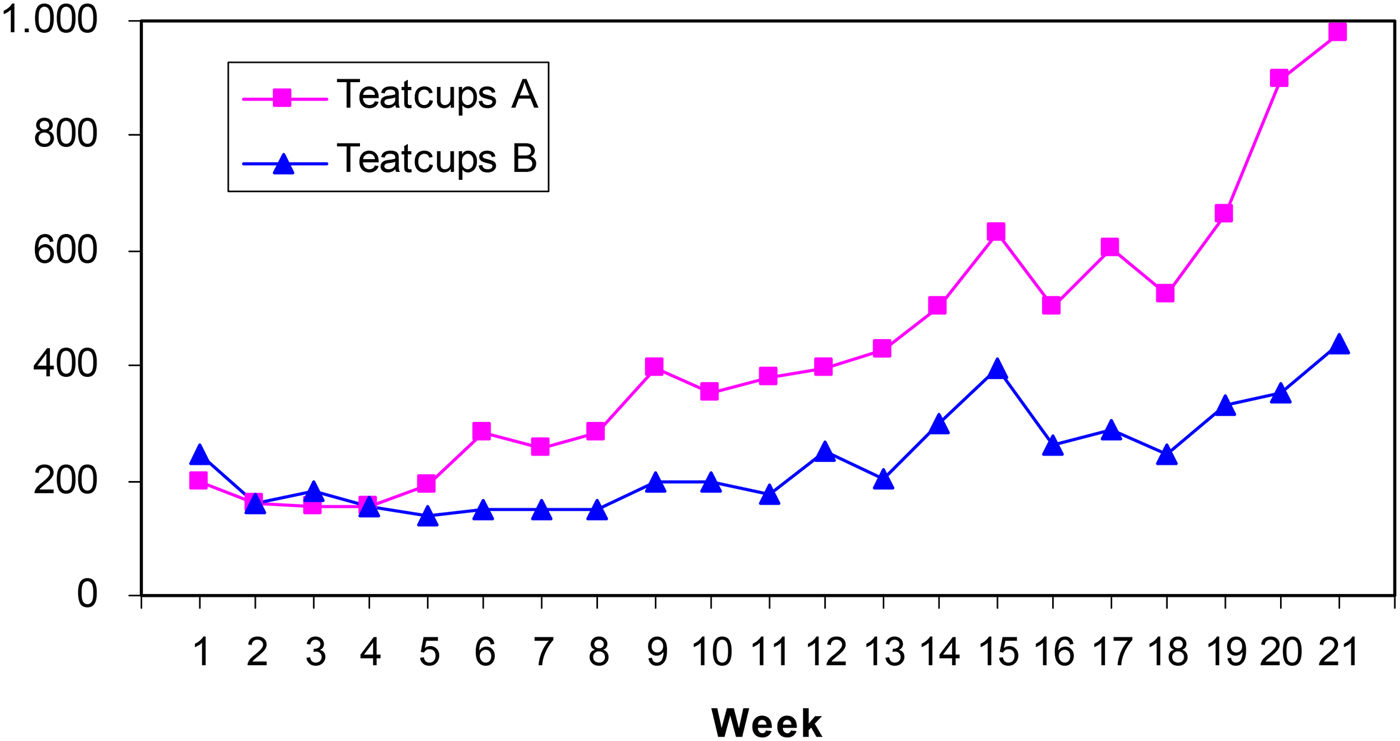
However, SCC did differ significantly between the two experimental batches (P < 0·05; Table 2), with goats milked using teatcups A (with automatic valves) presenting higher cell counts than those milked with teatcups B (log SCC: 5·58 vs. 5·35). Moreover, in this variable Teatcup × Day interaction almost reached the significance level of 5% (P = 0·07), given that the differences began to emerge as the experimental period progressed (Fig. 1).
Weekly evolution of somatic cell count (geometric mean, cells/ml × 1000) in two groups of 23 goats milked with teatcups with automatic valves (A) and without automatic valves (B) during a 20-weeks experimental period. Week 1 corresponds to the pre-experimental period.

In the first experiment (long-term), teatcup fall-off (TF) was significantly higher in the batch of goats milked with teatcups A than in the batch milked with teatcups B (7·7% vs. 3·4%, P < 0·01). However, the liner slips (LS: 19·5% vs. 23%, P > 0·05) and joint analysis of LS + TF (27·3 vs. 26·8%) did not differ significantly between the two types of teatcup clusters assayed. Likewise, in the second experiment, short-term and crossover design, the TF and LS did not reach significant difference when milking was performed with teatcups A or B (TF + LS: 37% vs. 33%; P > 0·05).
Teat condition and milk emission kinetics
In the first experiment, no teat-end lesions or alterations were observed in any goats milked using teatcups A or B. Besides, the teat thickness change after milking in both experimental groups did not differ significantly (P > 0·05), when it was expressed as difference (0·32 vs. 0·30 mm) or as percentage (8·17 vs. 7·87%).
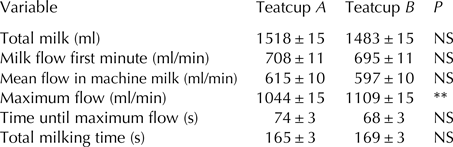
Milk emission kinetics results are presented in Table 3. Teatcups with automatic valves (A) caused a drop in maximum milk flow (1044 vs. 1109 ml/min; P < 0·01), but did not significantly affect the rest of variables: total milk, flow in the first minute, mean flow and milking time.
Mean (±se) of milk emission kinetics variables recorded in 54 goats milked with teatcups with automatic valves (A) or without automatic valves (B)

**P < 0·01; NS, not significant (P > 0·05)
Discussion
In this work, we have shown that the use of teatcups with automatic valves provides advantages in milking management compared to conventionally designed teatcups. Teatcup attachment and removal (vacuum was not cut off beforehand from the claw) is simpler and quicker, and teatcup fall-off interferes less in milking. However, we must highlight that liner slips, which in this study was 3 times more frequent than teatcup fall-off, did not trigger the automatic valve.
The results suggest that teatcups with automatic valves increased the risk of mastitis slightly, as in the first 8 weeks of the experimental period the new IMI rose significantly in animals milked with them, compared to milking with properly used conventional teatcups (cutting off the vacuum before removal).
The fact that in the next weeks of the experiment (weeks 9 to 20) the new IMI were equal with both teatcup types reveals the multifactorial nature of this disease (Bergonier et al. Reference Bergonier, De Crémoux, Rupp, Lagriffoul and Berthelot2003). We must bear in mind that when an intramammary infection sets in, the risk factors (predisposing and causative) and the animal's defence mechanisms are interrelated (Bramley, Reference Bramley, Bramley, Dodd, Mein and Bramley1992). If we accept that milking, in general, is a risk factor for mastitis (O'Shea, Reference O'Shea1987) and that the use of teatcups with valves increases said risk, this might explain the findings. Thus, the goats most prone (worse defensive mechanisms) would be infected before being milked with valve-fitted teatcups (higher risk). However, animals with high susceptibility to mastitis would also become infected by being milked with conventional teatcups (lower risk), albeit at a more advanced stage of lactation, having undergone more milkings.
The consequence of the hypothesis put forward above is that a milking-related factor that entails a moderately increased risk of mastitis would give rise to a higher incidence of mastitis at the onset of lactation (e.g., in the first third of lactation), but in the longer term this would give way to a tendency for mastitis prevalence to even out, with respect to the animals having been milked without this risk factor. This hypothesis is sustained not only by the outcomes of the present study and the work by Manzur et al. (Reference Manzur, Díaz, Mehdid, Fernández and Peris2012), both in experimental farm conditions, but also by results obtained experimentally in France (Billon, P, personal communication) It was found that milking using teatcups fitted with automatic valves, compared to conventional teatcups, significantly increased the mastitis prevalence in controls performed at mid-lactation, although towards the end of lactation the prevalence tended to level out between both experimental groups. Nevertheless, in the cited work the SCC differences did not reach significance level, an aspect which did occur in our experiment.
The results achieved in the current work did not allow us to identify the final cause of the higher mastitis incidence found in the first few weeks, when milking with teatcups fitted with automatic valves. Thus, this type of teatcup did not show differences in factors which might raise the risk of mastitis, such as high cyclical vacuum fluctuations (Billon et al. Reference Billon, Sauvee, Menard and Gaudin1998), or total teatcup slippage + fall-offs, or teat congestion/oedema (Mein et al. Reference Mein, Reinemann, Schuring and Ohnstad2004). Hence, we may assume that the rough method used to remove the teatcups (air intake in the liner mouthpiece until automatic valve is triggered) is the main factor responsible for the increased mastitis risk, although this hypothesis should be confirmed in further work. We should also emphasise that in the French studies, the increase in mastitis caused by milking with valve-fitted teatcups is attributed to the fact that they also raised the number of teatcup fall-off and liner slips events Billon, P, personal communication.
Moreover, the IMI incidence recorded throughout lactation was high (50 and 35% of goats for teatcups A and B, respectively), being even higher than the prevalence data usually recorded on many commercial farms (around 5–30%; Bergonier et al. Reference Bergonier, De Crémoux, Rupp, Lagriffoul and Berthelot2003; Contreras et al. Reference Contreras, Sierra, Sánchez, Corrales, Marco, Paape and Gonzalo2007), although we must bear in mind that in the current experiment exposure of the teats to pathogens was deliberately heightened, in order to highlight the milking-related risk factors (in this case the teatcup type). Regarding the IMI aetiology (mostly coagulase-negative staphylococci), our outcomes did agree with field studies carried out (Contreras et al. Reference Contreras, Luengo, Sánchez and Corrales2003; Contreras et al. Reference Contreras, Sierra, Sánchez, Corrales, Marco, Paape and Gonzalo2007).
The automatic valves used did not affect the mean flow or milking time. However, they did slightly decrease the maximum flow, which might explain the result that the minimum vacuum under the teat was not so low as with conventional teatcups. In any case, we must emphasise that the vacuum records taken might not exactly reflect what occurs in the teat end, as the measurement was carried out in the short milk tube, i.e., at a point further from the teat than the place where the valves were located (teatcup end).
Conclusions
The use of teatcups with automatic valves in milking goats, without manually shutting off the vacuum before teatcup removal, provides advantages in milking management, which is especially important if used in large flocks. However, in this study it was found to increase the risk of mastitis, which might raise intramammary infections, particularly at the onset of lactation, and SCC. However, we were unable to identify the root cause of this finding, as it was not shown to relate to teat congestion/oedema, the sum of liner slips and teatcups fall-off, or cyclical vacuum fluctuations. Moreover, the presence of automatic valves did not adversely affect other aspects determining milking effectiveness: production, milk fractionation and composition, or milking times and mean flows. Although peak flow decreased, the drop was small.
In summary, despite the advantages to milking management, our results suggest that farmers should not use teatcups with automatic valves, when vacuum is not cut off prior to teatcup removal, at least on farms with a high prevalence of mastitis.