Introduction
To explain the distribution of phonic variants according to social group, researchers support one of two opposing views: the inherent value hypothesis or the imposed norm hypothesis. In the first case, represented in particular by the normative trend, it is thought that this distribution does not happen by chance, that the varieties differ by intrinsic aesthetic characteristics, or that the differences are the product of variable relationships to the language according to social background. Thus, for Kroch (Reference Kroch1978:20, cit. Fasold Reference Fasold1984:261), “non-prestige dialects tend to be articulatorily more economical than the prestige dialect. This means that standard dialect pronunciations are likely to make more distinctions than are strictly necessary for understanding”. There often appear to be difficulties in formulating analyses in this view without any ideological connotations. The concept of articulatory economy is thus not far from the often-invoked “principle of least effort”, and suggests that laziness and sloppiness are more widely distributed among the working classes. This position has a bad reputation among sociolinguists, which is most likely due to its use of terms with moral implications and a slant that is easily exploitable by a fairly simplistic ideology.
If one attempts to give it a general scope, this hypothesis comes up against many counterexamples, a few of which we mention here. In various French speaking areas, words like escalier, millier, and soulier are pronounced either as /εskalje/, /milje/, and /sulje/, or /εskaje/, /mije/ and /suje/; the second series, in which /l/ is absent, is found more often in the working-class variety (Bauvois Reference Bauvois2002). Working-class dialects, however, also present units that are almost absent in the standard variety. For instance, in French, pronouncing a /j/ at the end of verbal forms like aie or sois (/εj/ vs. standard /ε/; /swaj/ vs. standard /swa/) is clearly a working-class feature. Divergent hierarchical rankings are also observed in space or in time. For example, in New York English, the higher up the social scale the speaker is, the more realisations of the postvocalic [r] (car, for, etc.) are observed, while in Reading, England, it is exactly the reverse (Labov Reference Labov1972; Romaine Reference Romaine1994:69). Where the historical dimension of language is concerned, there are also plenty of examples that show opposing situations, such as how the status attributed to the postvocalic [r] has varied over time (Labov Reference Labov1972), or, for French, the [ᴚ] vs. [r] alternation or the contrast between /wa/ and /wε/, where the former realisations are currently included in the standard variety and the latter are considered regional or even rural, even though these were the varieties that prevailed at the seventeenth-century French court.
The second (majority) view suggests that nothing intrinsic to the particular traits of the varieties explains their distribution. Their value is deduced from the status of their users. Introductions to sociolinguistics echo this view in unison: “what is considered standard, or worthy of official promotion, depends only on the social position of the people who use that particular variety” (Fasold Reference Fasold1984:261); “it should be clear that there is nothing linguistically inferior about non-standard forms. They are simply different from the forms which happen to be used by more socially prestigious speakers” (Holmes Reference Holmes1992:145–46); “some varieties get to be regarded as more prestigious than others simply because the people who speak them are thought to have higher status” (Romaine Reference Romaine1994:19).
If this is always the case for all of the linguistic variables available in the differentiation of sociolinguistic usages, then people who do not know a language and have never met its users should be incapable of determining which social group the speakers of this language belong to, simply from the way they speak. The social stratification of the varieties of this language should be impermeable to them. If, by contrast, when given samples of this language, they manage to pinpoint the speakers on a social scale, supporters of the latter view would undoubtedly have to reconsider or at least modify their position on the matter.
Nonetheless, little work has been done on this question. Most studies are in line with the scientific literature on attitudes, which has systematically shown that listeners attribute different moral, intellectual, and physical characteristics to speakers of their own linguistic community depending on the social dialects they use. What happens, however, if the speech samples are in an unfamiliar language? Research has produced different results. Giles, Bourhis, Lewis, & Trudgill (Reference Giles, Bourhis, Lewis and Trudgill1974) asked English listeners to attribute personality traits to speakers expressing themselves in several varieties of Greek, while Giles, Bourhis, & Davies (Reference Giles, Bourhis, Davies, McCormack and Wurm1975) did the same with various usages of French, and van Bezooijen (Reference van Bezooijen, van Roeland and Uus1988) exposed British, Japanese, Kenyan, and Mexican listeners to varieties of Dutch. In these three studies, the responses were independent of the actual social status of the people recorded.
By contrast, when Brown & Lambert (Reference Brown and Lambert1976) had English-speaking students listen to speech extracts produced by French-speaking Canadians and asked them to pinpoint the speakers on a social scale, there was a correlation of 0.70 between the estimated status and the actual status. The authors interpreted their results as an indication of an analogous distribution of social markers in French and English. In Mays (Reference Mays1982), 70% of English-speaking listeners who had to guess the social status of Arabic speakers from different backgrounds produced a correct response in at least five out of seven cases. Such data suggests that the imposed norm hypothesis is not broad enough to account for all of the factors that play a role in the differentiation of social dialects.
This study aims to test the limits of the imposed norm hypothesis. In summary, recordings in Wolof (a language spoken in Senegal) were first played to a group of Senegalese listeners, followed by a group of European listeners who had had no previous contact with the language. The listeners were then asked to determine the social status of each of the speakers, which they did correctly in proportions that exceeded chance in both groups.
In our societies, at least, our everyday experiences of the linguistic usages of people we do not know, people we meet in shops, on public transport, and so on, give us indications about their geographical, national, and social identity. To what extent are our judgements correct? Scientific studies show that our daily subjective experiences generally do not mislead us. To highlight just a few examples concerning social variation,Footnote 1 in three studies reported by Ellis (Reference Ellis1967) on the English used in the United States, people of different social backgrounds were recorded telling a story in their own words, and the listeners who were given the recordings were then asked to identify the social status of the people recorded. In all three cases, the correlation between the judgements of the listeners and the social scale used to objectively rank the speakers was at least 0.8. It dropped to 0.65 in Ellis (Reference Ellis1967), an experiment in which the speakers were limited to counting from one to twenty, thus limiting the number of available linguistic indicators (they were unable to pick up on lexicon, grammar, or discourse structure, prosodic variation was reduced, and so on). There were equally significant rates of correct social identification in the work of Armstrong & Boughton (Reference Armstrong and Boughton1998), in which listeners correctly guessed whether the recorded French speakers from Nancy (France) belonged to the working or the middle class in 74.1% of cases. Percentages were also strong in Mimmo (Reference Mimmo2002:84): the answers of Belgian French-speaking listeners, when asked to determine whether the speakers had had a short- or long-term education, were correct in 93% of cases on average, with percentages varying between 80% and 96.5% depending on the speaker.
These proportions of correct guesses are all the more remarkable considering that the linguistic material on which the listeners based their decision was limited. The recordings were very short: between twenty seconds (Ellis Reference Ellis1967; Mimmo Reference Mimmo2002) and sixty seconds (Putnam & O'Hern Reference Putnam and O'Hern1955; Harms Reference Harms1963; Armstrong & Boughton Reference Armstrong and Boughton1998). Listeners also made their judgements on the speakers' social identity very quickly. Harms (Reference Harms1961; cit. Armstrong & Boughton Reference Armstrong and Boughton1998) estimated that ten to fifteen seconds was enough, while it took Mimmo's (Reference Mimmo2002) listeners between 2.1 and 10.5 seconds to make a decision.
Before going any further, a few key facts about the Wolof language that are relevant to the purposes of this study should be considered. In Senegal, a country where some twenty languages are spoken, Wolof (initially the language of the Lebu and then the Wolof ethnic group) has spread very far outside its ethnic area and is currently established as the language of Senegalese towns. It is not the official language of Senegal, but its presence is felt in every aspect of life in Dakar in particular. It is heard not only in the private sphere or at the market, but also on the radio, on television, in Parliament, in the civil service, in university corridors, and so forth. The majority of Wolof speakers in Senegal regularly practise code-switching between Wolof and French (Thiam Reference Thiam1998a,Reference Thiamb,Reference Thiam and Canutc, Reference Thiam, Castellotti and Moore1999) and language items borrowed from French, which have been more or less integrated in Wolof phonology, are part of ordinary usages, even among people with little or no formal education.Footnote 2 When its users are broken down into different age groups, a spread dynamic becomes apparent: the proportion of Senegalese people who use Wolof is estimated at 80%, but only half of them use it as their first language. It is not, or at best very rarely, used as the vehicle of education (which is done entirely in French) and does not appear as a subject in school curricula (Mbodj Reference Mbodj, Asher and Simpson1993, Reference Mbodj2003; Juillard Reference Juillard1995; Dreyfus & Juillard Reference Dreyfus and Juillard2004). While there are explicit normative views on the use of Wolof, they are not, in any case, relayed by the schools. When asked who, in their opinion, speaks good Wolof, the Senegalese give priority to geographical criteria: “good”, “true”, or “pure” Wolof is said to be found in various regions of northern Senegal. These geographical criteria, however, are just another way of manifesting ethnic criteria. First of all, the regions indicated are those which, in the past, were essentially occupied by the Lebu or the Wolof. Secondly, Wolof speakers of other ethnic groups are systematically classified as speaking a “bastardised” version of Wolof, due to contact with other languages. Some people, though not many, suggest more solid geographical criteria, which identify good Wolof as the variety spoken in Dakar, the capital city (Drivaud Reference Drivaud1990; Juillard, Moreau, Ndao, & Thiam Reference Juillard, Moreau, Ndao and Thiam1994; Moreau & Thiam Reference Moreau and Thiam1995). The possibility of a hierarchical ranking of Wolof varieties according to professional occupation, length of education, or affiliation with a particular social class has never been envisaged.
Method
Speakers: Recordings
In Dakar, fifty-four men aged between twenty-five and forty-five who belonged to the Wolof ethnic group and had spoken Wolof since childhood were recorded as they talked about a subject of general interest (the content of which was irrelevant to social distribution, since they were answering the question “Does everyone who speaks Wolof speak it in the same way?”). Half of these fifty-four speakers had very little schooling (no high school or school leavers' certificates) and the other half were highly educated (academics working at the University of Dakar).
Wolof society is structured into various social castes (Diop Reference Diop1981; Diouf Reference Diouf1981; Mbow Reference Mbow2000), and each member of society is assigned a position in the social hierarchy. This traditional system, operating on a hereditary basis, specifies, for instance, what trades the individuals may enter into, who may marry whom, who has authority over whom, who is entitled to intervene in public debates, and so on. In the minds of the Wolof, the Géer caste (traditionally made up of men who work in nonmanual professions, not counting agriculture) occupies the top of the scale, and the Nienio caste (traditionally made up of craftsmen such as shoemakers, blacksmiths, jewellers, etc.) is at the bottom. This traditional classification system, which is often at odds with economic, educational, or cultural criteria regarding social status in modern Senegalese society, nevertheless remains highly influential today. Our sample consisted of thirteen Géer and fourteen Nienio with limited schooling, and sixteen Géer and eleven Nienio with a long education.
The samples were recorded in Dakar, on the Cheikh Anta Diop campus, as well as in shops and workshops. The first fifty-four people we found who met our sociological criteria (ethnic group, caste, age, length of stay in Dakar, and schooling) were chosen for recording, with no regard for whether their variety of Wolof was representative of their social group or not.
Sample segments of twenty to forty seconds were then selected with the help of the SoundEdit software. Pauses were shortened, repetitions and false starts were cut out, and passages that included content that might give away the speaker's status were removed. The extracts were all made up of complete sentences. The fifty-four segments were distributed in random order on the same medium, each segment preceded by its number. They were introduced by two recordings, different from the following ones, which served as examples.
Listeners
We played these recordings to 175 listeners from two categories.
• 116 Senegalese students enrolled in the Arts Faculty at the University of Dakar. They all knew Wolof, and for seventy-three of them, it was their first language. Of the 116 listeners, forty said they belonged to the Wolof ethnic group (the others included Joola, Sereer, Hapularn, and Balante). There were forty-one female students and seventy-five male students. The test was carried out on six different groups in a language laboratory.
• The second group, referred to as “Europeans” here, comprised a total of fifty-nine listeners. Among them, fifty-three were students from the Arts Faculty of the Autonomous University of Barcelona. This sample included forty-nine Catalan students and four Erasmus students (French, Icelandic, Italian, and Portuguese). Their answers were added to those of six French-speaking students from the Faculty of Psychology at the University of Mons. None of these students had ever had previous contact with the Wolof language or visited Senegal. The whole sample included only eight males; the “gender” variable was not taken into consideration in the processing of the European data.
Instructions
The Senegalese listeners were asked to listen carefully to the recordings, paying attention not to the content, but to the way the people spoke. They were then to decide, on this basis, whether each of these speakers had had a short or a long education. Examples of possible jobs were also given, such as shoe shiner, orange seller, street vendor, and so forth versus judge, doctor, architect, and so on. They were then asked if they could determine the caste to which these people belonged. We do not, however, go into detail about possible responses to this question here.
The European listeners only had to make a decision on the length of the speakers' schooling and indicate what led them to make their decision.
Results
In order to study the listeners' global performances as a function of the speakers' variables, let us first examine the proportions of “short education” versus “long education” responses, without worrying about whether they were correct or not. The first response appears in 53% of the cases in the Senegalese sample, compared with 50% in the European sample. There was not, therefore, a systematic bias that favoured one response over the other.
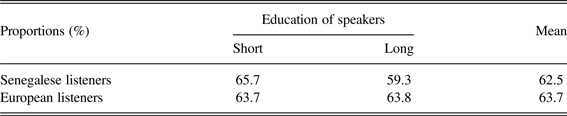
What proportion of these responses were correct? Table 1 shows what percentage of the listeners' responses were correct for each group of speakers. These percentages are calculated for the total number of responses for each group of speakers minus any missing data (which represented 0.3% to 1.6% of responses).
Proportions of correct answers given by the two groups of listeners for each group of speakers (“short” or “long” education).
From a statistical point of view, the Senegalese listeners were not different from the European listeners in their proportion of correct answers (62.5% vs. 63.7%) for both groups of speakers (t = −0.379, p = 0.706).
The Senegalese listeners
Let us first consider the results provided by the Senegalese listeners: the responses were correct in 62.5% of cases. This percentage is certainly lower than in other studies carried out on the perception of social identities based on linguistic indicators (see introduction), but statistical analysis of the data suggests that the distribution of responses cannot be attributed to chance (one sample Student t-test = 4.321, p < 0.001).Footnote 3 This fact is all the more interesting considering that the widespread epilinguistic culture in Senegal in relation to Wolof—as well as in specialists' descriptions of the language—has not considered the possibility of a differentiation of varieties according to the social position of speakers. Our Senegalese listeners probably responded for the most part without a preconceived idea on the matter. The results collected for sociocultural identification must, moreover, be examined in the context of the same listeners' answers to the question of the speakers' castes: on this point, the percentages of correct responses did not go beyond the threshold of chance, varying between 48.8% and 51%, depending on whether we take into account the answers of all the listeners, or only those of the Wolof or non-Wolof, native or nonnative Wolof speakers. The stratification of Wolof society into castes therefore differs from what is seen in India, where Tamil (Bright Reference Bright1966; Bright & Ramanujan Reference Bright, Ramanujan, Pride and Holmes1972), Kannada, and Tulu (Bright Reference Bright1966) speakers do not use the same varieties, depending on whether they belong to the Brahman caste or one of the other castes.Footnote 4
That said, caste membership does play a role in the differentiation of groups as perceived by the listeners. For example, with regard to the identification of the speakers' level of education, while the analysis of variance does not show an overall significant effect of the “education” and “caste” variables considered separately, it does indicate an interaction effect (at the limit of statistical significance: F = 3.085, p = 0.085) on the rate of correct responses. The speakers whose social status the Senegalese listeners most correctly identified were the more educated Nienio speakers and the less educated Géer speakers (see Figure 1). In other words, when speakers of low social status, as defined by their caste, have had a longer education, they speak a type of Wolof that ranks them more clearly (than in the case of the Géer) higher up in the sociocultural hierarchy, and when they have had a shorter education, their Wolof shows fewer working-class features (or more features of the prestigious variety) than that of the Géer.
Mean rate of correct answers provided by the Senegalese listeners (in %) as a function of the speakers' education level (“short” or “long” education) and sociocultural group (Géer or Nienio).

The European listeners
This possibility of gauging the sociocultural status of speakers in a significant proportion of cases is not limited to people who know the language and have had contact with its users: in the European listeners corpus, the distribution of correct responses cannot be attributed to chance either (one sample Student t-test = 4.514, p < 0.001). As in the Senegalese sample, but more markedly so here, the analysis of variance indicates an interaction of “education” and “caste” variables (F = 4.992, p = 0.031). Here too, a large proportion of the correct “long education” responses were collected especially with regard to Nienio speakers with a long education, and those for “short education” corresponded predominantly to Géer speakers with little education (see Figure 2).
Mean rate of correct answers provided by the European listeners (in %) as a function of the speakers' education level (“short” or “long” education) and sociocultural group (Géer or Nienio).
To interpret this data, we put forward the hypothesis that the Nienio attempt to reduce the stigma attached to their caste through the use of linguistic hypercorrection, either by bringing their usage closer to that found at the top of the sociolectal hierarchy—that is, by integrating more traits of prestigious Wolof (as used by the Wolof and non-Wolof who occupy a high position on the social scale)—or by eliminating working-class markers that might disclose an affiliation with their particular sociocultural group.
The idea that the sociolectal stratification of a language, or of the usage of that language, is perceptible to people who have never had contact with that language suggests that some linguistic features may be analogously typical of sociolects of different languages, or different ways of using the language. This point is addressed further in the discussion section.
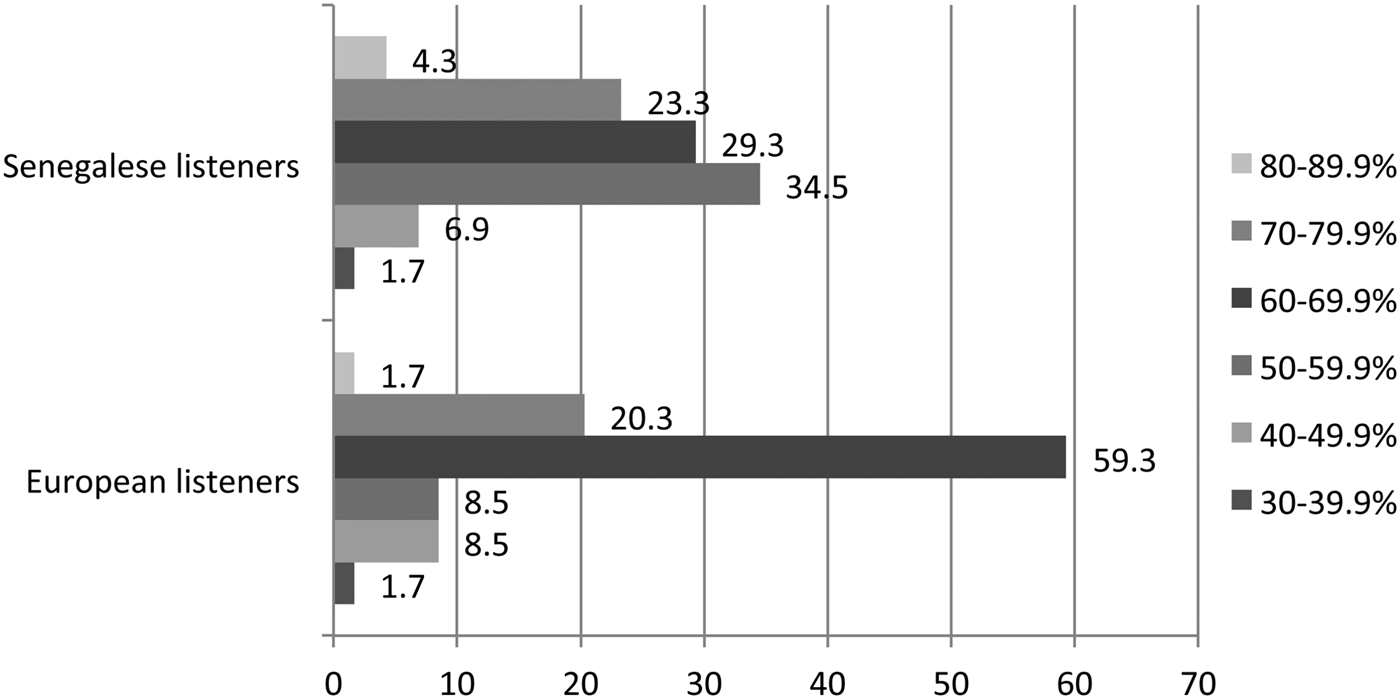
For both the Senegalese and the European samples, however, the overall results mask a fairly large variability among listeners, and among speakers. As a first point, let us examine Figure 3, which compares the proportions of correct sociocultural classifications made by the Senegalese and European listeners. The number 4.3 associated with the top bar of the figure thus means that 4.3% of the Senegalese listeners correctly guessed the social status of 80% to 89.9% of the speakers.
Proportions of correct sociocultural classifications made by Senegalese (top) and European (bottom) listeners.
Several things can be gathered from this graph.
• In the two groups, a wide range of results can be seen: more than a quarter of Senegalese listeners (4.3% + 23.3%) correctly pinpointed the social status of at least seven out of ten speakers. This was also the case for about one in five European listeners (1.7% + 20.3%). By contrast, 8.6% of the Senegalese listeners and 10.2% of the European group, probably mislead by inadequate indicators, failed to correctly assess the majority of the speakers.
• The most surprising results were seen in the two central categories: listeners who correctly identified 50% to 59.9% of the speakers were predominantly from the Senegalese group, while those who correctly identified 60% to 69.9% were mainly from the European group.
There is also considerable variability among the speakers, some of whom were clearly more identifiable than others. This is seen in the fact that percentages of correct responses vary between 15.3% and 96.6% depending on the speaker. A significant proportion of the less educated speakers (40.7%) were identified particularly well by the Senegalese group: their social status was guessed correctly by at least four out of five listeners. Conversely, European listeners got the upper hand with regard to the identification of highly educated speakers: three out of ten speakers (29.6%) were correctly evaluated by more than 80% of listeners.
Looking at these results more closely, however, one might call into question the relevance of reflecting on categories, as the two samples of listeners react differently from one speaker to another. This is illustrated in Figure 4 below, which shows the speakers in decreasing order of correct identifications by the Senegalese listeners.
Average proportions of correct responses by the two groups of listeners for the fifty-four speakers.
The response profiles of the two groups of listeners do not overlap at all. Speakers who were correctly identified by many listeners in one group were not necessarily identified correctly as often by the others, and those who were not evaluated correctly by some may end up achieving significant proportions of correct responses by others. The Pearson correlation between the responses of the Senegalese listeners and those of the European listeners is not very high (r = 0.431, accounting for 18.5% of the variance; significant result at p = 0.001). The difference between the two groups of listeners was greater than 30% in twelve out of fifty-four cases, with a significant difference of p = 0.10 in seven of these cases. This might indicate that the two groups do not use the same indicators when evaluating speakers.
The European listeners were asked to explain what criteria had guided their responses. First and foremost, this corpus shows the difficulty of identifying these criteria and expressing them. Many comments were limited to very general terms, such as voice, tone, intonation, rhythm, pronunciation, and so on, without going into any further detail. Some used metaphors, which, in fact, were little more than a rewording of their tick-box response: “He speaks like an educated person”, “like a person from the poor districts”, “like a journalist”, “like a waiter”, and so forth. The listeners also did not agree on the speed of elocution. The same speaker was said to speak quickly by some, but slowly by others, and the words “fast” and “slow” were attributed equally to both highly and less educated speakers. Even the number of pauses did not receive unanimous agreement: the same speaker, identified as less educated, was said to hesitate and make a lot of pauses by one listener, but to speak without pauses by another. Other responses offered even more significant and interesting indications: on one hand, confidence, fluidity, clarity, and control seem to be more associated with speakers presumed to have higher social status; on the other hand, hesitations, repetitions, short sentences, confused pronunciation, brusque tone, vehemence, and so on were associated with those who were presumed to have had little education.
Discussion and conclusion
In Wolof society, the distribution of individuals into socioeconomic groups according to education and occupation is a recent, modern phenomenon. Prior to this, the social hierarchical ranking of individuals had only taken into account the hereditary caste to which they belonged. It is not known if the difference between castes has ever been associated with distinct ways of speaking Wolof. In any case, at the present time, regardless of whether a Wolof speaker is Géer or Nienio, they speak Wolof in such a way that listeners cannot identify their caste status, as identifications of this kind never differ from what they would be if they were dictated only by chance.
The socioeconomic stratification of Wolof society is recent, and so is the sociolectal differentiation of the Wolof language. This phenomenon is most likely linked to urbanisation. Towns are generally laid out in such a way that they bring different social groups together in one place, reaching a critical mass that is unheard of in rural communities. Why is it, then, that both ordinary and specialist discourses on Wolof barely mention this differentiation? This is most likely due, for the most part, to its recent emergence, but it could also be due to the reticence that communities seem to feel in regard to associating linguistic varieties with social classes, preferring instead to define variation in geographical terms (Moreau, Bouchard, Demartin, Gadet, Guerin, Harmegnies, Huet, Laroussi, Prikhodkine, Singy, Tyne, & Thiam Reference Moreau, Bouchard, Demartin, Gadet, Guerin, Harmegnies, Huet, Laroussi, Prikhodkine, Singy, Tyne and Thiam2007).
Nevertheless, differentiation certainly exists. As has been demonstrated in many communities, Wolof speakers do not all speak in the same way, depending on their social position. This has become apparent in our work, despite the fact that we started off testing our hypothesis under rather risky conditions: apart from certain preimposed extralinguistic conditions (age, ethnic group, caste, education, etc.), the people we recorded were only selected through chance meetings and opportunities, and not because they were considered to be linguistically representative of their group, or because their Wolof showed any sort of interesting feature for our purpose.
Even if they are unequivocal, however, the percentages of correct identifications are lower than those reported in studies dealing with other languages (see introduction). In a society in which people are permanently confronted with linguistic variation resulting from ethnic intermingling and contact between languages, without a normative scholastic tradition that sets apart good and bad Wolof; a society where there is an absence of explicit distinctions between prestigious Wolof and common Wolof in ordinary discourse on the language, but where attention is obsessively focused on code-switching between Wolof and French; a society in which written Wolof is still very limited, and in which people therefore cannot align their written standards with their oral, it is possible that Wolof speakers are less attentive to sociolectal differentiation, which, in all likelihood, has not had time to settle into all families, schools, places of work, and so on. The sociolectal divides might be less systematic and less marked than elsewhere with regard to production and, as they are less perceptible in reception, might tend to be less ingrained than elsewhere.
Even more surprising is the ability of listeners to pinpoint speakers whose language they do not know on a social scale, especially when this language is both typologically and geographically distant from the one they use. Brown & Lambert (Reference Brown and Lambert1976) are of the view that when their English-speaking listeners guess the social identity of French speakers, they base their judgements on features common to both languages. In our case, the much more significant distance between Wolof and Castilian Spanish, Catalan or French calls for an entirely different explanatory theory. That said, the fact that some features of the prestigious variety of Wolof are influenced by French (which is spoken in Senegalese schools, on the radio, and on TV, among other places) cannot be excluded. In this case, the strategy of the European listeners was likely based on the more or less close proximity of the samples to French. No scientific studies that corroborate or invalidate this hypothesis are currently available, as many studies have been devoted to either the influence of French on the Wolof lexicon, the influence of Wolof on the lexicon of Senegalese French, or the Wolof-influenced phonetic realisations of the French-speaking Senegalese population, but never to the influence of French on Wolof phonetics.
In any case, regardless of what further analyses show or whether or not prestigious Wolof shares some characteristics with French, our data, just as Brown & Lambert's did, suggests the existence of crosslinguistic patterns that guide, at least partially, the features of Wolof sociolinguistic stratification. What is the scope of these patterns? Are they shared by just a few languages (e.g. English and French, Wolof and French, or Wolof, French, and Catalan), or are they widespread, if not universal? We can ask the question, but with our current data, the answer remains elusive.
It is unknown what linguistic or language indicators the listeners took into account. In this exploratory study we exerted almost no control over the formal aspects of the recordings. We simply ensured that the extracts contained whole sentences and were of comparable length, and reduced the length of pauses. For the other formal characteristics, we did not operate any sort of selection process and therefore had no control over the phonetic indicators present in or absent from the samples given to the listeners.
Despite this lack of control over the content, or perhaps because of it, our results present some interesting developments. A wide range of variability in identification abilities among the listeners was observed (Figure 3). We also see great differences in the Senegalese and European listeners' perception of the individual speakers (Figure 4). These differences suggest that social variation can, in fact, be perceived through a multiplicity of different indicators and groups of characteristics that each community and member of the community makes singular use of for identification purposes. Some listeners pay attention to certain features, while others perceive different traits, and some achieve good results, while others have more trouble doing so.
As a basis for their evaluations, the Senegalese listeners—who understood Wolof and Wolof-speaking society—were able to rely on a multitude of indicators: lexical variables, morphosyntactic variables, segmental phonetic variables (such as those usually studied in variationist sociolinguistics), and suprasegmental variables. The European listeners' ignorance of Wolof meant that they had no concept of the use of morphosyntax or of the lexis, with one exception: language items borrowed from French. But these, of which there are only traces in the recordings, are so numerous and so widespread in contemporary Wolof that putting them down to a long education would induce as many incorrect responses as correct ones. Many of the comments of the European listeners indicated in very broad terms that their judgements were based on only a few linguistic indicators (precision of articulation, length, and complexity of sentences deduced from intonation, and their supposed effect on the more or less nuanced way the speakers formulated their speech), and, more generally, on language-related rather than strictly linguistic criteria (linguistic posturing reflecting different degrees of confidence to assertiveness, verbal fluency, tone of voice, control of vocal intensity, and so on): in short, that mysterious alchemy of elements superimposed on segmental units of speech—elements whose intricate components have yet to be isolated and identified in instrumental phonetics.
In any event, while it has been confirmed that the hierarchical ranking of the different ways of using a language shows certain crosslinguistic constants, a better interpretation of this phenomenon can be reached with the help of the distinction concept put forward by Bourdieu (Reference Bourdieu1979), which states that one of the main concerns of the socioculturally dominant class is to “distinguish themselves” from the working classes and to adopt lifestyle, leisure, usage, aesthetic, artistic, and cultural preferences that are primarily in opposition to the usages and tastes of the groups found at lower levels of the social hierarchy. Such a concept might help to better understand how language variants are distributed, while avoiding ideologically tainted interpretations.
What, then, of the imposed norm hypothesis and the inherent value hypothesis? Are confidence, assertiveness, verbal fluency, and control of vocal intensity inherently valuable, or are they considered to be prestigious because they are more frequently observed in the speech of prestigious members of society? The answers to those questions make it difficult to agree with the inherent value hypothesis. By contrast, if the differentiation of social dialects is at least partially rooted in general sociological principles, such as Bourdieu's principle of distinction, then it may be inferred that the distribution of certain variants cannot always be explained on a strictly linguistic level, and that it is sometimes conditioned or subsumed by a more general, language-related behavioural norm that even external listeners can perceive, regardless of whether speakers comply with it or not. The imposed norm hypothesis should therefore be reformulated to have a wider scope that takes into account such phenomena.