Interstate cooperation takes a variety of institutional forms. Sometimes it operates through international organizations, sometimes through formal agreements, and sometimes through tacit understandings. Multilateral treaties are one such vehicle of international cooperation.Footnote 1 They are used to provide a wide range of collective goods from international security to human rights to environmental protection.Footnote 2 The 1968 Nuclear Non-Proliferation Treaty limits the spread of nuclear weapons; the 1989 Convention on the Rights of the Child addresses important issues regarding the treatment of children, and the 1987 Montreal Protocol protects the ozone layer. When states have problems that cannot be resolved through individual state action or bilateral agreements, they often turn to multilateral treaties. But not all states are equally important in shaping multilateral treaties. We address the role of powerful states—including but not restricted to the most powerful state—in achieving interstate cooperation through treaty ratification.
A variety of factors determine states' willingness to commit to treaties.Footnote 3 Decisions to ratify depend on policy preferences,Footnote 4 domestic politics,Footnote 5 legal system,Footnote 6 regime type,Footnote 7 reputationalFootnote 8 or normative benefits,Footnote 9 treaty design,Footnote 10 and international diffusion mechanisms.Footnote 11
We argue that states' influence in shaping treaties—determined by their power and independence—creates additional incentives for ratification. Power is the ability to shape treaty terms and press for its acceptance; independence is the ability to pursue one's own interests without being subject to pressure by others. The United States is the extreme case with its extraordinary ability to push for treaties and influence other states for support; it also has demonstrated an ability to exercise its influence outside of the treaty framework (even without ratifying). We focus in this study on powerful and independent states (other than the United States) that have significant influence on the adoption and operation of treaties but that unlike the United States can influence the treaty primarily through ratification. We label those states multilateral powers. We expect them to be particularly active ratifiers and to take the lead especially when the United States does not participate (by not ratifying or ratifying slowly). By contrast, if the United States decides to participate, multilateral powers are less important to the treaty process and so ratify at a lower rate. Other states that are less powerful and/or less independent than multilateral powers have less leverage and are therefore less supportive of treaties regardless of the US involvement—although they may be subject to US pressure to follow its lead. Contrary to those who see multilateralism as a tool of the strongFootnote 12 and others who see it as a weapon of the weakFootnote 13 we show that it can be a strategy of the multilateral powers and expect them to be central to the outcome of international cooperation.
We test our claim about the role of different states in cooperation using a data set of the most important postwar multilateral treaties. An event history analysis of treaty ratification confirms our conjecture that a group of powerful and independent states is key to the ongoing success of international cooperation. When the United States fails to ratify or does so slowly, the multilateral powers step up to ensure the success of cooperation. By contrast, when the United States moves decisively (by ratifying quickly), multilateral powers display a greater tendency to free ride. Weaker and dependent states generally participate less in multilateral treaties, although they are more likely to ratify when the United States ratifies—reflecting their susceptibility to US pressure. Thus our analysis provides a fuller understanding of how a state's influence in the treaty-making process determines the commitments it makes.
Multilateral Cooperation Through Treaties
There are many ways to address collective action problems in international cooperation. Multilateral treaties provide important legal instruments of international cooperation used to resolve collective action problems among states. Some create new multilateral institutions; others contribute to existing international regimes; yet others address more specific collective purposes. Although treaties are not always effective, states sign and ratify them because they believe they will change collective behavior in ways that benefit the international community and themselves. Because ratification is a legally binding commitment to obligations that entail both sovereignty and compliance costs, states have individual incentives not to accept treaties.Footnote 14 This creates a second-order collective action problem where states prefer to free ride rather than ratify, but the treaty process generates a common commitment and assurance that helps overcome this. The logic is that of Schelling's k-groupFootnote 15 whereby a sufficient number of cooperators can benefit from joint action, as is often reflected in treaty “entry into force” requirements aimed at ensuring sufficient participation.Footnote 16 This outcome remains susceptible to defection, however, and so may need support through exogenous factors including reputational, normative, and social incentives.
We focus in this article on how the treaty process shapes states' individual incentives to support it. The benefits and costs of a treaty for each state vary with its exact terms. For example, an arms control agreement might exempt certain categories of weapons, a trade agreement might cover only certain products, or an environmental treaty might define emission targets in ways that advantage certain states. Ratification brings a continuing voice in the treaty regime,Footnote 17 and is typically a prerequisite to inclusion in the conference of the parties or similar governing bodies that deal with interpretation and implementation of the treaty after its entry into force (and provide a forum for further developments within or beyond the treaty).Footnote 18 If the treaty creates or is governed by a formal international organization, ratification typically gives membership and voting rights. Thus ratification provides states with continuing opportunities to shape the treaty to their advantage.
A state's ability to affect the terms and governance of a treaty depends on its power and on its independence. Larger, more powerful states are usually more important to the solution of the problem at hand; they have more resources for addressing it and have greater diplomatic capacity.Footnote 19 This gives them greater leverage in the treaty process and therefore on the terms of the treaty, which makes them more likely to ratify it. It also gives them more continuing influence on the treaty after entry into force. But a state's ability to influence a treaty depends also on its ability to pursue its own interests without being pressured by other states. A state that is not independent but subject to influence from others will not be as effective in shifting treaty terms and operations to its favor.Footnote 20 Independent states are better positioned to advance their own interests.
Thus the conjunction of power and independence is key: to shape treaties to its interests, a state must have both the power to act and the independence to pursue its own interests. We label states that are both powerful and independent as multilateral powers for convenience. However, multilateral power ranges from states that are low in power and/or independence to the multilateral powers that are relatively high in both.Footnote 21
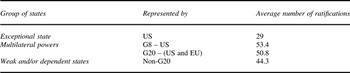
For heuristic purposes we introduce the logic of participating in interstate cooperation in terms of three categories: the United States as the exceptional state, the multilateral powers, and weak and/or dependent states. The basic puzzle we address is captured in Table 1 showing the ratification rates of major postwar multilateral treaties by these three representative groups. US behavior in international cooperation is reflected in its very low rate of treaty ratification compared with other countries. Although the United States ratified only twenty-nine of the full sample of the sixty-six treaties, the multilateral powers on average ratified 53.4 treaties (when approximated by the G8 − US) or 50.8 treaties (when approximated by the G20 − (US and EU)). Weak and/or dependent states (approximated in the table by the non-G20 states) ratified only 44.3 treaties on average. This pattern is explained by our argument regarding the interaction of power and independence across these states, which we demonstrate in terms of continuous variables.
Ratification rates

Notes: G8 – US excludes the US; and G20 – (US and EU) excludes the US and the EU. The table is based on the full sample of sixty-six treaties in our data set spanning a wide range of issue areas. The data are described in more detail in the Data Analysis section.
The Exceptional State
The United States is sufficiently extreme in its treaty-making power and independence as to be sui generis—accordingly we treat it separately. It is an outlier in both theory and practice. While hegemonic stability theoryFootnote 22 has empirical shortcomings, theoretically it usefully highlights the unique role of the “hegemon” in promoting international cooperation. When US preferences are aligned with the preferences of other states, it is positioned to take the lead on cooperation and others are positioned to follow. This has been echoed in the memorable invocation of the United States as the “indispensable nation” by former US Secretary of State Madeleine Albright and in recent analyses of monetary hegemonyFootnote 23 and unipolarity.Footnote 24 Although never truly “hegemonic” in the sense of being able to “pass” multilateral treaties without significant support from other states,Footnote 25 the United States is “exceptional” in having an extraordinary ability to push for treaties and influence other states to support them.Footnote 26 This influence is partly because US participation is highly important for most treaties; US influence also derives from its diplomatic resources and its ability to pressure other states (especially ones dependent on it) into ratifying.Footnote 27
Conversely, when US preferences diverge from those of other states and it is hesitant on a treaty, the United States has been famous—perhaps infamous—for playing a major role in the treaty negotiation process without ratifying.Footnote 28 The United States also can have significant influence over other states—again, especially those dependent on it—to lessen their willingness to participate in a treaty. When it does not ratify, the United States loses the advantages of being formally an insider participant in subsequent developments, but its dominance nevertheless allows it to retain significant influence over treaty developments from the outside.Footnote 29
This exceptional role of the United States in international treaty making is well-illustrated by the case of the Rome Statute on the International Criminal Court. The United States played a major role during negotiations and—as a signatory—continued to influence the development of the treaty even without ratifying it. Despite intense domestic opposition, President Bill Clinton explained his preference for signing the Rome Statute by arguing that “with signature, we will be in a position to influence the evolution of the court, without signature, we will not.”Footnote 30 But American influence continued even after President George W. Bush “unsigned” the treaty in 2002. The United States used extraordinary outside pressure to limit the International Criminal Court's (ICC) implications for the United States by concluding Bilateral Immunity Agreements with more than 100 states to prevent US citizens from being transferred to ICC jurisdiction without US agreement. The United States initially threatened sanctions on states that did not agree and worked aggressively through the UN Security Council to limit the ICC's authority.Footnote 31 Subsequently, the Bush administration softened its stand and tacitly supported ICC activities in Darfur; the Obama administration has actively engaged with the ICC while remaining outside of it. Although this is a stark case, it illustrates how the United States can play a major role in shaping, drafting, and signing treaties that it ultimately refuses to ratify and then use its general power to maintain significant influence over the treaty.
Thus, we distinguish between two situations regarding US behavior: one where the United States shares preferences with other states and uses its power to take the lead in international cooperation (thereby allowing others to slack); and another where the United States has divergent preferences and does not ratify so that it falls on others to take the lead.
Multilateral Powers
Although other states rarely have such extreme influence without actually joining a treaty, states that are powerful and independent (that is, multilateral powers) can have significant influence by participating in a treaty. By working together, such states have the ability to cooperate in bringing a treaty to fruition—if they can overcome their incentives to free ride.Footnote 32 The more capacity a state has to be an important contributor to an international agreement and the more independence it has from the United States, the more influence it can have over the course of negotiations and subsequent treaty developments. Thus the treaty process provides a propitious forum for multilateral powers to shape international governance. They have strong incentives to ratify a treaty to both ensure its success and to maintain continuing influence within it. Their influence is likely to be especially great if the United States does not ratify the treaty since that makes them more important to both its success and continuing operation. Conversely, multilateral powers' influence on the treaty is diminished whenever the United States takes the lead role in ratifying the treaty and influences it from the inside; the participation of the multilateral powers is no longer as necessary—they must compete with the United States for influence and so are increasingly tempted to free ride.
Weak and/or Dependent States
By contrast, states that are not powerful and/or not independent lack the capacity to make much difference to a treaty's success and/or the independence to push for their own positions. Because they have little influence on the treaty, they have less incentive to ratify and greater incentives to free ride.Footnote 33 However, they may be susceptible to US pressure to ratify because their participation plays a role in a treaty coming into force and adds to its legitimacy.Footnote 34 Overall, weak and/or dependent states participate in international treaties at typically lower rates (and for other reasons) than multilateral powers because they are unlikely to greatly affect the level or form of cooperation.Footnote 35
Hypotheses
This leads to a relatively simple set of connected hypotheses:
H1
Multilateral powers ratify at a higher rate than weaker, less independent states.
H2
When the United States does not ratify a treaty, multilateral powers have higher rates of ratification than when the United States does ratify a treaty.
H3
The impact of United States ratification (or nonratification) of a treaty is indeterminate for weak and/or dependent states except insofar as they are subject to its pressure to ratify.
In summary, multilateral powers are strong supporters of multilateral treaties and they will take the lead especially when the United States does not participate.
Data Analysis
We expect multilateral powers to be particularly relevant for treaties that are salient and costly to adopt. The more there is at stake, the more likely a state is to participate to influence the treaty content to its own advantage. We test our argument on a data set consisting of states' ratifications of major multilateral treaties adopted between 1945 and 2008 and ratified by 2010. Our treaty sample builds on the Institute for Agriculture and Trade Policy (IATP) treaty database that identifies such “prominent” multilateral treaties; we extend the sample to include post-2005 treaties as well as a small number of other key multilateral treaties not covered in the IATP sample.Footnote 36 Following the IATP criteria, we include binding international agreements that require the explicit consent of states through ratification; we exclude softer forms of international law such as recommendations, codes of conduct, or memoranda of understanding. We also restrict our sample to treaties that involve substantive additions to existing international law—they go beyond simple adjustments or amendments to previous treaties. All included treaties are universal in two senses: (1) participation is open to all recognized states as defined by UN membership and (2) they have global reach—we exclude treaties that are open to all states in terms of membership but have a regional or plurilateral focus. All included treaties are public international law instruments; we exclude private international law instruments (for example, created through the Hague Conference of Private International Law or the International Institute for the Unification of Private Law—UNIDROIT). Finally, our data set covers seven major areas of global governance, including environment (fifteen treaties), rule of law (five), human rights (eighteen), humanitarian law (three), labor law (seven), security (thirteen), and new security (five). The resulting sample includes sixty-six multilateral treaties addressing a wide variety of collective action problems. We believe it offers a comprehensive listing of the most important binding instruments of public international law. We also report results based on the smaller original IATP sample, and on a data set extended to include economic agreements not in the IATP data set under robustness checks.Footnote 37
Data Structure
Treaty ratification is our time-dependent outcome variable, which we analyze using event-history techniques. Event-history modeling offers an appropriate method for analyzing the timing of political change, that is, change in status from nonratification to ratification of a given treaty by a particular state. It considers both whether a state has ratified a treaty and also how long it takes to ratify. Event-history techniques can also accommodate data with “multiple events per subject.”Footnote 38 In this study, each state can ratify sixty-six treaties, and any number of available treaties in any year. To allow for this specification, we organize our ratification data as count data following Andersen and Gill.Footnote 39 The data take the form of state-treaty-year, with “years” formulated as intervals indicating the start and end of the count. The year count starts with the treaty being open for ratification or when a new state becomes sovereign; it ends with ratification, the end of the analysis period, or a state's termination.Footnote 40 Whether the ratification event actually occurred is indicated by a binary status variable. We account for correlated groups of observations (nonindependence of multiple ratifications per state) by clustering on states,Footnote 41 and applying robust sandwich variance estimators based on a grouped jackknife.Footnote 42
Explanatory Variables
We capture the role of multilateral powers in international treaty making through the interaction of power and independence (power × independence). Because our concern is state influence in the treaty process, we conceptualize power broadly (going beyond military resources or market size). Our power index is composed of ten variables reflecting three dimensions of power: military, economic, and social and human capital. The first two variables capture the military dimension and traditional geopolitical power: military expenditure (in thousands of current-year US$), and military personnel (in thousands). The next four variables cover the economic dimension and a state's material capacity to support and affect international cooperation: energy consumption (in thousands of coal-ton equivalents), total trade (in millions of current US$), gdp per capita (log), and government expenditure (in current US$). The final four variables address the social and human capital dimension capturing less direct elements of influence related to soft power: literacy rate (as percentage of adult population), number of physicians (per 1,000 people), total population (log), and population ages 15–64 (as percentage of total population).Footnote 43 To handle missing observations, we used several data sources and applied statistical imputation techniques. As a rule, we extrapolated and interpolated the data employing generalized additive models.Footnote 44 After a graphical examination of all variables for all states, we applied linear fits to individual cases.
To construct the power index, we applied factor analysis for time series.Footnote 45 Separate time-series factor models were estimated for all constituent variables and states. We then averaged the factor loadings for each variable over all states. Based on the linear combinations of the mean factor loadings and the standardized observations, we calculated a single power index. We also report results based on alternative power measures including the Composite Index of National Capability (CINC),Footnote 46 and gross domestic product (GDP),Footnote 47 as well as the individual dimensions of the power measure under robustness checks in the online appendix.Footnote 48
We operationalize independence in relation to the United States—the state in the strongest position to pressure others. We measure state independence by trade relations with the United States, following Kirshner's argument on how asymmetric relations shape a dependent state's foreign policy.Footnote 49 Balanced trade relations—where each state accounts for roughly the same share of the other's trade—indicate independence; conversely, when one state's trade is much more heavily oriented toward the other than vice versa, then the former state is less independent of the other. As an alternative operationalization we use trade dependence (dependence) measured as states' total trade with the dominant state as a proportion of its GDP. We report those results under robustness checks.Footnote 50
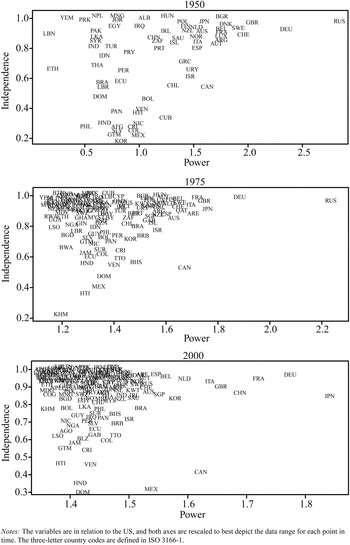
Our focus is on the contemporaneous interaction of states' power and independence that we show for three points in time (1950, 1975, and 2000) in Figure 1. The numbers are relative to the United States, which is not shown. Unsurprisingly, the location of states varies over time but the overall pattern remains fairly stable. A relatively small number of states are both powerful and independentFootnote 51 whereas the growing majority of countries are relatively nonpowerful and vary in degrees of independence. Only a few countries (Canada and Mexico in recent years) are fairly powerful but not highly independent. We check for the importance of particular groupings of states in the robustness checks.Footnote 52
States' power and independence for 1950, 1975, and 2000 (excluding US)

We control for several related and plausible explanations. First, we consider the effect of the domestic regime type (democracy versus autocracy). Democratic states are more likely to support multilateral treaties because such agreements' content often is more in accord with their domestic political values. To measure domestic regime type, we employ the Polity2 score from the Polity IV index (democracy).Footnote 53 We also control for the effect of state age on ratification.Footnote 54 New states that became sovereign through either decolonization or the breakup of the Soviet Union show a high rate of treaty ratification because they are eager to demonstrate their commitment to international rules. We also include a categorical variable for treaty issue areas. We distinguish between rule of law (as the reference category), human and labor rights, security, and environment.Footnote 55 In the robustness checks,Footnote 56 we report on models controlling for other effects in addition to those presented here, including colonial past, religious denomination, treaty signature, geographic diffusion of international norms, and different groupings of countries such as the G8, the G20, Europe, and new democracies. We follow Achen's ART approach and keep the models as simple as possible by focusing on the two main explanatory variables and their interaction term.Footnote 57 Fuller description of control variables and results are provided in the online appendix.Footnote 58
Methods
We use Cox proportional hazards regression models with the modified partial likelihood for right-censored and left-truncated data.Footnote 59 Fixed right-censoring applies to all states that have not ratified a particular treaty by the end of 2010. Cases of random right censoring include Czechoslovakia (state termination in 1992), the Socialist Federal Republic of Yugoslavia (terminated in 1991), the German Democratic Republic (1990), Zanzibar (1964), or South Yemen (1989). Left truncation is caused by delayed entry.Footnote 60 For example, successor states to Yugoslavia such as Croatia and Serbia and former colonies could ratify treaties only after they became sovereign. While a model modified for censored observations allows for the possibility that time to ratification varies across countries, a model adjusted for left-truncated observations further incorporates a consideration of the historical sequence of treaties (that is, the date a treaty becomes available for ratification depends not only on its date of adoption but also on the state's entry into the data set).
The Cox proportional hazards regression model estimates hazard ratios for these variables. The hazard ratioFootnote 61 is the exponential of the regression coefficient (exp(coef)) in the model. A hazard ratio (HR) of 1 indicates that a variable has no effect. A ratio greater than 1 indicates an increase in the rate of ratification (positive impact), and a ratio less than 1 indicates a reduction in the rate of ratification (negative impact). Any statement that a state is more likely to ratify is implicitly with respect to a given year, and is also a statement that the state ratifies more rapidly.
Results
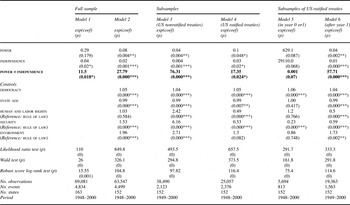
Table 2 presents the Cox proportional hazards regression models for ratification decisions by 199 states for sixty-six multilateral treaties from 1945 to 2010. Since not all explanatory variables are available for the entire period and all states, the number of observations varies across the models. In some models, we treat the US decision to ratify and its speed of ratification as a parametric condition for other states' ratification decisions.
Cox proportional hazards regression models

Notes: Each cell entry [exp(coef)] is the exponential of the coefficient which is the hazard ratio (HR). The likelihood ratio test assumes independence of observations within each cluster (country); the Wald and robust score tests do not. *p|z| ≤ .05; **p|z| ≤ .01; ***p|z| ≤ .001.
We present six models offering a fuller interpretation of our major explanatory interaction defined in terms of power × independence. Models 1 and 2 are based on the full sample of sixty-six treaties. Model 1 includes power and independence, as well as the central interaction of power × independence. Model 2 adds the effects of democracy and state age, as well as issue areas. Since all these controls behave as expected and do not change the main results, we discuss them in the online appendix with other control variables.Footnote 62
To assess the effect of a variable included in an interaction term, we must simultaneously take into account the exponentials of the coefficient (exp(coef)) not only of the interaction term but also of its constituent variables. (It is not appropriate to interpret coefficient size or direction in isolation.) To do this, we assume a fixed value for one variable (for example, independence), and then calculate the effect of a one-unit increase in the other variable (for example, power).Footnote 63
Model 1 displays a statistically significant effect for power × independence. Its constituent variable power has a negative impact lowering a state's propensity to ratify (with a hazard ratio—exponential of coefficient or exp(coef)—less than 1) for values of independence below 0.51, and a positive impact otherwise; independence has a negative impact for power values below 1.33, and a positive impact otherwise. This makes complete sense. A state that is powerful but dependent has less independent leverage and so has less incentive to participate; a state that has little power will have limited leverage even if it is independent. But states that are both powerful and independent (multilateral powers) have strong incentives to participate in multilateral treaties.Footnote 64
Model 2 sharpens the results by including the controls, but does not greatly change them. It further clarifies that power × independence is a robust predictor of ratification and its coefficient is substantively large. The constituent variables power and independence continue to work as above—a result that is consistent throughout our analysis with one important exception “that proves the rule” (as shown in Model 5). In sum, both models confirm H1 that multilateral powers ratify at a higher rate than weaker, less independent states.
To test H2 and H3 we split our sample into treaties that the United States ratified and those it did not ratify. A stratified analysis (not shown) confirmed that US ratification makes a significant difference to other states' behavior.Footnote 65 Having split the sample into two subsamples according to whether the United States ratified the treaty, we estimated Model 3 based on thirty-seven treaties that the United States has never ratified and Model 4 based on twenty-nine treaties that the United States has ratified. The results support our expectation. When the United States does not ratify, multilateral powers cooperate at a higher level both substantively and statistically (Model 3). The hazard ratio of the interaction term is more than four times as large when the United States does not ratify as when it does (Model 4). Thus the ratification rate of the multilateral powers is strongly contingent on the US decision to ratify—confirming H2 that multilateral powers pick up the slack when the United States does not ratify.Footnote 66
The comparison between Models 3 and 4 further suggests how preferences play a role for states' decisions to cooperate. When US preferences are roughly aligned with those of other states, it will take the lead in multilateral cooperation (Model 4) and the others can to a greater extent “free ride” by going slowly in ratification. But when US preferences differ and it is hesitant to take the lead (Model 3), the other states step up in its place.Footnote 67
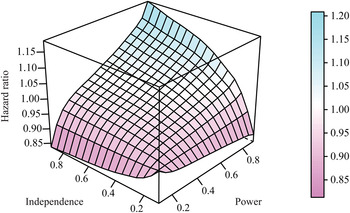
To further assess the interaction effect, we contrast the hazard ratios of multilateral powers with those of weak and/or dependent states. Here we compare a multilateral power at the 90th percentile of the variable values (on power and independence) with weak and/or dependent states at the 10th percentiles on one or both variable values. Figure 2 displays this relationship for the case where the United States does not ratify (Model 3). Multilateral powers are the strongest supporters of multilateral treaties as indicated by the extreme peak at the back corner of the diagram (HR of 1.17). Weaker and/or dependent states—represented by the three lower corners of the diagram—are hesitant supporters. Multilateral powers are between 27 percent (vis-à-vis weak and dependent states; HR: 0.92) and 36 percent (vis-à-vis powerful but dependent states; HR: 0.86) more likely to ratify treaties.
Visualization of the power × independence effect from Model 3

When the United States does ratify (Model 4), multilateral powers remain strong supporters of international agreements (with an HR of 1.08) but the differences between multilateral powers and other states diminish considerably. This is partly because multilateral powers ratify less when the United States does ratify and partly because other states ratify more when the United States ratifies (with HR ranging now between 0.88 and 0.99). This latter effect may reflect the US's ability to pressure weak and/or dependent states to ratify treaties it favors (and not to ratify treaties it does not favor). Multilateral powers are nevertheless still between 9.5 percent (vis-à-vis weak and dependent states) and 23 percent (vis-à-vis powerful but dependent states) more likely to ratify than other states. This confirms that while multilateral powers are strong supporters of multilateral treaties, they play an especially important role when the United States slacks.Footnote 68
To explore this effect of multilateral powers further, we examined cases where the United States showed decisive leadership through quick ratification (in the year of treaty adoption or the year after—Model 5), versus treaty cases where it ratified more slowly (in the second year or later—Model 6), suggesting that it was a reluctant cooperator. The hazard ratios for the key theoretical variables from Model 5 are dramatically different from the estimates in other models. They are not statistically significant and, more importantly, the directions of effects reverse. This suggests that with more decisive American leadership the multilateral powers play no special role in treaty ratification.
Further supporting this perspective, Model 6 shows that multilateral powers ratify more quickly when the United States goes slowly, just as they did when the United States did not ratify (Model 3). The hazard ratios for the power × independence interaction are again highly significant. When the United States is slow to ratify—and thus shows reluctance rather than leadership—multilateral powers again step up and ratify almost as frequently as when the United States does not ratify at all. This both broadens our view of leadership—it entails going early, not later—and confirms that multilateral powers step up their cooperation when the United States is not decisive.
These results are robust against a wide range of checks including alternative measures of power and independence, additional controls (for example, europe, new democracy, colonial past, religion (muslim), regional ratification intensity score, and signature), different subsamples of observations (with/without United States, G8, G20, European states) and different specifications beyond those shown here. Our results also hold against a simulation based on a random sampling of the original ratification data.Footnote 69
Our findings lead to four major conclusions. First, the models reveal a robust and statistically significant effect for power × independence. The empirical pattern shows that states' support for and influence on multilateral treaties is contingent on both their might and their independence. The conjunction of power and independence, rather than simply power alone, provides the more compelling explanation of treaty ratification. Second, the analysis verifies that multilateral powers are the strongest supporters of cooperation. This is especially the case when the United States hesitates or stays out (suggesting that it is a preference outlier). Third, when the United States does participate, it is able to pressure weak and/or dependent states to ratify—but the multilateral powers still remain the strongest supporters of multilateral cooperation. Finally, leadership in international legal cooperation requires decisiveness through speedy ratification. Overall, the results show that multilateral powers have compensated for the absence of US engagement in the postwar international system.
Conclusion
These findings open up interesting lines for further inquiry on international cooperation and governance more generally. Our analysis centered on the role of multilateral powers in international legal cooperation and we have not investigated the role of other states in depth. More work is needed on what determines the decisions of “smaller” states to ratify treaties. Our analysis was also tailored toward general patterns of legal international cooperation, looking at multilateral treaties of global reach and open to universal participation, but it neglects other more particular patterns. Investigating issue-specific (for example, commodity agreements) or regional patterns (for example, the role of regional hegemons) of cooperation would provide more detailed and complementary insights. Finally, our results are based on one specific type of cooperation. Future research should move beyond the study of international legal cooperation through treaties and assess the validity of our claims for other formalized arrangements (such as participation in international organizations), as well as for less formalized forms of cooperation (for example, soft law agreements, G-groups). The importance of multilateral powers as drivers of cooperation also should be investigated across these alternative forums.
Our findings on how US participation affects multilateral cooperation suggest broader, though speculative, implications of shifting global power balances. Whereas the United States has been commonly portrayed as indispensable for international order, other large and independent states may provide the foundation for continuing cooperation. These multilateral powers have the incentive to maintain and expand international cooperation regardless of whether the dominant actor participates. Thus the absence of American leadership need not undermine cooperation because multilateral powers can provide direction when the United States does not. This may increasingly circumscribe the US ability to achieve its particular goals insofar as it is not indispensable to the pursuit of multilateral cooperation.
Further questions arise with the prospective emergence of alternative leaders in international cooperation. For instance, a number of the key multilateral powers are organized through the EU which over time has become a more significant actor in treaty making, in international organizations, and in international cooperation more generally. The exploration of the EU's changing ability, not just to exercise power but also to influence smaller states, would be a useful extension of our analysis. Similarly, does the growth and possibly increased coordination among the BRICS states provide another source of leadership in international cooperation?
More speculatively yet, with the continuing rise of China, will competition between the United States and China dissolve into a dysfunctional rivalry or will it be channeled into multilateral cooperation? If the latter, then declining power may not be dangerous or destabilizing; competition for leadership when neither the United States nor China is singularly dominant might well have a catalytic role in promoting cooperation. The declining power has incentives to participate through the treaty since it will be less reliably able to control the cooperative outcome from the outside. Conversely, the rising challenger may seek to harness the power of multilateral support by working inside existing arrangements rather than seeking to undermine them. Although the scenario of rivalry between contesting powers is not implausible, our results support the possibility that multilateral cooperation can be the prevailing solution in global governance.
Supplementary Material
Supplementary material for this article is available at https://doi.org/10.1017/S002081831600031X.