Introduction
Cosmetic surgery is becoming more increasingly utilized worldwide. In the United States, more than 1.5 million cosmetic procedures are performed yearly, the top 5 of which are breast augmentation, rhinoplasty, blepharoplasty, liposuction, and rhytidectomy.1 Cosmetic surgery is defined according to the American Board of Cosmetic Surgery (ABCS)2 as “a unique discipline of medicine focused on enhancing appearance through surgical and medical techniques. Cosmetic surgery can be performed on all areas of the head, neck and body. Because treated areas function properly but lack aesthetic appeal, cosmetic surgery is elective.” Although the motivations for undergoing cosmetic surgery are likely diverse, it is reasonable to think that one of the major aims in undergoing such procedures is to ultimately improve one's subjective well-being and health-related quality of life (QOL). Post-surgery interviews have revealed that patients often believe that cosmetic surgery achieves not only a physical change, but also a transformation in QOL.Reference Adams3
We use the term “cosmetic” in this article consistently to minimize term confusion, although it is significant to note that “cosmetic” is synonymous with “aesthetic,” a term often used to describe cosmetic surgical procedures. The ABCS distinguishes between cosmetic surgery from plastic surgery by stating that: “Cosmetic surgery procedures enhance a person's appearance toward some aesthetic ideal,” whereas “plastic surgery focuses on repairing and reconstructing abnormal structures of the body caused by birth defects, developmental abnormalities, trauma, infection, tumors or disease.” Our usage of “quality of life” is guided by the World Health Organization (WHO), which has provided a conceptual definition of QOL as people's perceptions of their positions in life, in the context of the culture and value systems in which they live, and in relation to their goals, expectations, standards, and concerns.4 According to the WHO, the operational definition of QOL lends itself to measuring specific domains, such as subjective rating of physical health (eg, mobility), psychological health (eg, self-esteem), social relationships (eg, social support), and environment (eg, financial resources).5 Thus, factors such as physical appearance and body image are also related to QOL, for body image consists of “perceptions, thoughts, feelings, and behaviors not only about physical appearance but also one's body's competence, or fitness, and its biological integrity, or health/illness.”Reference Didie, Kuniega-Pietrzak and Phillips6 QOL encompasses the issues surrounding how one feels about one's own self/appearance and one's engagement and satisfaction with life activities, such as work, relationships, and leisure.4, 5
This article attempts a comprehensive review of the effects of cosmetic procedures on patients’ QOL. At the outset, it is important to note that while a large number of studies examined the relationship between cosmetic surgery and QOL, measuring QOL in this patient population remains to be remarkably challenging. QOL, as defined earlier,5 not only encompasses issues of appearance, but also of physical health, relationships, and social activities. However, the existing QOL literature on cosmetic surgery is quite fragmented and heterogeneous in that many studies we analyzed used a variety of general and procedure- or organ-specific QOL measurement tools.Reference Castle, Honigman and Phillips7, Reference Blomqvist, Eriksson and Brandberg8 Moreover, there is a lack of consensus on how constructs are defined, measured, and differentiated. For instance, some articles (that we ended up excluding) used the terms “QOL” and “body image” interchangeably. Consequently, future work on this important subject should attempt to employ specific scales to measure QOL in cosmetic surgery across procedures.
Furthermore, previous reviews have focused either on a particular body part, procedure, or set of measures. In addition, some studies, including one by Honigman etal ,Reference Honigman, Phillips and Castle9 concentrated on other valuable information, such as predictors of poor psychological or psychosocial outcome, rather than solely on pre- and post-QOL of different cosmetic surgeries. As a result, information regarding QOL at baseline and changes over time still needs to be explored. An assessment of the impact of cosmetic surgery on QOL would be of substantial value to patients who are thinking of undergoing cosmetic procedures, as well as to physicians who may be managing their physical and psychological health issues. Therefore, this review examines QOL across different body parts and procedures, especially before and after cosmetic surgery, in order to answer the following questions: What is the status of QOL before cosmetic surgery? Are there QOL improvements post-procedurally? And in patients experiencing QOL improvements, are these improvements sustained over time?
Review of Studies
The search strategy and yield are detailed in Figure 1.
Search strategy for studies examining QOL before and after cosmetic surgery.

Search strategy
A systematic literature search of articles published from January 1960 to December 2011 was conducted on PubMed/Medline and PsycINFO using the keywords “quality of life” OR “well-being” OR “self-esteem” AND “cosmetic” OR “aesthetic” OR “plastic” (in order to widen the scope of the search) AND “surgery.” We also reviewed the reference list of review articles for additional studies. This strategy identified 721 articles.
Study selection criteria and methodology
Two authors reviewed the 721 studies independently using the following inclusion criteria: (1) Articles in English or with an available published English translation, (2) publication in a peer-reviewed journal, (3) studies performed on adults, (4) Studies (of any design) that focused on cosmetic surgery, and (5) studies that used at least 1 self-reported outcome measure. Fifty-one articles met the above criteria, and 2 reviewers conducted a focused review using the full-text articles of studies that met the above criteria by assessing the studies for sample size, patient selection, interventions, group comparison, outcome measures, and statistical analysis, using study quality criteria adapted from Lohr and CareyReference Lohr and Carey10 by the Agency for Healthcare Research and Quality.11 This process led to the exclusion of 21 studies with serious limitations, such as studies with very small effective sample size and studies that used vague or insufficient data about outcome measurement. Two additional studies were excluded because they included procedures performed primarily for a medical indication (eg, bariatric surgery for morbid obesity) or office-based nonsurgical cosmetic procedures (eg, injectables). QOL studies in post-bariatric surgery procedures dealing with the cosmetic consequences of this type surgery were included in this review. The reviewers reached a consensus to include in this review 28 studies.
Data extraction
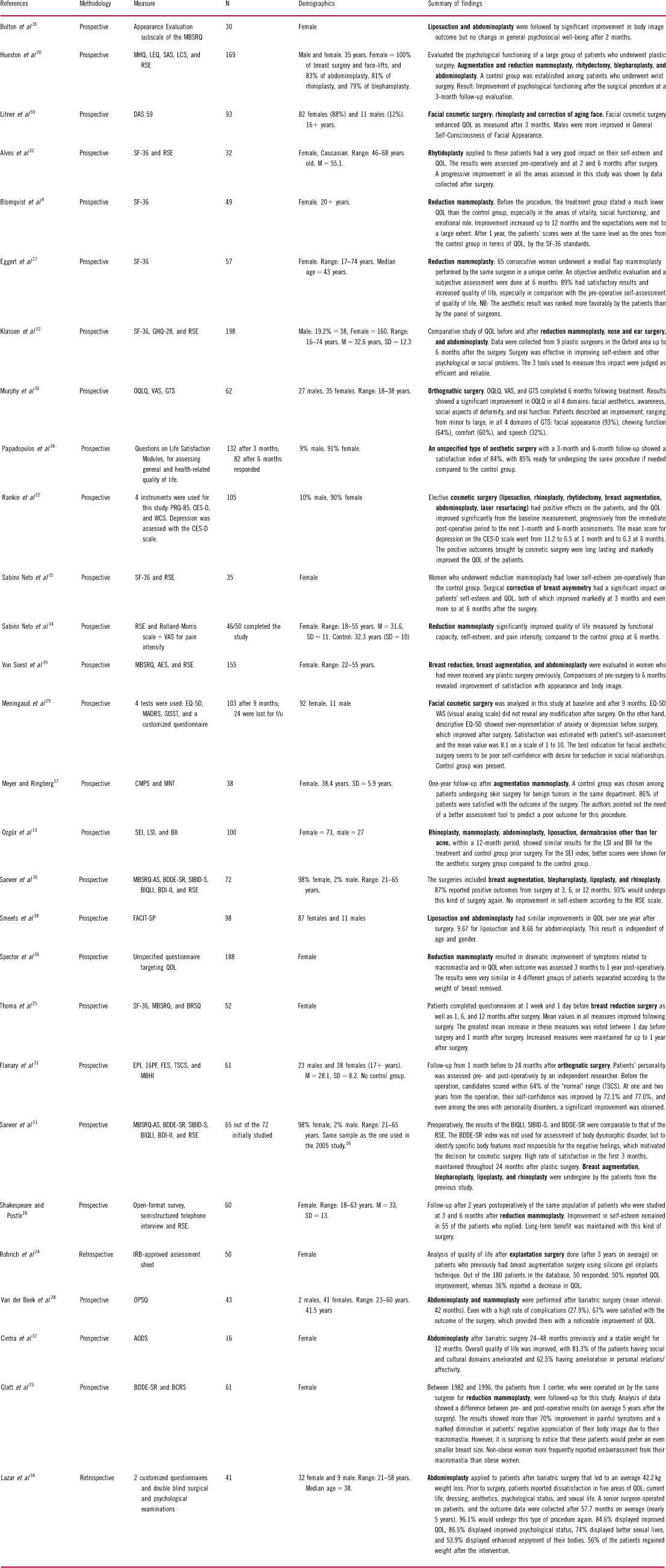
Research methodology and key findings were derived from the full text and tables of the selected 28 studies. Study design and findings are detailed in Table 1.
Quality of life in cosmetic surgery
Abbreviations: 16PF, Sixteen Personality Factor Questionnaire; AES, Appearance Evaluation Subscale of the Multidimensional Body Self-Relations Questionnaire; AODS, Adaptive Operationalized Diagnostic Scale; BCRS, Brief Cognitive Rating Scale; BDDE-SR, Body Dysmorphic Disorder Examination Self Report; BIA, Bioelectric Impedance Analysis; BMI, Body Mass Index; BII, Body Image Inventory; BIQLI, Body Image Quality of Life Inventory; BDI-II, Beck Depression Inventory II; CES-D, Center for Epidemiologic Studies Depression Scale; CMPS, Cesarec-Marke Personality Scheme; DAS 59, Derriford Appearance Scale; EQ-5D, European Quality of Life-5 Descriptive Self-Report Index; EPI, Eysenck Personality Inventory; FACIT-SP, Functional Assessment of Chronic Illness Therapy-Spiritual; FES, Family Environment Scale; GHQ-28, Scaled General Health Questionnaire-28; HRQOL, Health-Related Quality of Life; LCS, Locus of Control Scale; LEQ, Life Events Questionnaire; LSI, Life Satisfaction Index; MADRS, Montgomery–Asberg Depression Rating Scale; MBHI, The Millon Behavioral Health Inventory; MBSRQ, Multidimensional Body Self-Relations Questionnaire; MBSRQ-AS, Multidimensional Body Self Relations Questionnaire Appearance Assessment; MHQ, Middlesex Hospital Questionnaire; MNT, Marke-Nyman Test; MOS-HIV, Medical Outcomes Study HIV Health Survey; OPSQ, Obesity Psycho-social State Questionnaire; OQLQ, Orthognathic Quality of Life Questionnaire; GTS, Global Transition Scale; PRQ-85, Personal Resource Questionnaire; QOL, quality of life; QOLOD, Quality of Life, Obesity and Dietetics RSE, Rosenberg Self Esteem Scale; SAS, Social Adjustment Scale; SEI, Self-Esteem Inventory; SF-36, Short Form-36; SIBID-S, Situational Inventory of Body Image Dysphoria—Short Form; SISST, Social Interaction Self-Statement Test; TSCS, Tennessee Self-Concept Scale; VAS, Visual Analog Scale; WCS, Ways of Coping Scale.
Types of cosmetic surgery procedures
The identified studies reported on outcomes of the following procedures: rhytidectomy, rhinoplasty, breast reduction or augmentation, abdominoplasty/liposuction, and blepharoplasty/orthognathic surgery. Additionally, several studies described outcomes in patients who were pooled from a variety of the above cosmetic surgery interventions.
Reviewed studies
The studies addressing QOL in cosmetic surgery including QOL before and after intervention, type of intervention, and outcome measurement issues, are highlighted in the next sections.Reference Blomqvist, Eriksson and Brandberg8, Reference Klassen, Jenkinson, Fitzpatrick and Goodacre12–Reference Smeets, Noah and Seiferth38 Characteristics of all reviewed studies including methodology, outcome measures, number of subjects, demographics, and summary of the findings are presented in Table 1.
Pre- and post-operative QOL
QOL before cosmetic surgery
Six studies included assessment of QOL before cosmetic surgery interventions. Overall, the reviewed studies showed that cosmetic surgery candidates suffered from low QOL pre-operatively.Reference Ozgür, Tuncali and GülerGürsu13, Reference Sabino Neto, da Silva, Garcia, Freire and Ferreira15, Reference Sarwer, Infield and Baker21, Reference Lazar, Clerc, Deneuve, Auquit-Auckbur and Milliez34 Of note, 2 studies utilized general QOL measures that are widely used across illness and health states. Using the Medical Outcomes Study (SF-36), Blomqvist etal Reference Blomqvist, Eriksson and Brandberg8 showed that breast reduction candidates had significantly lower QOL baseline ratings compared to age-matched controls. Meningaud etal Reference Meningaud, Benadiba and Servant29 used the European Quality of Life-5 Dimensions (EQ-5D) to measure QOL at baseline in facial cosmetic surgery candidates. Although the anxiety/depression dimension of the EQ-5D indicated worse QOL at baseline, the mean EQ-5D VAS (overall QOL) scores did not significantly differ from community norm values.Reference Meningaud, Benadiba and Servant29 This illustrates the challenge in the assessment of QOL due to difference between study groups and the different measurement techniques used for assessing patient QOL.Reference Ozgür, Tuncali and GülerGürsu13
Short-term outcome: QOL within 6 months of cosmetic surgery
Sixteen studies included assessment of QOL within 6 months post-surgery.Reference Blomqvist, Eriksson and Brandberg8, Reference Klassen, Jenkinson, Fitzpatrick and Goodacre12, Reference Sabino Neto, Demattê and Freire14–Reference Sarwer, Gibbons and Magee16, Reference Shakespeare and Postle18, Reference Hueston, Dennerstein and Gotts20–Reference Rankin, Borah, Perry and Wey22, Reference Thoma, Sprague, Veltri, Duku and Furlong25, Reference Eggert, Schuss and Edsander-Nord27, Reference Murphy, Kearns, Sleeman, Cronin and Allen30, Reference Alves, Abla, Santos Rde and Ferreira32, Reference Litner, Rotenberg, Dennis and Adamson33, Reference Bolton, Pruzinsky, Cash and Persing35, Reference Papadopulos, Kovacs and Krammer36 Except for 1 study, patients undergoing cosmetic surgery showed improvement in QOL mean scores within the first 6 months. In the single study that did not show QOL improvement, by Bolton etal ,Reference Bolton, Pruzinsky, Cash and Persing35 the authors cited 2 potential reasons for the findings: (1) collection of outcome data after the relatively short period of time of 2 months and (2) the need to use more QOL specific instruments. In contrast, facial cosmetic surgery candidates showed progressive QOL improvement as early as 2 months in a study using the SF-36,Reference Alves, Abla, Santos Rde and Ferreira32 as well as 3 monthsReference Litner, Rotenberg, Dennis and Adamson33 and 6 months.Reference Murphy, Kearns, Sleeman, Cronin and Allen30, Reference Alves, Abla, Santos Rde and Ferreira32 Moreover, Sarwer etal Reference Sarwer, Gibbons and Magee16 studied 100 prospective cosmetic surgery candidates for 1 of 5 cosmetic surgeries: breast augmentation/breast lift, lipoplasty, rhinoplasty, rhytidectomy, and blepharoplasty. A multivariate analysis of variance (MANOVA) showed a significant improvement in QOL (p < 0.0001) and depression (using the Center for Epidemiologic Studies Depression Scale; CES-D) from baseline levels at 1 and 6 months post-operatively.Reference Sarwer, Gibbons and Magee16 Reduction mammoplasty was also noted to have a significant positive impact on QOL following the procedure in all studies.
Intermediate-term outcome: QOL 1 year after cosmetic surgery
Seven studies included assessment of QOL 1 year after cosmetic surgery, and 1 included assessment of QOL after 9 months. The findings indicate that 1-year postoperative QOL improved significantly compared to baseline across a variety of cosmetic procedures. Patients who underwent blepharoplasty, lipoplasty and rhinoplasty,Reference Sarwer, Gibbons and Magee16 augmentationReference Sarwer, Gibbons and Magee16, Reference Meyer and Ringberg17 and reductionReference Thoma, Sprague, Veltri, Duku and Furlong25, Reference Spector, Singh and Karp26 mammoplasty, liposuction and abdominoplasty,Reference Ozgür, Tuncali and GülerGürsu13, Reference Smeets, Noah and Seiferth38 and facial cosmetic proceduresReference Meningaud, Benadiba and Servant29 have been shown to experience significant QOL improvements compared to baseline after nearly 1 year. Notably, in one age-matched controlled study of reduction mammoplasty, the 12-month scores for the mammoplasty patients were close to the age-matched SF-36 scores, indicating normalization.Reference Blomqvist, Eriksson and Brandberg8 Additionally, sexual life also has a prominent role in QOL assessment after cosmetic surgery. One year after augmentation mammoplasty, 86% of patients not only reported both a satisfaction with the results of the surgery, but also an enhanced QOL in the area of sexual life with a 46% improvement.Reference Meyer and Ringberg17
Long-term outcome: QOL years after cosmetic surgery (2–5 years)
Eight studies included assessment of QOL 2–5 years post-surgery. The studies showed that during this time, significant positive long-term effects of cosmetic surgery are no longer continuing to improve but are maintained instead. For instance, in a large prospective multisite investigation of patient satisfaction and psychosocial status, Sarwer etal Reference Sarwer, Infield and Baker21 found that most improvements were seen at 3 months following cosmetic surgery and were maintained through the 2-year follow-up period post-surgery.
Remarkably, although 26.9% of patients had a negative opinion of their abdominoplasty after 2 years, the percentage of patients who rated 5 areas of QOL as good or very good were as follows: sexual relations (74%), psychological status (86.5%), current life (100%), dressing (84.8%), and aesthetics (79.5%).Reference Lazar, Clerc, Deneuve, Auquit-Auckbur and Milliez34 Similarly, even with a high rate of complications, patients who had abdominoplasty and mammoplasty performed after bariatric surgeryReference Van der Beek, Te Riele, Specken, Boerma and van Ramshorst28 continued to maintain their QOL ratings 3–5 years later.Reference Lazar, Clerc, Deneuve, Auquit-Auckbur and Milliez34, Reference Cintra, Modolin and Gemperli37
Comparison of QOL based on type of cosmetic surgery procedures: body vs. facial procedures
Because facial modifications are often more readily apparent to others than modifications on other body parts, we analyzed the difference in QOL findings between the 2 categories to see if facial cosmetic surgery would produce QOL results different from those seen in other areas. In the comprehensive study by Klassen etal Reference Klassen, Jenkinson, Fitzpatrick and Goodacre12, patient groups differed in the number of SF-36 dimensions that deviated from the general population prior to surgery. Non-facial procedures such as breast reduction and abdominoplasty differed from the general population significantly in 8 and 5 dimensions, respectively.Reference Klassen, Jenkinson, Fitzpatrick and Goodacre12 Pinnaplasty patients had significantly reduced social functioning and mental health scores, while rhinoplasty patients had significantly reduced general health perception scores.Reference Klassen, Jenkinson, Fitzpatrick and Goodacre12
Surprisingly, although all the patient groups—breast reduction, breast reconstruction, other breast operations, pinnaplasty, rhinoplasy, and abdominoplasty—showed a statistically significant change in 2 or more health status areas following surgery, the breast reduction group was the only one that showed a moderate to large change in effect size on all health status measures.Reference Klassen, Jenkinson, Fitzpatrick and Goodacre12 It must be noted that reduction mammoplasty is generally considered a reconstructive procedure due to the relief of back pain that accompanies the post-operative course; it may have cosmetic benefits for some patients. All other groups, including the facial procedures, only demonstrated small to moderate improvements in certain aspects.Reference Klassen, Jenkinson, Fitzpatrick and Goodacre12 Therefore, facial cosmetic surgeries do not actually lead to the highest improvements in postoperative QOL; these procedures yielded similar changes in QOL as other procedures.
Comment on the reviewed studies
Examination of QOL before cosmetic surgery reveals that most studies showed a lower preoperative global QOL in the treatment than in the control group. However, depending on the scale being used, some studies showed similar QOL ratings in both the treatment and community norm values.Reference Meningaud, Benadiba and Servant29 Again, this may be due to the possibility that study groups did not actually differ in terms of QOL or due to a consequence of the different measurement strategies employed for assessing patient QOL, which emphasizes the need for cosmetic procedure–specific QOL scales across procedure types in future studies. Our review also explored QOL following cosmetic surgery. Many articles in the literature measured QOL before surgery as well as after surgery at various intervals. Despite the heterogeneity of the population and assessment tools, most studies show an improvement in QOL after cosmetic surgery procedures. Follow-up intervals, ranging from 1 month to 5 years, were important in our analysis. Shorter intervals are problematic when considering QOL because the immediate postoperative period involves healing, where the patient may still have reduced function, significant pain, aesthetic differences, and an inability to work or socialize normally. In addition, patients may encounter various opinions from their social network regarding the results of the procedure at different intervals. Such issues may potentially have an impact on QOL. For example, an individual's partner, friends, or family may be the only observers of the results during the first month, but when the patient goes back to work, goes on a date, or goes to the beach for the first time after the procedure, there may be different reactions and emotions generated from the other people around the patient. These events may not be captured by short-term follow up.
At short intervals, up to 6 months, many authors have noted improvements in the QOL of cosmetic surgery patients. Differing aspects of the studies, such as the use of various measures or body parts, need to be taken into consideration when attempting to generalize results.Reference Blomqvist, Eriksson and Brandberg8, Reference Sabino Neto, Demattê and Freire14–Reference Sarwer, Gibbons and Magee16, Reference Bolton, Pruzinsky, Cash and Persing35 For instance, although QOL and/or self-esteem improved following mammoplasty,Reference Blomqvist, Eriksson and Brandberg8, Reference Sabino Neto, Demattê and Freire14–Reference Shakespeare and Postle18, Reference Hueston, Dennerstein and Gotts20, Reference Meningaud, Benadiba and Servant29 abdominoplasty,Reference Lazar, Clerc, Deneuve, Auquit-Auckbur and Milliez34 orthognathic surgery,Reference Murphy, Kearns, Sleeman, Cronin and Allen30 rhinoplasty,Reference Sarwer, Gibbons and Magee16 rhytidectomy,Reference Sarwer, Gibbons and Magee16 and blepharoplasty,Reference Sarwer, Gibbons and Magee16 patients’ post-operative QOL, in some studies, remained the same. The reason might be that the scope of QOL encompasses a wide range, including appearance, as well as satisfaction with life activities such as work, relationships, and leisure. Thus, it is possible for only 1 aspect of QOL to improve while the others stay the same or worsen with no significant improvement of the overall QOL after cosmetic surgery. For example, improvement in body image but not overall QOL or self-esteem in non-bariatric patients who underwent abdominoplastyReference Bolton, Pruzinsky, Cash and Persing35 was consistent with the findings of a prospective, multisite investigation of patient satisfaction and psychosocial status following cosmetic surgery.Reference Sarwer, Infield and Baker21 Consequently, while individual facets that comprise QOL, such as body image, may improve post-procedurally, the patient's holistic measure of QOL may remain the same for some types of surgery. This complex relationship between cosmetic surgery and QOL has been noted by other authors.Reference Mellor, Fuller-Tyszkiewicz, McCabe and Ricciardelli39, Reference Crerand, Infield and Sarwer40
When QOL does improve post-procedurally, this improvement may be evanescent, as increasing time intervals can narrow the difference in QOL ratings demonstrated by the treatment group as related to age-matched control group.Reference Blomqvist, Eriksson and Brandberg8 In fact, this Swedish studyReference Blomqvist, Eriksson and Brandberg8 saw a disappearance of post-operative differences in QOL when compared to age-matched normal controls after one year, ie, QOL normalization. Fewer studies followed up with patients for years post-operatively, suggesting a need for more long-term studies. Of the few studies that did, the focus was primarily on self-esteem and appearance-related psychological variables.Reference Lazar, Clerc, Deneuve, Auquit-Auckbur and Milliez34, Reference Von Soest, Kvalem, Skolleborg and Roald41, Reference Sarwer42 This information highlights the importance of performing serial, cosmetic-specific QOL assessments post-procedurally in future studies.
Other authors have also noted the diversity and potential unreliability of QOL measures in studies of cosmetic surgery patients. Kosowski etal Reference Kosowski, McCarthy and Reavey43 systematically reviewed the literature to analyze questionnaires that measured contentment and QOL after facial cosmetic surgery or nonsurgical facial rejuvenation, concluding that many questionnaires used in studies “had undergone limited development and validation,” while others were either constructed only from expert opinion or were lacking a published development process.Reference Kosowski, McCarthy and Reavey43 Furthermore, the content included in these questionnaires differed greatly, with none focused on procedure-related symptoms, procedural satisfaction, or pre-procedural patient education as discussed by Alderman etal. Reference Alderman and Chung44
Similarly, Reavey etal Reference Reavey, Klassen and Cano45 performed a systematic review of development, psychometric characteristics, and content of patient-reported outcome (PRO) measures that assess patient contentment and perception of body image or QOL after body contouring surgery. After subjecting the measures to appraisal for compliance with internationally-recommended guidelines, final five PRO measures, including one general measure Derriford Appearance Scale (DAS-59), one liposuction measure Freiburg Questionnaire on Aesthetic Dermatology and Cosmetic Surgery (FQAD), and three breast reduction measures: Breast Reduction Assessed Severity Scale Questionnaire (BRASSQ), Breast Related Symptoms questionnaire (BRS), and the BREAST-Q reduction module, were evaluated.Reference Reavey, Klassen and Cano45 The authors concluded that except for certain instruments that measure outcomes of breast reduction, PRO measures for most other body contouring procedures are limited in their reliability, validity, and responsiveness.Reference Reavey, Klassen and Cano45 Uniquely, for breast reduction outcome studies, there are adequate instruments that can be used, such as the BRASSQ and BREAST-Q, both of which have been shown to be valid and to have good psychometric properties.Reference Reavey, Klassen and Cano45
Although most patients are satisfied with their cosmetic surgery results and show an improvement in QOL postoperatively, there are those who are not satisfied. Identification of such patients and addressing their difficulties, a priori, might be important. Honigman etal Reference Honigman, Phillips and Castle9 identified the predictors of poor psychosocial or psychological outcome, and concluded that they should be used for screening in cosmetic surgery settings. These predictors include being young, being male, having unrealistic expectations of the procedure, previous unsatisfactory cosmetic surgery, minimal deformity, motivation based on relationship issues, and a history of depression, anxiety, personality disorder, and possibly body dysmorphic disorder.Reference Honigman, Phillips and Castle9
Conclusions
Measuring QOL in cosmetic surgery patients is complex. We found that the procedures and tools employed in research studies were remarkably diverse, thus yielding difficulties with data analysis. Several groups who set out to report outcomes after cosmetic procedures concluded that studies lacked the criteria required for meta-analysis, and the assessment measures suffered from design, reliability, and responsiveness issues. However, we found that several important themes emerged from these diverse studies. Most data indicate that individuals undergoing cosmetic surgery began with lower values on aspects of QOL than control subjects. Furthermore, while a patient's QOL improved significantly post-procedurally, this effect appears to plateau with time. Although most studies reviewed here show that QOL improves after cosmetic surgery procedures, a more detailed analysis reveals that QOL assessment in cosmetic surgery needs significant refinement of measurement techniques, including developing cosmetic surgery–specific QOL measures. The ultimate success of healthcare interventions (cosmetic surgery included) lies not only in fixing the surgical, medical, surgical, or/and psychiatric problem at hand, but also improving patients’ health status and QOL. Such conclusions represent a valuable starting point for further work on this important subject.
Disclosures
Dr. IsHak has received research grants from NARSAD (Quality of Life in Major Depression) and Pfizer (Geodon in Major Depression) that ended on December 31, 2011. Drs. Bensoussan, Bolton, Powell-Hicks, Postolova, and Razani, Mr. Reyes, and Ms. Pi have no conflicts of interest to declare.