Introduction
What does it mean to experience something as remote or wild? Can physical distance and a harsh natural environment be decisive factors in understanding a sociopolitical phenomenon? Can a wilderness be responsible for the emergence of a new social, religious, or political centre?
Imagine yourself visiting a remote nomadic region in Tibet.Footnote 1 You travel for several days (or more) by various forms of transport, but as you get closer to your destination you find yourself mostly in four-wheel drive vehicles because of the bumpy, dirt-covered, mountainous terrain. You note the insufficient infrastructural facilities as you enter the Tibetan plateau—the lack of proper public restrooms, clean restaurants and lodgings, and stable communication signals. If you are not used to high altitudes, your body has by then begun reacting to the soaring altitude: dizziness, headaches, and nausea intensify your physical experience of an already exhausting journey. Soon afterwards, however, once your body has made its peace with the new environment, the previously ignored vista of the plateau gradually draws your attention and refreshes you: the grass tapestries with no end in sight, the slow movements of grazing animals, crystal streams meandering through the land, the cold and bracing air penetrating your lungs, and, for some, a mysterious and spiritual energy permeating the atmosphere.
‘Yachen is far and cold!’ This remark is popularly shared among Buddhist practitioners, both Tibetans and (Han) Chinese alike, when they speak about the physical conditions of Yachen Gar,Footnote 2 the monastic community with which they are associated. Yachen is located on a nomadic plateau in the northwestern Sichuan province commonly known as Kham among Tibetans. For both Tibetans and Chinese, this area of Kham is seen as a wilderness because of its physical distance, challenging environment, and dearth of infrastructure. Despite, or—I would argue—because of, its remote geographic location and challenging living conditions, it has rapidly grown into one of the epicentres of the Tibetan Buddhist revival in post-Mao China. As of 2016, it houses approximately 12,000 practitioners, of whom more than 10,000 are Tibetan nuns.Footnote 3
The Tibetan Buddhist revival began on the Tibetan plateau in the early 1980s under the rather ‘loosened’ political environment that followed the Cultural Revolution.Footnote 4 The role of a handful of exceptional Tibetan male lamas, with their unusual spiritual charisma and personal charm, has been emphasized as a particularly important factor in attracting not only Tibetans, but, more significantly, Chinese disciples, including those from overseas.Footnote 5 While the roles played by various actors (mostly male lamas and Chinese disciples) and the ever-shifting political climate have been properly recognized, the physical environments of the leading monastic communities in the revival have been almost entirely ignored. In the dominant discussions of the revival, the remoteness and wildness of these communities, which are so commonly experienced and described by practitioners, are mentioned, at most, in passing and treated as background information.
Such disregard for the material features of these communities, however, results in more than a lack of information. Because of this disregard, we fail to recognize the presence of the wilderness as an essential and ongoing force that constitutes Yachen. In other words, because its physical features are not taken into account, Yachen has been treated as a steadfast and unchanging structure, as if it were a monastery captured in an old archive, waiting for an interpretation. Yet the community is far from static; it is inexhaustibly renewed and transformed through its distinctive spatial materiality. For Tibetan nuns, the physical distance between their natal villages and Yachen exempts them from labour obligations in their homes and villages. This allows the nuns greater latitude for their practice, which encourages more Tibetan girls to make the precarious journey to Yachen. For Chinese pilgrims, the experience of the gruelling and inconvenient road trip becomes a necessary component in their conception of Yachen as the purest and most sacred space, one that is utterly different from the impure cities from which they come. At the same time, within Yachen, there are now anxieties about the diminishing of this very wilderness due to the new technologies and modern facilities that have recently appeared in the community. For example, the adoption of electricity in Yachen not long ago has aroused contradictory sentiments that illuminate how members of Yachen conceive of their own community as a wilderness which safeguards its authentic practices and gives it its unique ethos.
I will present three ethnographic accounts—about a Tibetan nun, Chinese pilgrims, and reactions to the spread of electricity in Yachen—which are based on my field research gathered in and around Yachen between 2010 and 2016. Through these accounts, I show how the materiality of space plays a role in producing a centre where various social relations, actions, and meanings are forged. Before delving into these ethnographic details, I provide a brief sketch of the historical, geographical, and sociopolitical contexts of Yachen and the current Tibetan Buddhist revival. In doing so, I explain the specific liminal position that Yachen possesses and utilizes.Footnote 6
Yachen Gar and its liminality
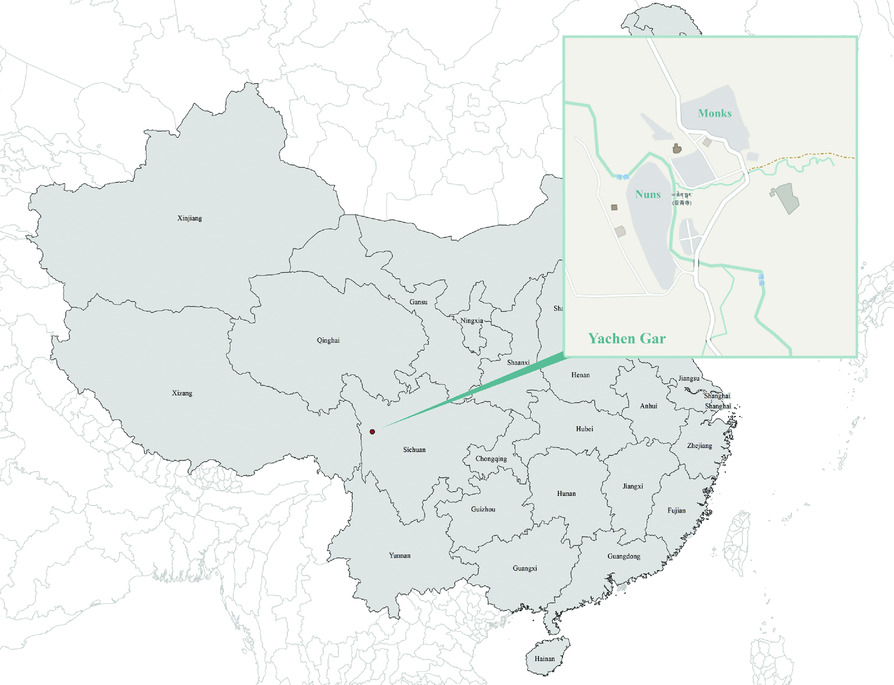
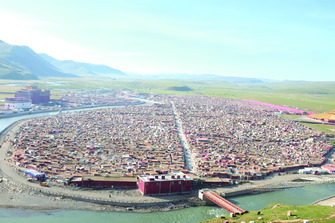
Since the 1980s, several Tibetan Buddhist encampments have arisen in the remote nomadic grasslands of Kham (northwestern Sichuan province), including Larung and Yachen, which have both grown into mega-sized Buddhist communities.Footnote 7 My focus in this article is Yachen, which is the more remote and physically challenging of the two encampments. Yachen is now considered as one of the living spiritual hubs of the Tibetan Buddhist revival and its profile continues to grow because of increasing numbers of religious events and its active teachings. But it is first and foremost an isolated Buddhist shantytown that sprang up in an out-of-the-way place on the Tibetan plateau, largely through the unexpected influx of young Tibetan women (see Figures 1 and 2). Yachen's geographic location places it far from almost all towns and cities in Tibet and China.Footnote 8 Even though road conditions have improved, seasonal floods, landslides, and snow relentlessly ruin the newly paved roads, which require constant repair and reconstruction, but are not properly attended to. Yachen's altitude of 4,000 metres often delays the time required to reach it and adds more difficulties to the trip, especially for those who are not used to such high altitudes. Since my first visit to Yachen in 2010, the improved road conditions have indeed shortened the travel time and the introduction of basic infrastructure has lessened the travails that occur during a journey to and stay in Yachen. However, for many visitors and residents alike, Yachen's remoteness and wildness nonetheless remain daunting and challenging, and its reputation as a wilderness is firmly intact.
A map of Yachen Gar. Source: This map was created by the author using the Geographic Information System (ArcGIS application).

The nuns’ residential encampment in Yachen, 2016.

Traditionally, Tibet consists of roughly three geographic divisions called Amdo, Kham, and Ü-Tsang. Historically speaking, Kham was considered to be on the far eastern periphery and lacked intimate connections to the central Tibetan government. Local chieftains often formed independent polities and non-Gelugpa-driven Buddhist practices and communities became influential in the region.Footnote 9 Kham is also on the far western frontier of the Chinese central polity and its proper inclusion in the Chinese state was subject to a heated debate in the early twentieth century. It has therefore been sandwiched between central Tibet and China proper, maintaining its distance from both these powerful political entities and generating its own sociohistorical trajectories and practices.Footnote 10 Yachen, located in Kham, shares the historical particularities of the region and occupies a liminal position in material, sociopolitical, and religious terms.
In post-Mao China, the distinctive liminality of Kham plays out dramatically in the religious realm by allowing for less-structured Buddhist communities to emerge and to thrive in unprecedented ways. The policies used by the Chinese state to control Tibet usually prioritize the Tibet Autonomous Region (TAR) in what might be understood as ‘TAR exceptionalism’.Footnote 11 The controls and surveillance aimed at formal, long-standing, major monasteries in the TAR are much sharper than those that target the nascent hermitages on the grasslands in Kham.Footnote 12 Moreover, Yachen's informality as a meditation-focused encampment resonates with a Tibetan sensitivity to the idea that, when it comes to practising Buddhism, putting oneself in a physically harsh environment and overcoming basic human material needs and desires are among the most highly respectful, and possibly the quickest, ways to achieve enlightenment. Historical and literary Tibetan accounts about renowned yogis, yoginis, hermits, and ‘crazy buddhas’ attest to this point.Footnote 13 The informality of Yachen is also responsible for attracting a large population of Tibetan girls who have little support from either their families (especially when they first begin their nunships) or lay society in general and who have limited access to or opportunities for joining formal monastic communities. Despite the lack of support from their families, the girls coming to Yachen are quickly able to settle down, receive good teaching and care from their new community, and practise fully as nuns.
While the historically significant monasteries in the TAR have largely turned into popular tourist destinations, Yachen is increasingly seen by practitioners as a promising new centre from which they can receive living and authentic Buddhist teachings. Countless Chinese pilgrims choose Yachen as their haven over traditional monasteries in the TAR. Increasing numbers of Tibetans from the TAR are also turning to Kham as their new pilgrimage destination due to government control of religious activities, which has been more severe in their region. One elderly male Tibetan from Lhasa whom I met in Yachen was travelling with his entire family. He told me that he had arranged this pilgrimage trip specifically to receive blessings from the great lamas in Yachen and from the place itself as well. I have seen and listened to many Tibetans like him who were travelling from the TAR because they believe that Yachen has become the new centre for Tibetan Buddhist teachings.
It is fair to say that Yachen is positioned simultaneously at two distant poles. From the Chinese perspective, it is located at the ethnic margin of a distant western part of China's territory, and from the Tibetan perspective, it sits at the political, religious, and geographic margins. Precisely by being on the margins of both China and Tibet, Yachen is growing into a spiritual hub of the Buddhist revival in contemporary China, one that is far away from the traditionally heated sites of political contention.
A nun far from homeFootnote 14
Anna Grimshaw's Servants of the Buddha is among the handful of ethnographic works in the English language about Tibetan nuns. Although the accounts in her book are limited to the lives of elderly Tibetan nuns living in a small isolated nunnery at the foot of the Himalayas, the book's title serves to alert us to a common and undeniable facet of nuns’ daily lives across the Tibetan plateau:Footnote 15 it signals that their lives may be less involved in solitary Buddhist practices than we imagine and considerably more geared towards physical labour for the communities in which they live. In fact, ethnographic studies about Tibetan nuns largely agree that, in many cases, their lives and their very existence are assured through the labour they supply for the monks and for the monasteries, rather than through their roles as independent religious practitioners.Footnote 16 Kim Gutschow's powerful ethnography demonstrates how Tibetan nuns in the Himalayan region are doubly burdened by having to provide labour for both monks and for their own families; daughters are ‘trafficked’ between families and monasteries in exchanges of merit making and the securing of lifetime labour.Footnote 17
It is likely that in small villages one can see more clearly how nuns are trafficked between families and monasteries because nunneries and monasteries share very similar territorial boundaries to village life. In such places, monastic and lay persons easily traverse across each other's social, economic, and kinship domains. Family members are often involved in building residential quarters in the monastery for their monk son or nun daughter, and monastics visit their natal homes to attend to various family affairs that are not always religious in character. Buddhist renunciation as detachment from worldly matters is hardly achievable in this context. As Gutschow vividly shows, for the Tibetan nuns in the Himalayas, these family ‘affairs’ are usually about providing labour—working on the family farmlands, herding animals, or helping with household chores.Footnote 18 This practice also occurs in nearly the same manner in Tibet: nuns in small nunneries located proximately to villages are often bound by seasonal labour obligations to their families.Footnote 19 The nuns can travel effortlessly between the nunneries and their natal villages whenever needed, and the kin-bound, lay-monastic relationship can easily compel the nuns to prioritize family affairs over religious obligations. From the outset, the general lack of systematic education for nuns and the overall belittling attitude towards nuns’ religious practices in Tibet can be discouraging to girls and lead them to seek out better environments—usually far from their natal villages—for advancing their practices.Footnote 20
In discussions of monastic expansion or reduction, the physical distance between villages and monastic communities has been almost entirely ignored and remains unanalysed. But when lay and monastic spaces are close to one another, the result is the frequent trafficking of nuns between the two locations. The labour demands placed on the nuns determine (and mostly disturb) the rhythm of their daily lives and the depth of their practices. Thus, the taken-for-granted and subordinate positions these women occupy, whether as nuns in androcentric monastic systems or as women in lay society, are fundamentally intertwined with their endless, unquestioned labour obligations in both spaces. The spatial proximity between village and monastic communities, through its lasting effect in maintaining a labour-mobilizing mechanism between the two domains, constantly degrades nuns into half-religious practitioners and half-standby labour providers.
Wangmo Footnote 21
Over the years in Yachen, I have spoken to many nuns, many of whom revealed, often casually, that they had escaped from their homes to become nuns in Yachen. While Wangmo's story is not representative of all of these stories, which are by no means homogeneous, it does provide an example of some of the changes that Yachen's wilderness produces in the lives of the nuns who live there.
Wangmo's home town is a small village near Lhasa, the capital city of the TAR.Footnote 22 She moved to the city by herself at the age of about 16 to escape the fate of becoming a wife and a mother, and began working in a small vehicle-repair shop run by a middle-aged Tibetan man. For a year or so before joining Yachen, she helped with chores around the shop and sometimes did the bookkeeping. According to Wangmo, her monthly salary was not bad and the work was not difficult either. Indeed, Wangmo knew that with her educational background—she was a primary school dropout—and without any connections in the city, she was very lucky to have secured such a stable, if not ideal, job. However, in the end, she decided to leave it because she felt uncomfortable with her boss's constant ‘inappropriate’ behaviour towards her and his claim that he wanted to marry her. She was about 17 at that time. Wangmo was too bashful to talk about this to me in more detail, but it was clear that his behaviour upset her very much.
It was not easy for Wangmo to find another, similar job in the city and she did not want to go back to her village. The life waiting for her there was one in which she helped out with household chores and herding animals until she was married off. Before coming to the city, she had, in fact, always dreamed about becoming a nun, yet had not dared to share that dream with her family because they would never have agreed to her plan.Footnote 23 But she thought this might be the right karmic time to revisit the idea. Wangmo was aware that it was not easy to seek out a nunnery in Lhasa. Becoming a nun in the TAR has become an extremely arduous, if not impossible, task as a result of the Chinese government's stricter policies for controlling Tibetan monastic communities and religious freedom in the TAR. Even if Wangmo had succeeded in joining a nunnery there, the sociopolitical and material conditions of most small nunneries in the TAR are no longer ideal for leading an active Buddhist life. On a practical level, the state's constant monitoring of monastic activities and personnel in the region restricts the core roles that Tibetan lamas play in Tibetan Buddhism and in Tibetan society in general. They are not allowed to offer teachings or religious initiations freely without being monitored by the Chinese state. Furthermore, the state has recently been aggressively trying to inculcate patriotism in Tibetan monasteries through mandatory education sessions.Footnote 24 Reading the situation clearly, Wangmo decided to look for a community outside of the TAR. She chose Yachen, which she had heard was a community where many nuns practise freely under the great teachers. Yet, because Yachen is located on a far eastern nomadic plateau, she would need to journey for many days to reach it.
After several days of rugged travel, Wangmo finally arrived in Yachen. It was not the first time she had travelled by herself, but travelling ‘this far’ was nonetheless very challenging for her. I met Wangmo in Yachen not long after she had disclosed to her parents that she had joined Yachen and become a nun. At first they expressed both anger and worry, but they soon accepted their daughter's bold decision and appreciated her determination. It seems that the girls who travel so far to escape their lives and become nuns are viewed by some parents as likely to be making firmer decisions. Wangmo's job in the city, which was already an unusual and courageous choice for a rural Tibetan girl, in fact enabled her to become a nun with little resistance from her family, and the unfortunate incident with her boss meant that instead of retreating home, she was able to venture out into the unknown world to live the life she had always wanted. Even though her options were limited, Wangmo chose the path of becoming a monastic and Yachen as the place where she would carry out her nunship for the rest of her life.
Leaving home and joining a nunnery is by no means a new path for Tibetan girls, but joining a monastic community that is significantly far from home has not been a very popular choice for young women in Tibet. Once they have escaped from their homes, most nuns spend up to several days alone on rough roads to reach Yachen. Many of them have never, or have only rarely, been outside of their villages or nearby towns. The nuns are probably not aware at first that one of the rewards for their long, gruelling trip is freedom from labour obligations to their families, which is firmly secured by Yachen's physical distance from their natal homes. This ‘freedom’ also creates a safe psychological distance for the nuns from the gender roles habitually imposed on them and allows them more independence as Buddhist practitioners. Yachen's remoteness effectively separates them from the visceral, kin-based ties of their lay villages that dominate village-monastic relationships in Tibetan society. It should be noted, though, that the nuns in Yachen are not entirely exempt from the gendered monastic hierarchy; in Yachen they are mobilized for large communal construction projects, while monks are never obliged to undertake such labour. The nuns are also tasked with making tea and food for monks during large and small rituals and ceremonies, and thus forego their own practices at these times. However, through the labour exemption from their home towns that is guaranteed by Yachen's remoteness, the nuns secure significantly more time for their practice and education when compared to those nuns who are constantly called upon to work on family farmlands due to their physical and mental proximity to their natal towns.
None of this should not mislead us into thinking that Yachen's ties to lay Tibetan society are fragile. In fact, they are stronger than ever when it comes to socioeconomic and cosmological exchanges. But these exchanges occur within a larger network and in a more systematic way that does not require trafficking the nuns’ labour to home villages and monasteries as a form of favour that is individually and unofficially exchanged between each household and a monastic head. The large sums donated to Yachen are also treated in a more transparent manner. The donors’ names are usually announced and donations are equally distributed to all practitioners. In return, the nuns pray for the donors in their collective prayer sessions.
Chinese disciples from afar
Another group with a strong desire to see Yachen as a truly distant place are probably the Han Chinese disciples who live in cities and visit Yachen occasionally for special events. Yachen's sublime purity is promoted by these disciples, who see it as a sacred respite from their contaminated cities. In the summer of 2014, I travelled with Xu and Zhao, Han Chinese disciples from a large city in southern China. We met as travelling partners in order to rent a vehicle together to attend one of the large annual rituals in Yachen. (Among my numerous trips to Yachen since 2010, this was the most luxurious—and the quickest—trip I experienced.) It was their first visit to the ethnic Tibetan regions and their excitement at travelling to an unknown space dominated the two full days of our journey from the city of Chengdu. With great expectations for meeting their Tibetan master in Yachen, they willingly endured, and even appreciated, the physical travails on the roads, such as poor infrastructural conditions, high-altitude sickness, the lack of toilets, and so on. In their view, the more inconvenience and hardship they experienced, the greater the sacredness of the place they would reach, and thus the more blessings they would receive from it. This view of the wilderness as a signifier of purity and sacredness is prevalent among Chinese pilgrims and visiting Yachen itself is thus considered to be a great merit-accumulating action.
As we travelled closer to Yachen, as she was appreciating the broad grassland through the window of our vehicle, Xu said, ‘Only uncontaminated lands such as “zangdi” generate great spiritual leaders.’Footnote 25 According to Xu, this is precisely why it is almost exclusively in Tibet that great masters are reincarnated, as opposed to, for example, large Chinese cities. The term ‘zangdi’, or ‘zangqu’, as used by Chinese tourists, indicates more than a neutral geographic designation for the ethnic Tibetan regions. Zangdi also elicits a romanticized image of Tibet as ‘the Other’, a backward yet uncontaminated space. Louisa Schein has called similar attitudes held by Han Chinese a form of ‘internal Orientalism’.Footnote 26 However, in a Buddhist context, ‘zangdi’ implies more than this Orientalized otherness that is ubiquitous in the context of the commercial, touristic Chinese view of ethnic minorities. It also connotes a sanctified and irreplaceable spiritual essence and power, embodied in the Tibetan lands and the teachings therein, which mainland China lacks. Apart from the cultural superiority many (Han) Chinese generally assume over ethnic minorities, I sense that these Chinese disciples also show genuine respect and absolute faith towards their teachers and the teachings that are rooted in this sacred land and culture.
The unquestionable admiration that Chinese disciples have for the Tibetan landscape and religion is well reflected in the incidents that occurred during Xu and Zhao's visit. The summer of 2014 when we were travelling was particularly busy. It was the third year since the previous great head lama, the founder of Yachen, had passed away and a special seven-day memorial ritual was scheduled for this particular event. Precisely because of this, that year was considered to be exceptionally auspicious for receiving blessings. Countless Chinese practitioners, including Xu and Zhao, arranged their pilgrimages for that year. It turned out that this was one of the largest gatherings Yachen had hosted thus far. The large number of Chinese disciples was well beyond Yachen's capacity for managing visitors. However, although the physical inconvenience was pronounced—lack of lodgings, public toilets, and other modern facilities—most disciples greatly appreciated participating in this once-in-a-lifetime ritual. And the feeling of ‘being selected’ for this special event was, in fact, further intensified because of a series of unfortunate accidents. During the first day of the ritual, a few Chinese practitioners suddenly fell ill, with most showing the symptoms of high-altitude sickness. They were given first aid and dispatched to a local hospital, where one disciple eventually died. In addition, we were informed that some disciples had not even been able to reach Yachen because of severe high-altitude sickness and had had to turn back.
Such events created a whole new dynamic among Chinese disciples by adding to the feeling of Yachen's unapproachability. The events described were taken to mean that human determination and planning alone cannot provide a guarantee for obtaining ultimate teachings; cosmological and karmic forces, which exist beyond individual effort and devotion, prevail in the end. Ongoing interpretations surrounding these events among the disciples were divided between attributing these forces to Yachen's coarse and wild natural environment and to its magisterial sacredness. Disciples who suffer enormously in reaching Yachen are considered to have negative karma, drawn from their previous as well as their present lives.Footnote 27 It is believed that such people carry a bad spirit or an ‘air of death’ (shaqi) and Yachen, by causing them serious physical hardship, does not allow them to step onto its sacred land. For those who succeed in reaching Yachen, these stories greatly enhance its sanctity as a true Buddhist spiritual hub. A consequence of the various interpretations, which circulate widely each year in Yachen, is that, for many Chinese devotees, Yachen embodies a form of supernatural power that is extremely protective of its sacred territory. This anthropomorphized land creates a spatial distance for itself away from polluted cities and any inauspiciousness, and only selectively accepts those who are considered to be suitable subjects. Among Chinese disciples, these incidents reassert Yachen's wilderness and enhance its unique aura.
Distant modernity
It should be noted that Yachen's wilderness is far from William Cronon's description of wilderness as ‘something irreducibly nonhuman, something profoundly Other than yourself’.Footnote 28 Nor is it the source of the kind of eccentric and startling experience that occurs when one confronts nature, things, or oneself—‘the sheer and singular thereness’, as in Jane Bennett's reading of Thoreau's works.Footnote 29 Instead, what Yachen stands for is a space of sanctified wilderness that is exclusively activated and protected by human involvement and imagination, for example, by the Tibetan nuns and the Chinese pilgrims whom I discussed above. Yet, the growing number and kinds of human activities and technologies that have recently come into Yachen both magnify and weaken its sanctified nature. Through the words, photos, and videos of Yachen produced by pilgrims and practitioners, Yachen's sacred landscape is broadly disseminated to an ever-larger audience. At the same time, the overcrowding presence of outsiders and the technologies they bring with them are destroying the pristine purity of the very wilderness these outsiders (and members of Yachen as well) seek in coming to Yachen.
The mix of anxiety and excitement about how technology may be affecting Yachen can be seen in the reactions of some of the nuns to the recent arrival of electricity in their residential quarters. The lack of electricity once powerfully guaranteed Yachen's role as a quiet, secluded space of contemplation; now, its availability challenges this image. And yet, precisely with the help of electricity, Yachen's secludedness is widely recognized far beyond its boundary. I show this complex and contradictory process and the mixed sentiments and attitudes towards encroaching modernity and the technological connectivity in Yachen, and address how its wilderness is held onto, if rather precariously, by the Tibetan nuns themselves.
Electricity in Yachen
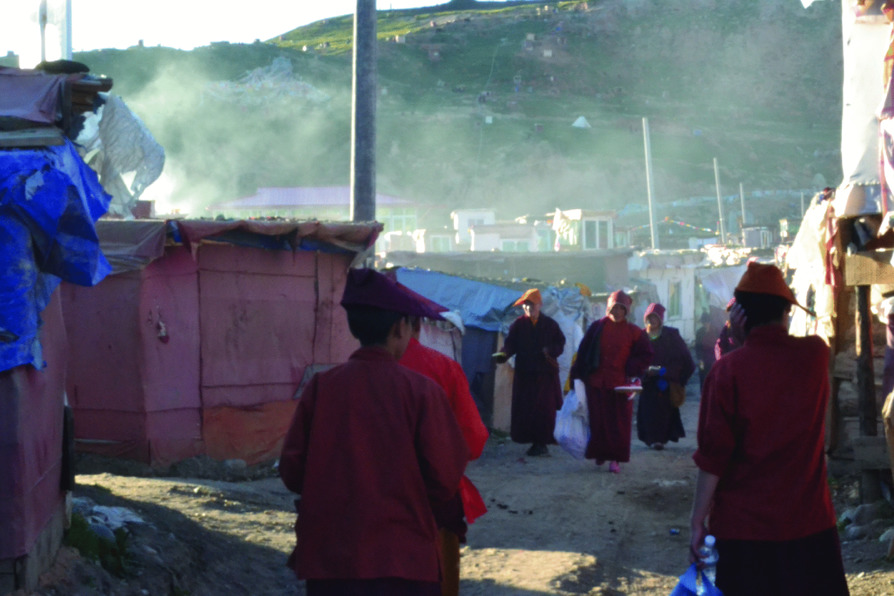
For several years, in the area of the nuns’ quarters, numerous telephone poles stood with no electrical wires attached to them (see Figure 3). Talk about electricity often buzzed around the community, and rumours and speculations were rife about when electricity would actually arrive. ‘When is it coming?’ ‘Soon.’ ‘Maybe within a month or two.’ By 2010, Yachen had already had some electrical power for years, although this power was mostly used in the monks’ and lamas’ residential areas. But, having seen the tall poles being set up in the nuns’ area and knowing that access to electricity had been available for some time already, it was reasonable to expect that power would arrive very soon to the nuns’ quarters as well. Nonetheless, this did not happen quickly after all. For more than three years the poles stood, planting a growing curiosity in all of us as to why nothing had happened yet. Speculation circulated in the community about the reasons for this. Different stories existed, but the principal one was that Yachen's head office had deliberately postponed the adoption of electricity service for the sake of the nuns’ solitude practices.Footnote 30 From my observations, regardless of the truthfulness of this claim, many nuns took this explanation seriously. Whenever faced with this unsubstantiated speculation, they seemed to agree that electricity would indeed affect their practices. ‘It doesn't quite matter. After all, we are here for practice, not for seeking material comfort,’ said one nun in a low tone, and few nuns would argue against this.
Telephone poles without wires in the nuns’ residential area in Yachen in 2011. Source: Photo by the author.

Electricity eventually came to the nuns’ quarters, beginning partially in the spring of 2013 and expanding to most of the area by the winter of 2015. Although the supply is still often unstable, electricity has significantly transformed the nuns’ living conditions, especially during the winter. Before electricity arrived, the nuns relied solely on small solar energy panels and generators that gave them, at best, a few hours of timid light at night. For heating, they usually used either a traditional stove fuelled with yak dung or, if that was not available—and this was indeed often the case—the nuns simply endured the long freezing winter without any heaters at all. Now, things have changed; instead of using traditional stoves, the nuns can use electric kettles to boil water and cook food, and they also enjoy much brighter light at night for longer periods of time. But most important, they use small electric heating units in their quarters, making Yachen a more tolerable place during the coldest months of the year.
However, the conversation I had with the head lama on this matter reflected the community's hidden anxieties about the negative effects of having electricity, something that had already been alluded to in the rumours and speculations. He expressed his concern regarding the adoption of electricity in the nuns’ quarters: ‘it [electricity] disturbs the mind’.Footnote 31 Even though he accepts the reality that certain modernization processes are inevitable and necessary, even in a place like Yachen, he has ongoing concerns about how to maintain a balance between spiritual practice and material comfort, which, in this case, potentially agitates the peaceful minds of the nuns. The head lama's concern largely resonates with the historically distinctive Tibetan Buddhist beliefs of the region mentioned above, namely, that harsher environments are more conducive to better and faster outcomes in the practice of Buddhism. Yachen is based on this type of hermit tradition and has found its spiritual authority as an emerging meditation centre precisely by projecting an image of itself as an ideal remote and secluded encampment that stands in sharp contrast not only to the bustling modern urban centres of China, but also to other formal monasteries in Tibet.Footnote 32 The increasing influx of modern facilities and technological connections threatens to erode the sacred remoteness of Yachen and the voluntary adaptation by practitioners to its harsh environment for the sake of their practice.
Despite such concerns and the inclination towards physical inconvenience to a greater end, electricity now affects every aspect of the mundane activities of the nuns. The solar panels that individuals used to have on their roofs are now almost obsolete, and those young nuns who joined Yachen after 2013, around the time when electricity was rolled out in the nuns’ area, seem to take for granted having electricity in their lives. They laughed at my descriptions of those years of Yachen before electricity. Furthermore, recently, some young nuns have begun carrying tablet PCs, which in itself is a strikingly unfamiliar scene. However, these nuns use their cutting-edge devices in a very restricted way: they mostly take photos of lamas, record lamas’ lectures and daily movements whenever possible, and share these photos and records with other device holders. Enshrining the photos and collecting the lectures of lamas are recognized and encouraged forms of expressing their faith and gratitude towards their teachers, and tablet PCs simply extend and reinforce these practices. Some Chinese nuns even save Buddhist texts to their gadgets and recite from them during rituals instead of using scriptures printed on paper. The nuns carry their photos and recorded lectures and texts with them to their homes and villages whenever possible and proudly share their collections with outsiders. They believe that this is one way to share the lamas’ blessings with the outside world. Therefore, the issue does not lie in owning electric devices per se, but in how to use them. The head office, at least thus far, does not seem to forbid nuns from using tablet PCs and other similar devices as long as these are not used to communicate with others and are employed for religious purposes only. Using devices for non-religious purposes is morally discouraged and condemned by fellow nuns, but even more so by the tablet users themselves. Self-monitoring the temptation to use electricity for entertainment is routinely practised by the nuns.
It is thus undeniable that electricity plays a crucial role in the promotion of Yachen as a leading Buddhist community: the lamas’ lectures are recorded and broadcast; auspicious pictures, books, and information circulate beyond the community; and certainly, more pilgrims arrive, more merits are made, and more people reach out for blessings because of the availability of modern technology. By relying upon electricity, Yachen's wilderness gains even wider recognition and practitioners obtain spiritual benefits. However, the processes of adopting electricity and extending its usages in Yachen have never been completely seamless; they sometimes cause speculations, expectations, concerns, and self-surveillance. Electricity might be exceedingly helpful for short-term visitors and residents in Yachen, but for many nuns the worry remains that the increase in modern conveniences may detract from the spiritual purity that Yachen embodies. A sense of apprehension lingers and occasionally looms large over the nuns when the head lama makes remarks about the side effects that modern facilities may have for practice or when the electricity shuts off completely for days to a week at a time and causes great inconvenience to the nuns, who are now accustomed to having electricity in their lives.
Conclusion
Social theorists see spaces as relational and processual. Henry Lefebvre, for example, emphasizes the generative role of social relations in producing spaces.Footnote 33 But while various social relations do play an important role in the production of a vital religious centre like Yachen, these relations are neither the exclusive, nor the major, cause in the making of this community. I have shown that Yachen's material and spatial features, and the specific relations forged through them, are fundamental components and an ongoing force in the formation of Yachen as a social space. Its material features are not merely incidental features that can provide, in footnotes and asides, background information about a space. Instead, I have argued that the materiality of a space plays a social role and should be treated as a crucial factor in producing that (social) space. The physical distance between Yachen and the natal villages of most of the nuns effectively creates a unique space in which they can fully immerse themselves in their practices and are free from labour and other obligations connected to their homes. This might seem insignificant at first, but by fully becoming practitioners, the nuns have begun to bring many subsequent changes to Yachen that other traditional monastic communities cannot even imagine for women.Footnote 34 This has resulted in attracting more Tibetan girls to Yachen. The Chinese disciples also rely upon Yachen's wilderness; it speaks to their desire for a sanctified site and their travel there becomes testimony to their own purity and worthiness as Buddhist practitioners. ‘Wild and remote Yachen’, therefore, serves the interests of both Tibetan nuns and Chinese pilgrims through the specific social relations they are creating with the space, and this image persistently serves to maintain Yachen as a unique centre in the Tibetan Buddhist revival.
However, the introduction of electricity to the community has begun disturbing the relationships these people are forging with Yachen. Practitioners in Yachen now enjoy various modern facilities that potentially change the entire nature of their experience of living in and travelling to this wild and remote hermitage. Yet it is too simple to say that Yachen is becoming modernized and more connected—through technology, it has become widely known to outsiders precisely as ‘wild and remote’. On 8 November 2016, The New York Times, in the first mention of Yachen in a major Western media outlet, published a report entitled ‘In remote settlement high on Tibetan plateau, Buddhist spirituality soars’.Footnote 35 The article, containing seven large, stunning photos of Yachen, focuses on showing how wild and remote Yachen is and, therefore, how pure and spiritual it is as a Buddhist land. While electricity (and technology, more generally) threatens Yachen's wilderness from inside, it makes possible the spread of this very remote and wild image of Yachen to the outside world in the most efficient and speedy manner. Technology complicates ever more the materiality of the space and the relations forged within it.
The philosopher Martin Buber notes the ontological potential of spatiality in human life by stating that the capacity for distancing, for objectifying the whole of nature at a distance, is an existentially unique feature of human life and that through distancing, human beings enter into relationships.Footnote 36 What follows from Buber's insight is that the insistent reproduction of Yachen's wilderness can be perceived as the act of creating a web of relations through spatial and material engagements. Various agents—nuns, Chinese pilgrims, and lama(s)—are setting out the relations that they wish to create with Yachen, as ways of distancing themselves from, for example, their places of origin (and the gendered roles embedded in those places), polluted urban centres, and the encroachment of technology. Through the practice of ‘distancing’ and the condition of ‘being distanced’, Yachen has evolved into a hub of Buddhist revivalism. This power of distancing, through which social relations and actions are formed, is the power behind the emergence of a centre in a marginal location.