Introduction
The use of antibiotics is far from homogeneous across geographic areas. A European cross-country comparison shows, for example, that the per capita outpatient antibiotic consumption in the Netherlands is three times lower than in France (Goossens et al., Reference Goossens, Ferech, Vander Stichele and Elseviers2005). Significant disparities are also observed across regions within a single country. In Germany, the rate of outpatient antibiotic use per inhabitant is approximately two times greater in high-consumption regions than in low-consumption regions (Kern et al., Reference Kern, de With, Nink, Steib-Bauert and Schröder2006).
This raises the question of optimal drug use, which is particularly important in the case of antibiotics. Studies show that the increasing use of antibiotics is associated with growing rates of bacterial resistance, which in turn reduce the effectiveness of antibiotic treatment (Boccia et al., Reference Boccia, Alegiani, Pantosti, Moro and Traversa2004; Coast et al., Reference Coast, Smith and Millar1998; McGowan, Reference McGowan2001; Levy, Reference Levy1998).
The investigation of what lies behind such variation in antibiotic use across geographic regions may help to identify sources of inefficiency in consumption. Few studies explore socioeconomic determinants of antibiotic use in the community.
Matuz et al. (2006) test associations between regional consumption of antibiotics in Hungary and possible determinants using the Spearman’s correlation coefficient approach. Determinants include the population structure, the prevalence of diseases, the per capita income, free access to medicines and the density of general practitioners and pharmacies. A significant positive correlation exists between antibiotic use and free access to selected medicines from the public health system, and between antibiotic use and social assistance.
Filippini et al. (2006) use an econometric approach and posit an ad-hoc model for the demand of outpatient antibiotics in Switzerland. They find evidence that antibiotic price, as well as other socioeconomic factors – such as the proportion of foreign residents, the density of medical practices, cultural and educational differences, and the per capita income – have a significant impact on antibiotic consumption.
Although the above studies differ in terms of statistical approach, the country under investigation and determinants considered, both conclude that further analysis should be undertaken to study the determinants of antibiotic consumption.
Although the literature is rich in studies exploring the variability ‘of antibiotic consumption at the hospital levelFootnote 1, very few studies investigate differences in community consumption across small areas. The focus on small geographic areas rather than on regions (counties or cantons) is desirable because smaller areas possess greater homogeneity in terms of health conditions and other population characteristics (Parchman, Reference Parchman1995). Nilson and Laurell (2005) and Henricson et al. (1998) focus on antibiotic consumption across city districts in Sweden and show that antibiotic use significantly varies across groups of individuals. Using a cross-sectional population survey, Muscat et al. (2006) examine epidemiological characteristics of antibiotic use in the community in Denmark. Generally, these studies focus on specific determinants with a descriptive approach rather than on identifying and estimating ad-hoc models of antibiotic demand.Footnote 2
The first purpose of this article is to explore socioeconomic determinants of small area variations in outpatient antibiotic use in Switzerland by means of a multivariate parametric approach. We specify and estimate an ad-hoc model for the local demand for antibiotics in outpatient care, which depends on antibiotic price, population income, age structure, health status and some cultural aspects of the population, as well as characteristics of the local antibiotic supply.
The second purpose of the article is to assess the economic impact of physicians’ and patients’ heterogeneous attitudes towards the use of antibiotics, i.e., heterogeneity in the risk perception of bacterial resistance. A common denominator in the analysis of small area variations is that significant differences in the utilisation of health services remain unexplained after controlling for standard determinants of demand and access. Many authors argue that heterogeneity in physicians’ practice styles may be an important cause of differences in medical utilisation across small areas (Wennberg, Reference Wennberg1984; McPherson, Reference McPherson, Andersen and Mooney1990; Westert and Groenewegen, Reference Westert and Groenewegen1999; Grytten and Sorrensen, Reference Grytten and Sorensen2003). In the use of antibiotics, after controlling for other factors, a substantial degree of the remaining heterogeneity can be associated with physicians’ and patients’ attitudes towards the risk of bacterial resistance (Harbath et al., 2002). Perceived levels of non-susceptible bacteria may affect physicians’ prescription strategies and patients’ decisions (Rudholm, Reference Rudholm2002; Laxminarayan and Weitzman, Reference Laxminarayan and Weitzman2002). Although average national levels of bacterial resistance are generally common knowledge, individual awareness of implications may be lacking.
To assess the impact of unobserved heterogeneity in practice style, Folland and Stano (1989) assume that this is an omitted variable complementary to all the explanatory variables considered in their model. Consequently, the unexplained variance can be interpreted as a measure of the impact of practice style on the consumption of medical services. We argue, however, that unexplained variations from a correctly specified ad-hoc model of the demand for antibiotics can be interpreted as a measure of the impact of heterogeneous practices due to uncertainty of the magnitude of bacterial resistance and different levels of risk perception. Parente and Phelps (1990) propose a methodology to assess the welfare loss due to unexplained variations in medical practice based on linear demand curves. We build on a similar approach to calculate the welfare loss due to heterogenous practices in the use of antibiotics in outpatient care.
The article is organised as follows: Section 2 summarises the Swiss policy context and describes variations in outpatient antibiotic use across 240 small areas. In Section 3 we sketch a simple ad-hoc model for the local demand of antibiotics in the community. A theoretical frame for the assessment of welfare loss due to unexplained variations is presented in Section 3.1. Results from econometric estimations are discussed in Section 4, with Section 4.1 providing a calculation of the welfare loss associated with unexplained variations. The conclusions of the article are presented in Section 5.
Small area variations
Switzerland is a federal state comprising 26 cantons. The country can be divided into three macro-areas by grouping cantons linguistically (i.e., German-, French- and Italian-speaking cantons). Health care policy, and as a consequence, the organisation of the health care system differ from canton to canton. In general, however, the health care system is based on a mixed (private-social) health insurance system. Health insurance is mandatory for residents and the same basic contract is offered by competing private insurance companies. The insured can choose from a limited menu of deductibles. Physicians are reimbursed using a straightforward fee-for-service scheme. The remuneration system is not directly related to the prescription of drugs but patients’ perceptions of doctors may be affected by prescription strategies.
Although average individual antibiotic consumption in Switzerland is low compared to other European countries, it varies greatly within the country. High levels of antibiotic use may increase bacterial resistance. Moreover, there is the risk that resistant bacteria may enter the food chain through livestock. The Swiss National Science Foundation (2007) argues that resistance will very likely progress if no containment measures are undertaken. However, Switzerland is in a “pre-pandemic” situation, where antibiotic resistance is not yet perceived as an important threat by the population. Few major hospitals in the country prepare guidelines on antibiotic use based on information on levels of bacterial resistance collected from cantonal laboratory tests. Such information is generally released every one or two years and, in some cases, is delivered to general practitioners. A national surveillance database on bacterial resistance is being developed and currently provides information for some macro regions.
As part of a larger project investigating outpatient consumption of antibiotics, we collated data from the 240 contiguous market areas that make up Switzerland. These market areas can be grouped to represent administrative units (the cantons) and cultural/linguistic regions. Generally, a canton is made up of between 10 and 20 market areas. Each market area exhibits high level of internal homogeneity with respect to population and health care provider density. The population varies between 4,980 and 125,275 inhabitants per area.Footnote 3 Each area has at least four pharmacies and/or drugstores. Local wholesale quarterly data on outpatient antibiotics at the product level were obtained from IHA-IMS Health Market Research for the year 2002. Using the number of inhabitantsFootnote 4 and WHO standard doses, we calculated the defined daily doses sold to 1,000 inhabitants per day (DID) for each of the areas.
This measure represents a good indicator of local outpatient antibiotic use. We assume that antibiotic purchases by individuals outside their area of residence offset purchases by non-residents inside each area. We do not take into account the difference, if any, between the quantity of antibiotics sold and the quantity actually consumed, assuming patient’s non-compliance to be a negligible factor. Finally, the potential mismatch between wholesale records and prescribing data due to seasonal fluctuations of retailers’ stocks is assumed to have only a limited temporary effect and is likewise ignored.
As illustrated in Fig. 1, there is a great heterogeneity in antibiotic use even across small areas within cantonsFootnote 5. The mean DID (across the small areas) is 11.71 and varies between a minimum of 4.65 and a maximum of 16.77 at the cantonal level. Note, however, that within-canton variation is much greater because the minimum DID in a small area is 3.18 (AG), whereas the maximum DID value is 141.27 (ZH).
Within-canton variations in per capita antibiotic use (2002)

The model
There may be several reasons for variations in the use of antibiotics across small areas. All other things being equal, we hypothesise that four main factors affect inter-area variability: the incidence of community-acquired infections, the local supply of community care, population characteristics (age structure and income, cultural aspects) and the price of antibiotics. In addition, antibiotic use could be influenced by the level of bacterial resistance and antibiotic consumption in adjacent areas. The magnitude of bacterial resistance country-wide is known to doctors and patients, but such figures are not broken down for smaller areas. We operate on the assumption that bacterial resistance does not vary across local areas but that local doctors and patients may have different attitudes towards the use of antibiotics. This means that the perceptions of the implications of bacterial resistance differ across the areas.
We specify an ad-hoc demand model to explain variations in the per capita use of outpatient antibiotics across the small areas. The dependant variable is the defined daily doses per 1,000 inhabitants described earlier. All other things being equal, we assume that for the area i:

where Yi is the average income of residents in the area i, POPji is the percentage of the population in the j age range; INFki is a proxy for the health status of the population represented by the incidence of k main bacterial infections at the cantonal level; DPHYi and DPHAi are respectively the density of physicians and pharmacies in the area; and Pi is the price of a defined daily dose in period t − 1. Lagged values for prices are used to reduce the risk of endogeneity between quantities and prices.
DBORi is a dummy that captures any borderland effects with neighbouring countries and DLATi is a dummy that considers whether an area is mainly characterised by Latin (French- and Italian-speaking) or German culture. Finally, DTt are time dummies that identify the four quarters of the year, with DT 4 (October, November, December) the baseline quarter. Defined daily doses of outpatient antibiotics per capita are expected to be higher during winter and lower in the spring and summer periods, as pointed out by Goossens et al. (2005).
Because patients’ preferences for antibiotics in one area may reflect individuals’ attitudes towards antibiotics in adjacent areas, we need to consider the potential impact of spatial dependency. The issue is further discussed with the model specification at the end of this section.
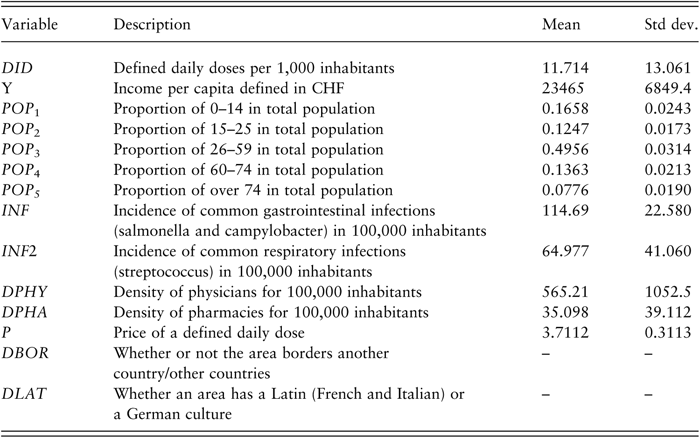
Our dataset includes quarterly information for the year 2002 and for the 240 regions on covariates defined in equation (1). Summary statistics are reported in Table 1.
Variables notation and summary statistics

Among the idiosyncratic characteristics of the population, we include the demographic structure, socioeconomic aspects and cultural attitudes. We consider five age groups: 0–14, 15–25, 26–59, 60–74 and over 74. For example, if the antibiotic therapy represents a time-saving choice for individuals in the work force, one might expect that middle-aged individuals are more likely to use them, ceteris paribus. This hypothesis is in accordance with the findings of Mousquès et al. (2003), who studied general practitioners’ antibiotic prescriptions for rhynopharingitis infections. On the other hand, the elderly may be less exposed to community-acquired infections, even though more susceptible, or be more concerned with the implications of bacterial resistance and hence use less antibiotics. We hypothesise that children are more likely to be prescribed an antibiotic than adults ceteris paribus. It can be argued that doctors and patients may be concerned with the potential harmful effect of delaying antibiotic treatment for the very young.Footnote 6 Resi et al. (2003) find that the percentage of children receiving antibiotics decreases as they grow up. Whereas 70% of children between 1 and 2 years of age received at least one prescription during 2002, this was the case for only 36% of young people 11 years old or older.
As for socioeconomic factors, Henricson et al. (1998) show that the level of income is positively correlated with the use of antibiotics. Attitudes towards antibiotics may also be affected by cultural/linguistic aspects. Lecomte and Paris (1994) suggest that sociocultural factors may explain differences in consumption patterns between European countries. Elsevier et al. (2007) show that southern European countries consume higher doses of outpatient antibiotics per capita. Because Swiss regions are characterised by German-, French- and Italian-speaking communities, we want to investigate whether these linguistic communities’ attitudes towards antibiotics mirror those of German, French and Italian speaking countries in Europe. Filippini et al. (2006) show that French- and Italian-speaking cantons consume more antibiotics compared to German-speaking cantons. This claim can now be inspected using data from small areas. Forty-four percent of our small areas are characterised by Latin (French and Italian) culture. Around 12.5% of the areas have a border with a foreign country. The density of foreigners or working commuters from other countries may also affect the per capita use of antibiotics.
The characteristics of the local supply of community health care can be captured by the availability of practices and pharmacies in the area. In our dataset the number of physicians per 100,000 inhabitants ranges from 43 to (in one special case) 10,730. The coefficient of variation is around 3 and suggests that there are large variations across the areas. Besides physicians’ density we observe large differences in the density of pharmacies across the small areas. The number of pharmacies per 100,000 inhabitants varies between 4.8 and 333. In the context of primary care, Grytten and Sorensen (2003) find that physician-specific effects in Norway explain between 47% and 66% of differences in expenditure. Folland and Stano (1990) suggest that the primary care physician to population ratio reflects the supply of medical services and constitutes a potential explanation for small area variations in the use of health care services. Similarly, we hypothesise that the density of physicians may affect the probability of antibiotic prescriptions under imperfect information on the impact of bacterial resistance, ceteris paribus.
Differences in the incidence of infections among geographic areas are also likely to impact the per capita use of antibiotics. Note, however, that remarkable seasonal fluctuations suggest that the incidence of the most relevant community-acquired infections, such as influenza and pneumonia, also vary widely during the year. Data on bacterial infections are based on information on the incidence of common gastrointestinal and respiratory diseases. As indicators we use the incidence of campylobacter and salmonella infections, the leading causes of gastrointestinal infections, and the incidence of Streptococcus pneumonie infections which represent the most common airborne bacterial infections among the population. In most cases patients recover without any medical treatment. However, patients, especially children and elderly patients, may be prescribed antibiotics when symptoms are particularly severe. Data on gastrointestinal infections are generally more reliable than those for airborne bacterial infections. However, the latter are also included in the model lest their omission impact residual variations.Footnote 7 Our information comes from yearly publications of the Swiss Federal Statistical Office at the cantonal level.
Although individuals bear only a small fraction of the cost of antibiotics, differences in health insurance co-payments and deductibles may influence the price elasticity of the demand. Moreover, competition and wholesalers’ marketing strategies may vary across the areas, thus leading to significant price differences. Consequently, the price of antibiotics may account for variance in consumption across small areas. The price of a defined daily dose is calculated quarterly and varies between CHF 2.81 and CHF 4.80.
The information on prescription and consumption practices related to doctors’ and patients’ risk aversion in the use of antibiotics has been omitted in our model and local rates of antimicrobial resistance cannot be observed. The interpretation of unexplained variations from equation (1) will be addressed in detail in Section 3.1.
To investigate the responsiveness of local per capita antibiotic sales to changes in the explanatory variables, we use a linear specificationFootnote 8 of the model defined by equation (1). Coefficients represent changes in the value of the dependent variable corresponding to variations in the value of each explanatory variable, ceteris paribus. Unexplained variations are assumed to be independently and identically normally distributed.
From the econometric point of view, we should consider that our dataset is characterised by a relatively small number of time periods (t = 3), a relatively large number of cross-sectional units (N = 240) and zero within-variation for most of the explanatory variables. The only two variables that change over time (three quarters) are the outpatient per capita consumption and the price of a daily dose. Hence, the typical model for panel data, e.g., the least squares dummy variable model and the error components model, are not appropriate.Footnote 9
An econometric problem that could arise when estimating the demand model (1) is spatial correlation due to spatial dependency in antibiotics consumption. For this reason, we use a spatial two-stage least-square (S-2SLS) estimation procedure.Footnote 10
Because we use time lags for the price, the first quarter (January, February and March) is excluded from the regressions. The estimation is performed using the econometric software STATA.
Unexplained variations
We now focus on the analysis of unexplained variations in the use of antibiotics in ambulatory care after controlling for the demand and supply-side determinants considered above. The literature suggests that unexplained variations in medical practice may be associated with unobserved heterogeneity in physicians’ practice styles but omitted factors may also be related to patients’ preferences. As posited by Stano (1993) patients’ preferences may interfere with the impact of practice style in the residual variations.
In the case of antibiotics, unexplained variations are plausibly related to differences in doctors’ and patients’ attitudes towards the risk of antibiotic treatment, i.e., the impact of bacterial resistance. National average levels of bacterial resistance are common knowledge but doctors and patients may be assumed to differ in their level of risk aversion. Doctors have two options: prescribe antibiotics at the first consultation despite uncertainty about the nature of the infection, or delay antibiotic treatment until the type of infection is determined. The former strategy may appease the patient but increases the risk of developing bacterial resistance. The latter strategy reduces the risk of bacterial resistance but may increase recovery time, and hence the opportunity cost for the patient.
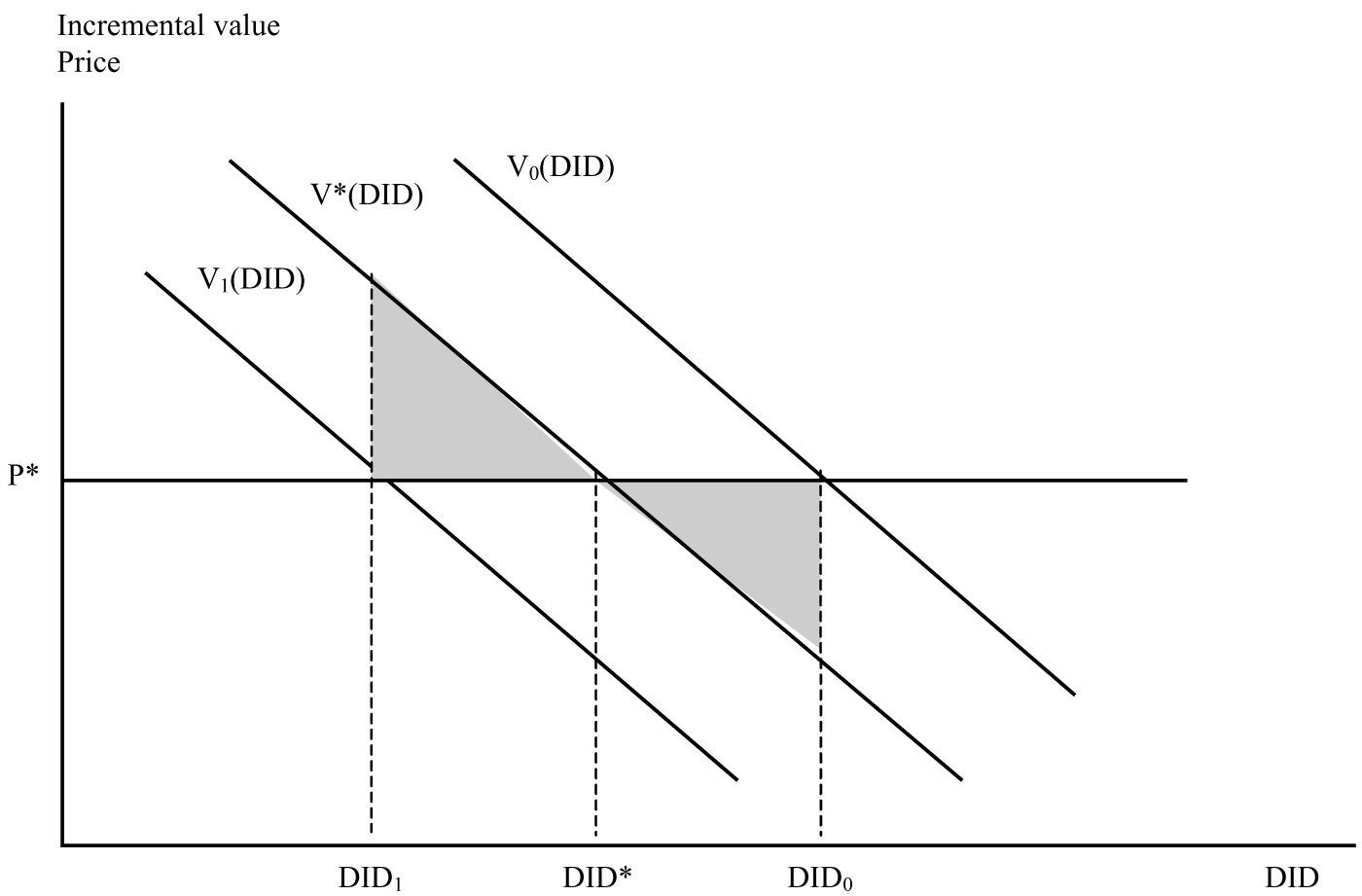
We assess the welfare loss from unobserved heterogeneity in the use of outpatient antibiotics building on a frame developed by Parente and Phelps (1990). The method relies on the determination of the loss of consumer surplus due to a shift in the linear demand curve. Figure 2 illustrates the market for antibiotic treatment. We presume that local variations arise from parallel shifts in the antibiotic demand curve between observed “uninformed” locations (V 0 and V 1) and a “fully informed” demand curve (V*) to which patients would move if they possessed all relevant information about the value of antibiotics. The “fully informed” demand curve would be the aggregate of all value curves for individuals and captures the social marginal benefit of antibiotic utilisation. This means that the implications of bacterial resistance are also taken into account. We assume that bacterial resistance does not vary locally and the aggregate level of antibiotic resistance is common knowledge among prescribers. This assumption is plausible given the low average levels of antibiotic consumption in Switzerland. Marginal benefits of antibiotic treatment are decreasing at constant rates. Many analyses of medical interventions rest upon this assumption. In the case of antibiotics, increasing daily doses may reduce antibiotic effectiveness because of the selection of resistant bacteria.
The loss of consumer surplus due to variations in the use of antibiotics (shaded areas). Heterogeneous attitudes towards bacterial resistance lead to shifts in the “fully informed” demand cure (V*) to “uninformed” locations (V 0 and V 1)

The level of antibiotic use that maximises consumer’s well-being (DID*) in each small area is the point where the marginal value just equals the marginal cost of antibiotic treatment (p*). We calculate the “optimal” amount of antibiotics as the average per capita rate of antibiotic use across all the small areas. Antibiotic use in each area measures consumption by the representative individual. This is ensured by the homogeneity of individuals’ characteristics within each area.
The marginal cost of a defined daily dose is constant and is given by the average antibiotic price across the areas.Footnote 11 This requires that the market price represents the full cost of antibiotic use and that patients do not incur additional incremental costs. Patients generally pay drug costs until their deductible has been reached. The cost of a consultation represents a fixed cost that presumably does not increase with the number of individual doses. It also requires that the market for antibiotics be competitive. Generally, new, branded antibiotics are sold under patent protection. Their market price may include research and development costs of new drugs because bacterial resistance undermines the effectiveness of previous generations of antibiotics. Note, however, that many types of antibiotics are traded in the generic drug market and that regulators are increasingly adopting mechanisms of reference pricing, which imply comparison with prices set in other countries.
Given this frame, we can quite naturally estimate the welfare loss from under- and over-consumption due to cross-area differences in utilisation. The procedure uses the residuals from equation (1) in order to account for systematic differences in consumption across areas due to factors such as age, income, price and infections.Footnote 12 Our explanatory factors are unaffected by the demand for antibiotics in outpatient care, and are thus truly exogenous. The incidence of mild respiratory and gastrointestinal epidemic infections (for instance, influenza) is presumably independent of antibiotic use in outpatient care. Physicians’ and pharmacies’ density are also independent of antibiotic consumption in the community because licences are usually regulated by the cantons. The slope of the demand curve is represented by the estimated coefficient of price from the linear regression of equation (1).
As demands are linear, the total daily loss for 1,000 inhabitants due to the misuse of antibiotics (shaded areas in Figure 2) adds up all of the values of inappropriate consumption over the N areas. Hence, the total loss is the sum of all the welfare loss triangles:

where ΔDIDi and ΔVi represent deviations from the “optimal” level DID* and V*. The value of residual variations in the use of antibiotics is then obtained by summing the value of deviations from the estimated (efficient) level of antibiotic use across the areas.
To approximate ΔV i we assume that V′ is the slope of the demand curve and we have ΔV = V′ (DIDi − DID*). Then we can rewrite equation (2) as

where  is the variance of the defined daily doses per capita across the areas. The above definition of welfare loss matches data available in the aggregate after some algebraic adjustments. We define ɛ as the percentage of change in DID for a one percent change in V. Hence, ɛ = (dDID/DID)/(dV/V) = V/(V′ DID). Similarly, we convert the variance measure into an expression using the coefficient of variation (CV). Finally, the “correct” use of antibiotics provides value just equal to the marginal cost of a daily dose. We divide the variance by the square of the average use to obtain CV 2 = σ2/DID*2. Thus, we can write equation (3) as

We can re-scale (4) to calculate the total welfare loss for one year for the whole Swiss population. We multiply WDID by (365POP), where POP is the Swiss population divided by 1,000. We then obtain

where DDDs is the total number of doses used for one year by the entire Swiss population. Consequently, V*DDDs represents the total Swiss spending on outpatient antibiotic use.
Empirical results
Four groups of determinants of small area variations in outpatient antibiotic use are included in the model defined by equation (1): (i) the incidence of infections; (ii) the demographic, socioeconomic and cultural aspects of the population; (iii) the supply of health care in the community; and (iv) antibiotic price. A preliminary investigation shows that correlation coefficients between the dependent variable and the explanatory factors are all significant on the basis of a two-tailed test.
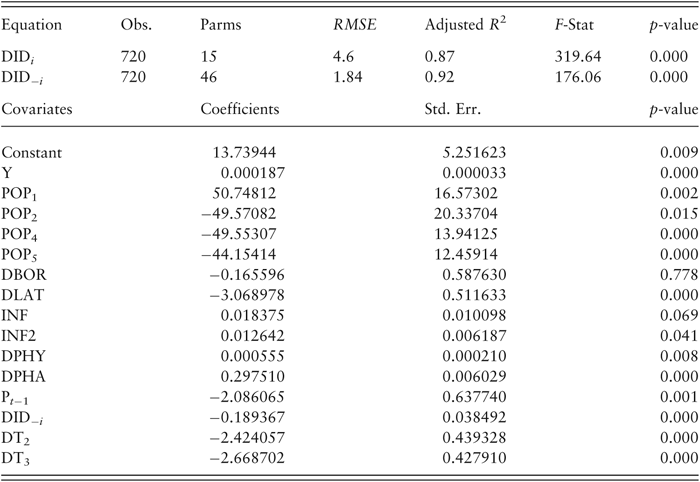
The estimation results obtained using the S-2SLS estimation procedure are reported in Table 2. The estimated spatial autoregressive parameter associated with the lag term DID−i is significant and negative. This indicates that the S-2SLS model should be preferred to the Ordinary Least Squares (OLS) model.Footnote 13
Determinants of outpatient antibiotic use (2002 quarterly) across small areas from spatial two-stage least square regression

Perhaps the first point to note is that the adjusted R 2 suggests that selected variables explain approximately 87% of small area variations in the use of antibiotics in the community. This figure is very close to the one estimated in Filippini et al. (2006) with a log-log model specification and cantonal data (the adjusted R 2 is between 0.887 and 0.9).
The positive relationship between DID and income is significant at less than 0.1% and suggests that richer areas spend more on outpatient antibiotics per capita than lower income areas. The result is in accordance with findings by Nilson and Laurell (2005), who analysed the impact of socioeconomic factors on antibiotic prescriptions in a Swedish city. Similarly, Henricson et al. (1998) found that antibiotic consumption is higher in higher income districts. However, our coefficient is relatively low and may indicate that antibiotics in outpatient care are not as strong normal goods as Baye et al. (1997) suggest for anti-infectives (elasticity around 1.3). Indeed, our calculated income elasticity is 0.37.Footnote 14 In a previous analysis at the regional level we found negative income elasticity around 0.5. Our finding seems to indicate that the Swiss higher-income population is likely to substitute alternative treatment for antibiotics than the comparable American population considered in Baye et al.’s study. This may be related to the awareness of the perverse effects of bacterial resistance. This explanation fits with the relatively low per capita antibiotic consumption in Switzerland compared to other countries. Note also that Baye et al.’s study is based upon 1984–1990 data. The increasing concern over the effects of bacterial resistance throughout the 1990s may have reduced the income elasticity of outpatient antibiotic expenditure over time, thus leading to our lower elasticity value. Finally, our data may not capture the effect of retailing strategies associated with income because such strategies are not aimed at the final consumer. We use total outpatient antibiotic wholesales to pharmacies, drugstores and medical practices, whereas Baye et al. use retailing prescription data collected through surveys of a sample of pharmacies.
Our analysis of the impact of demographic variables on outpatient antibiotic consumption is plausible. The impact of the proportion of children between 0 and 14 years of age on the total population (POP 1) reflects some health considerations. Because children are largely exposed to infections in childcare facilities and school, imperfect information on the type of infection may lead physicians and parents to provide them with antibiotics in order to minimise the risk of complications and possibly contagion. In terms of elasticity, a 1% increase in the proportion of children increases the use of antibiotics per capita by 0.72%.
Also of interest is the negative coefficient of the proportion of individuals over 74 years of age (POP 5) compared to the baseline category. The calculated elasticity is −0.29. A similar impact is observed for the proportion of individuals between 60 and 74 (POP 4) with elasticity around −0.58. This suggests that elderly people may be less exposed to the risk of infections in the community or that they are more concerned with the implications of bacterial resistance. However, it could also imply that elderly people are more likely to obtain hospital referrals for such infections, ceteris paribus, and hence to receive antibiotic treatment within the hospital. Our result is in accordance with findings by Mousquès et al. (2003), who investigated a panel of general practitioners prescribing antibiotics for rhynopharingeal infections.
We argue that the consumption of anti-infectives in the community differs from the use of other health care services, and consequently does not follow the same trajectory over an individual’s lifetime. Antibiotic treatment is likely delayed in the young and the elderly until confirmation of bacterial infection in order to avoid resistance implications. On the other hand, the antibiotic therapy can be conceived as a time-saving choice and hence more likely to be adopted by individuals in the work force. The literature on the determinants of health care expenditure generally suggests that the increasing prevalence of chronic health problems associated with aging may cause an increase in the utilisation of health care services. For instance, Di Matteo and Di Matteo (1998) and Di Matteo and Grootendorst (2002) investigate the determinants of the real per capital provincial government health expenditure in Canada using a log-log functional form. They calculate a slightly positive elasticity of the proportion of the population aged over 64 years. However, the result is not confirmed by a more recent study (Di Matteo, 2005).
Another point of interest is that areas at the border between Switzerland and other countries may share similar attitudes towards antibiotics for at least two reasons. First, the foreign workers may influence the perception of the need for antibiotic treatment in the area. Second, physicians’ attitudes regarding the prescription of antibiotics may be influenced by practice styles and the public perception of the need for antibiotics in neighbouring countries. We test this hypothesis in the light of differences observed in antibiotic consumption across Europe (Goossens et al., Reference Goossens, Ferech, Vander Stichele and Elseviers2005). Previous findings by Filippini et al. (2006) show positive and significant coefficients for these covariates. The percentage of foreigners in the total population increases the cantonal per capita outpatient antibiotic expenditure.
Although the “Latin” dummy suggests that antibiotic expenditure is higher in French- and Italian-speaking cantons compared to German-speaking cantons, these results are not confirmed by the current findings. The coefficient of DBOR is not significant. Moreover, the coefficient of DLAT is negative. Areas characterised by French and Italian culture are associated with lower antibiotic use compared to areas with German culture. Note, however, that the univariate correlation with the dependent variable is positive. Dropping DLAT from the multivariate model does not affect the other results significantly. The reason for such an effect is plausibly the interaction with local supply factors, i.e., the density of pharmacies. Because French- and Italian-speaking areas generally exhibit a higher density of pharmacies compared to German-speaking areas, it is difficult to pinpoint the effect of different cultural attitudes on the use of antibiotics.
The coefficients of the incidence of infections exhibit the expected positive sign. Both common gastrointestinal infections and common respiratory infections have an impact at less than 10% significance level. This result suggests that epidemiological differences are relevant in explaining variations in the use of antibiotics in the community. However, outpatient antibiotic expenditure does not seem to be very elastic with respect to epidemiological factors. Our calculated elasticities vary between 0.07 for respiratory infections and 0.18 for gastrointestinal infections. Similarly, Filippini et al. (2006) find positive and significant coefficients and their elasticity is very low. Note that the lack of quarterly data on the incidence of bacterial infections in our dataset may dilute the seasonal impact of infections on antibiotic consumption. Some seasonal effects are captured by time dummies.
Local supply factors are positively associated with the per capita antibiotic use. The level of significance is higher for the density of pharmacies than for the density of physicians. There is a slight correlation between the two covariates. We find that a 1% increase in the density of physicians raises antibiotic consumption by 0.03%, whereas the elasticity of antibiotic consumption to the density of pharmacies is 0.89.
The density of physicians is often used to measure the extent of the supplier-induced demand (SID) phenomenon in the empirical literature.Footnote 15 This variable is likely to be associated with higher per capita use of antibiotics, if physicians can compensate for the increased pressure on their income due to the reduced number of patients per doctor by increasing the amount of services provided to each individual (Carlsen and Grytten, Reference Grytten and Sorensen1998). The literature generally suggests that in systems where physicians are paid under a fee-for-service scheme, akin to the Swiss one, overconsumption of drugs is more likely. Given that daily doses are standardised, our result may suggest that variations in physicians’ practices might either take the form of differences in the number of antibiotic treatments per person or of differences in daily dosage schedules.
On the other hand, a recent study by Davis et al. (2000) analyses medical practice variations in New Zealand and does not find any evidence of SID. Similarly, Di Matteo and Grootendorst (2002) estimate that the per capita number of prescribing physicians is a negative, although not a significant, determinant of Canadian drug expenditure. More closely related to antibiotic consumption, Garcia-Rey et al. (2004) find a negative correlation between the number of physicians per capita and differences in antibiotic use across Spanish provinces. Supplier-induced demand may be unlikely in the Swiss context because physicians generally do not receive remuneration for prescriptions. More plausibly, physician density may increase the use of drugs by reducing patients’ access costs to physicians services. Indeed, the strong impact of the density of pharmacies may indicate that patients are more likely to purchase antibiotics if a pharmacy is located nearby their residence, ceteris paribus.
As expected, price has a negative and significant impact on antibiotic use in the area. Swiss consumers bear only a small fraction of the total cost of drugs directly because of compulsory health insurance. However, antibiotic sales my be affected by price changes because of standardised deductibles and copayments. On the other hand, the demand for antibiotics may be more inelastic compared to other types of drugs because antibiotics are generally purchased under doctor’s prescription. Our estimate of price elasticity (−0.66) is slightly lower in absolute value than that of Baye et al. (1997), who calculate both compensated (−0.785) and uncompensated (−0.916) own-price effects. Our findings support their argument that anti-infectives have the most significant own-price elasticities among all major pharmaceutical classes. Focusing on the demand for one antibiotic class, the cephalosporins, Ellison et al. (1997) calculate own-price elasticities for different brand/generic names irrespective of drug expenditure using US wholesale data from 1985 to 1991. Their estimates range from −0.38 to −4.34. Our results could also be compared to the ones found in Rudholm (2003), who derives own-price elasticities for three Swedish pharmaceuticals submarkets for each year between 1989–1996. However, it is the prescription drug market for β-receptor blocking agents that may be most similar to our outpatient antibiotic market, although not identical. Mean own-price elasticities calculated by Rudholm are also negative and significant at 5% level, ranging between −0.12 and −3.43. A shorter range (from −1.62 to −2.13) is covered by elasticities estimated by Rizzo (1999) using wholesales data from the US antihypertensive drug market.
Finally, we find remarkable seasonal effects on antibiotic consumption. The baseline season is represented by the fourth quarter, i.e., the autumn dummy (October, November, December). Per capita outpatient antibiotic use is expected to be lower in the second and the third quarters of the year, as pointed out by Goossens et al. (2005). Our estimated coefficients for the second and the third quarters (DT 2 and DT 3) are both negative and highly significant. This connotes lower per capita outpatient antibiotic use during spring and summer periods, possibly because the risk of bacterial infections is then lower.
Welfare loss assessment
Using equation (5) above, we can calculate the total welfare loss from antibiotic use for the Swiss population for one year. As stated in Section 3.1 we use the residuals from the estimation of the demand curve defined by equation (1). With this procedure, we control for differences in the socioeconomic characteristics of the areas, the incidence of infections and access to physicians and pharmacies.
The adjusted coefficient of determination derived in Section 4 denotes that heterogeneity in physicians’ and patients’ attitudes towards antibiotic use accounts for 13% (1 − R 2) of total variations. The unexplained residual variance  is computed as the raw variance times (1 − R 2), the proportion of variance left unexplained by the regression. We use this computation to calculate the coefficient of variation CV. Similarly, we compute the elasticity ɛ at average “correct” levels of antibiotic use (DID*) and marginal cost (V*) using the estimated price coefficient from our regression to approximate the slope of the demand curve V′. Finally, our dataset includes detailed information on the antibiotic sales for each small area quarterly. We use this information to calculate the total spending on antibiotics for the entire Swiss population in 2002.
We summarise the estimated components of equation (5) and results from the assessment of the welfare loss in Table 3. We calculate that the annual misuse of antibiotics amounts to ₠ 6,777,659, representing 12% of the total spending in outpatient antibiotics in 2002. Thus, we have identified the expected benefit (₠ 6,777,659) of reducing variations in antibiotic use due to heterogeneous attitudes towards bacterial resistance. (Our argument is based on the premise that the average rate of antibiotic consumption is optimal.)
Assessment of the welfare loss from attitudes towards antibiotic use and implications of bacterial resistance

It is worth noting that the calculated welfare loss could be understated or overstatedFootnote 16. First, our data are aggregated to the level of the area and cannot capture within-area variation in the treatment of patients. This may cause us to understate the overall welfare loss due to doctors’ attitudes towards the risk of bacterial infections. However, the small size of our areas and their internal homogeneity minimises this risk. Second, society is assumed to produce antibiotics at a constant incremental cost. Overall welfare loss may exceed our estimate if costs of production increase with the scale of production. Indeed, this may be realistic if bacterial resistance reduces the effectiveness of antibiotic treatment and consequently increases the costs of producing new, effective antibiotics. Finally, if the current average rate of antibiotic use is biased our measure of the welfare loss will also be biased. Clearly any additional gains from reducing systematic bias in use will not be measured by our approach.
Conclusions
Understanding antibiotic treatment practices is necessary in order to reduce antibiotic misuse and the cost of bacterial resistance. The major contribution of this study is the investigation of sources of small area variations in the use of antibiotics in the community and the assessment of the impact of physicians’ and patients’ heterogeneous attitudes. We propose a model in which antibiotic use varies according to the demographic and socioeconomic characteristics of the population, the incidence of infections, the local supply of health care and the price of antibiotics. Estimations are carried out on 2002 quarterly data of defined daily doses per 1,000 inhabitants per day (DID) available for 240 small areas in Switzerland. Results suggest that demographic and socioeconomic aspects only partially account for variations in outpatient antibiotic use across small areas. Characteristics of the local supply, such as the density of doctors, and consumption externalities across the areas are also relevant.
Because antibiotics are associated with bacterial resistance, differences in physicians’ practice styles and patients’ attitudes are probably related to attitudes towards the risks of bacterial resistance. Higher perceived levels of bacterial resistance induce physicians to switch to newer and more expensive antibiotics in order to fight the infection effectively. The final effect may be either an increase or a decrease in the per capita defined daily doses.
Looking at unexplained variations across the small areas, we assess the impact of heterogeneity in antibiotic treatment practices. Although the literature suggests that there is a positive correlation between antibiotic use and resistance (Nilsson and Laurell, 2005; Garcia-Rey, Reference Garcia-Rey, Fenoll, Aguilar and Casal2004), the economic impact has not yet been measured. Our assessment of the cost of variations in antibiotic treatment styles may then provide a measure of the expected benefits of policy interventions aimed at reducing the misuse of antibiotics.
The availability of information on the rate of bacterial resistance at the local level would improve our estimation of the welfare loss. The lack of this information prevents us from directly testing the effect of bacterial resistance on the use of antibiotics. Data on bacterial resistance would also make it possible to distinguish between physicians’ responsiveness to variations in bacterial resistance and other differences in practice style.
Despite these limitations, the analysis provides a first assessment of the impact of determinants of small area variations in the use of antibiotics in the community. The literature on small area variations argues that differences in the utilisation of health care resources are largely driven by physician practice style and supply variables rather than patient characteristics. Our findings add to this body of study demonstrating the significant impact of local supply variables, but also by pointing to patients’ attributes as an important factor in small area variations.