

This article was initiated by the realization of one of us (Campbell) that the term “atl-atl” was used uncritically during an experiential learning exercise for traditional tools during a collaborative Indigenous-led field school. If our best-intentioned teaching practices can result in this, then what types of deep biases do we have as archaeologists and heritage practitioners? From that realization, we then asked how one decolonizes the spear-thrower. Is such an effort even necessary, and how does it differ from merely challenging “archaeological orthodoxy” or terminological inertia? Chazin (Reference Chazin2024:71) cautions archaeologists to interrogate narratives (ontostories) that emerge from the practice of relying on scripted evidence categories that can substitute an answer in the place of questions. The inertial tendency of narratives—their taking a “life of their own”—can result in ontostories closing interpretive paths even if they are based on ambiguous interpretations or limited data. The extractive nature of anthropology and archaeology in reinforcing colonialist ontostories has been discussed by numerous Indigenous scholars (e.g., Benally Reference Benally2021; Deloria Reference Deloria1992; K’é Infoshop 2019; Nelson Reference Nelson2021; Tuhiwai Smith Reference Smith1999). We argue that spear-throwing technologies are the subject of numerous archaeological ontostories, and a decolonizing framework is the appropriate—and necessary—approach to challenging them.
Decolonization involves the active deconstruction and challenging of colonialism and its systems; awareness must be established to determine from where thoughts arise and to reframe or change them to engage in beneficial practice (Thurston Reference Thurston2026). As an approach in archaeology, decolonization recognizes the relationship of colonialism within the development of the practice, and as a method, proceeds to intentionally dismantle and reframe colonial forms of knowing. Although there is a considerable body of archaeological decolonizing theory and practice to draw from (Armstrong et al. Reference Armstrong, Spice, Ridsdale and Welch2023; Atalay Reference Atalay2006; Schneider and Hayes Reference Schneider and Hayes2020), Rizvi (Reference Rizvi and Kholeif2015) provides the framework for our discussion. To situate the authors, we acknowledge that we are of Euroamerican ancestry, but we recognize the need to decenter archaeological practice and narratives from colonial systems and make efforts to have practice be informed and driven by Indigenous knowledge. Unless we actively choose to decolonize archaeology, the systems in which we are taught and with which we engage in research methodologies will continue to reinforce older, oppressive, racist, chauvinist, and patriarchal interpretations of the archaeological record. Because of this, decolonizing approaches are concerned with having a more critical understanding of the underlying assumptions, motivations, and values that inform research practices (Smith Reference Smith1999). Having reflexivity and challenging ontostories is a key part of decolonizing, whereas uncritically examining and reinforcing ontostories perpetuates colonial practices. In this study, we specifically examine the assumptions and motivations behind the terminology used for spear-throwing technologies and present a methodology to examine these terms critically in collaboration with descendant communities. This body of critical thought we draw from is not a separate “decolonizing” archaeology—much as feminist critiques are not a “feminist” archaeology—but instead, part of practice that we must incorporate daily (Conkey Reference Conkey, Supernant, Baxter, Lyons and Atalay2020; Wylie Reference Wylie2007).
North American archaeologists commonly refer to spear-throwers by the Nahuatl term “atl-atl” (Nuttall Reference Nuttall1891). The adoption of this linguistically and culturally specific term honors Aztec warriors, respected adversaries in the Spanish conquest. Applying it to other North American contexts is a pan-“Indian” approach that obscures the existence of multiple regional traditions and independent innovation and development. The general archaeological narrative surrounding spear-throwers is that as a projectile system, they were a key factor that allowed humans to expand to ecological systems globally in the Pleistocene (Hoffecker and Hoffecker Reference Hoffecker and Hoffecker2017; Roberts and Stewart Reference Roberts and Stewart2018; Young Reference Young2009). The conventional wisdom—the ontostory of projectile system adaptation—is that most groups eventually adopted the bow to provide higher accuracy, longer ranges, increased rate of fire, and deeper penetration (Cattelain Reference Cattelain and Knecht1997; Churchill Reference Churchill1993; Hughes Reference Hughes1998). It has been argued that the bow replaced spear-throwers in areas with more conflict, growing populations, reduced mobility, changes in social structure, diversified resource bases, and the appearance of food-storage systems and domesticates (Bergman Reference Bergman1993; Bettinger Reference Bettinger2013; Grund Reference Grund2017; Kennett et al. Reference Kennett, Lambert, Johnson and Culleton2013). For this reason, much of the archaeological research on spear-throwers has been in the context of determining the antiquity of the bow and arrow, a focus that reveals a colonialist preoccupation with a technology familiar to Europeans over a technology that was unfamiliar and presumed to be more “primitive.” However, this tendency to view the bow as part of a unilineal technological development does not fit with the reality that spear-throwers (Figure 1) were in use in Alaska, the American Southwest, Mexico, Patagonia, and coastal Peru at the time of European contact (Churchill Reference Churchill1993; Hutchings and Brüchert Reference Hutchings and Lorenz1997; Marsh et al. Reference Marsh, Yebra, Castro and Cortegoso2024; Métraux Reference Métraux and Steward1949; VanPool Reference VanPool2006; Whittaker Reference Whittaker2013).
Different styles of spear-throwers (adapted from Cobb Reference Cobb2019).

Figure 1 Long description
The illustration shows different styles of spear-throwers from various regions. The top two are labeled as Australian. Below them, a Tarascan spear-thrower from Western Mexico is depicted. Next is a Santa Barbara spear-thrower from California. Following this is a Yup'ik spear-thrower from Alaska. Two spear-throwers from Key Marco, Florida, are shown next. A Great Basin spear-thrower follows. Then, a Basketmaker spear-thrower from the American Southwest is illustrated. Finally, two Inuit spear-throwers are shown, one from Labrador and the other from Baffin Island. A scale indicating 5 centimeters is present at the bottom left.
Recent syntheses (e.g., Garvey et al. Reference Garvey, Beggen, Brockway, Morgan, Tushingham and Bettinger2025) have begun to examine the complex interplays of ecological and social factors resulting in the historic innovation and adoption of the bow. In a similar vein, experimental work has focused on understanding the mechanics and physics of using a spear-throwing technology (e.g., Bebber et al. Reference Bebber, Buchanan, Eren, Walker and Zirkle2023; Lombard Reference Lombard2021; Lombard and Shea Reference Lombard and Shea2021; Riede and Lombard Reference Riede and Lombard2024). Our aim is not to “call out” specific researchers, given that this has been a systemic research bias that has only recently begun to be addressed by archaeologists as evidence builds to examine the ontostories of projectile technologies critically. Although much of this research has had the explicit goal of understanding the functional trade-offs between spear-throwers and bows, which is therefore affected by the implicit colonialist bias, the research also has contributed to a better understanding of spear-thrower design and effectiveness.
Part of the colonial lens and the focus on projectile technologies beyond their connection to archaeological ontostories can be tied to the notion of “charismatic artifact bias.” This is a concept we adapt from the charismatic species concept (Sunquist Reference Sunquist1992). With the charismatic species concept, there is a bias toward conservation efforts for animals that attract attention, curiosity, or fear, such as polar bears, elephants, and sea turtles. Applied archaeologically, charismatic artifact bias is a bias toward similarly eye-catching artifacts or ones that can easily drive archaeological narratives or interpretations. On the Northwest Coast, charismatic artifacts would include but not be limited to bentwood boxes, canoes, story poles, and ground-stone bowls. The focus on prestige artifacts on the Fraser Plateau (e.g., Hayden Reference Hayden and Hayden2000) is an example of charismatic artifact bias shaping research questions.
In the same way that the term “atl-atl” has been adopted as a generic label for a charismatic artifact, the well-preserved complete spear-thrower specimens from the Great Basin and Southwest have become the default mental images of what a spear-thrower looks like. In other regions, rare specimens found because of unusual preservation circumstances—that is, the Skagit atl-atl from the Coast Salish area (Borden Reference Borden1968), the Key Marco atl-atls from Florida (Whittaker Reference Whittaker2011), the Santa Barbara atl-atl from California (Heizer Reference Heizer1938a), and the Old Bering Sea spear-thrower from northwestern Alaska (Fitzhugh and Crowell Reference Fitzhugh and Crowell1988)—are treated as unique “curiosities” (we use their historical names in the literature for reference). As a result, rather than being used as indicators of past behavior, archaeological research concerning the spear-thrower is highly biased, rather than systematic, in approach. Even when there are larger collections, such as that from the Par-Tee site in Oregon (Sanchez et al. Reference Sanchez, Rick, Culleton, Kennett, Buckley, Erlandson and Losey2018), the implications for the continued importance of spear-throwers as a utilized technology in the past has not percolated into the literature. Ground-stone weights—sometimes referred to as “bannerstones” (Kinsella Reference Kinsella2013)—used for spear-thrower technologies provide a line of evidence to their presence in the archaeological record when the organic components are not preserved.
We advocate an approach that focuses on the introduction and development of the spear-thrower, not strictly when it was allegedly replaced by the bow and arrow. This recognizes the spear-thrower as an important weapons system that was not static but deserving of its own story in terms of how it changed and was refined through time to suit local social and environmental needs. Our approach also emphasizes that the innovation and adoption of the bow is radically different in an area with a maritime adaptation. Widespread use of throwing boards with harpoons for hunting marine mammals is well documented in the ethnographic record (Elmendorf Reference Elmendorf1960), yet that selective context is usually not brought into discussions of the introduction of the bow and arrow in the Pacific Northwest of North America. In a similar vein, the term “spear-thrower” can also be problematic because, for example, a Greek javelin thrower is called a spear-thrower. In that case, it is the spear-thrower as a person as opposed to the spear-thrower as a tool. Due to this ambiguity in using the term “spear-thrower,” we suggest “throwing board” or “propulsor,” borrowing the latter mostly from the French term for the Magdalenian ones—that is, propulseur, or thruster.
Projectile Systems and Propulsor Technologies
Archaeologists have long recognized a fundamental shift in human behavior involving the innovation of projectile technologies from thrusting technologies during the Middle Pleistocene (Churchill and Rhodes Reference Churchill, Rhodes, Hublin and Richards2009:202). Projectile technologies involve mechanically or chemically propelling a projectile at a target (e.g., Churchill and Rhodes Reference Churchill, Rhodes, Hublin and Richards2009; Knecht Reference Knecht1997). Researchers have increasingly begun to challenge narratives of unilineal system replacement by emphasizing general technological tradeoffs, or by adopting contextual approaches situated in specific regional histories (Angelbeck and Cameron Reference Angelbeck and Cameron2014; Lombard Reference Lombard2021; Lombard and Shea Reference Lombard and Shea2021; Riede and Lombard Reference Riede and Lombard2024). Just as recent research on Mesolithic and Pleistocene lithic technologies in Africa have challenged overly simplistic views of technological advancement in projectile systems (Lombard Reference Lombard2021; Lombard and Shea Reference Lombard and Shea2021), Garvey and colleagues (Reference Garvey, Beggen, Brockway, Morgan, Tushingham and Bettinger2025) provide a review of how these discussions have become more nuanced in recent years in North America. Experimental studies have also challenged traditional archaeological ontostories of “man the hunter,” and they highlight the complex intersectionality of social roles and projectile systems (Bebber et al. Reference Bebber, Buchanan, Eren, Walker and Zirkle2023). Unfortunately, one archaeological legacy that has not been challenged is the continued use of the term “atl-atl,” applied almost universally to dart projectile systems by Americanist archaeologists globally since the late nineteenth century (Nuttall Reference Nuttall1891). This erases regional traditions and innovation and can be argued to perpetuate the colonialist exoticism of “primitive technologies.”
Recent experimental approaches have shifted from antiquarian and outmoded linear evolutionary notions of technological progress to the examination of the functional tradeoffs between darts and arrows and their firing systems. Although some of these basic questions have been shaped by an implicit colonialist notion of technological progression, the findings of these studies have challenged archaeological ontostories for projectile technologies by revealing information on potential gender dynamics and social context. Bebber and colleagues (Reference Bebber, Buchanan, Eren, Walker and Zirkle2023) argued that propulsor technologies are an upper-body-strength equalizer compared to javelins, which may have served as a gender equalizer for hunting activities involving propulsor technologies. These studies suggest that contextual identities such as gender and status may have had more of an impact on the degree of use and adoption of propulsor technologies through time than notions of pure technological efficiency.
What is propulsor technology? Universally, it is a mass spring system with four components: (1) a fletched but flexible dart, (2) a projectile point on the dart, (3) a semirigid throwing board or platform, and (4) a weight. The weight can be separate, such as in the Basketmaker or Eastern Woodlands cases, or mass integrated into the throwing board. The mass spring system is a class 1 lever, where force is applied by hand on the short arm of the lever, and the long arm propels the projectile. The result is higher speeds and longer distances than hand-thrown javelins or spears. Propulsor technologies are a solution to a particular situation—where high speeds and longer distances are useful and there is room for the action of using a propulsor—and they complement other technologies such as thrown projectiles or the bow and arrow. The reasons for the more or less widespread adoption are historic and contextual, as opposed to notions of technological trajectories that intentionally or unintentionally primitivize propulsors. The earliest well-dated example of this technology is from 17,500 years ago in Europe, and it has a Solutrean propulsor made of reindeer antler (Cattelain Reference Cattelain1988). In Australia, evidence of skeletal stress consistent with the use of propulsor technologies—called “woomera” in the ethnographic literature—date to 43,000 BP (Bowler et al. Reference Bowler, Johnston, Olley, Prescott, Roberts, Shawcross and Spooner2003; Lawrence Reference Lawrence2006). Although researchers have applied the “woomera” broadly, much like “atl-atl,” it is a term specifically used by one group: the Yura, the Aboriginal peoples of the Sydney peninsula (Troy Reference Troy2019).
In the Americas, there is limited data on whether specifically fluted projectile points were part of thrust or thrown delivery systems (Eren et al. Reference Eren, Meltzer, Story, Buchanan, Yeager and Bebber2021), but there is a clear independent development of propulsor technology at the terminal Pleistocene. The earliest well-dated propulsor in North America is from 7980 ± 610 BP (uncalibrated) based on a basket found stratigraphically above the propulsor (Hester Reference Hester1974; Pettigrew Reference Pettigrew2012).
The Prevalence of the “Atl-Atl” in North American Archaeological Literature
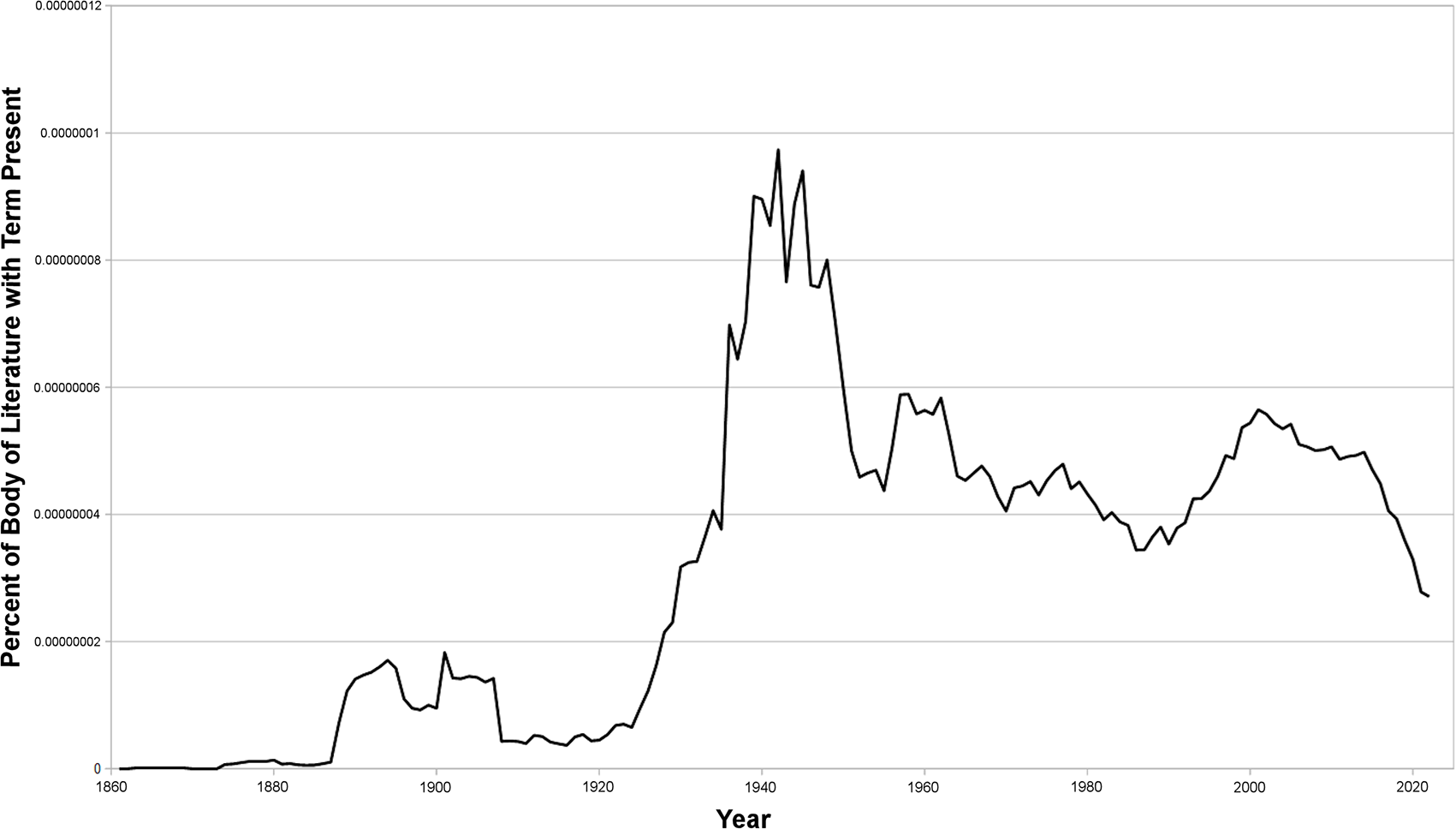
Since the term “atl-atl” first entered anthropological parlance, its use has increased over the past century in the North American archaeological literature. By North American archaeological literature, the scope is primarily scholars in the United States or Canada and English-publishing scholars with an area of study in North America. An Ngram of the frequency of mentions in North American archaeological literature (Figure 2) shows the increased use of the term with early adoption, peaking in the 1940s, and subsequent periods of increased use tied to discussions of technological shifts and innovation. Ngrams are based on a string search of documents scanned using optical character recognition (Michel et al. Reference Michel, Yuan Kui, Aviva Presser, Adrian, Matthew K., The Google Books Team and Joseph P.2011). Whereas some languages have accuracy issues, English-language literature since 1800 is generally accurate (Younes and Reips Reference Younes and Reips2019).
Ngram of the prevalence of “atlatl,” “atl atl,” and “atl-atl” in North American archaeological literature (Michel et al. Reference Michel, Yuan Kui, Aviva Presser, Adrian, Matthew K., The Google Books Team and Joseph P.2011).

The first reference to the atl-atl in anthropological literature is Tylor (Reference Tylor1871:67), who notes spear-throwers in North America and among some groups in South America, and who refers to atl-atls in their Mesoamerican context despite framing them in his unilinear evolutionary framework. According to Pepper (Reference Pepper1902:111) the term “atl-atl” was introduced in broader use in 1887 by Adolph Bandelier, who mentioned that Frederick Ward Putnam had identified Aleutian throwing-sticks as atl-atls. Other scholars, although applying the term to a wide geographic scope, were more restrictive in the types of tools referred to as atl-atls. For instance, Krause (Reference Krause1905:631–633) used the term to reference a specific form of “spear sling” technology with an expansive spatial distribution, including Utah, southwestern Colorado, California, Mexico, the Yucatan, the Isthmus of Tehuantepec, Guatemala, Panama, and the Greater Antilles and Lucayas.
By the 1930s, the term “atl-atl” for dart technological systems was prevalent in the American Southwest (Guernsey Reference Guernsey1931:71), Nevada (Heizer Reference Heizer1938b), California (Fenenga and Heizer Reference Fenenga and Heizer1941), and Texas (Kelley Reference Kelley1950; Taylor Reference Taylor1949). The first published Pacific Northwest use of the term is by Butler and Osborne (Reference Butler and Osborne1959), followed by Phebus and Drucker (Reference Phebus and Drucker1973, Reference Phebus and Drucker1979), who referred to dart throwers as atl-atls during the course of field work at the Par-Tee site on the Oregon coast. Overall, it appears that by the 1930s, the use of the term “atl-atl” for dart-throwing technological systems was widespread in North American archaeology in professional parlance. The use of the word “atl-atl” may reflect a degree of framing technological developments through the lens of cultural diffusionism in the otherwise culture-historic sequence-construction paradigm of the time. The peak observed in the use of atl-atl in the 1940s may also be the result of the lifeways reconstruction paradigm prevalent at that time (e.g., Clark Reference Clark and Forte2010). Whereas the term “arrowhead” was critically examined rather early on by Finkelstein (Reference Finkelstein1937), it is apparent that by the 1960s, “atl-atl” had been uncritically adopted by North American archaeologists. This appears to be due not to one particularly influential scholar or seminal article but to a “bottom-up” spread of a Nahuatl term in areas where the technology had archaeological but (at first) no clear direct ethnographic equivalents. In line with settler-colonialist impositions, the widespread adoption of the term also appears to have applied in cases where there were known Indigenous terms for dart-throwing technologies, such as the Pacific Northwest Coast and Plateau.
From the 1960s on, the use of “atl-atl” in archaeological literature appears to be primarily tied to technological discussions of projectile systems, including discussions of functional typology (Thomas Reference Thomas1978; Tuohy Reference Tuohy1982; VanPool Reference VanPool2006), experimental (Raymond Reference Raymond1986), and ethnoarchaeological (Binford Reference Binford and Roebroeks2007; Churchill Reference Churchill1993; Yu Reference Yu, Sellet, Greaves and Yu2006) approaches. Although there appears to be a marked decrease in the instances of the term “atl-atl”—and its variants—in the Ngram around 2010, this is more likely due to increased diversity in overall research topics than a decline in the use of the term by North American archaeologists. For instance, experimental studies continue to use the term “atl-atl” (Bebber et al. Reference Bebber, Buchanan, Eren, Walker and Zirkle2023; Whittaker Reference Whittaker and Ferguson2010, Reference Whittaker2013), as do regional and synthetic studies of projectile technological system shifts (Dixon Reference Dixon, Goebel and Buvit2011; Erlandson et al. Reference Erlandson, Watts and Jew2014; Morrissey Reference Morrissey2009; Rosencrance et al. Reference Rosencrance, Smith and Jazwa2023; Walde Reference Walde2014). The continued prevalence of the term in modern archaeological parlance is evident in current American Antiquity articles (Buchanan et al. Reference Buchanan, Hamilton and Walker2026; Connolly and Baxter Reference Connolly and Baxter2025) discussing the transition of dart and arrow technologies and technological classification.
Given that archaeologists from a wide range of theoretical and methodological approaches have uncritically used this term, we hope that this discussion has highlighted the origin and spread of the use of “atl-atl” to refer to a type of projectile system and that the uncritical use of this term is a continuing issue. The early adoption of this term may have obfuscated critical variation through the creation of an archaeological ontostory, hindering the ability to discuss regional differences in spear-throwing systems crucial to understanding their persistence—and lack thereof—in different environmental and historic contexts. The use of “atl-atl” as a broad term for dart-throwing technologies throughout North America obscures regional variation and the differential development and abandonment of these technologies that are historically and culturally contingent throughout the Americas.
Our critique of the continued uncritical use of “atl-atl” echoes concerns that Finkelstein (Reference Finkelstein1937) raised regarding the accuracy and precision lost in lithic studies by not using a less theoretically and culturally loaded term—“projectile point.” A similar critique has been recently forwarded that intends to bridge the terms used by archaeologists and descendant communities in rock image research (Wright and Welch Reference Wright and Welch2026). With these issues in mind, we propose the use of “propulsor” instead of “atl-atl” as a default term if there are not more contextually appropriate local terms as determined by descendant communities. Our case studies for propulsor technologies in the Salish Sea and Columbia Plateau take a “bottom-up” approach examining contextual ethnographic information, archaeological data, and finally, Indigenous terms for the systems.
Propulsor Technologies on the Salish Sea and Columbia Plateau
As opposed to merely problematizing this colonialist legacy that continues to be perpetuated in even collaborative or Indigenous-driven education and outreach programs, we aim to provide a path forward using examples from the southern Pacific Northwest Coast and Plateau, which we use as geographic markers and not in a “culture area” sense (Figure 3). To that end, we provide what is intended to be (1) a framework for discussing projectile systems and propulsor technologies and (2) a case study of culturally situated terms for these systems for the southern Pacific Northwest and Plateau. The aim of this discussion is not to engage in typological navel gazing but to have effective praxis for the pedagogy of the anthropological community by encouraging archaeologists to learn and use regionally appropriate terms for these technologies or neutral terms as defined by descendant communities.
Salish Sea and Columbia Plateau regions.

Figure 3 Long description
A regional extent map with two labeled areas: “Salish Sea” and “Columbia Plateau.” A thick boundary line encloses the mapped region and a second thick boundary line separates the two labeled areas. “Salish Sea” is labeled on the left side of the main map, adjacent to the coastline. “Columbia Plateau” is labeled across the central and right side of the main map, extending farther inland. The map includes a graticule with degree labels along the top edge. A scale bar at the lower right is labeled “0” and “500” with the unit “Km.” An inset locator map in the upper right shows a larger landmass outline with a small square marking the location of the main map area. No legend is shown. North arrow is not shown.
Our contribution to the ongoing reinterpretation of projectile systems is a discussion focusing on the Pacific Northwest Coast, specifically the Salish Sea and Columbia Plateau, and for the propulsor technologies used by Coast and Interior Salish- and Ichishkíin-speaking communities. The Salish Sea is a unique and distinct region of the Northwest Coast based on its ecological, ethnographic, and archaeological characteristics (Mitchell Reference Mitchell1971). It consists of the waterways, shorelines, and watersheds of the Strait of Georgia, Strait of Juan de Fuca, and Puget Sound. It has played a central role in the theorizing of the emergence of hereditary forms of social inequality in nonstate societies, horizontal forms of social organization, and the management of landscapes, seascapes, and food production by sedentary “foragers” (Ames Reference Ames Kenneth, Coupland and Banning1996; Angelbeck and Grier Reference Angelbeck and Grier2012; Cullon et al. Reference Cullon, Ritchie and McMillan2026; Martindale and Letham Reference Martindale, Letham, Bauer and Johansen2011; Moss Reference Moss2012; Rorabaugh and Shantry Reference Rorabaugh and Shantry2024; Suttles Reference Suttles1960).
The Columbia Plateau as a region is defined by the watersheds of the Columbia River and its major tributaries, the Snake and Yakima Rivers. It stretches east to west from Lewiston, Idaho, to Dalles, Oregon, with a northern extent at Okanogan, Washington, near the US-Canadian border. Plateau peoples have engaged in seasonal rounds using riverine and upland resources since time immemorial (Teit Reference Teit1928). The Columbia Plateau has been central to theorizing issues of population dynamics and resource intensification with complex semisedentary foragers (e.g., Ackerman Reference Ackerman2005; Ames Reference Ames Kenneth2012; Andrefsky Reference Andrefsky William, Prentiss and Kuijt2004; Butler and Campbell Reference Butler and Campbell2004; Chatters and Prentiss Reference Chatters and Prentiss2005; Lepofsky et al. Reference Lepofsky, Kusmer, Hayden and Lertzman1996). Both regions present unique technological-system challenges based on local resources. and they have unique historic trajectories shaping the use of propulsor technologies.
The first reference in the archaeological literature to dart and dart-throwing technologies on the Columbia Plateau is in Krieger’s (Reference Krieger1928:6) Snake River work in Idaho:
The blade point is of chipped jasper, the shaft is a stem of charred wood eight- and one-half inches long which tapers from a diameter of three-fourths inch at the nocked base to less than one-half inch at the bottom nock end. A groove one-eighth of an inch deep and of equal width extends the length of the shaft. The find of an atlatl among the burial offerings at Page marks the first known occurrence of this projectile weapon within the area of the upper plateau.
The earliest archaeological case of dart or propulsor technology on the Plateau with an estimated date is a 9,000-year-old stone dart from Latah Creek, Idaho (Reference Ross2011:Figure 23).
Ethnographic accounts in the Columbia Plateau do not discuss the use of dart technologies. This may in part be due to the introduction of the horse in Yakama territory by AD 1735 (Boxberger Reference Boxberger, Taylor and Grabert1984); bow use is more effective on horseback, particularly with the introduction of the stirrup. The later introduction of European firearms may also have contributed to the loss or replacement of this specific form of hunting and crafting knowledge. It appears that by the time of ethnographic records, dart technology had largely fallen out of favor on the Columbia Plateau, with smaller side-notched projectile points becoming the dominant form used with bow and arrow technologies.
Archaeological evidence indicates that although the bow and arrow did phase out dart technologies, use of darts was retained for approximately 1,000 years after the adoption of the bow and arrow (Galm et al. Reference Galm, Hartmann, Masten and Stephenson1981; Leonhardy and Rice Reference Leonhardy and Rice1970) and became exceedingly rare after 1200 BP (Yent Reference Yent1976). At 1000 BP, large dart projectile points disappear from the record and become replaced with smaller point styles associated with the bow and arrow. Brauner (Reference Brauner1976) argued that at site 45AS82 in Washington state, spatially separated small and large projectile points on semi-subterranean house floors dating 1250 to 1900 BP were contemporaneous evidence of preference by hunters for arrow or dart technologies. Arguments for late use of dart technologies suggest that continued dart use may have had a relationship to the type of prey being pursued (Chatters et al. Reference Chatters, Campbell, Smith and Minthorn1995; Schalk and Olson Reference Schalk, Olson and Schalk1983). Specifically, darts were employed in the initial centuries after the introduction of the bow and arrow when individuals were pursuing larger and/or thicker-skinned species, such as bison (Chatters et al. Reference Chatters, Campbell, Smith and Minthorn1995).
In contrast, in the Salish Sea region, chipped-stone tools have been less studied compared to other regions of North America, in part due to the prevalence of bone and ground-stone technologies in the region (C. Ames et al. Reference Ames, Costopoulous and Wren2010). One of the earliest chipped-stone tools classified as a dart point in the Salish Sea region is from Component 1 of DgRr-6 in British Columbia, which dates to approximately 6000 cal BP with marine reservoir corrections applied (Rorabaugh and Fulkerson Reference Rorabaugh and Fulkerson2015). However, much like bone or ground-stone tools, chipped-stone tools can be used as the arming elements of complex systems with line attachments, such as harpoons (McMurdo Reference McMurdo1972; Rorabaugh Reference Rorabaugh2010). Similarly, fletching is associated with a reduction in the mass of an arming element, making it difficult archaeologically to distinguish dart from arrow armatures (cf. K. Ames et al. Reference Ames, Fuld and Davis2010; Hughes Reference Hughes1998). Despite these methodological difficulties, archaeologists have been successful examining both lithic technologies and faunal datasets to investigate the underlying social relations driving the choices in the use of dart or arrow technologies (Angelbeck and Cameron Reference Angelbeck and Cameron2014). Bow and arrow use was a practice tied to both warfare and individual hunting, whereas dart systems tended to be used in more cooperative or group efforts. The social use of either technology was directly tied to the accrual of prestige and status within traditional Coast Salish social practice. In the neighboring Willamette Valley to the south of the Salish Sea region, there is a similar pattern of a higher frequency of smaller projectile points after 2000 BP, but these are also found with larger projectiles generally associated with spear-throwing systems, although direct evidence or historic references to spear-throwers are arguably absent (Connolly and Baxter Reference Connolly and Baxter2025:591). However, small and large projectile points are present from the mid-Holocene and after, which may reflect different tool objectives such as durability, use contexts, or the presence of fletching.
A Schema for Weapon Systems and Propulsor Technologies
Our aim is to provide a paradigmatic schema of different weapon systems to situate propulsors within their wider context, to explore the variability in these technologies, and to encourage archaeologists to employ more regionally specific and accurate terms. This schema is limited to single-person human-action mechanical systems. It excludes systems that require multiple users or stored energy (mechanical or chemical), such as crossbows, gunpowder, or rockets. The goals are to avoid intentional or unintentional exoticization of so-called primitive technologies and to provide clearer terminology. For instance, the term “spear-thrower” could refer either to someone throwing a dart or javelin or to the projectile launching system itself. To that end, we expand on Riede and Lombard (Reference Riede and Lombard2024) by breaking down these technologies into the overall systems, their projectile and launch system when relevant, and the human action undertaken (Table 1). Bear in mind that in cases where the human action is the primary distinction (thrusting and stabbing action with spears), there can be overlap, but systems may be refined and specialized by mass and balance for one action to be preferred. There are cases where a system may not be a “projectile” unless it has a detachable armature (thrusting and stabbing spears), which is why the table is a weapon-system schema and not merely a projectile-system schema.
Weapon System Schema.

Table 1 Long description
The table categorizes weapon systems by their projectile type, launch mechanism, and the human action used to operate them. Thrusting and stabbing spears have no separate projectile or launch system listed, and rely on direct thrusting or stabbing. A javelin uses a javelin projectile and is thrown without a distinct launch device. The propulsor uses a dart launched from a propulsor board and is operated with a levering motion. The bow uses an arrow launched by the bow and is operated by pulling. The harpoon row is marked with a note indicator for projectile, launch system, and action, signaling that its details depend on a specific attachment configuration rather than a single fixed entry.
* The presence of a line attachment on a detachable armature makes a harpoon system. Harpoon arrows, darts, javelins, and spears are all potential systems; If multiple armatures are present the tool is a leister.
In addition to the overall systems outlined here, the case study areas of the Salish Sea and Columbia Plateau also highlight additional complexities. Many of these technologies—such as javelins, propulsors, and bows—in maritime or riverine contexts used line attachments, making them harpoon technologies (McMurdo Reference McMurdo1972; Rorabaugh Reference Rorabaugh2010). These include harpoon arrows and harpoon javelins used for different types of marine and riverine prey. The presence of multiple armatures on one projectile also results in leisters, which are generally used for spearing fish and which fall under the stabbing-spear type in this schema.
There is significant variation in the potential components of propulsor boards (Figure 4). Propulsor boards—from proximal to distal end—consist of a handle, midsection with a weight, and a nock point. The proximal end can have a guide groove etched into the board to aid with the release of the dart. The proximal end also has the handle for the thrower to hold and throw the propulsor board. Integral handles are carved into the board, whereas added handles are components tied, glued, or slotted into place on the propulsor board. Handles can have finger and thumb loops or holes, protrusions, or wrapped material such as leather or fiber to serve as the grip. The midsection of the propulsor board has the weight. Weights can be integral to the propulsor board or an added mass—often ground stone—that is tied, glued, or slotted in place. Finally, the nock point is located on the distal end. The end nock or side nock of a dart is slotted into the nock point of the propulsor board. Nock points can be integral to the propulsor board, or an added component that is tied, glued, or slotted into place. Added nock points tend to be made out of a less flexible material than the propulsor board, such as bone, antler, hardwood, or stone.
Schematic components of various propulsor boards (not to scale). Inset: Propulsor weights to scale (adapted from Cobb Reference Cobb2019).

Figure 4 Long description
The diagram illustrates components of propulsor boards, including handles, midsections and nock points. Handles are categorized as integral or added, with examples from Alaska, Oregon and other regions. Midsections are shown as integral or added, featuring designs from Washington State and Finland. Nock points are depicted as integral or added, with examples from various locations. The diagram includes a scale for reference, indicating measurements in centimeters and inches. Each component is labeled with its origin, such as Yup'ik, Penutian and Skagit, highlighting the diversity in design and construction across different cultures and regions.
Our schematic of propulsor board components (Figure 4) shows variation in the construction of propulsor boards through the different styles of the three key elements: handle, midsection with weight, and nock point. In essence, by adding or removing these attributes (guide groove, handle, weight, and nock point), one can build a “Mr. Potato Head” for propulsor boards. The morphology of the handle, midsection, and nock point should have little to no impact on the functional performance of a propulsor board. Instead, the length of the propulsor board and weight would likely have greater impacts on functional performance. For this reason, much of the morphological variation seen in propulsor-board elements are likely stylistic. However, due to preservation issues, archaeological understanding of stylistic variability in propulsor boards is limited. Our attempt here is to create a reasonable and reproducible classification—at least for the two study areas—of possible combinations of projectile systems (Table 1) that were employed differentially through time and space based on social contexts. In places where most portions of a propulsor board may not preserve, this schema can be applied to consider portions of the system that tend to preserve better due to being constructed from more durable materials such as added weights or nock points.
Indigenous Terms for Spear and Projectile Systems
As part of the effort to encourage archaeologists to use regionally appropriate terms instead of “atl-atl,” we provide a brief review of terms for these technological systems to provide culturally situated context for these technological systems used traditionally in the Salish Sea and Columbia Plateau, respectively (Table 2). This section comes from discussions with staff of Tribal language programs, and the sources cited are publicly available language resources, but the interpretation and application of terms is from ongoing discussions since 2019. In some cases, staff changes and loss from the COVID-19 pandemic shifted interpretations, so the most recent are what is presented. Of the seven Indigenous languages in the study area, four have terminology related to propulsor technologies. The Nez Perce language, nimipuutímt, currently lacks terms that directly relate to propulsors, although it has extensive definitions available publicly for daily use of the language. Nimipuutímt is a living language. As a result, a term may be developed or rediscovered by the community. Similarly, Twana and Salishan do not have terms that directly map onto propulsor technologies. With respect to Indigenous terminology, we caution that one should not look for a direct translation of Western-allocated names and meanings that can impact one’s findings; instead, one should work with language programs to understand related contextual terms. However, in cases where there are no direct or contextually related terms, there may be interest in the future for these Tribes’ respective language programs to develop terms based on appropriate teachings and linguistic rules for these, and other, technologies.
Twana, Lushootseed, Salishan, Ichishkíin, Imatalamłaamí, nsəlxcin, and nimipuutímt Terms.

Table 2 Long description
The table lists vocabulary for five weapon systems (spear, javelin, propulsor or atlatl, bow, and harpoon) across Twana, Lushootseed, Salishan, Ichishkiin, Imatalamłaamí, nsəlxcin Okanogan, and Nimipuutímt. Spear terms appear in most languages, including Twana qʷe’ʎ̆’ab, Lushootseed č‘sáy?, Salishan xp’kanu’, Ichishkiin tiixáy, Imatalamłaamí tanú with a related verb pɨ́tya, and nsəlxcin łuʔmín and nyaʕ; Nimipuutímt has no spear entry. Javelin is only recorded in Lushootseed as stí?√ts?ɬ, with blanks elsewhere. Propulsor-related terms are provided for Lushootseed, Ichishkiin, Imatalamłaamí (including a throwing stick or atlatl term and a dart term), and nsəlxcin, but not for Twana, Salishan, or Nimipuutímt. Bow terms are present in Lushootseed, Salishan, Ichishkiin, Imatalamłaamí, nsəlxcin, and Nimipuutímt (which also lists an arrowhead term), while Twana is blank. Harpoon terms appear in Lushootseed, Ichishkiin, Imatalamłaamí, and nsəlxcin, with blanks for Twana, Salishan, and Nimipuutímt. Because several cells are empty, the table reflects incomplete documentation rather than confirming that a language lacks a concept or term.
Note: Not all terms are present in each language.
Ichishkiin, the name preferred by the Yakama Nation for their language, which anthropologists and linguists often refer to as Sahaptin, does not have a direct word for dart; however, there is a word for “spear pole or shaft”: “tiixáy” and “tamáwiluuk,” meaning “to throw into air” (Beavert and Hargus Reference Beavert and Hargus2009), which fits with the action of spear throwing. In Umatilla, there is a word for “dart”: “pityaťáwas” (Confederated Tribes of the Umatilla Indian Reservation and Rude Reference Rude2014). In addition, the Umatilla have the word “wɨx̣itpamá,” meaning “throwing stick” or a propulsor (Confederated Tribes of the Umatilla Indian Reservation and Rude Reference Rude2014).
In nsəlxcin, or Okanogan, “sckʷink” refers to the “bow and arrow,” and “sxʷulqn” refers to “harpoons” typically used for salmon fishing. “łuʔmín” is the term for “spear,” and “nyaʕ” is specific for “war spears.” “laʔmínt” refers to the action of throwing a dart. This action can be a free-handed or aided throw. “kłw̓ntim” refers to the action of spearing something, which can include thrown spears and propulsors (Colville Confederated Tribes Language Program 2021).
Turning to the coast, in Lushootseed (Bates et al. Reference Bates, Hess and Hilbert1994), “c’á?suč” is the “bow and arrow” and “s√tá?ɬ” is the term for “harpoons”—a broad term including composite and fixed harpoon types used for fish and marine mammals. “č‘sáy?” is a specific term for spears used for bottom fish, whereas “stí?√ts?ɬ” is for small spears that could be hand thrown but that lack a line attachment. “x̌əƛ’yácəd” refers to spears without a line attachment that can break in two, which broadly fits with propulsor systems.
How to (Start to) Decolonize the Spear-Thrower
We have argued that the term “atl-atl” is problematic: because the assumptions of the term unintentionally primitive types of material culture, the word obscures variation, and it has been uncritically adopted in the North American archaeological literature. The use of “atl-atl” perpetuates archaeological onto-stories and a charismatic artifact bias. To help address this issue, we also presented a schema for projectile systems, including propulsors, and Indigenous terms for the Salish Sea and Columbia Plateau as a case study. With these pieces, how can the spear-thrower be decolonized? First and foremost, it is essential to challenge one’s own archaeological and anthropological ontostories as a researcher and continually be reflexive. Decolonization must be grounded in an Indigenous framework (Thurston Reference Thurston2026), which is why we propose this approach as first steps.
The following is a list of reflexive questions to ask that is by no means exhaustive. Instead, we aim to scaffold meaningful praxis. The intent is that archaeologists (1) be more critical of the terms used and (2) engage with descendant communities in potentially enriching—as opposed to extractive—ways.
1. What descendant communities are affiliated with the material culture in question?
2. What is the overall projectile system that the projectile or launch system observed is part of?
3. Is there a term for that system in the literature that is appropriate for the descendant group and with which the material culture in question is associated?
4. Do the descendant communities in question have language programs? What appropriate terms exist in their language programs? Community interviews done with the permission of language and heritage programs are crucial for contextualizing both published and unpublished terms.
This type of collaborative approach can also result in meaningful discussion in cases where terminology may not be present in a descendant group, which can provide crucial insights for both archaeologists and descendant communities. It must benefit the community or else it is merely a form of repackaged extractive practice. If a term is not provided, neutral language such as “propulsor” instead of “atl-atl” reduces the issues of unintentional exoticization and primitivization from the colonial lens. This type of discussion may also result in a community creating new words or adapting existing words to describe objects used by their ancestors, in which case, these terms would be the most appropriate to use. One could argue that “atl-atl,” after a century of use, is neutral and that a term derived from propulseur simply colonizes by using a French term. However, using “propulsor” as a term in the sense of lithic debitage retains definitional accuracy and precision while encouraging archaeologists to critically examine the terminology they use.
Discussion and Conclusion
To answer our questions posed at the beginning of this article, we do perceive that the effort to decolonize the spear-thrower is necessary. What is proposed here is merely a first step in decolonizing the spear-thrower, and asking these questions about the underlying assumptions of basic anthropological terms is critical. Fundamentally all typologies are theoretically informed and shaped by each researcher’s own individual biases; they are never purely descriptive, and classification informs how archaeologists view material culture (refer to Whittaker et al. [Reference Whittaker, Caulkins and Kamp1998] for a cogent review). Because of this, calling dart-throwers “atl-atls” is reductionist and can bias research questions, thereby perpetuating archaeological ontostories. With that in mind, this article is intended to be a call for both clarification and less-loaded language—in much the same way that Finkelstein (Reference Finkelstein1937) proposed the use of “projectile point” instead of “arrowhead.” We suggest in situations where regionally appropriate Indigenous terms for these technologies are not present that the term “propulsor” is a less-loaded and more appropriate technical term, similar to archaeologists using the term “biface” as opposed to the colloquial “arrowhead” to avoid ascribing functional interpretation (sensu Knecht Reference Knecht1997). Our recommended approach also follows recent calls to critically examine the terminology used to describe rock images (Wright and Welch Reference Wright and Welch2026).
By using regionally appropriate Indigenous terminology, we reinforce that these are technological systems in their own social, ecological, and historic contexts. Chiblow and Meighan (Reference Chiblow and Meighan2022) note that learning and transmission occur in the land, the community, and the language. Following their argument, using descendant-community terms for technologies means that Indigenous worldviews and ideas are not forced into ill-fitting English words that reinforce archaeological ontostories. We also caution against “charismatic artifact” bias when interpreting these technological systems, and we remind archaeologists that in the vast majority of cases, preservation biases mean we only have small portions of these systems to examine. Being reflexive and critical of the terms and narratives we use and their implications is but a first step in actively dismantling and reframing colonialist ways of knowing, and frameworks for collaborative community engagement such as the one proposed here is merely a second step.
Additionally, in the Salish Sea, wet-site preservation and shell-bearing sites have provided a rare window into the diversity of materials used for projectile systems. Wood, shell, and bone materials comprised significant portions of the wet-site assemblages at Qwu?gwes and Biederbost in Washington state (Croes Reference Croes, Menotti and O’Sullivan2012). Over the past 20 years, anthropogenic global warming has also resulted in numerous ice-field finds in Alaska and the Yukon, with preserved projectile systems (Reckin Reference Reckin2013). However, these examples of unusually exceptional preservation do not apply to the vast majority of archaeological reporting with formed tools from projectile systems in either academic or cultural resource management contexts. Consequently, we caution against a charismatic artifact bias in field interpretation that may overlook other materials used for these systems not well represented in the record such as bone, antler, or wood. We also caution against broadly applying preserved cases from well-preserved sites as exemplars that apply to all cases for these systems.
Although significant efforts have been made in experimental studies to critically reexamine ontostories with projectile systems—ranging from gender relations to deconstructing narratives of unilineal technological development—we hope to highlight the continuing issues that bias and terminology have played in the perception of “atl-atls” as a technological system both in North America and around the world. Much as archaeologists have exhaustively discussed mental templates to examine material culture, we also as a discipline have perceptions swayed by the templates we construct for what a technological system is expected to develop, look, and function. To that end, we have presented a simple schema for projectile systems and regionally situated terminology. Our aim is not to debate technological system typology but to encourage archaeological and cultural heritage practitioners (1) to be more mindful of the full projectile systems that—except for the rare aforementioned cases—may not preserve and (2) to use either regionally appropriate terms (in collaboration with descendant communities) or neutral terms for these systems. Collaboration is critical due to the valid critique that anthropologists have continued the extractive mindset and that they compromise Indigenous ontologies through that process (Todd Reference Todd2016).
Actively engaging with descendant communities regarding archaeological terminology can provide unique insights and nuance while encouraging connections between past and present. Active community engagement also addresses concerns of research merely benefiting the archaeologist if the researcher is not a member of the community. It also serves an important social justice role by putting more underexamined portions of the interpretation of the past—in this case, uncritically adopted terminology and its unintentional ethical and epistemic impacts—in the hands of descendant communities. This meaningful praxis returns terminology to Indigenous hands (sensu Tuck and Yang Reference Tuck and Yang2012). By changing “atl-atl” to “propulsor,” nothing is lost in terms of accuracy or precision of terminology, and there is a degree of reflexivity gained by archaeological practitioners in facing disciplinary assumptions. In the end, decolonizing the spear-thrower begins with reflexivity and a willingness to learn. What we present is a necessary, but not sufficient, first step in this process.
Acknowledgments
This article is in memoriam for Sarah K. Campbell, Dennis Lewarch, and Guy Moura. This article was born from an idea that Sarah Campbell brought to Adam N. Rorabaugh and James Brown. We have carried that idea on to honor Dr. Campbell and her legacy in the Pacific Northwest. We thank Anne Parfitt for assistance with figure preparation, and Dennis Lewarch for his insights and discussion during the early formulation of this article. We also thank the historic preservation and language programs of the Colville Confederated Tribes, Confederated Tribes of the Umatilla Indian Reservation, Muckleshoot Indian Tribe, Nisqually Tribe of Indians, Puyallup Tribe, Suquamish Tribe, and Yakama Nation.
Funding Statement
This research received no specific grant funding from any funding agency or from commercial or not-for-profit sectors.
Data Availability Statement
No original data were used.
Competing Interests
The authors declare none.



 Open access

