


“Acts of violence, oppression, revolt, civil war, and so forth, chequer the history of every African state.” (Fortes and Evans-Pritchard Reference Fortes, Evans-Pritchard, Fortes and Evans-Pritchard1940, 16)
INTRODUCTION
Understanding the causes and consequences of conflict is now a major issue in studying economic development.Footnote 1 However, the relative importance of different factors in generating conflict remains open to debate. Perhaps the most robust observation is that conflicts are most prevalent in poor and weakly institutionalized countries. Many factors which make a country susceptible to conflict are, however, slow moving and the two-way causation between conflict and development creates a Gordian knot which is hard to unpick.
Given the weakness of its economic performance in the postindependence period, determinants of conflict in Africa are of particular interest.Footnote 2 Moreover, conflict prevalence in Africa is comparatively high; the Armed Conflict Database (ACD) measure of civil conflict based on a threshold of 1000 battle deaths suggests that around 8.5% of country-years in Africa since 1950 are conflict years compared to around 5% of country-years in the rest of the world over the same period.
But Africa’s history does not begin with colonialism and its legacy. The quote at the start of this article was an assessment made in 1940 by two leading anthropologists venturing into a comparative analysis of African political organization. As emphasized in Nunn (Reference Nunn2008) among many others, slavery and its aftermath was a cornerstone of organized political violence in Africa. But standard efforts to secure and maintain territory and people also provided incentives for conflict, particularly among and within Africa’s historical kingdoms. Historical research on Africa between 1400 and 1700, summarized in Brecke (Reference Brecke1999) and based on written sources, confirms that conflict between its peoples is far from new.Footnote 3
Prior to being carved up by colonial powers, Africa was divided into a patchwork of tribal structures and protostates (historical kingdoms) with heterogeneous political systems. Some areas were under forms of territorial control which resembled states. However, other areas were closer to being stateless, some with acephalous forms of political organization.Footnote 4 The mantra of colonialism in Africa was “indirect rule,” an attempt to control the hinterland by coopting traditional power structures into colonial administration (see, for example, Lugard, Reference Lugard1922). This ensured a degree of continuity between the precolonial and postcolonial eras. That said, some traditional power structures were weakened by colonialism while others were strengthened.Footnote 5 The biggest impact on political geography was in the form of well-defined borders, initially between the colonial powers and latterly between newly created independent states.
This article investigates to what extent the postcolonial period saw a legacy from conflicts that are documented to have occurred in precolonial times. We use data from Brecke (Reference Brecke1999) to locate 91 conflicts in Africa between 1400 and 1700. We focus on the data in the period before 1700 since we are interested in conflicts which predate major European interest in colonizing Africa. We find robust evidence that patterns of conflict after countries in Africa gained independence are correlated with having had more historical conflicts within their borders. We also find some evidence supporting the view that the mechanism at work may be a diminution in trust, and a weaker sense of national identity. Persistent conflict may also be due to the interaction between geography, natural resources, and patterns of settlement which spawn particular institutional arrangements although we find no evidence of a link with weak institutions at a country level. All of these factors are likely to make it more difficult to establish cohesive governance arrangements which resolve conflicts of interest in a peaceful manner. We also use data at the subnational level on conflicts between 1997 and 2010 to show that having had a historical conflict close by is positively correlated with more recent conflict. We also show that it is correlated with a lower level of economic development. These results are robust to controlling for a wide variety of other historical and geographical features of conflict locations.
This article belongs to an emerging body of research which traces the historical roots of contemporary economic and political outcomes.Footnote 6 Acemoglu, Johnson, and Robinson (Reference Acemoglu, Johnson and Robinson2001) made the landmark contribution which brought to researchers’ attention the correlation between historical settler mortality and contemporary income levels and institutions around the world.
This article is particularly related to a number of recent studies which have looked at persistent effects of African history. Nunn (Reference Nunn2008) finds a link between patterns of contemporary development in Africa and the location of slave extraction. Nunn and Wantchekon (Reference Nunn and Wantchekon2011) trace this to modern day attitudes towards trust in the Afro-barometer survey. And Nunn (Reference Nunn2010) finds a correlation between the location of Christian missions and modern day outcomes. Exploiting historical data on political geography, Michalopoulos and Papaioannou (Reference Michalopoulos and Papaioannou2011) examine the consequences of how Africa was partitioned between colonial powers and find that partitioned ethnic groups suffered greater conflict compared to those which have not been impacted by the border partition. Gennaioli and Rainer (Reference Gennaioli and Rainer2007) find a link between the nature of the precolonial regime and modern day provision of public goods. Michalopoulos and Papaioannou (Reference Michalopoulos and Papaioannou2013) find a link between precolonial political centralization and regional economic development. In common with this article, they emphasize precolonial continuity in the form of political organization in affecting the contemporary performance of African states.
The remainder of the article is organized as follows. In the next section, we discuss some background issues including our data and measurement. We then discuss between-country evidence and within-country (grid cell level) evidence in the next two sections, respectively. The last section concludes.
BACKGROUND
In this section, we first discuss some of the background literature and explanations of conflict. Second, we discuss how this may suggest historical legacies from precolonial conflicts. Third, we introduce our historical conflict data and its sources. And fourth, we provide a brief overview of African political organization and conflict in the precolonial and colonial periods.
Political Violence
The standard economic approach to political violence looks for factors that explain the costs and benefits of using violence to achieve specific ends, particularly in the form of either remaining in power or mounting an insurgency.Footnote 7 On this basis, four main hypotheses are frequently proposed to explain why Africa is conflict prone: (i) natural resource dependence, (ii) weak and poorly functioning political institutions, (ii) ethnic fragmentation and polarization, and (ii) endemic poverty. We briefly review these four strands of the literature.
Benefits from using violence are frequently couched in terms of capturing resources either directly, as in the capture of territory, or through winning political power. Both of these views motivate exploring the link between violence and natural resource rents as discussed in Ross (Reference Ross2004). Early empirical contributions to the literature on conflict such as Collier and Hoeffler (Reference Collier and Hoeffler2004) and Fearon and Laitin (Reference Fearon and Laitin2003) find evidence to support this channel.
Since the use of violence is generally thought of as a last resort, civil wars are usually rationalized in terms of commitment and/or information problems. The extent of commitment power depends on the institutional structures in place. Besley and Persson (Reference Besley and Persson2011a,b) model this as a constraint on the way that the state can be used for private ends which they refer to as “cohesive political institutions.” This could be the product of formal veto threats enhanced by Parliamentary democracy or by greater trust between groups which foster more cooperative policy outcomes. This places an emphasis on the role of institutions and/or trust in affecting the likelihood of conflict. The way that citizens identify with the common good versus sectional interests could also be important in shaping how institutions function to mitigate conflict risk.
In Africa, much emphasis is placed on ethnicity as the salient cleavage which leads to polarization and conflict. However, the empirical results are somewhat equivocal. Montalvo and Reynal-Querol (Reference Montalvo and Reynal-Querol2005a) find evidence that ethnic polarization, rather than fractionalization, is positively correlated with conflict. Moreover, this is consistent with the theoretical approaches of Esteban and Ray (Reference Esteban and Ray1999), Montalvo and Reynal-Querol (Reference Montalvo and Reynal-Querol2005b), and Besley and Persson (Reference Besley and Persson2011b, Chap. 4). Cederman et al. (Reference Cederman, Gleditsch, Salehyan and Wucherpfennig2013) study the impact of cross-border ethnic groups on violent conflict.
Endemic poverty reduces the opportunity cost of fighting. When there is unemployment and/or low wages it should theoretically make it easier for each side in a conflict to recruit combatants. This ties to the robust finding in the existing empirical literature that there is a negative correlation between income per capita and the prevalence of conflict; see the discussion in Blattman and Miguel (Reference Blattman and Miguel2009) who also address the issue of reverse causation. Conflict can affect development through a variety of channels including incentives to invest in physical and human capital. It may also affect incentives to invest in state capacities to support investments as emphasized in Besley and Persson (Reference Besley and Persson2011b).
Most of the existing quantitative research which looks at the link between violence and ethnicity treats the latter as given. However, the question of how individuals identify with groups and are motivated to commit violent acts in the name of furthering that group interest is worthy of explanation and is arguably fluid over time. Recent research has begun to explore the logic of constructivist views of ethnic identity. Ahlerup and Olsson (Reference Ahlerup and Olsson2011) offer an evolutionary perspective on these issues. Michalopoulos (Reference Michalopoulos and Papaioannou2011) explains ethnic diversity empirically in terms of variation in regional land quality and elevation. Caselli and Coleman (Reference Caselli and Coleman2011) develop a model of endogenous ethnic identities and conflict. These contributions fit into a nascent interest in the economics of identity pioneered by Akerlof and Kranton (Reference Akerlof and Kranton2010). Arguably, the trend over time in many countries has been a move away from identities based on smaller groups such as clans, tribes, or ethnicities towards identities forged around nation states. An important issue is to understand how symbolic attachment and ritual can build and sustain attachment to nations or ethnicities (see, for example, Hobsbawm and Ranger, Reference Hobsbawm and Ranger1983). The role of past conflicts and the way that history portrays them can play a key role in narratives which nurture particular identities.Footnote 8
This article contributes to a burgeoning literature that looks at the causes and consequences of conflict in Africa at the subnational level. One of the earliest contributions in this mode is Deininger (Reference Deininger2003) who finds that the distance from infrastructure, asset inequality, cash-cropping, and lower levels of education increase the likelihood of civil conflict in Uganda. Akresh and de Walque (Reference Akresh and de Walque2010) examine the magnitude of the Rwandan genocide on school attendance. Rohner et al. (Reference Rohner, Thoenig and Zilibotti2011) study the effect of conflict in Uganda in the period 2002–2005 on trust and expressions of ethnic and national identity and Ksoll et al. (Reference Ksoll, Macchiavello and Morjaria2010) study the disruptive effect of political violence in Kenya on the flower industry. Focusing on the causes of conflict rather than its consequences, Michalopoulos and Papaioannou (Reference Michalopoulos and Papaioannou2011) show how Africa’s partition by colonial powers affects contemporary patterns of conflict.
Such subnational studies are attractive since they are able to control for common country-level factors. More generally, they emphasize the need to look carefully at within country heterogeneity and remind us that civil conflict and political violence is often geographically specific (Fearon and Laitin, Reference Fearon and Laitin2010). Such is the case, for example, with episodes of political violence in advanced countries such as with terrorism in the Basque country or Northern Ireland. Patterns of violence are even quite specific and episodic in weakly institutionalized polities where violence is rife such as Colombia (see Dube and Vargas, Reference Dube and Vargas2013).
Historical Legacies
A key issue in this article is how events that took place centuries previously could influence in contemporary economic and political outcomes. Figure 1 suggests a schematic conceptual framework drawing on factors outlined in the previous section.
Historical Legacies

First, historical conflicts themselves have determinants in the social, political, geographic, and economic context of regions at the time that the conflicts took place. One of the reasons for persistent conflict may be the interaction between geography, natural resources, and settlement; areas that provide moderate climate and natural resources attract human settlement.Footnote 9 These settlements organize themselves in ways that relate to the resources around them and create different institutions. These relatively densely settled areas make it easier to organize armed conflict and make it more likely that sufficient people are killed to register this as a conflict in our data. Land disputes are often a particular source of contention in these instances as emphasized in Toft (Reference Toft2003). And many of these such factors are likely to be most important when studying subnational conflicts due to the localized nature of these factors.
Below, we will seek to control for some of these background factors directly. For example, we will measure physical geography at the grid cell level and we will look at the geography of political organization in the old kingdoms of Africa.
Second, conflicts can affect the evolution of subsequent economic, political, and social outcomes which have a bearing on contemporary conflict. For example, historical conflicts could promote distrust among social groups which affect attitudes and identities. They could also have an economic legacy, making regions poorer and could also influence the choice of political institutions. We will attempt to test for some of these channels below. However, it is quite difficult to be sure that all of these proximate determinants of more recent conflicts can be satisfactorily measured. Hence, we will end up with a somewhat “reduced-form” interpretation of the findings. Nonetheless, we will use the framework in Figure 1 to anchor our discussion of the empirical findings and the possible mechanisms at work.
Data and Measurement
Data on historical conflicts in Africa is from the conflict catalogue of Brecke (Reference Brecke1999). For Africa, this is based on three main published sources: Ajaye and Crowder (Reference Ajaye and Crowder1985), Freeman-Grenville (Reference Freeman-Grenville1973), and McEvedy (Reference McEvedy1995). Brekke’s definition follows Cioffi-Revilla (Reference Cioffi-Revilla1996) which uses Richardson’s base-10 log scale for violent conflicts—see Richardson (Reference Richardson, Wright and Lienau1960).Footnote 10 For each conflict in Africa between 1400 and 1700 defined this way, we have identified the modern country in which it took place as well as the specific geographical location. Where possible, we have cross-checked each case by reading the history of each war. We focus on the data in the period before 1700 since we are interested in conflicts which predate major European interest in colonizing Africa. Even if there are conflicts that have not been documented, we are confident that the catalogue includes the most important conflicts in Africa which have been written about by historians.Footnote 11 However, we are not aware of any similarly comprehensive effort to document historical conflict in Africa with which to compare these data.
Although we focus on Africa, Brecke (Reference Brecke1999) covers the universe of documented violent conflicts in which 32 or more people have died at any location in the world since 1400. The data are now being used by a number of researchers to explore the causes and consequences of conflict. For example, Zhang et al. (2007) uses them to explore at a macro scale the effects of climate change on the outbreak of war and population decline in the preindustrial era. Iyigun (Reference Iyigun2008) uses conflict catalogue for Europe between 1401 and 1700 to show that the incidence of military arrangements between the protestant reformers and Counter-Reformists between 1520 and 1650 depends negatively on the Ottomans’ military activity in Europe. Iyigun, Nunn, and Qian (Reference Iyigun, Nunn and Qian2010) use the data over the period 1400 and 2000 to look at the determinants of conflicts. They find, as many recent studies which use data on contemporaneous conflict, a link between economic shocks and violent conflict. Pinker (Reference Pinker2011) uses the conflict catalogue for his discussion of violence in human history. This nascent use of the data by researchers means that it will come under increasing scrutiny as a potentially valuable resource to researchers interested in historical conflict.
The data in the conflict catalogue treat as multiyear conflicts consecutive years in which that threshold of 32 deaths is surpassed. They follow Luard (Reference Luard1987) in using 400 AD as the cutoff date since it falls between major dates for the Chinese (1366) and European and American (1492) populations, and demarcates a point before which the quality and extent of data about many parts of the world fall precipitously.
For the between-country analysis, the main variable that we use is the prevalence of violent conflict in a country between 1400 and 1700, specifically the number of years between 1400 and 1700 in which some area within the country is coded as having been in what would now be regarded as an internal conflict.Footnote 12 This variable captures the intensity of precolonial conflict and has a mean of 5.13 years with a range 0–91 years and a standard deviation of 15.17 years. As a blunter measure, we also construct a dummy variable which is equal to 1 if the country has had any violent conflict between 1400 and 1700, and 0 otherwise.
When we study conflict at the subnational level, we take the
 $120\text{ km}\times 120$
km grids from the Yale University Geographically Base Economic Dataset (G-econ). Since some grids traverse country boundaries, we give 3546 country-grid cells (hereafter simply “grid cells”) spread across 49 countries in Africa.Footnote
13
For each grid cell in the data, we construct a dummy variable which is equal to 1 if there has been a conflict in that grid cell in the period 1400–1700 and 0 otherwise. For the purposes of this exercise, we GIS code each conflict within a modern country where the conflict occurred.Footnote
14
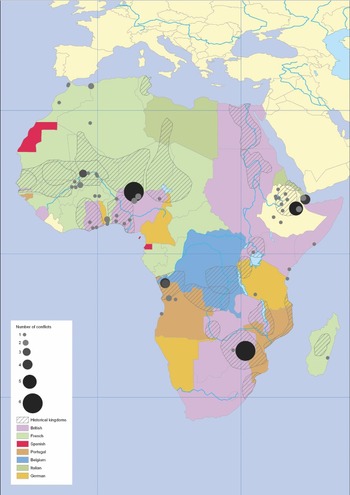
Figure 2 plots the 91 conflicts between 1400 and 1700 that we have located precisely and which we will exploit in this analysis. The sizes of the dots reflect the number of conflicts at each location where more than one conflict is recorded at the same location.
Map of Conflicts, Colonial Rule and Historical Kingdoms

We then match these data with information on the location of recent conflicts from the Armed Conflict and Location Event Data (ACLED).Footnote 15 These data give a precise GIS code for conflict locations in African countries for the years 1997–2010.Footnote 16 The dataset contains information on the date and location of conflict events, the nature of the event, and the groups involved.
The G-econ data provide a number of additional variables which we use as controls.Footnote 17 We augment these with data that we have extracted from historical maps which we detail below.
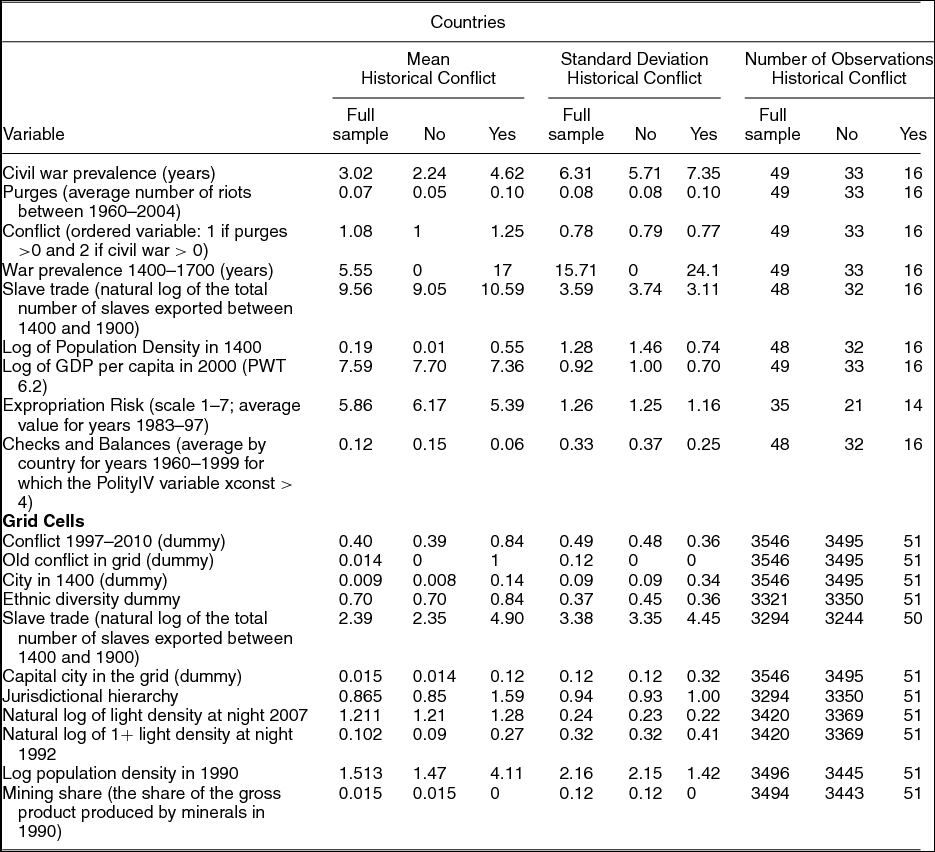
Table 1 gives descriptive statistics for the main variables used in the analysis below both at the country level and the grid-cell level. We do so comparing the sample of countries/grid cells which had a historical conflict to obtain a feel for whether there are obvious cross-sectional differences among these two groups. Looking at the first panel at the country level, Table 1 shows that there is a mean difference in years of postindependence conflict of around 2.4 years between countries that had a historical conflict compared to those that did not. Historical conflicts occur in areas that were more densely populated in 1400. However, there is no obvious difference in mean income and expropriation risk. The second panel, at the grid-cell level, shows a mean difference in conflict between 1997 and 2010 of about 50 percentage points with 84 percent of the grid cells with a historical conflict having a more recent conflict compared to 39 percent of those among the grid cells with no historical conflict. Historical conflict appears to occur in areas that are more densely populated areas. Moreover, historical conflict seems more likely to occur in grid cells where the current capital city is located and where there were cities in 1400. The mean difference in light density across the grid cells with and without a historical conflict is consistent with this.
Descriptive Statistics

Notes: Sources as stated in the text.
Conflict and Political Development in the History of Africa
Prior to the scramble for Africa in the late nineteenth century culminating in the Berlin conference of 1884, Africa was characterized by a patchwork of heterogeneous political systems. Some of these were organized authority structures of long standing including a number of historical kingdoms. Other areas were governed in a relatively stateless fashion. Just as in Medieval Europe, the conflicts that we study were in part a reflection of the process of indigenous state building. This was true, for example, of the Bunyoro-Buganda conflict in modern day Uganda in 1600 or the Songhai-Gourma conflict in modern day Mali in 1488, both of which appear in our data. Civil wars within kingdoms were common too (see, for example, Ben-Amos Girshick and Thornton, Reference Ben-Amos and Thornton2001). Of course, conflicts in organized political jurisdictions are also more likely to form part of the historical record. Anthropologists who have studied African political history draw a similar conclusion on the importance of territorial war in Africa. For example, Radcliffe-Brown (Reference Radcliffe-Brown, Fortes and Evans-Pritchard1940) notes that
“Amongst the various different kinds of warfare that can be distinguished, what we may call wars of conquest have been important in Africa, as they have been in Europe. When such war is successful it establishes one people as conquerors over another who are thus incorporated into a larger political society, sometimes in an inferior position as a subject people.” (page xix)
This process of territorial consolidation led, at various points in history, to the emergence of a variety of long-lived African kingdoms whose geographical reach is displayed in the hatched areas in Figure 2.Footnote 18 The map identifies 23 historical kingdoms in Africa.Footnote 19 Herbst (Reference Herbst2000, Chap. 2) argues that these kingdoms found it difficult to consolidate power over wide areas because of the ease with which populations could migrate. Thus, the limits and territorial boundaries of such kingdoms were somewhat porous. Examining the locations of the dots which represent conflict locations, it is apparent that there is a link between conflict and belonging to the territory of a historical kingdom; conflicts are twice as likely to occur in grid cells which belong to historic kingdoms compared to those which do not.
As European powers somewhat reluctantly extended their rule into the African hinterland, significant use was made of precolonial power structures in efforts at indirect rule. But this process showed little respect for historic territorial boundaries. This too is apparent in Figure 2 where we have shaded countries according to colonial control by World War I which is largely a reflection of the aftermath of the 1884 Berlin conference. The map confirms that patterns of colonial control did not seem to respect the boundaries of historical kingdoms.
One of the most significant organizational changes in Africa from the colonial period onwards was the creation and maintenance of political jurisdictions with clearly defined boundaries throughout the continent. As discussed in Herbst (Reference Herbst2000), colonialism also had a significant effect on the way that the protostate structures that preceded it operated. Much of this actually weakened existing authority structures that had been created in precolonial times.Footnote 20 And this may help to explain why the positive role of historical conflicts in state building identified by Hintze (1911) and Tilly (Reference Tilly1990) to be sources of European state strength are much less important in an African context.
The end of colonialism ushered in an era of mostly contrived nation state boundaries which therefore bore little relation to indigenous political structures, largely as a reflection of the arbitrariness of the boundaries created by the colonial division of Africa. On independence, most countries launched efforts to build nation states inside these well-defined boundaries broadcasting their intentions through national symbols such as flags, currencies, and citizenship regulations. The great challenge, which has so often not been met, is to move beyond symbolism to create functional polities within state borders that can deliver public goods and security to their citizens. Referring to the salience of historical conflict in this process, Bates (Reference Bates2008a) remarks that
“past conquests by monarchs and warriors created territorial disputes that reverberate to this day and so shape contemporary politics.” (page 85)
This, he argues, along with migration to secure agricultural land, sows the seeds of modern day political tensions behind much contemporary conflict. A similar sentiment about the importance of history is echoed in Reid (Reference Reid2012) which surveys the history of conflict in Africa from BCE to the present day and remarks that
“The past was very much present in the organization of violence, even during the revolutionary upheaval of the nineteenth century and the selfconsciously modernist struggles of the mid-twentieth century. States and societies sought historical precedent and heroic forebears, both for inspiration and solace, and constructed both oral and written narratives . . for the purpose.” (page 10)
It is also clear from his account that a number of historical conflicts are well documented and potentially salient in modern times.
This point can be illustrated for our data with reference to Figure 2 using the example of the Harari region in Ethiopia. Much of the conflict between 1400 and 1700 was due to the Islamic city of Harar’s efforts to repel the spread of Christian influence and a struggle to control lucrative trade routes. The city of Harar which was dominated by the Harari, known as Ge usu’ (people of the city), was eventually incorporated into the Ethiopian state in 1887. It is now a multiethnic region in which the Harari, who comprise less than 10% of the population, have disproportionate political power in coalition with a larger ethnic group (the Oromo). The status of the Harari remains a source of tension within the region.
BETWEEN-COUNTRY EVIDENCE
We are interested in whether historical conflict is correlated with the prevalence of civil conflict and other outcomes in a country during its postindependence history. Our basic specification is as follows:
 \begin{equation*}
y_{j}=\alpha +\beta c_{j}+\gamma x_{j}+\varepsilon _{j},
\end{equation*}
where yj is the outcome of interest in country j, α is the intercept, cj is the historical conflict variable, and xj are other controls which we describe as we go. Regional and colonial dummies are included in all specifications.
Conflict Results
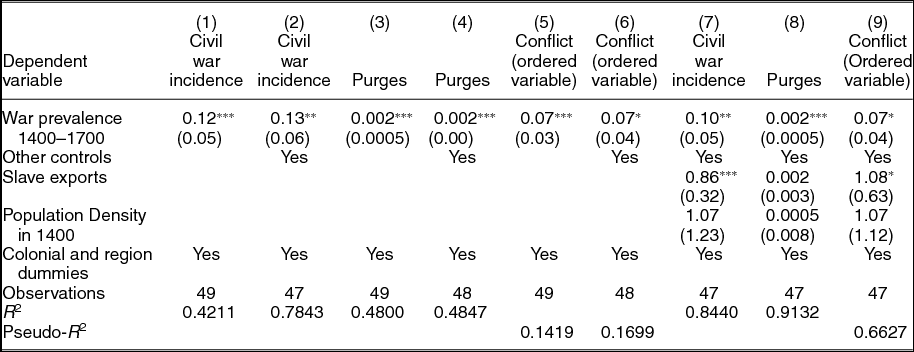
The main cross-country results are reported in Table 2. The outcome variable in columns (1) and (2) is the prevalence of civil war between independence and 2007 measured using the Armed Conflict Database (ACD). Column (1) controls only for regional and colonial dummies and finds a positive and significant correlation between the intensity of historical conflicts within a country and more recent experience. For each additional year of a historical conflict, the country suffers an extra 0.12 years (or about 2 months) of additional conflict in the postindependence period. Put another way, comparing a country with no history of conflict in the period 1400–1700 to one with 60 years of conflict over this period, then our point estimate predicts an additional 10 years of postindependence conflict.
Political Violence

Notes: Robust standard errors in parentheses (*** 1% significant, ** 5% significant, * 10% significant). Sample is all African countries for which data are available. Civil war incidence is the number of years that the country has been in civil war since independence. War prevalence 1400–1700 is the number of years in which the country was involved in a historical conflict. Historical conflicts which happened the same years but in different regions are counted separately. Other controls are GDP per capita in 1970, latitude, longitude, minimum rainfall, maximum humidity, low temperature, the log of the length of the coastline, a dummy for whether a country is an island, regional variables, measures of natural resource abundance, legal origin, ethnic polarization, proportion of the population that is Muslim, a dummy for yellow fever, and the ruggedness of the terrain. From columns (7) through (9) we include slave trade variable from Nunn (Reference Nunn2008) along with population density in 1400 from Nunn and Puga (Reference Nunn and Puga2012).
In column (2), we add additional controls: GDP per capita in 1970, latitude, longitude, minimum rainfall, maximum humidity, low temperature, the log of the length of the coastline, a dummy for whether a country is an island, measures of natural resource abundance,Footnote 21 legal origin, ethnic polarization,Footnote 22 proportion of the population that is Muslim, a dummy for yellow fever, and the ruggedness of the terrain. We lose two country observations due to missing data. However, the correlation between postindependence conflict and historical conflict prevalence is essentially the same.
The next four columns in Table 2 are motivated by the study of political violence in Besley and Persson (Reference Besley and Persson2011a). They argue that, from a theoretical point of view, government repression and conflict are two sides of a coin and should be studied jointly. We follow them and measure repression using Banks’ (Reference Banks2005) measure of the extent of purges—i.e., the removal, by jailing or assassination, of opponents considered undesirable by the incumbent government. Column (3) shows that countries with a prior history of conflict are more likely to suffer from this form of political violence too. And this result is robust to adding additional controls (column 4). In columns (5) and (6) we run some ordered logits where the ordered variable takes on the value 0 when there is no violence, a value of 1 if there is repression, and a value of 2 if there is conflict. The results also show that there is a significantly higher prevalence of political violence when a country has a history of conflict and that this is robust to including controls.
In column (7), we include the slave trade variable from Nunn (Reference Nunn2008) along with population density in 1400.Footnote 23 The former is included to guard against the possibility that the between-group breakdown in trust that slavery may have caused is not driving our result. While slavery is positively correlated with subsequent civil conflict, it does not disrupt the correlation with war prevalence between 1400 and 1700. Including population density in 1400 as a control addresses the possibility that the correlation between historical war prevalence and recent civil war is confounded by a country with more historical conflicts having been more densely populated at the time. In fact, there is no significant correlation between population density in 1400 and recent conflict. Adding these controls also leaves our results on purges and the ordered conflict variable robust as columns (8) and (9) demonstrate.Footnote 24
While these results paint a consistent picture, there are reasons to be cautious in interpreting them beyond the usual concerns about the vulnerability of cross-country analysis to unobserved omitted factors.Footnote 25 In particular, the evidentiary importance of two particular countries, Angola and Ethiopia, is an issue. These are highly influential outlier observations and dropping them leads to the correlation between conflict 1400–1700 no longer being present. The presence of such cases also makes classical OLS assumptions for inference questionable. So at best, the results in Table 2 should be regarded as suggestive. Moreover, this motivates the need to delve deeper in the form of a more disaggregated approach exploiting within-country variation that we adopt below.
Income Levels and Institutions
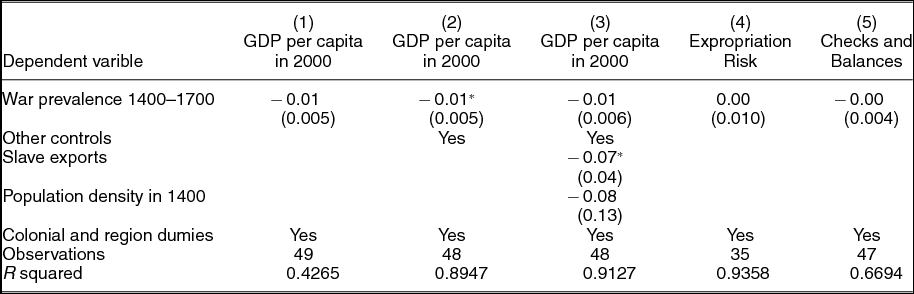
The theoretical literature on conflict identifies low income as a risk factor and also emphasizes how conflict may reduce incentives to invest and can destroy assets.Footnote 26 Columns (1)—(3) in Table 2 explore whether historical conflict is correlated with low income in the postcolonial period. In all three columns, there is a negative correlation between the historical conflict variable and income per capita but it is only significant (at a 10% level) in column (2). The magnitude of the point estimate suggests that a country with a history of precolonial conflict at around its mean will have a 5% lower level of per capita GDP in 2000, compared with a country that has had no historical conflicts between 1400 and 1700.Footnote 27 The coefficient is similar in size and significance when other controls are included, such as the slave extraction variable of Nunn (Reference Nunn2008). This provides some weak evidence that there may be a channel through economic effects but it is quite possible that this is simply a reflection of the fact that the higher prevalence of postcolonial conflict identified in Table 1 is also having a negative effect on the economy rather than via a direct effect from historical conflict.
In columns (4) and (5) of Table 3, we look to see whether historical conflict is correlated with two popular contemporary measures of the quality of the institutional environment: expropriation risk and the strength of checks and balances. In column (4), the dependent variable is the ICRG measure of expropriation risk which Acemoglu, Johnson, and Robinson (Reference Acemoglu, Johnson and Robinson2001) argue is the channel through which settler mortality affects modern day per capita income. We find no significant correlation between this variable at the country level and historical conflict. Column (5) chooses the extent of checks and balances from the PolityIV data which Besley and Persson (Reference Besley and Persson2011) argue is a plausible way of capturing institutional cohesiveness. Here, we use a cut-off value of 5 and above on the executive constraints scale of 1–7. Again, we find no significant correlation between this variable and historical conflict at the country level. While the measures of institutions here are quite crude, these findings are not particularly encouraging to the view that historical conflict creates a problematic institutional legacy.Footnote 28
GDP and Institutions

Notes: Robust standard errors in parentheses (*** 1% significant, ** 5% significant, * 10% significant). Sample is all African countries for which data are available. GDP per capita in 2000 comes from PWT6.3. The expropriation risk variable is from ICPRG. Checks and Balances come from the PolityIV dataset. War prevalence 1400–1700 is the number of years in which the country was involved in a historical conflict. Historical conflicts which happened the same years but in different regions are counted separately. Other controls are GDP per capita in 1970, latitude, longitude, minimum rainfall, maximum humidity, low temperature, the log of the length of the coastline, a dummy for whether a country is an island, regional variables, measures of natural resource abundance, legal origin, ethnic fractionalization, proportion of the population that is Muslim, a dummy for yellow fever, and the ruggedness of the terrain. Column 3 includes slave trade variable from Nunn (Reference Nunn2008) along with population density in 1400 from Nunn and Puga (Reference Nunn and Puga2012).
Trust and Identity
Table 4 uses the Afrobarometer survey to look at whether there is a historical legacy of conflict in shaping contemporary attitudes. This could well be the case if the way that conflicts are reported across generations affects feelings towards particular groups due to historical rivalries. It may also, for the same reason, weaken attachments to nation states whose boundaries were largely created as a legacy of colonialism. Such things are likely to matter in affecting the way that institutional arrangements for peaceful resolution of conflict operate. Given any formal rules of the game, beliefs and the way that they affect a willingness to trust or cooperate may assist in generating a negotiated outcome rather than resorting to violence.
Trust and Identity

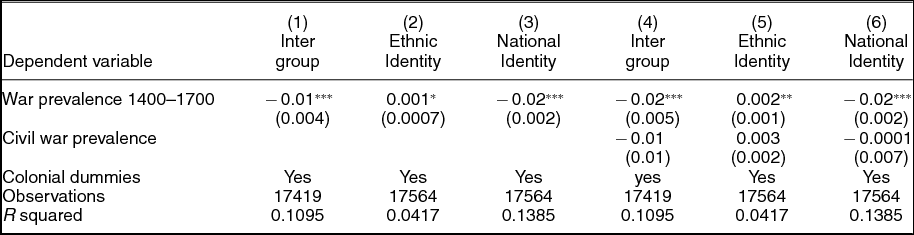
Notes: Robust standard errors clusterd by village in parentheses (* 1% significant, ** 5% significant, * 10% significant). The dependent variable are individual responses to trust, ethnic identity, and national identity from the Afrobarometer. Regressions are individual level and control for age, age squared, gender, education, occupation, religion, living conditions, district level ethnicity. We also include all of the country controls used in Tables 1 and 2. War prevalence 1400–1700 is the number of years in which the country was involved in a historical conflict. Historical conflicts which happened the same years but in different regions are counted separately. Civil war prevalence is the number of years that the country has been in civil war since independence (the dependent variable used in Table 2).
The Afrobarometer is a household level survey which explores a host of attitudinal questions among the citizens of African countries. The data that we use here are those collected for 2008 (round 3 of the survey). These surveys are conducted for a total of 25,397 respondents in 18 countries: Benin, Botswana, Cape Verde, Ghana, Kenya, Lesotho, Madagascar, Malawi, Mali, Mozambique, Namibia, Nigeria, Senegal, South Africa, Tanzania, Uganda, Zambia, Zimbabwe.Footnote 29 Each survey tries to be representative of the population and interviews are conducted in local languages. However, the survey is not administered in areas with ongoing conflicts.
We look first at intergroup trust where the survey asks how much the respondent trusts people from other groups. Answers are given on a four-point scale where 0 is “not at all,” 1 is “just a little,” 2 is “somewhat,” and 3 is “a lot,” We use this categorical variable as our dependent variable. The result is shown in column (1) of Table 4 where there is a negative correlation between trust and historical conflict. The specification that we use controls for a wide range of personal and country characteristics which are listed in the notes to the table. We also control for colonial and regional dummies as well as GDP per capita at the country level. The standard errors are clustered by village (the survey cluster for the data collection).Footnote 30
In columns (2) and (3), we look at a different variable from the Afrobarometer which reports self-ascribed identity. We create two dummy variables from the survey: the first is equal to 1 if an individual reports only having feelings about their ethnic identity compared to all other feelings of identity, and a second dummy variable which takes the value 1 if an individual expresses only a sense of national identity.Footnote 31 The results of regressions using these dummies as dependent variables are reported in Table 4. Column (2) shows that there is a positive and significant correlation between having only a sense of ethnic identity and the extent of historical conflict within a country. Column (3) shows a weaker sense of national identity which is simply the flip side of column (2) since it is derived from the same ordered variable as the ethnic identity variable. Once again, we control for a wide variety of personal characteristics, and all control variables that we use in Tables 1 and 2. These results are consistent with the idea that ethnic and national identities are in part constructed by salient historical events.
Taken together, the results in columns (1)–(3) in Table 4 give credence to the view that having had historical conflicts reduces trust between groups as well as affecting citizens’ sense of identity. That said, it is possible that is mostly a reflection of contemporary rather than historical conflict, especially given that we have already shown that such conflicts are positively correlated. To gain some reassurance that the effect is due to documented historical conflicts, columns (4)–(6) repeat the specifications in columns (1)–(3) while including the left-hand side variables from Table 1 (the prevalence of postcolonial civil conflict) as a right-hand side variable in explaining trust and identity. The historical conflict variables remain significant and of similar magnitude while contemporary conflict is not significant. These results provide some suggestive evidence that historical conflicts may play a role in shaping attitudes more than contemporary conflict even though the latter is correlated with historical conflict. However, there is the usual concern with cross-country variation that the variable of interest is correlated with omitted variables.Footnote 32
Summing Up
These results provide some encouragement to the view that historical conflict in the period 1400–1700 has a legacy at the country level both in terms of conflict and attitudes. In terms of the framework suggested in Figure 1, we find evidence of a link mediated through a changing sense of national identity rather than economic outcomes or choice of institutions.
WITHIN-COUNTRY EVIDENCE
We now turn to looking at evidence which exploits the more precise location of recent and historical conflicts. Specifically, we will exploit only within-country variation and include a country fixed effect to capture common country-level factors such as the level of development or national political institutions. We will look at the correlation between historical conflict and two outcomes: (i) more recent conflict, and (ii) the level of economic development across geographic areas within a country.Footnote 33
For this exercise, we use the grid cells whose construction we described in the second section. We construct a dummy variable that captures whether the grid cell had a conflict located in it between 1400 and 1700. Our core empirical specification is
 \begin{equation}
y_{j\ell }=\mu _{j}+\beta d_{j\ell }+\gamma x_{j\ell }+\varepsilon _{j\ell },
\end{equation}
where y jℓ is the outcome measure in grid cell ℓ in country j, μ j is a country fixed effect, d jℓ is either our old conflict dummy which is equal to 1 if there was a historical conflict in grid cell ℓ in country j, and x jℓ are other grid cell controls. Standard errors are clustered at the country level. Throughout, we use the log of population density in a grid cell as a control since both of our outcome measures are likely to be strongly related to this.Footnote 34 Other control variables in x jℓ are described as we introduce them with their sources/construction documented in the text and/or in footnotes.
We use two different outcome measures. The first is a dummy variable which is equal to 1 if grid cell ℓ in country j is the site of a conflict between 1997 and 2010 as reported in the ACLED data. The second captures the level of economic development in a grid cell. Since good data on income per capita are difficult to find at the grid cell level, we follow Henderson, Storeygard, and Weil (Reference Henderson, Storeygard and Weil2011) and use luminosity at night as a proxy for development. Michalopoulos and Papaioannou (Reference Michalopoulos and Papaioannou2012) provide numerous cross-validation checks of the luminosity variable showing that it correlates well with various proxies of development across regions in Africa. The satellite night light data are available from the National Oceanic and Atmospheric Administration.Footnote
35
Specifically, we use these data to calculate the natural log of the average luminosity at night per
 $ \text{km}^{2}$
at the grid cell level.Footnote
36
Core Results
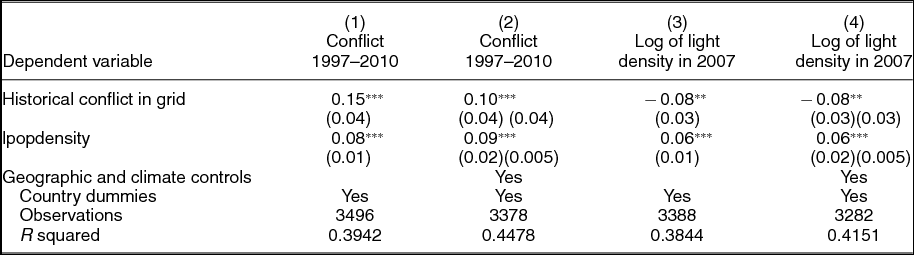
The core results are reported in Table 5. Column (1) shows that having a conflict in the grid cell makes it 15% more likely that there was a conflict in the same grid cell between 1997 and 2010. Population density, as we would expect, is positively correlated with conflict.Footnote 37 Column (2) shows that this finding is robust to including some additional basic geographic and climate controls from the G-econ data: distance to coast, elevation, ruggedness, average temperature, average precipitation, and area. However, the point estimate on the historical conflict variable falls to 10%. The coefficients on the additional controls (not reported) show that conflict is more prevalent where there is rough terrain, possibly because rebel forces are better able to mount insurgencies in such locations.
Conflict and Light Density in Grid Cells: Core Results

Notes: Robust standard errors clustered by country in parentheses (***1% significant, **5% significant, *10% significant). Variable descriptions are explained in text. The dependent variable is equal to 1 if there has been at least one conflict in the cell acording to ACLED during the period 1997–2010. Log of light density in 2007 is the natural log of the average luminosity at night per km2. Historical conflict in grid is a dummy variable which is equal to 1 if there was a conflict in the grid cell between 1400 and 1700. Geographical and climate controls are distance to coast, elevation, ruggedness, average temperature and average precipitation, and area from the Yale University Geographically Base Economic Dataset (G-econ). All columns include country dummies and log population density from G-econ. The alternative standard errors on the right-hand side in columns (2) and (4) adjust the standard errors for spatial correlation using the GMM method of Conley (Reference Conley1999).
Column (3) of Table 5 gives the core specification with our proxy for economic development as the outcome. Here, we find that having a historical conflict in the grid cell reduces the (log of) average light density in the grid cell by 8%. This is interesting since Table 1 showed that, on the whole, grid cells with more historical conflict had on average higher light density at night. But here we are controlling for population density. Column (4) shows that this result is robust to including our core controls.
Columns (2) and (4) present two sets of standard errors. The right-hand number in parentheses is adjusted for spatial correlation using the GMM method in Conley (Reference Conley1999). The reader will see that these are essentially the same as those which cluster at the country level.
Thus, we have a positive correlation between historical conflict and contemporary conflict and a negative correlation with economic development.
Robustness
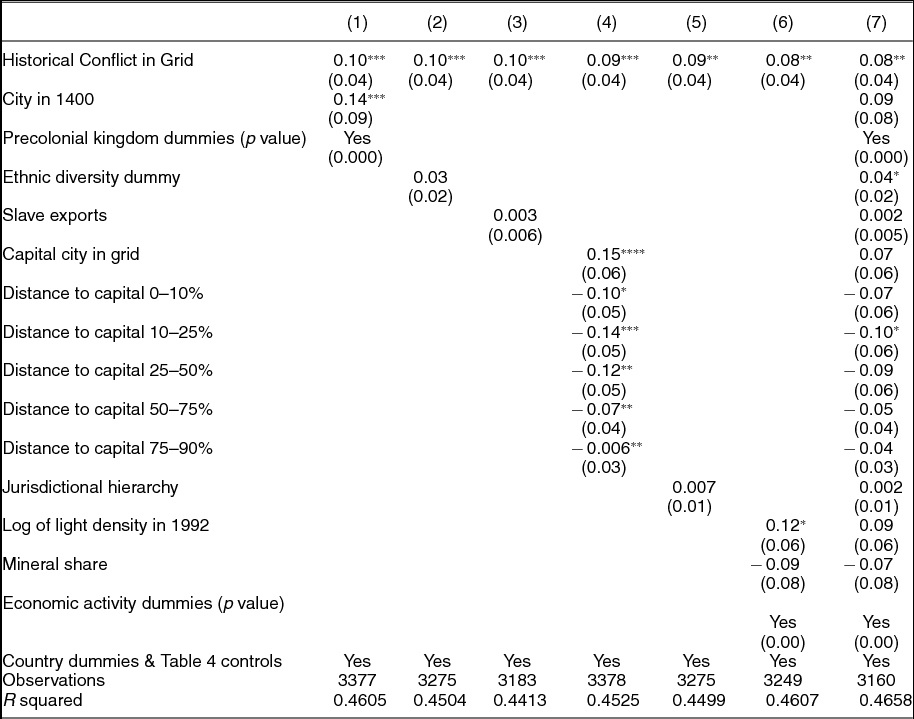
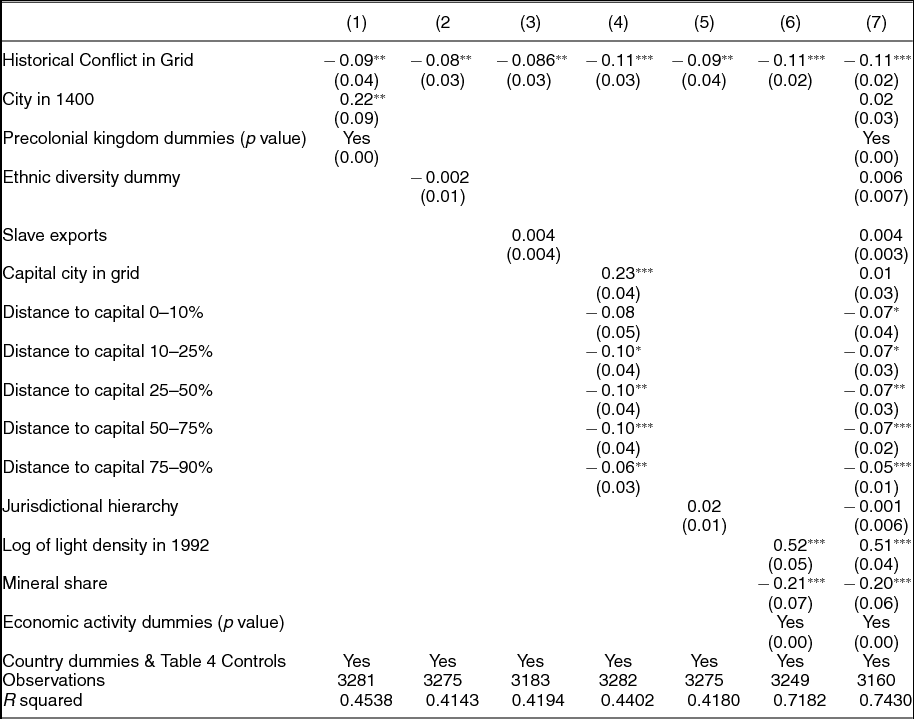
We now explore the robustness of the core findings by including a number of different controls. Many of these relate to concerns about other variables that historical conflict could be correlated with while others reflect recent findings from research explaining patterns of economic development in Africa. We report symmetric sets of results where conflict is an outcome, Table 6, and light density at night is an outcome, Table 7. In both tables, we include the log of population density and the basic geographic and climate controls from G-econ which were included in columns (2) and (4) in Table 5.
Conflict in Grid Cells (Robustness)

Notes: Robust standard errors clustered by country in parentheses (***1% significant, **5% significant, *10% significant). Variable descriptions are in the text. The dependent variable is a dummy which is equal to 1 if there has been at least one conflict in the grid cell according to ACLED during the period 1997–2010. Historical conflict in grid is a dummy variable that captures whether the grid cell had a conflict located between 1400 and 1700. Geographical and climate controls are as in Table 5: distance to coast, elevation, ruggedness, average temperature and average precipitation, and area from the Yale University Geographically Base Economic Dataset (G-econ). All columns include country dummies and the log of population density from G-econ. Column (1) includes a dummy variable which is equal to 1 if the grid cell contained a city in 1400. It also includes dummies for whether grid cells are located in the domain of a historical African Kingdom. Column 2 includes a dummy that has value 1 if there is more than one ethnic group in the grid cell. Slaves is a measure of slave extraction at the grid cell level using the data in Nunn (Reference Nunn2010). Capital city in the grid is a dummy that has value 1 if the grid cell contains the capital city. Distance to capital at x%, is a dummy that has value 1 if the grid cell has a distance to the capital which is in the percentile x. Jurisdictional hierarchy variable is the one used in Michalopoulos and Papaioannou (Reference Michalopoulos and Papaioannou2012) averaged at the grid-cell level. Log of light density in 1992 is the natural log of the average luminosity at night per km2. Mineral share is the share of income generated from minerals from G-econ. Economic activity dummies are dummy variables for the different economic activities between 1500 and 1800.
Light Density in Grid Cells (Robustness)

Notes: Robust standard errors clustered by country in parentheses (***1% significant, **5% significant, *10% significant). Variable descriptions are explained in text. The dependent variable is the natural log of the average luminosity at night per km2 in 2007. The dependent variable is a dummy which is equal to 1 if there has been at least one conflict in the grid cell according to ACLED during the period 1997–2010. Geographical and climate controls are as in Table 5: distance to coast, elevation, ruggedness, average temperature and average precipitation, and area from the Yale University Geographically Base Economic Dataset (G-econ). All columns include country dummies and log population density from G-econ. Column 1 includes a dummy variable which is equal to 1 if the grid cell contained a city in 1400. It also includes dummies for whether grid cells are located in the domain of an historical African Kingdom. Column 2 includes a dummy that has value 1 if there is more than one ethnic group in the grid cell. Slaves is a measure of slave extraction at the grid cell level using the data in Nunn (Reference Nunn2010). Capital City in the grid is a dummy that has value 1 if the grid cell contains the capital city. Distance to capital at x%, is a dummy that has value 1 if the grid cell has a distance to the capital which is in the percentile x. Jurisdictional hierarchy variable is the one used in Michalopoulos and Papaioannou (Reference Michalopoulos and Papaioannou2012) averaged at the grid-cell level. Log of light density in 1992 is the natural log of the average luminosity at night per km2 in 1992. Mineral share is the share of income generated from minerals from G-econ. Economic activity dummies are dummy variables for the different economic activities between 1500 and 1800.
We begin with conflict as an outcome. In column (1) of Table 6, we add an additional control to reflect a concern that conflicts in history were mainly around urban centers and hence historical conflict is proxying for this. It may also be the case that such conflicts were more likely to have been recorded. To look at this, we include a dummy variable which is equal to 1 if the grid cell contained a city in 1400.Footnote 38 This variable is positive and significant increasing the probability of there being a recent conflict in the grid cell by 14%. The specification in column (1) of Table 6 also includes dummies for whether grid cells are located in the domain of a historical African kingdom where violent conflict was also more likely to have been organized and documented. To investigate this, we used the historical maps of precolonial African kingdoms in the period 1500–1800 to locate each grid cell in a historical kingdom. Thus, we are able to calculate whether each grid cell is inside the area of influence of a historical African kingdom and use this to construct a dummy variable which is equal to 1 if the grid cell is located in a particular historical kingdom and 0 otherwise. The historical kingdom dummies are strongly significant with a p value of 0.000.Footnote 39 However, the core correlation between having a historical conflict in the grid cell and more recent conflict remains.
Another natural concern is that our core correlation is confounded by omitting ethnic diversity. To examine this, we include a dummy variable which is equal to 1 if there is more than one ethnic group within a grid cell level and 0 otherwise using data on ethnicity from Murdoch (Reference Murdock1959).Footnote 40 Column (2) shows that there is no correlation between the probability of conflict and this measure. But importantly, given our focus, the core correlation with having a historical conflict in the grid cell remains of similar size and significance.
Column (3) adds a measure of slave extraction at the grid-cell level using the data in Nunn (Reference Nunn2010).Footnote 41 This is positively correlated with recent conflict as we also found in Table 2, although it is not statistically significant at the grid cell level. The core correlation with having a historical conflict in the grid cell remains.
Column (4) addresses the concern that conflicts may be predominantly near the current capital city so that having a conflict in the grid cell is really just a proxy for this. When we include whether the capital city is in the grid cell, we find that having a more recent conflict is 15% more likely. And being closer to the capital in the distance distribution also predicts being more likely to have a conflict in the grid cell. However, even after introducing these controls, the correlation between contemporaneous and historical conflict at the grid-cell level remains positive and significant, with the size of the effect being similar.
Column (5) of Table 6 includes the jurisdictional hierarchy variable used in Michalopoulos and Papaioannou (Reference Michalopoulos and Papaioannou2012) averaged at the grid-cell level. This variable, based on data in Murdock (Reference Murdock1967), measures the strength of political organization above the local level in the precolonial period; it is an ordered variable with range between 0 and 4.Footnote 42 Once again the core correlation between historical conflict and more recent conflict remains and is similar in both size and significance to the core result.
Column (6) in Table 6 includes additional economic controls. From the G-econ data, we include the share of income generated from minerals. To get a handle on more historic economic activities, we use the historical maps to classify regions according to their principal economic activities in the 1500–1800 period.Footnote 43 This addresses the concern that the historical conflict variable proxies for persistent economic differences between areas which provoke conflict (the left-hand arrow in Figure 1). We include these economic activity dummy variables in column (6). Finally, we include the value of light density at night in 1992 as a right-hand side variable. This is measured prior to the period for which we are measuring contemporary conflict. The historical economic activity variables are strongly jointly significant with a pvalue of 0.000 .Footnote 44 The size of the coefficient on having a historical conflict remains of similar magnitude.
Finally, column (7) includes all of the controls from columns (1)–(6) simultaneously. Having a conflict in the grid cell now makes it 8% more likely that there was some form of conflict in the 1997–2010 period.Footnote 45
The Online Appendix (Table A.5) reports some further results based on codifying conflicts between 1700 and 1820 using the same method as we did for the period 1400–1700. We have also tried to separate those that had some kind of European involvement from those which did not. Two interesting findings emerge. First, non-European conflict between 1700 and 1820 is correlated with contemporary conflict. Second, conflict between 1400 and 1700 is positively correlated with non-European conflict between 1700 and 1820.
Table 7 runs through a similar array of robustness checks for our economic development outcome measure. The core finding from Table 4 is robust to all of the additional controls from Table 5; having a historical conflict in the grid cell reduces light density at night by around 10%.
Summing Up
This within-country evidence paints a picture which is consistent with the collective wisdom of the literature linking conflict and economic outcomes.Footnote 46 Taken together, Tables 6 and 7 suggest that our core findings on historical conflicts and their correlation with contemporary conflict and economic development is a robust one.
Returning to the schematic outline of possible channels in Figure 1, the results suggest the possible importance of an economic channel in addition to that working through trust and identity which is identified in Table 4. However, we are unable to test further for this in these disaggregated findings due to the fact that the Afrobarometer does not collect data in conflict areas. As we mentioned above, persistent conflict may be due to the interaction between geography, natural resources, and patterns of settlement which spawn particular institutional arrangements. Some of these factors are controlled for directly; the results suggest that what remains and provides our stable and robust correlation may well be due to the persistence of such hard-to-measure institutional factors.
The fact that we find results when we look within countries is not inconsistent with the findings in Table 3 since the source of within-country variation means that we are controlling for a whole host of country level differences.Footnote 47 Our efforts to control for other historical factors makes us more confident that we are not just seeing an effect coming through from persistent initial conditions such as slavery and precolonial political centralization.Footnote 48
CONCLUSIONS
This article has shown that there is a correlation between historically recorded conflicts in Africa between 1400 and 1700 and the more recent experience of civil conflict (and political violence). This relationship is found using both between-country and within-country variation. Country level attitudes also appear to have been influenced by conflict. We have also found evidence that the regional pattern of development within countries is correlated with the pattern of historical conflict. Hence the findings are consistent with the view that historical conflict has both a political and economic legacy.
The article has used a comparatively unexplored source of data on recorded conflicts which we think has the potential to inform future studies of conflict and will doubtless receive more scrutiny as it becomes more frequently used. However, even if the historically recorded conflicts on which we base the empirical analysis is incomplete, it seems likely that the bias is towards conflicts which are among the most salient to current citizens. Moreover, this might explain why such recorded historical conflicts are negatively correlated with trust and positively correlated with identifying most strongly with an ethnic group. This follows a long tradition in social science which sees identities as important social categories with real consequences. More generally, the findings add further fuel to the idea that some phenomena that we see in the world today are, at least in part, the product of historical legacies. Moreover, the results are consistent with other recent research on the persistence of civil war. Fearon and Laitin (Reference Fearon and Laitin2012) show that extra-state wars before 1945 are strongly related to civil war after 1945.
One reaction of the findings could be to create a sense of despair that much of what we see is historically determined and hence not easily amenable to manipulation. But that conclusion is too bleak. To the extent that there are headwinds in the face of progress which are due to historical legacies, it is better to understand them than to ignore them. The need to embed our theories of institutional change in an understanding of social structures shaped by history opens up many possibilities for research and for providing policy advice which is appropriately tailored to the particular circumstances in which it is given.





Comments
No Comments have been published for this article.