Introduction
Lead is a ubiquitous environmental heavy metal known to have deleterious effects on health, even at relatively low concentrations.Reference Wu, Cobbina and Mao 1 Nonetheless, it remains uncertain whether prenatal lead exposure is related to timing of sexual maturation in the offspring. Whereas animal studies have consistently shown that prenatal exposure to lead is related to later onset of puberty,Reference Dearth, Hiney and Srivastava 2 findings in human populations are mixed. In line with animal studies, cross-sectional surveys from the United States, Poland and South Africa have reported that higher blood lead concentration in adolescence is related to delayed pubertal status.Reference Naicker, Norris, Mathee, Becker and Richter 3 – Reference Selevan, Rice and Hogan 6 However, causal inference is hindered as lead measurements and pubertal assessments were taken at the same time, and pubertal status could potentially affect current blood lead levels. Furthermore, lead concentration during adolescence is most likely not a valid proxy for prenatal lead exposure.Reference Wright, Dietrich and Ris 7 In contrast to findings from cross-sectional studies, the only longitudinal study examining prenatal lead and menarche thus far reported a null association. Study authors found that United Kingdom (UK) girls whose mother’s blood lead concentration was ⩾5 µg/dl during pregnancy (measured at a median 11 weeks) did not have a delayed age at menarche compared with girls from mothers with <5 µg/dl lead concentration.Reference Maisonet, Jaakkola, Taylor, Marcus and Golding 8 One limitation of using age at menarche as a marker of puberty that could potentially explain the null findings in the UK study is the reliance on accurate recall. Although studies have found that recall of menarcheal age is highly accurate within a year of its occurrence,Reference Koo and Rohan 9 this accuracy diminishes quite rapidly. For example, a recent analysis among Brazilian girls estimated that after about 3 years, the event could not be recalled with fair accuracy.Reference Castilho, Nucci, Assuino and Hansen 10 This measurement error can result in loss of precision and/or bias of the estimates.
Using a longitudinal sample of 200 Mexican girls followed since prenatal life, we aimed to assess whether higher maternal blood lead, measured at the first, second, and third trimesters, was associated with later age at menarche. In this study sample, a considerable proportion (31%) of girls were older than 14.5 years of age at the time of the interview (which coincides with ~3 years after the reported average age of menarche in this populationReference Marvan, Catillo-Lopez, Alcala-Herrera and Callejo 11 ). Thus, in order to properly address the impact of potential measurement error in self-reported age at menarche, we used a current status time-to-event modeling strategy as our primary analytic technique. We contrasted the obtained estimates with those from the conventional time-to-event Cox regression approach.
Methods
Study population
The study population comprises a subset of participants from the Early Life Exposure in Mexico to Environmental Toxicants (ELEMENT) project, three sequentially enrolled cohorts of pregnant women and their offspring recruited from maternity hospitals in Mexico City. Our analysis includes mother/child pairs from the second and third of cohorts recruited from 1997 to 2004 during the first trimester of pregnancy (n=646 pairs at baseline, 321 were mother/daughter pairs).Reference Hu, Tellez-Rojo and Bellinger 12 , Reference Surkan, Schnaas and Wright 13 Mothers were recruited from prenatal clinics of the Mexican Social Security Institute in Mexico City, which serves low- to middle-income populations formally employed in the private sector. Exclusion criteria included planning to leave the area within 5 years; a history of infertility, diabetes, or psychosis; consuming alcoholic beverages daily during pregnancy; addiction to illegal drugs; diagnosis of a high-risk pregnancy; or being pregnant with multiples. During the baseline clinic visit, mothers provided household and demographic information including age, education, and number of previous pregnancies. Beginning in 2015, 549 child participants (52% were girls) from the original cohorts were re-contacted to participate in a follow-up study. The institutional review boards at the Mexico National Institute of Public Health and the University of Michigan approved research protocols, and informed consent was obtained for all participants.
Blood lead measurements
Blood samples were collected at three points during pregnancy – at the initial visit during the first trimester and again at two follow-up visits during the second and third trimesters. Trained personnel performed all sample collections at the Center for Environmental Health Research of the American British Cowdray Medical Center (ABC) in Mexico City. Maternal venous whole blood was collected into metal-free tubes (Vacutainer, B-D 367734; Becton-Dickinson, Franklin Lakes, NJ, USA). Graphite furnace atomic absorption spectrophotometry (model 3000; PerkinElmer, Norwalk, CT, USA) was used to quantify blood lead according to previously described techniques.Reference Miller, Paschal, Gunter, Stroud and D’Angelo 14 , Reference Ettinger, Roy and Amarasiriwardena 15 Measurements were performed at the ABC Hospital Trace Metal Laboratory, which participated in the Center for Disease Control (CDC) blood lead proficiency testing program administered by the Wisconsin State Laboratory of Hygiene (Madison, WI, USA). The limit of detection was 0.1 µg/dl. Six samples (three samples of trimester 1 and three samples of trimester 2) were below the limit of detection; their value was imputed as 0.1 µg/dl. In accordance with the CDC reference level for pregnant women and to facilitate comparisons with other studies, we categorized lead level as a dichotomous variable into <5 µg/dl and ⩾5 µg/dl.Reference Ettinger and Wengrovitz 16 In supplemental analyses, we also considered blood lead as a continuous variable.
Sexual maturation
Girls were asked about menarche during the follow-up visit. They were asked whether or not menarche had occurred (yes, no or don’t know/refused) and, if so, to recall the age (in years and months) it occurred.
Data analysis
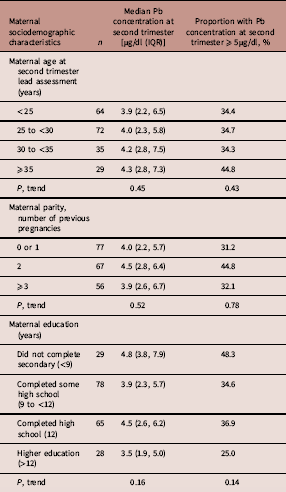
The study sample included 200 girls who were asked about menarche and also had blood lead measurements from their mothers during trimester 2. Due to some missing lead measurements, the sample sizes were 195 and 187 for trimesters 1 and 3, respectively. The analytic sample did not differ from the original baseline cohorts according to covariates listed in Table 1 (Supplementary Material Table 1).
Maternal blood lead (Pb) concentrations during second trimester of 200 Mexican schoolgirls, according to sociodemographic characteristics

To assess potential confounding, we estimated median maternal blood lead levels during each trimester according to maternal sociodemographic characteristics. Because associations did not differ by trimester and because there were a few missing lead measurements in trimesters 1 (n=5) and 3 (n=13), we showed estimates from trimester 2 (Table 1). We tested for trends in the association between sociodemographic characteristics and trimester 2 lead levels by treating each sociodemographic variable as ordinal in a regression model.
To analyze the occurrence of menarche we utilized time-to-event techniques, which appropriately account for censored data.Reference Kleinbaum and Klein 17 In these models, a hazard ratio >1 is indicative of an earlier age at menarche in the exposure group compared to the reference group; in contrast, a hazard ratio <1 indicates a later age at menarche. Our primary analytic strategy used interval-censored Cox regression models to estimate hazard ratios (HR) and 95% confidence intervals (CI), comparing the hazard of menarche among girls with prenatal maternal blood lead ⩾5 µg/dl to those with prenatal maternal blood lead level <5 µg/dl. With this approach, it is assumed that the exact timing of menarche is not known, but only whether or not it occurred within a time window. The time window we considered was birth through the age of the sexual maturation interview; 20% of the girls in the analytic sample had not experienced menarche and were considered censored observations in the analysis. For censored observations, we used the age at the interview as the observation time. Separate models were run for each trimester of lead measurement. We performed unadjusted analyses as well as analyses adjusted for maternal age, parity, and education, variables deemed as potential confounders a priori. We also took into consideration the fact that the study sample was assembled from different ELEMENT cohorts. In particular, we adjusted for prenatal calcium treatment status, because 71 (36%) mothers were part of a calcium intervention trial during pregnancy, which affected the lead exposure levels of the mothers and could potentially affect age at menarche.Reference Ramezani Tehrani, Mirmiran, Gholami, Moslehi and Azizi 18 We did not adjust for body mass index or height because they occurred after the exposure and could be intermediates on the causal pathway.Reference German, Shmoish and Hochberg 19 In supplemental analyses, we ran all models in the same manner, with the exception that prenatal lead levels were considered as a continuous variable rather than dichotomous.
Since age at menarche can naturally be thought of as a time-to-event outcome, we also estimated HRs and 95% CI with conventional Cox regression models using self-reported age at menarche as the time to event. However, since Cox regression results are likely to be biased due to error in self-reported age at menarche, we also ran these models in a restricted sample of girls <14.5 years of age at the time of the interview (girls who would theoretically be able to recall age at menarche with greater accuracy). All analyses were performed using R Statistical Software R 3.2.2; the conventional Cox regression model was implemented in R package survival, and the code for the interval-censored Cox model is available upon request.
Results
The mean age±s.d. of mothers at the child’s birth was 28±5.6 years. The median (IQR) blood lead levels (µg/dl) of the mothers during trimesters 1, 2 and 3 were 4.8 (2.9–7.1), 4 (2.5–6.4) and 4.5 (2.9–6.6), respectively. The proportion of mothers with blood lead ⩾5 µg/dl during trimesters 1, 2 and 3 were 47, 36 and 43%, respectively. Maternal characteristics including age, parity and education were not related to blood lead levels during any trimester of pregnancy (Table 1, trimester 2).
The mean age±s.d. of girls at the follow-up interview was 13.8±2.0 years. The estimated median age at menarche according to self-reported age (IQR) was 11.7 (11.0–12.7) years.
Interval-censored Cox regression results
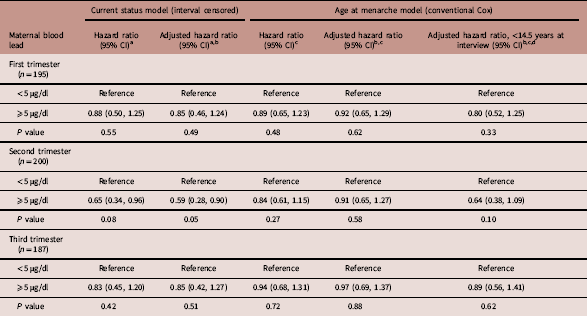
In bivariate analysis, girls whose mothers had ⩾5 µg/dl blood lead during the second trimester had a lower probability of menarche at a given point in time compared with girls whose mothers had <5 µg/dl blood lead (Table 2), signifying a delayed onset of menarche. After adjustment for maternal age, maternal parity, maternal education, and prenatal calcium treatment status, girls whose mothers had ⩾5 µg/dl blood lead during the second trimester had a 41% lower probability of menarche compared with girls whose mothers had <5 µg/dl blood lead (HR=0.59; 95% CI 10–72, P=0.05). Using these parameters, the estimated median age at menarche among girls with prenatal lead <5 µg/dl was 11.46 years and for girls with ⩾5 µg/dl was 12.07 years (~7-month difference). Maternal blood lead levels during trimesters 1 and 3 were not statistically significantly related to daughters’ age at menarche, although they were in the same direction as the second trimester estimate. In supplemental analyses, continuous maternal blood lead levels were not related to age at menarche in either unadjusted or adjusted (Supplementary Material Table 2).
Probability of menarche among Mexican school-age girls aged 9.8–18.1 years according to prenatal lead exposure

a From interval-censored Cox regression models, with status of menarche from birth through age during sexual maturation interview as the outcome.
b Adjusted for maternal age, maternal parity, maternal education, and prenatal calcium treatment status.
c From Cox regression models with self-reported age at menarche as the outcome.
d Restricted sample sizes are 141, 138 and 133 for first, second and third trimesters, respectively.
Conventional Cox regression results
There were no statistically significant differences in the age at menarche during any trimester according to level of maternal blood level, although estimates were all in the same direction as estimates from the current status models (Table 2). In sensitivity analyses restricting to girls <14.5 years of age at the time of interview, the hazard ratio during the second trimester approached statistical significance and was in the expected direction (HR=0.64 with 95% CI 0.38–1.09; P=0.10). Continuous maternal blood lead levels were not related to age at menarche in adjusted or unadjusted analysis (Supplementary Material Table 2).
Discussion
Lead exposure in Mexico and in other populations worldwide continues to be a public health concern. A recent meta-analysis estimated that the average blood lead level among adult Mexican women was 9.5 µg/dl,Reference Caravanos, Dowling and Tellez-Rojo 20 notably higher than the CDC currently recommended toxicity threshold of 5 µg/dl for women of reproductive age.Reference Ettinger and Wengrovitz 16 While lead exposure during pregnancy is known to affect cognitive outcomes in the offspring,Reference Wasserman, Liu and Popovac 21 whether it is related to sexual maturation timing has been less clear. In this longitudinal analysis of 200 Mexican girls, there was evidence to suggest that higher maternal lead levels during the second trimester may be related to delayed menarche.
A positive association between maternal blood lead and menarcheal age is supported by several lines of evidence. In one animal study, pregnant Fisher rats in the experimental group were given a 12 mg daily dose of lead acetate solution (comparable with low-level lead toxicity in humans) during pregnancy. Female offspring of these rats had significant delays in the timing of vaginal opening and first diestrus compared with offspring in the control group.Reference Dearth, Hiney and Srivastava 2 Similarly, epidemiological cross-sectional studies among South African, Polish and US adolescent girls have found that higher concurrent blood lead levels are related to markers of delayed puberty, including older age at menarche, less advanced Tanner stages for pubic hair and breast development, and lower levels of inhibin B and luteinizing hormone.Reference Naicker, Norris, Mathee, Becker and Richter 3 – Reference Selevan, Rice and Hogan 6 Different methodological approaches make it challenging to directly compare effect sizes, although our trimester 2 findings are fairly similar to cross-sectional results among African Americans in the NHANES study, which reported a 3.6-month delay in menarche among girls with 3 µg/dl blood lead compared with girls with 1 µg/dl.Reference Selevan, Rice and Hogan 6 Nonetheless, one longitudinal examination of prenatal lead exposure and age at menarche among girls in the ALSPAC study did not find any differences in the timing of sexual maturation according to prenatal lead exposure.Reference Maisonet, Jaakkola, Taylor, Marcus and Golding 8 In addition to the potential for measurement error in self-recall of menarche, another difference between this study and ours is the timing of blood lead assessment. The UK study only had one measurement from each mother as opposed to three, and over half of the blood samples were collected during the first trimester. Thus, it is possible that this study missed the sensitive window of lead exposure; which, according to our findings, may be trimester 2. There could also be population differences to consider. In the UK study, only 15% of mothers had blood lead levels ⩾5 µg/dl, whereas over 30% of our population crossed this threshold. Thus, exposure levels in the UK population may not have been high enough to produce discernible differences in sexual maturation timing.
Speculations on mechanisms for this association rely mostly on the animal studies. A prevailing theory is that early exposure to lead alters the programming of the hypothalamic–pituitary–gonadal axis, which, in turn, affects the amount of insulin-like growth factor 1 (IGF-1) secretion during peri-puberty. Lower IGF-1 levels during the peri-pubertal period have been related to delays in puberty.Reference Thankamony, Ong and Ahmed 22 In support of this mechanism, one experimental study showed that adolescent rats that were prenatally exposed to lead did not experience delays in sexual maturation if they were injected with IGF-1 during peri-puberty compared with control rats that were exposed to lead but not injected with IGF-1.Reference Dearth, Hiney and Srivastava 2 One novel aspect related to the mechanism that is highlighted by our study is the potential for trimester-specific effects. Previous animal studies have not examined this, but the second trimester has plausibility as a sensitive time period because this is when the hypothalamus undergoes sex differentiation.Reference Savic, Garcia-Falgueras and Swaab 23
The paper introduces a novel analysis technique to the area of menarche studies. We used interval censored models, which do not rely on participants to recall the age of the first menstrual period, an indicator that can prove quite challenging to remember accurately. Indeed, our study showed indirect evidence for measurement error in the self-recalled age at menarche. This limitation has been cited in the literature as a concern for many years,Reference Koo and Rohan 9 , Reference Castilho, Nucci, Assuino and Hansen 10 , Reference Cooper, Blell and Hardy 24 , Reference Bergsten-Brucefors 25 although the nature and extent of the potential bias remains unclear. A recent study in a Brazilian population found that the reported age of menarche was reliable for only up to about 3 years after the event.Reference Castilho, Nucci, Assuino and Hansen 10 Whether this length of time holds for other populations, including the Mexican population, is unknown. However, when we restricted the sample to include only girls who were within ~3 years of menarche, we noted a shift in the estimates, particularly those from trimester 2, such that the estimates from the restricted sample were remarkably consistent with the estimates from the interval-censored model. This observation provides us with indirect evidence that there may have been recall error in the age at menarche among the oldest girls in the sample, resulting in biased estimates in the conventional Cox models. This could have occurred if girls with high prenatal and/or childhood lead exposure also had cognitive impairmentsReference Canfield, Jusko and Kordas 26 that made it increasingly difficult for them to accurately recall their menarcheal age. Another possibility is that embarrassment or stigma of being a late maturer caused older-maturing girls to report an earlier age at menarche.Reference Knaul 27 Random measurement error in the recall of age at menarche also cannot be discounted, and it may explain a lack of precision in the conventional Cox model estimates.
The clinical relevance of these findings is an important consideration. Although much of the menarche literature focuses on the public health impacts of earlier puberty, delayed puberty may also be associated with detrimental sequelae including poor psychosocial outcomes, low bone mineral density and adverse cardiometabolic health in later life.Reference Zhu and Chan 28 Nonetheless, it is unknown if the delay in menarche that we reported here may be associated with any of these outcomes later in adolescence or early adulthood; this is a question that should be followed-up in future studies.
This study has several strengths. One is that lead was measured at three time points during pregnancy, which allowed us to observe trimester-specific associations. Another strength is the longitudinal study design, which allowed us to establish clear temporality between the exposure to lead and sexual maturation timing. There are also limitations to consider. First is the small sample size, which may have limited power to detect associations during the first and third trimesters. Second is that we had to rely on maternal blood lead as a proxy for fetal exposure to lead. Another is the potential for unmeasured confounding from substances associated with (but not caused by) prenatal lead exposure that are also independent factors of sexual maturation timing, such as other heavy metals or dietary exposures. Although some information on other toxicants has been collected in these cohorts, the sample size of participants with multiple metal measures was too limited. Finally, although our original study question was focused on prenatal lead exposure, it remains a possibility that postnatal exposures to lead during childhood could modify the associations of in utero exposure and sexual maturation.
In conclusion, using longitudinal data from a Mexican population, we found suggestive evidence that prenatal exposure to lead during the second trimester is related to delayed sexual maturation. A closer examination of trimester-specific associations in larger-powered data sets is warranted to more fully understand the underlying mechanism and discern windows of vulnerability.
Acknowledgments
The authors are grateful to the American British Cowdray Hospital in Mexico City for providing access to research facilities.
Financial Support
This study was supported by U.S. National Institute of Environmental Health Sciences (NIEHS) grants R01-ES007821, R01 ES014930, R01, P42-ES05947, K23ES000381, P01ES022844; by Consejo Nacional de Ciencia y Tecnología (ES013744CONACyT) Grant 4150M9405; by US Environmental Protection Agency (US EPA) grant RD83543601; by National Institutes of Health (NIH) grants R01ES024732 and 5T32DK071212-12; and by CONSERVA, Department of Federal District, México. Funding sources were not involved in the study design, analyses, or preparation of the manuscript.
Conflicts of Interest
None.
Ethical Standards
The authors assert that all procedures contributing to this work comply with the Helsinki Declaration of 1975, as revised in 2008, and has been approved by the institutional review boards of the National Institute of Public Health in Mexico and of the University of Michigan. Informed consent was obtained from all participants.
Supplementary material
To view supplementary material for this article, please visit https://doi.org/10.1017/S2040174418000223