1. INTRODUCTION
Fake-barn cases, which were introduced into the philosophical literature by Alvin Goldman in 1976, have played an important role in epistemological debates.Footnote 1 In these cases, a protagonist has what seems to be a justified true belief, but many philosophers have the intuition that the protagonist's belief is not an instance of knowledge. Thus, fake-barn cases pose an important challenge to the traditional justified-true-belief account of knowledge. Since intuitions about fake-barn cases remain relevant to epistemologists, we decided to examine empirically whether or not lay people attribute knowledge in these cases.
Our empirical study was undertaken with three goals in mind. The first was to determine whether non-philosophers share the intuition that protagonists in fake-barn cases do not have knowledge – we'll call it the ‘philosophically popular’ intuition.Footnote 2 The second was to examine whether the number of fakes that a protagonist in a fake-barn style thought experiment has been exposed to affects participants' willingness to attribute knowledge. The third goal was to explore a demographic variable, age, which has been largely ignored by experimental philosophers interested in epistemology. While other studies have investigated the relationship between epistemic intuitions and such demographic variables as ethnicity (Weinberg et al. Reference Weinberg, Nichols and Stich2001; Nichols et al. Reference Nichols, Stich, Weinberg and Luper2003; Waterman et al. ms) and gender (Buckwalter and Stich Reference Buckwalter, Stich, Knobe and Nichols2013), there has been no experimental work looking at the impact of age on epistemic intuitions.Footnote 3 We see three reasons to examine the impact of age. Correlations between age and several kinds of judgment – including political judgment (Truett Reference Truett1993) and risk attitude (Bonsang and Dohmen Reference Bonsang and Dohmen2012) – have been reported, suggesting that age could influence philosophical intuitions as well, including epistemic intuitions. In addition, according to some epistemologists, whether or not an agent's epistemic state counts as knowledge depends in part on ‘the stakes’: how much a mistake would cost her (Fantl and McGrath Reference Fantl and McGrath2002; Hawthorne Reference Hawthorne2004; Stanley Reference Stanley2005; for a critical discussion, see Buckwalter and Schaffer forthcoming). If older individuals are more risk-averse, they may view a given situation as involving a higher stake, and, if knowledge attribution is stake-sensitive, they may be less likely to attribute knowledge in a fake-barn case. Finally, the older one is, the more often one may have had experiences of merely apparent knowledge (cases where one's beliefs turned out not to be instances of knowledge), and the more cautious one may be in attributing knowledge when potential defeaters are salient.
This article will proceed as follows. In Section 2, we will introduce some theoretical background to the fake-barn case. In Section 3, we will describe our empirical protocol and methods, and we will report our findings. Finally, in Section 4, we will discuss the significance of these findings.
2. FAKE-BARN CASES IN THE PHILOSOPHICAL LITERATURE
Goldman's original case tells the story of a man who sees a real barn and forms the belief that he sees a real barn. The man's perceptual and cognitive apparatus are working normally, and he has a clear, uncompromised view of the real barn. However, unbeknownst to the man, there are many fake barns nearby; the only real barn in the area is the one he currently sees. Many philosophers who have discussed cases like this have maintained that the protagonist does not know that he sees a barn.Footnote 4 They typically think that, although he has not seen any of the fake barns and although he is not aware of them, the protagonist fails to have knowledge because he could easily have seen one of them rather than the real one. So, like Gettier cases, fake-barn cases are widely considered to be thought experiments in which an individual has a justified true belief that is not an instance of knowledge. Among other things, our study was designed to test whether lay people share the philosophically popular intuition.
In Goldman's case, the fake barns are meant to work as epistemic defeaters: The possibility of seeing these fake barns is supposed to undermine the protagonist's knowledge. Our study was also designed to test the claim that knowledge attribution is influenced by the number of potential defeaters the protagonist has been exposed to (DeRose Reference De Rose2009: 23, n. 24): If the number of encountered potential defeaters affects knowledge attribution, participants should be more likely to attribute knowledge when the protagonist has not yet seen any potential defeater than when, unbeknownst to him, he has seen many potential defeaters.
3. THE FAKE-BARN EXPERIMENT: PARTICIPANTS, METHODS, AND RESULTS
Participants were recruited in various public places, including streets in the downtown area of New Brunswick, New Jersey, and public parks in New York City. A total of 234 people participated (138 males, 96 females; 47% above 30 years of age). These participants volunteered to answer a short questionnaire and received no compensation for filling out the surveys.
In a between-subjects experimental design, participants were randomly assigned to one of four conditions: the low-defeaters knowledge condition, the high-defeaters knowledge condition, the low-defeaters fake-barn condition, and the high-defeaters fake-barn condition. Participants read vignettes that were very similar to Goldman's original barn case except for the fact that the barns were replaced by houses. All vignettes began as follows:
Gerald is driving through the countryside with his young son Andrew. Along the way he sees numerous objects and points them out to his son. ‘That's a cow, Andrew,’ Gerald says, ‘and that over there is a house where farmers live.’ Gerald has no doubt about what the objects are. What Gerald and Andrew do not realize is the area they are driving through was recently hit by a very serious tornado. This tornado did not harm any of the animals, but did destroy most buildings. In an effort to maintain the rural area's tourist industry, local townspeople built house façades in the place of destroyed houses. These façades look exactly like real houses from the road, but are only for looks and cannot be used as actual housing.
For participants in the two low-defeaters conditions, the vignette ended like this:
Having just entered the tornado-ravaged area, Gerald has not yet encountered any house façades. When he tells Andrew ‘That's a house’ the object he sees and points at is a real house that has survived the tornado.
For participants in the two high-defeaters conditions, the vignette ended like this:
Though he has only recently entered the tornado-ravaged area, Gerald has already encountered a large number of house façades. However, when he tells Andrew ‘That's a house,’ the object he sees and points at is a real house that has survived the tornado.
So, the number of potential epistemic defeaters (fake houses) the protagonist has been exposed to distinguished the low- and high-defeaters conditions.
Participants were then asked the following three questions about one of the objects in the brackets:
(1) Comprehension Question: Does Gerald think he saw a [cow/house]?
(2) Comprehension Question: Did Gerald see a [cow/house]?
(3) Knowledge Question: Does Gerald know he saw a [cow/house]?
Participants in the knowledge conditions read questions about the cow, while participants in the fake-barn conditions read questions about the house.
After each of the comprehension questions, all participants were asked to respond either ‘Yes’ or ‘No.’ After the knowledge question, all participants were given a seven-item response scale anchored at ‘0’ with ‘Doesn't Know’ and at ‘6’ with ‘Knows.’ Participants were then asked to complete a brief demographic questionnaire that collected information about four demographic variables: gender, ethnicity, age, and native language. No other demographic information was collected since the study was explicitly designed to examine the effect of age.Footnote 5
If participants share the philosophically popular intuition, we would expect to find a significant difference between responses to the knowledge question in the knowledge conditions (which we take to involve clear cases of knowledge) and in the fake-barn conditions. If knowledge attribution is more likely to be undermined when a protagonist has already encountered a large number of potential defeaters rather than none at all, we should also expect to find a significant difference between the low-defeaters and high-defeaters conditions. Finally, for the reasons discussed in the introduction, we hypothesized that age may influence knowledge attribution in this kind of case.
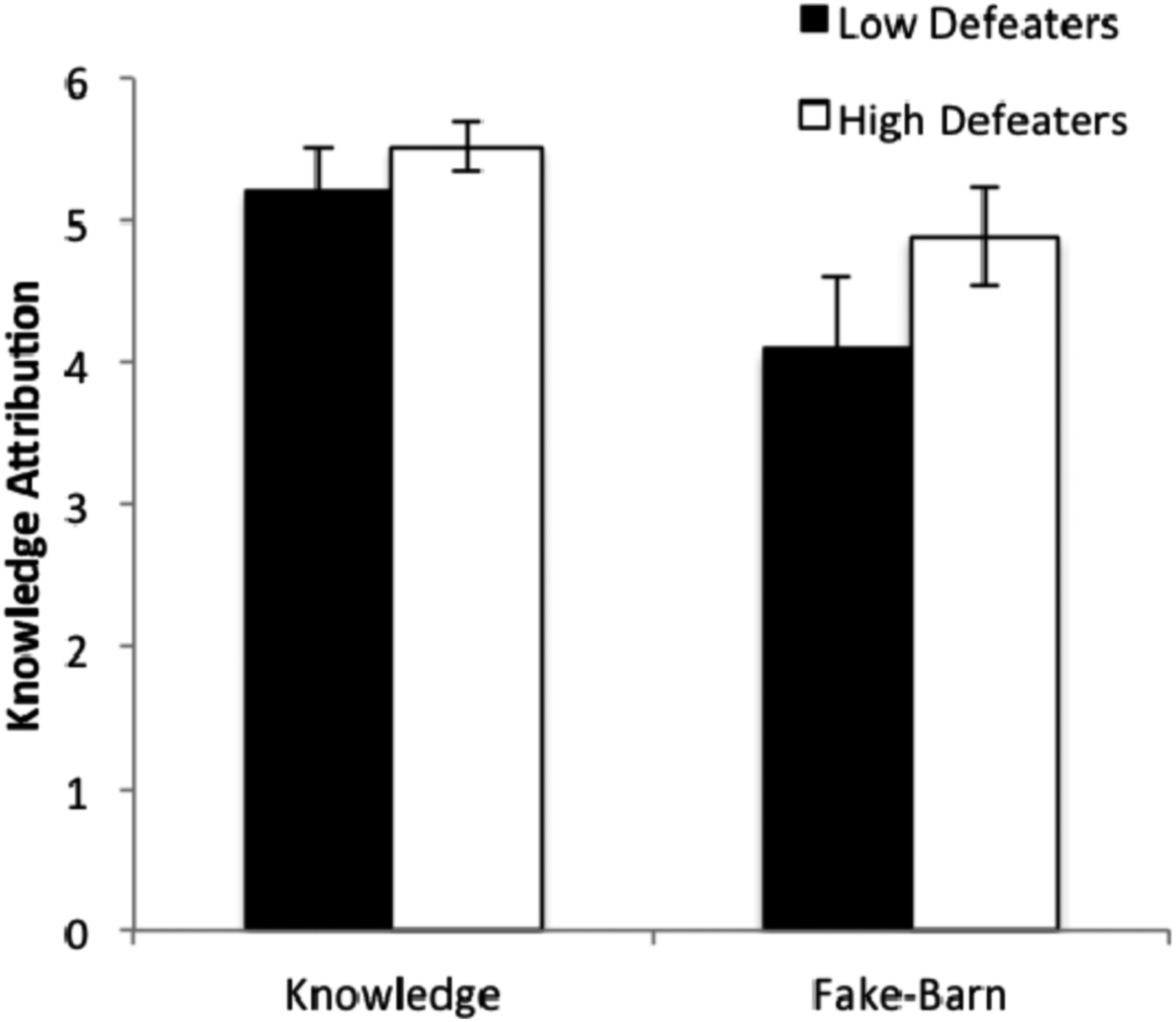
To analyze the results, we began by removing from the study participants who did not respond ‘Yes’ to both comprehension questions, resulting in a sample of 169 participants, with all of the remaining participants attributing a true belief to the protagonist in the vignette they read. We found that participants responded differently in the fake-barn and knowledge conditions.Footnote 6 More specifically, in the low-defeaters condition, there was a significant difference between participants’ responses to the knowledge question in the knowledge and fake-barn conditions: They were more likely to ascribe knowledge to Gerald when asked about the cow than about the house.Footnote 7 Furthermore, both values were significantly above the mid-point of the scale (three), suggesting that knowledge is being attributed both in the fake-barn and knowledge conditions.Footnote 8 In the high-defeaters conditions, there was no statistically significant difference between responses to the knowledge question in the fake-barn and knowledge conditions.Footnote 9 Once again, the means were above the mid-point, suggesting knowledge attribution in these conditions too.Footnote 10 Finally, in the fake-barn conditions, we failed to find any statistically significant difference between the low-defeaters and the high–defeaters conditions.Footnote 11 These data are represented in Figure 1.
Mean knowledge ratings in the knowledge and fake-barn conditions grouped by number of potential defeaters. Scales ran from 0 to 6.

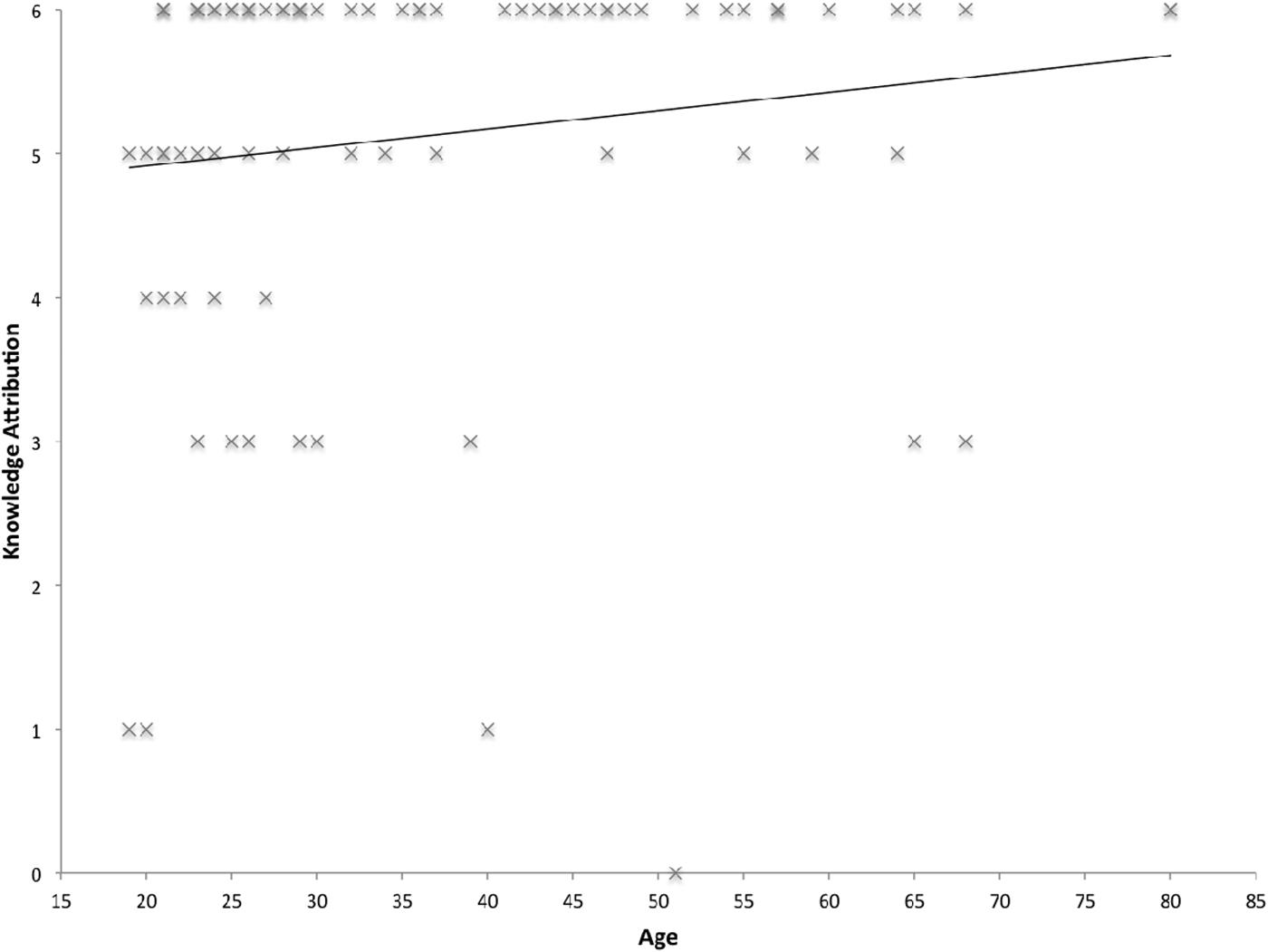
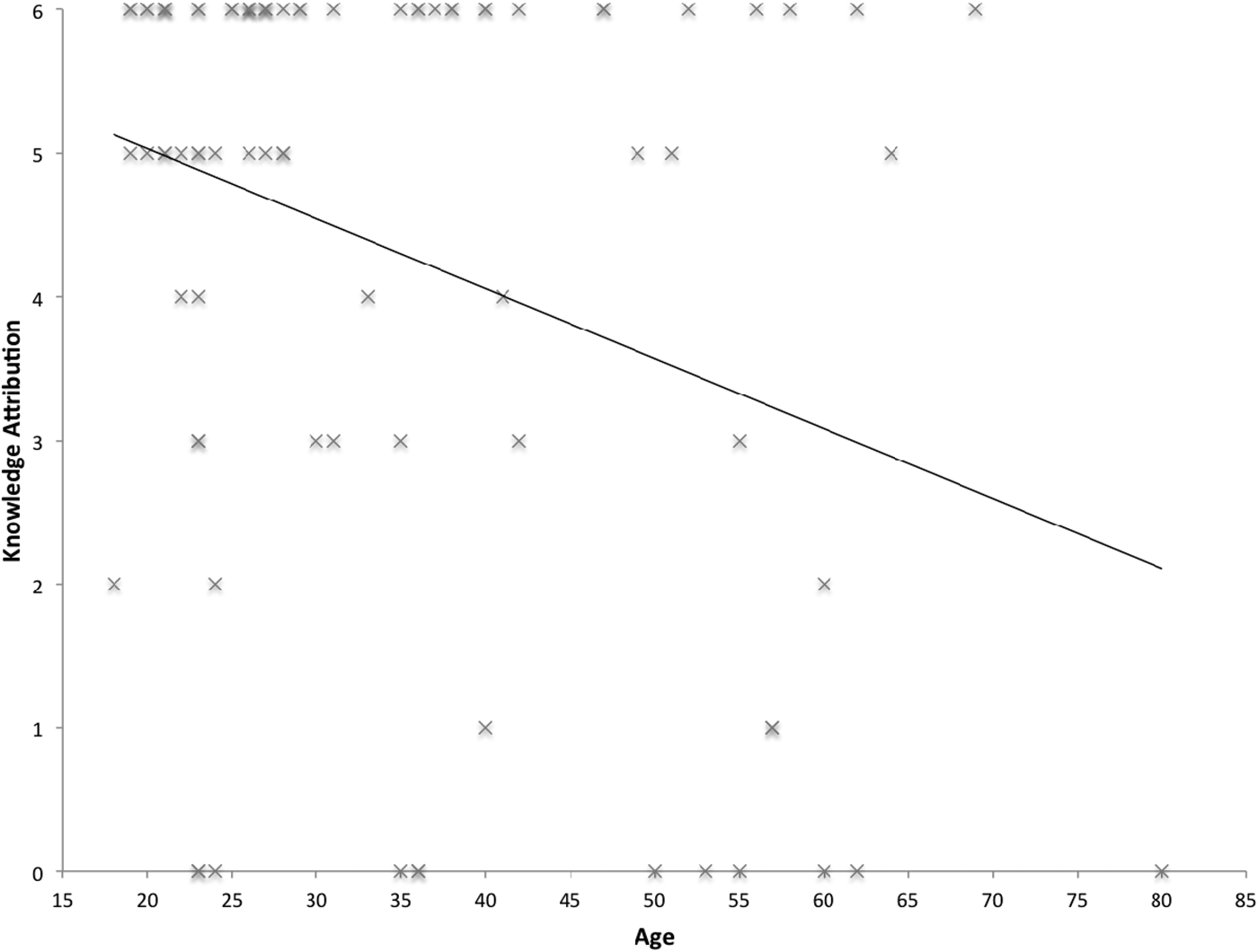
We now turn to the relationship between participants’ attributions of knowledge and their age. We examined whether age first, and then age, gender, and the number of potential defeaters linearly predicted knowledge attribution in the knowledge and fake-barn conditions. In the knowledge conditions, age did not significantly predict knowledge attribution, either when considered alone or with gender and the number of potential defeaters.Footnote 12 By contrast, in the fake-barn conditions, age significantly predicted knowledge attribution, either when considered alone or together with gender and the number of potential defeaters (a medium effect size according to Cohen Reference Cohen1992).Footnote 13Figures 2 and 3 present the corresponding scatter plots.
Knowledge attribution as a function of age in the knowledge conditions.
Knowledge attribution as a function of age in the fake-barn conditions.

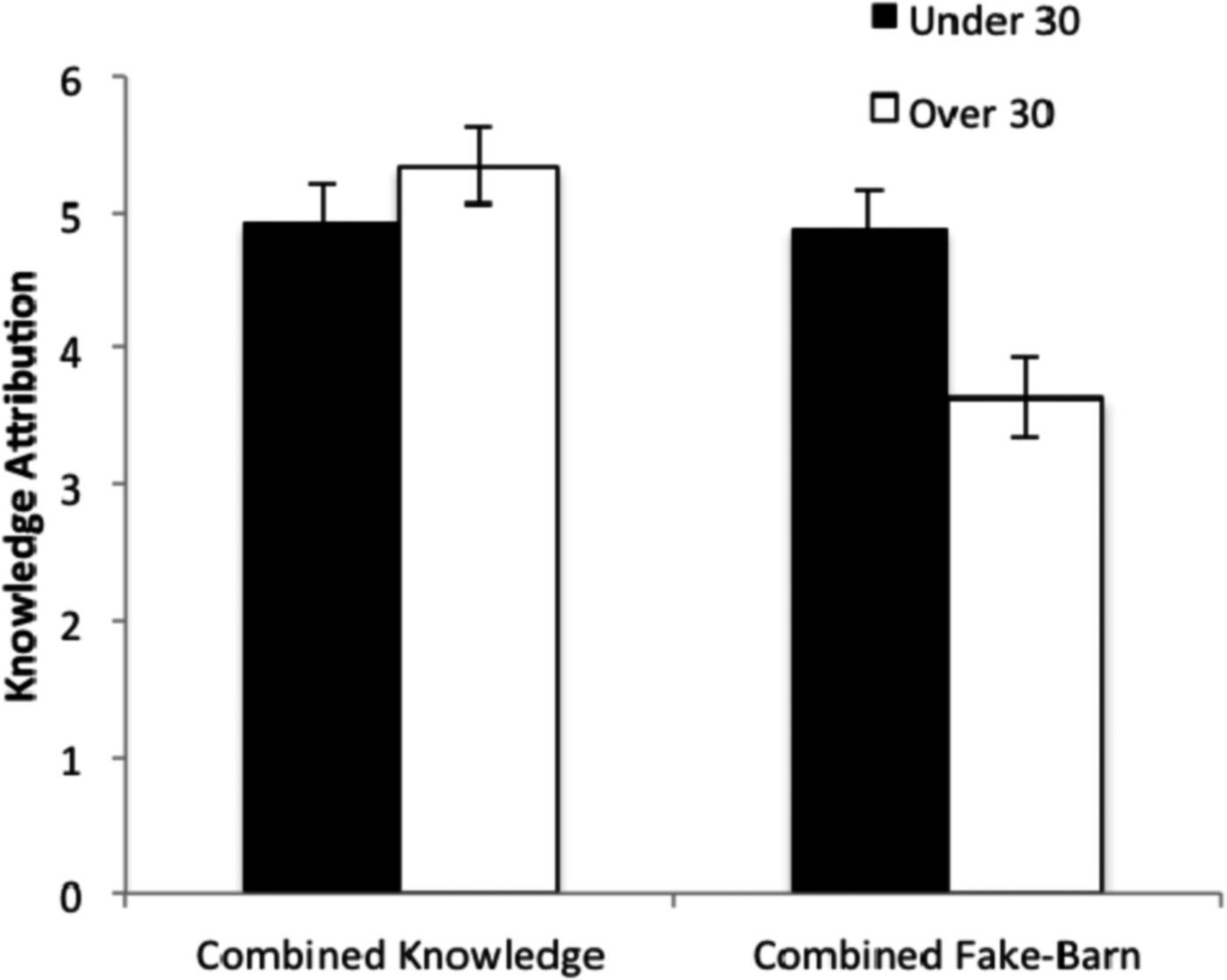
To further analyze the relationship between age and knowledge attribution in our experiment, the sample was divided into two relatively even groups: those participants who indicated that they were 30 years old or younger (N = 88) and those who indicated that they were over 30 years of age (N = 80).Footnote 14 Since no significant difference was found between low-defeaters and high-defeaters conditions, we collapsed these responses, leaving us with a combined knowledge condition (N = 82) and a combined fake-barn condition (N = 85). We found that these two groups attributed knowledge very differently.Footnote 15 In line with the philosophically popular intuition, the over-30 group tended to judge that Gerald knew he saw a cow, but did not judge that he knew he saw a house (a large effect size according to Cohen Reference Cohen1992).Footnote 16 In contrast, the under-30 group tended to give high knowledge ratings in both combined knowledge and fake-barn conditions.Footnote 17Figure 4 illustrates this difference. As far as we know, besides evenly dividing the sample, the age 30 is of no further theoretical significance. Nevertheless, it illustrates that younger people in the sample are far less sensitive to putative epistemic differences between knowledge and fake-barn conditions when compared with older people.Footnote 18 Most philosophers would consider that the knowledge conditions involved a clear case of knowledge (whence its name!), and participants under 30 exhibited the tendency to respond in the fake-barn conditions in much the same way that they responded in the knowledge conditions.
Mean knowledge ratings in the combined (low- + high-defeaters) knowledge condition and the combined (low- + high-defeaters) fake-barn condition by age group. Scales ran from 0 to 6.
4. DISCUSSION
In this final section, we discuss the significance of our findings. First, this study might be interpreted as showing that lay people share the philosophically popular intuition about fake-barn cases since there is a statistically significant difference between the knowledge and fake-barn conditions. Knowledge attribution is higher in the knowledge conditions (where no potential defeaters exist) than in the fake-barn conditions (where potential defeaters do exist). However, the difference between knowledge and fake-barn conditions is much smaller than what one would expect in light of the philosophically popular intuition. Moreover, since all mean values were significantly above the mid-point on the Likert scale, it would appear that non-philosophers are inclined to attribute knowledge in all these conditions. Caution is needed here since there are legitimate questions about how the mid-point of a Likert scale should be interpreted in experimental philosophy (Cullen Reference Cullen2010), but, if we do interpret responses that are higher than the mid-point as attributions of knowledge, and if our findings are indicative of how non-philosophers would react to these and other fake-barn style cases, then non-philosophers do not share the philosophically popular intuition. This conclusion fits well with previous critical discussion of the philosophically popular intuition. In particular, Gendler and Hawthorne have argued that ‘the concept of knowledge … never offered any stable negative verdict in the original fake barn case’ (Reference Gendler and Hawthorne2005: 348), although they did not include age, or any other demographic factors, among the potential causes of this lack of stability.
These results are similar in spirit to the findings presented by Swain et al. (Reference Swain, Alexander and Weinberg2008). Although their study does not have a between-subjects experimental design, and is thus not directly comparable to ours, knowledge attributions about fake-barn cases are above the mid-point, and ‘surprisingly stable across presentation position’ (Reference Swain, Alexander and Weinberg2008: 146; see also Turri et al. ms). Since their study was performed on college undergraduates, these ‘surprisingly stable’ knowledge attributions are compatible with our findings for individuals under the age of 30. Swain and colleagues may have obtained other results if they had examined a more diverse population. The findings in Wright (Reference Wright2010) follow the same experimental design as Swain, Alexander and Weinberg, and cannot be directly compared with ours. In contrast to Swain and colleagues, Wright reports that knowledge attribution in a fake-barn case varies across contexts: Most people attribute knowledge when the case follows an unclear instance of knowledge (the true-temp case), but only a minority do so when the case follows an instance of scientific knowledge or a clear case of lack of knowledge. How can we explain the difference between people's willingness to ascribe knowledge in a fake-barn case in our study and their reluctance in some conditions in Wright's study? We speculate that the difference may be due to the fact that, in Wright's fake-barn case but not in our case, all the barns except the one the agent happens to be looking at are fake. Even if the number of encountered potential defeaters does not influence lay people's knowledge attribution, as our study seems to reveal, lay people may be unsure about ascribing knowledge when the case makes it clear that the agent formed a true belief by sheer luck.
Second, perhaps surprisingly, lay people do not seem to think that having been exposed to many potential defeaters makes any difference to one's knowledge (in contrast to DeRose Reference De Rose2009): We failed to find evidence that the number of encountered potential defeaters affects whether lay people attribute knowledge in fake-barn cases.
Third, perhaps the most interesting result of this study is that there is a negative relationship between knowledge attribution and age. Younger people seem to have little or no problem counting a fake-barn case as a genuine case of knowledge, regardless of the number of potential defeaters. Older people, on the other hand, are substantially less inclined to judge that these cases count as knowledge. (Remember that we found a medium to large effect size for the effect of age on knowledge ascription in fake-barn conditions.) Thus the intuitions of older people are more similar to the philosophically popular intuition about fake-barn cases, while those of younger people depart rather dramatically from it.
Since the correlation between age and knowledge attribution did not occur in the knowledge conditions, it is doubtful that it can be explained by appeal to the way older people fill out surveys or by the way they interpret all questions about knowledge. Rather, it seems that there is something about fake-barn intuitions that reflects age. Whether similar effects occur with other philosophically important thought experiments is an intriguing topic for further research.
We see three possible explanations for why older individuals are less likely to attribute knowledge in fake-barn cases. First, as noted earlier, risk aversion seems to increase with age (Bonsang and Dohmen Reference Bonsang and Dohmen2012), and more risk averse people may judge that more is at stake in a fake-barn case than less risk averse people. If knowledge attribution is stake-sensitive, then older people should be less likely to attribute knowledge in fake-barn cases. Second, older people are likely to have had more experiences of instances of merely apparent knowledge (cases where one's beliefs turned out not to be instances of knowledge) when compared with younger people. If one considers, tacitly or explicitly, such experiences when attributing knowledge, particularly when potential defeaters are salient, as they are in fake-barn cases, then older people should be less likely to attribute knowledge in fake-barn cases. Third, and perhaps less plausibly, younger people may be more likely to tacitly endorse some form of epistemic subjectivism than older people – the view that, if it seems to an agent that she knows that p, then she knows that p. Beebe and Sakris (Reference Beebe and Sakris2011) reported that college-aged individuals are more disposed to make judgments that reflect moral subjectivism, and whatever causes college-aged individuals to be more disposed to make morally subjectivist judgments may also play some role in making them more disposed to epistemologically subjectivist judgments. We remain agnostic about which of these explanations, if any, is correct, and further research will be necessary to examine them.
One could question whether the effect reported in this article may be due to a demographic variable correlated with age instead of being attributable to age per se. With the exception of the variables we controlled, we cannot discount this possibility. Despite this fact, the following comments remain compelling, whether the effect is produced by age or by a factor statistically correlated with it.
The findings presented above are relevant to arguments in at least three different domains – pedagogical, methodological, and experimental – that either already are, or should soon become, of great interest to philosophers. We will begin with the pedagogical significance of our findings. An informal survey of acquaintances who teach epistemology suggests that early on in many courses, the instructor tries to make the point that justified true belief is not sufficient for knowledge. One common technique for conveying this idea is to use examples like barn cases, on the assumption that they are intuitively clear cases in which a justified true belief does not qualify as knowledge. But the data we have presented pose a challenge to this assumption. For even if most philosophers have the intuition that fake-barn cases are not instances of knowledge, it is quite possible their students do not. Thus, one practical conclusion to be drawn from these data is that if one wants to convince undergraduates (who are typically well under 30) that the traditional justified-true-belief account of knowledge is problematic, presenting standard barn cases may not be a particularly effective strategy for doing so.
Next, we'll consider their methodological significance. If it is true that philosophers tend to have different fake-barn intuitions than members of the general public, this joins a growing number of empirical findings in a variety of philosophical domains suggesting significant differences in intuition between professional philosophers and non-philosophers (see Sytsma and Machery Reference Sytsma and Machery2010; Buckwalter and Stich Reference Buckwalter and Stich2011, Reference Buckwalter, Stich, Knobe and Nichols2013; Tobia et al. Reference Tobia, Buckwalter and Stich2012, Reference Tobia, Chapman and Stich2013). The fact that a number of important philosophical intuitions diverge among people in different demographic groups has been an important premise in a family of arguments in experimental philosophy known collectively as ‘the negative project’ or the ‘restrictionist challenge’ (Alexander and Weinberg Reference Alexander and Weinberg2007; Weinberg and Crowley Reference Weinberg and Crowley2010; Machery Reference Machery2011). Though the nature and structure of these arguments are diverse, they all call into question in various ways the use of intuitions as evidence in philosophical discourse. At present writing, diversity in philosophical intuitions has been reported for ethnicity (Weinberg et al. Reference Weinberg, Nichols and Stich2001; Machery et al. Reference Machery, Mallon, Nichols and Stich2004, Reference Machery, Olivola and De Blanc2009, Reference Machery, Deutsch, Mallon, Nichols, Sytsma and Stich2010; Mallon et al. Reference Mallon, Machery, Nichols and Stich2009; Beebe and Undercoffer ms; Sytsma et al. ms; Waterman et al. ms), gender (Zamzow and Nichols Reference Zamzow and Nichols2009; Buckwalter and Stich Reference Buckwalter, Stich, Knobe and Nichols2013), personality (Feltz and Cokely Reference Feltz and Cokely2009), and philosophical background (Nichols et al. Reference Nichols, Stich, Weinberg and Luper2003). We now add intuiter's age to the list of factors that may mark differences in intuition. And although this claim will require a more careful defense than can be provided here, we think the results we have reported contribute to the ongoing criticism in experimental philosophy of the evidentiary status of intuitions in many kinds of philosophical argument (see Stich ms in preparation).
Lastly, we'll consider their experimental significance. As mentioned above, in recent years experimental philosophers have uncovered a number of results regarding the philosophical intuitions of ordinary people. Sometimes, experimentalists have found evidence to support traditional philosophical wisdom (Sytsma and Livengood Reference Sytsma and Livengood2011; Dunaway et al. Reference Dunaway, Edmonds and Manley2013; Rose and Schaffer forthcoming; Buckwalter ms); and sometimes, they have reported results that have done much to question it (Livengood and Machery Reference Livengood and Machery2007; Starmans and Friedman Reference Starmans and Friedman2012; Murray et al. forthcoming; Myers-Shulz and Schwitzgebel forthcoming). But often, the age of participants in experimental philosophy studies goes unreported. We think the current findings should inspire experimental philosophers to pay attention to, and in some cases take further steps in an attempt to control for, possible variation in philosophical intuition based on important demographic variables like age. Though this will likely require surveying populations with greater diversity of age than is often available in an undergraduate classroom, failing to collect data on demographic variables like age may cause researchers to miss significant effects like the ones we have reported. We hope that by raising awareness of this factor, future researchers will be motivated to be more precise and nuanced in the descriptive account they offer about philosophical intuitions across the lifespan, in barn cases, and beyond.
5. CONCLUSION
In the philosophical literature, fake-barn thought experiments are widely – though not universally – taken to be uncontroversial cases in which a protagonist has a justified true belief that is not knowledge. One may have also thought that fake-barn cases in which the protagonist has been exposed to a large number of potential defeaters are clearer cases of non-knowledge than fake-barn cases in which the protagonist has been exposed to few or none. Our study raises questions about both of these contentions. For, while participants attributed knowledge differently in the fake-barn and knowledge conditions, they nonetheless tended to attribute knowledge in the fake-barn conditions. Moreover, the intuition that the protagonists in fake-barn cases do have knowledge is largely impervious to the change in the number of potential defeaters the protagonist has encountered. The finding that participants are sensitive to the distinction between fake-barn cases and unproblematic cases of knowledge is largely driven by older people; younger participants are much more likely to attribute knowledge across the board. Perhaps the safest conclusion that can be drawn from our study is that there may be complexities behind fake-barn intuitions that have not been recognized in the epistemological literature and that would be difficult or impossible to discern without employing the techniques of experimental philosophy. We suggest that philosophers begin to think very carefully about the role of standard barn cases – in classrooms as well as in epistemological arguments – given the apparent disagreement and variability of barn intuitions across the lifespan.Footnote 19