One of the most surprising aspects of the 2003 German film Good Bye, Lenin! (at least to viewers who grew up outside of East Germany) might be the close relationship that the protagonist Alex has to space travel, especially in his youth.Footnote 1 The film opens with a young Alex and his sister sitting in their living room, watching as Sigmund Jähn (an actual historical figure) becomes the first citizen from either East or West Germany to travel to space. A subsequent montage of the following years shows that for Alex, spaceflight formed a centerpiece of his childhood. He went to space clubs, where he wore a spacesuit and played in replica spaceships. He made his own model rockets. And he even sent a doll of the beloved East German children's television character Unser Sandmännchen (Our Little Sandman) on a trip into the above sky. For a state seemingly far removed from the Space Race between the United States and USSR, the personal relationship that one child had to space travel might be unexpected.
Yet, the opening scenes of Good Bye, Lenin! provide an introduction to what was a wide phenomenon: the ubiquity of space culture in East German childhoods. Beginning in the late 1940s and continuing through the collapse of East Germany (German Democratic Republic, GDR) in 1989, leading organizations such as the Sozialistische Einheitspartei Deutschlands (Socialist Unity Party, SED), the Freie Deutsche Jugend (Free German Youth, FDJ), the Ernst Thälmann Pioneers, and publishing houses expressly encouraged East German children to learn about the cosmos, to become excited about the possibilities for space travel, and to participate in a range of space activities. Children (here meaning youth through eighth grade or around fourteen years old) read nonfiction space literature, watched their favorite television characters travel to space, played space-themed board games, and followed along as beloved literary characters traveled to distant planets.Footnote 2 In particular, youth space enthusiasm was centered around activities. East German students did not just sing songs about space travel, for instance. Rather, songbooks included directions for children to act out the orbits of Soviet spacecraft while the lyrics described how the children might someday travel into space themselves.Footnote 3
Youth space culture in the GDR embodied a wide range of activities and media. Together, these sources demonstrate the GDR's sustained investment, from the 1940s through the 1980s, in teaching children about space travel. As will be discussed, many reasons encouraged East German adults to include spaceflight within youth entertainment and education. Space travel, for instance, represented a particular success of the Soviet Union, and it also offered a clear example of the techno-socialist future promised across the eastern bloc. Although children encountered the cosmos in a variety of contexts, this article particularly considers space education in the GDR: what and how East Germany's youngest citizens learned about the growing possibilities for venturing beyond the Earth. This study of how East German children learned about traveling to the cosmos informs two areas of scholarship: studies on youth and education in the country and research on how East German adults conceived of the future, both for East Germany's children and more broadly for the state itself.
First, space activities represented one particularly prominent youth activity in the GDR and therefore add to scholarship on youth education and free time in the country. Scholarship on children in East Germany mostly focuses on the workings of official youth organizations, especially their formation, connections to the regime, and efforts to become popular, rather than the specific activities that they offered. Authors such as Anna Saunders and Alan McDougall have shown that the two main state youth organizations—the Young Pioneers for children from six to fourteen and the Free German Youth for youth from fourteen to twenty-five—aimed to make future socialist, patriotic East German adults, especially through organized extracurricular engagement,Footnote 4 while other research has focused on the anti-fascist character of youth activities.Footnote 5 In some ways, space activities were reliant on this existing structure: space groups easily formed within this wider network of free-time activities, allowing for space education to take place alongside other aspects of East German education. At the same time, space education adds a particular example of one kind of activity in which children often participated and especially shows how one topic could be used to teach a variety of lessons.
Youth space activities also allow for an investigation into expectations for East Germany's future because future-looking aspects are intrinsic to both education and spaceflight. The project of education is future-inflected: leaders and educators need to predict what the world will look like (and what skills children will someday need) once these students become adults themselves. Moreover, the particular context of spaceflight adds a further layer of futurity: because the dream for widely accessible spaceflight or trips to other planets remained on the temporal horizon, space education often relied on expectations for the possibilities of space travel as much as current technological capabilities.
Although the relationship between space education and the future might be clear, the wider ways in which East Germans thought about the future remain an open question. The future seems to be central to the GDR. Even a cursory glance at East German culture reveals a country infused with anticipations of what was to come, from future-inspired building projects to SED propaganda about the coming benefits of the Five-Year Plan to the official support for Prognostik, or futurology.Footnote 6 Sources like the children's book Unsere Welt von morgen, which predicted the technological, colorful, and organized future of socialism, encapsulate this perception of East Germany (and the Soviet bloc as a whole) as a place bursting with optimistic expectations for society and technology.Footnote 7
When discussing how the East German state looked toward the future, historians often comment on the overlap between present and future in the country. For socialist parties, present and future were intrinsically related. The project of “building socialism” in the present would directly create a better tomorrow, whereas the deferment of present dreams and desires would be counteracted by more plentiful times in the future.Footnote 8 As Sheila Fitzpatrick has pointed out, socialist realist images of supposedly contemporary people in the USSR were more about life as it might someday be than about life as it actually was.Footnote 9 East German historians in particular have studied this relationship between present and future through cultural artifacts like building projects and consumer goods, showing that they were simultaneously presented as small-scale foretastes of what the future would be like and also as the necessary tools that would be used to build imagined futures.Footnote 10 Space travel provides a concrete example of this phenomenon. Space missions supposedly showed how people would live in the future, but they were also the means by which this future—with regular spaceflight, global communications provided by satellites, and new materials that could only be created in zero gravity—would be built.
Marxist-Leninism's commitment to building a better future has often encouraged scholars and observers to connect it with the idea of utopia. This association might be unexpected because there are reasons to deny that the states of the Soviet bloc had utopian impulses. Friedrich Engels himself rejected “utopian socialism,”Footnote 11 and contemporary scholars during the Cold War, such as Soviet historian Adam Ulam, noted the disintegration of the ideology's utopian aims.Footnote 12 Yet, the idea of utopia is persistent within scholarship on socialism.Footnote 13 Perhaps the resiliency of this belief in socialism's utopian qualities stems from party insistence that society could actively build such a future and that this future would be better in measurable ways. What is clear is that this insistence that the future would be better subsequently encouraged artists to use the genre of utopia as a way to criticize the present. For instance, East German science fiction authors and filmmakers adopted the genre of the utopia as a way to point out the state's failure to meet its own visions for a better future.Footnote 14
The role of the future and utopian dreaming in socialist states is deserving of further inquiry, but within this much larger and more complicated question of how East Germans conceived of and anticipated their own future, youth space education provides one specific answer. Indeed, the particularities of youth space education challenge some assumptions about the future in the GDR. First, space education did not present only objects as the means to anticipate the future. Instead, the lessons that children were given were presented as another set of tools that would be used to build the world of tomorrow. Second, the vision of the future in space education contrasts with the boundless examples of (maybe utopian) dreams in other areas. When it came to space education, the future was not endless but instead relatively fixed. Educators focused on teaching about the facts (not dreams) of the cosmos and showing how lessons about spaceflight were useful for a future on Earth (not in space).
The intersection of spaceflight and youth culture in the GDR provides new insights into two questions: how East German adults hoped to educate the youth in the present and how they hoped children would someday live in the future. This focus on adults’ attitudes toward youth space education is largely driven by the source base. As in other instances, the voices from children are rarely preserved in archival material about space education. Even sources that claim to represent youth opinions have usually been translated through an adult, be it an editor, author, or government official. Although individual reactions to youth space education might be lost, the richness of existing sources—including newspaper articles, nonfiction books, magazines, science fiction stories, films, games, and archival material—can illuminate the multifold ways that East German children encountered information about the cosmos.
This article begins by discussing the phenomenon of space enthusiasm in East Germany generally, for adults as well as children. It next explores how East German children were taught about space by considering three areas in which they were mostly likely to encounter it. The first instance is the most literal way in which children learned about spaceflight: at cosmonaut centers and clubs spread across the GDR. At these clubs, East German children completed modified versions of the tests that were used in cosmonaut training while also learning skills that were designed to be useful not in space but rather on Earth. Indeed, as the next section on the Jugendweihe, the confirmation ceremony of East Germany, points out, these lessons of spaceflight were supposed to teach children lessons that they would take into their adult futures. And yet, as the third section on space in popular media demonstrates, these lessons did not revel in possibilities for imagination about the future. Instead, they prioritized the factual over the fantastical. Ultimately, the example of youth space culture provides one way to examine how adults understood the SED's claims for the techno-socialist future and presented this future to East Germany's children.
The Role of Spaceflight in East Germany
Space education aimed at children represented just a small sliver of the much wider East German engagement with space travel, or indeed with science and technology in general, and any discussion of youth space interest must take this wider context into consideration. Beginning in the late 1940s and continuing through the 1980s, East Germans of all ages visited planetariums, went to space exhibits, and flocked to space films.Footnote 15 In 1960, East Germany's first space film Der schweigende Stern (The Silent Planet) became a popular hit.Footnote 16 Newspapers regularly ran articles about the milestones of spaceflight and plans for future missions, and satirical magazines like Eulenspiegel especially found endless possibilities for humor in spaceflight. East Germans were also surrounded by physical reminders of the Space Age. The ubiquitous Trabant automobile was named in honor of the first satellite, and East Germans also bought a variety of home goods with space-themed decorations, such as commemorative plates and lamps.Footnote 17 Even East German public building projects relied on space themes. The iconic East Berlin Fernsehturm (television tower), for instance, intentionally referenced the shape of Sputnik.
Although spaceflight was genuinely popular, its visibility also stemmed from its importance to the SED, which encouraged popular interest in the topic. For the party, spaceflight made tangible what were otherwise two nebulous promises. First, spaceflight, especially in its early years, offered an example of a clear Soviet victory over the United States, and the SED used examples from space travel to show that the GDR was allied with the victorious superpower. Second, spaceflight was used as a shorthand to explain the many ways in which East Germany's future would supposedly be better. According to the SED, spaceflight was technologically advanced, peaceful, and useful. Just like other examples of technology in the GDR, spaceflight supposedly offered both a foretaste of what the future of the socialist GDR would look like and also the means by which this future would be created.
The party's visual imagery especially conveyed these many attitudes about the meaning of spaceflight. SED propaganda depicted spaceflight as futuristic, bright, and hopeful. It often featured smiling moons, optimistic assertions, and an assumption that spaceflight would only be bounded by the confines of human imagination. At the same time, SED depictions also linked the cosmos to life on Earth, making it seem like space travel would never be that far away or unfamiliar for socialist citizens. Space travel was presented as boundless but not alien, simply a logical consequence of socialist development. An illustrative image appeared in the East German party newspaper Neues Deutschland one week after the launch of Sputnik. In it, a smiling Sputnik launches from the Kremlin (Figure 1).Footnote 18 A grinning moon asks, “Who carried you to such heights?” “Socialism!” the Sputnik answers. The Sputnik prefigured the technological benefits that would accompany socialist development, and the friendly cosmic bodies anticipated that socialism would feel comforting and familiar. Even the ease with which the Sputnik fit into an image spanning from the Kremlin to the moon showed that these great technological changes would not alter life in the future to make it completely unfamiliar. Through imagery like this cartoon, the SED presented spaceflight, both present and future, as optimistic, inviting, and inclusive.
“Mond,” Neues Deutschland, October 12, 1957, 1.

Yet not all space enthusiasm was equal in the eyes of the state. While the SED encouraged popular interest in spaceflight, the party also remained skeptical and even fearful of fictional imaginations of the cosmos, most notably in science fiction. The settings of extraterrestrial science fiction—spread across time and space—were by definition limitless. Science fiction authors from the GDR could (and sometimes did) use spaceflight to imagine social systems beyond those prescribed by socialism or to gain a distance from which to criticize life in East Germany.Footnote 19 Publishing houses and authors censored science fiction, and some science fiction clubs faced Stasi surveillance. Two members of the Stanislaw Lem Science Fiction Club, founded by students at the TU Dresden, were expelled from the university on the basis of the supposedly “anti-socialist tendencies” in their amateur science fiction stories.Footnote 20
One common theme that spanned both official and popular space enthusiasm was an interest in the figure of the cosmonaut. As the individuals who personally bridged life on Earth with life in the cosmos, cosmonauts connected contemporary life with the anticipated future. The SED (along with its counterparts throughout the eastern bloc), presented cosmonauts as embodiments of an ideal socialist lifestyle and builders of the socialist future. Cosmonauts were resourceful and hardworking, adhered to ideology, and believed in technology's ability to shape a better future. A review for an East German children's book about the first woman cosmonaut, Valentina Tereshkova, praised the fact that the book made Tereshkova into an excellent role model whose life and outlook (such as her commitment to hard work) could teach lessons to children.Footnote 21 This interest in cosmonauts also extended to science fiction, and stories aimed at adults and children alike often contained plots centered around the exploits of space travelers.Footnote 22
Indeed, East Germany's first and only cosmonaut initiated the biggest moment of space enthusiasm in the GDR. In August 1978, Sigmund Jähn, flying aboard the Soviet Soyuz 31 mission, became the first citizen from either German state to reach outer space, kicking off cosmic celebrations across the GDR. Bands released space songs, and consumers excitedly purchased memorabilia from official kiosks.Footnote 23 More than one hundred thousand people supposedly went to the official Soyuz 31 exhibition in East Berlin.Footnote 24 Every evening during the Jähn mission, East Germany's youngest citizens could watch a puppet version of Sigmund Jähn travel into space on the popular nightly children's television show Our Little Sandman.Footnote 25 Like all cosmonauts, Jähn was presented as an ideal socialist citizen. He was supposedly brave, ideologically oriented, and personable. But for the first time, the GDR could claim that East Germans—not just their Soviet allies—also exemplified these traits in the cosmos. Moreover, just as Soviet space victories signaled superiority over the United States, so too did Jähn's mission, coming before any West German had traveled into space, signal an East German victory over West Germany.
Space excitement among adults shared several aspects with youth space education. First, space travel was a popular subject, and the variety of activities aimed at children shows that adults assumed that spaceflight was exciting and engaging for students. Second, just as space travel was closely connected to bigger ideas about socialism, the Soviet Union, and the future of the East German state, so too were children's space activities not limited to lessons about the cosmos but were also used to teach a variety of life lessons to East Germany's students. Third, the figure of the cosmonaut played a central role in children's space culture. Perhaps the clearest use of all three of these characteristics—encouraging excitement, teaching lessons, and focusing space on the figure of the cosmonaut—can be seen in the example of the cosmonaut center.
Space Education and Cosmonaut Centers
East German children encountered spaceflight through various activities, programs, and media, but it was at cosmonaut centers and clubs spread across the GDR where children most clearly learned about space travel and the practical lessons that could be derived from it. The largest and most famous center was the Yuri Gagarin Cosmonaut Center, later renamed after Sigmund Jähn, in Karl-Marx-Stadt (now Chemnitz). The center, which attracted local and visiting students from around the GDR and around the world, offered its guests a fantastical assignment: to experience what it was like to train and work as a cosmonaut. Other cosmonaut centers and clubs were founded across the GDR in cities such as Leipzig, East Berlin, and Cottbus beginning in 1961 through the mid-1980s.Footnote 26
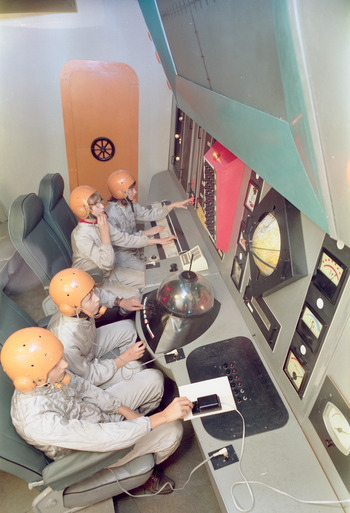
The Karl-Marx-Stadt Cosmonaut Center was initially designed for the Fifth Pioneer Meeting held in the city in 1964. The organizers of the meeting, along with editors from the popular East German youth magazine Technikus and the prolific author of youth space books Heinz Mielke (to my knowledge, no relation to Minister for State Security Erich Mielke), created the building and its initial facilities in the span of one month. It later expanded into a permanent facility.Footnote 27 Here, children took various physical and knowledge-based “tests” that supposedly measured the skills and physical traits that were needed to survive aboard a space mission. Ultimately, these tests claimed to mimic the training undertaken by professional cosmonauts. Students who had passed all of the tests could then wear a spacesuit and participate as one of four crewmembers on a simulated spaceflight (Figure 2).Footnote 28
BArch, Bild 183-M1030-405, Wolfgang Thieme, “Karl-Marx-Stadt, Kosmonautenzentrum,” October 1973.

The Karl-Marx-Stadt Cosmonaut Center proved to be popular with locals and tourists alike. Visitors grew from five thousand in 1964 to between ten and fifty thousand per year through the 1980s.Footnote 29Neues Deutschland claimed in 1983 that there were visitors from more than fifty countries and from every continent who had signed the guest book.Footnote 30 The center's guest books seem to corroborate this claim. In the late 1970s and early 1980s, there were numerous comments in Russian, along with Arabic, Bulgarian, Spanish, French, Czech, and Polish.Footnote 31 Visitors from West Germany and Austria also wrote down their impressions of the center.Footnote 32 This volume of visitors might have in part stemmed from the center's coverage in Technikus, which encouraged its tens of thousands of readers to see the center for themselves.Footnote 33 The magazine described the center in exciting detail and even suggested times to visit during school holidays.Footnote 34 To further encourage students to take a trip to Karl-Marx-Stadt, Technikus promised to mail a commemorative certificate to every student who passed the tests.Footnote 35 Moreover, the structure of training and simulated missions might have been already familiar to visitors from other socialist states. Pioneer palaces in the USSR, for instance, featured clubs of “future cosmonauts,” where children also pretended to train like cosmonauts.Footnote 36
The Karl-Marx-Stadt Cosmonaut Center professed two different but related goals. One purpose was to educate and entertain. According to Neues Deutschland, the center was tasked with conveying “basic knowledge about spaceflight in a fun way.”Footnote 37 Students could learn from the center's exhibits as well as the activities themselves. Professional cosmonauts told children about their experiences in space, and Sigmund Jähn became a regular visitor after his spaceflight.Footnote 38 This educational prerogative extended to students across the country. For children who could not attend in person, Technikus made it easy to replicate the experience at home. The magazine published information about the cosmonaut tests, which were easily reproducible with only basic equipment. Children could presumably also reenact the simulated spaceflight with the reprinted transcripts. Every East German child, therefore, could in some way share in the experience of the Cosmonaut Center. Indeed, Technikus had attempted to engage all of its readers with the Cosmonaut Center since its inception. During the center's initial construction in 1964, Technikus wrote to its readers, calling “all young cosmonauts” to collaborate and send in ideas for the design of the center and the tests that should be included.Footnote 39
This encouragement for all East German children to participate aligned with the center's second aim: to use space education to teach important lessons that would be useful for everyone, including children who would not become cosmonauts. The tests focused on issues that were applicable to life on Earth, such as fitness, spatial aptitude, Morse Code, and mechanical ingenuity (such as assembling a working flashlight in under a minute).Footnote 40 Beyond particular skills, students also learned about responsibility, leadership, and the importance of education. For this reason, it was critical that the students—not adults—were the teachers at the centers. Students who had already passed their cosmonaut tests taught new groups of cadets, commanded the simulated spaceflights, and led tours of the center's exhibitions. Approximately forty to fifty children and teenagers worked at a time at the center in Karl-Marx-Stadt. Because only one in ten students passed the tests on their first attempt, most students had already dedicated a significant amount of time to their training before they became leaders themselves.Footnote 41 Adults ran the behind-the-scenes work of the Karl-Marx-Stadt Cosmonaut Center, but for visitors, the students were at the forefront. For the center's members, it was also clear that they were training to become leaders themselves and learning other useful life skills.
The focus on educating the next generation of East Germans for a life on Earth was clear, especially given that sources seemed to deemphasize the relationship between the center and the future of spaceflight. In some small ways, children at the centers pretended to be cosmonauts. They dressed in spacesuits, completed their training, and went on missions. Technikus reports about the center also seemed to suggest that the children had a connection to spaceflight of the future. One article claimed that in their flight suits, the students “look like proper space cadets” and that they possessed characteristics connecting them to “the space cadets of tomorrow.”Footnote 42 At the same time, imaginations about their roles within a future of spaceflight were curtailed. The simulated space missions at the Karl-Marx-Stadt center replicated Yuri Gagarin's first spaceflight, instead of going on missions to new places. Students also repeated the same cycle of tests and missions in a facility filled with replicas of historical spacecraft and exhibitions on the history of spaceflight. The emphasis fell on the past, not on an imagined future. Even Technikus articles made it clear that the student members did not expect to grow up to be cosmonauts. Students listed other careers such as animal keeper, kindergarten teacher, and marine merchant as their desired future professions.Footnote 43
The extent to which the East German center did not aim to inspire children to become future cosmonauts is made even clearer through a comparison with the United States, which introduced official space education later and with contrasting goals. In the United States, state-supported youth space activities, epitomized by Space Camp, commenced in the 1980s. The timing is important: the coordinated effort from NASA and the executive branch to encourage space interest among children coincided with the beginning of the Space Shuttle program. With the Space Shuttle missions, general assumptions in the United States about the future of spaceflight changed. Space travel was no longer seen as something for only a handful of elite pilots. Thanks to the Space Shuttle's promise for lower-cost, continually operational space travel, it became reasonable for the first time to believe that US children might grow up to live in a world in which spaceflight was an everyday reality.Footnote 44 To help create this new world of regular space travel, the executive branch and NASA worked in tandem to foster excitement for and knowledge about outer space. Activities included a program to send teachers into space, and every elementary and middle school in the country was invited to participate in the Young Astronaut Program.Footnote 45
Space Camps, as part of this wider aim to educate children about spaceflight, provided a particularly clear way in which children could learn firsthand about professional spaceflight. The first Space Camp opened in Huntsville, Alabama, in 1982, and it was designed much like its East German counterparts: it aimed to educate children and offer them a small taste of what it was like to be an astronaut. But it was also clear that Space Camp had a different purpose. To prepare children for the supposedly imminent future of more widespread access to space travel thanks to the Space Shuttle, US Space Camps were built near NASA branches in Alabama, Florida, Texas, and California, physically tying them to professionalized spaceflight but also making them inaccessible for the majority of US children.Footnote 46 East German youth space activities, by contrast, were centered around existing youth centers in well-populated areas of the country, melding activities about space into a city's wider education program. By fitting space activities into the everyday places of the GDR, space educators more clearly indicated that cosmonaut centers were intended to teach lessons that were part of everyday life. They were not a place set aside to learn about a particular future career.
At cosmonaut centers, children could take time from school, activities, and family to learn about space travel. They dressed in imitation spacesuits, conducted physical and mental tests, and pretended to go on a space mission. All of these activities provided concrete, if highly approximated, ways through which children could experience what it was like to train and work as a cosmonaut. At the same time, these activities were directed toward skills useful on Earth. Science, technological proficiency, and working within the collective were the major lessons for students to learn. Although the Cosmonaut Center used lessons about space to teach more widely applicable skills, there was also a future inflection to its mission: to use spaceflight to teach future East German adults. Indeed, in the case of the Jugendweihe, perhaps the most future-looking aspect of East German adolescence, education, spaceflight, and the future were connected even further.
Future Cosmic Socialists and the Jugendweihe
The Cosmonaut Center was probably the clearest place in which East German children engaged with the cosmos. Yet, the emphasis on spaceflight in the Jugendweihe, the secular youth confirmation ceremony of East Germany, and its preparatory classes, known as the Jugendstunde, ultimately reached far more East German children. As a secular ceremony, the Jugendweihe was intended to replace the Christian ceremonies that had previously welcomed children into adulthood. The SED did not invent the ceremony—the Socialist Democratic Party had used it as part of their youth program in the nineteenth century—but in the GDR, the preparation and ceremony took on a particular importance to the state and individuals.Footnote 47 For the SED, the Jugendweihe marked one way to educate East German youths in the main tenets of the state, such as its anti-fascist foundations or commitments to the teachings of Karl Marx and Friedrich Engels.Footnote 48 For individuals, the Jugendweihe became a regular activity completed by almost every eighth grader because the doors to higher education and most professions were closed without it. In 1955, 18 percent of students took part, growing to 82 percent by 1959 and 97 percent by 1984.Footnote 49 Because the ceremony was explicitly forward-looking, anticipating the kinds of adults that the participants would become, and emphasized spaceflight, the Jugendweihe demonstrates how space education was seen as a way to teach all East German students, not just those interested in the cosmos, about their own futures.
The cosmos played a notable role in the Jugendstunde. In East Berlin, the Archenhold Observatory became a particularly popular place for students to work on their requirements. According to a report from the Archenhold's director, Diedrich Wattenberg, the observatory offered Jugendweihe candidates an “astronomical worldview,” which he considered an “essential component” of the Jugendstunde.Footnote 50 The Archenhold's staff were particularly proud that its number of Jugendweihe participants had increased throughout the 1950s, despite the fact that school class sizes were dropping on account of fewer children having been born in the final years of the war.Footnote 51 The Archenhold's staff cited the Jugendweihe, not the launch of Sputnik and the start of the Space Age, as the main reason for the increase in youth visitors over the decade.
These preparatory activities culminated in the Jugendweihe, which marked a moment when young people were supposed to go out into the world as socialist adults. At this bridge between childhood and adulthood, all participants from 1954 to 1975 received a book, described as the “crowning ritual” of the preparatory activities.Footnote 52 This book bridged the Earth and the cosmos. Weltall Erde Mensch (Outer Space, Earth, Man) offered a five-hundred-page scientific discussion of the universe, the planet, and the history of humankind. Because one of the priorities of the Jugendweihe was to replace the Christian religious ceremony (and Christianity's emphasis on creationism), the book relied heavily on scientific explanations for topics such as human evolution.Footnote 53 Indeed, discussions of the cosmos and the scientific study of them might have also been a part of the ceremony's anti-Christian emphasis.
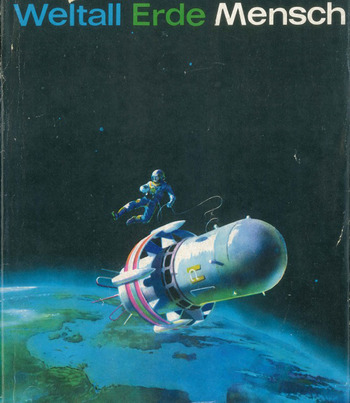
The section on outer space—coming first in Weltall Erde Mensch—cemented the importance of the study of the cosmos in the GDR. This lengthy section discussed atoms, stars, the solar system, rockets, space travel, cosmonauts, and the possibilities for a future in space. Even as early as 1954, before the launch of the first satellite, Weltall Erde Mensch underlined that a discussion of human life needed to begin on the cosmic level. The 1955 edition contained illustrated articles about astronomy, the solar system, and other galaxies.Footnote 54 As spaceflight moved from a dream to reality, and gained a particular cultural meaning in socialist states, Weltall Erde Mensch increasingly related space travel to the East German youth. The first picture in the 1965 edition showed children looking up into the heavens through a telescope, and the first chapter mentioned famous cosmonauts before it mentioned socialism, despite the book's publication for a socialist confirmation ceremony.Footnote 55 By the 1969 edition, the connections among socialism, East Germans, and space became particularly clear. Printed the same year as the Apollo 11 lunar landing, the cover featured an illustration of a cosmonaut performing a spacewalk (Figure 3).Footnote 56 Its vibrant colors exuded an excitement but also an awe for the space traveler, who singlehandedly embodied all three themes of the book: outer space, Earth, and humanity. Yet even more important than the cosmonaut's relationship to space, Earth, and humanity is the metaphor that he represented for the East German youth. As students crossed a border between two stages of life, they received a book, on the very front of which was a cosmonaut. The colors and illustrative style reflected the excitement that children might have had for spaceflight, but the cosmonaut's presence carried a message for the students as they left the ceremony: their task was to bring the characteristics of the ideal cosmonaut into their own lives.
Alfred Kosing et al., eds., Weltall Erde Mensch (Berlin: Verlag Neues Leben, 1969), Cover (Courtesy of Eulenspiegel Verlagsgruppe, Berlin).

The case of the Jugendweihe shows the extent to which essentially all East German youths at some level had to engage with space education. Although the students at cosmonaut clubs might have been self-selecting, the Jugendweihe activities reached students of all backgrounds and interests. The Jugendweihe also demonstrates how closely the state connected the future of spaceflight to students’ own futures. East German youths might not have been expected to become cosmonauts, but the ideas and meaning of space travel were presented as critical to how they should live in the years to come. Yet this emphasis on both facts and the imagined future—two seemingly contradictory topics—in the Cosmonaut Center and the Jugendweihe opens up further questions about the relationships among facts, fiction, and imagination in youth space education, which will be considered in the final section on nonfiction books and magazines.
Separating Expectations from Imaginations
The examples of the Cosmonaut Center and the Jugendweihe demonstrate how spaceflight was used to teach children lessons for their own lives. Similar lessons also appeared in nonfiction books and magazines about technology and the cosmos. Like other space activities, these books (and the reviewers for them) were adamant that they presented supposedly realistic visions of what it would be like to travel to the stars. And yet, these printed sources also included information and images that were more fantastical, from illustrations of lush worlds on other planets to physically impossible space maneuvers. Therefore, these sources pose a final, wider question related to space education, namely the relationship between fact and fiction in imaginations about the cosmic future.
Nonfiction books about space travel in many ways resembled the Cosmonaut Center and the Jugendweihe. First, they were often utilized by the SED and educational groups. Dozens of books about outer space science and travel were published in East Germany, demonstrating the genre's importance to the SED, because the state tightly controlled publishing quotas. And second, like other space activities, nonfiction books about the heavens were often participatory. For instance, the 1948 youth space book Sterne und Welten im All (Stars and Worlds in Space) showed its readers how to find the North Star and explained the properties of the universe through concrete Earth analogies, such as comparing the orbits of planets around the Sun to the movements of a biker and a motorcyclist.Footnote 57 Later nonfiction youth space books continued this emphasis on space activities. The 1974 astronomy book Wieviel Sterne hat der Groβe Bär? (How Many Stars Does Ursa Major Have?) appeared in a series that focused on “self-activities” and also required participation from its readers.Footnote 58 The book's readers (who the author imagined would be about eleven years old) were supposed to learn about the phases of the moon by using a moving light source to cast changing shadows.Footnote 59 According to one review, a further benefit of the book was that it gave its readers suggestions for “observations and small experiments,” through which they could discover the universe themselves.Footnote 60
The book that perhaps best exemplifies this connection between education and participation is the Cosmonaut Primer (Kosmonauten-Fibel), by well-known space writer Horst Hoffmann.Footnote 61 It was designed for twelve-year-olds and included information about spaceflight and the cosmos, drawings that explained the text, and diagrams that suggested some experiments that readers themselves could carry out to understand cosmic phenomena. The publishing report concluded that these experiments in particular would help children better understand the text.Footnote 62 Furthermore, the book included a board game, in which players (called cosmonauts) raced their spaceships from the Earth to the moon. This combination of entertainment, instruction, and development of scientific skills resonated with other aspects of space education.
East German youth magazines, like nonfiction books, also emphasized scientific explanations and encouraged activities for their readers. Space represented one of the focal points for Technikus and was also a centerpiece for similar publications such as Jugend + Technik. From its first issue in 1963 through 1990, Technikus published more than 650 articles, stories, and discussions about space travel and space science, meaning that on average space was featured twice per issue. The cover featured scenes set in the cosmos fifty times. Technikus also presented its readers with space-related activities. Readers could pull out collector cards about spacecraft and rockets, take space quizzes, ask questions about space travel, or send the editor reactions to space articles. A letter from a young reader named Matthias Rippin from Miesitz encapsulated the encouragement for space to become an activity. He said, “One of my many hobbies is astronomy and astronautics. Through you, through Technikus, I have come to this new free-time activity. [Technikus] also provided me more knowledge in this area.”Footnote 63 Outer space was not only something that Matthias read about in a magazine; he also saw space as an activity for his free time, exactly as the magazine had encouraged, which suggests why the editors printed Matthias's comment or perhaps even invented it entirely. For the magazine's readers, Technikus offered an opportunity to learn about space and in a small way reenact the same work as scientists who studied the cosmos.
Nonfiction books did not only repeat the same issues as other forms of space interest, they also raised new questions about how children should be educated about spaceflight. Publishing reports, which commented on the ideological, educational, and social value of new youth books about outer space, illuminate a particular concern that publications not stray into the realm of fantasy. Heinz Mielke, the cofounder of the Cosmonaut Center in Karl-Marx-Stadt, was a prolific author of nonfiction space books, likely at least in part due to the fact that his emphasis on science aligned with the state's approaches to space education. His 1956 book Der Weg ins All (The Way into Space), aimed at eighth-grade readers, presented a history of the idea of space travel from the ancient world to the present. The publishing report for the book emphasized that Mielke's manuscript described the problems of spaceflight factually, clearly, and scientifically. The reviewer praised how the book gave the “true picture” of the possibilities for spaceflight, counteracting the “fantasies” of other publications, which supposedly gave readers unclear ideas about the actual potential of space travel. Indeed, the success of Mielke's book, the reviewer claimed, lay with his ability to write a popular book based in science not sensationalism.Footnote 64
This emphasis on the facts of spaceflight continued throughout Mielke's career. More than a decade later, Mielke wrote Der Weg zum Mond (The Way to the Moon), a bright, colorful book about real efforts toward what was the imminent US lunar landing.Footnote 65 According to the publishing report, the book aimed to capitalize on youth space enthusiasm, which had reached a new height thanks to the Apollo 11 mission.Footnote 66 Again, accuracy was important to the reviewer. The review praised the book for showing concretely how space travel—especially the Soviet Union's long-term plans for the study of the cosmos—was useful for human development. The publishing report noted that The Way to the Moon was not the first book about spaceflight—even Mielke had already written on the topic. But given the fact that existing books treated the topic of travel to the moon only briefly, the reviewer feared that young people would instead rely on spectacular news reports for their information.Footnote 67 Thus, the scientific book filled an important gap. Instead of conveying the excitement and wonder that spaceflight provoked, Mielke's book described the science and technology behind it.
It might be predictable that reviewers would have wanted nonfiction books to present up-to-date information about spaceflight, but it is surprising that the more fantastical aspects of spaceflight—which could also have interested children and provided opportunities for imagination—were downplayed. This insistence on the factual anticipation of the future also appeared in science fiction. For instance, some sources explicitly pointed out that although space travel might seem as fantastical as a fairy tale, it was instead a prediction of a future reality. The 1959 children's film Gleich links hinterm Mond (Sharp Left Beyond the Moon), a twenty-minute puppet film, made this point explicitly.Footnote 68 After a spaceship crewed by young pioneers from around the world launches into space, the narrator clarifies that, though their story might sound like a fairy tale, it could also be a completely true story that just had not happened yet. Even the more fantastical aspects of youth space entertainment—including a spaceship crewed entirely by children—were presented as if they were visions of a world that would one day be reality.
The comparison between space and fairy tales might have been a clear one to make. Fairy tales are a common genre for children's stories, and one way to position a story as scientific is to contrast it with fantasy. Indeed, a similar tactic can be found in one of the most famous examples of West German space culture, the 1966 television show Raumpatrouille Orion (Space Patrol Orion). The opening sequence of the show also remarked that what seems like a fairy tale today may be reality tomorrow.Footnote 69
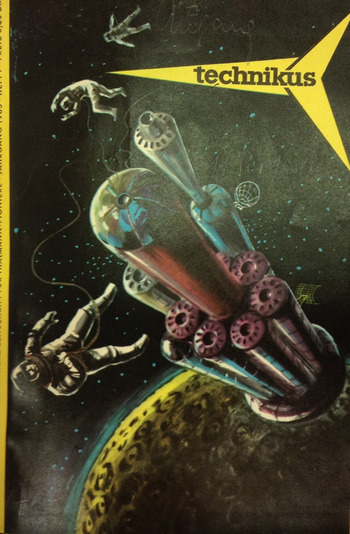
Upon closer inspection, however, the line between reality and imagination was often not as clear-cut as reviewers sometimes made it seem. For instance, although the nonfiction book Stars and Worlds in Space was based on scientific knowledge of the cosmos, the illustrator took artistic license, depicting dreamscapes like lush cosmic forests on distant moons, which the accompanying text claimed were unlikely. Yet, these images were still included in the book.Footnote 70 Moreover, not everything in Technikus was scientific. The magazine included more than ninety science fiction articles in addition to more fantastical illustrations. The cover of its first issue depicts three space travelers, who tumble precariously as their rocket launches from the moon (Figure 4).Footnote 71 The image's neon colors suggest a frenzied excitement for spaceflight found within the pages of the magazine. At the same time, the image is free from scientific constraints, because cosmonauts would presumably not attempt a spacewalk during a launch, and was entirely speculative, because it predated the first spacewalk by almost two years.
Technikus, January 1963, Cover.

The fantastical images of spaceflight, especially on the cover of youth magazines, might be predictable. Widespread spaceflight still remained the purview of the future, and magazine covers had to encourage children to read them. Indeed, East Germany is often seen as a state with aims toward the fantastical, especially supporting possibilities for boundless imagination among its youth. For instance, DEFA fairy tale films seem to act as reminders of the significant role that imagination played in East German childhoods.Footnote 72 Given the importance of imagination in other contexts, perhaps what is more surprising is the overall muted reliance on imaginative elements. Youth space culture might seem like it would have been an ideal avenue to encourage imagination, but instead, space nonfiction and even films often returned to the idea that although anticipations of spaceflight might seem fantastical, these stories presented a plausible future reality. In this regard, the problems that East German science fiction authors faced are particularly relevant. To distinguish youth culture from the critical ideas found in some space fiction, it is likely that makers of youth space culture intentionally underlined the seeming plausibility of their future expectations, thereby also modeling appropriate ways for children to dream about spaceflight. This combination of fact and fantasy, though important for the study of imagination in the GDR, might also illuminate a particular attitude toward anticipations of the future. As will be addressed in the conclusion, makers of youth space education seemed to have accepted the consequences of the assumed future of spaceflight—the idea that children would someday live in a way that relied on the model of the cosmonaut—more than the actual vision of the future in which spaceflight would become widely available.
Conclusion
The question of how East Germans thought about the future of spaceflight—and how they presented it to children—did not always have the same answer. Some aspects of space education did, however, remain relatively constant over the course of multiple decades. Cosmonaut centers and clubs remained popular, with new centers being built through the 1980s. East Berlin opened the Orbitall youth space center in 1980, and a cosmonaut center was founded at the Station of Young Naturalists and Technicians in Bad Liebenwerda in 1987.Footnote 73 Nonfiction books and magazines continued to teach children about the cosmos. State-mandated education about outer space still played a role in the lives of East German teenagers, who were obliged to learn astronomy in high school, unlike their West German counterparts.Footnote 74 Even once it had become clear that spaceflight was not quickly becoming accessible to most people, including citizens of the GDR, adults continued to encourage participation in various space-related activities.
That is not to say that space enthusiasm was constant in the GDR. Particular events, especially Sigmund Jähn's spaceflight, created moments of increased attention, and in the 1980s, there was a diminishing interest in space travel. The USSR's perceived loss of preeminence in spaceflight after the lunar landing and general frustrations that spaceflight had fallen dramatically short of earlier dreams dampened enthusiasm, lowered expectations, and reduced excitement for space-themed activities. Moreover, space travel lost part of its attraction once the US-Soviet Space Race competition dwindled, coinciding with a wider East German commitment to see technology not as a place of competition but rather as a possible connection between East and West.Footnote 75
Perhaps the most visible change in youth space education in East Germany came in the Jugendweihe, which in 1975 changed its official book from Weltall Erde Mensch to Der Sozialismus, Deine Welt (Socialism, Your World), which did not emphasize spaceflight to the same extent. Although this change might have stemmed from a different relationship between the cosmos and socialism, it was not only spaceflight that fell out of favor. Instead, these changes to the official Jugendweihe book seem to signal much wider changes in the GDR, of which space enthusiasm was just one part. For instance, in the Jugendweihe book Vom Sinn unseres Lebens (From the Meaning of Our Life, 1983), even the anti-fascist aspects of East Germany's national myth received less treatment than in prior books. Coverage of the Third Reich shrank from several pages to only three paragraphs.Footnote 76 Aspects of identity that had once been foundational to the GDR, including anti-fascism but also spaceflight, were no longer central to these textbooks, perhaps indicating either that these aspects of East German identity were already widely adopted or that they no longer fit within contemporary notions of what it meant to be East German.
A particularly clear example of both changes and continuities in youth space education comes from the 1988 children's book Der verlorene Glühstein (The Lost Glow Stone) by Carlos Rasch, a prolific writer of science fiction for adults.Footnote 77 The book follows the adventures of a child cosmonaut, a typical character in East German youth science fiction. However, The Lost Glow Stone departs from earlier books by intentionally embracing fairy tales. The story takes place on a fantastical planet, filled with wispy balloon creatures, forest spirits, and a dragon. In fact, the cosmonaut's knowledge of fairy tales is what allows him to save the planet. Whereas earlier stories explicitly contrasted fairy tales and spaceflight, Rasch's book combines the two genres in a way that seems intentional, given the author's deep familiarity with the conventions of the genre in the GDR, perhaps signaling that once it became clear that spaceflight would not be an everyday reality for any state in the near future, more freedom could be given to imagination. In the late 1980s, therefore, there might have been wider changes in accepting the ideal future as created or embodied by spaceflight, certainly thanks to shifting views of spaceflight but perhaps also because of changing views of East Germany's future.
Lessons about life did not have to be taught within the context of spaceflight, so it is useful to consider why these lessons became attached to space travel at all. One answer might be that because socialism maintained a close connection to space travel in space entertainment aimed at East German adults, it was logical for children's education also to rely on space lessons. Furthermore, it could be argued that space travel might have been seen as a way to attract students to the Soviet Union, given the superpower's successes in spaceflight. At the same time, youth activities did not focus exclusively on the Soviet Union. Alongside Soviet missions, Technikus regularly featured stories about NASA space missions, and Mielke's The Way to the Moon capitalized on youth enthusiasm for the Apollo moon missions. Even more noticeably different from adult visions of spaceflight, discussions of socialism appeared less often in youth space culture, apart from the clear connection at the Jugendweihe. Encouraging support for the Soviet Union and by extension the East German socialist project was clearly a factor in youth space education, but it does not seem to fully explain its ubiquity.
Perhaps a more convincing approach is that outer space travel was seen as critical to the education of children who, as adults, would not travel to the stars but would instead live on Earth. In this way, space education illuminates some new ways to think about how East Germans saw their own futures, especially the complicated reactions to party presumptions about the future of the East German state. Although SED propaganda showed the unbounded future of spaceflight, youth space education made more modest, purportedly factual, claims for what spaceflight would be like. Historians have made it clear that East Germans did not always accept the regime's visions for the future. In petition letters to the government (Eingaben), East Germans routinely weaponized the SED's claims about the better future of socialism to demand solutions to everyday problems, such as poor consumer goods.Footnote 78 But the case of space education suggests a certain picking and choosing of official SED proclamations for what the future of the GDR would be like. While accepting SED rhetoric about the ideological importance of the cosmonaut or the social and technological developments attached to spaceflight, adults also seemingly rejected the party's claims that space travel would quickly become an everyday activity, especially in the later years of the GDR. Although the more concrete ideas about technology and the future seem to have remained, the iconic dreams about the better future, of which spaceflight was a part, began to lose their plausibility.
This decline in enthusiasm for the technological future of the GDR perhaps suggests new opportunities for understanding the end of the state. At the conclusion of Good Bye, Lenin!, Sigmund Jähn returns as the hero of an imaginary East Germany that could have lived up to its promises: a fictional GDR that was better, freer, and more egalitarian. Jähn, a memorable success of the GDR, seems to be a fitting leader for this imagined socialist country, both because of his widespread popularity and also because of his personal importance to the film's protagonist, who was mesmerized by spaceflight as a child in the 1970s. In the film, therefore, spaceflight embodies two opposite ideas: East Germany's ultimate dreams for a techno-socialist future and its failure to meet those promises. But between the hope of Jähn's mission in the 1970s and his fictional triumphant return in 1990 sit the 1980s, a time when the protagonist became disenchanted with life in the GDR and with socialism. As this article suggests, this development might have been a part of wider changes to the presumed future of the GDR, with some visions of the future lasting well into the 1980s and with iconic dreams like spaceflight losing their relevance. Yet in order to see the 1980s as a decade in which large segments of East German society became frustrated with a state that never made good on its promises, perhaps it is necessary to consider what promises about the future East Germans were given in the first place, which ones they accepted, and how they repeated those promises back to their own children.