


Introduction
Interest in participation in a variety of sports disciplines varies among individuals. Success in sports and games demands a substantial amount of competitiveness. Moreover, the desire to enter, participate and win in a sport has often been found to be linked with individual differences in competitiveness (Houston et al., Reference Houston, Carter and Smither1997). Competitiveness has been positively related to sporting interest, which in turn has been positively linked to participation in sport and games (Mowen, Reference Mowen2004). Some sports, e.g. judo or boxing, have been associated with greater relative risk (Mitchell et al., Reference Mitchell, Haskell, Snell and Van Camp2005; Clausen et al., Reference Clausen, McCrory and Anderson2005) or may need more aggressiveness to win. Individuals who generally choose such sports disciplines may differ in some way or other from those who choose others. For instance, personality measures that are predictive of sport interest, as well as sport participation, such as competitiveness, instrumentality, expressivity and sensation seeking, have been found to be more prevalent in males than in females (Franken et al., 1994). Moreover, these characteristics are also higher in females with relatively high testosterone level (Cashdan, Reference Cashdan2003). Making a decision to participate in such high-risk sports appears to be guided by a greater sensation-seeking attitude, which is found more often in men (Zukerman, Reference Zuckerman1991; Austin et al., Reference Austin, Manning, McInroy and Mathews2002), and has also been found to be associated with higher testosterone level (Gerra et al., Reference Gerra, Avanzini, Zaimovic, Sartori, Bocchi and Timpano1999).
Risk-taking behaviour has exhibited sex difference in some studies. For example, in economic experiments, men were observed to exhibit less risk aversion than women (Byrnes et al., Reference Byrnes, Miller and Schafer1999; Daruvala, Reference Daruvala2007; Ball et al., Reference Ball, Eckel and Heracleous2010). Thus, the biological characteristics that determine sex differentiation, for example testosterone, may have a role in making a risk-taking decision. Prenatal, i.e. intrauterine, hormone exposure has indeed been linked to risk-taking behaviour (Apicella et al., Reference Apicella, Dreber, Campbell, Gray, Hoffman and Little2008). It is also known that prenatal testosterone (PT) has ‘organizational’ effects on the brain and thus determines behaviour to a great extent (Zheng & Cohn, Reference Zheng and Cohn2011). Thus, it can be assumed that PT and prenatal oestrogen may explain risk-taking behaviour in men and women to some extent.
The ratio of the second-to-fourth digit lengths (2D:4D) is a well-accepted proxy indicator of PT exposure (Manning et al., Reference Manning, Scutt, Wilson and Lewis-Jones1998; Keogh et al., Reference Keogh, Mounce and Brosnan2007). A lower 2D:4D value indicates higher PT exposure, and a higher value indicates the opposite (Manning, Reference Manning2011). Recent experimental studies on mice also strongly support this (Zheng & Cohn, Reference Zheng and Cohn2011; Auger et al, Reference Auger, Le Denmat, Berges, Doridot, Salmon, Canivenc-Lavier and Eustache2013). Prenatal testosterone seems to lengthen the ring finger, whereas prenatal oestrogen lengthens the index finger (Manning, Reference Manning2011). Male fetuses experience higher levels of PT producing sex difference, such that males tend to have a longer 4D relative to 2D as compared to females. This results in males having a lower 2D:4D than females (Manning et al., Reference Manning, Scutt, Wilson and Lewis-Jones1998; Cohen-Bendahan et al., Reference Cohen-Bendahan, van de Beek and Berenbaum2005). This sex difference manifests at the end of the first trimester (Malas et al., Reference Malas, Dogan, Evcil and Desdicioglu2006; Galis et al., Reference Galis, Ten Broek, Van Dongen and Wijnaendts2010). Subsequently, 2D:4D may increase slightly with growth, but the change is small and is little affected by puberty (McIntyre et al., Reference McIntyre, Ellison, Lieberman, Demerath and Towne2005; Trivers et al., Reference Trivers, Manning and Jacobson2006).
An association between testosterone and risk taking has also been reported (Buser, Reference Buser2009). On the other hand, a lower 2D:4D shows an association with risk-taking behaviour (Coates et al., Reference Coates, Gurnell and Rustichini2009; Garbarino et al., Reference Garbarino, Slonim and Sydnor2011; Hönekopp, Reference Hönekopp2011), more enterprising nature (Weiss et al., Reference Weiss, Firker and Hennig2007), success in various sports and games (Voracek et al., Reference Voracek, Reimer, Ertl and Dressler2006) and with activities and performances requiring greater physical ability (Hönekopp & Schuster, Reference Hönekopp and Schuster2010; Zhao et al., Reference Zhao, Yu, Zhang and Zheng2013; Trivers et al., Reference Trivers, Hopp and Manning2013). Aggression and testosterone levels also showed an association in both sexes (Harris et al., Reference Harris, Rushton, Hampson and Jackson1996) and with a lower 2D:4D (Liam et al., Reference Liam, Kilduff, Hopp, Cook, Crewther and Manning2013). Although the relationship between aggression and 2D:4D is not consistent (Hönekopp & Watson, Reference Hönekopp and Watson2011), some evidence of a link with directional asymmetry in 2D:4D has been reported in woman (Coyne et al., Reference Coyne, Manning, Ringer and Baily2007). Besides, sensation- and/or thrill-seeking behaviour have been found to be negatively associated with 2D:4D (Fink et al., Reference Fink, Neave, Laughton and Manning2006; Hampson et al., Reference Hampson, Ellis and Tenk2008; Austin et al., Reference Austin, Manning, McInroy and Mathews2002; Koziel et al., Reference Kozieł, Chakraborty and Sitek2013). However, other recent studies have found no association between a lower 2D:4D and sensation seeking (Voracek et al., Reference Voracek, Pum and Dressler2010a, Reference Voracek, Tran and Dresslerb).
The General Kuściuszko Military Academy of Land Forces (GKMALF) in Wrocław, Poland, offers both military and civil courses. The military course students are strictly regulated as in a military troop with rigorous physical training. However, the civil course students have rights and duties similar to those of students of regular universities. An earlier recent study in this academy (Kociuba et al., Reference Kociuba, Kozieł and Chakraborty2016) demonstrated that 2D:4D was lower in female students who chose relatively more physically and mentally challenging military training courses than in females on civil courses. This difference between the courses was not evident among their male counterparts. However, the study indicated that this occupational (course) choice might have been due to an inclination towards risk-taking behaviour. This follow-up study was carried out among the female students from the civil courses in the same academy. These students were representative of young Polish females as they were not selected for greater physical fitness, as was the case for military course females. The study attempted to assess whether the voluntary choice made by healthy young female students of regular training and participation in judo/boxing, in contrast to aerobic exercises, was associated with a lower 2D:4D. Judo and boxing were assumed to be extremely competitive and risky in nature compared with individual aerobic exercise (Mitchell et al., 2005). If this decision-making had some connection with the relative difference in intrauterine testosterone exposure, this would be expected to be reflected in differences in 2D:4D between the two sports-choice groups (judo/boxing vs aerobics). It was expected that among the female civil course students at GKMALF, those who chose judo/boxing would have a lower 2D:4D than their peers who opted for aerobics.
Methods
Subjects and setting
The study was cross-sectional and included 167 female students from the first-year civil course of GKMALF. Of these 119 had voluntarily chosen to participate in aerobic exercise, and 48 in judo or boxing as their obligatory physical education exercises (at least 2 hours per week). Formal consent of the chancellor of GKMALF and informed consent from the participants were obtained. The participants were measured and underwent physical fitness tests in October–November during the academic sessions 2012–13 and 2013–14. Ethical standards as set out in the Helsinki Declaration were adhered to (Goodyear et al., Reference Goodyear, Krleza-Jeric and Lemmens2007).
Anthropometric measurements and assessment of physical fitness
Height was measured using a stadiometer to the nearest 0.01 cm. Weight was measured by a digital scale to the nearest 0.1 kg following standard protocol (Lohman et al., Reference Lohman, Roche and Martorell1988). During measurement, subjects wore their sports outfit. The lengths of the second and fourth digits in each hand were measured to the nearest 0.1 mm by one of the authors (MK) using a digital caliper (TESA SHOP-CAL). The finger lengths were measured on the ventral surface of the hand, from the mid-point of the basal crease (most proximal to palm) to the tip of the digit (Manning, Reference Manning2002). The digit ratio was measured without reference to other information, particularly the participant’s sports preference (aerobics vs judo/boxing). Measurements were taken first, then participants were interviewed to determine other information, including their sport choice. The digit ratio (2D:4D) was calculated as the length of the 2D divided by the length of the 4D in each hand. A Eurofit test set was employed to assess physical fitness and endurance (Eurofit, 1993). This is a reliable and well-tested method to evaluate both fitness skills and health-related physical ability. The tests are widely used in research for their relative operational ease (Ranson et al., Reference Ranson, Stratton and Taylor2015). The following tests were performed: Cooper’s 12-minute run test, Bent arm hang test, Sit-up test, 10×5 metres (m) shuttle run, Sit-and-reach test, Flamingo balance test, Standing long jump (broad jump) test and Handgrip strength. Handgrip strength was measured using a standard isometric dynamometer (Saehan Corporation, South Korea). A detailed description of the procedures of these tests was described in a previous publication (Kociuba et al., Reference Kociuba, Kozieł and Chakraborty2016). All these fitness tests were carried out in the sport centre of GKMALF by one of the authors (MK).
Statistical analysis
The differences in the means of the results of the Eurofit tests, anthropometric measurements, age and digit ratios between the two sports preference groups were assessed using Student’s t-test for independent samples. Pearson’s correlation coefficients (r) were calculated to show the relationship between the left-hand and right-hand 2D:4D with each Eurofit test score. Stepwise (forward) multiple regression analysis was employed to assess the relationship between 2D:4D and sports preference allowing for the fitness variables. The results of the nine Eurofit tests were included in the regression model as separate variables. All analyses were performed using Statistica 10.0 software (StatSoft, 2010).
Results
Table 1 shows a comparison of the fitness scores, ages, heights, weights, BMI values and 2D:4D ratios for the two sports preference groups (aerobics vs judo/boxing). The two groups did not differ significantly either in the physical fitness tests or in the body size variables. However, the 2D:4D in both hands showed significant differences between the preference groups (right hand: t=3.27, p<0.01; left hand: t=3.73, p<0.001). The judo/boxing group displayed significantly lower mean 2D:4D values than the aerobics group. Figure 1 demonstrates these differences in mean 2D:4D values along with the 95% confidence intervals.
Means (95% CI) of the 2D:4D ratio of both hands by sports preference group.

Comparison of female sports preference groups (aerobics vs judo/boxing) by physical fitness, 2D:4D ratio, height, weight, BMI and age

CRT, Cooper’s run test; BAH, bent arm hang test; Sit-up, sit-up test; 10×5 SR, 10×5 m shuttle run test; SBJ, standing broad jump test; Dyn Right, handgrip strength right hand; Dyn Left, handgrip strength left hand; Sit-a-R, sit-and-reach test; FBT, flamingo balance test.
**p<0.01; ***p<0.001.
Table 2 shows the Pearson correlation coefficients of the 2D:4D ratio and the Eurofit test parameters. Noticeably, no parameter showed a significant correlation with the 2D:4D of either hand. Only the 10×5 m shuttle run had a nearly significant correlation of 0.15 (p=0.05) in the right-hand 2D:4D.
Results of Pearson’s correlation of Eurofit test scores with 2D:4D ratio
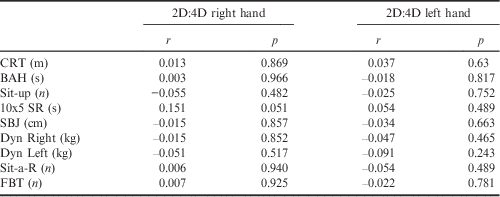
CRT, Cooper’s run test; BAH, bent arm hang test; Sit-up, sit-up test; 10×5 SR, 10×5 m shuttle run test; SBJ, standing broad jump test; Dyn Right, handgrip strength right hand; Dyn Left, handgrip strength left hand; Sit-a-R, sit-and-reach test; FBT, flamingo balance test.
Table 3 shows the results of multiple forward stepwise regression analyses of the right and left 2D:4D (separately) on age, sports preference group, body size and Eurofit test results. The result reveal that the preference groups had a significant impact on the 2D:4D ratio after controlling for age, height, BMI and all the fitness scores in both hands (left-hand Model R=0.301, F=5.42, p=0.001; right-hand Model R=0.303, F=4.10, p=0.003). Moreover, no fitness variable could qualify to enter in the final model. However, the shuttle run test scores showed a significant positive association with the right-hand 2D:4D (t=2.02, p<0.05).
Results of forward stepwise multiple linear regression analysis showing the relationship of 2D:4D with sports preference, anthropometry and Eurofit score
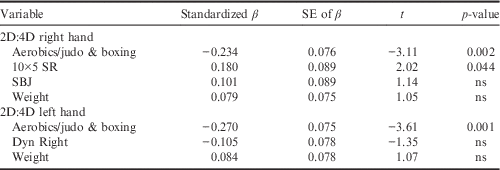
10×5 SR, 10×5 m shuttle run test; SBJ, standing broad jump test; Dyn Right, handgrip strength right hand.
Discussion
The aim of this study was to evaluate whether 2D:4D – a proxy indicator of PT exposure – had any association with the preference for, or choice of, particular sport disciplines among young Polish female students. Judo and boxing are assumed to be extremely competitive in nature compared with aerobic exercises. There is no reason to consider aerobic exercise as a challenging sport. Judo/boxing, in contrast, is definitely considered a competitive sporting activity bearing a moderate to high risk of mild to severe injury. A previous study found that young Polish females on a military training course in Poland had a lower 2D:4D than those on a civil course in this same academy (Kociuba et al., Reference Kociuba, Kozieł and Chakraborty2016). This study tested if the choice of sporting activity was associated with 2D:4D among just the civil course female students, who were neither pre-selected for higher physical fitness nor had a relatively lower 2D:4D. The results of the present study demonstrated that the females who preferred to participate in judo/boxing had significantly lower 2D:4D than those who chose aerobics. This indicates that the preference for a risky sporting activity has some connection with a lower 2D:4D, which implicates higher intrauterine testosterone exposure during prenatal development. Choosing a sport discipline of a competitive nature therefore could also be associated with PT level.
Personality measures of competitiveness, instrumentality, expressivity and sensation seeking are predictive of sport interest as well as sport participation. Competitiveness and aggressiveness can be positive qualities in sport. Females engaged in sport have been shown to have a higher level of competitiveness, and that these were exposed to high androgen levels in utero (Pokrywka et al., Reference Pokrywka, Rachon, Suchecka-Rachon and Bitel2005). Oestradiol and androgens, including testosterone, have been associated with assertive behaviour in women, and this could affect their competitive behaviour as well (Cashdan, Reference Cashdan1998). Women with low levels of testosterone are less likely to express their competitive feelings, and women with high level of the androgen hormone androstenedione even more so (Cashdan, Reference Cashdan2003).
According to a well-accepted global classification of different sports, boxing and martial arts (e.g. Judo) are amongst the top-ranking sports that require the highest levels of dynamic or static intensity and contact collisions (Mitchell et al., 2005). In the present study, voluntary choice of boxing/judo, rather than aerobics, by women was definitely a decision that involved acceptance of higher risk. Many previous studies have linked risk taking with digit ratio. Male financial market day-traders with lower 2D:4D ratios, for example, were found to be more successful in terms of earning (Coates et al., Reference Coates, Gurnell and Rustichini2009). Garbarino et al. (Reference Garbarino, Slonim and Sydnor2011) observed that a lower 2D:4D showed an association with taking greater financial risk within each sex; but the sex difference disappeared at both extremes of 2D:4D values, indicating a definitive role of sex-determining factors (such as PT) in risk-taking decisions. In women, a lower 2D:4D was found to be associated with more enterprising careers (Weiss et al., Reference Weiss, Firker and Hennig2007). A recent online study also indicated that self-reported risk taking was associated with a lower right-hand 2D:4D among German women (Hönekopp, Reference Hönekopp2011). However, the present study indicated that greater relative PT exposure (indicated by lower 2D:4D) might also have a role in making risky decisions, even in smaller aspects of life like choosing a sport discipline within a course curriculum. On the other hand, women of similar ages and physical ability but with higher 2D:4D ratios perhaps avoided these high-risk sports. Indeed in a recent study, more risk aversion for higher 2D:4D was also found even within gender (Garbarino et al., Reference Garbarino, Slonim and Sydnor2011).
A lower 2D:4D has also very often been found to be correlated with activities and performances requiring greater physical strength (Hönekopp & Schuster, Reference Hönekopp and Schuster2010; Zhao et al., Reference Zhao, Yu, Zhang and Zheng2013; Trivers et al., Reference Trivers, Hopp and Manning2013). In this present study, the two preference groups had similar levels of physical fitness and strength. This perhaps indicates that something more than physical ability was leading one group (with a lower 2D:4D) to choose relatively more challenging sport disciplines. Even among a female group with similar health and fitness, there could be factors like choice and propensity that might have played roles in sport discipline preference. The women with higher PT exposure (indicated by their lower 2D:4D) might have a natural propensity towards sensation seeking and challenging activities such as participating in boxing/judo. A lower 2D:4D has indeed been found to be associated with a greater involvement in ‘male-typical’ occupations among women, suggesting that PT is likely to have a relationship with occupational choice among women (Govier, Reference Govier2003; Manning et al., Reference Manning, Reimers, Baron-Cohen, Wheelwright and Fink2010). The present study was a further attempt towards testing the hypothesis that PT might have an ‘organizational’ effect on the brain and hormonal system, which ultimately influences not only the choice of occupation (Manning et al., Reference Manning, Reimers, Baron-Cohen, Wheelwright and Fink2010; Kociuba et al., Reference Kociuba, Kozieł and Chakraborty2016), but also smaller decisions, such as choosing a sport. A study by Franken et al. (Reference Franken, Hill and Kierstead1994) showed that female participants had significantly more interest in gymnastics and figure skating, whereas males were significantly more interested in hockey, football, baseball and basketball, golf, tennis and boxing. The present study indicated that even within a sex, a ‘male-typical’ digit ratio could also determine sporting choice. In another very recent study in Jamaica, it was found that the association of a low 2D:4D with endurance was strongest in females (Trivers et al., Reference Trivers, Hopp and Manning2013).
There is evidence that persons with high sensation seeking prefer sports that involve high levels of personal risk such as more body contact (Zuckerman, Reference Zuckerman1983). Jack and Ronan (Reference Jack and Ronan1998) found that both male and female high-risk-sport athletes (sky-diving, mountaineering, hang-gliding, automobile-racing) scored higher on the sensation-seeking scale than did low-risk-sport athletes (swimming, marathon running, aerobics, golf). Other studies have shown an association between lower 2D:4D and sensation seeking (Austin et al., Reference Austin, Manning, McInroy and Mathews2002; Fink et al., Reference Fink, Neave, Laughton and Manning2006; Hampson et al., Reference Hampson, Ellis and Tenk2008). The choice of boxing/judo by the women in this study with a lower 2D:4D might also be related to a higher sensation-seeking attitude among them. It is worth mentioning here that recent studies (Voracek et al., Reference Voracek, Pum and Dressler2010a, Reference Voracek, Tran and Dresslerb) have found no relationship between 2D:4D and sensation seeking. However, Voracek et al., (Reference Voracek, Pum and Dressler2010a) found an association between lower 2D:4D ratios and higher scores of the disinhibition component of sensation seeking. Thrill and adventure seeking is the desire to engage in physically perilous activities such as risky sports and there are strong associations as well as conceptual similarities between psychological constructs like risk taking, adventure seeking, impulsivity and the disinhibition components of sensation seeking (Acton, Reference Acton2003; Zukerman, 2007). High levels of thrill and adventure seeking and disinhibition have also found to be associated with general deviance (Newcomb & McGee, Reference Newcomb and McGee1991). Choosing a risky sport by women is a matter of conflict with, and winning over, social and psychological inhibitions, which can be referred to as the ‘female/athlete paradox’ (Dworkin, Reference Dworkin2001; Krane et al., Reference Krane, Waldron, Michalenok and Stiles-Shipley2001). It is argued here that a preference for judo/boxing over aerobics by the Polish girls might be linked to a higher relative impulsivity and disinhibition as components of sensation seeking, and thus is associated with a lower 2D:4D.
To conclude, this study’s findings indicate that voluntary choice of participation in a sport discipline by women is associated with a lower 2D:4D. This indicates the existence of a psychological dimension of the ‘organizational’ effect of higher intrauterine testosterone exposure during prenatal growth, as well as the physical strength and ability in determination of participation in a particular sport discipline.
Acknowledgement
The authors thank the chancellor and authority of the General Kuściuszko Military Academy of Land Forces, Wrocław, all participants in the study, the Polish Academy of Sciences and the Indian National Academy of Science. Conflicts of interest: none.



