A prominent line of research on electoral systems and income redistribution argues that proportional representation (PR) leads to tax-and-transfer policies that benefit the poor at the expense of the rich (Austen-Smith Reference Austen-Smith2000; Iversen and Soskice Reference Iversen and Soskice2006; Iversen and Soskice Reference Iversen and Soskice2015; Bueno De Mesquita, Downs and Smith Reference Bueno De Mesquita, Downs and Smith2017). In a multiparty system with a full range of center, left and right-wing parties (ideological trichotomous multipartism), this is because PR produces encompassing center-left coalitions that protect the poor and middle classes. Yet countries with PR electoral systems tend to rely heavily on consumption taxes and lightly on capital taxes, both of which are inconsistent with this expectation. Typically, both policies are viewed as regressive and would seem to benefit the rich at the expense of the poor.
While there is little doubt that, on balance, PR electoral systems are good for the poor, I argue that PR is not as hostile to the rich (nor are majoritarian systems as friendly to them) as is commonly believed. Countries with PR would redistribute even more generously if they relied on a different tax mix to finance their transfers. Moreover, levels of absolute inequality hinge crucially on taxation, even in countries with generous and universal welfare state programs. What explains this tax puzzle? I argue that we need to understand how electoral, party and wage-bargaining systems interact to create strategic political–economic interdependence between the lower, middle and upper classes.
The rich and poor benefit more from strong economic growth than the middle class. The poor are at greater risk of unemployment when the economy slows, compared to the middle class, and the rich receive more of the rewards when the economy grows. Revenue systems that rely on indirect consumption taxes rather than direct income taxes, particularly income from capital, are good for economic growth. This is because consumption taxes encourage savings, which finance investment that drives economic growth (Hines Reference Hines2007; IMF 2010; OECD 2010). Thus their common interest in growth serves as the basis for tax policy co-operation, and tax policy co-operation between political parties that represent the lower and upper classes in the legislature is most likely when their respective peak associations collaborate in the labor market through centralized wage-bargaining institutions, a core component of corporatist systems of industrial relations. Thus the common clustering of PR, ideological trichotomous multipartism and corporatism explains why some countries adopt high-consumption and low-capital tax regimes.
In what follows, I start with a discussion of redistribution and inequality and then review the literatures on electoral systems and redistribution, as well as the politics of capital and consumption taxation. I build a formal theoretical model to explain why countries with PR electoral systems, ideological trichotomous multipartism and corporatist labor market institutions have high-consumption, low-capital tax regimes. The model suggests that (1) PR with trichotomous multipartism can produce high-consumption taxes (but not low-capital taxes) without corporatism and (2) right-leaning coalitions are more likely to govern in countries with PR, trichotomous multipartism and corporatism as employers’ bargaining position improves from outside production opportunities. The latter result challenges conventional thinking and develops a novel mechanism through which domestic institutions moderate the tax rate effects of economic globalization. I finish the article with empirical analysis that evaluates these theoretical predictions.
Institutions, Taxes and Transfers
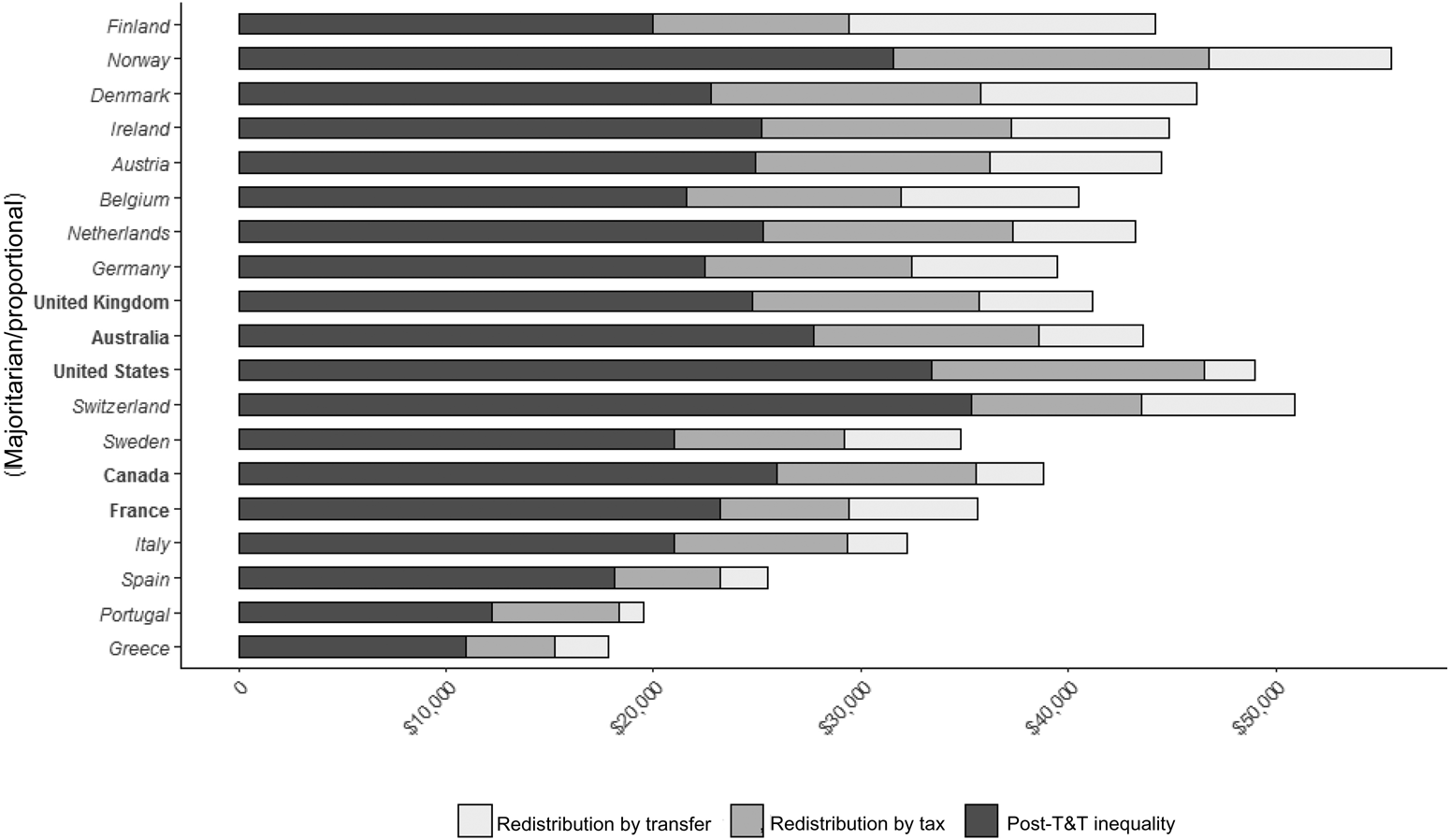
A large literature examines the extent to which the tax-and-transfer policies of Organisation for Economic Co-operation and Development (OECD) governments create a more egalitarian distribution of income.Footnote 1 The bars in Figure 1 present data from 2014 on the redistributive effects of tax-and-transfer policies for nineteen developed democracies using the OECD's Income Distribution Database (OECD 2018).Footnote 2 Each bar, which is decomposed into three parts, represents the mean absolute difference (MAD) from before and after the tax-and-transfer income distributions. MAD is the absolute value of the expected difference in incomes for two households randomly selected from the population (see the Appendix). It is a measure of absolute inequality. In Finland, for example, the MAD is $44,179 (2011 US$). The lightly shaded portion of the bar represents the reduction in MAD ($14,767) that is attributable to transfers. The moderately shaded portion of the bar represents the reduction in MAD ($9,442) that is attributable to taxation. The remainder, the darkly shaded portion of the bar, is after the tax-and-transfer MAD, which in Finland is $19,970.
Redistribution through tax-and-transfer systems, 2014
Note: total reduction in MAD statistics is reported in 2011 US$. The data are from the OECD Income Distribution Database.

These bars are ordered by the total amount of redistribution generated by a country's tax-and-transfer system. In this sample, Finland, Norway and Denmark redistribute the most income while Spain, Portugal and Greece redistribute the least. The countries in bold have majoritarian electoral systems, while the others have proportional electoral systems. Thus countries with PR electoral systems are located at both extremes of redistribution. There are many differences between the countries at both the top and bottom of this redistribution scale. One important difference is in their party systems. The countries at the top have (ideological) trichotomous multiparty systems, while those at the bottom do not. In other words, the countries at the top have parliamentary parties representing the ideological center, left and right (Schmidt Reference Schmidt1996). At the bottom of the redistribution scale, Portugal and Greece lack center parties, and Spain is missing right-wing parties (Armingeon et al. Reference Armingeon2017). Similarly, with the exception of France, none of the majoritarian democracies have trichotomous multipartism. They are two-party systems. I refer to countries with PR electoral systems and ideological trichotomous multipartism as PRITM systems.
In their seminal work, Iversen and Soskice argue that PR benefits left-wing (over right-wing) parties because center parties, representing the middle classes, will choose to form coalitions with them in order to tax and redistribute the income of the rich (Iversen and Soskice Reference Iversen and Soskice2006; Iversen and Soskice Reference Iversen and Soskice2010; Iversen and Soskice Reference Iversen and Soskice2015). Under majoritarianism, two centrist parties emerge, a center-left and center-right party. Redistribution, in this case, depends on the party leadership. If the leader of the center-left party is a member of the lower class, the party will tax both middle- and high-income individuals and redistribute the income. If the leader of the center-right party is a member of the upper class, the party will not tax and redistribute any income. Thus under majoritarian electoral systems, the middle classes have more to fear from a center-left party led by a member of the lower class than a center-right party led by a member of the upper class, and therefore vote for center-right parties. This logic explains the leftist bias of PR and the rightist bias of majoritarianism.Footnote 3 Austen-Smith (Reference Austen-Smith2000) and Bueno De Mesquita et al. (Reference Bueno De Mesquita, Downs and Smith2017) provide related formal models that show PR electoral systems, and the encompassing governing coalitions they create, lead to more progressive tax rates and redistribution.
One problem with the general notion that political coalitions under PR protect the interests of the poor while majoritarian politics are more responsive to the interests of the rich is that countries with PR electoral systems tend to rely more on consumption taxes and less on capital taxes than their majoritarian counterparts to finance public spending. Because consumption taxes, unless they are levied exclusively on luxury goods, are regressive, their use can undermine attempts to redistribute income to the poor. According to Akaishi and Steinmo (Reference Akaishi, Steinmo, Garon and Maclachlan2006), Beramendi and Rueda (Reference Beramendi and Rueda2007) and others, this puzzling relationship is explained by the budget constraints that arise under social democratic corporatism – political–economic systems that combine left-wing governments with encompassing (corporatist) labor market institutions. Corporatism brings together peak-level (economy-wide) associations that represent workers and employers to negotiate wages and other important employment-related decisions. Historically, the corporatist ‘bargain’ trades a generous welfare state and full employment in exchange for wage moderation and low capital taxes, both of which drive economic growth. Since a large welfare state is costly and the corporatist bargain prevents governments from turning to capital taxes, the result is higher consumption taxes, frequently under left-wing governments. Thus the corporatist tax regime taxes consumption heavily and capital lightly.
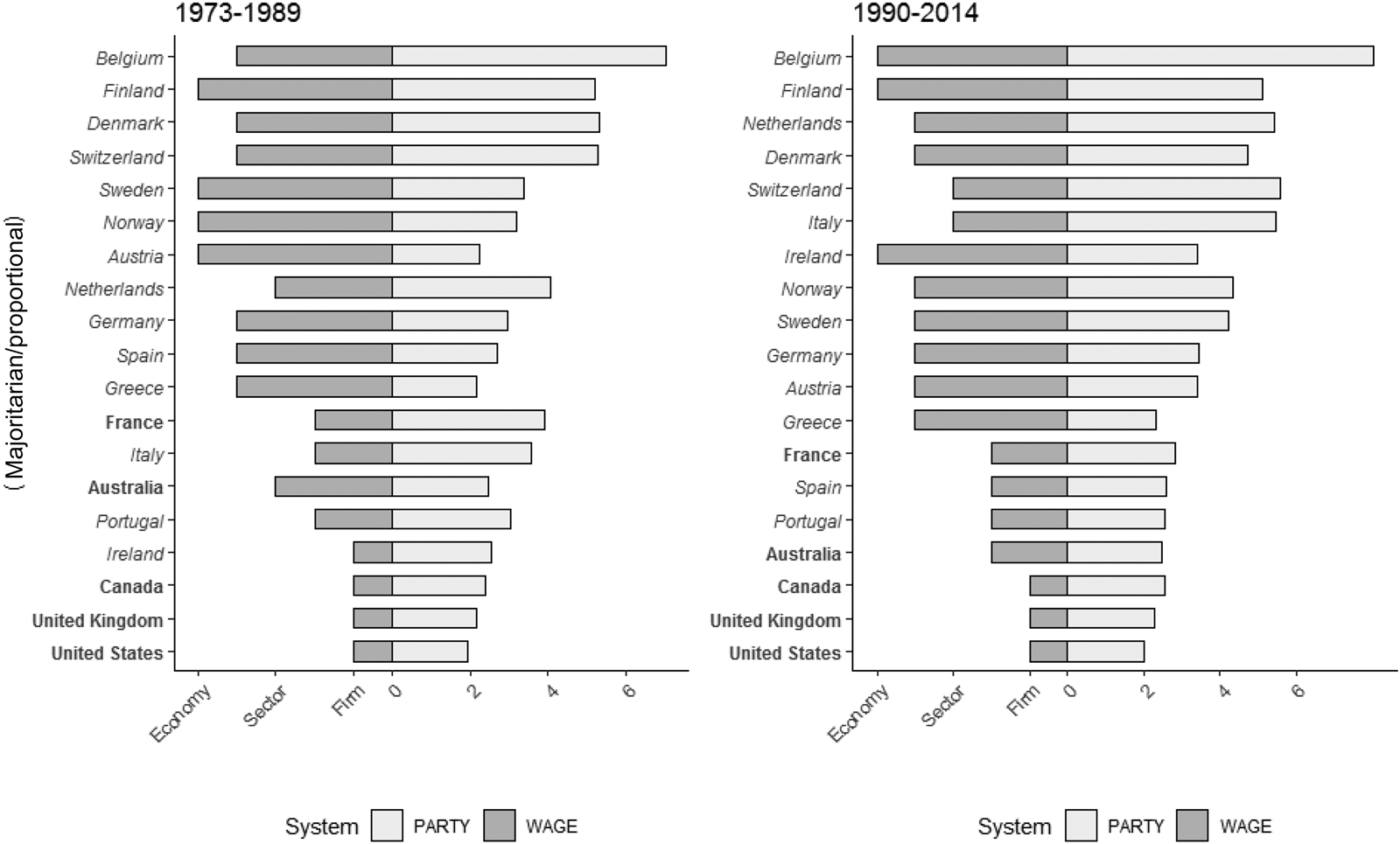
Given that strong social democratic parties, PRITM and corporatist labor market institutions all tend to cluster together, there is also a clear relationship between electoral and party systems, on the one hand, and consumption and capital taxes on the other. Figure 2 shows the relationship between pure and predominantly PR systems, multipartism and wage-bargaining centralization (corporatism) across the nineteen developed democracies with relatively stable electoral institutions over the period 1973–2014. The sample is split into ‘Cold War’ and ‘globalization’ subperiods (Friedman Reference Friedman2000). The majoritarian countries are Australia, Canada, France, United Kingdom and United States. The remaining countries had either pure or predominantly PR systems over the entire period. The darkly shaded bars display the (median) level at which wage bargaining takes place for each country, while the lightly shaded bars display the (median) effective number of political parties represented in the legislature.Footnote 4 The degree of wage-bargaining centralization ranges from firm level to economy wide; sector-level bargaining is the intermediate category. The effective number of legislative parties ranges from 1.93 (US, Cold War period) to 8.05 (Belgium, globalization period). Two points are worth noting. First, the relationships between electoral institutions, multipartism and corporatism are strong across both historical subperiods. Secondly, in contrast to the popular view that globalization undermines corporatist labor market institutions, degrees of wage-bargaining centralization remain very stable across the two subperiods.
Electoral, party and wage-bargaining systems
Note: the data are from the Institutional Characteristics of Trade Unions, Wage Setting, State Intervention and Social Pacts Database (Visser Reference Visser2016) and the Comparative Political Data Set 1960–2014 (Armingeon et al. Reference Armingeon2017).

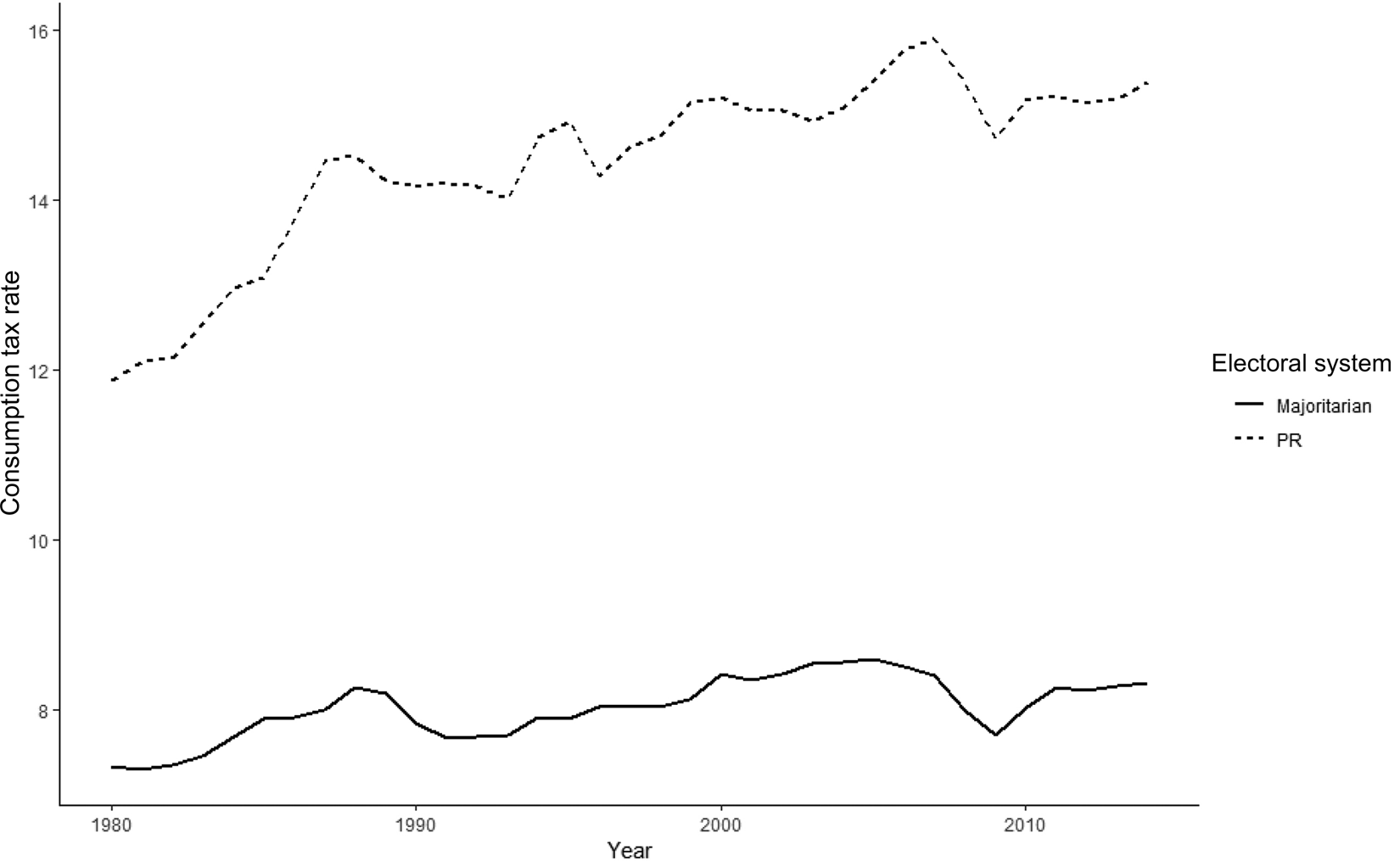
Turning to tax policy, Figure 3, which plots average effective consumption tax rates for PR and majoritarian democracies over the period 1980–2014, shows that the difference in average consumption tax rates is large, between 4 and 7 percentage points, and persistent over the 35 years covered by the graph. This historical relationship could be explained by budget constraints under the corporatist bargain, but this story implies that tax policy is driven by expenditures and that social democratic governments had no other revenue sources available. Is there more to the story? I argue that consumption taxes are also used to shift the burden of income taxation away from the tails of the distribution.
Consumption taxes in PR and majoritarian democracies, 1980–2014

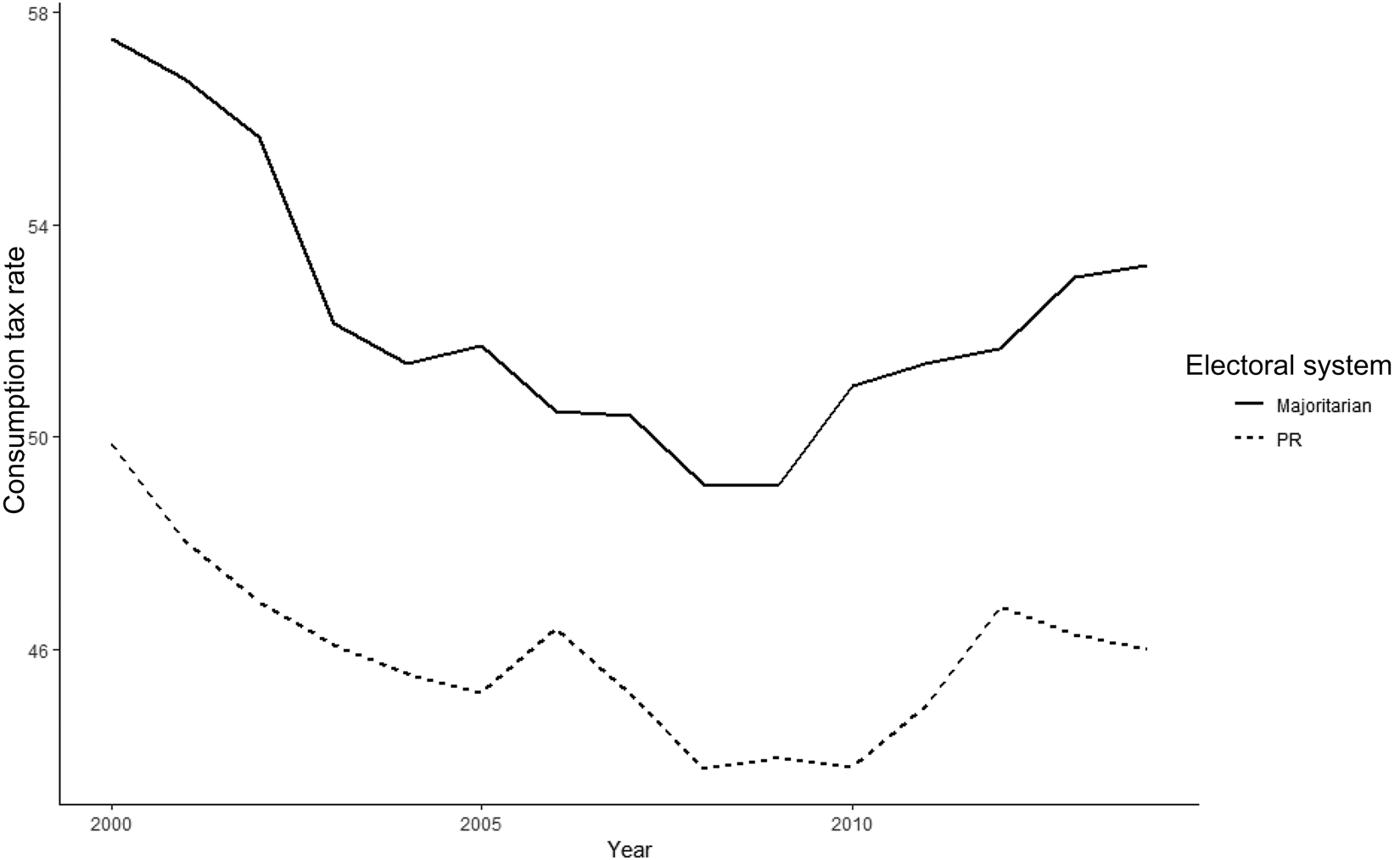
Many scholars have examined the relationship between electoral systems and capital taxation (Steinmo Reference Steinmo1993; Persson and Tabellini Reference Persson and Tabellini2000; Basinger and Hallerberg Reference Basinger and Hallerberg2004; Swank Reference Swank2016). Hays (Reference Hays2003, Reference Hays2009) notes that average effective capital tax rates were higher in countries with majoritarian electoral systems than in those with PR over the period 1965–2000. Figure 4 shows that this is true for dividend tax rates during 2000–2014 as well.Footnote 5 There are large and persistent differences in the taxes paid on distributed profits. These differences are surprising, once again, because of the strength of social democratic parties in countries with PR electoral systems.
Capital taxes in PR and majoritarian democracies, 2000–2014

Part of the explanation for this capital tax puzzle is the corporatist bargain. The failed experiments in Britain during the 1970s and Australia during the 1980s teach us that corporatism without PR, even under Labour governments, does not produce the corporatist tax bargain of high-consumption taxes combined with low-capital taxes. Moreover, even countries without centralized wage bargaining tend to rely heavily on consumption taxes for revenue if they have PR electoral systems. This suggests that there is more to the story. Again, the presence of social democratic governments, PR electoral systems, multipartism and corporatist institutions correlate empirically, which makes it difficult to disentangle the underlying forces at work. The literature emphasizes the importance of social democratic governments, the welfare state and corporatism. I add the interaction between PR, party systems and corporatism to that logic. The partisan composition of a government is a strategic choice made by the formateur and remains important in my framework.
In the next section, I build a theoretical model that combines the basic setup of Iversen and Soskice (Reference Iversen and Soskice2010) with the corporatist tax bargain described in Akaishi and Steinmo, Beramendi and Rueda, and elsewhere to explain these puzzling facts about taxation.Footnote 6 First, it is important to discuss the extent to which corporatist institutions have changed in recent decades and to consider the implications (if any) for my argument. The claim that corporatism is breaking down is belied by the evidence in Figure 2. Some argue that this stability is because corporatism is robust to globalization, deindustrialization and other related political–economic phenomena that were once thought to exert significant pressure on these labor market institutions (Garrett Reference Garrett1998; Golden, Wallerstein and Lange Reference Golden, Wallerstein and Lange1999; Pontusson Reference Pontusson2005; Hall and Gingerich Reference Hall and Gingerich2009). Others argue that corporatism is evolving rather than disappearing. In many recognized bastions of corporatism, wage bargaining is becoming more decentralized, but peak-level employer and worker associations continue to bargain over other important employment-related policies and programs that benefit their constituencies. For example, there is bargaining over the design of active labor market programs that upgrade the skills of marginal workers (Martin and Swank Reference Martin and Swank2012; Thelen Reference Thelen2014).
I focus on centralized wage bargaining in my theoretical model, but the bargaining need not be over wages. The basic theoretical logic only requires that peak-level associations representing workers and employers bargain over an employment-related policy, program or production decision that is valued by both sides and can only be implemented successfully with the co-operation of both labor and capital. If this is the case, workers and employers will be able to protect their interests with respect to policy and legislation even when the parties that represent them are excluded from government.
Theoretical Model
The model suggests that PRITM is necessary, but not sufficient to produce both high-consumption and low-capital tax regimes. The combination of PRITM and corporatism is important because centralization under the latter system of industrial relations allows the party that is excluded from center-led coalitions to protect its interests. Corporatism makes the commitment to form left–right coalitions credible, and this possibility moderates the demands of centrist parties, even in countries where we never observe poor–rich (red–blue) coalitions.
Following Iversen and Soskice (Reference Iversen and Soskice2006) and Becher (Reference Becher2016), I assume that the electorate is composed of individuals from one of three classes or groups indexed by i ∈ {L, M, H}, where L, M and H stand for low-, middle- and high-income groups, respectively. Society is represented in the legislature by parties that determine the tax rates (by majority rule) to finance public goods and transfers. The tax regime is defined by a vector of taxes on earned income (y), consumption (c) and capital (k),  ${\boldsymbol t} = [ t_y, \;t_c, \;t_k] $ where 0 ≤ t ≤ 1.
The tax policy politics stem from conflicts of interest with the tax instruments. I assume that the members of each group pay two taxes. The most preferred tax is the one that is not paid. Members of the low- and middle-income groups pay taxes on earned income (that is, wages and salary) and consumption. Members of the upper-income group pay taxes on unearned income (that is, distributed profits) and consumption. Because they pay the same taxes, the tax rate preferences of middle-income individuals tend to be closer to low-income individuals than to members of the high-income class. Let  ${\boldsymbol t}^{i}$ be a vector with the two taxes paid by members of group i and t i be the most preferred tax by members of group i. The tax regime endogenously determines levels of public spending. The utility function for group i,
 $U^i = f^i( {\boldsymbol t}^{i}) + g^i( t^i) $, has two components. The function
 $f^i( {t}^{i}) $ is the utility received from public spending financed with taxes paid by members of group i, and g i(t i) represents the utility of a pure transfer to group i. These functions are assumed to be twice continuously differentiable and strictly concave.
Low-income individuals are low-skilled workers who choose their labor effort, are paid wages and consume all of their income. Income taxes distort their labor/leisure decisions. As the income tax rate increases, low-income individuals work less than optimal, and this induces a welfare loss. I assume consumption taxes are less distorting than income taxes. The assumption can be justified by the potentially offsetting effects of consumption taxes on labor demand. If consumption taxes are high, members of the low-income group will work less than optimal, but the welfare loss is at least partially offset – to the extent that consumption taxes increase savings and investment – by an increase in the demand for labor and higher wages.
Members of the middle-income group are high-skilled salaried employees and managers with fixed work schedules who choose how much of their income to save. For the middle classes, consumption taxes distort their savings decisions, and thus reduce utility beyond the direct effect from lost income. As the consumption tax rate increases, middle-income individuals under consume and this induces a welfare loss. The income tax is less distorting because it is paid on all income regardless of whether it is consumed or saved.Footnote 7
High-income individuals are business owners and shareholders who receive income in the form of distributed profits from capital investments and choose how much of their income to reinvest. For the upper classes, capital taxes distort their optimal investment decisions, and thus reduce their utility beyond the direct effect from lost income. I assume that consumption taxes are less distorting. To the extent that they increase savings that can be used to finance investment, these taxes reduce the opportunity cost (that is, less investment) of distributing profit. In other words, employers can substitute middle-class savings for corporate savings (that is, retained profits).
In theory, low-income workers and high-income employers agree on the second-best tax. Consumption taxes stimulate savings, which finance investment, which, in turn, generates profits that benefit employers and either reduces the likelihood of unemployment or increases wages, benefiting workers.Footnote 8 The sequence of events is as follows: (1) elections are held, (2) tax policy is decided, (3) work, savings, investment and all other production decisions are made.
One of the more important defining characteristics of advanced industrial democracies is that the middle class is relatively large. I incorporate this fact into the model by assuming the middle-income group is the largest of the three classes.Footnote 9 The rich and poor are in the tails of the income distribution. A second important fact among the advanced industrial democracies is that countries with PR electoral systems are much more likely to have corporatist labor market institutions (Lijphart and Crepaz Reference Lijphart and Crepaz1991; Lijphart Reference Lijphart2012; Martin and Swank Reference Martin and Swank2012). I bring this relationship into the model by assuming that the corporatist tax bargain can influence the equilibrium under PRITM but not under majoritarian two-party systems. Under corporatism, I assume that all major production decisions, such as wage, price and output levels, are determined by a bargaining process. Workers and employers have a preferred tax regime as well, which is a part of the bargain, but they ultimately depend on the government to implement this regime.
Majoritarian electoral systems produce single-party majorities in the legislature that represent the middle class. Thus the tax regime under majoritarianism maximizes the utility of middle-income voters. This is an unconstrained maximization problem. Given the tax policy preferences of the middle classes, majoritarian electoral systems will produce high-capital tax and low-consumption tax regimes.Footnote 10
Tax policy politics are more complicated under PR. Following Iversen and Soskice (Reference Iversen and Soskice2006, Reference Iversen and Soskice2010, Reference Iversen and Soskice2015), each class is represented in the legislature by a party that is a perfect delegate of its constituency. In other words, class cleavages are assumed to produce trichotomous multipartism under PR. I assume that the middle-class party is the largest, but no party wins a majority of seats. Party M is given the first opportunity to form a majority coalition with one of the other parties by proposing a tax regime. If the proposal is rejected, the party with the second-largest seat share is given an opportunity to form a coalition. If this party fails, the party with the smallest seat share is given an opportunity. If all three parties fail to form a majority coalition, the outcome is the status quo tax regime. This produces a one-tail constrained optimization problem represented by the following Lagrangian function:
 $$L^j = f^M( t_y, \;t_c) + g^M( t_k) + \lambda ^j( U_R^j -f^j( {\boldsymbol t}^{\boldsymbol j}) -g^j( {\it t}^j) ) \,{\rm for}\,j\in \{ L, \;H\} , \;$$
in which λ j, the Lagrange multiplier, represents the rate of change in U M with respect to  $U_R^j $, Party j's reservation utility level. Because of their relatively similar tax rate preferences, the ‘natural’ coalition is between parties M and L.
PR-Corporatist Systems with Trichotomous Multipartism
In PR-corporatist systems with trichotomous multipartism, I assume that low-income workers and high-income employers are represented in the economy by monopoly peak associations, which are able to protect their members’ interests if tax policy deviates too far from the corporatist tax bargain.Footnote 11 Low-income workers are represented by a monopoly union, which can determine the supply of low-skilled labor, and high-income employers are represented by a monopoly employers' association, which determines the demand for labor. If Party L is given the opportunity to form a coalition, chooses Party M and adopts a high capital tax rate, employers can scale back production and reduce employment. If Party H is given the opportunity to form a coalition, chooses Party M and adopts high income tax rates, then the monopoly union can punish the high-income group with industrial action that reduces profits.
I distinguish representation by political parties from representation by monopoly peak associations by assuming the latter producer group organizations are only concerned about the net-of-tax return on production. Producer groups care about direct taxes while political parties internalize the costs and benefits of indirect taxes. Corporatism changes the nature of the bargaining interaction between Party M and its potential coalition partners because the corporatist tax bargain becomes the reversion outcome for parties L and H should M fail to form a majority coalition. I assume that parties L and H will be punished for proposing a tax regime that deviates from the corporatist bargain, but not for accepting a proposal from M that deviates from the corporatist tax bargain, unless it deviates too far.
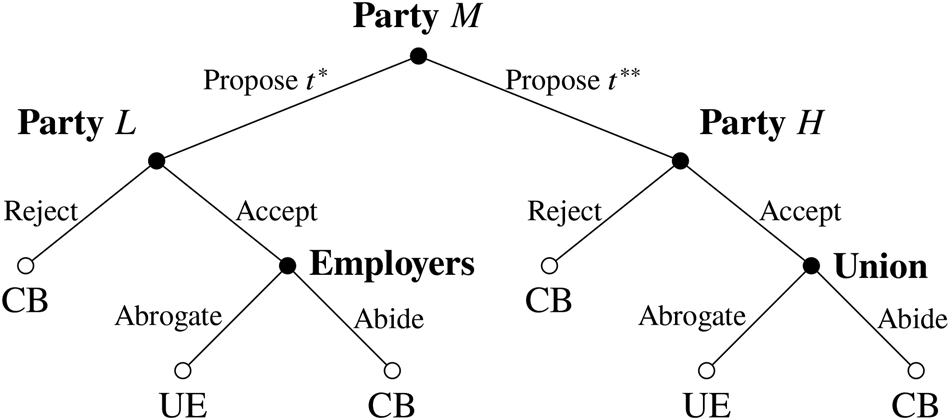
The PRITM-Corporatist game tree is presented in Figure 5. Prior to the game, the corporatist bargain is set. This bargain establishes the full-employment wage and communicates a preferred tax regime,  $\bar{{\boldsymbol t}} = [ \bar{t}_y, \;\bar{t}_c, \;\bar{t}_k] $, to the future government. In the first stage of the game, Party M proposes a set of tax rates as the basis for a coalition with either Party L or Party H. In the second stage, Party L or Party H decides whether to accept the proposal or not. If the proposal is rejected, Parties H and L form a coalition and implement the focal tax regime, the corporatist tax bargain. If the proposal is accepted, the monopoly peak associations decide whether to abide by the terms of the corporatist bargain or to exploit their market power by reducing either the supply or demand for labor. The game is solved by backward induction.
The PR-corporatist game under trichotomous multipartism
Note: CB is the outcome with full-employment domestic production according to the terms of the corporatist bargain. UE is the underemployment outcome that occurs when one of the monopoly peak associations abrogates the contract.

The preferred tax regime signaled by the monopoly peak associations provides income and capital taxes that are too low and consumption taxes that are too high from the perspective of the political parties. This is because the parties internalize utility from consumption while the producer groups focus exclusively on the return from production. Formally, the tax policy preference assumptions described above can be stated as follows:
 $$\left. {\displaystyle{{\partial U^H} \over {\partial t_y}}} \right\vert _{t_y = {\bar{t}}_y} > \left. {\displaystyle{{\partial U^M} \over {\partial t_y}}} \right\vert _{t_y = {\bar{t}}_y}\left. { > \displaystyle{{\partial U^L} \over {\partial t_y}}} \right\vert _{t_y = {\bar{t}}_y} > 0$$
 $$\left. {\displaystyle{{\partial U^i} \over {\partial t_k}}} \right\vert _{t_k = {\bar{t}}_k} > \left. {\displaystyle{{\partial U^H} \over {\partial t_k}}} \right\vert _{t_k = {\bar{t}}_k} > 0, \;\;{\rm where}\;i\in \{ L, \;M\} $$
 $$\left. {\displaystyle{{\partial U^M} \over {\partial t_c}}} \right\vert _{t_c = {\bar{t}}_c} < \left. {\displaystyle{{\partial U^i} \over {\partial t_c}}} \right\vert _{t_c = {\bar{t}}_c} < 0, \;\;{\rm where}\;i\in \{ L, \;H\} $$
According to Equation 2, high-income individuals would benefit the most from an increase in income taxes from the corporatist bargain tax rate, while low-income individuals would benefit the least. Equation 3 implies that low- and middle-income individuals would benefit the most from an increase in capital taxes from the corporatist bargain tax rate while high-income individuals would benefit the least. Equation 4 formalizes the assumption that middle-income individuals would benefit the most, and high- and low-income individuals would benefit the least from a decrease in consumption taxes from the corporatist bargain tax rate.
From Party M's standpoint, the PRITM-Corporatist game creates a two-tail constrained optimization problem, in which t j is determined by the relevant producer group's reservation net-of-tax return on production,  $I_R^j $, j ∈ {L, H}. If Party M forms a coalition with Party L, then t j is the capital tax rate t k, which is determined by the employer association's reservation net-of-tax return on investment
 $( I_R^H ) $. Party M offers the highest capital tax rate that the employers association is willing to accept under the wage and employment terms of the corporatist bargain. If Party M forms a coalition with Party H, then t j is the income tax rate t y, which is determined by the monopoly union's reservation net-of-tax return on labor (
 $I_R^L $). These two equilibria are described in Proposition 1.
Proposition 1: There is a subgame perfect equilibrium to the PRITM-Corporatist game in which Party M proposes  ${\boldsymbol t}^\ast{ = } [ t_y^\ast , \;t_c^\ast , \;t_k^\ast ] $
 $( {\boldsymbol t}^{{\ast}{\ast} } = [ t_y^{{\ast}{\ast} } , \;t_c^{{\ast}{\ast} } , \;t_k^{{\ast}{\ast} } ] ) $ as the basis for a coalition with Party L (H); Party L (H) accepts, and the monopoly employers' association (union) chooses to abide by the corporatist bargain.
I demonstrate the existence of both equilibria below using numerical illustrations. The ‘natural’ equilibrium, given their relatively similar tax preferences, is a center-left coalition between Parties L and M. I start with the comparative statics of this equilibrium and show how, as the bargaining power of employers increases, the optimal coalition partner for M switches from L to H.
One of the most significant developments in the global economy over the last several decades is the multinationalization of production either through intra-firm or arm's length offshoring. By creating outside options to domestic production, offshoring has altered the balance of bargaining power between organized labor and employers (Rodrik Reference Rodrik1997). With this in mind, under a center-left coalition, the most interesting exogenous parameter in the theoretical model is the employers association's reservation net-of-tax income from investment  $I_R^H $. As their outside options improve, employers will demand more net-of-tax income. More specifically, the employers association will tolerate less deviation in the capital tax rate from the initial corporatist bargain.
What are the implications of an exogenous increase in the bargaining power of capital? What happens to tax policy? The implicit function theorem gives the comparative statics for tax policy:
 $$\left[{\matrix{ {\displaystyle{{dt_y} \over {dI_R^H }}} \cr {\displaystyle{{dt_c} \over {dI_R^H }}} \cr {\displaystyle{{dt_k} \over {dI_R^H }}} \cr } } \right] = \left[{\matrix{ {-\displaystyle{{( {\delta_{cc}f_y^L -\delta_{yc}f_c^L } ) g_k^L } \over {\Delta I^H}}} \cr {-\displaystyle{{( {\delta_{yy}f_c^L -\delta_{yc}f_y^L } ) g_k^L } \over {\Delta I^H}}} \cr {-\displaystyle{1 \over {I^H}}} \cr } } \right], \;$$
where  $\Delta = ( {2\delta_{yc}f_c^L f_y^L -\delta_{yy}{( f_c^L ) }^2-\delta_{cc}{( f_y^L ) }^2} ) $,
 $\delta _{\ell \ell } = {\partial ^2f^M \over \partial t_\ell ^2 } -\lambda {\partial ^2f^L \over \partial t_\ell ^2} , \;\ell \in \{ y, \;c\} $ and δ yc =
 ${\partial ^2f^M \over \partial t_y \partial t_c } - \lambda {\partial ^2f^L \over \partial t_y \partial t_c }$ (see the Appendix for the derivation). In this context, the subscripts on the right-hand side of Equation 5 identify partial derivatives with respect to income, consumption and capital taxes. The last (total) derivative on the left-hand side for capital taxes is, of course, negative. As the employers association's reservation net-of-tax return on investment increases, the capital tax rate must decrease. The derivatives for income and consumption taxes provide the optimal response to the lost revenue from capital taxes, subject to the coalition constraint. The drop in capital tax reduces the utility of low-income individuals. To maintain the coalition, Party M must propose higher consumption taxes and lower income taxes.
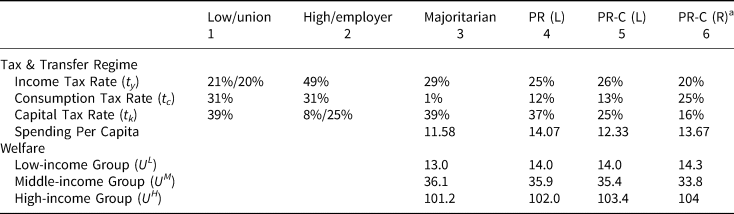
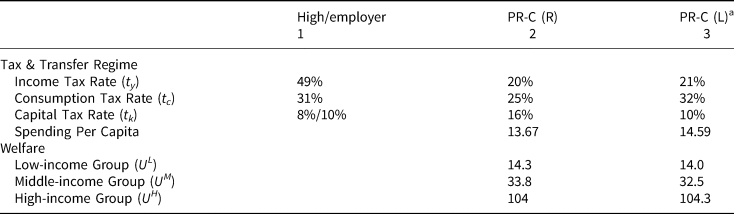
Tables 1 and 2 demonstrate the differences in equilibrium tax regimes. The results are based on second-order Taylor series approximations of the underlying functions. These functions are twice differentiable and concave. The parameter values are provided in the Appendix. Table 1 presents the case in which the employers association has relatively low bargaining power. This represents the low-capital-mobility case for the PRITM-Corporatist countries. The entries represent the bliss point tax rates of Party L and Party H and the reservation tax rates of the monopoly union and employers association. The table also provides government spending and welfare outcomes. The reservation net-of-tax return on investment is low, implying a relatively high reservation tax rate on capital. Table 2 presents the case in which the employers association has high bargaining power. This represents the high-capital-mobility case for the PRITM-Corporatist countries. The reservation net-of-tax return on investment is high, implying a relatively low reservation tax rate on capital. The only (exogenous) difference between Tables 1 and 2 is the employers association's reservation tax rate on capital, which drops from 25 to 10 per cent.
Numerical illustration of equilibrium tax regimes with center-left coalition and an out-of-equilibrium center-right coalition (low capital mobility)

a These fiscal and welfare outcomes are off the equilibrium path.
Equilibrium tax regime with center-right coalition and an out-of-equilibrium center-left coalition (high capital mobility)

a These fiscal and welfare outcomes are off the equilibrium path.
The first column in Table 1 provides the optimal tax rates for Party L (Low) as well as the tax on income implied by the monopoly union's reservation net-of-tax income from wages (Union). The second column provides the optimal tax rates for Party H (High) as well as the tax on investment implied by the employers association's reservation net-of-tax return on capital (Employer). The third column provides the optimal tax rates for Party M, which is the outcome under majoritarian systems. Under PRITM, Party M must decide which party to choose as its coalition partner. Without corporatism, Party M will choose Party L as its coalition partner because of their similar tax rate preferences (Table 1, Column 4). With corporatism, the strategic environment changes: Party M must now confront a producer group's peak association. If Party M chooses Party L, it co-opts the monopoly union and takes on a more adversarial relationship with the employers' association. If Party M chooses Party H, it co-opts the employers’ association and takes on a more adversarial relationship with the monopoly union. In the low-bargaining-power scenario presented in Table 1, it is optimal for Party M to form a coalition with Party L (Column 5). In this case, there is room for Party M to cut spending to keep consumption taxes low. Under a center-right coalition, the maximum utility that Party M can obtain for its constituents is less than what it can obtain under a center-left coalition. The center-right outcomes, which are off the equilibrium path, are presented in Column 6 of Table 1.
The first column in Table 2 provides the optimal tax rates for Party H (High) as well as the tax on investment implied by the employers association's reservation net-of-tax return on capital (Employer). The optimal tax rates for Party H do not change as offshore production opportunities improve, but the reservation capital tax rate for the employers association does. In this case, tax rates above 10 per cent make it more profitable to offshore production. The second column provides the equilibrium fiscal and welfare outcomes from a center-right coalition. These outcomes are not affected by a change in the employer association's reservation capital tax rate. However, the center-left coalition produces different outcomes under high capital mobility. The capital tax rate is fixed now at the new reservation level, 10 per cent, which is lower than what Party M could get in a coalition with Party H. The reason is that Party H internalizes some benefit from government spending, which is financed with all three taxes. Party H is willing to accept a capital tax rate that is higher than optimal in exchange for a higher consumption tax rate that is closer to its bliss rate.
Empirical Implications of the Theoretical Model
The theoretical model generates several testable hypotheses. Under majoritarianism, consumption tax rates will be low. The middle class is not constrained in this case. PR forces Party M to compromise with respect to consumption taxes.
Hypothesis 1a: Consumption tax rates are higher in countries with PRITM systems than in those with majoritarian two-party systems.
The effect of corporatism depends on employers' outside production options. If offshore production is costly, employers’ bargaining power will be relatively low. Capital tax rates will drop, but the revenue loss will be offset primarily by lower spending. This minimizes the impact on consumption (and income) tax rates. When employers’ bargaining power is high, corporatism matters significantly. This is seen by comparing the consumption tax rates in Column 4 with Column 5 in Table 1 and then comparing Column 4 in Table 1 with Column 2 in Table 2.
Hypothesis 1b: Under high capital mobility, consumption tax rates are higher in countries with PRITM systems and corporatist labor market institutions.
With respect to capital tax rates, the model implies the following hypothesis:
Hypothesis 2: Capital tax rates are lower in countries with PRITM and corporatist labor market institutions than in other countries.
In the theoretical model, a switch from majoritarian to proportional electoral systems has very little effect on capital tax rates when producer groups are not organized. This is because Party M will form a coalition with Party L, its ‘natural’ partner, and the interests of high-income individuals will not be represented in tax policy. Compare Columns 3, 4 and 5 in Table 1. With respect to the partisan control of government, the model implies the following:
Hypothesis 3: International capital mobility increases the likelihood of center-right governments in countries with PRITM systems and corporatist labor market institutions.
This result is counter-intuitive in light of the existing literature for two reasons. First, consider the argument about political–economic coherence in Geoffrey Garrett's (Reference Garrett1998) book, Partisan Politics in the Global Economy. He argues that under corporatism, left governments are much more likely than right governments to preside over healthy economies because their policy agenda encourages wage moderation and co-operation more generally from organized labor. Right governments produce political–economic incoherence. Their policy agenda encourages labor militancy, which undermines economic performance. These governments are likely to be unsuccessful and short-lived in a global economy.
Secondly, applying Hirschman's logic, we would expect capital to be less involved in governance as offshore production opportunities become more lucrative. The multinationalization of production makes the ‘exit’ option more desirable than ‘voice’ (Hirschman Reference Hirschman1970). In my model, the multinationalization of production makes it more likely that the parties representing employers will govern. This is similar to the logic in Clark, Golder and Golder's (Reference Clark, Golder and Golder2017) recent formalization of Hirschman's model, in which the desirability of one's ‘exit’ option makes an actor more likely to exercise their ‘voice’ in equilibrium. These three hypotheses contain the most important implications of my theoretical model. In the next section, I empirically evaluate these hypotheses.
Empirical Analysis
The tax rates in my analysis are the average effective tax rates on consumption and the combined personal and corporate tax rates on distributed profits. Consumption tax rates are calculated using central government revenue only. The data are from the OECD's Revenue Statistics database. My sample includes the nineteen OECD countries in Figures 1 and 2 as well as Japan and New Zealand. The sample period for the consumption tax rate analysis is 1971–2014, and the sample for the capital rate tax analysis is 1981–2014.
In order to identify countries with PRITM systems in my sample, I rely on Bormann and Golder (Reference Bormann and Golder2013) and Armigeon et al. (Reference Armingeon2017).Footnote 12 To identify the degree of labor market centralization, I use the level of wage setting co-ordination in the ICTWSS database (Visser Reference Visser2016). This scale ranges from 1 (fragmented bargaining at the individual firm level) to 5 (economy-wide bargaining with enforceable agreements between peak union and employer associations). The full set of controls used in the analysis includes the partisan composition of government, Lijphart's measure of consensus democracy, the degree of federalism, capital account openness, trade openness, the size of social security transfers, interest rates, European Union membership and European Monetary Union membershipFootnote 13 (summary statistics are provided in the Appendix).
The main challenge with the empirical analysis is that almost all of the variation in electoral/party systems is cross-national. Japan and New Zealand switched from majoritarian to proportional electoral systems during the sample period, but only Japan's party system qualifies as ideologically trichotomous. There is much more variation over time in countries' wage-bargaining institutions. To address this challenge, I decompose the variation in the institutional variables and controls into between- and within-country variation. The within-country coefficient estimates are more reasonably interpreted as causal, while the between-country estimates provide suggestive partial correlations. To estimate these relationships, I use dynamic mixed-effects models that take the following form:
 $$\eqalign{y_{it} = &\beta _0 + \beta _1( y_{it-1}-{\bar{y}}_i) + \beta _2( x_{1it}-{\bar{x}}_{1i}) \cr & \quad + \cdots + \beta _{k + 1}( x_{kit}-{\bar{x}}_{ki}) + \beta _{k + 2}{\bar{x}}_{1i} \cr & \quad + \cdots + \beta _{2k + 1}{\bar{x}}_{ki} + u_i + \omega _{ki} + \varepsilon _{it}, \;} $$
where k = 1, 2…, K, i = 1, 2…, N, t = 1, 2…, T; x kit are the institutional and control variables,  $\bar{x}_{ki}$ are the country-level means of these variables, and
 $u_i\sim N( 0, \;\sigma _u^2 ) $,
 $\omega _{ki}\sim ( 0, \;\sigma _\omega ^2 ) $ and
 $\varepsilon _{it}\sim ( 0, \;\sigma _\varepsilon ^2 ) $ are random disturbances indexed by country, country-covariate, and country-year, respectively. The disturbances u i and ω ki have a variance-covariance matrix
 ${\boldsymbol \Sigma }$. Specification tests are used to determine when it is reasonable to constrain the elements of
 ${\boldsymbol \Sigma }$ to zero.Footnote 14
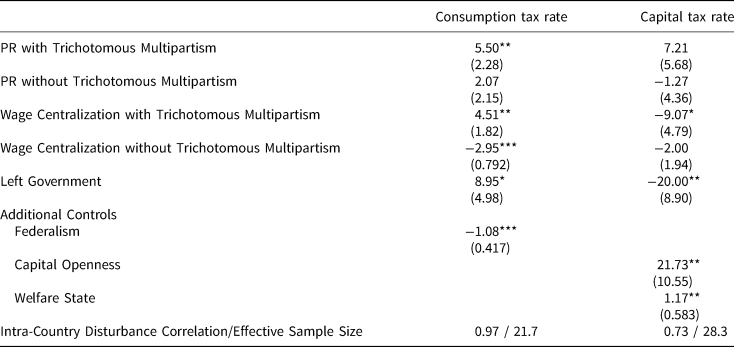
Table 3 presents the cross-national tax rate results. Given the country-level dependence in the data, the effective sample sizes for these cross-national analyses are much closer to N than N × T. The intra-country correlations for the consumption and capital tax rate disturbances are 0.97 and 0.73, respectively, giving effective samples sizes of 21.7 and 28.3. The reported standard errors are clustered by country to account for this dependence. I estimate the tax rate relationships of PR, with and without trichotomous multipartism, wage centralization, with and without trichotomous multipartism, and the share of cabinet posts held by leftist parties. All of these relationships are substantively interesting in light of the theoretical model. With respect to controls, given the small samples, I include only those that have statistically significant partial correlations with the tax rates.
Cross-national tax rate associations

Note: parentheses contain standard errors clustered by country. * p < 0.10, ** p < 0.05, and *** p < 0.01
The cross-national associations are consistent with the theoretical model. Hypothesis 1a states that consumption tax rates are higher under PRITM than under majoritarian electoral systems. Empirically, countries with PR and trichotomous multipartism are associated with consumption tax rates that are 5.5 percentage points higher than those with majoritarian electoral systems. It is important to note that the left's share of cabinet posts is statistically significantly associated with consumption and capital tax rates. Countries with historically strong left parties have higher consumption tax rates and lower capital tax rates, on average. This is consistent with previous research (Akaishi and Steinmo Reference Akaishi, Steinmo, Garon and Maclachlan2006; Beramendi and Rueda Reference Beramendi and Rueda2007). To the extent that the partisan composition of government is a strategic choice, as suggested by the theoretical model, these associations could represent indirect pathways through which electoral, party and wage-bargaining institutions affect tax rates.
These cross-national estimates are only suggestive, but they are important because cross-national comparisons are the best way to broadly evaluate the relationships between PRITM and tax rates. (At best, we only observe one country that switches from majoritarianism to PRITM: Japan.) While the observed associations are consistent with the causal theoretical story, cross-national comparisons do not provide compelling evidence of causation. Fortunately, we observe much more change in wage-bargaining institutions across a broad range of electoral and party system contexts.
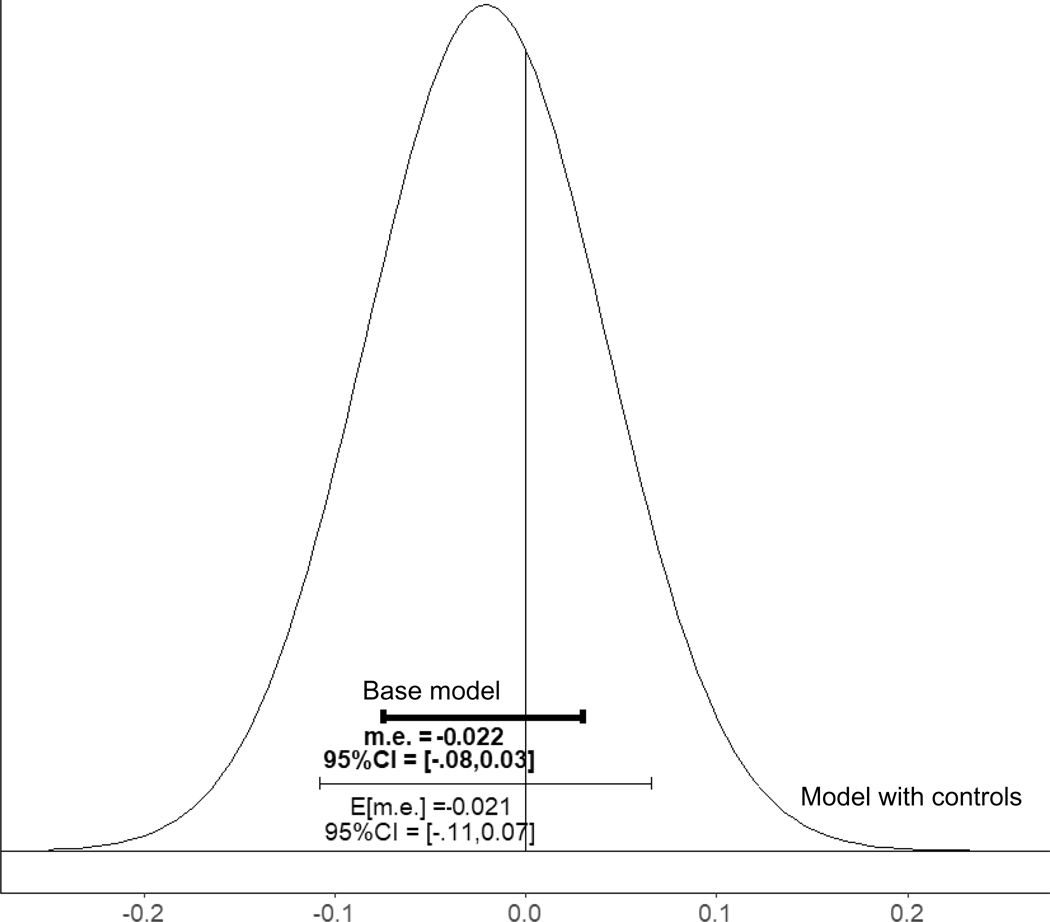
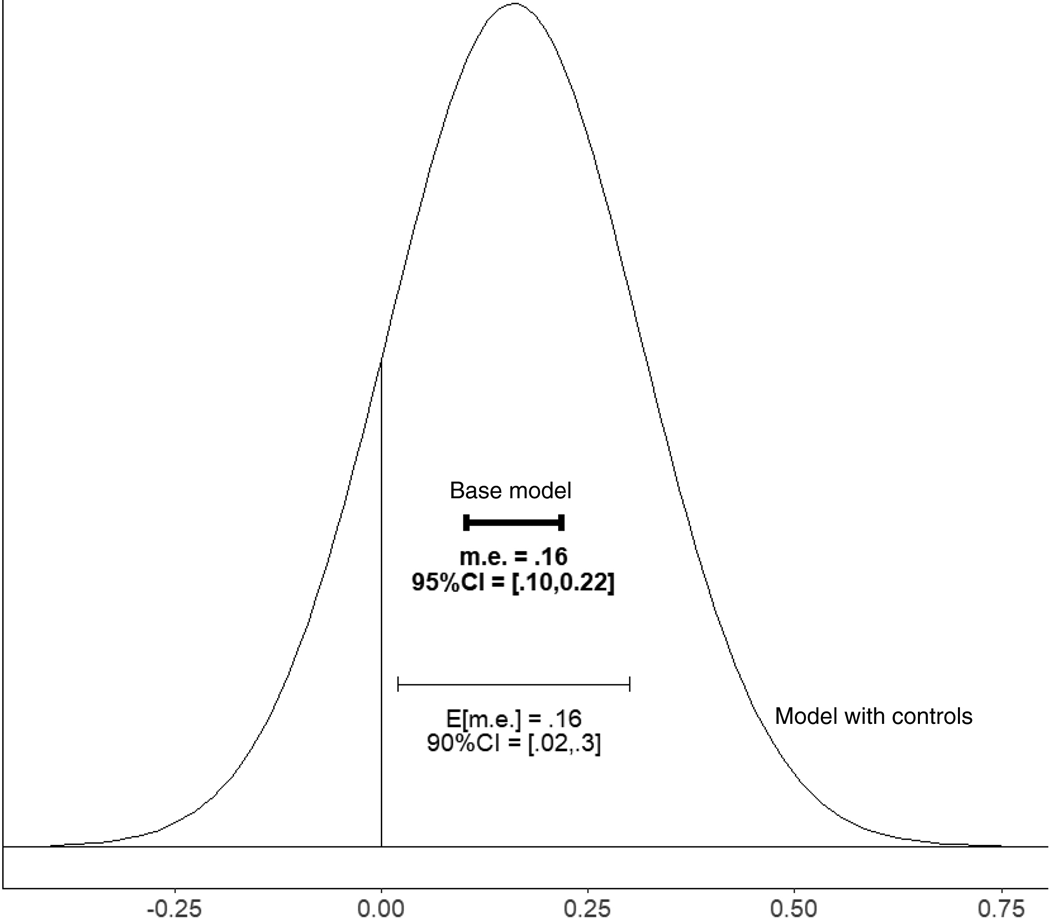
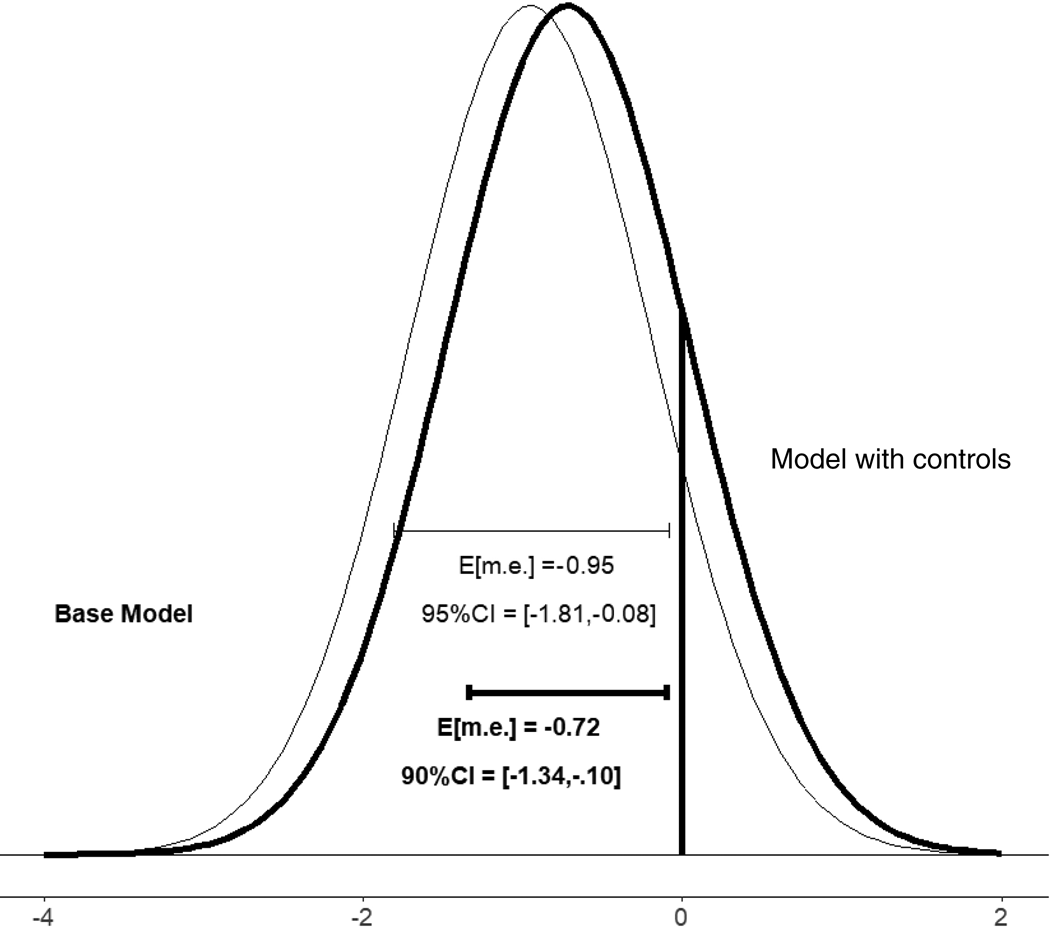
Figures 6–8 present the estimated within-country tax rate effects of wage-bargaining centralization. Where there is evidence of cross-national heterogeneity, marginal effects are modeled as random, and the full probability densities are provided with confidence intervals for the expected marginal effects. When there is no evidence of heterogeneity, the figure simply provides a confidence interval for the fixed marginal effect. I present two sets of consumption tax rate results. The theoretical model clearly shows that the interactive effect of electoral/party systems and wage-bargaining institutions is complex and depends on the reservation capital tax rate, which in turn depends on the outside production options available to employers.
Marginal effect of wage-bargaining centralization on consumption tax rates in PR systems with trichotomous multipartism

Marginal effect of wage-bargaining centralization on consumption tax rates in PR systems with trichotomous multipartism under high mobility

Marginal effect of wage-bargaining centralization on capital tax rates in PR systems with trichotomous multipartism

When the reservation tax rate is high, under corporatism, governments will rely more heavily on capital taxes and keep consumption taxes low. Countries with PR electoral systems will have similar consumption tax rates regardless of their wage-bargaining institutions (Hypothesis 1a). However, when the reservation capital tax rate is low, governments in PRITM systems that must satisfy employers' associations will be forced to place a higher tax burden on consumption (Hypothesis 1b). The results presented in Figures 6 and 7, generated from two samples, evaluate these hypotheses. The set of estimated effects in Figure 6 uses the full sample, while the estimated effects in Figure 7 use a high-capital-mobility subsample.Footnote 15
The results in Figure 6 come from two models: (1) a base model with no within-country control variables and (2) a model with the full set of within-country controls. Both models include the between-country controls in Table 3. In the former model, there is no evidence of effect heterogeneity, so the marginal effect of wage-bargaining centralization on consumption tax rates in countries with PRITM systems is treated as fixed. The quantity of interest is the estimated marginal effect. In the latter model there is evidence of effect heterogeneity, so the marginal effect is treated as random, and the quantity of interest is the estimated average marginal effect (or expected marginal effect). In both cases, the estimated effects are slightly negative and fail to achieve statistical significance.
The estimated effects in Figure 7 provide evidence that consumption tax rates increase with wage-bargaining centralization when capital mobility is high. Again, there is no evidence of effect heterogeneity in the base model. The estimated (short-run) effect from this model is a statistically significant 16-basis-point increase in the consumption tax rate. Based on the data, the marginal effect in the model with controls is treated as random. The estimated expected marginal effect is again 16 basis points. Adding controls reduces the precision of the estimate, but a 90 per cent confidence interval does not cover the no-average-effect null hypothesis.Footnote 16
Hypothesis 2 states that governments in countries with PRITM and corporatism will have lower capital tax rates. Figure 8 presents the estimated within-country capital tax rate effects of wage-bargaining centralization. There is evidence of effect heterogeneity in both the base and control models. Therefore, the probability densities are provided for both. The estimated average (short-run) marginal effect from the base model for a one-increment increase in wage-bargaining centralization is statistically significant at the 10 per cent level, which represents a 72-basis-point decrease in the capital tax rate. The effect (−0.95) is larger and statistically significant at the 5 per cent level when a full set of within-country controls is added. The long-run multipliers from these models are approximately 6.5, so the total effects are substantively large.
Finally, Hypothesis 3 posits that center-right governments are more likely in countries with PRITM and corporatism when international capital mobility is high. The partisan composition of governments is a strategic choice that favors center-right coalitions as employers’ bargaining power increases. To test this hypothesis, I create two measures of center-right governance. The first is the share of cabinet posts held by right parties. The second is an indicator variable for right-wing party inclusion in the government. The sample includes every country-year following an election year over the period 1970–2014. The outcomes measure the share of cabinet posts held by right-wing parties in the year after an election and the rate of participation by right-wing parties in the year after an election, respectively. There are 263 observations. The estimates are based on within-country variation; in other words, they draw on observed reforms to countries' labor market institutions and observed changes in their capital account policies, rather than cross-national comparisons. I control for both within- and between-country variation in inflation and unemployment.
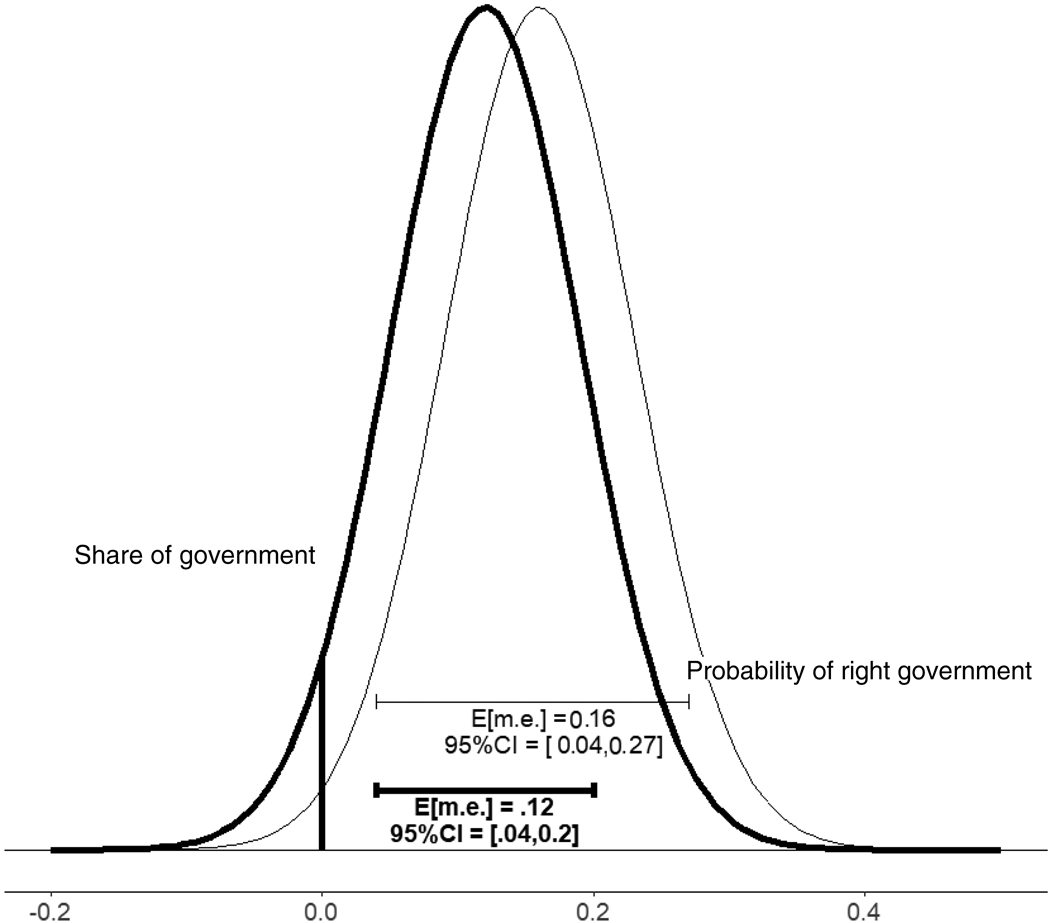
Figure 9 illustrates the estimated effects of capital account liberalization on center-right governance. The estimates represent the average effect of a one-standard-deviation increase in capital account openness for a country with PRITM and economy-wide bargaining with enforceable agreements between peak union and employer associations. Both models are linear, and there is evidence of marginal effect heterogeneity in both cases. Standard errors are clustered by country. A one-standard-deviation increase in capital account openness is expected to result in a 0.12 increase in right-party cabinet shares, while a one-standard-deviation increase in capital account openness is expected to generate a 0.16 increase in the probability that a right-wing party will participate in government. Both estimates are statistically significant.Footnote 17
Marginal effect of capital account openness on the probability and share of right government

Overall, I find considerable evidence to support the predictions generated by my theoretical model. When countries centralize their wage-bargaining institutions, under PRITM, their capital tax rates decrease. When PRITM countries remove their capital account restrictions and centralize their wage-bargaining institutions, their consumption taxes increase and their governments are more likely to include right-wing parties.
Conclusion
A long tradition in the study of political economy considers how institutions interact. With respect to taxation, I have argued that it is particularly important to understand how electoral and party systems, and the governments they produce, interact with organized labor and employers in the context of different labor market institutions. Under reasonable assumptions, institutional complementarities between PRITM and corporatism can explain why the revenue systems of countries that redistribute the most are relatively more dependent on regressive tax policies and instruments. On balance, PRITM systems generate more redistribution than majoritarian systems (Iversen and Soskice Reference Iversen and Soskice2006), but countries with PRITM have tax policies that moderate their levels of redistribution somewhat, particularly when it comes to absolute inequality. Moreover, the varying degrees to which broad-based consumption taxes are used around the world depend not only on the size of a country's welfare state (Kato Reference Kato2003) and the strength of its social democratic parties (Beramendi and Rueda Reference Beramendi and Rueda2007), but also on its electoral institutions and party systems.
Supplementary material
A supplementary online appendix that (1) describes the relationship between Gini coefficients and mean absolute difference statistics, (2) derives the comparative statics from the formal model, (3) calculates the numerical illustration and (4) presents all of the regression tables from the empirical analysis is available at https://doi.org/10.1017/S0007123420000861.
Data availability statement
The data, replication instructions, and the data's codebook can be found in the Harvard Dataverse at: https://doi.org/10.7910/DVN/HINSEA.
Acknowledgements
I appreciate helpful comments on earlier versions of the article from Michaël Aklin, Despina Alexiadou, Barry Ames, Cory Belden, Daniel Berkowitz, Stephen Chaudoin, Xinyuan Dai, Daniela Donno, Rob Franzese, John Freeman, Valentina Gonzalez Rostani, Stephan Haggard, Sarah Hummel, Junko Kato, George Krause, Carol Leff, Avital Livny, Scott Morgenstern, Robert Pahre, Amaury Perez, Aníbal Pérez-Liñán, Amy Pond, Gisela Sin and participants attending the Governance, Institutions, and Organizations workshop at the University of Pittsburgh and the Politics Workshops at the University of Illinois and the University of Strathclyde.