Increasing numbers of patients with CHD are surviving to adulthood, following advances in medical and surgical care. Living a physically active life is important for the health and wellbeing of those with adult CHD. General physical activity guidelines suggest adults aged 19–64 years should undertake at least 150 minutes of moderate, or 75 minutes of vigorous exercise per week, and this should also be applied to the adult CHD population. 1
Regular structured exercise is both safe and effective therapy for adult CHD patients and is therefore recommended by European Society of Cardiology (ESC) and American Association of Cardiology guidelines. The benefits of regular exercise are well documented. Significant improvements have been demonstrated in aerobic capacity, weight management, mental wellbeing, and overall quality of life, without causing major sequelae of sudden cardiac death or arrhythmia. Reference Fredriksen, Kahrs and Blaasvaer2−Reference Opić, Utens and Cuypers6 Furthermore, discussions about exercise participation should be undertaken at every consultation with a healthcare professional and individualised exercise prescriptions should be considered. Reference Fredriksen, Kahrs and Blaasvaer2,Reference Pelliccia, Sharma and Gati7,Reference Longmuir, Brothers and de Ferranti8
Evidence suggests that exercise levels in patients with adult CHD are lower than their non- adult CHD counterparts, often due to over-caution, and this is associated with lower perceived general health. Reference Opić, Utens and Cuypers6,Reference Longmuir, Brothers and de Ferranti8,Reference Reybrouck and Mertens9 Simple prescribed exercise programmes have been shown to significantly improve exercise capacity and quality of life measures, including satisfaction with life and self-perception in patients of all stages of adult CHD. Reference Opić, Utens and Cuypers6,Reference Pelliccia, Sharma and Gati7,Reference Giannakoulas and Dimopoulos10−Reference Pemberton, McCrindle and Barkin12 This group is also at greater risk of acquired cardiovascular risk factors such as obesity, therefore maintaining a physically active lifestyle is paramount in secondary prevention of cardiovascular disease, improving long-term morbidity and mortality. Reference Longmuir, Brothers and de Ferranti8,Reference Scholes13
The COVID-19 pandemic has posed an enormous challenge to healthcare professionals and patients alike with regard to ensuring compliance with guidelines and achieving physical activity targets. During the first wave of the pandemic, clinically vulnerable patients (including those with adult CHD) were advised to “shield” to protect them from COVID-19. Shielding comprised restrictions on usual activities and social interactions, including advice to stay at home as much as possible, minimise contact with those not living in the same household, and only go outside for exercise or to attend health appointments.
We explored the implications of the COVID-19 pandemic on implementation of ESC guidelines with regard to physical activity in adult CHD. Identifying barriers to the implementation of recommendations could be invaluable in developing solutions to improve exercise participation and optimise outcomes in adult CHD.
Materials and methods
A data-based questionnaire was developed and distributed to adult CHD patients during opportunistic interactions by healthcare professionals at outpatient clinics and inpatient wards at a regional tertiary centre, Queen Elizabeth Hospital Birmingham, between October 2020 and November 2020. The population studied were adult CHD patients aged 18 years and above with a variety of congenital heart conditions ranging from mild to severe.
The questionnaire collected baseline demographic data including age, ethnicity, and gender. The main body of the questionnaire aimed to collect quantitative data based on three key themes. Questions were multiple choice with an option for “other”, along with a free-text box for the respondent to expand. Firstly, pre-pandemic exercise levels were captured along with motivations for exercise. Secondly, data on exercise levels during the first national lockdown period as a result of the pandemic were collected. This included objective questions about average hours of exercise per week along with subjective responses regarding whether the respondent thought their physical activity levels had increased, decreased, or stayed the same. The reasons for any change in activity levels were also captured. An example questionnaire can be found in Supplementary Fig. S1.
Questionnaire responses were collated by the authors and presented as quantitative data. Statistical analysis was performed using SPSS (V.25) software. Chi-squared or Fisher’s exact tests were used to determine statistical significance of relationships between categorical variables at 95% confidence interval, depending on sample size. To determine if there was a significant association between those meeting exercise guidelines before the pandemic compared with during lockdown, McNemar’s test was used for the two related samples.
This study was approved by the Clinical Audit Department at the Queen Elizabeth Hospital Birmingham (CARMS Reference 16,560).
Results
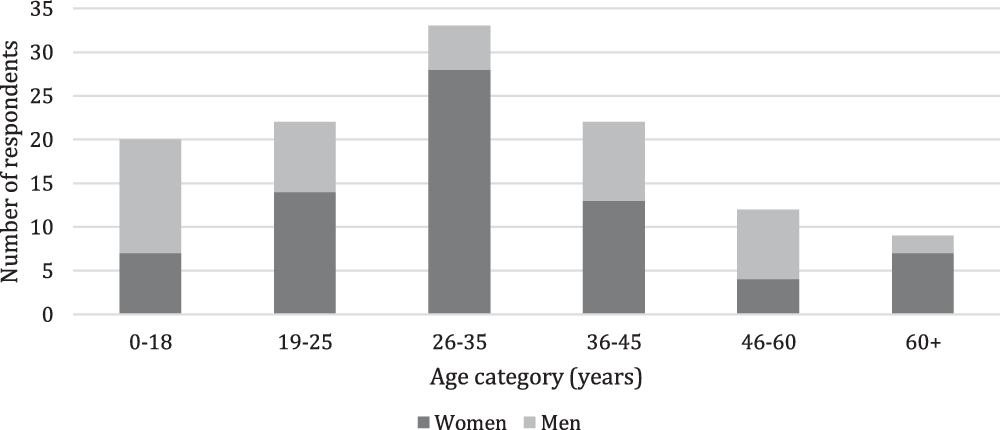
Of the 125 respondents, 75 (60%) were women, 45 (36%) were men and 5 (4%) preferred not to answer. The distribution of age of respondents is shown in Figure 1. The majority of respondents were of White British or European ethnicity (73.6%), 16 were from Black and Minority Ethnic communities, and 10.4% did not respond.
Age of questionnaire respondents.

Before the COVID-19 pandemic
Of the 125 respondents to the questionnaire, 96 (79.3%) reported participating in regular physical activity prior to the COVID-19 pandemic.
Sixty-six (52.8%) respondents met guidelines, participating in moderate physical activity for at least 150 minutes per week prior to the pandemic. The remaining 59 respondents (47.2%) did not meet this target. There was no significant difference between the percentage of women versus men who met this target (57.3% versus 51.1%, p = 0.51).
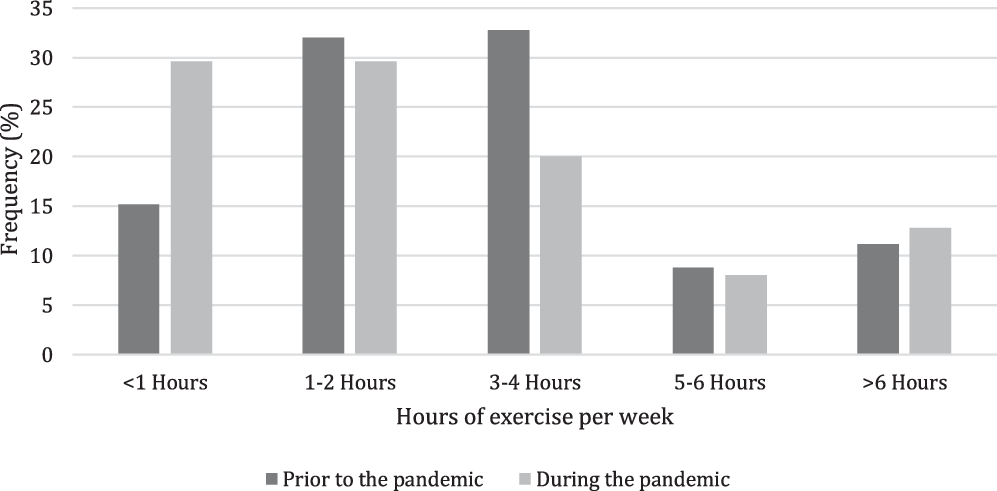
Prior to the pandemic, 19 respondents (15.2%) reported doing less than 1 hour of physical activity each week. Forty (32.0%) respondents did 1–2 hours, 41 (32.8%) 3–4 hours, 11 (8.8%) 5–6 hours, and 14 (11.2%) more than 6 hours of physical activity per week.
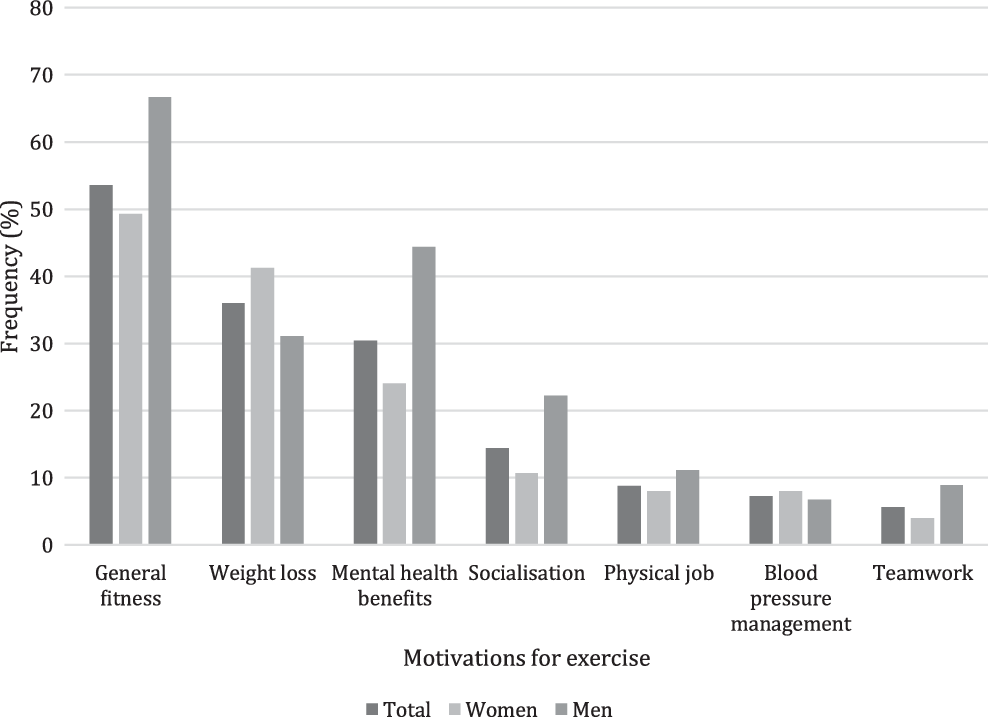
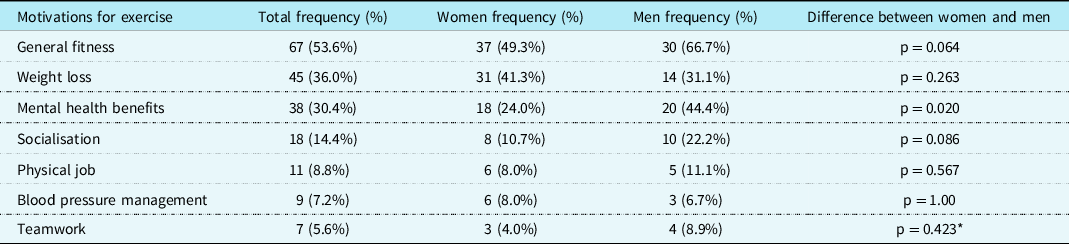
The commonest motivation for physical activity amongst respondents was general fitness (53.6%), followed by weight loss (36.0%) and mental health benefits (30.4%). Socialisation, physicality of their occupation, blood pressure management, and teamwork were also reported as motivations. The only significant difference between women and men in their motivations for physical activity was for mental health benefits, which was more likely to be reported by men than women (44.4% versus 24.0%, p = 0.02). These data are presented Figure 2 with more detailed data in Table 1.
Motivations for physical activity amongst respondents.

Motivations for physical activity amongst respondents

Chi-squared test was used to calculate p-values except where otherwise stated.
* Fisher’s exact test used as frequency <5.
p < 0.05 is considered statistically significant.
Impact of the COVID-19 pandemic
During lockdown as a result of the pandemic, the percentage of respondents that met the target of 150 minutes of physical activity decreased significantly from 52.8% to 40.8% (p = 0.03). Of the 125 respondents, 43 (34.4%) reported a subjective decrease in their physical activity due to the COVID-19 lockdown. Twenty-three respondents (18.4%) reported an increase in their activity, and 48 (38.4%) reported no change. Eleven were unsure or did not answer (8.8%). Figure 3 displays the number of hours of physical activity that respondents engaged in before and during the pandemic.
Weekly physical activity prior to and during pandemic.

Forty-three (34.4%) respondents reported a decrease in physical activity due to lockdown; there was no significant difference in proportion of women and men who reported decreased activity (38.7% versus 31.1%, p = 0.40).
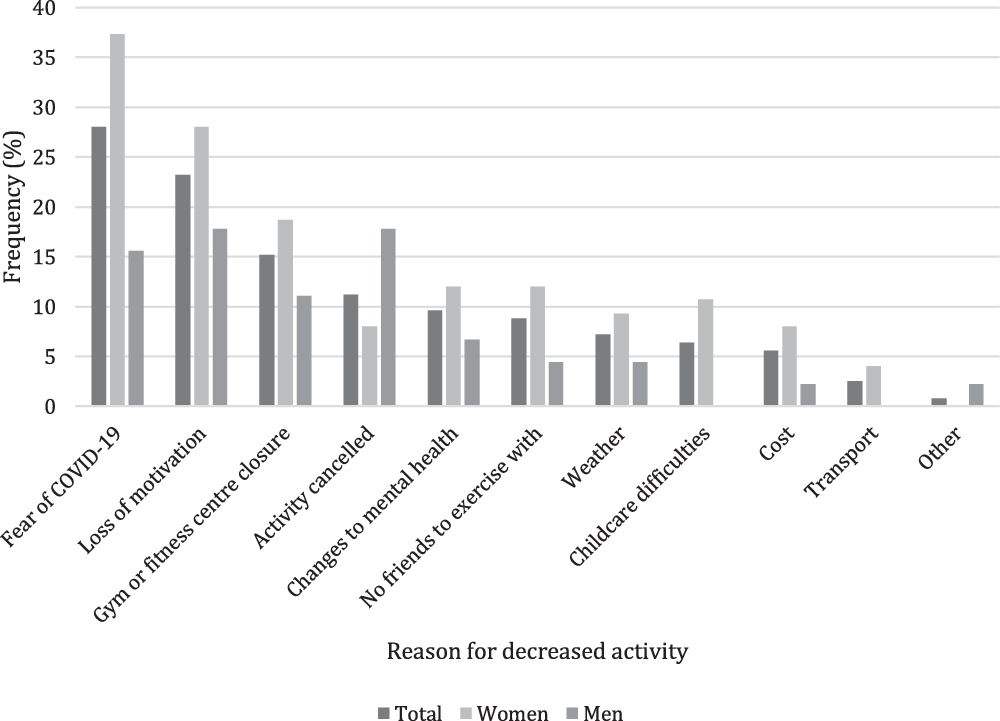
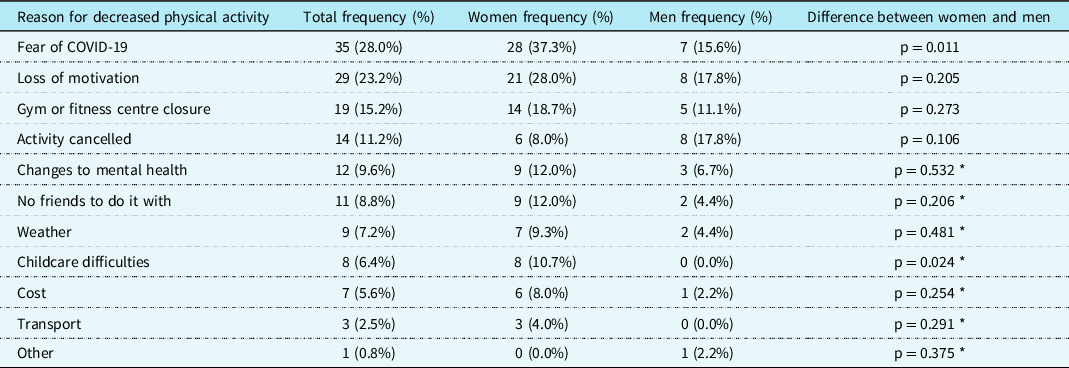
The commonest reason for decreased exercise during lockdown was fear of COVID-19 (28.0%). This was followed by the loss of motivation (23.2%) and gym/fitness centre closure (15.2%). Other reasons included cancellation of activities (11.2%), changes to mental health (9.6%), no friends to participate in physical activity with (8.8%), weather (7.2%), difficulties with childcare (6.4%), cost (5.6%), and transport limitations (2.5%). Breakdown of reasons for decreased exercise can be found in Figure 4, with more detailed data in Table 2.
Reasons for decreased physical activity during the COVID-19 pandemic lockdown.

Reasons for decreased physical activity during the COVID-19 pandemic lockdown

Chi-squared test used to calculate p-values.
* Fisher’s exact test used as frequency <5.
p < 0.05 is statistically significant.
Closure of gyms and fitness centres was a common reason for decreased exercise in the surveyed population, reported by 15.2%. Prior to the COVID-19 pandemic, 38 (30.4%) of respondents reported attending a gym or fitness centre to exercise and there was no significant difference between women and men (29.3% versus 35.6%, p = 0.48). For those that attended a gym or fitness centre prior to the pandemic, closure of such facilities stopped their physical activity in over a third (39.5%).
There was a statistically significant difference between women and men reporting fear of COVID-19 as a reason for decreased exercise, being reported by more women than men (37.3% versus 15.6%, p = 0.011). Similarly, childcare issues as a reason for decreased activity significantly and disproportionately affected women compared to men (10.7% versus 0.0%, p = 0.02).
Twenty-three respondents (18.4%) reported an increase in their physical activity throughout the COVID-19 pandemic (20.0% of women and 17.8% of men). The reasons for increased physical activity during the pandemic were having more time (36.0%) and easily accessible online classes (6.4%).
Discussion
Before the COVID-19 pandemic
Our data show that even before the COVID-19 pandemic, only just over half of respondents (52.8%) met national guidelines for target physical activity levels. There are several possible explanations for this. Firstly, patients with adult CHD and their parents/carers may be over-cautious about exercise due to fears of causing harm. In 2017, 66% of men and 58% of women in the United Kingdom met recommended physical activity levels according to national data collection. Reference Scholes13 Contrastingly, in the adult CHD population, an international study collating data from 15 countries worldwide found 31% met physical activity guidelines. Reference Larsson, Johansson and Sandberg14 It is therefore important that patients receive health promotion advice and reassurance regarding exercise from their adult CHD team.
In addition to this, healthcare professionals themselves may be uncertain about exercise recommendations given the heterogeneous population of patients encountered in the outpatient setting, with varying anatomical and physiological considerations. Although exercise is safe in the majority of patients with adult CHD, there are certain situations where caution is advised, such as those at high risk of arrhythmia. However, the risk of sudden cardiac death in adult CHD patients is rare (<0.1% per year) and only a small proportion of those deaths occur during exercise. Reference Reybrouck and Mertens9,Reference Koyak, Harris and de Groot15,Reference Zomer, Vaartjes and Uiterwaal16 Mitchell et al. and the Bethesda guidelines categorise sports based on the level of exercise intensity, both dynamic and static, generally required to perform it, as well as identifying sporting disciplines which carry increased risk of bodily collision. This classification could be used to help healthcare professionals and patients understand the comparative physiological and physical stresses of different sports and thus determine most suitable categories for each individual. Reference Mitchell, Blomqvist and Haskell19 Guideline recommendations specific to the adult CHD population may increase healthcare professionals’ confidence in delivering exercise recommendations.
Dua et al. explored the feasibility of providing exercise training to adult patients at all stages of adult CHD. A structured exercise programme, which involved gentle walking over a period of 10 weeks, was prescribed to patients. Quality of life and physical activity levels increased following this intervention. Moreover, patients’ treadmill test duration improved, providing evidence of the increased exercise capacity that implementing a simple physical activity intervention can achieve. Reference Pelliccia, Sharma and Gati7,Reference Dua, Cooper, Fox and Graham Stuart11 Formal prescription of an exercise programme could thus be considered as a feasible option to improve physical activity levels and compliance in our patient cohort. Another useful adjunct is the provision of written guidance in the form of patient information leaflets to patients in order to develop confidence and understanding of the topic. HEART UK offers a wealth of resources detailing the benefits of exercise and provides workout videos which are openly and freely accessible to all. 17 The provision of gym tokens to patients is also an option to improve physical activity levels. It must be considered that there are expenses related to many forms of physical activity, such as membership and equipment costs. As cost was a factor reported to negatively impact activity levels, this may encourage physical activity by making gyms and sports centres more financially accessible. However, as these centres were forced to close due to the COVID-19 pandemic, such tokens would be of limited benefit while lockdown restrictions were in place.
Impact of the COVID-19 pandemic
Fear of COVID-19 was the most common reason to which reduced physical activity levels were attributed. While it is understandably difficult to allay these fears, psychological support could be offered by the responsible healthcare team. Furthermore, as our study showed some respondents undertake physical activity for its mental health benefits, exercise can be advocated as an intervention to assuage this fear and boost mental wellbeing in patients.
Closure of fitness centres was one reported reason for reduced physical activity levels during the COVID-19 pandemic. While such restrictions are in place, alternative forms of exercise should be considered in order to sustain activity levels. As clinically vulnerable populations were advised to stay inside and “shield” to protect themselves from COVID-19, options are limited, and although the advent of vaccination programmes will hopefully enable easing of lockdown restrictions in the near future, the timing of this is difficult to predict.
Some respondents reported the availability of online fitness classes to positively impact their activity levels during the pandemic. In this way, our study has identified a novel intervention that could improve compliance with exercise guidelines. Healthcare professionals should raise awareness of these online classes to their patients, in order to help them meet and maintain recommended levels of activity despite closure of fitness centres. A systematic review investigating home-based exercise programmes for patients with adult CHD found these to be a safe and feasible alternative to cardiac rehabilitation, which reaffirms the efficacy of this proposed intervention. Reference Giannakoulas and Dimopoulos10,Reference Meyer, Brudy and García-Cuenllas18
Limitations
The timing of this study should be accounted for when interpreting these results, in order that they are appropriately contextualised. Data were collected during October and November 2020, so questionnaire responses will reflect the attitudes of patients during this time, before the second lockdown was announced in the United Kingdom. In this period of summer and autumn, days are usually longer and weather more permissive to outdoor exercise. Since this study there have been two further lockdowns in the United Kingdom, over the winter months, so it is possible that exercise levels and attitudes may have changed during this time.
Our study population predominantly comprised females from a White British ethnic background, which should be accounted for when interpreting findings. Our questionnaire did not capture details of underlying congenital pathology or severity of disease, instead investigating the adult CHD population as a whole. The adult CHD population is heterogenous and it is important to consider individual pathology and physiology when making exercise recommendations.
Questionnaires are subject to social desirability bias and this is particularly important when capturing lifestyle data. It is possible that exercise levels are overstated using the questionnaire method as a result of this bias. Questionnaires are also subject to recall bias; therefore, it is impossible to say whether discussions about exercise do in fact take place at most consultations with healthcare professionals.
Finally, patients attending outpatient clinics captured with this questionnaire may have better health behaviours than those who do not attend their scheduled appointments, which is possibly a source of selection bias. Similarly, volunteer bias may be a contributing factor.
Suggestions for future research
Although exercise has been found to have benefits for both morbidity and mortality in patients with adult CHD, ESC guidelines are not specific regarding type and quantity of exercise recommended in this patient group. Instead, recommendations are extrapolated from the non- adult CHD population. More specific guideline recommendations may increase healthcare professionals’ confidence in delivering exercise recommendations. Furthermore, possible interventions to improve exercise participation should be explored with high-quality interventional studies.
Conclusions
The COVID-19 pandemic has had a significant negative impact on the exercise levels of patients with adult CHD. The principal factor contributing to poor compliance with recommended exercise levels is fear of COVID-19. On the other hand, the availability of online classes can positively impact exercise levels, and these must be considered as a means of increasing compliance with recommendations.
Regular physical activity has been shown to improve morbidity and mortality in patients with CHD. It is a recommended therapy in guidelines published by both the European Society of Cardiology and the American Association of Cardiology. It is critical that engagement in physical activity is discussed and encouraged at every encounter with a healthcare professional in order to optimise management and outcomes for this patient group.
Supplementary material
To view supplementary material for this article, please visit https://doi.org/10.1017/S1047951121001864
Acknowledgements
None.
Financial support
This research received no specific grant from any funding agency, commercial or not-for-profit sectors.
Conflicts of interest
None.
Ethical standards
The authors assert that all procedures contributing to this work comply with ethical standards including the Helsinki Declaration of 1975, as revised in 2008, and have been approved by the local institutional committee (Clinical Audit Department at the Queen Elizabeth Hospital Birmingham).