Introduction
Military training is an intense and stressful period during which individuals are exposed to a combination of dangerous stressful events on a daily basis (Bernton et al. Reference Bernton, Hoover, Galloway and Popp1995), thus representing a well-defined period of chronic stress (Day & Livingstone, Reference Day and Livingstone2001) that may impact the development of stress-related symptoms such as anxiety and depression (Morgan, Reference Morgan2001; Taylor et al. Reference Taylor, Sausen, Potterat, Mujica-Parodi, Reis, Markham, Padilla and Taylor2007). A detailed neurobehavioral characterization of individuals experiencing realistic intense stress may enhance our understanding of the development of these symptoms.
Stress vulnerability and resilience have been associated with trait anxiety (McFarlane, Reference McFarlane, Wolf and Mosnaim1990), patterns of attention to threat (Bar-Haim et al. Reference Bar-Haim, Lamy, Pergamin, Bakermans-Kranenburg and van IJzendoorn2007; Wald et al. Reference Wald, Degnan, Gorodetsky, Charney, Fox, Fruchter, Goldman, Lubin, Pine and Bar-Haim2013) and limbic and prefrontal cortex (PFC) function (Admon et al. Reference Admon, Lubin, Stern, Rosenberg, Sela, Ben-Ami and Hendler2009, Reference Admon, Milad and Hendler2013b ). These factors also interact with each other: threat attentional bias has been related to trait anxiety (MacLeod & Mathews, Reference MacLeod and Mathews1988; Mogg et al. Reference Mogg, Bradley and Hallowell1994), and with the interplay between limbic and PFC function, which is unbalanced in stress-related disorders (Bishop, Reference Bishop2007, Reference Bishop2008). However, the relationships between trait anxiety, threat bias and brain activity and their contribution to the severity of stress-related symptoms remain unclear.
A common approach to measuring threat-related attention bias is the dot-probe task (DPT; Mogg & Bradley, Reference Mogg and Bradley1999; Monk et al. Reference Monk, Nelson, McClure, Mogg, Bradley, Leibenluft, Blair, Chen, Charney, Ernst and Pine2006; Bar-Haim et al. Reference Bar-Haim, Lamy, Pergamin, Bakermans-Kranenburg and van IJzendoorn2007; Fani et al. Reference Fani, Tone, Phifer, Norrholm, Bradley, Ressler, Kamkwalala and Jovanovic2012). This task simultaneously presents pairs of threat-neutral stimuli, followed by a probe that requires a response. The probe replaces a threat stimulus in threat-congruent trials or a neutral stimulus in threat-incongruent trials. Participants can be stratified into those who tend to respond faster to congruent relative to incongruent trials, preferentially directing attention towards threat cues (vigilance bias tendency), and those who tend to respond faster to incongruent relative to congruent trials, preferentially directing attention away from threat cues (avoidance bias tendency) (Price et al. Reference Price, Tone and Anderson2011; Waters et al. Reference Waters, Mogg and Bradley2012). Behavioral studies using the DPT typically find vigilance bias in high trait anxious individuals and in clinical populations including patients with post-traumatic stress disorder (PTSD; Bradley et al. Reference Bradley, Mogg, White, Groom and Bono1999; Bar-Haim et al. Reference Bar-Haim, Lamy, Pergamin, Bakermans-Kranenburg and van IJzendoorn2007; Fani et al. Reference Fani, Tone, Phifer, Norrholm, Bradley, Ressler, Kamkwalala and Jovanovic2012).
Imaging studies report that threat bias involves limbic regions including the amygdala, the hippocampus and PFC areas, including the anterior cingulate cortex (ACC) and lateral PFC (lPFC) (Bishop et al. Reference Bishop, Duncan, Brett and Lawrence2004; Monk et al. Reference Monk, Nelson, McClure, Mogg, Bradley, Leibenluft, Blair, Chen, Charney, Ernst and Pine2006; Bishop, Reference Bishop2008; Telzer et al. Reference Telzer, Mogg, Bradley, Mai, Ernst, Pine and Monk2008; Vollstädt-Klein et al. Reference Vollstädt-Klein, Loeber, Richter, Kirsch, Bach, von der Goltz, Hermann, Mann and Kiefer2012; Fani et al. Reference Fani, Gutman, Tone, Almli, Mercer, Davis, Glover, Jovanovic, Bradley, Dinov, Zamanyan, Toga, Binder and Ressler2013). Together, these limbic and prefrontal regions encompass a major part of the stress-related neural circuit that may affect threat processing and anxiety (Mogg et al. Reference Mogg, Mathews, Bird and Macgregor-Morris1990; Dedovic et al. Reference Dedovic, D'Aguiar and Pruessner2009).
The role of the amygdala in this task may be related to rapid tagging of threat cues (Ledoux & Muller, Reference Ledoux and Muller1997). Amygdala activity during threat processing has been shown to be predicted by individual differences in trait anxiety (Etkin et al. Reference Etkin, Klemenhagen, Dudman, Rogan, Hen, Kandel and Hirsch2004). Moreover, amygdala activity before stress predicted an increase in post-trauma symptoms (Admon et al. Reference Admon, Lubin, Stern, Rosenberg, Sela, Ben-Ami and Hendler2009). The hippocampus, however, may be involved in processing threat context during probe detection (Sanders et al. Reference Sanders, Wiltgen and Fanselow2003) and monitoring the levels of threat to control behavioral inhibition, such as avoidance behavior (Bach et al. Reference Bach, Guitart-Masip, Packard, Miró, Falip, Fuentemilla and Dolan2014). Indeed, a recent dot-probe study related the neural activity of the hippocampus to threat avoidance in clinically anxious youth (Price et al. Reference Price, Siegle, Silk, Ladouceur, McFarland, Dahl and Ryan2014). Within the context of threat, hippocampal activity has been suggested to play a role in mediating trait anxiety (Satpute et al. Reference Satpute, Mumford, Naliboff and Poldrack2012) and has been associated with PTSD (Shin et al. Reference Shin, Rauch and Pitman2006). Additionally, hippocampal plasticity has been related to stress vulnerability (Admon et al. Reference Admon, Lubin, Stern, Rosenberg, Sela, Ben-Ami and Hendler2009, Reference Admon, Milad and Hendler2013b ). Finally, the lPFC may be important for allocating attention (Egner & Hirsch, Reference Egner and Hirsch2005) and the ACC for conflict monitoring and threat appraisal (Kerns et al. Reference Kerns, Cohen, MacDonald, Cho, Stenger and Carter2004; Etkin et al. Reference Etkin, Egner and Kalisch2011), all of which are important in threat-processing tasks such as the DPT. Akin to the limbic regions, activity in these prefrontal regions has been associated with trait anxiety (Bishop, Reference Bishop2009; Klumpp et al. Reference Klumpp, Ho, Taylor, Phan, Abelson and Liberzon2011), and disrupted function in the ACC has been implicated in PTSD (Shin et al. Reference Shin, Whalen, Pitman, Bush, Macklin, Lasko, Orr, McInerney and Rauch2001, Reference Shin, Rauch and Pitman2006) and associated with vulnerability to such psychopathology (Shin et al. Reference Shin, Bush, Milad, Lasko, Brohawn, Hughes, Macklin, Gold, Karpf, Orr, Rauch and Pitman2011; Admon et al. Reference Admon, Milad and Hendler2013b ).
Thus, several lines of research indicate that attentional threat bias is related to trait anxiety and clinical anxiety including PTSD and that limbic and prefrontal regions are associated with trait anxiety, threat bias and PTSD. However, two key questions remain unresolved. First, does threat bias interact with trait anxiety to influence stress-related symptoms? Second, is this relationship reflected in specific brain responses? To address these open issues, we combined measurements of trait anxiety, behavioral threat bias in the DPT, neural reactivity to threat and PTSD symptoms in combat soldiers following 1 year of intense military training. Specifically, we recruited soldiers from an elite combat unit undergoing a prolonged training course, which is among the most difficult and rigorous training programs in the Israel Defense Forces (IDF). We hypothesized that individuals with high trait anxiety and avoidance bias would have fewer PTSD symptoms than individuals with high trait anxiety and vigilance bias. From a neural perspective, we assumed that threat stimuli in the context of emotional conflict during the DPT would engage the amygdala, hippocampus, ACC and lPFC. We further assumed that only among high trait anxious individuals would avoidance and vigilance biases show a differential pattern of limbic and prefrontal activity, which would be related to differences in PTSD symptoms.
Method
Participants
Participants were 55 male IDF soldiers (mean age 18.87 ± 0.92 years) trained in an elite combat unit. Participants were recruited to the study after 1 year of intensive and advanced combat training. During military training, participants were exposed to a wide variety of stressful physical and psychological demands that have been shown to affect well-being, including sleep restrictions, prolonged periods of physical survival challenges, face-to-face combat training and a counter-terrorism combat course (Gomez-Merino et al. Reference Gomez-Merino, Drogou, Chennaoui, Tiollier, Mathieu and Guezennec2005). Participants were asked to complete a questionnaire with several items regarding life history of traumatic and significant experiences and illnesses. These included specific questions regarding any severe mental and/or physical illnesses, and/or hospitalizations of the participant and their close family, along with an open question in which participants were asked to describe any traumatic and/or significant experience that occurred throughout their civilian life prior to their military service. According to this, participants had no reported history of psychiatric or neurological disorders, no current use of psychoactive drugs, no family history of major psychiatric disorders, and no incidence of childhood abuse or potentially traumatic events before military enrollment. All participants provided written informed consent approved by the Tel Aviv Sourasky Medical Center Ethics Committee and the IDF Ethics Board.
PTSD and depression measurements
PTSD symptoms were evaluated with the military version of the 17-item PTSD Checklist (PCL; Weathers et al. Reference Weathers, Litz, Herman, Huska and Keane1993), which specifically asks about symptoms related to stressful military experiences. Depression symptoms were evaluated with the nine-item Patient Health Questionnaire (PHQ-9; Kroenke & Spitzer, Reference Kroenke and Spitzer2002; Löwe et al. Reference Löwe, Unützer, Callahan, Perkins and Kroenke2004; Fann et al. Reference Fann, Bombardier, Dikmen, Esselman, Warms, Pelzer, Rau and Temkin2005). Three participants did not complete these questionnaires, and thus were excluded from analyses concerning these variables.
Anxiety measurement
Trait anxiety was assessed using Spielberger's Stait–Trait Anxiety Inventory, Trait Version (STAI-T; Spielberger et al. Reference Spielberger, Gorsuch, Lushene, Vagg and Jacobs1970; Barnes et al. Reference Barnes, Harp and Jung2002). To discriminate between high (mean = 37.8 ± 5.0, n = 28) and low trait anxiety (mean = 25.8 ± 3.4, n = 27), we used a median split of STAI-T scores (which was 31 in our sample), as in prior studies (Mogg et al. Reference Mogg, Holmes, Garner and Bradley2008; Sheppes et al. Reference Sheppes, Luria, Fukuda and Gross2013). Possibly because of military screening processes, anxiety levels of our high and low trait anxiety groups were lower than the common cut-off levels in non-clinical populations (Eysenck & Byrne, Reference Eysenck and Byrne1992).
Threat bias assessment
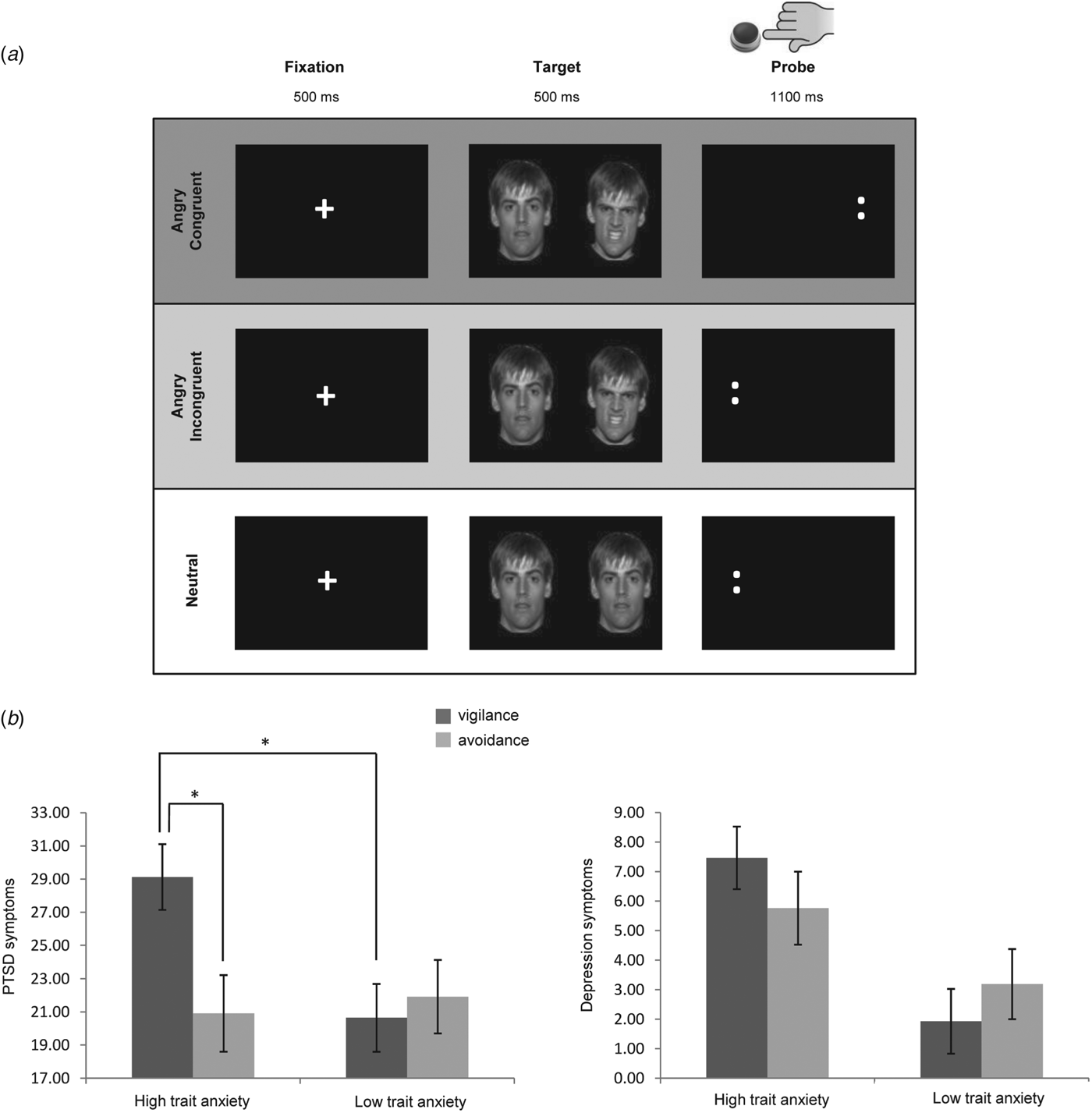
Threat-related attention bias was evaluated using the DPT adapted to functional magnetic resonance imaging (fMRI) with angry faces as the threat signal (Mogg & Bradley, Reference Mogg and Bradley1999) using E-Prime version 1.0. Two face stimuli, one emotional (angry or happy) and one neutral, were shown briefly in each trial, and their offset was followed by a probe in the location occupied by just one of these faces. Each trial began with a 500-ms central fixation cross. Two faces then appeared for 500 ms. These were replaced by a pair of dots in one hemifield for 1100 ms. The inter-trial interval was between 1485 and 2300 ms (Fig. 1a ). For the measure of threat bias, there were two conditions of interest: (1) threat-congruent trials, in which an angry/neutral face pair was followed by a probe at the location of the angry face; and (2) threat-incongruent trials, in which an angry/neutral face pair was followed by a probe at the location of the neutral face. Threat bias scores reflect the difference between mean reaction times for threat incongruent versus threat congruent trials. A bias score in the positive range, which reflects faster mean reaction time to targets appearing at the location of threat stimuli, was termed vigilance. A bias score in the negative range reflects the opposite pattern, which was termed threat avoidance.
Threat bias, trait anxiety and post-traumatic stress disorder (PTSD) symptoms. (a) Sequence of events in the dot-probe task (DPT) of the three possible trials. Vigilance is represented by faster reaction to congruent trials (dark gray) versus incongruent trials (light gray), and avoidance is reflected by the opposite pattern of response. (b) Severity of symptoms with regard to trait anxiety level and threat bias group. ANOVA revealed a significant interaction showing that high anxious individuals with vigilance bias have increase PTSD symptoms compared to high anxious avoiders and to low anxiety individuals (left graph), a pattern of results that was not obtained for depression symptoms (right graph). *p < 0.05.

Although threat trials were the main experimental condition of interest, three other control conditions were included: happy-congruent and happy-incongruent trials following a happy/neutral face pair, and neutral trials following neutral/neutral face pairs. There were 24 trials for each of the four emotional conditions and 48 trials for the neutral condition. In addition, 115 blank trials (no faces and no pair of dots) were presented. Trial presentation order was determined randomly for each participant. Equal numbers of trials displayed the emotional face on right and left hemifields. Participants were instructed to respond as quickly as possible by pressing one button with their index finger if the dots were horizontal or a second button if the dots were vertical, thus leaving the emotional component implicit. Participants initially practiced the task outside the scanner. This practice task included eight neutral trials.
Trials with incorrect response, trials in which the response time was 2 standard deviations below or above the participant's mean for a particular condition, and trials in which response time was faster than 150 ms were excluded from the analysis. Participants were allocated to groups according to their threat bias direction (in the negative or positive range): avoidance (n = 25) and vigilance (n = 30). A similar classification has been used in clinical samples (Price et al. Reference Price, Tone and Anderson2011; Waters et al. Reference Waters, Mogg and Bradley2012).
MRI data acquisition and analysis
Brain scanning was performed on a GE 3-T Signa HDxt MRI scanner (GE Healthcare, USA) with an eight-channel head coil. Functional images were acquired using a single-shot echo-planar T2*-weighted sequence. The following parameters were used: repetition time/echo time (TR/TE) = 2400/35 ms, flip angle = 90°, field of view (FOV) = 20 × 20 cm, matrix size = 96 × 96, 26 axial slices, slice thickness = 4 mm, and no gap covering the entire brain. Acquisition orientation was of the fourth ventricle plane. In addition, each functional scan was accompanied by a three-dimensional (3D) scan using a T1-spoiled gradient recalled (SPGR) sequence (1 × 1 × 1 mm3). Data were preprocessed and analyzed using conventional statistical parametric mapping (SPM5). fMRI data preprocessing included correction for head movement (subjects with movement >2 mm were discarded), realignment, normalizing the images to Montreal Neurological Institute (MNI) space and spatially smoothing the data [full-width at half-maximum (FWHM) = 6 mm]. The first four functional volumes, before signal stabilization, were excluded from the analysis.
Statistical maps were prepared for each participant using a general linear model (GLM), in which the five task conditions were defined as district predictors: happy-congruent, happy-incongruent, angry-congruent, angry-incongruent and neutral. Time points for trials in which participants responded incorrectly or with reaction times outside of a predefined time window were placed in a separate vector and included in the regression model as a nuisance covariate. Following Monk et al. (Reference Monk, Nelson, McClure, Mogg, Bradley, Leibenluft, Blair, Chen, Charney, Ernst and Pine2006), whole-brain individual statistical parametric maps were calculated for the a priori defined contrast of interest of angry faces versus baseline. At group level, anatomical masks were placed in a priori defined regions of interest (ROIs) including the hippocampus, amygdala, ACC and lPFC and multiple comparisons corrections were performed (false-discovery rate, FDR < 0.05). Bilateral amygdala, hippocampus and ACC were defined according to the Automated Anatomical Labeling (AAL) atlas (Tzourio-Mazoyer et al. Reference Tzourio-Mazoyer, Landeau, Papathanassiou, Crivello, Etard, Delcroix, Mazoyer and Joliot2002). The lPFC included the dorsolateral PFC [dlPFC; Brodmann area (BA) 9, 10, 46] and the ventrolateral PFC (vlPFC; BA 44, 45) and was defined using the Talairach Daemon BAs (Lancaster et al. Reference Lancaster, Woldorff, Parsons, Liotti, Freitas, Rainey, Kochunov, Nickerson, Mikiten and Fox2000). For each participant, β weights were extracted and averaged across all voxels within each ROI that exceeded the set threshold, and subsequently averaged across angry congruent and angry incongruent conditions.
Mediation analysis
Mediation describes possible causal mechanisms of complex processes by revealing intervening variables that may fully or partially account for the relationship between two variables. An indirect path may also reveal an otherwise non-existent direct relationship between these variables. Using the INDIRECT procedure for SPSS (Preacher & Hayes, Reference Preacher and Hayes2008), a standard three-variable path model was used to obtain further insight into the neural mechanism of threat bias and PTSD symptoms. The indirect effect was considered to be significant if its 95% bootstrap confidence intervals (CIs) from 10 000 iterations did not include zero at p = 0.05.
Results
Characteristics of threat bias groups
The mean attention bias was 25.4 ± 3.8 ms for the vigilance group and −24.7 ± 4.2 ms for the avoidance group, both scores significantly different from zero (t 29 = 5.8, p < 0.001 and t 24 = −7.21, p < 0.001 respectively). The means of both avoidance and vigilance groups in our study are similar to those found in generalized anxiety disorder and social phobia (Waters et al. Reference Waters, Mogg and Bradley2012). Notably, the groups did not differ in bias scores for happy faces (F 1,53 = 0.01, p = 0.99), indicating that the attention bias characteristics used for group assignment are specific to threat-related stimuli. Threat bias groups did not differ in task accuracy (F 1,53 = 0.51, p = 0.48; vigilance group: mean = 94.3%, s.e. = 1.3; avoidance group: mean = 92.9%, s.e. = 1.1), indicating that general perceptual or motor phenomena did not contribute to the observed attentional differences.
The effect of trait anxiety and threat bias on PTSD symptoms
To test for the relationship between trait anxiety level, threat bias group and PTSD symptoms, a 2 × 2 analysis of variance (ANOVA) was conducted with trait anxiety (low, high) and bias group (avoidance, vigilance) as between-subject factors. Although no significant main effects of trait anxiety (F 1,48 = 3.04, p = 0.08) and bias group (F 1,48 = 2.64, p = 0.11) were found, the interaction between these two variables was significant (F 1,48 = 4.90, p < 0.05; Fig. 1b ). Post-hoc analyses revealed that high trait anxious vigilant individuals (mean = 29.13, s.e. = 1.98, n = 15) showed more PTSD symptoms than high anxious avoidance individuals (mean = 20.91, s.e. = 2.31, n = 11; F 1,48 = 7.28, p < 0.05). The difference between group means (8.22 points on the PCL scale) is considered a reliable difference (Monson et al. Reference Monson, Gradus, Young-Xu, Schnurr, Price and Schumm2008). In this analysis we also found that, among vigilant participants, high trait anxious individuals had more PTSD symptoms than low trait anxious individuals (F 1,48 = 8.86, p < 0.05). Taken together, it seems that shifting attention away from threat among high trait anxious soldiers is related to more PTSD symptoms.
To test whether the effect of trait anxiety and attention bias is specific to anxiety-related symptoms, we performed the same analysis for depression symptoms. This analysis revealed a significant main effect of trait anxiety (F 1,48 = 12.47, p < 0.05). However, there was no main effect of bias group (F 1,48 = 0.04, p = 0.84) and no interaction between trait anxiety and threat bias (F 1,48 = 1.66, p = 0.20; Fig. 1b ), suggesting that the observed threat bias effect is specific to anxiety symptoms.
The effect of trait anxiety and threat bias on brain activity
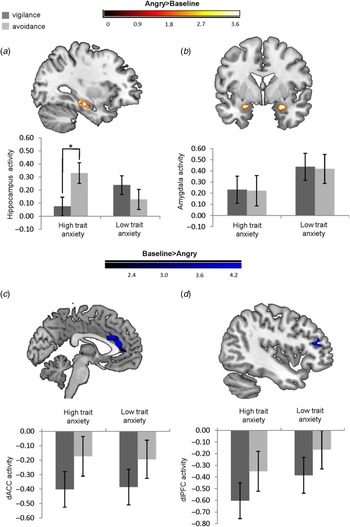
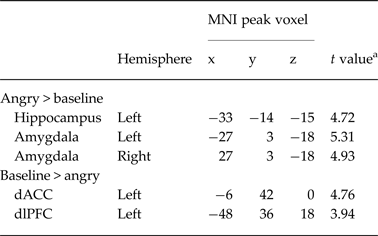
At the whole-group level we found increased activation to angry faces versus baseline in the left hippocampus (−33, −24, −15) and bilateral amygdala (−27, 3, −18; 27, 3, −18), along with decreased activation in the dorsal ACC (dACC; −6, 42, 0) and dlPFC (−45, −33, −15) (Table 1 and Fig. 2). For each of these regions, an ANOVA was performed with trait anxiety and bias group as between-subject factors. For hippocampal activity we found a significant two-way interaction among trait anxiety and bias group (F 1,51 = 5.41, p < 0.03) (Fig. 2a ). Post-hoc analysis revealed a significant difference in hippocampal activation between avoidant and vigilant participants in the high trait anxiety group (F 1,51 = 6.79, p < 0.05) but not in the low trait anxiety group (F 1,51 = 0.43, p = 0.29), with enhanced hippocampal activity in high anxious avoiders (mean = 0.34, s.e. = 0.08, n = 12) relative to high anxious vigilant individuals (mean = 0.07, s.e. = 0.07, n = 15). There were no main effects of trait anxiety (F 1,51 = 0.01, p = 0.80) and bias group (F 1,51 = 1.95, p = 0.33) on hippocampal activity. Similar analyses for the activations of the amygdala (right and left), ACC and dlPFC revealed no significant main effects or interactions (all F's < 2.7, p's > 0.11; Fig. 2b–d ). To confirm that the effect observed for the hippocampus is specific to threat (i.e. angry faces), we performed an equivalent analysis for hippocampal response to happy faces, in which no main effects or interactions were found (all F's < 1.4, p's > 0.25).
Regional activation maps in response to angry faces versus baseline (with an anatomical mask) and the corresponding region of interest (ROI) analysis with trait anxiety and bias group as between-group factors in the ANOVA. (a) Only the hippocampus showed significant interaction, indicating that high anxious individuals with avoidance bias had enhanced activity compared to high anxious vigilant individuals This interaction and all main effects were not obtained for (b) both the left and right amygdala, (c) the dorsal anterior cingulate cortex (dACC) and (d) the dorsolateral prefrontal cortex (dlPFC). *p < 0.05.

Regions showing significant difference between threat and baseline

dACC, Dorsal anterior cingulate cortex; dlPFC, dorsolateral prefrontal cortex; MNI Montreal Neurological Institute.
a Student's t given by statistical parametric mapping (SPM) output. Regions are represented by coordinates of the most significant voxel.
Typifying the functional relationship between hippocampal activity, threat bias and PTSD symptoms
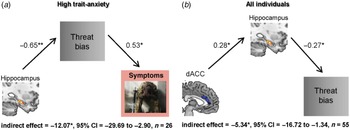
Our ANOVA results indicate that high anxious avoiders show enhanced hippocampal activity and report fewer PTSD symptoms compared with high anxious vigilant individuals. Importantly, this effect was absent in low trait anxious individuals. This raises two possibilities of functional relationships between threat bias, hippocampal activity and PTSD symptoms among high trait anxious individuals: (a) hippocampal activity has an effect on PTSD symptoms through attentional threat bias; and (b) threat bias has an effect on PTSD symptoms through engagement of the hippocampus. To test these options, we performed two separate mediation analyses (Preacher & Hayes, Reference Preacher and Hayes2008) among high trait anxiety individuals (n = 26). This analysis depicted a significant indirect path from hippocampal activity to PTSD symptoms through threat bias in high anxious individuals (indirect effect = −12.07, 95% CI −29.69 to −2.90; Fig. 3a ). Specifically, enhanced hippocampal activity led to fewer PTSD symptoms through attentional threat avoidance. The alternative indirect path in which threat bias could lead to decrease in PTSD symptoms through enhanced hippocampal activity was not significant (indirect effect = −0.02, 95% CI −0.98 to 0.05). Both indirect paths were not significant in low trait anxious individuals (threat bias indirect effect = 0.05, 95% CI −1.4 to 2.23; hippocampal activity indirect effect = −0.02, 95% CI −0.02 to 0.008).
Models of the relationship between brain activity, threat bias and post-traumatic stress disorder (PTSD) symptoms. (a) The illustrated mediation model for the group of high anxious individuals (n = 26) depicts a significant indirect path from hippocampal activity to PTSD symptoms through attentional threat bias. Specifically, enhanced hippocampal activity led to fewer PTSD symptoms through attentional threat bias of avoidance. (b) The illustrated mediation model for all participants (n = 55) depicts a significant indirect path from dorsal anterior cingulate cortex (dACC) activity to threat bias through hippocampal activity. Specifically, less deactivation of the dACC led to avoidance threat bias through increased hippocampal activity whereas more deactivation of the dACC led to vigilance through decreased hippocampal activity. β values are shown next to the arrows indicating each link in the analysis. This model was not significant using the dorsolateral prefrontal cortex (dlPFC). *p < 0.05, **p < 0.0005.

Testing for a regulatory role of the PFC in threat bias
To further elucidate the neural mechanism underlying threat bias, we examined whether the PFC has a regulatory role in the hippocampus by two additional mediation analyses that explicitly tested whether the relationship between activations in dACC or dlPFC and threat bias could be explained by values of activation in the hippocampus. As the response of these regions was unrelated to trait anxiety (Fig. 2c, d ), these analyses were performed on all participants (n = 55). We found a significant indirect path from the dACC to threat bias through the hippocampus (indirect effect = 5.34, 95% CI −16.72 to −1.34; Fig. 3b ), supporting the notion that the dACC acts on the hippocampus to influence threat bias. Conversely, the indirect effect of dlPFC through the hippocampus was not significant (indirect effect = 2.99, 95% CI −12.29 to 0.32).
Discussion
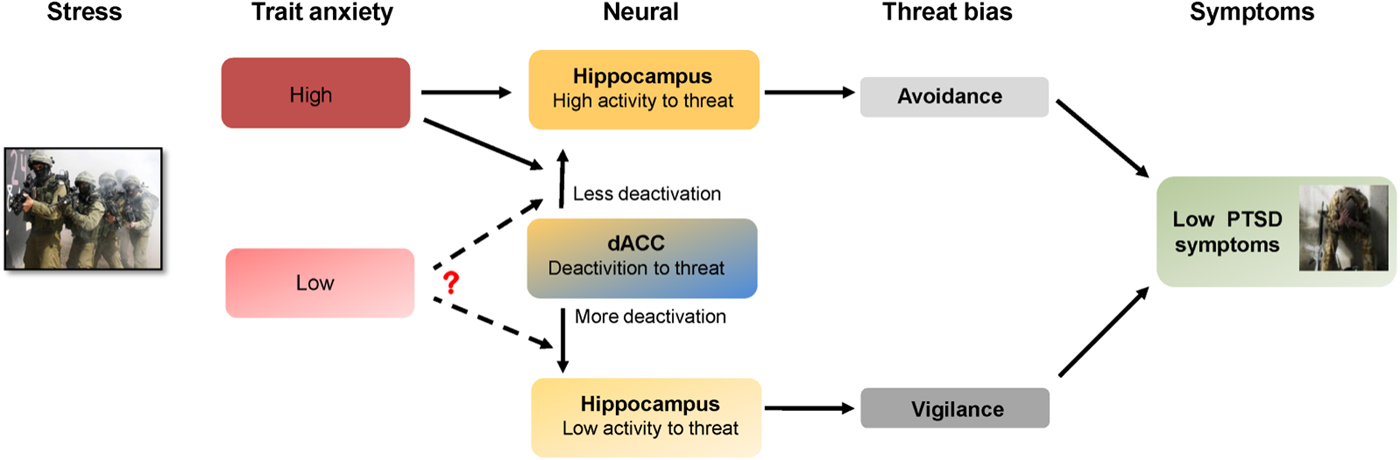
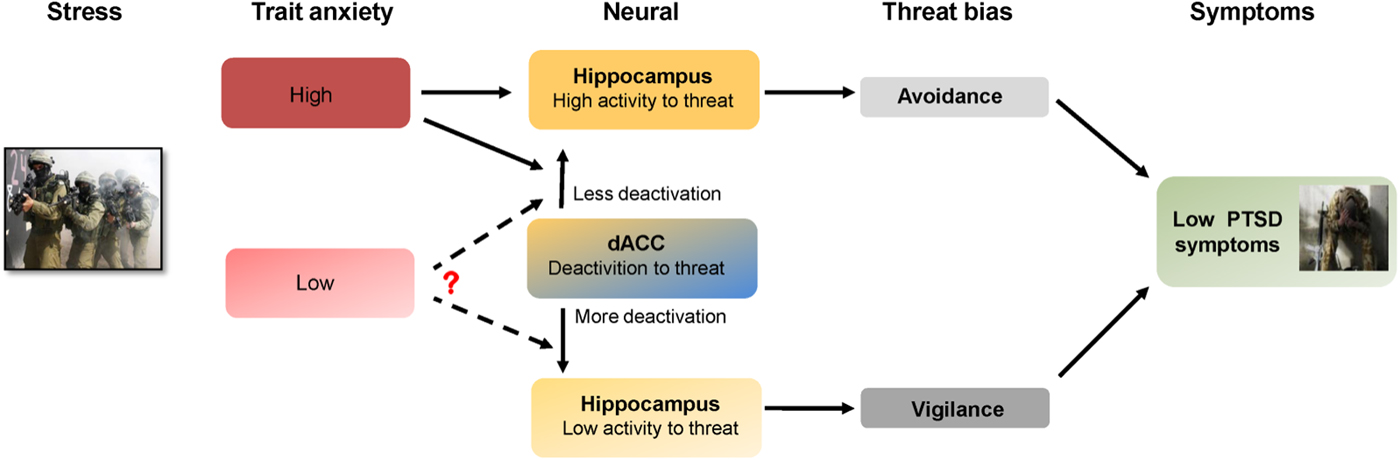
Using a population of soldiers undergoing intense and stressful military training, we were able to delineate the relationship between trait anxiety level, attentional threat bias tendency, brain activity in stress-related nodes and severity of PTSD symptoms. High trait anxious combat soldiers with attentional threat avoidance tendency exhibited enhanced hippocampal activity in response to threat cues in the DTP and fewer PTSD symptoms than high trait anxious individuals with a vigilance bias tendency. The functional relationship between these factors among high anxious individuals was depicted by mediation analysis, revealing that increased hippocampal activity led to lower levels of PTSD through the tendency of avoidance. Of note, the regulatory effect of the dACC on the hippocampus in determining threat bias tendency was revealed by a mediation analysis that was unrelated to trait anxiety level. Specifically, less deactivation in the dACC led to more hippocampal activity and greater avoidance threat bias. By considering trait anxiety level, threat bias and brain activity of major stress circuit nodes, our results provide, for the first time, a possible neurobehavioral model for PTSD symptom severity among individuals exposed to prolonged stressful life occurrence (see the proposed model in Fig. 4).
A neurobehavioral model accounting for resilience to post-traumatic stress disorder (PTSD) symptoms. The model postulates that, under stressful environments, personality factors of anxiety level determine the state-related bias of threat processing through hippocampal activity and its interplay with the dorsal anterior cingulate cortex (dACC), thus affecting the development of PTSD symptoms. Specifically, high anxious individuals with increased hippocampal activity to threat have fewer PTSD symptoms through an adaptive tendency of allocating attention away from threat stimuli (i.e. avoidance bias). The role of the dACC in modulating the effects of the hippocampus is also suggested. Avoidance is modulated by less deactivation of the dACC (that in turn leads to enhanced hippocampal activity) whereas vigilance is gained through more deactivation of the dACC, leading to reduced hippocampal activity. The broken arrows represent the speculation that, in low anxious individuals, the tendency to allocate attention towards and also away from threat is adaptive, despite being modulated by either high or low hippocampal activity through interplay of the hippocampus with the dACC.
Our results demonstrate that vigilance compared to avoidance tendency was associated with more severe PTSD symptoms among high anxious but not low anxious individuals. This effect seems to be specific to PTSD-related symptoms, and was not found for depression symptoms (Fig. 1b ). These findings shed light on how factors known to contribute to stress-related symptoms interact with each other. Importantly, our results demonstrate the presence of the two threat bias tendencies in individuals with low trait anxiety and in those with high trait anxiety. This suggests that under challenging stressful circumstances, such as intense military training, attentional threat biases may assist all individuals to cope with stress and provide protection from the development of psychopathology. Nevertheless, the finding that trait anxiety interacts with threat bias to affect PTSD symptom severity suggests that, in low anxious individuals, both threat biases may be sufficient for adaptive coping with prolonged stress. In high anxious individuals, however, excessive allocation of attention towards threat may have maladaptive consequences of increased PTSD symptoms, whereas attention away from threat may have a protective effect. Notably, this notion is consistent with a previous prospective study showing that before combat deployment, soldiers who show threat vigilance are at greater risk for PTSD measured 1 year later during combat deployment (Wald et al. Reference Wald, Degnan, Gorodetsky, Charney, Fox, Fruchter, Goldman, Lubin, Pine and Bar-Haim2013).
Our brain imaging results suggest that the hippocampus plays a role in trauma-related psychopathology and is also relevant to attentional threat bias tendency. This supports the hypothesis that the hippocampus is important for adaptive coping with chronic and potentially traumatic stress. This assertion corresponds with a recent study showing attenuated response of the hippocampus during the DPT in clinically anxious youth (Price et al. Reference Price, Siegle, Silk, Ladouceur, McFarland, Dahl and Ryan2014). Notably, in our study the relationship between the hippocampus, threat bias and PTSD symptoms was revealed in a military population with low levels of anxiety and only minor (subclinical) PTSD symptoms. Although caution is required in interpreting the current results, we tentatively suggest a protective role for increased hippocampal activity in response to threat stimuli, possibly through induction of an avoidance attention bias. As the hippocampus has been shown to control behavioral inhibition by contextual threat monitoring and evaluation (Bach et al. Reference Bach, Guitart-Masip, Packard, Miró, Falip, Fuentemilla and Dolan2014), it is possible that, during the DPT, the hippocampus encodes and evaluates the context as threatening, and when it is highly activated an inhibitory behavior such as threat avoidance bias can be achieved. The relationship between the hippocampus and PTSD symptoms is supported by prospective imaging studies indicating more PTSD symptoms following potentially traumatic military exposure among soldiers with reduced hippocampal volume and with greater changes in hippocampal activity and connectivity (Admon et al. Reference Admon, Lubin, Stern, Rosenberg, Sela, Ben-Ami and Hendler2009, Reference Admon, Leykin, Lubin, Engert, Andrews, Pruessner and Hendler2013a , b). Furthermore, hippocampal activity during the DPT has been associated with risk for stress-related psychiatric disorders such as PTSD (Fani et al. Reference Fani, Gutman, Tone, Almli, Mercer, Davis, Glover, Jovanovic, Bradley, Dinov, Zamanyan, Toga, Binder and Ressler2013). In sum, these findings indicate that accounting for trait and state elements is important for elucidating the relationship between hippocampal activity and stress-related symptoms, but further prospective studies are required to disentangle the role of the hippocampus in threat-related attention bias and in PTSD symptom development.
As perturbed activation patterns in the amygdala is a common finding in dot-probe imaging studies of anxious individuals (Monk et al. Reference Monk, Nelson, McClure, Mogg, Bradley, Leibenluft, Blair, Chen, Charney, Ernst and Pine2006; Telzer et al. Reference Telzer, Mogg, Bradley, Mai, Ernst, Pine and Monk2008), it is surprising that we did not find that the DPT differentiated between trait anxiety and threat bias groups. Prior studies, however, have focused on between-group comparisons that categorized participants based on their clinical profiles rather than task performance (i.e. threat bias). Hence, the previously observed differences in the DPT may possibly represent basic functional abnormalities in anxiety that are unrelated to threat bias, such as hyper-responsivity of the amygdala to emotional stimuli per se.
Unexpectedly, the PFC nodes revealed in response to threat stimuli (i.e. dACC and dlPFC) did not differentiate between the groups as defined by the interaction between trait anxiety and threat bias. However, considering their crucial roles in regulating limbic function, we further investigated their interplay by mediation analyses across all individuals. We found that regardless of individual levels of trait anxiety, less deactivation of the dACC led to enhanced hippocampal activity and hence to avoidance tendency on the DPT (Fig. 3b ). Although not directly demonstrated here, this result may suggest that the interplay between the hippocampus and the dACC may also affect the psychopathology (see a summary model scheme in Fig. 4). Although our results may be sufficient to tentatively propose this model, verifying it requires further research on a more severe pathological population with a larger variance in anxiety and PTSD symptoms.
Considering the role of the dACC in emotion regulation (Etkin et al. Reference Etkin, Egner and Kalisch2011), the current results may indicate that efficient implicit emotion regulation involves the hippocampus and attains avoidance tendency, thus plausibly providing protection from traumatic stress vulnerability. The fact that this model was obtained for all individuals suggests that the interplay between the hippocampus and the dACC is important in determining the direction of threat bias regardless of trait anxiety. However, it is important to note that, among individuals with high trait anxiety, enhanced hippocampal activity may be sufficient to induce processing of threat stimuli through avoidance threat bias and hence provide protection from the development of PTSD symptoms (Fig. 4). Although the dACC has been implicated in cognitive control processes including conflict monitoring (Kerns et al. Reference Kerns, Cohen, MacDonald, Cho, Stenger and Carter2004; Egner & Hirsch, Reference Egner and Hirsch2005), in our analysis this region showed deactivation in response to threat stimuli of angry faces in the context of the attention conflict task. This is consistent with previous reports regarding deactivation of the dACC in response to affective faces (Duval et al. Reference Duval, Hale, Liberzon, Lepping, Powell, Filion and Savage2013). Notably, dACC deactivation during negative affect has been previously interpreted as interference of emotional states with cognitive processing, resulting in a failure to cognitively control and regulate emotional behavior (Sterzer et al. Reference Sterzer, Stadler, Krebs, Kleinschmidt and Poustka2005). In line with these findings, more deactivation of the dACC, which may lead to vigilance, might reflect an impaired ability to control and regulate the response to threat in a priori susceptible individuals with high trait anxiety, thereby leading to a heightened propensity for anxiety symptoms. Low anxious individuals with vigilance tendency, by contrast, may have alternative strategies for counteracting the attenuated dACC activity and the disposition to anxiety, making them more resilient to PTSD. This speculation is possible in light of the greater number of PTSD symptoms among high anxious vigilant individuals compared to low anxious vigilant individuals (Fig. 1b ). However, further study is necessary to test this hypothesis directly and understand the alternative mechanisms that enable low anxious vigilant individuals to counteract the attenuated dACC activity.
In contrast to our expectations, the dlPFC, a major node in attention allocation, did not play a regulatory role in controlling the association between the hippocampus and threat bias. The dlPFC, however, is thought to be involved in other aspects of cognitive processing during the DPT (Telzer et al. Reference Telzer, Mogg, Bradley, Mai, Ernst, Pine and Monk2008) beyond attentional bias, such as maintaining task-specific information about rules and goals (MacDonald et al. Reference MacDonald, Cohen, Stenger and Carter2000), which may be less associated with the hippocampus and threat bias relationships.
Our results have several clinical implications. As concluded in a recent PTSD review (Shvil et al. Reference Shvil, Rusch, Sullivan and Neria2013), understanding how different behavioral and neural PTSD markers influence each other may assist in establishing an objective gold standard biomarker for PTSD. Indeed, these results point to the importance of considering state-related processing tendencies such as threat bias, in addition to trait manifestations of anxiety, when investigating stress- and trauma-related brain markers. Furthermore, the results of the current study suggest that, when using attention bias modification (ABM) training, it may be useful to consider neurobehavioral markers of treatment efficacy such as the a priori trait anxiety level, threat bias and the hippocampus–dACC interplay pattern. Finally, the identified neural mechanism informs the development of novel individually tailored treatments targeting the interplay between the dACC and the hippocampus. Thus, high anxious individuals with vigilance bias could undergo ABM or alternatively could be trained to directly up-regulate their hippocampal response to threat cues by neurofeedback procedures. Conversely, we could speculate that low anxious individuals should not alter their attentional bias, but instead might need to learn how to switch from one strategy to another, depending on the context. As attentional bias could be regarded as an emotion regulation process (Todd et al. Reference Todd, Cunningham, Anderson and Thompson2012), this notion is supported by recent research proposing that the adaptiveness of emotion regulation strategies depends on the context in which they are used (Troy et al. Reference Troy, Shallcross and Mauss2013).
Although conducting this study on a particular population of healthy combat soldiers has helped to gain an insight into PTSD resilience, to fully validate this emerging model future studies should examine these ideas in other populations. As our study was conducted on a highly selective population that underwent extensive mental and physical screenings by the IDF to verify they were competent to serve in a combat elite unit, generalizing the resilience mechanisms to other populations requires further studies. Specifically, some of the participants were characterized with a small threat bias, thus it would be important to test these effects among individuals with extreme biases in studies using a larger sample size of healthy subjects or populations prone to show exaggerated biases. Similarly, our sample consisted of individuals with only moderate levels of trait anxiety, and should also be tested in truly high anxious populations including healthy individuals with high trait anxiety scores and clinical populations. This should be tested first in PTSD patients and subsequently in other anxiety-related disorders. It is reasonable to assume that, for each type of anxiety disorder, an analogous yet different model will be identified, based on the core brain regions implicated in that specific pathology. Additionally, the current study focused on military training stress; thus further studies are required to extend these findings to other types of stressors including actual combat exposure. Finally, the lack of a systematic trauma history assessment raises the possibility that the PTSD symptoms reported in the current study reflect not only military training stress exposure effects but also prior traumatic events that have not been fully documented. As prior trauma history has been associated with altered psychophysiological responses to subsequent trauma (Delahanty & Nugent, Reference Delahanty and Nugent2006), testing the proposed model in prospective studies that assess PTSD symptoms prior to and after military training may resolve this issue.
In conclusion, the present study depicts a neurobehavioral mechanism by which the hippocampus and the dACC modulate attentional threat bias to influence PTSD symptom severity. This work combines previous behavioral and neural findings into a single broad model. Although mediation analyses should be interpreted with caution, this study provides empirical support to the widespread notion that threat bias may contribute causally to the development and maintenance of pathological response to stress (MacLeod et al. Reference MacLeod, Mathews and Tata1986; Mogg et al. Reference Mogg, Bradley, Williams and Mathews1993; Kaspi et al. Reference Kaspi, McNally and Amir1995). Furthermore, our results advocate that future research aimed at identifying PTSD-related brain markers should take into account individual differences in trait anxiety level and threat bias tendencies.
Acknowledgments
This work was supported by a grant from the U.S. Department of Defense, award number W81XWH-11-2-0008. We thank G. Gilam for assistance with the mediation analysis.
Declaration of Interest
None.