Introduction
Emergent bilinguals (EBs) learn a societal language at school but use another language at home (García & Kleifgen, Reference García and Kleifgen2018). The number of EBs enrolled in public schools in North America has increased dramatically since 2001 (Solari et al., Reference Solari, Petscher and Folsom2012). In 2020, it was reported that there were about 5 million children in U.S. public schools learning English as a second language (National Center for Education Statistics, 2022). Moreover, Canada was reported to have 1 million public school EBs (about 20% of their total population of K-12 public school students) (Statistics Canada, 2021). The rapid increase of EBs in North America calls for an increase in attention to quality instructions for EBs and interventions for those who are at risk.
EBs have been reported to have lower academic achievement in reading than their monolingual peers in North America (Soland, Reference Soland2019). It is expected that EBs who are still developing their English proficiency may experience difficulties (Li et al., Reference Li, Geva, D’Angelo, Koh, Chen-Bumgardner and Gottardo2021). According to Li et al. (Reference Li, Geva, D’Angelo, Koh, Chen-Bumgardner and Gottardo2021), EBs scored lower than their monolingual peers on vocabulary, listening comprehension, and morphological awareness due to limited exposure to English. Studies have shown that there is a disproportionate number of EBs who experience reading difficulties, with the gap in reading performance between EBs and monolingual students increasing across age groups (Swanson et al., Reference Swanson, Kudo and Guzman-Orth2016). Without proper support, EBs who are at risk for reading disabilities are likely to show persistent difficulties in reading (Hamayan et al., Reference Hamayan, Marler, Sanchez-Lopez and Damico2022). On the other hand, research has also shown that, if given explicit and systematic instruction, at-risk EBs can learn foundational reading skills such as phonological awareness, letter knowledge, and grapheme-phoneme correspondence rule at the same pace as at-risk native English-speaking students (Baker et al., Reference Baker, Burns, Kame’enui, Smolkowski and Baker2016; Snow et al., Reference Snow, Burns and Griffin1998; Vaughn et al., Reference Vaughn, Linan-Thompson, Mathes, Cirino, Carlson, Pollard-Durodola, Cardenas-Hagan and Francis2006). Thus, it is important to understand how to foster these foundational reading skills through quality interventions.
Phonological awareness, which is the ability to manipulate and reflect upon the sound units of one’s language, has been shown to be a significant and powerful predictor of reading ability (Foorman et al., Reference Foorman, Francis, Fletcher, Schatschneider and Mehta1998; Melby-Lervåg et al., Reference Melby-Lervåg, Lyster and Hulme2012; Vellutino et al., Reference Vellutino, Scanlon, Jaccard and Foorman2003). Recent research has demonstrated that lexical specificity, which refers to the ability to build phonologically specific lexical entries on minimal phonological differences, is the foundation of phonological awareness in both monolingual and bilingual children (e.g., Krenca et al., Reference Krenca, Gottardo, Geva and Chen2020a, Reference Krenca, Segers, Chen, Shakory, Steele and Verhoeven2020b; Janssen et al., Reference Janssen, Segers, McQueen and Verhoeven2015, Reference Janssen, Segers, McQueen and Verhoeven2017; van Goch et al. Reference van Goch, McQueen and Verhoeven2014). Those who have difficulties in phonological awareness may have underspecified phonemic representations (Krenca et al., Reference Krenca, Gottardo, Geva and Chen2020a). According to the lexical restructuring hypothesis (Metsala & Walley, Reference Metsala, Walley, Metsala and Ehri1998), as children’s vocabulary increases, they are better able to distinguish words based on subtle phoneme differences. The ability to distinguish phonemes has been shown to be crucial for word reading (Wang & Geva, Reference Wang and Geva2003). Poor phoneme discrimination can hamper the formation of high-quality phonological representations and hinder children from acquiring words that differ from one another on a single and similar phoneme, for example, lumber and number (Hulme & Snowling, Reference Hulme and Snowling2009). Because EBs may need to learn to distinguish phonemes that are not differentiated in their first languages, those who are at risk for reading difficulties may find it particularly difficult to acquire these new phonemic contrasts. Despite this, to our knowledge there have been no studies testing whether supporting EBs’ lexical specificity can improve their reading performance and shift learners out of the at-risk category. This study was designed to evaluate the potential benefits of an intensive lexical specificity intervention for at-risk EB children.
Effective interventions for emergent bilinguals
In order to ensure that at-risk EBs are appropriately supported, it is imperative that effective, validated, and high-quality interventions be in place. An abundance of research has provided evidence for the positive effects of early reading intervention on students’ academic growth and success, especially when those interventions focus primarily on phonological awareness (Fuchs & Fuchs, Reference Fuchs and Fuchs2007). These types of intervention programs have been proven to improve single-word reading skills and produce long-term benefits (Katzir et al., Reference Katzir, Goldberg, Ben Aryeh, Donnelley and Wolf2013). Difficulties in phonological awareness have been associated with reading disabilities (Wagner et al., Reference Wagner, Zirps, Wood, Snowling, Hulme and Cain2022), and interventions focused on phoneme awareness improve reading outcomes. For example, a 20-minute per day 1-1 intervention in phoneme awareness, letter recognition, and word reading boosted poor readers’ scores to the average range in one semester (Vellutino et al., Reference Vellutino, Scanlon, Jaccard and Foorman2003). Similarly, Mathes et al. (Reference Mathes, Denton, Fletcher, Anthony, Francis and Schatschneider2005) found that at-risk children were able to attain reading levels within the average range by the end of 1st grade after receiving high-quality and high-intensity phonological awareness interventions.
While there is a breadth of research on monolingual students’ early reading interventions, there are only a few studies that have examined the effects of interventions to improve early reading skills in bilingual students, perhaps because such students are not expected to attain grade level performance before achieving oral proficiency in English. Since EBs, the “fastest-growing student subgroup” in the U.S. (Brandes & McMaster, Reference Brandes and McMaster2017), show the same relationship between phonological awareness and accurate word reading skills as monolinguals (Geva & Massey-Garrison, Reference Geva and Massey-Garrison2013), they also benefit from explicit phonological awareness instruction and intervention. For example, an intervention that emphasized phonological awareness and letter-sound knowledge generated similar levels of growth among struggling monolingual students and EBs in Toronto (Lovett et al., Reference Lovett, De Palma, Frijters, Steinbach, Temple, Benson and Lacerenza2008).
Research has shown that phonological awareness interventions that provide extra support in distinguishing phonemes are especially effective for bilingual students (Golloher et al., Reference Golloher, Whitenack, Simpson and Sacco2018). In order to acquire phonological awareness and print decoding, children must be able to identify and differentiate phonemes. According to van Goch et al. (Reference van Goch, McQueen and Verhoeven2014), “…decoding skill is a perceptual skill, whereas phonological awareness is a metalinguistic skill” (p.156). Thus, phonemic discrimination in the target language is a necessary precursor to relying on phonological awareness in that language in learning phoneme-grapheme mappings. This is where lexical specificity comes into play: The ability to distinguish between similar phonemes allows children to recognize words that vary in only one phonetic feature and become cognizant of their distinct meanings.
Lexical specificity intervention
Lexical specificity refers to representation of fine phonological distinctions between items in the emerging mental lexicon (Krenca et al., Reference Krenca, Gottardo, Geva and Chen2020a, Reference Krenca, Segers, Chen, Shakory, Steele and Verhoeven2020b; Janssen et al., Reference Janssen, Segers, McQueen and Verhoeven2015, Reference Janssen, Segers, McQueen and Verhoeven2017; van Goch et al. Reference van Goch, McQueen and Verhoeven2014). It involves building phonologically specific lexical entries in the mental lexicon and differentiating between words based on minimal phonological differences. It is a foundation of phonological awareness in preliterate children because the contrast between two words that differ in only one phoneme highlights the existence and analyzability of those two phonemes. It progresses over time and is driven by an increase in vocabulary (van Goch et al., Reference van Goch, McQueen and Verhoeven2014). As children acquire larger lexicons and thus have access to greater lexical specificity, they learn to make the contrasts crucial for differentiating words with similar phonological profiles. As students’ vocabulary increases, so do the odds that they encounter minimal pairs – pairs of words that only differ in one phoneme. Minimal pairs require students to recognize, for example, that “pen” and “pan” are distinct words that have different meanings, though the two vowels that distinguish them might fall within a single phoneme category in some languages. A major advantage of teaching lexical specificity is that it is a route to many undeveloped reading skills such as phonological awareness in the early stages of reading because the development of phonemic segments that lexical specificity triggers contributes to phonological awareness and affects how phonological representations are stored and structured (Fowler, Reference Fowler, Brady and Shankweiler1991; Goswami, Reference Goswami, Kamil, Mosenthal, Pearson and Barr2000).
Words vary across languages, making it vital that bilingual students have an understanding of different lexical forms and representations (Swingley & Aslin, Reference Swingley and Aslin2000). Based on the lexical restructuring hypothesis (Metsala & Walley, Reference Metsala, Walley, Metsala and Ehri1998), the more a child’s vocabulary expands, the more they are able to differentiate between phonologically similar words because vocabulary stimulates the development of phonological awareness. With young children’s limited vocabulary, phonological representations are holistic, and distinguishing lexical items based on minimal phonological differences is not necessary. For example, young EBs can easily distinguish “bear” from “dog” because of obvious phonetic distinct features between the two words. However, as an EB’s vocabulary grows, he or she encounters words that differ on fewer phonemes, for example, “bear” and “pear.” The ability to distinguish fine-grained sound contrasts between minimal pairs can be more challenging, especially if the phonemic boundaries in the EB’s L1 are distinct from English (Fennell et al., Reference Fennell, Tsui, Hudon, Nicoladis and Montanari2016) or the EB has reading difficulties (Brown, Reference Brown2000).
Previous research has demonstrated a clear relation between training to enhance lexical specificity and successful reading (e.g., Janssen et al., Reference Janssen, Segers, McQueen and Verhoeven2015, Reference Janssen, Segers, McQueen and Verhoeven2017; van Goch et al. Reference van Goch, McQueen and Verhoeven2014). Lexical specificity training focuses on fine details of speech sounds, differentiation between similar sounding words that differ by one phoneme, and creation of specific entries for each word in the mental lexicon. An intervention study training lexical specificity was conducted by van Goch et al. (Reference van Goch, McQueen and Verhoeven2014). In the lexical specificity intervention, minimal pairs of new monosyllabic Dutch words in pictures were taught to Dutch-speaking kindergarten children. The researchers found that lexical specificity enhanced children’s phonological awareness through its beneficial effects on rhyme awareness. Since rhyme awareness is one of the earliest forms of phonological awareness that children can develop, targeting rhyming as a route to phonological awareness is developmentally appropriate. This may represent the mechanism by which lexical specificity intervention indirectly facilitates children’s early literacy skills (van Goch et al., Reference van Goch, McQueen and Verhoeven2014). In a subsequent study, Janssen et al. (Reference Janssen, Segers, McQueen and Verhoeven2015) designed a lexical specificity intervention that taught new Dutch words with minimal acoustic-phonetic differences to Dutch monolingual and Turkish-Dutch bilingual kindergarten children. The lexical specificity intervention was delivered in Dutch to all children. Both monolingual and bilingual children improved on Dutch phoneme blending, a phonological awareness task that is a precursor to word reading in Dutch. A recent study conducted by Janssen et al. (Reference Janssen, Segers, McQueen and Verhoeven2017) showed that L2 lexical specificity intervention predicted L1 phonological awareness, which in turn predicted L2 phonological awareness, indicating cross-linguistic transfer. It is worth noting that the lexical specificity intervention incorporated training on both phoneme discrimination and vocabulary because the minimal pairs were presented in pictures. Filippini et al. (Reference Filippini, Gerber and Leafstedt2012) studied the effects of an intervention program on combined phonological awareness and vocabulary among first-grade Spanish-speaking EBs who were at-risk readers. Their findings indicated that the students who received a vocabulary plus phonological awareness intervention outperformed the students who received only the phonological awareness intervention. The findings highlight the importance of focusing on vocabulary as well as phonological processing with EBs. Brandes and McMaster (Reference Brandes and McMaster2017) echo these findings by emphasizing that vocabulary knowledge is a significant component of EBs’ literacy development and vocabulary should be considered in the phonological training to achieve the maximum benefits.
Krenca et al. (Reference Krenca, Segers, Chen, Shakory, Steele and Verhoeven2020b) investigated the effects of lexical specificity in both English and French in grade 1 French immersion children in Canada. In their study, lexical specificity intervention programs were designed and delivered in both languages (English and French) to bilingual participants. They found that lexical specificity in English (L1) at the beginning of grade 1 predicted both English (L1) and French (L2) word reading at the end of grade 1 and both relations were mediated by English (L1) phonological awareness. Therefore, training in lexical specificity that targets minimal phonological contrasts could improve phonological awareness. Research has also shown that bilingual children’s exposure to two oral language systems may promote their phonological awareness, an effect Verhoeven (Reference Verhoeven2007) attributes to their “experience with two language systems and the frequent attention to the phonotactic aspects of language” (p. 427). When studying the relationship between early language proficiency and phonological awareness in Turkish-Dutch bilingual kindergarten students, Verhoeven (Reference Verhoeven2007) found that students with high levels of L1 and L2 proficiency scored high on phonological awareness tests in general, and more specifically on tests of phonemic awareness. Although research has shown a cross-linguistic relationship between L1 and L2 phonological awareness, studies have also shown that phonological awareness tends to be most at risk for EBs because of differences in the phonetic features of the respective languages (Le Roux et al., Reference Le Roux, Geertsema, Jordaan and Prinsloo2017). Difficulties may arise as EBs develop awareness of a more limited set of phonological contrasts in their home language than the second language requires (Gersten & Geva, Reference Gersten and Geva2003). Under these circumstances, L2 lexical specificity interventions for young EBs may reduce difficulties in learning to read.
Lexical specificity is also considered as an assessment for identifying at-risk bilingual students. Krenca et al. (Reference Krenca, Gottardo, Geva and Chen2020a) conducted a study on 1st-grade English (L1) – French (L2) bilingual students to determine if a dynamic test of lexical specificity helped to identify at-risk students. They found that a dynamic measure of English lexical specificity, which is a precursor of phonological awareness, improves the prediction of French at-risk status over and above phonological awareness. Thus, lexical specificity could be assessed early on for bilingual learners, potentially improving identification and in turn eligibility for early intervention for at-risk bilinguals.
The present study
Discriminating minimal L2 contrasts not differentiated in the L1 is required for L2 vocabulary learning (Llompart & Reinisch, Reference Llompart and Reinisch2020), for example, discriminating /i:/ and /ɪ/ as in heat and hit for Spanish speakers learning English. Building phonologically specific lexical entries fosters reading acquisition in both L1 and L2 due to the impact on phonological awareness (Krenca et al., Reference Krenca, Gottardo, Geva and Chen2020a, Reference Krenca, Segers, Chen, Shakory, Steele and Verhoeven2020b). Lexical specificity training has been shown to improve Turkish–Dutch and English–French bilingual students’ phonological awareness. Research is needed to examine whether a lexical specificity intervention would also support English L2 phonological awareness and literacy acquisition for young at-risk EBs because this group of students may find it more challenging to differentiate between similar sounds due to limited exposure to English and their at-risk status. In fact, previous studies have demonstrated that deficits in the specificity of phonological representations (i.e., lexical specificity) predict phonological awareness and reading disabilities in children (Elbro et al., Reference Elbro, Borstrøm and Petersen1998; Elbro & Jensen, Reference Elbro and Jensen2005). Phonological processing difficulties in dyslexia are caused by lack of distinctness of phonological representations (Goswami, Reference Goswami, Kamil, Mosenthal, Pearson and Barr2000). Therefore, the purpose of this study was to design a brief lexical specificity intervention program focusing on the ability to discriminate similar phonemes and examine its effectiveness among at-risk EBs who are learning English as a second language. It was designed to determine whether training on lexical specificity would improve at-risk EBs’ phoneme discrimination, reading, and reading-related skills, such as phonological awareness, word reading fluency, rapid automatized naming, and decoding, which have been observed in bilingual children in other studies (e.g., Janssen et al., Reference Janssen, Segers, McQueen and Verhoeven2015; van Goch et al., Reference van Goch, McQueen and Verhoeven2014). These measures have been chosen because evidence has shown that low performance on them strongly predicts reading disabilities (see Catts et al., Reference Catts, Petscher, Schatschneider, Bridges and Mendoza2009). Because reading achievement at grade 1 is primarily influenced by word reading abilities, the outcome assessments focus on word reading accuracy and fluency. A computerized lexical specificity intervention (see method section for details) was designed to teach at-risk EBs specific English sound contrasts through the use of minimal pairs. Trainings on minimal pairs were provided and followed by testing to examine whether learning during training has been transferred to testing during the lexical specificity intervention.
Below are the research questions in the study.
-
1. Do EBs who are at risk for reading disabilities show improvement in performance on phoneme discrimination, reading, and reading-related skills, following a three-week lexical specificity intervention, compared to controls?
-
2. Are there any improvements in the at-risk EBs’ performance on lexical specificity across training and testing during the intervention?
Because research has demonstrated that building phonologically specific lexical entries enhances reading acquisition by its impact on phonological awareness for bilingual children (Krenca et al., Reference Krenca, Gottardo, Geva and Chen2020a, Reference Krenca, Segers, Chen, Shakory, Steele and Verhoeven2020b; Janssen et al., Reference Janssen, Segers, McQueen and Verhoeven2015), we hypothesize that at-risk EBs would show improvement on phoneme discrimination, reading, and reading-related skills after they receive lexical specificity intervention, compared to at-risk EBs without receiving the intervention. With specific training on minimal pairs that target similar but distinct phonemes for a few weeks, we hypothesize that training leads to improved performance and transfer to testing for at-risk EBs.
Method
Participants
Participants were 127 grade 1 culturally and linguistically diverse EBs (67 boys and 60 girls) from seven public schools with a high concentration of EBs in Toronto, Canada. The mean age of EBs was 80.26 months, SD = 6.93. According to the demographic data obtained, the participating schools were located in neighborhoods of low to middle socioeconomic status (Statistics Canada, 2016). Participants spoke a variety of home languages including Albanian, Arabic, Azerbaijani, Bengali, Chinese, Dari, Farsi, French, Greek, Gujarati, Hindi, Ilocano, Japanese, Korean, Hebrew, Malaysian, Pashto, Persian, Portuguese, Russian, Saraiki, Telugu, Turkish, Slovakian, and Urdu. Eighty percent of participants were born in Canada. All participants started exposure to formal English in junior kindergarten when they were four years old. Participants with significant cognitive delays, behavioral problems, emotional/psychiatric disturbances, chronic neurologic conditions, and documented vision or hearing impairment were excluded. Parent consent forms and child assent were collected before participation.
At the end of the fall semester of grade 1, classroom teachers nominated EBs for participation in the study. The EBs identified by their teachers as having difficulty acquiring reading skills were considered at-risk EBs and the others were considered typically developing controls (TD). All children were administered screening measures consisting of decoding (Word Identification and Word Attack; Woodcock et al., Reference Woodcock, McGrew and Mather2001) and phonological awareness (Comprehensive Test of Phonological Processing-CTOPP Deletion; Wagner et al., Reference Wagner, Torgesen and Rashotte1999). EBs at risk for reading disabilities were selected on the basis of low performance in English decoding and phonological awareness. These screening measures have been chosen because evidence has shown that low performance on them strongly predicts reading disabilities (see Catts et al., Reference Catts, Petscher, Schatschneider, Bridges and Mendoza2009). It is widely accepted that a cutoff of the 25th percentile on the screening measures be used to identify those who are at risk (e.g., Catts et al., Reference Catts, Nielsen, Bridges, Liu and Bontempo2015; Geva & Massey-Garrison., Reference Geva and Massey-Garrison2013). EBs who scored below the 25th percentile on the screening measures of decoding and phonological awareness were selected and randomly assigned to one of two conditions: (1) at-risk intervention condition (at-risk I) or (2) at-risk control condition (at-risk C). A group of typically developing EBs who did not meet the risk criteria were selected as (3) typically developing controls (TD). There were 40 EBs in the at-risk intervention group, 36 EBs in the at-risk control group, and 51 EBs in the typical control group. The computerized lexical specificity program, which included minimal pair training, was delivered to the EB at-risk intervention group during the spring semester. The EB at-risk control group received the intervention after the study was completed.
Intervention
Lexical specificity intervention
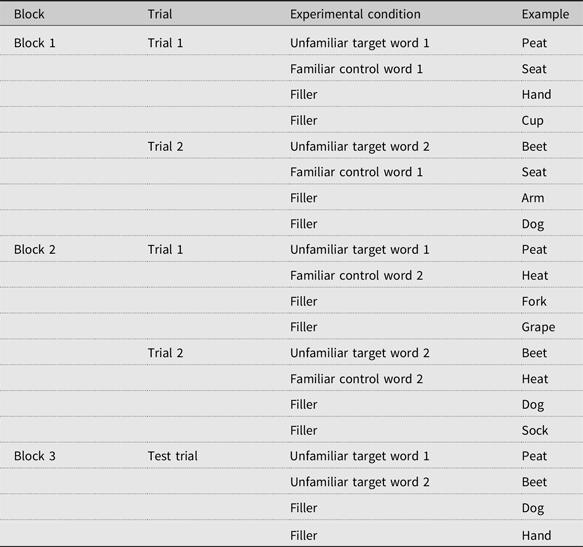
The lexical specificity intervention program, adapted from Janssen et al. (Reference Janssen, Segers, McQueen and Verhoeven2015) and Krenca et al (Reference Krenca, Gottardo, Geva and Chen2020a, Reference Krenca, Segers, Chen, Shakory, Steele and Verhoeven2020b), was used to train children to discriminate between pairs of words that were phonologically minimally different. The protocol consisted of 20 phonemic contrasts including 12 consonant contrasts (/p/-/b/, /f/-/v/, /θ/-/ð/, /f/-/θ/, /θ/-/s/, /ð/-/z/, /s/-/ʃ/, /m/-/n/, /ʃ/-/tʃ/, /l/-/ɹ/, /v/-/w/, /l/-/n/) and 8 vowel contrasts (/ʌ/-/ɑ/, /ɪ/-/i/, /æ/-/ε/, /ɑ/-/u/, /o/-/u/, /e/-/i/, /æ/-/ɪ/, /ʊ/-/u/). Each phonemic contrast was presented in a minimal pair with each minimal pair having two unfamiliar target words that differ in one phonetic feature (e.g., /p/ - /b/ in peat vs. beet). The varying phonetic features included manner of articulation, place of articulation, and voicing. The lexical specificity intervention had a training phase and a testing phase. Before the training phase, there was a practice period that consisted of three trials to get the children familiar with the task. The training phase consisted of two blocks of 20 sets with two trials (Trial 1 and Trial 2) per set, each of which presented one of the target words from the minimal pair as part of a quadruplet composed of target word 1 or 2, a familiar control word, and two fillers with corresponding pictures. The control word, which was highly frequent and familiar to EBs, differed in two phonetic features from the target word. The two fillers were high-frequency words which were highly familiar to EBs. All words were monosyllabic words which were taken from the MRC Psycholinguistic Database based on frequency and structural complexity (Wilson, Reference Wilson1988). The familiarity of words was rated by the grade 1 teachers on a 5-point scale from (1) highly unfamiliar to (5) highly familiar to grade 1 EBs as well as at-risk and typical students. The target and control words included nouns, adjectives, and verbs but the majority were easily picturable nouns. All fillers were monosyllabic concrete nouns which are familiar to children aged one to four. Block 2 presented the same pattern as Block 1 but with a new familiar control word. The testing phase consisted of one block (Block 3) of 20 one-trial sets in which the two target words were presented together. No familiar control word was presented in this block. See Table 1 for the design and examples. In each block, the quadruplets were presented in a randomized order.
Design of one set of trials in the lexical specificity intervention, with item examples

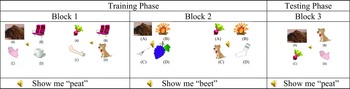
For example, the minimal pair was /p/ - /b/ and the two target words were “peat” and “beet.” In Block 1 of the Training phase, Trial 1 included A. peat, B. seat, C. hand, D. cup, and Trial 2 included A. beet, B. seat, C. arm, D. dog; in Block 2, Trial 1 included A. peat, B. heat, C. mouse, D. grape, and Trial 2 included A. beet, B. heat, C. dog, D. sock. In the testing phase (Block 3), the two target words were presented in the same trial together with two fillers: A. peat, B. dog, C. beet, D. hand. An example of a trial sequence from the two training blocks to the testing block is shown in Figure 1.
Sample Trials from the Training Phase to the Testing Phase.

All the words were pictured on a computer screen. On each trial, the child was asked to click anywhere in the picture after hearing, “Show me [target word].” Using the process of elimination, the child should be able to choose the correct answer on the training trials because the control word and two fillers were familiar. We did not expect the child to know the meaning of the target words beforehand. If the target words were familiar to the child, s/he would easily choose the correct answer without attending to the sound difference between target word and control word. In the example, the target words “peat/beet” and control word “seat” or “heat” differed in two acoustic-phonetic features whereas the two target words “peat” and “beet” only differed in one acoustic-phonetic feature. Therefore, the child was initially trained to detect the coarse sound difference between target and close distractor in the training phase and then shifted to the subtle sound difference between the two target words in the testing phase. The outcomes were the number of correct responses and response times in the testing phase. E-Prime was used to program the lexical specificity intervention, present the items on the screen, and record each child’s performance and response time. A 30-second break was given after 10 sets of trials. Simple feedback was provided to students during training. If the student picked the right answer, a smiling face was shown. If the student picked the wrong picture, a “+” symbol was shown.
Regarding the intensity and duration of the intervention program, Williams (Reference Williams2012) concluded that at least 30 sessions would be required for a conventional minimal pairs intervention with 4- to 7-year-old children who are lacking phonological awareness. This number increases to at least 40 for students with more severe phonological difficulties. Similarly, Katzir et al. (Reference Katzir, Goldberg, Ben Aryeh, Donnelley and Wolf2013) took a deeper look at the effects of intensity and duration in a reading intervention program for 6- to 8-year-old children and found that a 7-month intervention program that occurred twice a week for one hour was more beneficial than a 4-week summer intervention that occurred five days a week for 4-hour sessions. However in Janssen et al.’s (Reference Janssen, Segers, McQueen and Verhoeven2015) and van Goch et al.’s (Reference van Goch, McQueen and Verhoeven2014) studies with Dutch monolingual and/or Dutch–Turkish bilingual children, only one session (15-minute) of lexical specificity intervention was sufficient for intervention groups to outperform the control group on phoneme awareness and rhyme awareness. Training on lexical specificity may impact phonological awareness more readily in languages like Dutch and Turkish, that have a shallow orthography. While longer and more intensive interventions are more likely to show effects (Katzir et al., Reference Katzir, Goldberg, Ben Aryeh, Donnelley and Wolf2013; Williams, Reference Williams2012), we considered it important to test whether an intervention that took students out of their regular classrooms for a briefer period could also have an impact on the very specific skill of phoneme discrimination. Indeed, Janssen et al. (Reference Janssen, Segers, McQueen and Verhoeven2015) and van Goch et al. (Reference van Goch, McQueen and Verhoeven2014) showed positive effects from only 15 min of lexical specificity training with Turkish-Dutch bilingual students. Therefore, we designed a lexical specificity intervention that lasted for 3 weeks, twice per week, 20 minutes per session. Each of the 6 sessions had training blocks 1 and 2 (20 sets with 40 trials in each block) and one testing block (20 sets with 20 trials).
Measures
Measures included decoding (Woodcock-Johnson III Tests of Achievement Assessment, Woodcock et al., Reference Woodcock, McGrew and Mather2001), fluency (Test of Word Reading Efficiency; Torgesen et al., Reference Torgesen, Wagner and Rashotte1999), phonological awareness (PA) (Comprehensive Test of Phonological Processing; Wagner et al., Reference Wagner, Torgesen and Rashotte1999), rapid automatized naming (RAN) (Wagner et al., Reference Wagner, Torgesen and Rashotte1999), and experimental phoneme discrimination task. These measures were administered to all participants twice – before and after the intervention. Vocabulary (Peabody Picture Vocabulary Test, Dunn & Dunn, Reference Dunn and Dunn2007) and working memory (Digit Span Backward, Wechsler Intelligence Scale for Children-IV, Wechsler, Reference Wechsler2003) were administered to all participants before the intervention as control measures. This is because the lexical specificity intervention relied on children’s vocabulary knowledge and working memory to process pictures of target words re-appeared in each block. Therefore, these two variables were controlled to rule out possible intervening effects.
Decoding
Decoding was assessed by the Letter-Word Identification and Word Attack subtests of Woodcock-Johnson III Tests of Achievement Assessment (Woodcock et al., Reference Woodcock, McGrew and Mather2001). The WJ-III Letter-Word Identification subtest is an untimed measure of non-contextual single-word reading ability requiring the child to read a list of increasingly complex English words aloud. The Word Attack subtest asks the participant to apply knowledge of English phonology to decode non-words or pseudowords in isolation. The total score for each subtest represents the number of words read correctly. Cronbach’s alpha was 0.91 for the current sample.
Fluency
Fluency was assessed by the Test of Word Reading Efficiency (Torgesen et al., Reference Torgesen, Wagner and Rashotte1999), an assessment of the child’s single-word reading and single pseudoword decoding fluency under timed conditions (Torgesen et al., Reference Torgesen, Wagner and Rashotte1999). The child is asked to read as many individual words (Sight Word Efficiency) or non-words (Phonetic Decoding Efficiency) of increasing length and phonetic difficulty as possible in 45 seconds. Scores for Sight Word Efficiency and Phonetic Decoding Efficiency represent the number of correctly read words within the time limit. Cronbach’s alpha was 0.92 for the current sample.
Phonological awareness
Elision subtest of the Comprehensive Tests of Phonological Processing (Wagner et al., Reference Wagner, Torgesen and Rashotte1999) was used to assess children’s phonological awareness. Elision measures the ability to remove phonological segments from spoken words to form other words. Cronbach’s alpha was 0.95 for the current sample.
Rapid automatized naming
The Rapid Automatized Naming Digits subtest of the Comprehensive Tests of Phonological Processing (Wagner et al., Reference Wagner, Torgesen and Rashotte1999) was used to assess children’s naming speed. It requires the child to rapidly name a series of digits (e.g., 2, 3, 4, 5, 7, and 8) repeated randomly in 4 rows of 9 items as quickly as possible without making mistakes. There are two forms (Form A and Form B). The total score was the total time used for Forms A and B. The test-retest reliability for the current sample was 0.83.
Phoneme discrimination
A researcher-designed phoneme discrimination task was used to assess children’s ability to discriminate two pseudowords which differ by one phoneme. It consisted of 10 “same” item pairs of pseudowords with 6 pairs targeting consonants and 4 pairs targeting vowels as well as 20 “different” item pairs of pseudowords with 12 pairs targeting consonants and 8 pairs targeting vowels. Pseudowords were used to avoid the semantic advantage that some EBs might have had with real English words. All pseudowords were monosyllabic with a CVC structure. In this study, we focused on phoneme discrimination of initial and final single consonants and middle single vowels. For example, /sæn/-/ ʃæn/ in initial position, /zɪm/-/zɪn/ in final position, and /ʃʌb-/ʃɑb/ in middle position. The task was professionally audio-taped using a female native English-speaking voice. The task was administered individually. The child was told: “You are going to hear two made-up words at a time. Please listen carefully and say ‘same’ when the two words are the same but say ‘different’ when the two words are different. Let’s try some examples.” Children would listen to the audiotape controlled by the tester, say “same” or “different” for each pair, and the response was recorded by the tester. Two practice items were provided. One point was given for each correct response. The total score was 30. Cronbach’s alpha was 0.70 for the task administered before the intervention and 0.71 for the task administered after the intervention.
Vocabulary
The Peabody Picture Vocabulary Test-Fourth Edition (PPVT-IV Form A; Dunn & Dunn, Reference Dunn and Dunn2007) was used to assess oral receptive vocabulary breadth as a control measure. There were 228 items within 19 sets. On each item, the examiner said a word, and the student was required to point to one of four pictures that best depicted that word. Items become increasingly difficult, and testing stopped when there were eight or more errors within a set. Cronbach’s alpha was 0.90 for the current sample.
Working memory
The Digit Span Backward subtest from the Wechsler Intelligence Scale for Children-IV (WISC-IV, Wechsler, Reference Wechsler2003) was used to assess working memory as a control measure. The child was asked to repeat presented digit strings in reverse sequence (backward). Cronbach’s alpha was 0.81 for the current sample.
Procedure
In January, all participants were administered the standardized measures by trained research assistants to assess their reading and reading-related skills. After pre-tests, the EBs at-risk group was given the lexical specificity intervention for 3 weeks, twice per week, and 20 minutes per session. Post-tests were administered to all three groups after the intervention was complete. Testing for all children took place at the children’s school during regular school hours and took approximately 30–40 minutes for pre-tests and 30 minutes for post-tests. Children were given breaks if necessary.
Data analysis plan
To answer the first research question, we conducted a series of t tests to compare pre- and post-tests for the at-risk intervention group as well as post-tests among at-risk intervention, at-risk control, and typically developing groups. In addition, we also compared pre-tests between the at-risk intervention and at-risk control groups to ensure that the two groups were equivalent. Furthermore, growth curve modeling was employed to examine whether there was any improvement observed in the EB at-risk intervention children’s performance across the training blocks and test blocks, during the 6 intervention sessions. All data and analysis codes are available online at https://osf.io/nuvqa/.
Results
Descriptive statistics
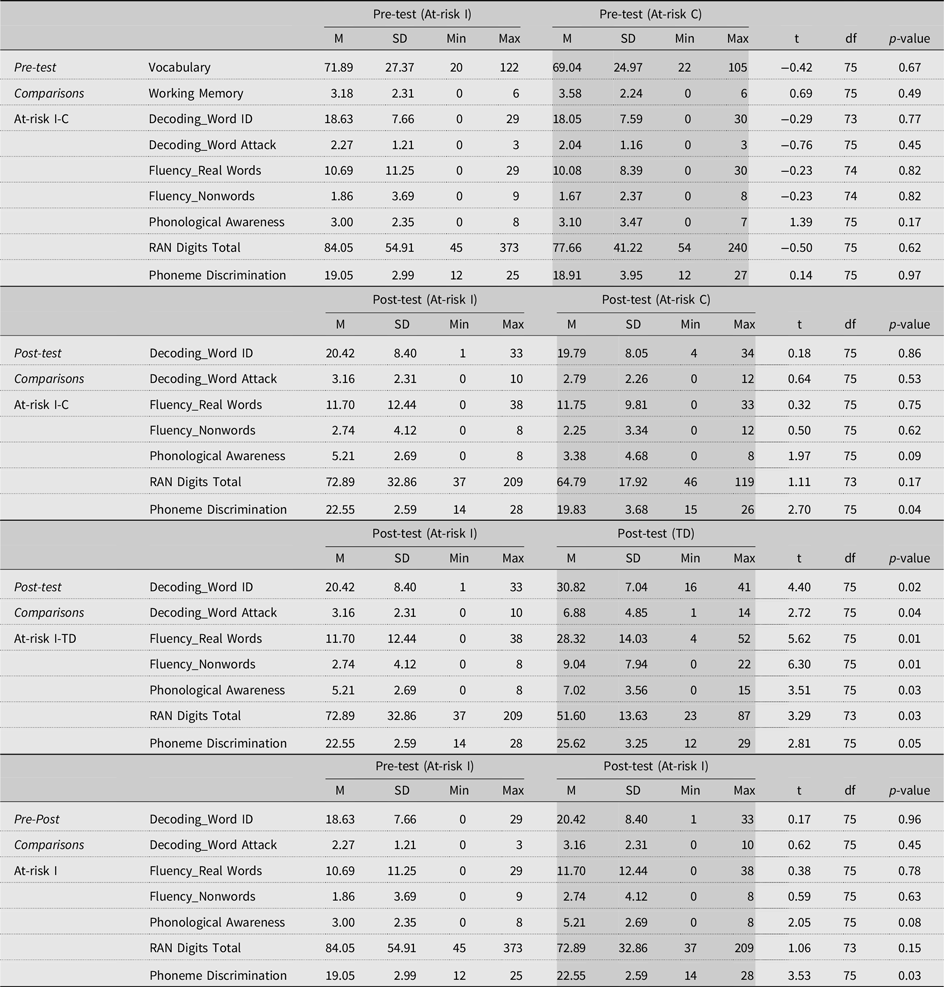
Table 2 contains descriptive statistics for participants in all three conditions. The measures of PPVT-4 and Digit Span Backward were only administered at pre-test but all other measures were administered at pre-test and post-test. Raw scores rather than standard normed scores were used because norms of the standardized measures are based on monolingual English speakers. We used raw scores for the current sample to avoid misrepresenting their English proficiency levels (O’Connor et al., Reference O’Connor, Geva and Koh2019).
Comparisons of the at-risk intervention group, at-risk control group, and typically developing control group, at pre-test and at post-test, using t tests and descriptive statistics for the three groups

Note. At-risk I = At-risk Intervention group; At-risk C = At-risk Control group; TD = Typically Developing control group.
Note. Word ID = Woodcock-John Letter-Word Identification Subtest; Word Attack = Woodcock-John Word Attack Subtest; RAN Digits = Comprehensive Test of Phonological Processing Rapid Automatized Naming Subtest.
To establish pre-test equivalence of subjects in the randomly assigned at-risk intervention and at-risk control conditions, independent samples t tests were conducted and effect sizes were calculated, comparing the groups at pre-test. None of the t tests were statistically significant (see Table 2), and the effect sizes (Cohen’s d) ranged between 0.03 and 0.18, providing no evidence that the groups were different at pre-test.
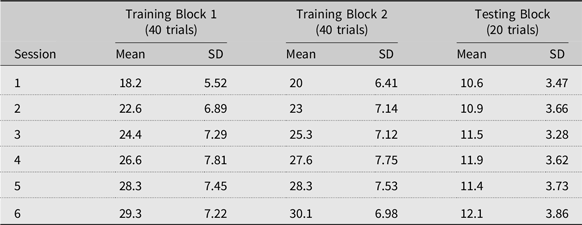
Table 3 contains means and standard deviations of intervention group performance on the training and testing blocks at each of the six sessions. Performance on the training blocks increased from a mean of 18.2 to 29.3 for Block 1 and from 20 to 30.1 for Block 2 (maximum score of 40). However, performance on the testing block exhibited a smaller shift, from a mean of 10.6 to 12.1 (maximum score of 20).
Means and standard deviations of performance during intervention for the at-risk intervention group

Note. Each training block has 40 trials because each target word in 20 minimal pairs is presented in one trial. The testing block has 20 trials because two target words in 20 minimal pairs are presented in one trial.
Comparison of pre- and post-test of EB at-risk intervention group
Paired samples t tests were conducted (see Table 2), and effect sizes were calculated to compare the intervention group’s post-test to pre-test scores. The only significant difference between pre- and post-test was on phoneme discrimination (Cohen’s d = 1.25). Although this brief intervention improved phoneme discrimination of at-risk EBs, effects on reading and reading-related skills could not be detected. In addition, a marginally significant difference was found on CTOPP Elision which assessed phonological awareness (Cohen’s d = 0.87).
Comparison of EB at-risk intervention group and at-risk control group at post-test
Independent samples t tests were conducted (see Table 2) and effect sizes were calculated to compare the EB at-risk intervention group to the at-risk control group at post-test. The at-risk intervention group scored higher than the at-risk control group on the phoneme discrimination post-test (Cohen’s d = 0.86). However, no effects on reading and reading-related skills could be detected from this brief intervention. A marginally significant difference was found on CTOPP Elision which assessed phonological awareness (Cohen’s d = 0.49).
Comparison of EB at-risk intervention group and typically developing control group at post-test
Independent samples t tests were conducted to compare the EB at-risk intervention group to the typically developing control group at post-test. Comparison of EB at-risk intervention group and typically developing control group at pre-test was not conducted because EBs in the typically developing group were expected to outperform those in the at-risk group due to their advanced reading skills. Instead, we compared the post-test performance of these two groups to see whether at-risk intervention group might perform similar to the typically developing control group due to intervention training. However, the EB at-risk intervention group continued to score significantly lower than the typically developing control group on all reading and reading-related skills at post-test (see Table 2). This brief lexical specificity intervention was insufficiently robust to produce effects on reading and reading-related skills, at least in the short run.
Improvement in the performance of EBs at-risk intervention group during intervention
Given that some improvement appeared to be present in the subjects’ performance during the training blocks (see Table 3), further exploratory analyses were conducted to investigate this improvement and whether it would be transferred to testing sessions. Using paired samples t tests, significant differences were found between mean performance at session 1 compared to session 6 for Block 1 and for session 1 compared to session 6 for Block 2, with higher scores at session 6. When scores were combined across the two training blocks, this combined score was also significantly higher at session 6 compared to session 1.
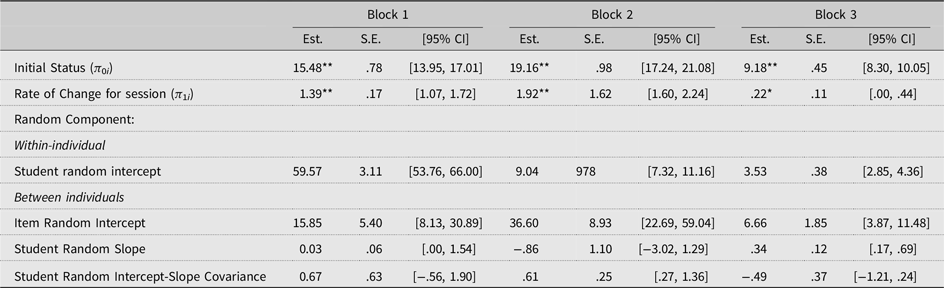
Growth curve modeling was employed to examine whether there were any changes observed in the EB at-risk intervention children’s performance across the training blocks and test blocks, during the 6 intervention sessions (see Table 4). Because the lexical specificity intervention involved vocabulary knowledge and working memory, these variables were controlled to rule out possible intervening effects. Modeling was conducted in Stata. Crossed random-effects models were calculated separately for training Blocks 1 & 2, and testing Block 3. Fixed effects were used to model linear change in performance across the six sessions and random effects were used to model variance across children in either their performance at the first session (intercept centered at time 1), or in their rate of change across the six sessions (slope). We found significant change across the 6 sessions for Blocks 1, 2, and Block 3. In the model for Blocks 1 and 2, there was significant intercept variance, indicating significant variability among children in their final performance in session 6. There was a smaller but significant amount of random slope variance, indicating significant variability among children in their rate of change across the six sessions. In the model for Block 3, there was a small significant fixed effect of session, indicating that performance improved very slightly across sessions. There was significant intercept variance, indicating significant variance across children in their final performance in session 6. These results parallel the results from the t tests reported above, showing likely effects of the intervention on phoneme discrimination even over the brief intervention period.
Growth curve models for Blocks 1 and 2 combined, and Block 3, with random intercepts for student and item

Note: ** p < 0.01, * p < 0.05.
Discussion
This study sought to examine the effects of a lexical specificity intervention on phoneme discrimination, reading, and reading-related skills for EBs. The results indicated that a lexical specificity intervention targeting phonemic minimal pairs showed some evidence of generating improvement in phoneme discrimination. Our finding partially supports the hypothesis that lexical specificity training enhances EB’s phoneme discrimination. An EB student may have difficulty distinguishing “bear” from “pear,” because the initial stops differ only in one feature – voicing. To EBs whose first language does not differentiate between the phonemes /b/ and /p/, or whose phoneme boundaries between the two sounds are characterized by a different voice onset time than in English, distinguishing these sounds is even more challenging; however, semantic support from the presence of two distinct words in the emerging mental lexicon and increasing exposure to similar minimal pairs can reinforce the distinction and enhance the specificity of the representation (Krenca et al, Reference Krenca, Segers, Chen, Shakory, Steele and Verhoeven2020b; Janssen et al., Reference Janssen, Segers, McQueen and Verhoeven2015; van Goch et al., Reference van Goch, McQueen and Verhoeven2014). This means that as children develop more vocabulary they shift from unconscious phonological restructuring of words in the mental lexicon to conscious phonological awareness (Metsala & Walley, Reference Metsala, Walley, Metsala and Ehri1998). The lexical restructuring process involves the evolution of children’s knowledge of phonemes from implicit to explicit. This process is linked to the development of phonological awareness and the ability to learn to read. Individual differences in phonological awareness and reading ability can be explained by differences in lexical growth and restructuring. The way phonological representations are stored and structured in the mental lexicon changes as children become more aware of segments (syllables, onset/rime, phonemes), and this restructuring is thought to be related to the development of phonological awareness (Fowler, Reference Fowler, Brady and Shankweiler1991). In other words, as a student’s vocabulary expands, the need for lexical specificity in order to accurately distinguish phonemes and sound contrasts also increases, which leads to improvement in phonological awareness.
The findings in the current study showed that a six-session lexical specificity intervention has exerted impacts on phoneme discrimination. Lexical specificity training can help improve an individual’s ability to recognize and differentiate between phonemes, which is a key aspect of phoneme discrimination. Lexical specificity plays an important role in phoneme discrimination, which is a precursor of decoding and facilitates phonological awareness. However, Janssen et al. (Reference Janssen, Segers, McQueen and Verhoeven2015) and van Goch et al. (Reference van Goch, McQueen and Verhoeven2014) did not find significant gains on phoneme discrimination from their one-session lexical specificity training. They argued that it might take longer to develop phoneme discrimination skills for kindergarteners who are still preliterate. Also, the intervention’s effects on reading and reading-related skills in the current study were not immediately measurable. This is perhaps because our lexical specificity intervention is comparatively brief. A longer intervention to train EBs’ lexical specificity may be needed to detect measurable effects on reading and reading-related skills.
An important outcome from the present study was a marginally significant difference that was observed between the pre- and post-test on phonological awareness for the at-risk intervention group, a difference that led the at-risk intervention group to outperform the at-risk control group at post-test. Lexical specificity training has been shown to enhance phonological awareness (Fowler, Reference Fowler, Brady and Shankweiler1991; Elbro et al., Reference Elbro, Borstrøm and Petersen1998; van Goch et al., Reference van Goch, McQueen and Verhoeven2014; Goswami, Reference Goswami, Kamil, Mosenthal, Pearson and Barr2000; Janssen et al., Reference Janssen, Segers, McQueen and Verhoeven2015; Krenca et al., Reference Krenca, Segers, Chen, Shakory, Steele and Verhoeven2020b). For example, van Goch et al. (Reference van Goch, McQueen and Verhoeven2014) found that lexical specificity training enhanced Dutch kindergarteners’ rhyme awareness (one form of phonological awareness) and Janssen et al. (Reference Janssen, Segers, McQueen and Verhoeven2015) reported that Dutch (L2) lexical specificity training improved Dutch (L2) phoneme blending (an aspect of phonological awareness) in both Dutch (L1) kindergarteners and Turkish (L1) – Dutch (L2) kindergarteners. Additionally, Janssen et al. (Reference Janssen, Segers, McQueen and Verhoeven2017) also found that Dutch (L2) lexical specificity training predicted Turkish (L1) phonological awareness, which in turn predicted Dutch (L2) phonological awareness. It is highly likely that the lexical specificity training that Dutch learners received could more easily predict rhyme awareness and phoneme blending skills due to highly transparent orthography of Dutch, compared to English which is an opaque orthography. Although the difference between the at-risk intervention group and the at-risk control group in the current study fell below statistical significance, the positive trend signifies the potential for a greater and more significant difference with a larger sample size and/or a longer intervention. By encouraging children to focus on the finer details of word sounds and to differentiate between similar sounding words, lexical specificity training can improve their phonological awareness and ability to recognize and manipulate sounds in language. Because phoneme discrimination is a precursor of phonological awareness, the training effects on phoneme discrimination led to improved phonological awareness. Phonological awareness skills are required to facilitate phoneme-grapheme linking, or phonics (Eslick et al., Reference Eslick, le Roux, Geertsema and Pottas2020). Eslick et al. (Reference Eslick, le Roux, Geertsema and Pottas2020) describe the developmental sequence of phonological awareness as being a progression from “metalinguistic awareness of rhyme, to awareness of syllables, to lastly phonemes” (p. 2) As students’ phonological awareness is increased, so is their literacy acquisition in the long term.
The growth curve modeling results showed a powerful training effect in Blocks 1 and 2, which supported our hypothesis. Students improved from session 1 to session 6 in both training blocks, indicating that the training on minimal pairs would enhance EB children’s sensitivity to subtle phoneme distinctions. This training effect still holds even after controlling vocabulary knowledge and working memory which might also have impacts on intervention. A number of studies have shown that minimal pairs, phonological awareness, and speech discrimination are the three most popular intervention methods for children with phonological deficiencies (e.g., Hegarty et al., Reference Hegarty, Titterington, McLeod and Taggart2018). The present study further supports the value of minimal pairs training through the improvements shown between sessions.
Substantial growth was not observed in Block 3, the testing block. The testing trials were more challenging than those in the training blocks, which could be the reason that the growth in the training blocks did not carry over. Additionally, it is possible that some EBs in the at-risk intervention group are at severe risk for reading disabilities, which would mean that a three-week exposure to minimal pairs is not adequate to have an effect on skill growth and long and intensive intervention is needed to support steady progress in the testing block. One finding that warrants further discussion is that the growth within the training blocks was correlated with the performance on the testing block for the intervention group, indicating that the rate of learning within the intervention was associated with the construct that the testing block assessed.
The significant growth shown in both Blocks 1 and 2 between sessions 1 and 6 suggests that these targeted lexical specificity interventions for EBs are beneficial in improving students’ ability to discriminate between phonemes, and the effects of minimal pairs interventions should be studied further. The main purpose of the lexical specificity training was to build phonologically specific lexical entries based on minimal phonological differences and create specific entries for each word based on the differences in their sounds. It focuses on the richness and specificity of the mental lexicon and the distinctiveness of phonological representations. Because our findings suggest that the lexical specificity training can improve phoneme discrimination – a skill that facilitates phonological awareness and decoding in intervention group, we conclude that a lexical specificity intervention could enhance early literacy development for at-risk EBs.
Limitations, future directions, and implications
There are some limitations that deserve mentioning in the study. First, the sample size is small, so the power to detect small impacts was limited. We found significant differences between pre-test and post-test for the intervention group and between the intervention and control groups at post-tests only on the experimental measure of phoneme discrimination. The marginal significant difference we found for phonological awareness and the moderate and large effect sizes suggests the value of a replication with more power, and perhaps a more robust intervention. It is also possible that the time between standardized pre- and post-tests was too short to observe the intervention effect. The lexical specificity intervention evaluated here was much less intense than many other phonological awareness intervention programs. Our purpose was to design and evaluate an intervention that would require minimal time and effort from the classroom teachers. Future studies could systematically vary duration and intensity to find the threshold for educationally significant effects. Some EBs have more advanced L1 phonological skills than their L2 phonological skills. The L1 lexical specificity intervention may help facilitate L2 lexical specificity due to a cross-linguistic transfer. Janssen et al. (Reference Janssen, Segers, McQueen and Verhoeven2015) found that bilingual children performed better on minimal pairs with phonological overlap between their L1 and L2. Krenca et al. (Reference Krenca, Segers, Chen, Shakory, Steele and Verhoeven2020b) showed that L1 lexical specificity significantly predicted L2 word reading in English-French bilingual children. Future research should include lexical specificity interventions in both languages to examine whether cross-linguistic interventions have significant impacts on at-risk EBs’ literacy skills.
This study has significant theoretical and educational implications. Theoretically, the lexical specificity intervention exerts effect on phoneme discrimination, which is an important precursor to early literacy development. The emphasis of the lexical specificity is on the phonological representations of individual lexical items. Early vocabulary development has been linked to implicit (unconscious) phonological restructuring of words in the mental lexicon. As children’s vocabulary grows and they encounter more words, their phonological representations of those words become more specific, leading to an increase in lexical specificity. This implicit phonological restructuring is considered to be a precursor of explicit (conscious) phonological awareness, as children’s increased ability to differentiate between words based on their sounds can lead to the development of explicit phonological awareness. Thus, early vocabulary development and the resulting lexical specificity can play a role in the development of explicit phonological awareness for young EBs. Practically, when at-risk students are identified in schools, they are monitored and provided with more intensive instruction if they are unresponsive to the general classroom instruction. Teachers typically determine what the reading problems are, analyze their causes, provide goal-oriented interventions to address the problems, monitor student progress, and then modify the interventions if necessary. As the percentage of EBs continues to rise in North America and worldwide, it is imperative that teachers be knowledgeable about effective phonological awareness instruction and be given the intervention tools that would enable them to support all students’ learning in areas such as phoneme discrimination and minimal pairs, which are precursors to word reading. The findings from this study suggest that training on the specificity of phonological representations could help at-risk EBs improve their ability to discriminate phonemes, which should in turn enhance the development of phonological awareness and reading ability.
Acknowledgements
This work was supported by the Social Sciences and Humanities Research Council of Canada (grant number 430-2016-00747) and the William T. Grant Foundation (grant number 189631).
Replication package
All study materials, data and analysis codes are available online at https://osf.io/nuvqa/.