
Introduction
Chitosan (CS) is an amino-polysaccharide that is characterized by its high affinity for drug and metal retention.[Reference Kim1] However, CS has been receiving increasing amounts of attention as a polymeric material for tissue engineering applications because crosslinked CS can be used as a three-dimensional (3D) cell culture scaffold.[Reference Shia, Neoha, Kanga and Wang2–Reference Wan, Sun, Gao and Li4] 3D cell cultures have many known research benefits compared with conventional 2D cell cultures.[Reference Diekjürgen and Grainger5–Reference Tibbitt and Anseth8] One commonly observed difference is the change in cell morphology witnessed across diverse cell types: cells seeded on 2D substrates grow flat and spread widely, lacking the requisite support to grow in a vertical dimension; while this is normal behavior for some cell types (e.g., epithelial cells), other cells (e.g., mesenchymal cells) grow in a stellate manner in 3D matrices, polarizing simply for migration purposes. Cells unnaturally forced into artificial morphologies can exhibit altered functions and phenotypes.[Reference Baker and Chen9]
However, CS solubility depends on the degree of deacetylation and also exhibits some inherent disadvantages such as poor mechanical strength and uncontrolled water uptake. To overcome some of these problems, combinations of CS with different synthetic monomers have been widely studied. N,N-dimethylacrylamide (DMAAm) is a typical nonionic water-soluble molecule that has received attention because of its hydrophilic and biocompatible nature. DMAAm hydrogels could be used in cell culture applications, but the compounds used for crosslinking are usually very toxic, which is a disadvantage for biomedical applications.[Reference Baser, Demirel and Caykara10, Reference Caliari and Burdick11] Therefore, the use of ionizing radiation is a more appropriate method to synthesize polymers and hydrogels that can be used in this field, because it does not use chemical initiating agents and catalysts, and the reactions can be made at any temperature and physical state.
The effect of radiation on CS has been studied by several authors,[Reference Choi, Ahn, Lee, Byun and Park12–Reference Chmielewski14] and it is known that ionizing radiation causes CS main chain scission[Reference Ramaprasad, Rao, Praveena, Sanjeev, Ramanani and Sabharwal15] and ring opening, with the dominance of chain scission events causing a narrowing of the overall distribution of molecular weight. A rapid decrease in viscosity was observed up to 10 kGy, but no severe changes in the structural state of CS occurred at doses up to 100 kGy. However, radiation has been successfully used to modify CS with different vinyl monomers, such as N-vinylcaprolactam,[Reference Perez-Calixto, Ortega, García-Uriostegui and Burillo16] N-isopropylacrylamide,[Reference Montes, Ortega and Burillo17] and hydroxyethylmethacrylate,[Reference Cai, Zhang, Ch. Sun, He and Zhu18] among others.
The present work is focused on the study of systems of CS hydrogels with DMAAm in different architectures such as comb-type grafting hydrogels [(net-CS)-g-(DMAAm)], interpenetrating networks (IPNs) [(net-CS)-inter-(net-DMAAm)], and semi-interpenetrating hydrogels [(net-DMAAm)-inter-CS], as well as a comparison of their properties. The synthesized systems can be used for cell growth in tissue engineering.
Experimental
Materials
CS supplied by Sigma-Aldrich Co., Mexico (average molecular weight of 1.46 × 10⁵ and deacetylation degree of 79%) was used without any purification. DMAAm was purchased from Sigma-Aldrich Co., Mexico and distilled under reduced pressure. Citric acid, acetic acid, and formaldehyde from Sigma-Aldrich were used as received.
DMAAm crosslinking: net-DMAAm
The crosslinking was performed using gamma irradiation (Gammabeam 651 PT, Nordion Canada) of different DMAAm acetic acid solutions (5% v/v). Five milliliters of the solution were placed in glass ampoules, which were bubbled with argon for 15 min to eliminate the oxygen and then sealed. The samples were irradiated at doses varying between 3 and 15 kGy with a dose rate of 7.8 kGy/h. The irradiated samples were washed with water and methanol to remove the residual monomer and formed homopolymer. The samples were then dried in a vacuum oven until reaching a constant weight, and the crosslinking percentage was calculated using Eq. (1).
 $${\rm Gel}\left( \% \right) = \left( {\displaystyle{{W_{\rm f}} \over {W_0}}} \right) \times 100\; $$
where W f and W o are the weights of the insoluble crosslinked and the initial DMAAm, respectively.
CS crosslinking: net-CS
A solution of CS at 3% w/v in acetic acid (5% v/v) and formaldehyde (10% v/v) was stirred for 2 h and dried in a fume hood for 96 h. The crosslinked CS was extracted with an acetic acid solution (5% v/v) to eliminate the un-crosslinked CS and then washed with distilled water until neutral pH. The CS hydrogel was dried at room temperature under vacuum to constant weight. The crosslinking percentage (gel) was calculated with Eq. (1), where W f and W o are the weights of the insoluble crosslinked CS after extraction with acetic acid and the initial CS, respectively.
Comb type hydrogel: (net-CS)-g-DMAAm
For the radiation grafting of DMAAm onto net-CS; different DMAAm concentrations from 2 to 15% in acetic acid solution (1% v/v) were placed into glass ampoules (7 mL) with a certain amount of net-CS (~0.2 g), bubbled with argon for 15 min, sealed and irradiated at a dose rated of 12 kGy/h for different doses (2–10 kGy). The residual monomer and ungrafted homopolymer were extracted with an acetic acid solution (5% v/v) over 24 h, then the samples were washed with water until reaching neutral pH, and vacuum dried. The degree of grafting was calculated by the gravimetric method, using Eq. (2).
 $${\rm Grafting}\left( \% \right) = \displaystyle{{\left( {W_{\rm f} - W_{\rm o}} \right)} \over {W_{\rm o}}} \times 100,$$
where W o and W f are the weights of net-CS before and after grafting, respectively.
Semi-interpenetrating networks (SIPNs): (net-DMAAm)-inter-CS
SIPNs of CS in DMAAm hydrogels were synthesized by the irradiation of DMAAm solutions with different concentrations (10–50% v/v) in the presence of CS (3% v/v) in acetic acid (5% v/v). Seven milliliters of the CS and DMAAm solutions were placed in Pyrex glass ampoules, bubbled with argon for 15 min to eliminate the presence of oxygen, and sealed and irradiated with a 60Co source (Gammabeam 651 PT, Nordion International Inc.) at dose rate of 6.9 kGy/h and with doses from 3 to 15 kGy. To extract the residual monomer and homopolymer of DMAAm that could be occluded in the networks, the samples were washed with water for 72 h with a change of water each 24 h, and then they were dried under vacuum to constant weight. The amount of interpenetrating CS (in percentage) was calculated with Eq. (3)
 $${\rm CS}\,{\rm interpenetrated}\left( \% \right) = \displaystyle{{\left( {W_{\rm f} - W_{\rm o}} \right)} \over {W_{\rm o}}} \times 100,$$
where W f and W o are the weights of the final semi-interpenetrated system and the initial DMAAm monomer (100% crosslinked), respectively.
IPNs: (net-DMAAm)-inter-(net-CS)
The IPNs were synthesized by mixing DMAAm solutions at different concentrations (10–50% v/v) with CS (3% v/v) and formaldehyde (10% v/v) in an acetic acid solution (5% v/v); the crosslinking reaction of CS was realized by the presence of formaldehyde during 24 h; then, for the DMAAm crosslinking, the ampoules were bubbled with argon to eliminate oxygen, sealed, and irradiated at different doses (3–15 kGy). After irradiation, the samples were extracted with acetic acid (5% v/v) for 24 h, they were washed with water several times until neutral pH, and then vacuum dried. The interpenetration percentage of the CS network in the DMAAm network was calculated by Eq. (3), where W f and W o are the weights of the interpenetrated samples and the initial DMAAm monomer (100% crosslinked), respectively.
Characterization of different polymeric architectures
Fourier-transform infrared spectroscopy-attenuated total reflection (FTIR-ATR)
The FTIR-ATR spectra of different CS architectures were recorded from 4000 to 650/cm with 16 scans, using a Perkin-Elmer spectrum 100 instrument with a Universal ATR and diamond tip.
Thermal properties
The thermal decomposition of different samples was determined by thermogravimetric analysis using a TGA Q50 (TA Instruments, New Castle, DE) at a heating rate of 10°C/min for a temperature interval from 25 to 800°C under a nitrogen atmosphere. The glass transition (T g) of different CS architectures was investigated by differential scanning calorimetry using a DSC Model 2010 (TA instruments, New Castle, DE) in a temperature range from 25 to 400 °C under a nitrogen atmosphere at a flow rate of 60 mL/min and a heating rate of 10°C/min.
Scanning electron microscopy (SEM)
To observe the morphology of the different hydrogels, all samples were swelled in water (up to the equilibrium state), cryo-fractured in liquid nitrogen and freeze-dried (FreeZone 1.0 L Benchtop Freeze Dry System, Labconco) at −50°C overnight. The dry cross-sectional surface was sputter-coated with Au for 30 s, using an SPI Module Sputter Coat system. The samples were then examined using field-emission SEM (FE-SEM) carried out on a Tescan Mira 3 LMU, at an acceleration voltage of 10 kV.
Swelling behavior
For the determination of the equilibrium swelling time, dried samples were immersed in distilled water at 20°C; the weight of the samples were measured at various time intervals after soaking in water, and the excess surface water was removed. The procedure was repeated until there was no further increment in weight. The swelling percentage (Sw %) was calculated by Eq. (4).
 $$Sw\left( \% \right) = \displaystyle{{\left( {W_{\rm s} - W_{\rm d}} \right)} \over {W_{\rm d}}} \times 100, $$
where W d and W s are the weights of the initial dried and the final swollen sample after a certain period of time, respectively.
Critical pH point
The pH sensitivity of the different systems was evaluated in Na2HPO4/citric acid buffer solutions in the pH range of 2–10 and with NaOH for further adjustments, by immersion for 24 h at 20°C (HI 4212 potentiometer, Hanna instruments, CA, USA). The pH critical point was identified as the inflexion point in the plot of the swelling percentage versus pH.
Results and discussion
Synthesis of hydrogels
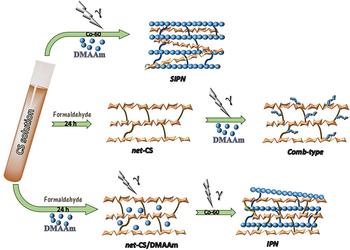
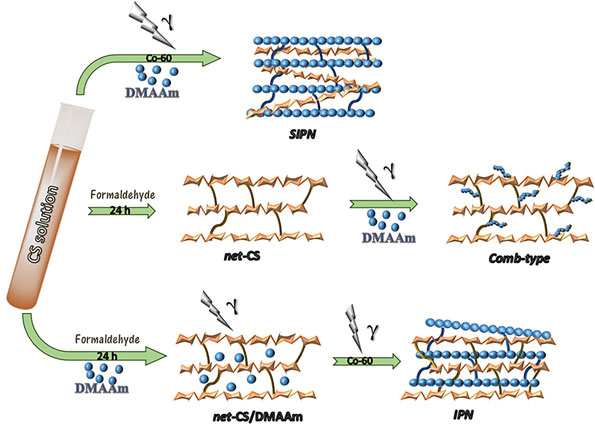
The crosslinking percentage increased drastically with DMAAm concentration and dose, reaching 80% crosslinking at a concentration of 10% v/v and then leveling near 100% at further concentrations. The minimum dose to completely crosslink the DMAAm was 3 kGy, while higher doses only increased the crosslinking density. Different methods to obtain the studied systems can be observed in Fig. 1.
Scheme of different steps in the syntheses of SIPN, IPN, and comb-type hydrogels.

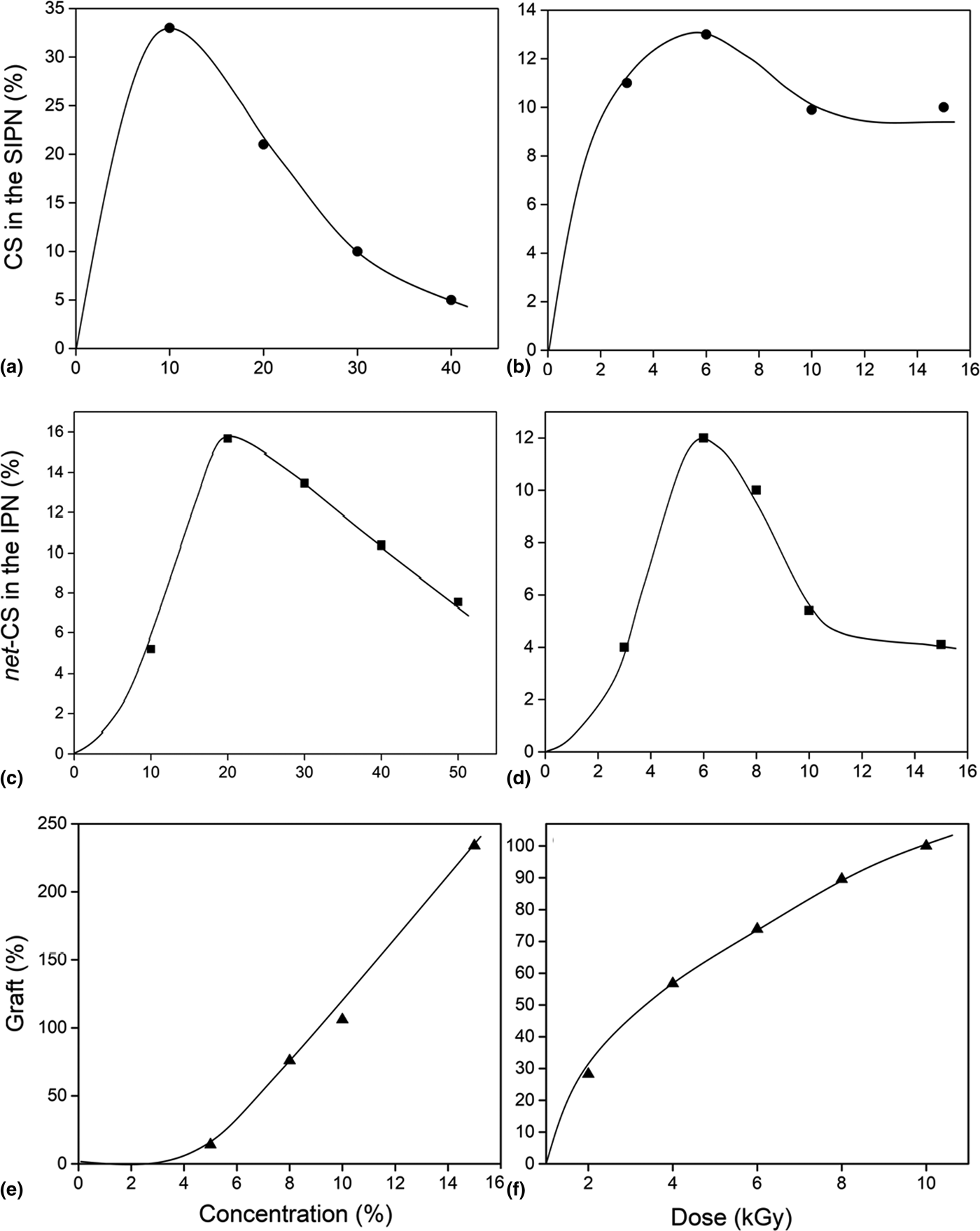
The maximum CS percentage in the SIPNs was 33% at a DMAAm concentration of 10% and decreased at further concentrations; this was due to the higher concentration of DMAAm increasing the crosslinked amount, thereby hindering the diffusion of CS in the system [Fig. 2(a)]. In the case of IPNs, the maximum CS percentage obtained was lower (16%) at a DMAAm concentration of 20%; this was further due to the crosslinking of CS, as one excess of DMAAm could also be crosslinked at the surface, and then the amount of CS in the IPN would be decreased [Fig. 2(c)].
SIPN: Amount of CS interpenetrated as a function of (a) DMAAm concentration and (b) dose. IPN: Amount of net-CS interpenetrated as a function of (c) DMAAm concentration and (d) dose. Comb-type: Grafting percentage as a function of (e) DMAAm concentration and (f) dose.

Additionally, the CS interpenetrated percentage in the SIPNs and IPNs as a function of the dose was studied. CS in the IPN increased with dose up to 6 kGy [Fig. 2(d)], where we observed a maximum percentage of crosslinked DMAAm with the optimum conditions for the interpenetrated CS network; at higher doses, the crosslinking density of DMAAm increased to a high extent and avoided the crosslinking of CS with formaldehyde. The crosslinking behavior of DMAAm with increasing dose was confirmed via the swelling behavior, where we observed a decrease in swelling % because of the higher DMAAm crosslinking. Additionally, higher doses increased the CS degradation of the system.
The same behavior occurred with SIPNs, where increases in dose increased the crosslinking density, preventing the facile diffusion of the CS polymer in the network and increasing CS degradation [Fig. 2(b)].
In the comb-type system [Figs. 2(e) and 2(f)], the grafting yield increased with dose and with DMAAm concentration, but a considerable gel formation of DMAAm without grafting reaction was produced, making separation difficult. To avoid this problem, we synthesized a net-CS at a concentration of 3% in a 5% acetic acid solution.
Characterization of systems
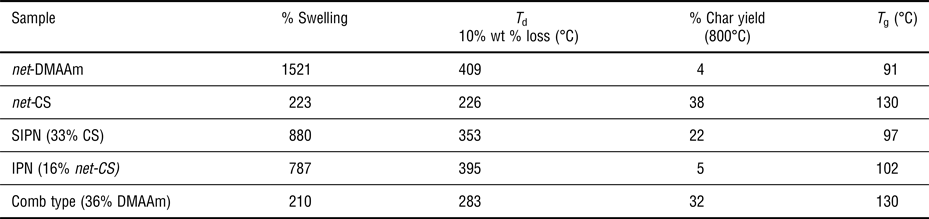
The equilibrium swelling times for net-DMAAm and net-CS were approximately 48 and 24 h, respectively; while for the SIPNs and IPNs, the time was approximately 72 h. The lowest time was in the comb type system, which reached maximum swelling in 2 h. This behavior was a consequence of system architecture, DMAAm was crosslinked in the SIPNs and IPNs, causing the water absorption to be slower due to the network needing more time to rearrange its chains and reach equilibrium. In the comb-type samples, DMAAm was grafted like branches onto CS, affording DMAAm chains more mobility, and the swelling was faster. In all cases, the maximum swelling percentage decreased when the amount of CS or net-CS in the system was higher (Table I).
% Swelling and thermal properties of different systems.

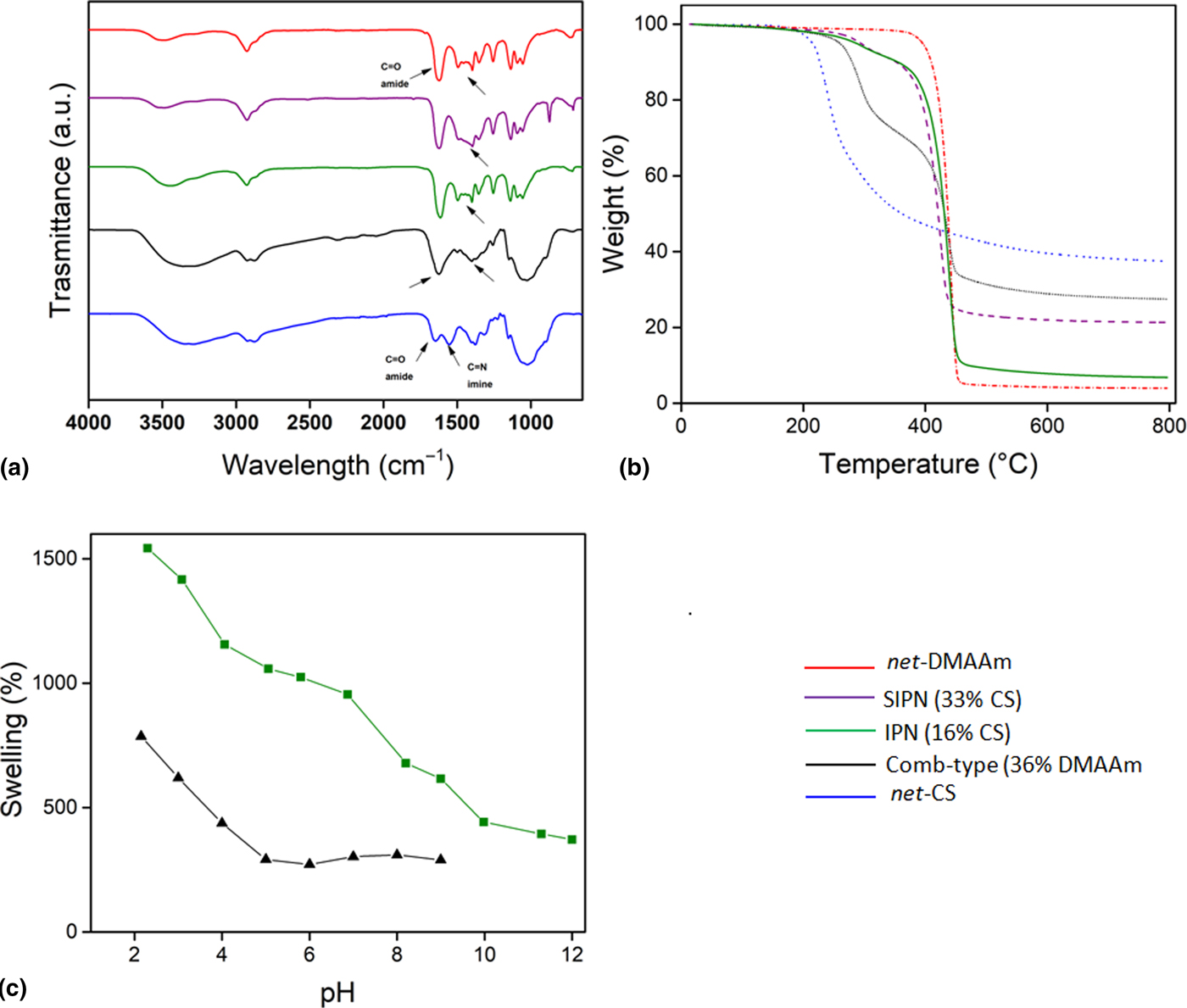
The FTIR spectra of different systems can be observed in [Fig. 3(a)]. net-DMAAm showed characteristic peaks at 2926 and 1619/cm corresponding to the stretching of C–H (in methyl and methylenes) and C = O of a tertiary amide, respectively [Fig. 3(a), red line]. The net-CS showed peaks at 3356 (OH stretching), 2985 (CH2 stretching vibration of a pyranose ring), and 1657/cm (carbonyl stretching of the acetamide groups), with a significant peak at 1563/cm (C = N) because of the imine bonds formed during the CS crosslinking [Fig. 3(a), blue line].[Reference Perez-Calixto, Ortega, García-Uriostegui and Burillo16, Reference Casimiro, Gil and Leal19–Reference Taşkın, Canısağ and Şen21] In all synthesized systems, it was possible to observe the presence of CS; however, the carbonyl peaks of CS and DMAAm were overlapped at 1622/cm in the SIPN [Fig. 3(a), violet line] and IPN [Fig. 3(a), green line] systems, while the rest of the peaks could not be observed clearly. The comb-type structure showed more peaks associated with CS [Fig. 3(a), black line] at 3355 (OH stretching) and 1545/cm (NH bending), in addition to the overlapped peak of carbonyls at 1629/cm.
Characterization of the systems: (a) FTIR spectra, (b) TGA analysis and (c) swelling behavior: (- - -) net-DMAAm, (- - -) SIPN (33% CS), (- - -) IPN (16% net-CS), (- - -) Comb-type (36% DMAAm), and (- - -) net-CS.

The thermal degradation of different systems was determined by TGA [Fig. 3(b)]. The net-DMAAm and net-CS samples show single step degradation at 433 and 241°C, which is in accordance with the literature. net-CS was less thermally stable than net-DMAAm, because it underwent dehydration and saccharide ring-opening reactions, while the latter was degraded by the depolymerization of the main chain. IPN, SIPN, and comb-type systems showed two-step degradation reactions: the first one was due to CS degradation (~292°C), and the second one to DMAAm degradation (~430°C), being noticed more clearly in the last system. In addition, Table I shows the loss of 10% weight (T10%wt loss), char residue (%), and glass temperature (T g) of each system. The T g values measured for the networks of DMAAm and CS were 91 and 130°C, respectively. The IPNs and SIPNs showed values between those exhibited by DMAAm and CS networks, depending on the CS content in the system. The comb-type system also showed a similar behavior, but its values were closer to those exhibited by net-CS.
CS is a pH-responsive polymer because of the presence of amine groups in its structure, the critical pH of net-CS was previously reported by Pérez-Calixto at 3.2.[Reference Casimiro, Gil and Leal19] This behavior was not well defined in the SIPN and IPN systems because of the considerably high percentage of DMAAm, and there appeared to be more than one critical pH value [Fig. 3(c)]. On the other hand, the comb-type system was the only one that showed a critical point at 3.5, because the system consisted mostly of CS.
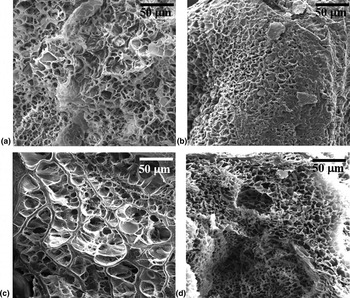
The SEM micrographs of the cross-section of the different synthesized hydrogels are shown in Fig. 4. As we can see, all samples displayed a porous and interconnected structure, which is required for enabling the permeability of nutrients and oxygen useful for cell growth. When compared with the micrographs of the different hydrogel architectures, net-DMAAm [Fig. 4(a)], and (net-CS)-g-DMAAm [Fig. 4(d)] displayed similar honeycomb-like structures with homogeneous porosity. In contrast, the SIPN [Fig. 4(b)] hydrogels showed an evident decrease in the pore size because of the interpenetration of CS polymer chains into the DMAAm network, hence, the formation of a dense structure. Furthermore, the IPN hydrogels [Fig. 4(c)] exhibited heterogeneous porosity, and the micrograph reveals some pores to be substantially larger than those of the other hydrogel architectures (a, b, and c), which could be due to the reduced quantity of net-CS interpenetrated in the IPNs compared with that in the SIPNs. On the other hand, net-CS suffered degradation under gamma irradiation,[Reference Perez-Calixto, Ortega, García-Uriostegui and Burillo16, Reference Taşkın, Canısağ and Şen21] and hence, it could be that the network breakdown resulted in the net-CS pore size increase. Moreover, it seemed that the second network was formed both on the walls and in the pores of the first network.
SEM images of different systems: (a) net-DMAAm, (b) SIPN (33% CS), (c) IPN (16% CS), and (d) Comb type (36% DMAAm).

Conclusions
Different hydrogel architectures based on CS and DMAAm were synthesized by gamma irradiation: SIPNs and IPNs, as well as DMAAm grafted onto CS gel. It was observed that the swelling and critical pH are mainly influenced by the CS amount. The IPN and SIPN systems had higher swelling percentages, but the time required to reach the equilibrium swelling time was very long (72 h). In addition, those systems did not present a well-defined pH-response. In contrast, the comb-type system decreased the time needed to reach maximum swelling to 2 h, showing a critical pH at 3.5. The morphology of the synthesized systems showed a porous and interconnected structure, where the porosity depended on the architecture developed between CS and DMAAm. IPNs showed more heterogeneous porosity than did SIPNs, while the comb-type system and net-DMAAm displayed a honeycomb structure with more homogeneous pore sizes.
CS and DMAAm are used separately for the purposes of cell adhesion, whereas the studied hydrogels combining both substances in different architectures, with better apparent mechanical properties and appropriate morphologies containing large numbers of pores and channels, will be of benefit to the field.
Acknowledgements
The authors thank M. Cruz, L.M. Valdez, L.M Escamilla, and B. Leal from ICN UNAM, and K.E. Reyes-Morales from IIM UNAM for technical support, and DGAPA UNAM grant IN200116 for financial support.