Introduction
In the field of bilingualism, a question of interest is to what extent the syntax of the two languages of bilinguals are integrated. The current literature on this issue provides two contrasting theoretical views. Some researchers argue that the syntactic representations of the two languages in bilinguals are separate (e.g., De Bot, Reference De Bot1992). According to this view, for each language, bilinguals have a separate representation of a particular syntactic construction (such as a passive construction), even if the syntactic construction exists in both languages. In contrast, other researchers maintain that syntactic representations are shared between the languages (Hartsuiker, Pickering & Veltkamp, Reference Hartsuiker, Pickering and Veltkamp2004). In other words, bilinguals have only one representation for a syntactic construction when the construction is used in both languages. Following Hartsuiker et al. (Reference Hartsuiker, Pickering and Veltkamp2004), we will refer to the first view as the separate-syntax account and the second view as the shared-syntax account.
Although not many studies have investigated the question of whether syntactic representations are shared between languages or separate for each language, these studies consistently lend support to the shared-syntax account at least to some extent (e.g., Hartsuiker et al., Reference Hartsuiker, Pickering and Veltkamp2004; Loebell & Bock, Reference Loebell and Bock2003; Meijer & Fox Tree, Reference Meijer and Fox Tree2003; Schoonbaert, Hartsuiker & Pickering, Reference Schoonbaert, Hartsuiker and Pickering2007). However, several issues are still not completely settled. One of these issues is whether parallel syntactic constructions of the languages in bilinguals share a representation when the surface word orders of the constructions differ from each other. In other words, can two languages that employ passive constructions of different word orders share an abstract syntactic representation for the construction? A number of studies have explored this issue, and their findings are not completely consistent, although recent studies have added to supporting evidence for the shared-syntax account (e.g., Bernolet, Hartsuiker & Pickering, Reference Bernolet, Hartsuiker and Pickering2007; Chen, Jia, Wang, Dunlap & Shin, Reference Chen, Jia, Wang, Dunlap and Shin2013; Loebell & Bock, Reference Loebell and Bock2003; Shin & Christianson, Reference Shin and Christianson2009). In addition, the existing studies of bilingual syntactic representation have looked at only a limited number of syntactic structures. To be specific, the scope of most studies is limited to dative constructions (e.g., Kantola & van Gompel, Reference Kantola and van Gompel2011; Schoonbaert et al., Reference Schoonbaert, Hartsuiker and Pickering2007) or passive/active constructions (e.g., Hartsuiker et al., Reference Hartsuiker, Pickering and Veltkamp2004; Vasilyeva et al., Reference Vasilyeva, Waterfall, Gámez, Gómez, Bowers and Shimpi2010), with a few exceptions (e.g., genitive constructions: Bernolet, Hartsuiker & Pickering, Reference Bernolet, Hartsuiker and Pickering2013; relative clauses: Bernolet et al., Reference Bernolet, Hartsuiker and Pickering2007). In short, the issue of to what extent syntactic knowledge is shared between bilinguals has remained unresolved.
The present study addresses these unresolved issues. We investigate whether bilinguals with two typologically distant languages, namely English and Korean, can have shared syntactic representations, by testing whether cross-linguistic priming of the subject-to-object raising construction occurs in balanced Korean–English bilinguals. Priming of this construction has not been tested yet by any previous studies in cross-linguistic contexts. Crucially, although the subject-to-object raising construction exists in both of the languages, it employs different word orders in the two languages.
Background
Structural priming
A major reason for the scarcity of research on the separate-syntax vs. shared-syntax issue resides in the difficulty of designing appropriate experimental methods that allow researchers to directly probe into the activation of a particular syntactic structure, and consequently, the influence of this syntactic activation in one language on the activation of the corresponding syntactic structure in the other language, as Desmet and Declercq (Reference Desmet and Declercq2006) point out. Among the few methodological options, structural priming paradigms are the most frequently used method for research on the question of whether syntax is separate or shared between the languages in bilinguals.
Structural priming refers to a speaker's tendency to reuse the underlying abstract syntactic structure of sentences that he/she has recently encountered or produced. For instance, right after a speaker heard or produced a sentence with a passive construction, he/she is more likely to produce another sentence with a passive construction than one with an active construction. This tendency in within-language contexts is well demonstrated in Bock's (Reference Bock1986) highly influential study. In the study, participants were asked to describe pictures in English after repeating English prime sentences, which were presented auditorily. Prime sentences and target pictures were semantically unrelated to each other. In one manipulation, the primes were either in passive structure or in active structure (e.g., One of the fans punched the referee vs. The referee was punched by one of the fans); in another manipulation, primes were either in prepositional dative structure or in double-object dative structure (e.g., The secretary is baking a cake for her boss vs. The secretary is baking her boss a cake). The results showed that participants were more likely to describe the pictures with passive structure after repeating passive primes than after repeating active primes. Participants also tended to describe the pictures with double-object structures more frequently than those in prepositional dative structures after repeating double-object primes (and vice versa).
Since Bock's (Reference Bock1986) study, extensive research has found structural priming effects in monolinguals, using different syntactic constructions (e.g., high vs. low relative clause attachment: Scheepers, Reference Scheepers2003; simple vs. complex noun phrase: Cleland & Pickering, Reference Cleland and Pickering2003), different tasks (e.g., sentence fragment completion task: Pickering & Branigan, Reference Pickering and Branigan1998; sentence recall task: Fox Tree & Meijer, Reference Fox Tree and Meijer1999), and different languages (e.g., Dutch: Hartsuiker & Kolk, Reference Hartsuiker and Kolk1998; German: Scheepers, Reference Scheepers2003). In addition, some studies showed that structural priming occurs not only in production but also in comprehension (e.g., Branigan, Pickering & McLean, Reference Branigan, Pickering and McLean2005; Noppeney & Price, Reference Noppeney and Price2004; Thothathiri & Snedeker, Reference Thothathiri and Snedeker2008). In general, the results of these studies are interpreted as strong evidence for the existence of abstract syntactic representations, which include phrasal constituents (e.g., nouns/verbs/prepositional phrases), syntactic relations (e.g., subject, object, and predicate) and the hierarchical configuration of these constituents (see Pickering & Ferreira, Reference Pickering and Ferreira2008, for a detailed discussion).
Recently, structural priming paradigms have been adapted for research investigating how the syntax of bilinguals’ two languages is represented (Hartsuiker et al., Reference Hartsuiker, Pickering and Veltkamp2004; Loebell & Bock, Reference Loebell and Bock2003). In a typical cross-linguistic structural priming paradigm, the prime sentence is presented in one language, and participants’ target production is elicited in the other language. The rationale of such adapted paradigms is that if the syntactic representation of the two languages is highly integrated, producing or encountering a structure in one language would prime the corresponding structure in the other language; on the other hand, if the syntactic representations are separate, such cross-linguistic priming effects would not occur (Desmet & Declercq, Reference Desmet and Declercq2006). That is, the shared-syntax account predicts structural priming across languages, whereas the separate-syntax account does not.
Evidence for the shared-syntax account from structural priming studies
Since Loebell and Bock (Reference Loebell and Bock2003) first found cross-priming effects in German–English bilinguals, structural priming has been consistently used to investigate the question of whether syntactic representation is separate or shared between the languages in bilinguals. Though few, the existing cross-linguistic syntactic studies consistently report that cross-linguistic priming of a syntactic construction does occur at least when the construction is formed in an identical word order in the two languages, supporting the shared-syntax account (Bernolet et al., Reference Bernolet, Hartsuiker and Pickering2007; Cai, Pickering, Yan & Branigan, Reference Cai, Pickering, Yan and Branigan2011; Hartsuiker et al., Reference Hartsuiker, Pickering and Veltkamp2004; Kantola & van Gompel, Reference Kantola and van Gompel2011; Meijer & Fox Tree, Reference Meijer and Fox Tree2003; Salamoura & Williams, Reference Salamoura and Williams2007; Schoonbaert et al., Reference Schoonbaert, Hartsuiker and Pickering2007; Vasilyeva et al., Reference Vasilyeva, Waterfall, Gámez, Gómez, Bowers and Shimpi2010). For example, Hartsuiker et al. (Reference Hartsuiker, Pickering and Veltkamp2004) found structural priming across languages using a confederate-scripting task. In the task, a participant and a confederate, both of whom were Spanish (L1)–English (L2) bilinguals, took turns describing pictures to each other; the participant was asked to speak in English and the confederate spoke in Spanish. After either the participant or the confederate finished describing the picture, the other determined whether the description matched his or her own picture. The confederate produced four types of prime sentences: actives, passives, intransitives, and OVSs (sentences with object-verb-subject word order). As the example sentences in (1) show, all the constructions except OVS exist in English and have the same word orders in English and Spanish.
-
(1)


The results showed that Spanish–English bilinguals were more likely to produce English passive sentences following a Spanish passive sentence than following a Spanish active sentence or intransitive sentence, but not than following an OSV sentence. Hartsuiker et al. (Reference Hartsuiker, Pickering and Veltkamp2004) interpreted these results as evidence for the shared-syntax account.
Moreover, several studies show that structural priming can occur not only from L1 to L2 but also from L2 to L1, providing further evidence for strongly integrated syntax in bilinguals. For instance, using the method employed by Hartsuiker et al. (Reference Hartsuiker, Pickering and Veltkamp2004) (i.e., a confederate-scripting paradigm), Schoonbaert et al. (Reference Schoonbaert, Hartsuiker and Pickering2007) found priming of the two alternate dative constructions (i.e., double-object [DO] and prepositional [PO] datives) both from L1 to L2 and vice versa with Dutch (L1)–English (L2) bilinguals. Also, with Chinese (L1)–English (L2) bilinguals, Chen et al. (Reference Chen, Jia, Wang, Dunlap and Shin2013) observed priming of the passive construction in both directions. Furthermore, their results showed that the structural priming effect was not modulated by priming direction.
Another piece of evidence for the shared-syntax account comes from Kantola and van Gompel's (Reference Kantola and van Gompel2011) study, which demonstrated that structural priming between languages is as strong as structural priming within languages (see also the results of studies by Desmet & Declercq, Reference Desmet and Declercq2006 and Schoonbaert et al., Reference Schoonbaert, Hartsuiker and Pickering2007; cf. Cai et al., Reference Cai, Pickering, Yan and Branigan2011). As Kantola and van Gompel (Reference Kantola and van Gompel2011) point out, the shared-syntax account predicts that when a syntactic construction is present in both languages of bilinguals, cross-linguistic priming and within-language priming of the construction are equally strong. To elaborate, if the representation of the construction is shared between the languages, the amount of the residual activation of the representation – which determines the occurrence of structural priming (e.g., Hartsuiker & Pickering, Reference Hartsuiker and Pickering2008) – should not be affected by which language has activated the representation. Using a written fragment completion paradigm, Kantola and van Gompel (Reference Kantola and van Gompel2011) observed priming of the alternate dative constructions (i.e., DO and PO) across Swedish (L1) and English (L2) and within each of the languages, and that the strength of cross-linguistic and within-language priming was equal.
Unresolved issues on cross-linguistic structural priming
Although previous studies have consistently reported cross-linguistic structural priming, lending support to the shared-syntax account, there are a number of issues that call for further research.
Word Order and Cross-linguistic Structural Priming
One of the issues is whether the representation of a particular syntactic construction can be shared between the languages when the construction has different surface word orders in the languages. This issue is crucial in interpreting the cross-linguistic priming effects found in the studies that used a syntactic construction formed in an identical word order in the languages. To elaborate, since word order effects and structural priming effects could not be teased apart in the studies, without further supporting evidence, the priming effects found in the studies can be interpreted as word order priming (i.e., surface-structural priming), rather than structural priming, which mainly depends on abstract syntactic representation. This possibility cannot be ignored, because previous studies show that word order per se can be primed in monolingual contexts (e.g., Hartsuiker, Reference Hartsuiker1999; Hartsuiker & Westenberg, Reference Hartsuiker and Westenberg2000). Therefore, in order to claim that the cross-linguistic priming effects came from shared abstract syntactic representations rather than similarity of surface structures, we need to provide evidence of structural priming independent of word order.
Despite its importance, to the best of our knowledge, only six studies have delved into this issue (Bernolet et al., Reference Bernolet, Hartsuiker and Pickering2007; Chen et al., Reference Chen, Jia, Wang, Dunlap and Shin2013; Loebell & Bock, Reference Loebell and Bock2003; Shin & Christianson, Reference Shin and Christianson2009, Reference Shin and Christianson2010; Weber & Indefrey, Reference Weber and Indefrey2009), although a few more studies have provided some relevant experimental results. Moreover, the results of these studies are not completely conclusive regarding word order effects on structural priming, although many of them report word-order-independent structural priming. First, Loebell and Bock (Reference Loebell and Bock2003) and Bernolet et al. (Reference Bernolet, Hartsuiker and Pickering2007) found cross-linguistic priming of syntactic constructions only when the constructions have the same word order in the languages. More specifically, Loebell and Bock (Reference Loebell and Bock2003) found structural priming between German (L1) and English (L2) when prime sentences were in the alternate dative constructions, which employ the same word order in the two languages, whereas they did not when the primes were in the alternate transitive constructions, which employ different word orders in the languages. The word orders of passives in German and English differ, because in German the main verb appears in sentence-final position, as (2) shows.
-
(2)

Bernolet et al. (Reference Bernolet, Hartsuiker and Pickering2007) report similar results. They used a confederate-scripting paradigm to investigate cross-linguistic priming in Dutch (L1)–English (L2) and Dutch (L1)–German (L2) bilinguals. The prime descriptions included either a simple noun phrase consisting of a determiner, an adjective, and a noun, or a complex noun phrase consisting of a relative clause (see [3] for examples). The simple noun structures in Dutch, English, and German are formed in an identical word order; in contrast, only Dutch and German share the same word order for the complex noun structure. As the examples in (3) show, in the Dutch and German complex noun phrase, the adjective precedes the auxiliary verb, whereas in the English complex noun phrase, the adjective follows the auxiliary.
-
(3)

The results showed that priming of the complex noun structure occurred from Dutch to German, but not between Dutch and English. Based on these results, Bernolet et al. (Reference Bernolet, Hartsuiker and Pickering2007) argued that an identical word order is required for the representation of a syntactic construction to be shared between languages.
Shin and Christianson (Reference Shin and Christianson2009), however, first observed word-order-independent cross-linguistic priming of syntactic structures. Specifically, Shin and Christianson (Reference Shin and Christianson2009) found dative priming from Korean (L1) to English (L2). As the basic word orders in Korean and English differ considerably (i.e., SOV and SVO, respectively), the two alternate dative constructions are formed in different word orders in the languages, as demonstrated in (4).
-
(4)

In a sentence-recall task, Korean–English bilinguals were instructed to listen to an English sentence in either prepositional or double-object dative construction and to recall the sentence in each trial. Before recalling the original English sentence, they had to listen to a Korean dative sentence in either postpositional or double-object construction. The results showed that the bilinguals recalled an English direct-object dative as a prepositional dative after listening to a Korean postpositional dative more often than after listening to a Korean direct-object dative. Shin and Christianson (Reference Shin and Christianson2009) interpreted this result as evidence that cross-linguistic structural priming can occur independently of word order (see also Shin and Christianson, Reference Shin and Christianson2010 for a discussion of this finding in a broader context).
Since Shin and Christianson's (Reference Shin and Christianson2009) study, a couple more studies have reported word-order-independent priming of syntactic structures across languages. First, Chen et al. (Reference Chen, Jia, Wang, Dunlap and Shin2013) found priming of passive structure between Chinese (L1) and English (L2), despite the different word orders of passives in the two languages. Chinese and English active sentences are formed in an identical word order, whereas passive sentences of the two languages are formed in different word orders, as in (5).
-
(5)

Note that in the Chinese passive, the phrase denoting the agent (i.e., bei xiao mao ‘by the kitten’) is not in sentence-final position, unlike in English. Despite this word order difference, Chen et al. (Reference Chen, Jia, Wang, Dunlap and Shin2013) observed passive priming not only from Chinese to English but also vice versa, using two different experimental paradigms (i.e., a picture description and a confederate-scripting paradigm). The bilinguals were more likely to produce a passive in one language after reading or listening to a passive sentence in the other language than after reading or listening to an active sentence in the other language. These findings buttress the claim that an identical word order is not a necessary condition for priming of cross-linguistic syntactic structures to occur.
In addition, Weber and Indefrey (Reference Weber and Indefrey2009) provide some neurocognitive evidence for the word-order-independent nature of cross-linguistic priming. They investigated cross-linguistic priming of passive structure in German (L1)–English (L2) bilinguals, which was previously examined by Loebell and Bock (Reference Loebell and Bock2003). Recall that Loebell and Bock (Reference Loebell and Bock2003) did not find any priming effects. Weber and Indefrey (Reference Weber and Indefrey2009) did, however, observe structural priming effects, using a functional magnetic resonance imaging (fMRI) repetition suppression paradigm. In this paradigm, the degree of activation in several brain regions is measured by the blood oxygenation level-dependent (BOLD) signal in fMRI while a participant comprehends the prime sentence and the consecutive target sentence, which are formed with the same syntactic structure; decreases of brain activation in the regions – which is called repetition suppression or fMRI adaptation – are interpreted as structural priming effects (for a brief review of this paradigm, see Weber & Indefrey, Reference Weber and Indefrey2009). The results showed that bilinguals’ brain activity in all three regions of interest (i.e., left inferior frontal gyrus, left precentral gyrus and left middle temporal gyrus) significantly decreased. Weber and Indefrey (Reference Weber and Indefrey2009) argued that cross-linguistic structural priming occurs independently of surface word-order differences between the languages, at least in comprehension.
Furthermore, Desmet and Declercq (Reference Desmet and Declercq2006) showed that information of hierarchical structural configurations is shared between the languages in bilinguals, although word order effects on structural priming were not their interest. In one of their experiments, Dutch–English bilinguals first completed a Dutch prime sentence fragment and then an immediately-following English target sentence fragment to make an acceptable sentence in each trial. Dutch prime fragments were constrained by gender agreement to induce participants to attach a relative clause either to the first noun phrase (high attachment) of a complex NP as in (6), or to the second noun phrase (low attachment) as in (6).
-
(6)

In contrast, target English fragments were ambiguous so that participants could freely attach a relative clause to either the first NP (high attachment) or the second NP (low attachment) of a complex NP, as in (6). The results demonstrated that despite the word order difference between English and Dutch relative clausesFootnote 3 , participants completing an English target fragment preferred high attachment significantly more often after just having completed a Dutch prime fragment that induced high attachment than after just having completed a Dutch prime fragment that induced low attachment.
Bernolet, Hartsuiker and Pickering (Reference Bernolet, Hartsuiker and Pickering2009) also demonstrated word-order-independent priming from Dutch (L1) to English (L2), although their goal was not to investigate whether cross-linguistic structural priming occurs independently of word order. As prime sentences, they used active and passive constructions. Compared to passives in English, passives in Dutch provide more freedom, as they can be realized in at least three different word orders, as shown in (7).
-
(7)

Note that in Dutch, the by-phrase (e.g., door de bliksem) in passives can be positioned at the beginning of the sentence as in (7b), at the end of the sentence as in (7d), or in the middle of the sentence as in (7c). In English, however, by-phrases can be placed only at the end of the sentence. In a series of experiments (Experiments 3, 4, and 5), Bernolet et al. (2009) showed that their Dutch–English bilinguals were more likely to produce a passive in English after listening to a Dutch passive sentence than after listening to an active or a baseline sentence (two conjoined noun phrases such as de gorilla en de piraat, ‘the gorilla and pirate’) even when the by-phrase was not at the end of the Dutch prime sentence.
A generalizability issue
Unresolved issues regarding the shared-syntax account include to what extent the shared-syntax account can be generalized. In other words, can every syntactic construction that exists in both of the languages have a representation shared between the languages? Or can only some of the constructions be shared? This issue arises because most cross-linguistic structural priming studies have dealt with either the alternate dative constructions (i.e., direct-object dative vs. prepositional dative; Cai et al., Reference Cai, Pickering, Yan and Branigan2011; Kantola & van Gompel, Reference Kantola and van Gompel2011; Loebell & Bock, Reference Loebell and Bock2003; Meijer & Fox Tree, Reference Meijer and Fox Tree2003; Salamoura & Williams, Reference Salamoura and Williams2007; Schoonbaert et al., Reference Schoonbaert, Hartsuiker and Pickering2007; Shin & Christianson, Reference Shin and Christianson2009) or the alternate transitive constructions (i.e., active vs. passive; Bernolet et al., 2009; Chen et al., Reference Chen, Jia, Wang, Dunlap and Shin2013; Hartsuiker et al., Reference Hartsuiker, Pickering and Veltkamp2004; Loebell & Bock, Reference Loebell and Bock2003; Vasilyeva et al., Reference Vasilyeva, Waterfall, Gámez, Gómez, Bowers and Shimpi2010; Weber & Indefrey, Reference Weber and Indefrey2009). To the best of our knowledge, there are only a few exceptions. As discussed earlier, Bernolet et al. (Reference Bernolet, Hartsuiker and Pickering2007) and Desmet and Declercq (Reference Desmet and Declercq2006) examined priming of a complex noun structure containing a relative clause and priming of syntactic hierarchical configurations (in relative clauses), respectively. In addition, Bernolet et al. (Reference Bernolet, Hartsuiker and Pickering2013) reported cross-linguistic priming of genitive constructions (i.e., Saxon genitive vs. of-genitive; e.g., the girl's apple vs. the apple of the girl).Footnote 4 Such lack of variety in the syntactic constructions tested in previous studies calls for further research to investigate the cross-linguistic structural priming of different syntactic constructions.
Summary
Structural priming appears to be, so far, the most frequently used and reliable experimental methodology available to investigate the question of whether syntax is shared or separate between the two languages of bilinguals. Although not many studies have explored this issue, those that have consistently report some structural priming effects across languages. However, the question of whether cross-linguistic priming of a syntactic structure can occur without regard to word order difference, so long as both languages have the structure, is still controversial, to at least some extent. In addition, the existing studies do not provide enough support for the shared-syntax view to generalize it to various syntactic constructions, because their scope is limited to a small set of syntactic structures.
The present study
In order to contribute to settling the unresolved issues for the shared-syntax account, the present study tests whether structural priming can occur from English to Korean. These two languages are typologically very distant, and they employ fundamentally different word orders (Korean: SOV vs. English: SVO). Crucially, this study examines priming of a syntactic construction that previous structural priming studies have not yet tested in cross-linguistic contexts: the subject-to-object raising (STOR) construction.Footnote 5 As its name suggests, this construction is derived by STOR, a syntactic operation that raises the subject of an embedded clause to the direct object position in the main clause (e.g., Postal, Reference Postal1974). This syntactic structure exists in both English and Korean, but it is formed in different surface word orders because of the fundamental word-order difference between the two languages (see [8] and [9] below).
-
(8)
-
(9)


Furthermore, notice that the surface word order of a Korean sentence before STOR does not change at all after STOR (compare the two sentences in [9]). Therefore, finding STOR priming between the two languages would be additional evidence that an identical word order is not necessary for cross-linguistic structural priming.
It should be noted, however, that priming from English STOR sentences such as (8) to Korean STOR sentences such as (9) can be interpreted in different ways. Note that in both languages, after STOR, the raised elements, which originally bore nominative case marking (i.e., he and Yengmi-ka), take accusative case forms (i.e., him and Yengmi-lul). Hence it can be argued that priming of English STOR sentences to Korean STOR sentences simply reflects case-marking priming, which is the priming of morphological surface forms, rather than structural priming. In other words, participants may produce the Korean STOR sentence (9b) after reading or listening to the English STOR sentence (8b) simply by matching the case marking of the noun phrase Yengmi-lul to that of the pronoun him (such that both are accusative-marked in surface form), not necessarily primed by the mental representation of the STOR construction.
Fortunately, the grammar of English makes it possible to disentangle structural priming effects from case-marking. In English, pronouns are overtly case-marked, but nouns are not. As a result, when STOR involves a pronoun, the case-marking of the pronoun changes through inflection, as shown in (8); in contrast, when STOR involves a noun, the noun does not change in terms of case-marking, because it is not case-marked, as (10) shows.
-
(10) English subject-to-object raising construction with nouns (O'Grady, Reference O'Grady2008, p. 232)
-
a. Without subject-to-object raising
Mary believes that Jerry is trustworthy.
-
b. With subject-to-object raising
Mary believes Jerry to be trustworthy.
-
Thus, by using both STOR sentences with raised nouns and those with raised pronouns, we can tease apart structural priming and surface morphology (i.e., case-marking) priming effects. To elaborate, if we observe any priming effects from an English STOR sentence containing a raised pronoun, we can interpret the effects as either structural priming or case-marking priming effects, or both; however, if we discover a priming effect from an English STOR sentence containing a raised noun, this priming effect can be claimed to be exclusively syntactic. Therefore, by comparing the priming effect of the noun and pronoun STOR sentences (if there is any), we can disentangle structural priming effects from case-marking priming effects. Possible outcomes and probable explanations for the outcomes are discussed in more detail below:
-
1. If both STOR primes containing a raised noun and STOR primes containing a raised pronoun induce priming effects, and the pronoun STOR primes cause a stronger effect than the noun STOR primes, we can claim that the STOR construction can be primed across English and Korean, and that the surface morphology (i.e., case-marking) overlap of English and Korean STOR sentences boosts structural priming.
-
2. If both types of STOR primes cause priming effects, but the priming effects of the two types of primes do not significantly differ from each other, then we can argue that STOR priming occurs between the languages, but surface morphology does not have a role in the structural priming.
-
3. If priming occurs only with STOR primes containing a raised pronoun, two interpretations can be suggested: (1) surface morphology overlap is required for cross-linguistic STOR priming to occur, or (2) STOR priming cannot occur, but surface morphology priming such as case-marking priming can occur, across the languages.
Method
Participants
Participants were 27 bilinguals of Korean and English living in the United States (n = 21) or in Korea (n = 6), who considered themselves as well-balanced bilinguals of the languages.Footnote 7 In order to qualify for this study, participants had to have been exposed to both Korean and English in natural language acquisition contexts (i.e., not in classroom contexts) before the age of 12, which is considered to be around the end of the critical period (Lenneberg, Reference Lenneberg1967) or the sensitive period (Patkowski, Reference Patkowski1980). This requirement was designed to support the assumption that an observed priming effect results from normal language use rather than translation from one language to another. The language background information of the participants was collected using a modified version of Loebell and Bock's (Reference Loebell and Bock2003) questionnaire, which was in Korean. An English translation of the questionnaire with a summary of their answers is provided in the Appendix.
Most of the participants (89% or 24 out of 27) reported that they were equally or almost equally comfortable with speaking in English and Korean. On self-assessment questions, where the participants subjectively rated their levels of overall language competence in the two languages on a scale from 1 (=bad) to 7 (= native-like), they rated their language skills of English and Korean as 6.63 (SD = .53) and 6.22 (SD = .58) on average, respectively. The self-rating scores for their speaking skills were higher than the scores for their overall language competence: 6.74 (SD = .69) and 6.56 (SD = .08), respectively. All these responses indicate their strong confidence in their bilingual competence. Lastly, it was made sure that all these bilinguals were literate in both English and Korean, because the structural priming experiment of this study was designed based on the assumption of full literacy in both languages.
Materials
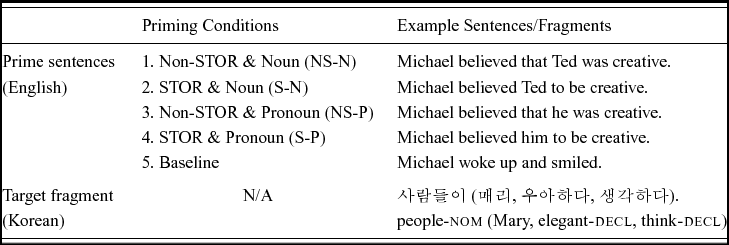
The critical materials consisted of 30 sets of five priming types of English sentences and one Korean target sentence fragment. An example of a critical item set is provided in Table 1, and a complete list of the critical item sets can be found in Appendix S in the Supporting Information online.
Example of Experimental Item Sets.

The five priming conditions were (1) Non-STOR with Pronoun (NS_P), (2) Non-STOR with Noun (NS_N), (3) STOR with Pronoun (S_P), (4) STOR with Noun (S_N), and Baseline. Of the three levels of the prime structures, STOR and non-STOR were further specified by syntactic category, yielding the first four priming conditions (i.e., NS-N, NS-P, S-N and S-P); the baseline level, however, was not further specified by syntactic category, simply because it could not be (see the description of the Baseline condition below in this section). As a result, this experiment had a design consisting of five priming conditions, rather than six (3 × 2) conditions, as Table 1 shows.
In the Non-STOR condition (i.e., NS_P and NS_N conditions), prime sentences employed a verb that allows the STOR operation (henceforth, a STOR verb) in the main clause and a finite embedded clause beginning with the complementizer that (e.g., Michael believed that Ted/he was creative ); in the STOR conditions (S_P and S_N conditions), sentences employed a STOR verb in the matrix clause, and the verb was followed by an infinitival clause (e.g., Michael believed Ted/him to be creative ). This study used four English STOR verbs (assume, believe, expect, and prove).
Sentences in the pronoun conditions (S_P and NS_P sentences) employed pronouns as the subject of the embedded clause in the non-STOR condition (e.g., Michael believed that he was creative) and as the object in the matrix clause in the STOR condition (e.g., Michael believed him to be creative), so that the subject and the object were overtly case-marked. Sentences in the noun conditions were generated by replacing the pronouns in the pronoun primes (e.g., he and him) with proper nouns (e.g., Ted) or common nouns (e.g., the boy), which were not overtly case-marked; however, the sentences otherwise remained the same as the sentences in the pronoun conditions. Furthermore, in the pronoun conditions, the pronoun paradigms of (i) I/me, (ii) he/him, and (iii) they/them were employed for clear and strong case-marking priming. In English, the nominative and accusative inflection forms for the second-person pronouns (singular and plural) are the same (both are you); also, the accusative and possessive forms for the singular female third-person pronoun are the same (both are her). Therefore, these pronouns were not used.
Lastly, sentences for the Baseline conditions were constructed with two intransitive verbs (e.g., Michael woke up and smiled). Consequently, baseline sentences did not contain any entity that was raised or that could be raised, disallowing them to be further specified by the Syntactic Category variable. This condition was included to reveal Korean–English bilinguals’ baseline preference between the STOR construction and the construction without STOR in Korean. Given that baseline sentences did not contain a STOR verb, these sentences were not expected to affect participants’ selection between the two alternate constructions in the subsequent target production in Korean. Each baseline sentence contained two intransitive verbs, so that it had the same number of verbs as the sentences for the other conditions.
On the other hand, there was only one type of Korean target fragments. A fragment began with the subject (a noun or pronoun with either a nominative case-marker -i/-ka or topic case-marker -un/-nun), which was followed by a set of parentheses containing three words: a proper noun (a person's name), an adjective, and a STOR verb (see [10] below). This constrained situation induced participants to produce sentences using the STOR verb either without or with the raising operation, as shown in (10b) and (10c), respectively.
-
(11)

In every critical item set, the English prime sentences and the Korean target fragment employed different raising verbs to rule out lexical boost effects. Previous studies have consistently showed that stronger priming occurs when prime and target sentences have the same verb in within-language contexts (e.g., Branigan, Pickering & Cleland, Reference Branigan, Pickering and Cleland2000; Gries, Reference Gries2005; Pickering & Branigan, Reference Pickering and Branigan1998), and when priming and target sentences have translation-equivalent or cognate verbs in cross-linguistic contexts (Cai et al., Reference Cai, Pickering, Yan and Branigan2011; Schoonbaert et al., Reference Schoonbaert, Hartsuiker and Pickering2007).
In addition to these critical item sets, there were 60 filler item sets. Each filler set consisted of an English sentence and a Korean sentence fragment, neither of which employed STOR verbs. Since it was the most crucial part of the experiment to see whether participants employed either the nominative/topic case marker or the accusative case marker, the Korean fragments of filler sets provided participants with the same number of obligatory conditions for their use of nominative/topic and accusative case markers, in order to preclude participants from having a bias toward either nominative/topic or accusative case. That is, to make acceptable Korean sentences, participants had to use the nominative/topic case marker in 30 filler fragments and the accusative case marker in the other 30 fragments.
With these 30 critical and 60 filler item sets, five lists were composed. The experimental items in these lists were counterbalanced in a Latin-Square design; consequently, six critical items in each of the five priming conditions (NS-N, NS-P, S-N, S-P, and Baseline), 30 critical items in total, were presented to each participant. Thus, for each item set, each participant saw a prime sentence only in one condition (among the five conditions). The five lists had the same 60 filler item sets.
These 30 sets of critical stimuli and 60 sets of filler stimuli were presented in pseudo-random order to each participant. A random order was first generated, and then this order was adjusted by the experimenter for a balanced distribution of the critical and filler stimuli. Through this process, critical items were always separated by at least one filler item. All the lists had identical sequences of experimental items and filler items.
Procedure
The participants first filled out a questionnaire about their language background. Then they sat at a computer and heard verbal instructions, which informed them that they would see a slide with a grammatical English sentence on the screen first, and a slide with a Korean sentence fragment later in each trial. They were instructed to read aloud and memorize the English sentence, and to repeat the sentence aloud when an immediately following blank slide appeared with a beep sound. Then a slide with a Korean sentence fragment followed, and participants were instructed to complete the fragment, making it a full and acceptable sentence. Instructions emphasized that participants could not change the order of the words in the set of parentheses, and requested them to speak out the first thing that came to mind. Participants were told that they could add morphemes such as particles or even other words so as to yield acceptable sentences. However, they were also encouraged to minimize additional words (not morphemes). In order to increase the similarity between the English (prime) part and the Korean (target) part, the experiment also provided a blank slide following the Korean slide, and required participants to memorize and repeat aloud the completed Korean sentence after the sound of the beep. After they went through the instructions, they completed three practice trials. The experimenter then asked whether or not the instructions were clear. If participants had no further questions, they were told to proceed to the experiment. All utterances that they produced were recorded.
Scoring
The critical target sentences that participants made from target fragments were scored based on their syntactic structures. In cases where participants produced more than one full sentence as their answer, the first full Korean sentence in the answer was scored. The produced sentences were scored as “STOR sentences” when the accusative marker -ul/-lul was attached to the proper noun given in the set of parentheses and the proper complementizer -ko was used. The utterances were scored as “non-STOR sentences” when either the nominative marker -i/-ka or the topic marker -un/-nun was attached to the proper noun and the proper complementizer -ko was employed. All other utterances were scored as “other constructions” and excluded from the analysis.
Results
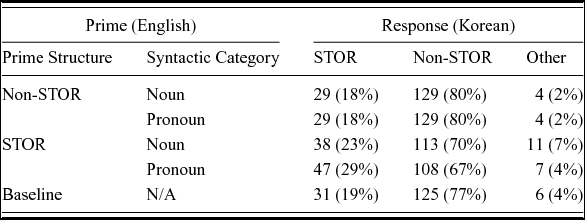
The participants produced 810 utterances. Among these utterances, 174 (about 21%) were STOR sentences, and 604 (about 75%) were non-STOR sentences, indicating that Korean–English bilinguals highly prefer the non-STOR construction to the STOR construction (see Table 2 for details). In addition, a very small number of sentences (32 out of 810, about 4%) were scored as other constructions, and omitted from the analyses.
Response Frequency and Percentage (in Parentheses) in each Prime Condition.

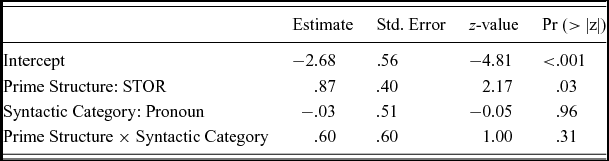
For the first analysis of the data, in order to explore the (potential) effects of the Syntactic Category variable (especially its interaction with the Prime Structure variable), the results from the Baseline condition, which was not further specified by this variable (i.e., Noun vs. Pronoun), were excluded. That is, only results from the NS-N, NS-P, S-N and S-P conditions were included. The data were analyzed by fitting a mixed effects logit (i.e., logistic regression) model (e.g., Baayen, Davidson & Bates, Reference Baayen, Davidson and Bates2008), using the lmer function from the lme4 package (Bates, Maechler & Dai, Reference Bates, Maechler and Dai2014) in the software R (R Core Team, 2016). The dependent variable was binary, namely, whether the produced Korean target for each trial was a Non-STOR sentence or a STOR sentence; in this model, the intercept reflects the overall preference for the STOR construction over the non-STOR construction. The model included as fixed factors Prime Structure (Non-STOR vs. STOR), Syntactic Category (Noun vs. Pronoun), and the interaction of Prime Structure and Syntactic Category. The reference levels of Prime Structure and Syntactic Category were Non-STOR and Noun, respectively. A random intercept was included for items, and a random intercept and a random slope for Prime Structure were included for participants. Including additional random slopes did not improve model fit (no significant difference was found between the assumed model and the models with additional random slopes), or resulted in models that did not converge. Therefore, a model only with random slopes for Prime Structure for participants is reported. Table 3 reports the results of the statistical analysis.
Results of the Linear Mixed-Effects Model for the Analysis Excluding the Baseline Condition Data.

Note. The reference level for Prime Structure was Non-STOR, and Noun for Syntactic Category
First, the significant negative intercept indicates that the Korean–English bilingual participants were significantly more likely to produce non-STOR sentences than STOR sentences in their responses in Korean, suggesting a strong preference for non-STOR sentences. Most importantly, the significant positive coefficient for Prime Structure indicates that the bilinguals produced STOR sentences more frequently when the English prime was a STOR sentence than when the prime was a non-STOR sentence. In other words, priming of the STOR construction occurred from English to Korean. The analysis did not, however, find a significant effect of the Syntactic Category variable: the non-significant coefficient indicates that whether the prime sentence employed a noun or pronoun per se did not encourage or discourage the bilinguals to produce STOR sentences. In addition, the interaction between Prime Structure and Syntactic Category did not reach significance. The non-significant coefficient indicates that the structural priming effect was not strengthened or weakened whether prime sentences employed a pronoun or a noun. Taken together, these results suggest that the case-marking in the STOR sentences played no role in the priming of the STOR construction.
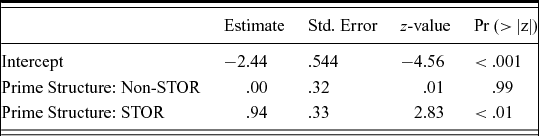
In a following analysis, the data from the Baseline condition (B) were included. As the previous analysis found no effect of the Syntactic Category variable, in this analysis, the two STOR conditions (i.e., S-N and S-P) and the two non-STOR conditions (i.e., NS-N and NS-P) were merged into a STOR and a Non-STOR condition, respectively. As a result, the analysis was conducted with only one independent variable, namely, Prime Structure, which consisted of three levels (Baseline vs. Non-STOR vs. STOR). For this analysis, we fitted another mixed effects logit model, using the lmer function again. In this model, the dependent variable was the same as in the previous model (Non-STOR response vs. STOR response). Prime Structure was entered as a fixed factor, setting Baseline as the reference level. A random intercept was included for items, and a random intercept and a random slope for priming type were included for participants. The results are given in Table 4 below.
Results of the Linear Mixed-Effects Model for the Analysis Including the Baseline Condition Data.

Note. The reference level for Prime Structure was Baseline
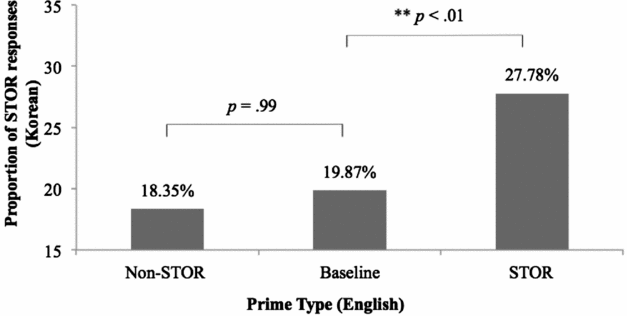
The significant negative intercept confirmed that in general the Korean–English bilinguals strongly preferred the non-STOR construction to the STOR construction. In addition, a significant structural priming effect was found again. The positive coefficient of Prime Structure: STOR indicates that the participants produced more STOR sentences in Korean after memorizing and repeating English STOR sentences than after memorizing and repeating English Baseline sentences (27.68% vs. 19.87%; see Figure 1). However, the results did not reveal a significant difference between the Baseline condition and the Non-STOR condition. The non-significant coefficient of Prime Structure: Non-STOR indicates that the bilinguals produced STOR sentences in the two conditions to comparable extents (19.87% vs. 18.35%; see Figure 1). This result also means that the participants produced non-STOR sentences in the Baseline condition (80.13%) as dominantly as in the non-STOR condition (81.65%), revealing no significant effect of non-STOR structure priming. It seems that the bilinguals had an overall strong preference for the non-STOR structure such that there was not much room left for non-STOR primes to encourage the use of the non-STOR structure.
Proportions of STOR sentences produced in the three priming conditions.

Taken together, the results of the statistical analyses show that overall the Korean–English bilinguals strongly preferred the non-STOR construction, but they were significantly less likely to produce non-STOR sentences and more likely to produce STOR sentences in Korean when they had just memorized and repeated a STOR sentence in English, suggesting that STOR priming occurs across English and Korean. The results also revealed that the structural priming effects were not influenced by the syntactic categories (i.e., noun vs. pronoun) of the raised or unraised entities in the English prime sentences, suggesting that the case-marking overlap between the STOR structures in English and Korean did not affect the STOR priming.
Discussion
The present study addressed several unresolved issues regarding the shared-syntax account. Specifically, the study investigated the issues of (1) whether priming of a syntactic structure can occur across languages despite surface word order difference, as long as both languages have the structure, and (2) whether we can generalize the shared-syntax view to different syntactic structures. In order to contribute to resolving these issues, we investigated whether structural priming occurs between English and Korean, using a syntactic structure that had not been tested yet in bilingual contexts, namely, the subject-to-object raising construction. As previously illustrated, this construction is formed in different surface word orders in the two languages. The results show that STOR priming occurred from English to Korean despite the word order difference, but do not show a case-marking overlap effect. These results provide further evidence that cross-linguistic structural priming is independent of word order, and lend further support to the claim that the shared-syntax account can be generalized to different syntactic constructions. The following subsections discuss these issues in detail.
Word-order difference and structural priming
The results of this study provide another piece of evidence that cross-linguistic priming of a syntactic construction can occur independently of word order. As previously discussed, finding cross-linguistic structural priming independent of word order is strong evidence that abstract syntactic representation – which is distinguished from surface structure – can be shared between languages. The results demonstrate that despite the word order difference, the STOR construction can be primed between Korean and English in bilinguals. The balanced Korean–English bilinguals tended to produce STOR sentences in Korean more frequently after being primed with STOR sentences in English than after being primed with sentences without STOR (i.e., non-STOR sentences and baseline sentences). As English and Korean STOR sentences have distinct word orders, this priming effect cannot be interpreted as an effect of surface word order. In addition, because no case-marking overlap effect (i.e., no effect of the Syntactic Category variable) was found in the experiment, this priming effect cannot be interpreted as a surface morphology priming effect. Taken together, these results suggest that the priming effects found in this experiment came from a shared abstract syntactic representation rather than from similarity of surface structures.
Therefore, this study's results discount the possibility that the previously found cross-linguistic priming of syntactic constructions that are formed in identical word orders in the languages (Chen et al., Reference Chen, Jia, Wang, Dunlap and Shin2013; Desmet & Declercq, Reference Desmet and Declercq2006; Shin & Christianson, Reference Shin and Christianson2009; Weber & Indefrey, Reference Weber and Indefrey2009) simply reflects similarity in surface structure. The results suggest rather that the basis of cross-linguistic priming is shared syntactic representations.
How, then, can we account for the studies that failed to observe cross-linguistic priming of a syntactic construction when it is formed in different word orders in the languages, such as Loebell and Bock's (Reference Loebell and Bock2003) and Bernolet et al.’s (Reference Bernolet, Hartsuiker and Pickering2007)? First, it should be noted that in Loebell and Bock's study, the effects of active/passive priming failed to reach significance, which they ascribed to the low statistical power of their within-language experiment. In this sense, the results of Loebell and Bock's study are not very convincing. Second, the results of Bernolet et al.’s study can be explained by the idea that cross-linguistic structural priming may be modulated by usage frequency of syntactic structures (Chen et al., Reference Chen, Jia, Wang, Dunlap and Shin2013; Shin & Christianson, Reference Shin and Christianson2009). In other words, it might be the case that priming of the complex noun structure tested in Bernolet et al.’s (Reference Bernolet, Hartsuiker and Pickering2007) study cannot occur because of its very low frequency in Dutch. This idea seems to be plausible if we assume that structural priming reflects the residual activation of syntactic representations that have just been accessed (Hartsuiker & Pickering, Reference Hartsuiker and Pickering2008), and that the residual activation is likely to fade away relatively faster when the representation has a low usage frequency than when it has a high usage frequency. Note that the Dutch (L1)–English (L2) bilinguals in Bernolet et al.’s (Reference Bernolet, Hartsuiker and Pickering2007) study rarely produced the complex noun structure with a relative clause in Dutch (e.g., 0.4% or 3 of 768 responses in Experiment 3a). This extremely low usage of the syntactic structure indicates that it may be highly infrequent in Dutch, compared to its alternative structure.
Generalizability of the shared-syntax account
The results of the present study also lend support to the idea that the shared-syntax account can be generalized to different syntactic constructions. The study found cross-linguistic priming of the STOR construction, which had not been used yet by structural priming studies. As mentioned earlier, most cross-linguistic structural priming studies tested priming of the alternate dative constructions (prepositional vs. double-object) and the alternate transitive constructions (active vs. passive), with few exceptions. The reason for this lack of variety seems to be that there are not many pairs of alternate constructions that are syntactically distinct, but semantically equivalent (or at least very similar). The present study provides researchers with an additional pair of such alternate syntactic constructions, which should enable more varied research on cross-linguistic structural priming. Since the STOR construction is also employed in other languages besides English and Korean, such as Japanese and Chichewa, with varying surface structures including different word orders (see O'Grady, Reference O'Grady2008, pp. 232–234), investigating STOR priming between these languages can provide further opportunities to test whether abstract syntactic representations can be shared between languages in bilinguals, despite surface structure differences.
Surface morphology priming effects
While this study found cross-linguistic priming of the STOR construction, it did not find any surface morphology priming effects between Korean and English. Overt case-marking in English prime sentences did not exert any influence on the structural priming effects. That is, the structural priming effects were neither triggered nor boosted by the case-marking overlap between English and Korean STOR sentences. This finding is in accordance with the finding that structural priming occurs independently of word order; both of them suggest that similarity of surface structure (e.g., identical word order or morphological overlap) does not have a central role in structural priming between languages, because cross-linguistic priming of a particular syntactic construction occurs via the shared abstract syntactic representation, rather than due to the similarity of its surface structures in the two languages. These results are also in line with the results of previous structural priming studies in within-language contexts (e.g., Bock, Reference Bock1989; Pickering & Branigan, Reference Pickering and Branigan1998). These studies showed that morphemes or closed-set words (e.g., auxiliary verbs such as be in English, or prepositions) do not have an effect on structural priming in general, suggesting that structural priming primarily relies on abstract syntactic representations rather than on surface forms (see Pickering & Ferreira, Reference Pickering and Ferreira2008, for a review). The absence of cross-linguistic case-marking priming effects in this study parallels these results.
A different interpretation, however, is possible: the failure to find case-marking overlap effects might have resulted from the sheer difference of the morphological case-marking systems of English and Korean. Pronouns in English are case-marked through suppletion, which causes an unpredictable form change, such as I → me or he → him; in contrast, nouns and pronouns in Korean are case-marked by suffixation without any form change in the base, as in John-i ‘John-nom’ or John-ul ‘John-acc’. Thus, it might be the case that case-marking overlap actually can boost structural priming, but only when the two languages have similar case-marking systems.
At this point, it seems that neither of the possibilities can be excluded. To the best of our knowledge, no previous study has explored case-marking or surface morphology effects on cross-linguistic structural priming. Moreover, only a few studies have examined case-marking priming in within-language contexts, and the results are inconsistent (Santesteban, Pickering & Branigan, Reference Santesteban, Pickering and Branigan2011; Yamashita, Chang & Hirose, Reference Yamashita, Chang and Hirose2005). Future research investigating surface morphology (including case-marking) effects on structural priming between languages with similar morphological systems may shed light on this issue.
The status of the subject-to-object raising construction in Korean
Thus far, we have interpreted the results under the assumption that the syntax of Korean STOR sentences is fundamentally analogous to that of English STOR sentences, such that Korean STOR sentences are counterparts of English STOR sentences (e.g., Hong, Reference Hong2005; Hong & Lasnik, Reference Hong and Lasnik2010; O'Grady, Reference O'Grady1991). Although this assumption is generally accepted, we acknowledge that there is a group of linguists with an alternative view. Pointing out distinct syntactic properties of the Korean STOR construction (e.g., in Korean, unlike in English, (1) the embedded clauses of the STOR construction are finite and (2) a range of non-subjects such as adverbs in the embedded clause can be raised to the subject position of the main clause), these linguists argue that apparent STOR sentences in Korean do not involve raising at all, and that the morpheme -lul in such sentences is not the accusative maker but simply a focus/topic marker (e.g., Hong, Reference Hong1990; Schütze, Reference Schütze2001).Footnote 8
Our study informs this debate on the formal analysis of Korean STOR sentences by providing psycholinguistic evidence for the view that at an abstract level, Korean STOR sentences and English STOR sentences have similar underlying structures (i.e., both involve raising of the subject of the embedded clause). If Korean STOR sentences had a fundamentally different syntactic representation than English STOR sentences (i.e., a representation that does not involve raising at all), the cross-linguistic priming found in this study would be difficult to interpret, because abstract syntactic representation forms the basis for structural priming in general (Pickering & Ferreira, Reference Pickering and Ferreira2008). Previous cross-linguistic structural priming studies have contributed to evaluating conflicting formal accounts of sentence structures (e.g., Meijer & Fox Tree, Reference Meijer and Fox Tree2003; Shin & Christianson, Reference Shin and Christianson2010), and the present study does so as well. We consider this aspect of our study to be meaningful in that it bridges formal linguistics and psycholinguistics, two disciplines that should be mutually informative in principle but often remain disconnected in reality.
Components of structural priming
As previously mentioned, the current literature suggests that abstract syntactic structure is a major source of structural priming. In addition, however, a few studies have demonstrated that other aspects of linguistic information also contribute to structural priming (e.g., lexical information: Pickering & Branigan, Reference Pickering and Branigan1998; semantic information: Griffin & Weinstein-Tull, Reference Griffin and Weinstein-Tull2003; pragmatic information: Bernolet et al., 2009). Importantly, the findings of these studies suggest that priming effects observed using structural priming paradigms may have other linguistic components in addition to the syntactic components.
Information (or conceptual) structures that entail semantic and pragmatic specifications of messages are of particular relevance to the current study (Bernolet et al., 2009; Griffin & Weinstein-Tull, Reference Griffin and Weinstein-Tull2003). As in English STOR sentences, the raised direct object tends to be topicalized in Korean STOR sentences (see Givón, Reference Givón1993, for English, and Hong, Reference Hong1990; Schütze, Reference Schütze2001, for Korean). Thus, the structural priming observed in this study may be pragmatic at least to some extent, rather than completely syntactic. Unfortunately, the present experiment does not allow us to tease apart the extent to which the structural priming effects we observed had syntactic or pragmatic sources. The experiment did not include a condition in which information structures were manipulated (with syntactic structure controlled) to distinguish pragmatic and/or semantic priming from syntactic priming; it was designed assuming that structural priming is syntactic in general, like previous cross-linguistic structural priming studies (the only exception that we know of is Bernolet et al.’s 2009 study). In order to better understand how syntactic and pragmatic/semantic knowledge contribute to structural priming in cross-linguistic contexts, future research needs to address its multi-componential nature.
Conclusion and future research
This study showed that despite the word order difference, the STOR construction can be primed between English and Korean, and that this structural priming is not affected by the case-marking overlap between STOR sentences of the two languages. These findings suggest that the syntactic representation of the STOR construction is shared between English and Korean. In addition, the findings serve as further supporting evidence that the shared-syntax account can be generalized to different syntactic structures.
As the present study considered only one direction of STOR priming (i.e., from English to Korean), it should be followed by testing priming in the other direction (i.e., from Korean to English). Furthermore, as briefly mentioned earlier, cross-linguistic experiments of other pairs of languages both of which employ the STOR construction, such as Japanese and Korean, would be meaningful. Because Japanese and Korean STOR sentences have the same surface structure (e.g., the same word order and the same case-marking pattern), comparing STOR priming between these languages with the results of the present study may lead us to better understanding of how the similarities or differences in the surface structures of a particular syntactic construction between two languages influence priming of the shared representation of the construction. Last but not least, to provide a final missing piece of evidence for the shared-syntax account, future investigations should attempt to demonstrate that priming does not occur across languages when the prime and target sentences share linear order but not underlying abstract syntactic representations.
Supplementary Material
For supplementary material accompanying this paper, visit https://doi.org/10.1017/S1366728916001152