Introduction
According to community studies, one-third of persons diagnosed with dementia live alone (Ebly et al.,Reference Ebly, Hogan and Rockwood1999; Tuokko et al., Reference Tuokko, MacCourt and Heath1999; Prescop et al., Reference Prescop, Dodge, Morycz, Schulz and Ganguli1999; Schneider et al., Reference Schneider2002; Sibley et al., Reference Sibley2002). PWD living alone are predominantly widowed women but are less cognitively and functionally impaired than those living with others (Wenger, Reference Wenger1994; Ebly et al., Reference Ebly, Hogan and Rockwood1999; Tuokko et al., Reference Tuokko, MacCourt and Heath1999; Prescop et al., Reference Prescop, Dodge, Morycz, Schulz and Ganguli1999; Sibley et al., Reference Sibley2002). They can be divided into two different groups: those who live alone but receive help from a family carer who visits them or is in contact with them by phone (a “long distance carer”), and PWD who live alone with no identifiable carer. In contrast to PWD living with others, who are mainly cared for by spouses, most caregivers of those living alone are adult children (Ebly et al., Reference Ebly, Hogan and Rockwood1999; Tuokko et al., Reference Tuokko, MacCourt and Heath1999, Moriarty and Webb, Reference Moriarty and Webb2000). Between 3% and 30% of PWD in the community have been reported as having no identifiable carer (Wenger, Reference Wenger1994; Gordon et al., Reference Gordon, Carter and Scott1997; Tuokko et al., Reference Tuokko, MacCourt and Heath1999). The differences between studies are due mainly to the different criteria used to determine who is considered as a carer.
PWD living alone are also less likely to use health services (Nelson et al., Reference Nelson, Livingston, Knapp, Manela, Kitchen and Katona2002; Reference Nelson, Fernandez, Livingston, Knapp and Katona2004; Schneider et al., Reference Schneider2002) and more likely to get help from social services such as home-delivered meals, homecare services and day care compared to those living with others (Webber et al., Reference Webber, Fox and Brunette1994; Livingston et al., Reference Livingston, Manela and Katona1997; Ebly et al., Reference Ebly, Hogan and Rockwood1999; Tuokko et al., Reference Tuokko, MacCourt and Heath1999; Moriarty and Webb, Reference Moriarty and Webb2000; Nelson et al., Reference Nelson, Livingston, Knapp, Manela, Kitchen and Katona2002; Reference Nelson, Fernandez, Livingston, Knapp and Katona2004; Schneider et al., Reference Schneider2002; Larsson et al., Reference Larsson, Thorslund and Forsell2004).
Meaney et al. (Reference Meaney, Croke and Kirby2005) carried out a needs assessment in a sample of 82 community-dwelling PWD who were seen in a psychiatry of old age service and found that those who lived alone had a higher mean of total unmet needs and significantly more unmet needs in thinking/memory, housework, and community living domains compared with those living with others.
Finally, it has been shown that living arrangements are related to potential risk in older people with cognitive impairment. According to clinicians, PWD living alone in their homes are at risk in the following areas: nutrition, money management, medication management, hygiene and falls (Tuokko et al., Reference Tuokko, MacCourt and Heath1999; Tierney et al., Reference Tierney, Snow, Charles, Moineddin and Kiss2007). The extent to which these risks are a problem may depend on the level of support actually received by the PWD living alone.
In summary, prior investigations have found that PWD who live alone in the community have a high risk of unmet needs. The aims of the current study were to identify met and unmet needs of PWD living alone and to compare the needs of PWD living alone versus those living with others. We aimed to replicate the previous report that PWD living alone have significantly more unmet needs than those living with others (Meaney et al., Reference Meaney, Croke and Kirby2005), in a larger sample, using an alternative valid and reliable needs assessment measure and to examine the predictors of unmet need. Furthermore, we aimed to clarify the roles and adequacy of informal and formal support in meeting the needs of PWD living alone.
Methods
The staff of the services which agreed to collaborate with the study were given information about this research verbally and in writing and were requested to identify any potential participants. The manager or appropriate member of staff was requested to make a first approach, either with the PWD's carers or the PWD themselves (depending on dementia severity and/or living situation), to give them the Information Sheet and to discuss if they were willing to be approached by the researcher regarding this study. Subjects who had no objection were contacted by the researcher and were given more information about the study as required. If the potential participant agreed to be involved, the researcher arranged a day for the interview, which was carried out by an experienced clinical psychologist or an old age psychiatrist trained to undertake the assessment. All the interviews with PWD were carried out in their homes. Some interviews with carers were undertaken either at the PWD's home, their own home or at a health centre (e.g. memory clinic, day hospital). Informed consent/assent was gained for all participants according to a protocol approved by East London and the City HA Research Ethics Committee 3.
A total of 152 PWD living at home and 128 informal carers were recruited from health and social services, and from voluntary organizations in north-east London, Cambridgeshire and Liverpool. The majority of PWD (129, 84.9%) were recruited from National Health Service (NHS) facilities and the rest (23, 15.1%) were recruited from other organizations.
PWD were included in the study if they were aged 60 years or over, had a diagnosis of dementia according to DSM-IV and were living at home (not in institutions). A person was considered an informal carer (spouse, relative, friend or neighbor) when he/she was knowledgeable about the PWD and spent a minimum of four hours a week in direct contact with them. Only one person who met the inclusion criteria stated above could be considered the informal carer; thus, for each PWD only one carer was interviewed. Twenty-four PWD did not have an available carer and consequently no carer-provided information was collected. In order to make comparisons between PWD living with others versus PWD living alone, a sample was recruited similar to those obtained from previous community studies of dementia in terms of living situation, i.e. 65% of participants living with another person and 35% living alone.
Measures
Camberwell Assessment of Need for the Elderly
The Camberwell Assessment of Need for the Elderly (CANE) (Reynolds et al., Reference Reynolds2000; Orrell and Hancock, Reference Orrell and Hancock2004) is a comprehensive tool which offers a structured evaluation of needs in older people. The instrument covers 24 areas of social, psychological, physical, and environmental needs related to the PWD. The areas listed are:
• accommodation
• looking after the home
• food
• self-care
• caring for someone else
• daytime activities
• memory
• eyesight/hearing/communication
• mobility/falls
• continence
• physical health
• drugs
• psychotic symptoms
• psychological distress
• information
• deliberate self-harm
• accidental self-harm
• abuse/neglect
• behavior
• alcohol
• company
• intimate relationships
• money/budgeting
• benefits
The CANE is based on the notion that identifying a need implies identifying a problem and a potential intervention to solve that problem – and consequently to meet the need. The CANE comprises four sections: Section 1 assesses whether there is currently a need in the specific area. Needs are rated as no need (score 0), met need (score 1), unmet need (score 2) or unknown (score 9) for each area. When Section 1 is rated as 1 or 2, Sections 2–4 should be completed. Section 2 of the CANE asks about informal support received from family, friends or neighbors. Section 3 covers formal support actually received from local services and asks about the formal support the interviewer feels the patient requires. Section 4 asks if the person who is making the rating (in this study, the researcher) considers that the patient is receiving the most appropriate type of help with the problem. The same section also asks about the patient's satisfaction with the support they are receiving. The CANE has shown good levels of reliability (α = 0.99) and validity (correlated with the CAPE-BRS, r = 0.66; and the Barthel r = −0.53) (Reynolds et al., Reference Reynolds2000). Furthermore, this tool assesses the needs of older people from the perspective of the patient, the carer, the staff and the researcher, which allows a comparison of these different views. In this article only researcher ratings of needs were included. Researchers were trained by an expert (MO) to undertake the interviews using the CANE (Orrell and Hancock, Reference Orrell and Hancock2004) and their ratings were based on their own views about the PWD's situation. Pilot interviews were discussed and agreement in rating criteria was achieved particularly for complex cases.
Mini-mental State Examination
The Mini-mental State Examination (MMSE; Folstein et al., Reference Folstein, Folstein and McHugh1975) is a brief test that assesses severity of cognitive impairment, including orientation, memory and attention. The MMSE has been widely used in clinical and research practice (Burns et al., Reference Burns, Lawlor and Craig2004). This instrument was completed by the researcher in an interview with the PWD.
Neuropsychiatric Inventory
The Neuropsychiatric Inventory (NPI; Cummings et al., Reference Cummings, Mega, Gray, Rosenberg-Thompson, Carusi and Gornbein1994) is a structured interview designed to assess a broad range of behavioral and psychological symptoms commonly encountered in PWD (Cummings et al., Reference Cummings, Mega, Gray, Rosenberg-Thompson, Carusi and Gornbein1994). This tool has shown high internal consistency reliability (Cummings, Reference Cummings1997). The NPI was rated by the researcher in an interview with the carer.
Physical Self-maintenance Scale and Instrumental Activities of Daily Living Scale
The Physical Self-maintenance Scale (PSMS) (Lawton and Brody, Reference Lawton and Brody1969) assesses functional status through a rating made by the person or an informant about the person's ability to perform basic activities of daily living (ADL) independently. The instrumental activities of daily living (IADL) scale has been designed to evaluate more complex daily tasks which reflect environmental adaptation (Lawton and Brody, Reference Lawton and Brody1969). The PSMS and IADL were rated by the researcher in an interview with the carer.
Quality of Life in Alzheimer's Disease
The Quality of Life in Alzheimer's Disease (QoL-AD; Logsdon et al., Reference Logsdon, Gibbons, Mc Curry and Teri1999) measures quality of life in PWD, including areas such as physical health, energy, mood, living situation, memory, family, marriage, friends, self as a whole, ability to do chores around the house, ability to do things for fun, money and life as a whole. The scale includes the PWD and caregiver report. The QoL-AD has shown good levels of reliability and validity (Logsdon et al., Reference Logsdon, Gibbons, Mc Curry and Teri1999; Thorgrimsen et al., Reference Thorgrimsen2003). The QoL-AD PWD version was administered by the interviewing the PWD and the carer version was self-completed by the carer.
Practitioner Assessment of Network Typology
The Practitioner Assessment of Network Typology (PANT; Grant and Wenger, Reference Grant and Wenger1993) was developed to assess older people's support networks. The instrument comprises eight items about three main features: availability of local close kin, level of involvement of family friends and neighbors, and the level of interaction with the community and voluntary groups. Thus, networks are characterized into five main types:
• Local family dependent support network. Includes close local family ties with a few peripheral friends and neighbors. It is a small network (1–4). Older people in this network generally live very near to or in co-residence with an adult child; they are less likely to be in good health; and their community involvement is low.
• Locally integrated support network. This is the most common and the most robust network. It is composed of local family, friends and neighbors; is larger than average (+7) and implies high levels of community involvement. This network is related to the fewest risks.
• Local self-contained support network. Reliance is mainly on neighbors and occasional contact with at least one relative more than five miles distant. This network is of average size (5–6). Community involvement, if any, is low. Risks are associated with concern for privacy.
• Wider community-focused support network. It is characterized by the absence of local kin. This network includes mainly friends living within 5 miles, some neighbors, and family living more than 50 miles away. The size of this network is larger than average (+8). Community involvement is usually high.
• Private restricted support network. It is associated with absence of local kin other than the spouse. This network is composed of relatives who live more than 50 miles away and is smaller than average. Usually comprises two subtypes: independent married couples and older people who have withdrawn or become isolated from local involvement. It includes minimal contact with neighbors and no community involvement. Members of this network are most at risk.
The PANT was rated by the researcher in an interview with the PWD and the carer.
Client Service Receipt Inventory
The Client Service Receipt Inventory (CSRI; Beecham and Knapp, Reference Beecham, Knapp and Thornicroft1992) collects retrospective information about the patient and the carer such as accommodation, medication, income and expenditure, hospitalization and services received by the patient during the last three months. The CSRI has been widely used and has been proved useful in assessing care receipt service and the associated costs (Schneider et al., 2003; Nelson et al., Reference Nelson, Fernandez, Livingston, Knapp and Katona2004). The CSRI was rated by the researcher in an interview with the carer.
Hospital Anxiety and Depression Scale
The Hospital Anxiety and Depression Scale (HADS; Zigmond and Snaith, Reference Zigmond and Snaith1983) is a self-administered instrument which is divided into two subscales: anxiety (HADS-A) and depression (HADS-D), each including seven items. It has good reliability and validity for measuring anxiety and depression in carers (Bjelland et al., Reference Bjelland, Dahl, Haug and Neckelmann2002). The HADS was self-completed by the carer.
Burden Interview
The Burden Interview (BI; Zarit et al., Reference Zarit, Reever and Bach-Peterson1980) comprises 22 questions about the impact of the patient's disabilities on the carer's life. For each item, caregivers are asked to indicate how often they have felt that way. Reliability has been estimated at 0.71 and 0.91, and validity has been estimated at 0.71 (Whitlatch et al., Reference Whitlatch, Zarit and Eye1991). The BI was self-completed by the carer.
Data analysis
Statistical analyses were undertaken using the SPSS 15.0 software package (SPSS, 2006). In general the significance level used was p < 0.05, which was adjusted accordingly for multiple comparisons. Since needs (met and unmet) were not distributed normally, non-parametric tests were performed. For a better understanding of the results, when comparing groups, means instead of ranks are showed.
Results
Characteristics of people with dementia by living situation
Demographics
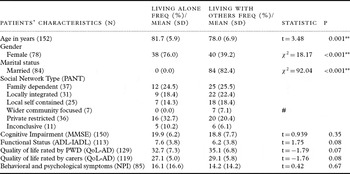
The characteristics of PWD living alone and of those living with others are shown in Table 1. PWD living alone were significantly older than those living with others. Also, significantly more women than men were living alone. PWD living alone (28, 93.3%) were more likely to be looked after by someone other than a spouse (mainly children) (χ2 = 56.1, p < 0.01) while most of those living with others were cared for by a spouse (80, 81.6%).
Characteristics of people with dementia by living situation

PANT = Practitioner Assessment of Network Typology; MMSE = Mini-mental State Examination; ADL = activities of daily living; IADL = instrumental activities of daily living; PWD = people with dementia; QoL = quality of life; AD = Alzheimer's disease; NPI = Neuropsychiatric Inventory.
**p < 0.01; *p < 0.05; χ2 = chi square; U = Mann-Whitney test; # χ2could not be calculated.
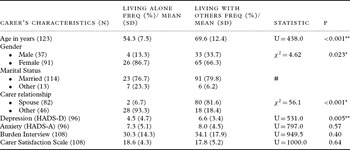
Carer's characteristics by PWD's living situation are shown in Table 2. Carers of PWD living alone were significantly younger (M = 54.3, s.d. 7.5) than those living with others (M = 69.6, s.d. 12.4) (t = −8.0, p < 0.01). Also, significantly more women (26, 86.7%) than men (4, 13.3%) were caring for a PWD living alone (χ2 = 4.62, p < 0.05). Carers of PWD living alone scored significantly lower for depression (M = 4.5, s.d. 4.7) compared to carers of PWD living with others (M = 4.5, s.d. 4.7) (t = −2.0, p < 0.05).
Carer's characteristics by the living situation of those with dementia

**p < 0.01; * p < 0.05; χ2 = chi square; U = Mann-Whitney test; # χ2 could not be calculated.
HADS –A = Hospital Anxiety and Depression Scale (anxiety); HADS-D = Hospital Anxiety and Depression Scale (depression).
Social networks
The most common social networks found among PWD living alone were private restricted (16, 32.7%), family dependent (12, 24.5%), and locally integrated (9, 18.4%). None of them had a wider community-focused network. For PWD living with others, the most frequent networks found were family dependent (25, 25.5%), locally integrated (22, 22.4%), and private restricted (20, 20.4%). There were no significant differences in the amount of community involvement (social networks) by living situation (alone vs with others).
Clinical characteristics
The total sample had a mean MMSE score of 19.1 (s.d. 7.2) indicating moderate cognitive impairment. Almost half of participants (71, 47.3%) had a mild level of cognitive impairment (MMSE >21), 57 (38%) had moderate cognitive impairment (MMSE 11–20), and 22 (14.7%) had severe cognitive impairment (MMSE 0–10). Although those living alone had a slightly higher MMSE score (19.9 vs 18.8), this difference was not significant (p = 0.35). No significant association was found between cognitive impairment and the number of unmet needs rated by the researcher (H(2) = 2.09; p = 0.35).
Participants living alone had lower levels of dependency (PSMS-IADL score) (M = 7.6, s.d. 3.8), a higher number, frequency and severity of behavioral and psychological symptoms (NPI score) (M = 16.6, s.d. 16.6) and a lower self-reported (M = 32.7, s.d. 7.3) and carer-reported (M = 27.1, s.d. 5.0) quality of life than those living with others (M = 36.2, s.d. 3.8; M = 14.2, s.d. 14.2; M = 35.1, s.d. 5.8; and M = 29.1, s.d. 5.8, respectively). However, none of these differences were significant (see Table 1).
The needs of people with dementia living alone vs living with others
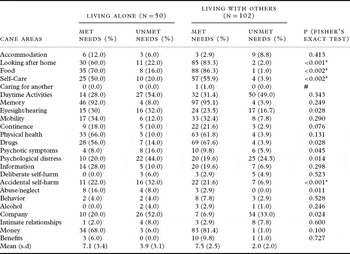
In total, PWD living alone had 552 needs. Of these, 355 (64.3%) were met and 197 (35.7%) remained unmet. The mean total number of needs was 11.04 (s.d 3.8, range 3–19), and of these 7.1 were met needs (s.d. 3.4, range 1–17) and 3.9 were unmet needs (s.d. 3.1, range 0–11). PWD living with others had 970 needs. Of these, 766 (79.0%) were met and 204 (21.0%) unmet. The mean total number of needs for PWD living with others was 9.51 (s.d 3.0, range 3–16), and of these 7.5 were met needs (s.d. 2.5, range 2–14) and 2.0 were unmet needs (s.d. 2.0, range 0–7).
Overall, PWD living alone had significantly more unmet needs (M = 3.9, s.d. 3.1) than those living with others (M = 2.0, s.d. 2.0) (U = 1578, p < 0.01). The mean number of met needs was lower for participants living alone (M = 7.1, s.d. 3.4) compared to those living with others (M = 7.5, s.d. 2.5), but this difference was not significant (U = 2273, p = 0.27).
The frequency of CANE met and unmet needs by area by living situation are shown in Table 3. The most frequent unmet needs for PWD living alone were daytime activities (27, 54.0%), company (26, 52.0%), psychological distress (22, 44.0%), eyesight/hearing (16, 32.0%), and accidental self-harm (16, 32.0%). The most common unmet needs for PWD living with others were daytime activities (50, 49.0%), company (34, 33.0%), psychological distress (25, 24.5%), and eyesight/hearing (17, 16.7%).
Frequency (%) of met and unmet needs by people with dementia's living situation

*p < 0.002; # No statistics were computed because “Caring for another” was a constant.
Table 3 shows that PWD living alone had significantly more unmet needs than those living with others in the areas of looking after home (χ2 = 17.23, p < 0.001), food (χ2 = 13.91, p < 0.002), self-care (χ2 = 10.23, p < 0.002) and accidental self-harm (χ2 = 16.51, p < 0.001).
Predictors of unmet needs
In order to determine predictors of unmet needs by living situation (alone vs. with others) a multiple linear regression analysis for each group was performed. The number of unmet needs was entered as the dependent variable and the variables that were significantly associated with unmet needs by living situation were entered as independent variables. In the regression model for PWD living alone, the patient's quality of life rated by carers (rs = −0.493, p < 0.01), behavioral and psychological symptoms (NPI score) (rs = 0.789, p < 0.01) and carer's anxiety (rs = 0.421, p < 0.01) were entered as independent variables. For PWD living alone, the number of unmet needs was predicted only by NPI score. Thus, PWD with more behavioral and psychological symptoms were more likely to have a higher number of unmet needs. This model explained 63% of the variance in unmet needs of PWD living alone (F = 22.4, p < 0.01, R2 = 0.63). In the regression model for PWD living with others, carer's age (rs = −0.265, p < 0.01), self-rated patient's quality of life (rs = −0.252, p < 0.05), behavioral and psychological symptoms (NPI score) (rs = 0.433, p < 0.01) and carer's type of relationship with the PWD (spouse/others) (rs = 0.247, p < 0.05) were entered as independent variables. For PWD living with others, the number of unmet needs was predicted by NPI score and carer's age. Thus, PWD with a higher number of behavioral and psychological symptoms and those cared for by a younger carer were more likely to have a higher number of unmet needs. This model explained 31% of the variance in unmet needs of PWD living with others. (F = 12.2, p < 0.01; R 2 = 0.31).
Services and informal help received
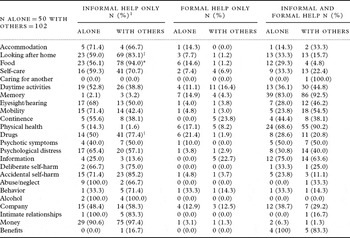
Services and informal help received by living situation are shown in Table 4. In general, PWD living alone were receiving significantly more formal services (M = 8.8, s.d. 4.5) than those living with others (M = 6.9, s.d. 4.6) (U = 495.5, p < 0.05). The most common services used by PWD living alone were outpatient services (18, 60.0%), psychiatrist sessions (16, 55.2%), general practitioner appointments (16, 53.3%), and home care (16, 45.7%). Significantly more PWD living alone (16, 45.7%) had received the help from a home care worker, compared to those living with others (10, 12%) (χ2 = 16.24, p < 0.001). Also, more PWD living alone (9, 26.5%) than with others (1, 1.2%) had used the meals-on-wheels service (χ2 = 19.70, p < 0.001). In addition, PWD living alone were receiving significantly less informal help in the areas of food (p < 0.001), looking after the home (p < 0.001) and drugs (p < 0.001).
Help for needs received by living situation

1 n indicates the number of needs (met and unmet) by living situation and % indicates the percentage of help (informal, formal or both) received by living situation.
*p < 0.0001, †p < 0.005, ‡p < 0.01 Fisher Exact Test.
Whether PWD were living alone or with others, help was mainly provided either by family and friends only or by family/friends along with services. Most help with needs relating to alcohol (6, 100%), money (104, 95.4%), abuse/neglect (11, 91.7%), intimate relationships (6, 87.5%), food (101, 81.4%), accidental self-harm (38, 79.2%), looking after home (92, 75.5%), deliberate self-harm (5, 71.4%), accommodation (9, 69.2%), drugs (55, 67.9%), self-care (59, 67.0%), psychological distress (35, 53.8%) and behavior (6, 60%) was provided by family and friends only. Most participants were receiving help from family/friends along with services in the areas of benefits (9, 90%), memory (125, 89.2%), physical health (79, 82.3%), and information (26, 68.4%). In both groups, help in the areas with the most common unmet needs (company, psychological distress and eyesight/hearing) came from family and/or friends, except for daytime activities where support was shared between informal and formal sources.
Discussion
This study compared the unmet needs of PWD living at home alone versus those living with others, and is the first study to identify how formal and informal help met or did not meet those needs by considering these needs from the perspective of both the PWD and the carer. The hypothesis that PWD living alone would have significantly more unmet needs than those living with others was supported.
The demographic characteristics of PWD living alone and the carers of this sample were similar to those reported in previous studies. PWD living alone were mainly widowed (88%) women (76%), older than those living with others (Webber et al., Reference Webber, Fox and Brunette1994; Ebly et al., Reference Ebly, Hogan and Rockwood1999; Tuokko et al., Reference Tuokko, MacCourt and Heath1999). Carers of PWD living alone were mostly children (70%) and more likely to be younger compared to carers of PWD living with others (Tuokko et al., Reference Tuokko, MacCourt and Heath1999; Ebly et al., Reference Ebly, Hogan and Rockwood1999). Consistent with the literature, PWD living alone were slightly less cognitively and functionally impaired than those living with others. In line with Ebly et al.(Reference Ebly, Hogan and Rockwood1999), carers of PWD living alone were significantly less likely to be depressed and had lower levels of burden than those living with others.
The most common social network types found for PWD living alone were private restricted (36.4%), followed by family dependent (27.3%). According to Wenger (Reference Wenger1994), PWD who have a private restricted network and no spouse/partner are at high risk – in this network type the dementia could remain hidden or unrecognized for a long time. Therefore, in this study, more than a third of PWD living alone were at high level of risk of social isolation.
In the U.K., formal support for people with dementia living at home is provided by the health and social care systems. The services available and the way they are organized may vary across the country. The most common health services include general practitioners, specialist old age psychiatry consultants, community psychiatric nurses and memory clinics. Social Services Departments arrange support from social workers, home care (support with general domestic tasks and with self-care), meals on wheels (home-delivered meals), day care (support with leisure activities), and respite care (a short break away from the carer). The voluntary sector offers different kinds of support for the person with dementia and their carer including: information, advocacy, support groups, as well as training, campaigning and funding for research in the field of dementia. Despite a wide range of services available, the coordination between different agencies involved in community care is not always efficient, leading to people with dementia having their needs unmet. It is known that service usage is determined by service availability in the locality where people live. Thus, results found in this study may not be completely generalizable to other regions. However, as Knapp et al. state, there are some common elements in the community care of people with dementia living in developed countries such as “needs assessment, counselling and advice, self-help support groups, respite care, crisis management, support centres, day programmes, support for people in their own homes (‘home care’,including home help, meals, and community nursing), residential and nursing home provision, and – increasingly – a range of housing-with-support services (such as sheltered housing, ‘extra-care housing’ and some retirement communities)” (Knapp et al., Reference Knapp, Comas-Herrera, Somani and Banerjee2007a, p. 14).
In terms of the specific services received by PWD living alone, the findings were similar to previous studies (Tuokko et al., Reference Tuokko, MacCourt and Heath1999; Ebly et al., Reference Ebly, Hogan and Rockwood1999; Moriarty and Webb, Reference Moriarty and Webb2000; Schneider et al., Reference Schneider2002), with PWD living alone being more likely to use home care and home delivered meals compared to those living with others. Using the CSRI in a clinical sample, Schneider et al. (Reference Schneider2002) found that significantly fewer PWD living alone had seen a psychiatrist and GP or had used respite sitting. In the present study, the patterns were similar but these differences were not significant. Most PWD from this sample were recruited from memory clinics and psychiatrist consultations so they were quite likely to have seen a specialist over the last three months. However, in line with Schneider et al. (Reference Schneider2002), nobody living alone had used respite sitting services. Since carers of PWD living alone were not co-residents and consequently spent less hours caring for the PWD, they were less likely to use this kind of service which mainly focuses on helping carers by providing respite out of the home.
Overall, areas of unmet needs were similar, regardless of the living arrangements of the PWD, but PWD living alone had more unmet needs in the areas of looking after the home, food, self-care and accidental self harm. The results of this study support what clinicians in the study by Tuokko et al. considered as more risky areas since PWD living alone were found to have either significantly higher unmet needs in the areas of food (nutrition), self-care (hygiene), and accidental self-harm (fire) or at least a higher number of unmet needs in areas of money (money management), drugs (medication management), and mobility (falls).
Behavioral and psychological symptoms (BPSD) were the only predictor for unmet needs of PWD living alone, explaining almost two-thirds of the variance. This variable was also the most important predictor for unmet needs of PWD living with others. This highlights the importance of carrying out appropriate assessment and intervention focused on reducing the number of BPSD. By doing this, the number of unmet needs, particularly of those living alone, could be reduced.
Meaney et al. (Reference Meaney, Croke and Kirby2005) found that PWD living alone had significantly more unmet needs, as measured by the CarenapD, than those living with others in the domains of thinking/memory, housework and community living (including taking and obtaining medication, shopping and ability to do snacks, transport, using the phone, smoking, alcohol, and managing finances). There are differences between the CANE and CarenapD. Only some of the domains measured by the CarenapD are similar to the areas considered on the CANE; thus, the results may not be directly comparable. The present study, in line with Meaney et al. (Reference Meaney, Croke and Kirby2005), found that PWD living alone had higher unmet needs in the area of looking after the home (housework in the CarenapD) and food (which are included in the CarenapD domain of community living). Nevertheless, no differences were found for memory (thinking/memory in the CarenapD) or for other areas considered in the domain of community living, such as alcohol and money. In contrast, in the present study's sample, PWD living alone had significantly higher psychological (psychotic symptoms and psychological distress) and social unmet needs (abuse/neglect and company). In Tuokko et al. (Reference Tuokko, MacCourt and Heath1999), perception of risk by clinicians was assessed from patient files, so it was not surprising that they focused mainly on physical and environmental factors.
Most of the help received by PWD living at home came only from informal sources (family and friends). This supports previous evidence that the family is the main source of support for PWD living at home (Wenger, Reference Wenger1994; Schneider et al., Reference Schneider2002). Services were used in only a few areas such as memory, physical health, information and benefits, where relatives felt specialized assistance was required. Informal help was also the main source of support for the most frequently unmet areas, such as company, psychological distress and eyesight/hearing. This could suggest that even though family and/or friends actually provide most of the support for PWD, this is not enough or is not the appropriate help to meet their needs.
This study has limitations. Since this was a cross-sectional study, causality cannot be established from the results. The sample was not intended to be an epidemiological sample. Since one of the main aims of this study was to compare the needs of PWD living at home by living situation (alone vs with others), the sample was stratified so as to consider this factor. Since most of the sample had mild (47.3%) or moderate (38.0%) cognitive impairment, the results may be less applicable to people living at home with severe cognitive impairment. Fratiglioni (Reference Fratiglioni, Wimo, Jonsson, Karlsson and Windblad1998) has estimated that 30% of people with dementia living in the community have mild dementia, 40% have moderate dementia, and 30% have severe dementia. However, this distribution of dementia severity includes people living in residential care. The fact that the sample in this study has a smaller proportion (14.7%) than Fratiglioni's findings for people with severe cognitive impairment is congruent with the fact that the proportion of people with dementia living in institutions increases with dementia severity and age (Knapp et al., Reference Knapp2007b). Almost all the participants were white, so the results may not be applicable to ethnic minorities. Furthermore, the sample in this study was recruited from clinical service providers and consequently the results cannot be generalized to PWD living at home who have not been in contact with services. Future research could consider an epidemiological population-based sample in order to reflect the prevalence of needs, including ethnic minorities and PWD who are not in contact with services, thereby making the results more generalizable.
In conclusion, in line with the main hypothesis of this study, PWD living alone had significantly more unmet needs than those living with others and they also had significantly higher unmet needs in the areas of looking after the home, food, self-care, and accidental self-harm. PWD living alone had also a high level of unmet needs in areas such as eyesight/hearing, drugs, psychotic symptoms, psychological distress, abuse/neglect, and company. In those living alone, the most common social network was private restricted, which is a high risk network type. Although PWD living alone were using more home-delivered meals and home care services compared to those living with others, they still had more unmet needs in the areas of food, self-care and drugs (medication management). This could indicate that the services available to meet these needs did not provide the right sort of help or not to the extent that was necessary. Because PWD living alone have more unmet needs and are more isolated it is important that policy-makers and services recognize the very special situation of this vulnerable and high risk group.
Conflict of interest
None.
Description of authors' roles
CM and MO designed the study. CM collected data, carried out the statistical analyses and drafted the paper. All the authors contributed to the interpretation of data, reviewed the paper and approved the final version.
Acknowledgments
We are grateful to all the staff and participants in Peterborough, London, Cambridge and Liverpool who took part in this study, particularly to Dr. Charles Olojugba, Dr. Sabu Oomman, and Dr. Kumari Galboda who interviewed one-third of the participants of this study. We would also like to thank Clare Wenger and Anne Scott who provided the “Support network type algorithm” version1.2 to classify social network types. CM's doctoral studies were made possible by the sponsorship of the Chilean National Scholarship for Graduate Studies “Presidente de la República”.