INTRODUCTION
Except observed falls, meteorites are typically found long after they fell on Earth, therefore their original composition, and possibly also their physical properties have been already changed by terrestrial processes before their discovery. In the last decades, there have been many studies investigating and quantifying weathering processes in meteorites (e.g., Bland et al. Reference Bland, Smith, Jull, Berry, Bevan, Cloudt and Pillinger1996, Reference Bland, Sexton, Jull, Bevan, Berry, Thornley, Astin, Britt and Pillinger1998; Lee and Bland Reference Lee and Bland2004; Al-Kathiri et al. Reference Al-Kathiri, Hofmann, Jull and Gnos2005; Bland et al. Reference Bland, Zolensky, Benedix and Sephton2006, Zurfluh et al. Reference Zurfluh, Hofmann, Gnos, Eggenberger and Jull2016) and studying their terrestrial ages (e.g. Jull et al. Reference Jull, Wlotzka and Donahue1991, Reference Jull, McHargue, Bland, Greenwood, Bevan, Kim, LaMotta and Johnson2010; Jull Reference Jull2001, Reference Jull2006). For example, the connection between degree of weathering and terrestrial age was studied by, e.g., Jull et al. (Reference Jull, Wlotzka, Palme and Donahue1990), Al-Kathiri et al. (Reference Al-Kathiri, Hofmann, Jull and Gnos2005), Bland et al. (Reference Bland, Smith, Jull, Berry, Bevan, Cloudt and Pillinger1996, Reference Bland, Sexton, Jull, Bevan, Berry, Thornley, Astin, Britt and Pillinger1998), and Zurfluh et al. (Reference Zurfluh, Hofmann, Gnos, Eggenberger and Jull2016). However, there is no universal correlation (e.g., Jull et al. Reference Jull, Donahue, Cielaszyk and Wlotzka1993, Reference Jull, McHargue, Bland, Greenwood, Bevan, Kim, LaMotta and Johnson2010) and the results can only be applied to local populations for certain meteorite groups. By way of example, iron and stony meteorites, or Antarctic and hot desert finds weather at a different rate, therefore a quite fresh looking Antarctic meteorite can have a longer terrestrial age than a strongly weathered hot desert find. Usually, Antarctic meteorites have relatively long terrestrial ages; the ordinary chondrites ALHA 88019 and LEW 86360 have terrestrial residence times >2 Ma (Scherer et al. Reference Scherer, Schultz, Neupert, Knauer, Neumann, Leya, Michel, Mokos, Lipschutz, Metzler, Suter and Kubik1997; Welten et al. Reference Welten, Alderliesten, van der Borg, Lindner, Loeken and Schultz1997). However, a surprisingly long terrestrial age of 2.7 Ma has also been obtained for the iron meteorite Tamarugal, which was found in Chile (Chang and Wänke Reference Chang and Wänke1969). Rare achondrites can also survive for several hundreds of thousands of years. The longest terrestrial age reported so far for a lunar meteorite (Dho 025) is 0.5–0.6 Ma (Nishiizumi and Caffee Reference Nishiizumi and Caffee2001) and for a Martian meteorite (Dho 019) is 0.36 Ma (Nishiizumi et al. Reference Nishiizumi, Okazaki, Park, Nagao, Masarik and Finkel2002). A summary about the terrestrial age distributions in different find locations can be found in Jull (Reference Jull2006). Knowing the time of fall of collected meteorites is important for the quantification and corroboration of the meteorite flux and for the recognition of paired meteorites.
Terrestrial age determinations of meteorites started to become more widespread after 1977, when β-decay counting for radiocarbon (14C) has been replaced by accelerator mass spectrometry (AMS), allowing to measure much smaller samples in a much shorter time (e.g., Jull Reference Jull2006). Currently, a wide variety of cosmogenic nuclides with half-lives ranging from less than a year (54Mn, 312 d) to centuries (39Ar, 269 yr), and to millions of years (53Mn, 3.7 Ma), are in use to measure terrestrial ages of meteorites. For a list of cosmogenic isotopes used in terrestrial age studies see Jull (Reference Jull2001, Reference Jull2006). However, 14C is the most widely used isotope for terrestrial age determinations for stony meteorites, especially for hot desert finds (e.g., Jull Reference Jull2006).
14C is the rarest, naturally occurring isotope of carbon (14C/12C=1.1694×10–12 in modern terrestrial carbon, T1/2=5700±30 yr; National Nuclear Center, Brookhaven National Laboratory). In meteorite finds, 14C originates from two sources: (1) in-situ cosmic-ray produced 14C; and (2) contaminating 14C that is added from the terrestrial environment during weathering and possibly by biological processes. For terrestrial age determinations, we are interested in cosmogenic 14C, which is mainly produced by spallation reactions induced by primary and secondary GCR particles mainly with O atoms (e.g., Reedy and Arnold Reference Reedy and Arnold1972; Born and Begemann Reference Born and Begemann1975; Leya et al. Reference Leya, Neumann, Wieler and Michel2001, Reference Leya, Lange, Neumann, Wieler and Michel2000; Leya and Masarik Reference Leya and Masarik2009). Contributions from spallation reactions on Mg, Al, Si, Ca, Fe, and Ni are only a few percent (e.g., Leya et al. Reference Leya, Lange, Neumann, Wieler and Michel2000). Note that cosmogenic in situ 14C is not only produced in space but also on the Earth’s surface. However, the latter production rate is about 220–1600 times lower than the production rate in space (Lifton et al. Reference Lifton, Jull and Quade2001; Jull et al. Reference Jull, Giscard, Hutzler, Schnitzer, Zahn, Burr, McHargue and Hill2013), therefore terrestrial in situ 14C contributions are usually negligible in meteorites. The 14C activity of bulk recent ordinary chondrite falls ranges between 35–59 dpm/kg (e.g., Jull et al. Reference Jull, Donahue and Linick1989; Jull Reference Jull2006).
In addition to cosmogenic 14C, either produced in space and/or on Earth, there is often also a contamination with terrestrial 14C, which must be removed from the sample before analysis. Earlier studies showed that contaminating 14C is released at a lower temperature than in situ 14C, whereas the release pattern is largely affected by the grain size of the sample. For example, in fine grained samples the release of in situ 14C begins already at 700–800°C (Jull et al. Reference Jull, Donahue and Linick1989). Jull et al. (Reference Jull, Donahue and Linick1989) reported about 60% less 14C in preheated samples (>500°C) compared to the not preheated ones, clearly indicating that contamination with terrestrial 14C is an issue to be considered.
For calculating 14C ages, the 14C-activity of the meteorite before it fell to Earth must be known, which depends on the chemical composition, the size of the object, and the shielding depth (Born and Begemann Reference Born and Begemann1975; Reedy Reference Reedy1985; Leya et al. Reference Leya, Lange, Neumann, Wieler and Michel2000). Some studies were made on the depth-, size-, and chemistry dependency of the production rates (e.g., Leya et al. Reference Leya, Lange, Neumann, Wieler and Michel2000, Reference Leya, Neumann, Wieler and Michel2001; Leya and Masarik Reference Leya and Masarik2009). However, usually neither the pre-atmospheric size nor the pre-atmospheric shielding depth of the sample is known, leaving one still with the problem of an unknown 14C activity of this individual sample at the time of fall. To overcome this problem, 14C measurements are often combined with 10Be measurements because the production rates for both cosmogenic nuclides show a similar shielding dependence, thus keeping the 14C/10Be ratio almost shielding independent. However, this method can only be used if 10Be is in saturation, i.e., if the cosmic-ray exposure age is longer than about 7–8 million (e.g. Jull et al. Reference Jull, Giscard, Hutzler, Schnitzer, Zahn, Burr, McHargue and Hill2013). More information on the 14C/10Be age determinations can be found in, e.g., Jull (Reference Jull2006) and Jull et al. (Reference Jull, Giscard, Hutzler, Schnitzer, Zahn, Burr, McHargue and Hill2013).
The purpose of setting up a 14C extraction line at the Physics Department, University of Bern, is to analyze the already significant and still increasing number of hot desert meteorites, mostly collected during our own field work in the Sultanate of Oman and Saudi Arabia. In addition, we will study in detail the effects of terrestrial contamination and how to safely and reliably correct for such effects.
EXPERIMENTAL
Description of the Experimental Setup
The 14C extraction line, operating at the University of Bern (Physics Department), is loosely related to the 14C extraction line for terrestrial quartz samples (e.g., Hippe et al. Reference Hippe, Kober, Baur, Ruff, Wacker and Wieler2009, Reference Hippe, Kober, Wacker, Fahrni, Ivy-Ochs, Akçar, Schlüchter and Wieler2013) and to the only available 14C extraction line for meteorites (e.g. Jull et al. Reference Jull, Donahue and Linick1989, Reference Jull, McHargue, Bland, Greenwood, Bevan, Kim, LaMotta and Johnson2010), and it was designed, with some modifications, after the 14C extraction at ETH Zürich (Hippe et al. Reference Hippe, Kober, Baur, Ruff, Wacker and Wieler2009, Reference Hippe, Kober, Wacker, Fahrni, Ivy-Ochs, Akçar, Schlüchter and Wieler2013). The latter was originally adopted from Lifton et al. (Reference Lifton, Jull and Quade2001) and Pigati (Reference Pigati2004), however, also with some modifications.
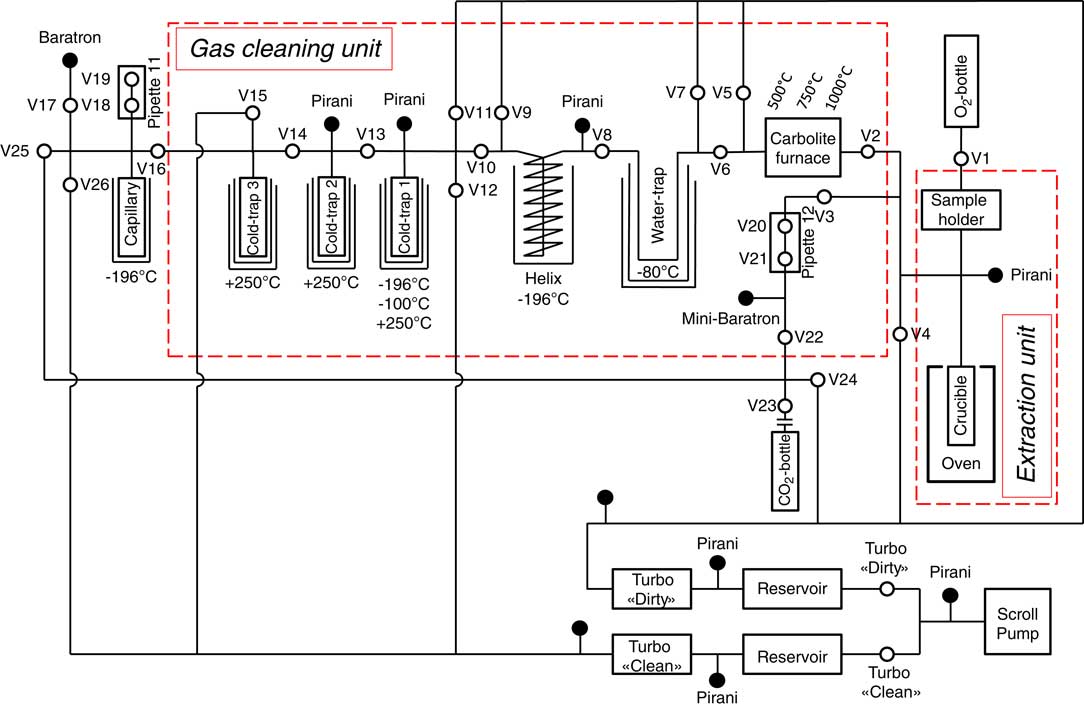
A schematic diagram of the line is depicted in Figure 1. The system has two major parts: the extraction unit and the gas cleaning unit, which are connected directly to each other, and both are working under high vacuum conditions. The extraction unit consists of a custom-made Ir crucible placed in a high-temperature tube furnace (Carbolite-Gero®). Note that in an earlier version, we unsuccessfully used an Al2O3-crucible (see below). An interesting specialty for this type of furnace is that the heating elements are made of MoSi2, which forms at high temperatures an oxide layer. Thanks to this oxide layer, the heating elements are protected against thermal or chemical corrosion and can therefore be operated in air and no complicated outside vacuum is needed. The maximum operational temperature is 1800°C. The Ir crucible is connected to an all metal, except for a glass window, sample holder in which 22 samples can be stored. From the sample holder, the samples are directly dropped into the crucible using a manual manipulator. Attached to the sample holder is the connection for adding ultra-high purity (UHP) O2 into the system. The O2-flow is controlled by a flow-meter. The gas cleaning unit has several parts: a second high-temperature tube furnace (Carbolite-Gero®), a water trap, a helix trap, and three additional cold traps. At the end of this part of the line there is a capillary, where the extracted, pure CO2 gas is trapped. The pressure in the crucible, in the helix, and in two of the three cold traps is measured by Pirani gauges, while the pressure in the capillary is monitored using a baratron (MKS 626B®). The amount of CO2 gas added is determined via the pressure measured using a second baratron (MKS 870B®) in a well calibrated pipette with a precisely known volume (1.01845±0.00022 cm3).
Schematic image of the 14C extraction line at University of Bern (Physics Department), dashed lines bordering the extraction unit and the gas cleaning unit. In the gas cleaning procedure only the first cold-trap (Cold-trap 1) was used; the other two (Cold-traps 2 and 3) are spare ones, and constantly held at 250°C.

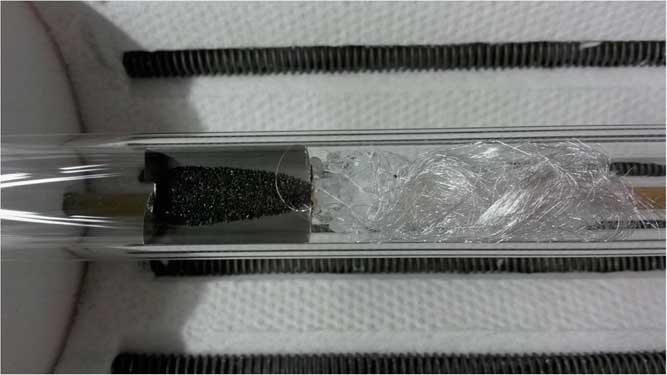
The second, high temperature tube furnace is separated into three zones, which can be heated independently from each other. A quartz glass tube is running through the furnace. The first zone is filled with quartz beads (d=2–4 mm) and held at 1000°C. The next part is filled with the same type of quartz beads but also with CuO powder. This second part is held at a temperature of 750°C. Finally, the third part consists of the same type of quartz beads and CuO powder as the second part, but contains in addition Ag wool. This part is held at a temperature of 500°C. The CuO powder is placed in small Pt boats (Figure 2). These materials ensure the conversion of carbon species into CO2 and remove NOx, SOx, and halides (e.g., Hippe et al. Reference Hippe, Kober, Baur, Ruff, Wacker and Wieler2009). Schaefer and Fegley (Reference Schaefer and Fegley2007) modeled the chemical equilibrium gas composition of the Holbrook L6 chondrite for up to ~1300°C at 1 mbar pressure. Their model is based on the bulk chemical composition of the meteorite and show that below ~800°C water and CO2 are the most abundant gases. Above this temperature, the main gas is SO2, then H2O, S2, and CO2 in decreasing order; contributions from other gases (e.g., H2, H2S, CO, SO, Na, K) are only very minor. Earlier, Gooding and Muenow (Reference Gooding and Muenow1977) found in an experimental vaporization study of the Holbrook meteorite a very similar result. While both studies give indication that most of the released gases are CO2 and water, the results cannot directly be applied to our extraction system because in our set-up the heating is performed in an UHP oxygen atmosphere at about 20–30 mbar, therefore, other gases can form as well.
Close-up view of the third zone (T=500°C) of the Carbolite furnace filled with copper-oxide, quartz beads and silver wool (from left to right). The diameter of the glass tube is 2 cm.

Gas Extraction and Purification
We started testing the extraction system with gas recovery experiments by simulating a preheated extraction using a ceramic (Al2O3) crucible. Doing so, we heated the crucible up to 500°C and applied an UHP O2-flow (30 mL/min) with continuous pumping. Above 500°C, we stopped the continuous O2-flow, closed the pumps, added a known amount of CO2, and heated the crucible up to 1590°C with 10°C/min. The maximum temperature was held for 1 hr. During heating, the O2 pressure was held constant at 15–30 mbar. During the entire heating, the gas was expanded into the second furnace and into the helix trap, which was held at –196°C using liquid nitrogen (LN). While cooling down the furnace, the unfrozen gas, which is supposed to be O2, was pumped away. After closing the pumps, the helix trap was heated and the released gas was transferred to and frozen into the capillary, cooled with LN. Finally, the gas was released into a known volume and the pressure was measured. During these experiments, we observed significant (up to 14%) gas loss, which seemed to depend on the conditions in the crucible and got worse over time. We speculated that the Al2O3-crucible might become porous under the operation conditions used by us and therefore decided to change to an Ir crucible. However, later performed porosity tests of the used crucible showed no indications of an increased porosity, leaving us without explanation why the Al2O3 crucible was not working as expected. Further tests using the much cheaper Al2O3 crucibles in combination with HF-heating are planned.
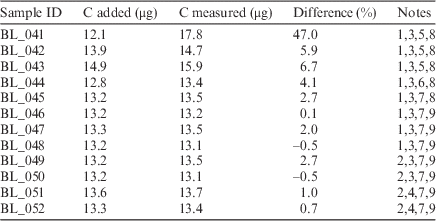
First gas recovery tests using the Ir crucible were also not as successful as hoped. The tests were conducted the same way as with the ceramic crucible, except that the Ir crucible could be heated much quicker (50°C/min) and to a slightly higher temperature of 1600°C, which was then held for 40 min. During the first tests, we recovered more CO2 in the capillary at the end of the procedure than we had added at the beginning of the test; the excesses were as high as 47%. This problem could be solved by adding two extra cleaning steps. The procedure is as follows: the gas is frozen into the helix trap, which is at the temperature of LN, and non-condensable gases are pumped away. After this first cleaning step, the pump is closed and the gas that is released from the helix trap (between valves 6 and 10) is frozen into the water trap held at –80°C by a mixture of ethanol and LN. After condensable gases, in our case mostly water, had been frozen into the water trap, the species still in the gas phase are transferred to the first cold trap (up to valve 13), which is cooled with LN. After the pressure over the helix and over the cold trap had dropped to the minimum (~5×10⁻⁴ mbar), the line is pumped to remove any remaining unfrozen gases. After pumping, the LN is removed from the cold trap, which is then set to a temperature of −100°C. Released gases are transferred to the capillary where the gas is again frozen with LN. After a stable pressure has been reached, the remaining gas phase is pumped away and the gas from the capillary is released into a known volume and the pressure is measured. The results of the gas recovery experiments are summarized in Table 1 and discussed in more detail in the “Results” section.
Results of gas recovery tests.

1 – measured before sample.
2 – measured after sample.
3 – preheated.
4 – not preheated.
5 – no purification.
6 – only water was removed.
7 – complete purification procedure.
8 – not measured with AMS.
9 – measured with AMS.
For the analysis of samples and procedural blanks, we use essentially the same cleaning procedure as described above. After loading the samples, the sample holder was heated to 100°C for a few days to release adsorbed water and atmospheric contamination. After the pressure was lower than 5×10⁻⁴ mbar, the crucible was heated up to 1600°C (while the sample heater was still on) to ensure that no contaminating gases remain in the crucible. After this precleaning procedure, the procedural blanks are usually very low (see below).
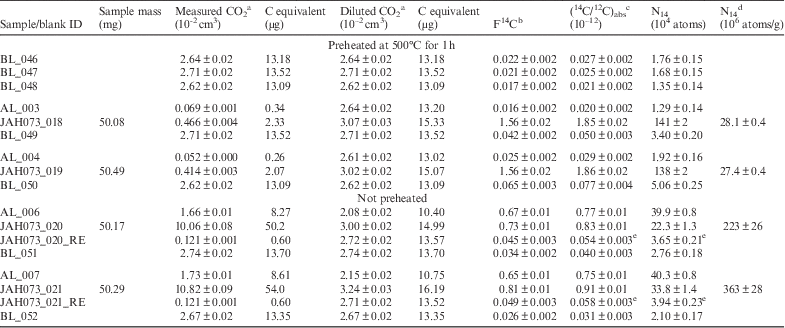
In order to find the most reliable extraction procedure we prepared preheated and not preheated samples and procedural blanks. For not preheated samples the gas was collected during the whole heating cycle, i.e., from room temperature up to 1600°C. Not preheated samples were re-extracted the following day at 1610°C (held for 40 min) to ensure complete gas release. The procedure for the preheated samples differed in the way that all gas below a crucible temperature of 500°C was pumped away and only the gas in the temperature range of 500°C up to 1600°C was collected. At the end of each gas extraction and cleaning procedure the CO2 is trapped into the glass capillary held at the temperature of LN. The glass ampoule is then fused and transferred to the AMS facility (see below). The results of all sample and blank extraction are given in Table 3.
Sample and Sample Preparation
The 14C extraction protocol was tested using the well-studied L6 chondrite (W2-4 S4) JaH 073 (e.g., Huber et al. Reference Huber, Gnos, Hofmann, Welten, Nishiizumi, Caffee, Hillegonds and Leya2008; Gnos et al. Reference Gnos, Lorenzetti, Eugster, Jull, Hofmann, Al-Kathiri and Eggimann2009). JaH 073 is a strewnfield meteorite that was found in the Sultanate of Oman in 2002. The strewnfield has an area of 114 km2, where 3463 single stones were collected until 2009 with a total mass of 600.8 kg (Gnos et al. Reference Gnos, Lorenzetti, Eugster, Jull, Hofmann, Al-Kathiri and Eggimann2009). The previously determined mean 14C age of JaH 073 is 19.7 ka (Al-Kathiri et al. Reference Al-Kathiri, Hofmann, Jull and Gnos2005) and the average 14C/10Be age is 14.4 ka (Gnos et al. Reference Gnos, Lorenzetti, Eugster, Jull, Hofmann, Al-Kathiri and Eggimann2009). Sufficient amount of this meteorite for study is available at the Natural History Museum in Bern.
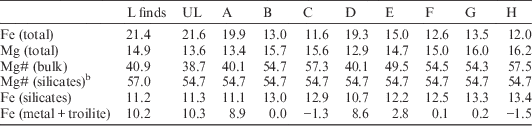
First, samples were fragmented using the SELFRAG® instrument at the Geology Department, University of Bern. After fragmentation, samples were separated into <125, 125–250, 250–500, 500–1000, and >1000 μm grainsize fractions. For further chemical treatment, we have chosen the 125–250 μm fraction. We used first 6.0 N HCl to dissolve carbonates and then EATG (ethanolamine-thioglycollate) to remove iron oxides and hydroxides (e.g., Cornish and Doyle Reference Cornish and Doyle1984). Chemical treatment was conducted at room temperature. It is essential for the leaching procedure that unwanted compounds are removed but that primary minerals are not affected to make sure that no in situ 14C is lost, therefore we performed a series of etch experiments using different etching times. The results can be found in Table 2.
Results of the leaching experiments of JaH 073.Footnote a

a Total Fe and Mg obtained from ICP-MS. L finds data from Jarosewich (Reference Jarosewich1990). Elemental Fe and Mg values are given in wt%.
b Mg# of silicates assumed to be constant in each leaching step. Negative values indicate overleaching of samples. Mg#=[Mg/(Fe+Mg)]×100.
UL – unleached.
A – leached with 6.0 N HCl for 10 min.
B – leached with 6.0 N HCl for 10 min, then with EATG for 1 week.
C – leached with 6.0 N HCl for 10 min, then with EATG for 2 weeks.
D – leached with 6.0 N HCl for 30 min.
E – leached with 6.0 N HCl for 30 min, then with EATG for 2 d.
F – leached with 6.0 N HCl for 30 min, then with EATG for 4 d.
G – leached with EATG for 1 week.
H – leached with EATG for 2 weeks.
To control the compositional changes caused by leaching, an aliquot of ~500 mg of each sample was sent for chemical analysis via ICP-MS (ActLabs, Ontario, Canada). Using these data, we estimated the change of chemical composition during leaching. According to Jarosewich (Reference Jarosewich1990), ~52% of the total iron in L-chondrite finds is incorporated into mafic silicates (the rest is in metal and troilite). This gives, with the measured Fe content, the amount of iron in mafic silicates (
 {\rm Fe}_{{{\rm sil}_{{\rm UL}} }}
) in the untreated sample. Furthermore, we assume that all Mg is incorporated into mafic silicates, i.e., the amount of Mg in secondary minerals is negligible. Using these assumptions, we can give
 ${\rm Mg}\#$
of the mafic silicates (Equation 1), which should remain constant over the leaching steps assuming that silicates were not affected, i.e.,
 {\rm Mg}\#_{{{\rm sil}_{{\rm UL}} }}\!{\equals}{\rm Mg}\#_{{{\rm sil}_{{\rm L}} }}
. We also calculated
 ${\rm Mg}\#$
of the leached bulk samples (
 {\rm Mg}\,\#\,_{{{\rm bulk}_{{\rm L}} }}
) (Equation 2), which should increase compared to the unleached sample as some of the total iron (Fet) was removed by dissolving iron oxides and hydroxides. In all equations “t” designates the total Mg or Fe, “sil” the Fe in the silicate fraction, “L” the leached, and “UL” the unleached samples.
 $${\rm Mg}\#_{{{\rm sil}_{{\rm L}} }} {\equals}{{{\rm Mg}_{{{\rm t}_{{\rm L}} }} } \over {{\rm Mg}_{{{\rm t}_{{\rm L}} }} {\plus}{\rm Fe}_{{{\rm sil}_{{\rm L}} }} }}$$
and
 $${\rm Mg}\#_{{{\rm bulk}_{{\rm L}} }} {\equals}{{{\rm Mg}_{{{\rm t}_{{\rm L}} }} } \over {{\rm Mg}_{{{\rm t}_{{\rm L}} }} {\plus}{\rm Fe}_{{{\rm t}_{{\rm L}} }} }}$$
From the
 {\rm Mg}\#_{{{\rm sil}_{{\rm L}} }}/{\rm Mg}\#_{{{\rm bulk}_{{\rm L}} }} }}
ratio (Equation 3) and the assumption of
 {\rm Mg}\#_{{{\rm sil}_{{\rm UL}} }}\!{\equals}{\rm Mg}\#_{{{\rm sil}_{{\rm L}} }}
we can calculate the amount of Fe in mafic silicates for each leaching step (
 {\rm Fe}_{{{\rm sil}_{{\rm L}} }}
, Equation 4).
 $${\rm X }{\equals}{\rm }{{{\rm Mg}\#_{{{\rm sil}_{{\rm L}} }} } \over {{\rm Mg}\#_{{{\rm bulk}_{{\rm L}} }} }}{\equals}{{\left( {{{{\rm Mg}_{{{\rm t}_{{\rm L}} }} } \over {{\rm Mg}_{{{\rm t}_{{\rm L}} }} {\plus}{\rm Fe}_{{{\rm sil}_{{\rm L}} }} }}} \right)} \over {\left( {{{{\rm Mg}_{{{\rm t}_{{\rm L}} }} } \over {{\rm Mg}_{{{\rm t}_{{\rm L}} }} {\plus}{\rm Fe}_{{{\rm t}_{{\rm L}} }} }}} \right)}}{\equals}{{{\rm Mg}_{{{\rm t}_{{\rm L}} }} } \over {{\rm Mg}_{{{\rm t}_{{\rm L}} }} {\plus}{\rm Fe}_{{{\rm sil}_{{\rm L}} }} }}{\times}{{{\rm Mg}_{{{\rm t}_{{\rm L}} }} {\plus}{\rm Fe}_{{{\rm t}_{{\rm L}} }} } \over {{\rm Mg}_{{{\rm t}_{{\rm L}} }} }}{\equals}{{{\rm Mg}_{{{\rm t}_{{\rm L}} }} {\plus}{\rm Fe}_{{{\rm t}_{{\rm L}} }} } \over {{\rm Mg}_{{{\rm t}_{{\rm L}} }} {\plus}{\rm Fe}_{{{\rm sil}_{{\rm L}} }} }}$$
Consequently,
 $${\rm Fe}_{{{\rm sil}_{{\rm L}} }} {\equals}{{{\rm Mg}_{{{\rm t}_{{\rm L}} }} {\plus}{\rm Fe}_{{{\rm t}_{{\rm L}} }} } \over {\rm X}}{\minus}{\rm Mg}_{{{\rm t}_{{\rm L}} }} $$
The chemical changes of the leaching steps are compiled in Table 2; negative values for iron in metal and troilite indicate overleaching of the sample. As the result of the leaching experiments, we concluded that the best leaching procedure is to treat the samples with 6.0 N HCl for 30 min followed by EATG for 2 d. With this procedure, the amount of Fe remaining in metal and troilite is 2.8 wt%, which is consistent with the observation of Al-Kathiri et al. (Reference Al-Kathiri, Hofmann, Jull and Gnos2005), who found that in JaH 073 ~93% of the metal and ~40% of the troilite are oxidized. Consequently, about 3 wt% iron should be in non-weathered metal and troilite phases, which is what we found.
After chemical treatment, samples were rinsed with isopropanol and then with distilled water, dried under an IR lamp, and ~50 mg aliquots were wrapped in cleaned, commercial Al foil for extraction. The sample mass was chosen according to the literature data on the carbon content of ordinary chondrites. Typical carbon content of L chondrites is 0.10 wt% for falls and 0.073 wt% for finds according to Moore and Lewis (Reference Moore and Lewis1967), 0.09 wt% according to Wasson and Kallemeyn (Reference Wasson and Kallemeyn1988), 0.12 wt% for falls and 0.14 wt% for finds according to Jarosewich (Reference Jarosewich1990), between 0.05 and 0.30 wt% in the matrix according to Makjanic et al. (Reference Makjanic, Vis, Hovenier and Heymann1993), and between 0.01 and 0.90 wt% according to Schaefer and Fegley (Reference Schaefer and Fegley2007).
AMS Measurement
14C analyses were conducted using the MIni radioCArbon DAting System (MICADAS) at the Laboratory for the Analysis of Radiocarbon with AMS (LARA) at the Department of Chemistry and Biochemistry, University of Bern (Szidat et al. Reference Szidat, Salazar, Vogel, Battaglia, Wacker, Synal and Türler2014). The CO2 samples collected at the meteorite extraction line were inserted into the gas interface system of the MICADAS (Ruff et al. Reference Ruff, Wacker, Gäggeler, Suter, Synal and Szidat2007; Wacker et al. Reference Wacker, Fahrni, Hajdas, Molnar, Synal, Szidat and Zhang2013), where the ampoules were cracked and the CO2 was transferred to the gas ion source after mixing with helium. For normalization and background correction during measurement, CO2 produced from the Standard Reference Material 4990C, Oxalic Acid II (NIST, Gaithersburg, USA) and 14C-free CO2 was used, respectively. All 14C results are expressed as F14C values (Reimer et al. Reference Reimer, Brown and Reimer2004).
Terrestrial Age Calculation
For calculating 14C terrestrial ages, first the absolute 14C/12C ratio and the number of 14C atoms (N14) have to be determined using Equations (5) and (6) given by Hippe et al. (Reference Hippe, Kober, Wacker, Fahrni, Ivy-Ochs, Akçar, Schlüchter and Wieler2013) and Hippe and Lifton (Reference Hippe and Lifton2014):
 $$\left( {^{{14}} {\rm C}/^{{12}} {\rm C}} \right)_{{{\rm S }\,{\rm abs}}} {\equals}1.1694 \cdot 10^{{{\minus}\!12}} \cdot {\rm Ab}12_{{\rm S}} \cdot {\rm F}^{{14}} {\rm C}_{{\rm S}} \cdot {\rm }\left[ {{{1{\plus}{\rm }{{{\rm \delta }^{{13}} {\rm C}_{{\rm S}} } \over {1000}}} \over {0.975}}} \right] \cdot {\rm e}^{{{{1950{\minus}{\rm y}} \over {8223}}}} $$
where the value of 1.1694×10⁻¹² corresponds to the abundance of 14C in modern carbon, Ab12S is the 14C/12C of the sample determined by the measured δ13C of the sample, F14CS is the fraction of modern carbon in the sample normalized to δ13C=–25‰VPDB and AD 1950, and y is the year of measurement.
 $${\rm N}_{{14}} ({\rm atoms}/{\rm g}){\equals}{{\left( {( {^{{14}} {\rm C}/^{{12}} {\rm C}} )_{{{\rm S}\,{\rm abs}}} \cdot {\rm N}_{{\rm A}} \cdot {{{\rm V}_{{\rm S}} } \over {{\rm V}_{{\rm A}} }}{\minus}{\rm B}} \right)} \over {{\rm M}_{{\rm S}} }}$$
where NA is Avogadro’s number (6.022×10²³ atoms/mol), VS is the volume of CO2 of the sample at 20°C and 1013 mbar, VA is the volume of 1 mol CO2 at 20°C and 1013 mbar, B is the number of 14C atoms in the blank, and MS is the mass of the sample in g. From the concentration of 14C we can calculate the activity (in dpm/kg) of the sample (Am) using Equation (7)
 $${\rm A}_{{\rm m}} {\equals}\lambda _{{14}} \left( {min^{{\!{\minus}\!1}} } \right) \cdot {\rm N}_{{14}} \cdot 1000$$
where λ14 is the decay constant of 14C (1.216×10⁻⁴ yr−1=2.314×10⁻¹⁰ min−1). Finally, we can calculate the age via
 $${\rm T}_{{14}} {\equals}{\minus}{1 \over {{\rm \lambda }_{{14}} }}{\rm ln}\left( {{{{\rm A}_{{\rm m}} } \over {{\rm A}_{{{\rm sat}}} }}} \right)$$
where Asat is the saturation activity of the sample (in dpm/kg), which is taken to be 51±1 dpm/kg for recent L chondrite falls based on analyses of the meteorite Bruderheim (e.g., Jull et al. Reference Jull, Giscard, Hutzler, Schnitzer, Zahn, Burr, McHargue and Hill2013), an L6 chondrite which fell in 1960. Since at the current status of our project we do not have 10Be and/or shielding data, this average value for L chondrites was taken into account calculating the terrestrial age of JaH 073.
RESULTS
System and Procedural Blanks
We distinguish two different types of blanks: system blanks and procedural blanks. System blanks (abbreviation BL in tables) refer to a known amount of CO2 gas that has been injected into the line out of the CO2 bottle, and procedural blanks (abbreviation AL in tables) are the same type and mass of Al-foil used to wrap the samples. The main purpose of system blanks is (1) to test for losses or gain of gas (gas recovery tests, see Table 1), (2) to check the isotopic composition of the added CO2 carrier gas, (3) to control the cleanliness of the extraction line, and (4) to check if samples were completely extracted.
Table 1 summarizes the results of the gas recovery tests. System blanks BL_041-048 were measured in a factory clean Ir crucible before any samples were extracted. After preheating, BL_041-043 were frozen into the helix and then transferred directly into the capillary, while for the other system blanks the whole gas purification procedure was conducted, except for BL_044, from which only water was removed (see also above). It can be seen in Table 1 that the first tests revealed higher gas amounts at the end of the procedure than CO2 was injected at the start of the procedure, i.e., there was a gain of gas. The differences were decreasing test by test, possibly indicating that every heating cycle cleaned the crucible a little further. For all remaining gas recovery tests the differences between added and finally measured CO2 concentrations are less than 2%, with no systematic trend. The average of the last eight tests is 1.0%, i.e., the finally measured pressure in the capillary is on average 1.0% higher than the expected pressure. The differences between expected and measured carbon amounts for system blanks after the meteorite samples (BL_049-052) are essentially in the same range as those measured before the samples (BL_041–BL_048). There is also no significant difference between preheated (BL_041–BL_050) and not preheated blanks (BL_051 and BL_052).
For most of the system blanks we also calculated the absolute 14C/12C ratio to obtain information about the isotopic composition of the CO2 carrier gas and of the possibly evolving other gases, and to check if the extraction of samples was complete. Results are listed in Table 3. The data clearly indicate that the added CO2 carrier gas is indeed 14C-free and is therefore well suitable for our purpose. The system blanks also confirm that the extraction line is clean, i.e., the overall blank levels are low. The absolute 14C/12C ratios of system blanks range between 0.021×10⁻¹² and 0.077×10⁻¹², with an average of 0.040×10⁻¹².
Results of the extraction of system blanks, procedural blanks and samples.

The purpose of procedural blanks is to correct the sample values. The results of the AMS measurements are listed in Table 3. Without preheating the Al-foil produces extremely high blank levels. The blank level drops during the preheating procedure, i.e., the absolute 14C/12C value of preheated procedural blanks is about one order of magnitude lower (0.024×10⁻¹² on average) than non-preheated blanks (0.76×10⁻¹² on average), therefore we are currently working on experiments with other types of foils and/or sample containers. Our measurements showed that this type of Al-foil can be used only in preheated procedures.
Samples and Terrestrial Ages
We summarized the results of the AMS measurement of system blanks, procedural blanks, and meteorite samples in a single table (Table 3) in order to make the measurement sequence clear and easy to follow. Data are listed as groups; before each sample a procedural blank (AL), and after each sample a system blank (BL) has been prepared. Note that the values given for the samples are all blank corrected, except for the re-extraction steps.
We analyzed four samples of the JaH 073 meteorite (JAH073_018, JAH073_019, JAH073_020, JAH073_021). The data for the two preheated samples agree within uncertainty in terms of number of 14C atoms per g sample, i.e., JAH073_018=(28.1±0.4)×106 14C atoms/g and JAH073_019=(27.4±0.4)×106 14C atoms/g, indicating the reproducibility of the extraction. However, more measurements are needed to further confirm this conclusion. Comparing the blank measurements before and after samples (Table 3), it can be seen that the number of 14C atoms in the blank is higher (~60%) after the samples than it was before. Even if the data suggests the incomplete extraction of samples, the effect is small (~3% of the sample values) and would not affect significantly terrestrial 14C age determinations.
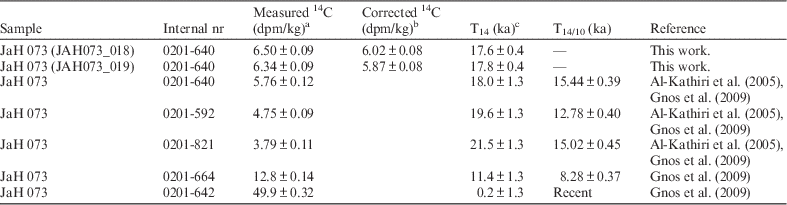
For the two samples that were not preheated (JAH073_20 and JAH073_021) there was a re-extraction (JAH073_020_RE and JAH073_021_RE) to ensure complete gas release. The data of the re-extraction steps are comparable to blank values. From this finding we conclude that one extraction step at 1610°C (instead of only 1600°C) is more efficient. Not preheated samples contain about 25 times more carbon, and have one order of magnitude more 14C than the preheated samples, which is consistent with the observation of e.g. Jull et al. (Reference Jull, Donahue and Linick1989). In addition, the values for the two samples differ significantly, i.e., (223±26)×106 14C atoms/g for JAH073_020 and (363±28)×106 14C atoms/g for JAH073_021. Since the 14C concentrations of these samples are only slightly higher than those of the procedural blanks (see also above), we conclude that with the Al foil, currently used to wrap the samples, a preheating step is necessary for reliable and reproducible 14C terrestrial age determinations. Note that so far essentially all 14C analysis used a preheating step (e.g., Jull et al. Reference Jull, Donahue and Linick1989). However, our aim was to check whether or not the etched samples, i.e., samples where the terrestrial alteration products were chemically removed, still need a preheating procedure. Unfortunately, due to the high blank values of the used Al foil, we cannot make a meaningful comparison and we cannot draw any reasonable conclusions at the current state. For calculating the terrestrial age of JaH 073, we used only the data of preheated samples (JAH073_018 and JAH073_019). The results are compiled in Table 4, where we also give the data from previous works for comparison. We assumed a saturation activity of 51±1 dpm/kg (e.g., Jull et al. Reference Jull, Giscard, Hutzler, Schnitzer, Zahn, Burr, McHargue and Hill2013) to calculate the terrestrial ages. Since this value is defined for bulk meteorites, we had to correct the measured activities of JaH 073 for the mass loss during chemical treatment. During leaching, about ~13% of the sample mass was lost, which includes terrestrial contamination (e.g., carbonates), and also oxidized metal and troilite. For the correction, only the latter phases (metal and troilite) need to be considered, since they were part of the unaltered bulk meteorite. Our calculations showed (see above and Table 2) that leaching typically removed 7.5 wt% of iron derived from oxidized metal and troilite. We therefore corrected the measured activities with a factor of 0.925. In Table 4 we listed both the measured and mass-corrected activities for comparison, however, to calculate the terrestrial ages, only the mass-corrected activities were used. The terrestrial ages of 17.6±0.4 ka (JAH073_018) and 17.8±0.4 ka (JAH073_019) are in good agreement with 14C age for the sample having the same internal number (0201-640, see Table 4) determined by Al-Kathiri et al. (Reference Al-Kathiri, Hofmann, Jull and Gnos2005), but are somewhat higher than 14C/10Be ages given by Gnos et al. (Reference Gnos, Lorenzetti, Eugster, Jull, Hofmann, Al-Kathiri and Eggimann2009).
Terrestrial age of JaH 073 meteorite and comparison with previous works.

a Calculated after Equation (7).
b Measured activity was mass corrected with a factor of 0.925 due to mass loss during chemical treatment. For the age calculation the corrected activity was used.
c Calculated after Equation (8) and assuming a saturated activity of 51±1 dpm/kg (e.g. Jull et al. Reference Jull, Giscard, Hutzler, Schnitzer, Zahn, Burr, McHargue and Hill2013).
Errors of this work are all 1σ.
DISCUSSION AND CONCLUSION
The preliminary results of the newly installed 14C extraction line for meteorite samples at the University of Bern are promising. The first data are reproducible, however, more experiments and tests are needed for a firmer conclusion. Some technical issues and problems also need to be discussed before routine analyses are possible. First, while the iridium crucible works well because it allows a relatively rapid extraction with 50°C/min and a high extraction temperature of up to 1600–1610°C, it can only be a temporary solution. The total price of the crucible combined with the expected lifetime would make the extraction of large number of samples (several hundred) unfeasible. Unfortunately, the performance of the much cheaper ceramic crucibles was unsatisfactory, at least when using a high temperature tube furnace. Another possibility could be the combination of ceramic crucibles with RF heating (e.g. Jull et al. Reference Jull, Donahue and Linick1989, Reference Jull, Donahue, Cielaszyk and Wlotzka1993, Reference Jull, McHargue, Bland, Greenwood, Bevan, Kim, LaMotta and Johnson2010), which we will test in the future.
Another point that needs to be understood better is concerning the gas purification. We were planning to follow the gas cleaning procedure described by Hippe et al. (Reference Hippe, Kober, Baur, Ruff, Wacker and Wieler2009, Reference Hippe, Kober, Wacker, Fahrni, Ivy-Ochs, Akçar, Schlüchter and Wieler2013), who released the CO2 gas from the cold traps at –145°C and subsequently at –130°C. In contrast, we did not observe any gas release at either of these temperatures. The gas started to be released only at –100°C from the cold trap in our system. The reason for the difference in temperatures, compared to the 14C extraction line at ETH, is not understood, but the final results indicate that the released gas is essentially all CO2, which makes it unnecessary to go for lower temperatures (i.e., below –100°C). Moreover, to produce lower temperatures (i.e., –145 to –130°C) would need a more expensive chemical (2-methylpentane; e.g. Hippe et al. Reference Hippe, Kober, Baur, Ruff, Wacker and Wieler2009) anyway than what we use now (ethanol) for the cooling baths.
The terrestrial ages obtained for preheated samples of the L-chondrite JaH 073 are in good agreement with previous results. Note that the given uncertainty of ±0.4 ka for the terrestrial age rather represents a lower limit because variations in the saturation activity are not included. Jull et al. (Reference Jull, Donahue and Linick1989) reported variations of ±16% for the saturation activity for recent ordinary chondrite falls, which equals to an uncertainty of ±1.3 ka in terrestrial age. Later, Jull et al. (Reference Jull, Donahue, Cielaszyk and Wlotzka1993) noted that this value is only valid for meteorites with a radius in the range ~10–40 cm; for smaller and larger objects the uncertainty can be even larger. For JaH 073, Gnos et al. (Reference Gnos, Lorenzetti, Eugster, Jull, Hofmann, Al-Kathiri and Eggimann2009) calculated a minimum radius of ~35 cm based on collected masses and measured densities. Assuming ablation losses about 90%, the radius could have been larger than 75 cm (Gnos et al. Reference Gnos, Lorenzetti, Eugster, Jull, Hofmann, Al-Kathiri and Eggimann2009). Based on radionuclide and noble gas data, Welten et al. (Reference Welten, Nishiizumi, Hillegonds and Caffee2006) determined a pre-atmospheric radius in the range of 50–200 cm, which was later narrowed down to 75–100 cm by Huber et al. (Reference Huber, Gnos, Hofmann, Welten, Nishiizumi, Caffee, Hillegonds and Leya2008).
Note that Gnos et al. (Reference Gnos, Lorenzetti, Eugster, Jull, Hofmann, Al-Kathiri and Eggimann2009) also reported 14C/10Be ages of JaH 073 (Table 4). However, these results are somewhat obsolete. The 14C/10Be method can only be applied to meteorites with saturated 10Be activities, i.e., to ordinary chondrites with cosmic ray exposure ages longer than ~7–8 Ma (e.g., Jull et al Reference Jull, Giscard, Hutzler, Schnitzer, Zahn, Burr, McHargue and Hill2013). Huber et al. (Reference Huber, Gnos, Hofmann, Welten, Nishiizumi, Caffee, Hillegonds and Leya2008) concluded that JaH 073 experienced a 2π exposure of ≤5 Ma at a large shielding depth, followed by a 0.5–0.7 Ma long 4π irradiation. Therefore, 10Be in JaH073 was most likely not saturated at the time of fall.
In summary, the new 14C extraction line at the University of Bern is operating well, and we could achieve two important developments concerning the extraction of 14C from meteorites. First, our system enables extraction of 14C from significantly smaller sample masses, i.e., as low as 0.05 g in contrast to other laboratories that need sample masses of ~0.1–0.5 g (e.g., Jull et al. Reference Jull, Donahue, Cielaszyk and Wlotzka1993). Therefore, our system makes it possible to determine 14C terrestrial ages in meteorites found with small masses and/or do repeated measurements for rare (e.g., lunar, Martian) meteorites. Second, for our measurements, no graphitization of the samples is needed, and 14C can be measured directly in gaseous CO2.
ACKNOWLEDGMENTS
We would like to thank Urs Eggenberger and Christine Lemp from the Institute of Geological Sciences (University of Bern) for their kind technical support with the SELFRAG®. We thank Maarten Lupker from ETH Zürich for helping us develop our extraction line. We are grateful to Malgorzata Urszula Šliz from the Department of Space and Planetary Sciences (University of Bern) for the sample preparation, and to Gary Salazar from the Department of Chemistry and Biochemistry (University of Bern) for the AMS measurements. We thank Kristina Hippe, the reviewer of this paper, who helped us to improve the manuscript with her constructive comments. The samples used in this study were collected during joint Omani–Swiss meteorite search campaigns. We thank the Public Authority for Mining, Muscat, for their support and the permissions. This study was supported by the Swiss National Science Foundation, grants 200021_143966 and 200020_137924.