Implications
Differences in rumen headspace gas concentrations of hydrogen sulphide are related to the degradation of sulphur (S) in the rumen. As a high proportion of dietary S is contained within protein, this association offers potential for a new approach to compare protein degradation of different protein sources. This may be particularly useful for studying the early stages of degradation of soluble proteins where the existing nylon bag technique is of limited value.
Introduction
Rumen microbes produce sulphide from both inorganic sulphate (Lewis, Reference Lewis1955) and sulphur (S) amino acids (AAs; Halverson et al., Reference Halverson, Williams and Paulson1968). Sulphide is then incorporated into microbial protein or absorbed and oxidized to sulphate in the liver (Anderson, Reference Anderson1956). However, under conditions of high dietary S intake, the microbial sulphide production increases (Kandylis, Reference Kandylis1983). Recent in vitro work has focused on evaluating the use of alternative feeds (e.g. cereal co-products) that, although more economical, can show high and variable S content, increasing the likelihood of hydrogen sulphide production (Leibovich et al., Reference Leibovich, Vasconcelos and Galyean2009; Quinn et al., Reference Quinn, May, Hales, DiLorenzo, Leibovich, Smith and Galyean2009; Smith et al., Reference Smith, DiLorenzo, Leibovich, May, Quinn, Homm and Galyean2010). As most of the S in feed is contained in methionine and cystine within proteins (Havlin et al., Reference Havlin, Tisdale, Nelson and Beaton1999), we hypothesized that hydrogen sulphide production in the rumen gas could represent a new approach to study rumen protein degradation. This could overcome the known main constraints of the nylon bag technique, which is widely used to evaluate protein degradation – physical losses of dry matter (DM) of the feed or of their fractions from the nylon bags (Dewhurst et al., Reference Dewhurst, Hepper and Webster1995), and the assumption that soluble material is fermented. Indeed, Bach et al. (Reference Bach, Ruiz Moreno, Thrune and Stern2008), evaluating the fermentation dynamics of soluble CP in continuous culture fermenters, clearly showed that the soluble CP fraction is not completely degraded in all feeds – the extent of degradation from fish meal, SBM and rapeseed meal being 99%, 30% and 37% of soluble CP, respectively.
Our hypothesis is further supported by an earlier study (Dewhurst et al., Reference Dewhurst, Evans, Mottram, Španěl and Smith2001) that showed an increase in concentrations of hydrogen sulphide, methyl sulphide and dimethyl sulphide after feeding, similar to that of ammonia concentration in the rumen liquor, reflecting their common dependence on the fermentation of AAs. In addition, studies showed cysteine to be the dominant source of hydrogen sulphide in the rumen, leading to concentrations higher than those for methionine and inorganic S sources (Bird, Reference Bird1972; Dewhurst et al., Reference Dewhurst, Kim, Evans, Cabrita and Fonseca2007). However, the variable effect of cysteine on hydrogen sulphide concentrations noted in earlier work (Dewhurst et al., Reference Dewhurst, Kim, Evans, Cabrita and Fonseca2007) questions the accuracy of the proposed approach as an assay for protein degradation.
The present study aimed to elucidate the relationship between the hydrogen sulphide concentration in the rumen headspace gas and the early stages of protein degradation. Expt 1 compared the concentrations of hydrogen sulphide in the rumen headspace gas from three protein sources differing in rumen N (nitrogen) degradability (maize gluten feed (MGF), sunflower meal (SFM) and soyabean meal (SBM)). Expt 2 investigated whether these differences are also evident when looking at the concentration of hydrogen sulphide in rumen headspace gas from four different batches of the same feed (MGF). Samples were chosen based on their colour, assuming that it relates to heat damage and thus to rumen N degradability (Cabrita et al., Reference Cabrita, Maia, Freitas, Abreu and Fonseca2011b).
Material and methods
Experiment 1
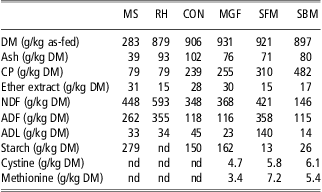
This study evaluated the effects of MGF, SFM and SBM on hydrogen sulphide concentrations in rumen headspace gas of three non-pregnant and non-lactating Holstein cows that had previously been prepared with rumen cannulae (10 cm diameter; Bar Diamond Inc., Parma, Idaho, USA). The cows were housed in tie stalls with individual feed bins (Campus Agrário de Vairão, Portugal). Cows were fed at the maintenance level (Agricultural and Food Research Council, 1993), with a daily allocation of 18.5 kg of a diet comprising (as fed) 800 g/kg maize silage, 140 g/kg concentrate (820 g/kg MGF, 150 g/kg SBM, 18 g/kg calcium carbonate, 4 g/kg dicalcium phosphate, 6 g/kg salt and 2 g/kg of a mineral–vitamin mixture; Premix, SA, Viana do Castelo, Portugal) and 60 g/kg of coarsely chopped ryegrass hay (Table 1). The diet was offered as a complete feed in two equal meals (0930 and 1730 h) and was totally consumed.
The measurements of hydrogen sulphide concentrations in rumen headspace gas were recorded on 4 alternate days, according to a 3 × 3 Latin square design with an additional experimental period (three cows × four periods; four observations per treatment). On the day before the measurements, the cows were offered, as usual, the afternoon meal at 1730 h. Cows were fasted overnight before each measurement day, and concentrations of hydrogen sulphide in rumen gas had declined close to zero by morning, which was confirmed by sampling rumen headspace gas. At 0900 h, the cows were offered 0.75 kg DM of MGF, SFM or SBM (previously ground with a hammer mill equipped with a 4-mm sieve). The protein sources were almost always readily consumed, and any source that was not ingested by 0910 h was introduced through the ruminal cannulae. Recording of hydrogen sulphide concentrations in rumen headspace gas commenced at 0930 h. Immediately after the last collection, the cows were offered the morning meal (1315 h), with the afternoon meal being offered at the normal time (1730 h). Samples of feeds and protein sources were taken each day and analysed for DM (oven drying), ash (furnace), CP (micro-Kjeldahl with Se catalyst), ether extract (extraction with petroleum ether using Gerhardt Soxtherm 2000 Automatic equipment, Foss, Hillerød, Denmark), NDF, ADF and ADL (van Soest detergent methodology with amylase and without sodium sulphite; using Fibretec equipment, Foss) and starch (enzymatic) according to Cabrita et al. (Reference Cabrita, Dewhurst, Melo, Moorby and Fonseca2011a). AAs were analyzed on dried samples after initial oxidation with performic acid according to Dewhurst et al. (Reference Dewhurst, Kim, Evans, Cabrita and Fonseca2007).
Experiment 2
This study evaluated the effects of four batches of MGF obtained from two compound feed manufacturers in North Portugal (Sodol, Sociedade Descascadora Ovarense, LDA, Ovar, Portugal and Cooperativa Agrícola de Vila do Conde, CRL, Vila do Conde, Portugal), representing different degrees of heat damage evaluated through their colour by visual observation (from lighter to darker: MGF1, MGF2, MGF3 and MGF4). Later, colour analyses (CIE L*, a*, b* (CIELAB) colour scale) were performed on samples milled through a 0.5-mm screen using a colorimeter CR 400 (Minolta, Osaka, Japan). The instrument was calibrated with a white plate before recording the measurements.
The measurements of hydrogen sulphide concentrations in rumen headspace gas, separated by periods of 2 to 5 days, were performed according a 4 × 4 Latin square design, using four (three in late-lactation and one non-lactating) Holstein–Friesian cows that had previously been prepared with rumen cannulae (10 cm diameter; Bar Diamond Inc.). The cows were housed in tie stalls with individual feed bins (Trawsgoed Research Farm, Wales, UK), and had continuous access to water. Cows grazed perennial ryegrass between the morning and afternoon milkings, and lactating cows received 3 kg of concentrate at each milking. Cows were brought inside after the afternoon milking and given ad libitum access to grass silage until 2200 h. At 0800 h, the cows were offered 1.0 kg DM of MGFs, previously ground with a hammer mill equipped with a 4-mm sieve. The MGFs were almost always completely consumed, and any that was not ingested by 0810 h was introduced through the ruminal cannulae. The rumen headspace gas collections started at 0830 h. Basal diet and MGF samples were taken each day and analyzed for DM (oven drying), ash (furnace), CP (micro-Kjeldahl with Cu catalyst), ether extract (extraction with petroleum ether using Soxtec equipment, Foss, Hillerød, Denmark), NDF (van Soest detergent method with amylase; using Fibretec equipment, Foss, Hillerød, Denmark), water-soluble carbohydrates (automated anthrone method) and starch (enzymatic step prior to automated anthrone method), according to Dewhurst et al. (Reference Dewhurst, Moorby, Dhanoa, Evans and Fisher2000). S content was analysed according to Method 72 (total S in plant material) in Ministry of Agriculture, Fisheries and Food (1986).
Sampling and measuring rumen gas
Duplicate samples of rumen gas were collected from each cow and concentrations of hydrogen sulphide recorded at 30, 60, 90, 120, 150, 180, 210 and 240 min after test feeds were given. Samples of rumen headspace gas (∼1 l) were obtained using a vacuum pump attached to a semirigid plastic tube (length 40 cm; external diameter 6 mm) that was inserted through the cannula cap. The tube was moulded in order to remain in the anterior rumen headspace cap, reducing the likelihood of drawing rumen fluid. The collection lines incorporated a ‘Y’ connection that allowed any rumen fluid withdrawn by accident to be diverted into a separate collection bag. Collection lines were purged with rumen gas and further gas was then collected into evacuated 2 l polyethylene terepthalate bottles. Bottles had rubber stoppers and were linked to the collection lines through bidirectional valves. Concentrations of hydrogen sulphide were measured immediately using a Crowcon Triple Plus+ meter (Crowcon Detection Instruments Ltd, Oxfordshire, UK), modified to read in the range of 0 to 700 ppm and calibrated using a standard obtained from Sigma-Aldrich Chemical Company (Poole, Dorset, UK).
In sacco degradability
The nylon bag technique (Ørskov et al., Reference Ørskov, Hovell and Mould1980) was used to measure the DM and N (Expt 1) or S (Expt 2) degradation of feeds in the rumen. In Expt 1, rumen degradability of protein sources was measured using the same three cows, the week after rumen headspace gas collections. In Expt 2, two of the three lactating cows were used for in sacco measurements. Diets and animal management were as described for rumen headspace gas collections. Nylon bags (10 × 20 cm; Bar Diamond Inc.) containing 5 g of each feed that had been ground through a 4-mm screen were incubated in the rumen of each cow, in triplicate for Expt 1 during 1, 2, 4, 8, 12, 16, 24 and 48 h and in duplicate for Expt 2 during 1, 2, 4, 8, 16, 24 and 48 h. Immediately after removal from the rumen, the bags were washed in cold water and frozen at −18°C. At the end of the collections, they were thawed and washed, along with the zero time bags, in a washing machine for 40 min at 40°C and then dried at 65°C for 24 h. Dried residues were analysed for Kjeldahl N (Expt 1) and S (Expt 2) contents. In Expt 1, the dried residues from 1, 2, 4 and 12 h incubations from two cows were also submitted for AA analysis.
Statistical analysis
Experiment 1
Hydrogen sulphide concentrations in rumen headspace gas were analysed by repeated measures ANOVA for a Latin square design using the mixed procedure of SAS (version 8.1, 1999–2001, SAS Institute Inc., Cary, NC, USA). The statistical model included the fixed effects of period (n = 4), protein source (n = 3), time (n = 8) and protein source × time, and the random effect of cow (n = 3), assuming a first-order autoregressive covariate structure fitted on the basis of Akaike information and Schwarz Bayesian model fit criteria. Data on rumen DM, N and AA degradation of protein sources were also analyzed by repeated measures ANOVA using the mixed procedure of SAS (version 8.1, 1999–2001, SAS Institute Inc.). The statistical model included the fixed effects of protein source (n = 3), time (n = 8 for DM and N data and n = 4 for AA data) and protein source × time, and the random effect of cow (n = 3 for DM and N data and n = 2 for AA data), assuming a first-order autoregressive covariate structure fitted on the basis of Akaike information and Schwarz Bayesian model fit criteria. Wash losses data (from zero time bags; nine per protein source) were subjected to a one-way ANOVA analysis.
Experiment 2
Hydrogen sulphide concentrations in rumen headspace gas were analyzed by repeated measures ANOVA for a Latin square design using the mixed procedure of SAS (version 8.1, 1999–2001, SAS Institute Inc.). The statistical model included the fixed effects of period (n = 4), MGF batch (n = 4), time (n = 8) and MGF batch × time, and the random effect of cow (n = 4), assuming a first-order autoregressive covariate structure fitted on the basis of Akaike information and Schwarz Bayesian model fit criteria. Data on rumen DM and S degradation of MGF batches were also analyzed by repeated measures ANOVA using the mixed procedure of SAS (version 8.1, 1999–2001, SAS Institute Inc.). The statistical model included the fixed effects of MGF batch (n = 4), time (n = 8) and MGF batch × time, and the random effect of cow (n = 2), assuming a first-order autoregressive covariate structure fitted on the basis of Akaike information and Schwarz Bayesian model fit criteria. Wash losses data (from zero time bags; four per MGF batch) were subjected to a one-way ANOVA analysis.
Results
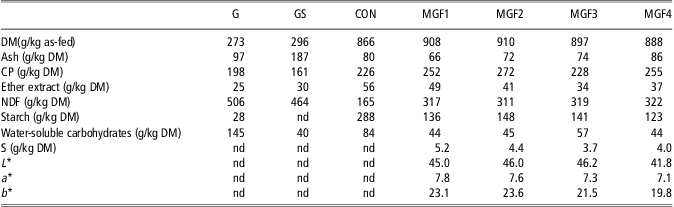
The chemical composition of the feeds offered to cows before recording measurements, the protein sources tested in Expt 1 and the four batches of MGF tested in Expt 2, as well as their CIELAB parameters, are presented in Tables 1 and 2, respectively. Colour parameters agreed with visual observation, with lower values for a*, b* and L* found for MGF4 (darker).
Chemical composition of the feeds offered to cows before measurements (MS, RH, CON) and the protein sources (MGF, SFM, SBM) tested in Expt 1
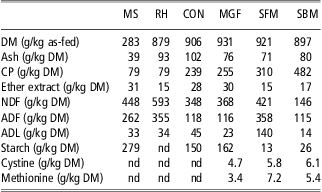
MS = maize silage; RH = ryegrass hay; CON = concentrate; MGF = maize gluten feed; SFM = sunflower meal; SBM = soyabean meal; DM = dry matter; nd = not determined.
Chemical composition of the feeds offered to cows before measurements (G, GS, CON) and the chemical composition and colour parameters (CIELAB scale) for the four batches of MGF tested in Expt 2
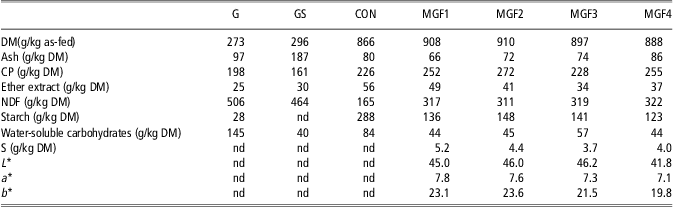
G = grass; GS = grass silage; CON = concentrate; MGF = maize gluten feed; DM = dry matter; nd = not determined; S = sulphur.
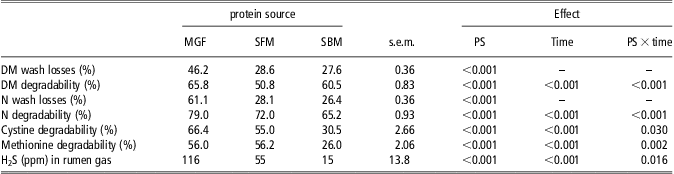
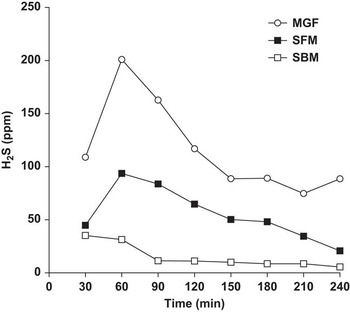
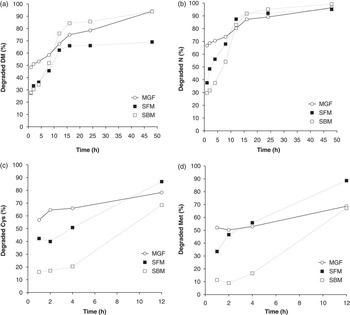
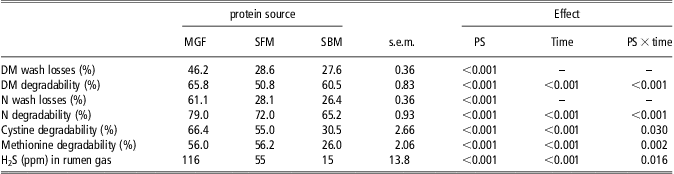
The mean effects of protein sources on the concentration of hydrogen sulphide in rumen headspace gas, and rumen DM, N, cystine and methionine degradability are presented in Table 3 (Expt 1). The interactions protein source × time are presented graphically for each parameter in Figures 1 and 2. The N degradation curves (Figure 2b) show that the degradation rate of the insoluble, but potentially degradable, N fraction was much higher for SFM than for SBM. There were marked differences in the degradation of cystine and methionine between protein sources, although the degradation of cystine was always higher than methionine (Table 3, Figures 2c and d).
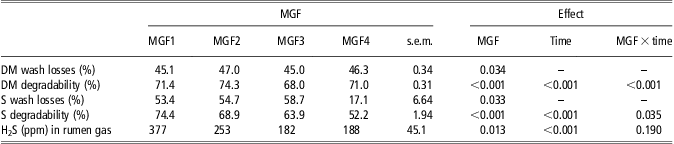
Mean effects of protein source (MGF, SFM, SBM) on rumen degradability of DM, N, cystine and methionine, and on concentration of hydrogen sulphide (ppm) in rumen headspace gas (Expt 1)
Effects of the intake of 0.75 kg dry matter of maize gluten feed (MGF), sunflower meal (SFM) and soyabean meal (SBM) on the concentration of hydrogen sulphide in the rumen headspace gas of dairy cows (Expt 1). Values represent the mean from three animals. s.e.m. = 18.9.

Dry matter (a), nitrogen (b), cystine (c) and methionine (d) degradability of maize gluten feed (MGF), sunflower meal (SFM) and soyabean meal (SBM; Expt 1). In Figures 2a and b, values represent the mean from three animals (s.e.m. = 1.34 and 1.73, respectively). In Figures 2c and d, values represent the mean from two animals (s.e.m. = 5.03 and 4.12, respectively).

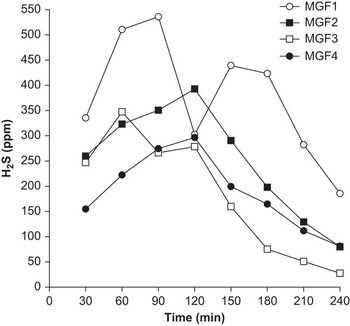
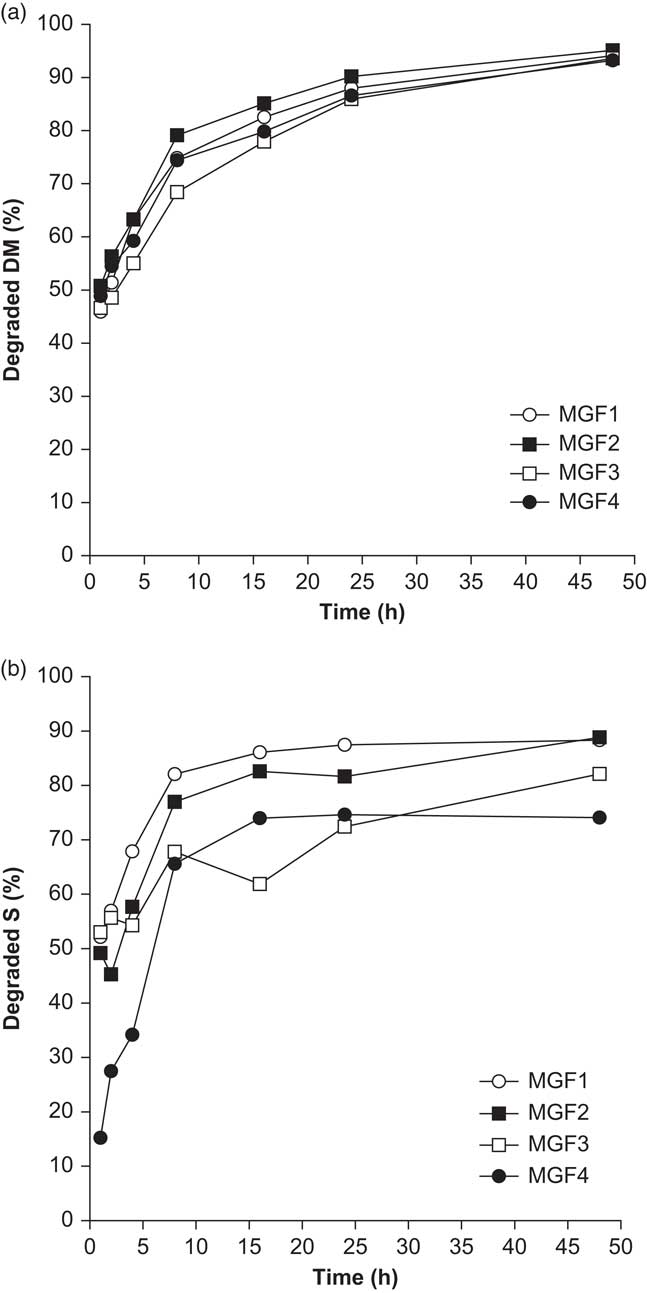
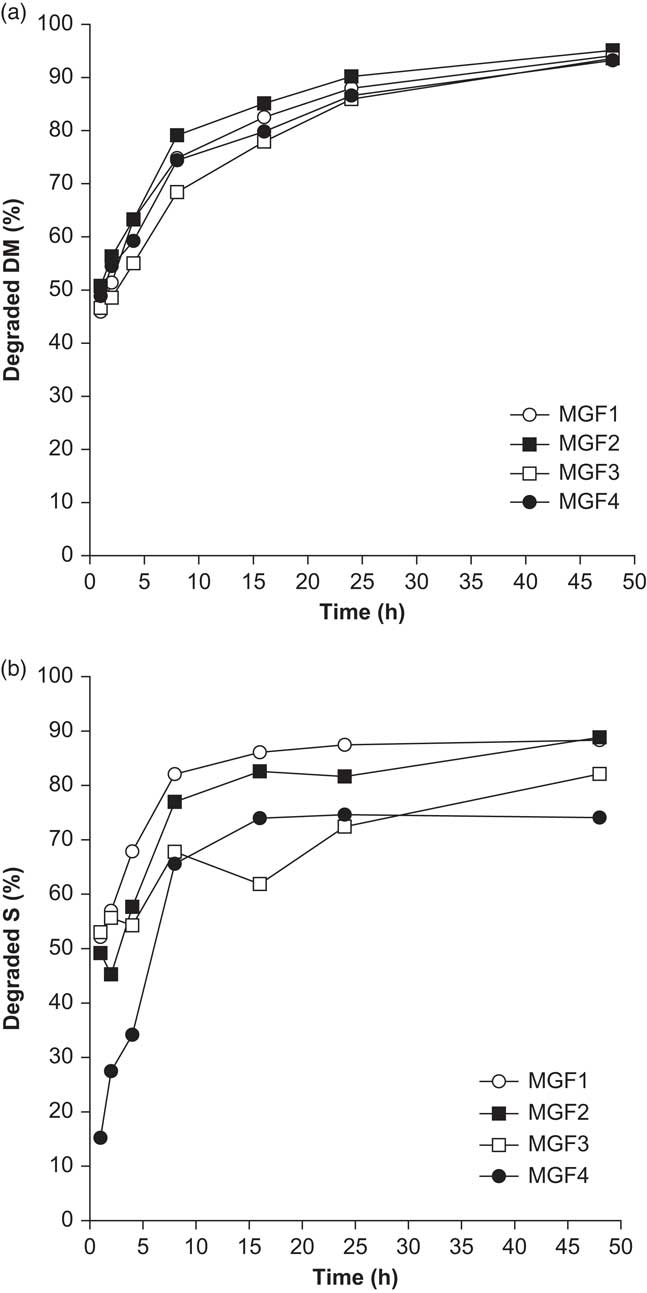
Table 4 presents the mean effects of the intake of 1.0 kg DM of four batches of MGF on the concentration of hydrogen sulphide in the rumen headspace gas, as well as on rumen DM and S degradability (Expt 2). The interactions MGF batch × time are presented graphically for each parameter in Figures 3 and 4. MGF led to high concentrations of hydrogen sulphide (Figure 3). Peak concentrations were achieved between 1 (MGF3) and 2 (MGF2 and 4) hours after feeding. The concentrations of hydrogen sulphide were higher for MGF1, intermediate for MGF2 and lower for MGF3 and 4 (Table 3, Figure 3). Although S content varied among batches (higher in MGF1; Table 2), the differences were lower than for concentrations of hydrogen sulphide, particularly for MGF2, 3 and 4 (Tables 2 and 4, Figure 3). The differences in S degradability were much higher, agreeing with rankings of feeds based on the concentrations of hydrogen sulphide (Table 4, Figure 4). S wash losses were significantly lower for MGF4 than for the other MGF batches.
Mean effects of MGF batch on rumen degradability of DM and S, and on the concentration of hydrogen sulphide (ppm) in rumen headspace gas (Expt. 2).
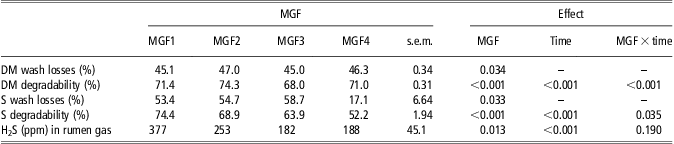
MGF = maize gluten feed; DM = dry matter; S = sulphur; H2S = hydrogen sulphide.
Effects of the intake of 1.0 kg dry matter of four batches of maize gluten feed (MGF) on the concentration of hydrogen sulphide in the rumen headspace gas of dairy cows (Expt 2). Values represent the mean from four animals. s.e.m. = 70.6.

Dry matter (DM; a) and sulphur (b) degradability of four batches of maize gluten feed (MGF; Expt 2). Values represent the mean from two animals. (s.e.m. = 0.81 and 4.90, respectively).
Discussion
Protein sources
The chemical composition of the protein sources used in Expt 1 agrees with the mean composition of these feeds used by the compound feed industry in Portugal and Spain (Fundación Española para el Desarrollo de la Nutrición Animal, 1999). In addition, the in sacco degradation parameters are typical for these feeds (Guedes and Dias-da-Silva, Reference Guedes and Dias-da-Silva2005), with MGF having very high N wash losses, twice those for SFM and SBM. As expected, although the DM degradability of SFM was lower than that of SBM, the degradation rate of insoluble N was much higher for SFM. Therefore, the aim of having protein sources of very different N degradability was achieved.
The nutritive value of MGF is normally assumed by the compound feed industry to be related to its colour. Indeed, Cabrita et al. (Reference Cabrita, Maia, Freitas, Abreu and Fonseca2011b) used 28 samples of MGF from the same feed compounder to show that colour measured by the CIELAB system was related to N solubility and N enzymatic digestibility. The chemical composition, as well as the colour parameters of the batches used in Expt 2, was in the range of those used by Cabrita et al. (Reference Cabrita, Maia, Freitas, Abreu and Fonseca2011b). Although colour values were confined to half of the range from the previous study, we did achieve a reasonable range of values for N degradability.
Concentration of hydrogen sulphide in the rumen headspace gas
Dewhurst et al. (Reference Dewhurst, Kim, Evans, Cabrita and Fonseca2007) confirmed that cyst(e)ine is the dominant source of hydrogen sulphide in rumen gas and showed that there was a linear increase in hydrogen sulphide concentrations in response to increasing cysteine additions. In Expt 1, the concentration of hydrogen sulphide was very different between protein sources, with MGF having the highest concentration followed by SFM and SBM leading to a very low concentration. In Expt 2, the hydrogen sulphide concentrations in rumen gas were different between MGF batches. Interestingly, the concentrations observed in Expt 2 were much higher than that found in Expt 1, and the peak was reached later than in Expt 1. This could be explained by the different protocols used. Indeed, in Expt 1 the cows received the evening meal and were fasted until the morning measurements commenced. Conversely, in Expt 2, the cows had access to grass silage until 2200 h. The different meal patterns could influence rumen outflow rates (Gill et al., Reference Gill, Robinson and Kennelly1999), whereas the more recent meal could increase rumen microbial activity.
Relationships between concentrations of hydrogen sulphide in the rumen and in sacco degradation parameters
Although the ranking of concentrations of hydrogen sulphide was the same as that for in sacco N degradability, in Expt 1, and S degradability, in Expt 2, it should be noted that the relationship may not be causal. Indeed, concentrations of hydrogen sulphide were measured in vivo after feeding a fixed amount of a protein source with all aspects of the cows’ biology, including microbial activity and outflow rate, having an effect. Conversely, in sacco data relate only to the insoluble fraction, without considering the rumen outflow rate. However, in sacco results from Expt 1 show that the degradation of insoluble cystine was much higher in SFM than in SBM. Methionine in SBM was much less degradable than in the other protein sources (MGF and SFM). The degradability of methionine was always lower than cystine, confirming the results of Dewhurst et al. (Reference Dewhurst, Kim, Evans, Cabrita and Fonseca2007).
The batches of MGF differing in colour also differed in S degradability, as well in concentrations of hydrogen sulphide in rumen headspace gas. The highest hydrogen sulphide concentrations were observed for the batch with high S content (MGF1), but the S content of the other batches was quite similar, despite leading to very different hydrogen sulphide concentrations. Although the low initial degradability of S in MGF4 was matched by the lowest hydrogen sulphide concentrations in the first 90 min after feeding, the relative difference between feeds was much greater for the S degradability measurements. This suggests that there were differences in S degradability that are not reflected in the solubility of S, similar to the differences between feed classes noted by Bach et al. (Reference Bach, Ruiz Moreno, Thrune and Stern2008). These results agree with those found by Cabrita et al. (Reference Cabrita, Maia, Freitas, Abreu and Fonseca2011b), showing that the colour of MGF is related to its protein value. In addition, the rumen headspace hydrogen sulphide methodology could be useful in identifying nutritional parameters that are not measured by the in sacco technique – notably the degradation of protein within the first few hours after ingestion, which cannot be distinguished from solubilisation from nylon bags (Bach et al., Reference Bach, Ruiz Moreno, Thrune and Stern2008).
Acknowledgements
This work was partially financed by The British Council (Lisboa, Portugal), Anglo-Portuguese Joint Research Programme – Treaty of Windsor; [Acção No. B 4/2 and LIS/992/2(2002/03)], as well as by a European Commission Project (QLK5-CT-2002-71812).