Introduction
It is estimated that about 10–40% of the total damage to stored grains worldwide is caused by insect pests (Matthews, Reference Matthews, Matthew and Hislop1993). Infestation by the rust red flour beetle Tribolium castaneum Herbst. (Coleoptera: Tenebrionidae) reduces the weight, quality, cultural value and germination of harvested grain. For instance, the beetle is known to cause up to 40% loss by weight in wheat flour (Ajayi and Rahman, Reference Ajayi and Rahman2006). It also reduces the market value and can make the grain unsuitable for human consumption. The cowpea weevil Callosobruchus maculatus F. (Coleoptera: Bruchidae) is a serious pest of pulses, especially cowpeas, pigeon peas, soybean, green grams and lentils (Chaube, Reference Chaube2008).
Synthetic insecticides are commonly used to control storage losses, but these can pose environmental and health hazards and cause the development of resistance in the insects (Champ and Dyte, Reference Champ and Dyte1976; Tyler et al., Reference Tyler, Tayler and Rees1983; White, Reference White, Jayas, White and Muir1995). Thus there is a need to develop cheaper and safer alternatives for insect pest control, including plant-based products (Ndungu et al., Reference Ndungu, Hassanali, Moreka and Chander1995).
Some plants such as peppermint, Mentha piperita Linnaeus (Misra and Kumar, Reference Misra and Kumar1983); black pepper, Piper nigrum Linnaeus (Su, Reference Su1977); Indian beech, Pongamia glabra Vent. (Sighamony et al., Reference Sighamony, Aness, Chandrakala and Osmani1986); and neem, Azadirachta indica (Jilani and Malik, Reference Jilani and Malik1973), have been evaluated for use as stored grain protectants.
Spices are characterized by their flavour and odour due to the presence of aromatic oils. These volatile constituents can influence insect behaviour (Jacobson, Reference Jacobson1966) and some can act as botanical pesticides (Jilani et al., Reference Jilani, Saxena and Rueda1988). Essential oils of spices like anise, peppermint (Shaaya et al., Reference Shaaya, Ravid, Paster, Juven, Zisman and Pissarerw1991), ginger (Prakash and Rao, Reference Prakash and Rao1987) and cinnamon (Michael et al., Reference Michael, Ahmed, Mitchel and Hylein1985) have been used in stored grain protection, and their constituents have also been evaluated for toxicity against stored product insect pests (Weaver et al., Reference Weaver, Dunkle, Ntezurubanza, Jackson and Stock1991).
In this paper, we report on the contact and fumigant toxicity of some common spices against two stored product coleopteran pests, C. maculatus and T. castaneum. Green cardamom, camphor, cinnamon, clove, ginger, Indian cassia, large cardamom, turmeric and ajowan were evaluated, singly and also in various combinations, for their individual or synergistic effects as stored grain protectants.
Lipophilic compounds with alkyl side chains or oxygenated components normally impart insecticidal properties to plants (Naik et al., Reference Naik, Kumar and Maheshwari1993). The spices evaluated in the present study, commonly used for colouring and flavouring food and in herbal medicine, contain essential oils rich in these classes of molecules.
Materials and methods
Test products
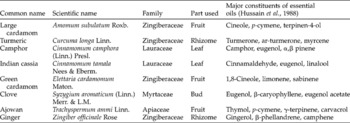
Spices listed in Table 1 were dried in the shade and ground to fine powder in a mixer/grinder just before the start of each set of experiments. Various amounts of powder were packed in muslin bags measuring 5 × 5 × 2 cm. These bags were used in all the experiments.
Spices tested for activity against two storage pests, Callosobruchus maculatus and Tribolium castaneum

Culturing of insects
C. maculatus was reared in the laboratory on chickpea seeds (Cicer arietinum var. ‘Pant G 114’), and T. castaneum on wheat flour mixed with brewer's yeast in a growth cabinet at a constant temperature of 30 °C and 70% relative humidity, with a photoperiod of 12 h light:12 h darkness. The diet was placed in 1 l plastic jars, and 20 pairs of adults were released into the jar for egg laying. C. maculatus parent adults were removed after 7 days and T. castaneum adults were removed after 10 days. Adults of C. maculatus (0- to 1-day-old) and T. castaneum (5- to 7-day-old) from the F1 progenies were used in all the experiments.
Contact toxicity assay
Chickpea seed was used in the evaluations with C. maculatus and wheat flour for T. castaneum experiments. Ground spices of 5, 10, 15, 20 and 25 g per 100 g substrate were evaluated with untreated food materials serving as controls. Spice powders in muslin bags were placed at the bottom of 300 ml capacity screw cap glass jars and steam-sterilized food substrates added. Batches of 10 adult insects were introduced into each bottle, which was then closed tightly with a lid. Five replicates of each treatment were evaluated. Insect mortality was recorded daily for 7 days.
Fumigant toxicity assay
The plant powders were tested for fumigant toxicity in a space trial test. Plant powders (5, 10, 15, 20 and 25 g for each test product) in muslin cloth bags were placed at the bottom of a 1 l glass bottle. Batches of 10 insects of each species were introduced into each bottle by placing them in separate plastic vials containing food materials for the test insects. Both ends of the vial were covered with copper wire mesh and the vials were suspended in each bottle, whose cap was screwed on tightly. The controls had no spice powders. Ten replicates were set up for each treatment. Mortality of adults was observed at 48-h intervals until the end-point mortality, which was reached after 7 days, and the LC50 values were determined using the adult mortality data.
Repellency assay
Each spice was evaluated for repellency, using 1.5 g spice powder per 50 g of food substrate. Treated and untreated food substrates (50 g each) were placed on opposite sides of a rectangular glass arena (20 × 12 × 12 cm) with 12 cm space between the surfaces. Ten adults of each test species, starved for 48 h, were introduced halfway between the treated and untreated substrates. After 1 h, the number of insects found within a 1.5 cm radius of the treated and untreated food substrate was counted. The experiment was replicated 10 times. Percentage repellency (PR) values were computed as PR = [(N C − N T)/(N C+N T)] × 100, where N C = no. of insects in the control area and N T = no. of insects in the treated area.
Effect of spice powders on progeny development
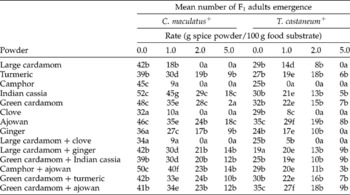
Spice powders found to be toxic to C. maculatus and T. castaneum were tested for their effects on progeny development. Spice powders were mixed with either wheat flour or chickpea flour at the rate of 1, 2 and 5 g/100 g substrate, and placed in cylindrical jars (25 × 10 cm). Ten adults of either species were introduced separately into each jar and then covered. The parent adults were removed after 7 days. The number of F 1 adults that emerged was recorded after 30 days of introduction of adults. Each treatment was replicated five times.
Data analysis
Data from all experiments were subjected to ANOVA and means were separated using the least-squares difference test (SAS Institute, 1988). LC50 was determined by probit analysis (Finney, Reference Finney1971). Mortality data were corrected for natural mortality using Abbott's formula (Abbott, Reference Abbott1925; SPSS, 1999).
Results
Contact toxicity
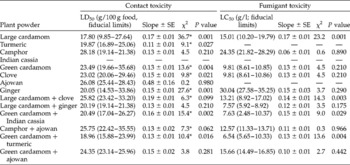
The contact toxicity of the spice powders to C. maculatus is shown in Table 2. Large cardamom, turmeric and ginger showed toxicity with LD50 values of 17.80, 19.87 and 20.05 g/100 g, respectively. Camphor and ajowan, and green cardamom and clove had equivalent toxicity. In 1:1 combination, green cardamom+turmeric showed the highest toxicity against C. maculatus with an LD50 value of 18.96 g/100 g, followed by green cardamom+Indian cassia with an LD50 value of 20.49 g/100 g food. Green cardamom and turmeric, with LD50 values of 23.49 and 19.87 g/100 g, respectively, were more toxic in combination (Table 2). Indian cassia was non-toxic alone, but the mixture of Indian cassia+green cardamom showed toxicity, clearly demonstrating a synergistic effect.
Activity of spice powders singly and as 1:1 mixtures against Callosobruchus maculatus in contact and fumigant toxicity assays

* χ2 values are significant.
— no activity.
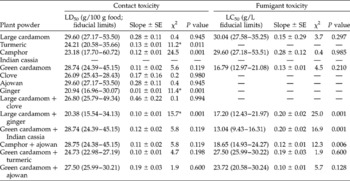
Among the plant powders, only ginger was found to be toxic to T. castaneum with an LD50 value of 20.94 g/100 g (Table 3). Among the combinations, large cardamom+ginger was slightly more toxic than ginger alone (LD50 20.38 g/100 g). Similar results were obtained with green cardamom+turmeric. The synergy between Indian cassia and green cardamom seen in assays with C. maculatus was not observed against T. castaneum; a likely reason for this is that green cardamom on its own was less toxic to T. castaneum than to C. maculatus.
Activity of spice powders singly and as 1:1 mixtures against Tribolium castaneum in contact and fumigant toxicity assays

* χ2 values are significant.
— no activity.
Fumigant toxicity
Green cardamom and clove both showed fumigant toxicity against C. maculatus with LC50 values of 9.81 g/100 g each (Table 2). Turmeric, Indian cassia and ajowan showed no fumigant activity. However, as mixtures, green cardamom+turmeric, large cardamom+ginger and green cardamom+Indian cassia were toxic with LC50 values of 6.54, 7.57 and 7.63 g/100 g, respectively.
The LC50 of the 1:1 mixture of large cardamom and ginger was found to be four times and double that of large cardamom and ginger alone, respectively. Indian cassia was non-toxic to C. maculatus. The LC50 value of green cardamom+Indian cassia was lower than that of green cardamom alone. Ajowan showed no fumigant toxicity, but ajowan+camphor had an LC50 value of 12.57 g/l air, indicating a synergistic action. Camphor alone had an LC50 of 24.35 g/l air against C. maculatus, which was lower than ajowan+camphor (Table 2).
Turmeric was toxic to T. castaneum in combination with green cardamom, but not alone. Indian cassia, clove, ajowan and ginger showed no fumigant toxicity (Table 3). Green cardamom showed toxicity with an LC50 value of 16.79 g/l air. In combination with Indian cassia, its toxicity increased. Similarly, the mixture of camphor+ajowan showed higher fumigant toxicity against T. castaneum with an LC50 value of 18.65 g/l air than a linear average of the two products.
Repellency
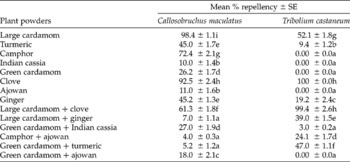
The powders of large cardamom and clove were highly repellent against C. maculatus (Table 4), whereas clove showed complete repellency against T. castaneum. A mixture of large cardamom+clove had 99.4% repellency against T. castaneum. At 1.5 g/50 g, none of the combinations tested showed better repellency than this against C. maculatus (Table 4).
Repellency against Callosobruchus maculatus and Tribolium castaneum caused by various spice powders and their 1:1 mixtures at a dose of 1.5 g/50 g

Means in a column followed by different letters are significantly different at P = 0.05 (least-squares difference).
Progeny development
At the maximum dose of 5 g/100 g, large cardamom, camphor and clove completely inhibited progeny production in both C. maculatus and T. castaneum (Table 5). Among the combinations, only large cardamom+clove completely inhibited progeny production in both insects.
Effect of spice powders and their 1:1 mixtures on progeny development of Callosobruchus maculatus F. and Tribolium castaneum Herbst

+Each value is an average of observations on five replicates of 10 adult beetles each.
Means in a column followed by the same letters are not significantly different at P = 0.05.
Discussion
The powders of large cardamom, clove and green cardamom exhibited contact and fumigant toxicity, repellency and suppression of progeny development in C. maculatus and T. castaneum. The essential oil of cardamom had been previously reported as having contact and fumigant toxicity against Sitophilus oryzae and T. castaneum (Huang et al., Reference Huang, Lam and Ho2000). This oil has 1,8-cineole as a major constituent (Hussain et al., Reference Hussain, Virmani, Sharma, Kumar and Mishra1988; Table 1). Furthermore, 1,8-cineole from Artemisia annua oil has been found to have toxic, anti-feedant and growth-disruptant properties against T. castaneum (Tripathi et al., Reference Tripathi, Prajapati, Aggarwal and Kumar2001). Thus the bioactivity of green cardamom and large cardamom may be attributed to the presence of cineole.
Eugenol, a constituent of some plants, has been reported to protect grain against stored product insects (Obeng-Ofori and Reichmuth, Reference Obeng-Ofori and Reichmuth1997). It may be possible that the same constituent, present in clove, is responsible for the bioactivity reported in this paper. A hexane extract of flower buds of clove has been reported to cause mortality to Sitophilus zeamais adults and also suppress progeny production in T. castaneum (Ho et al., Reference Ho, Cheng, Sim and Tan1994).
The synergistic effect of the combinations of essential oils of clove, ginger and Piper guineense in the population suppression of C. maculatus has been reported (Ajayi and Lale, Reference Ajayi and Lale2000). The combination of the essential oils of Artemisia princeps and camphor showed repellency against S. oryzae and Bruchus rugimanus (Liu et al., Reference Liu, Mishra, Tan, Tang, Yang and Shen2006). The compounds linalool, limonene and camphor in camphor oil have been reported to be toxic, repellent or fumigant against insects, with some of them acting synergistically (Tripathi et al., Reference Tripathi, Prajapati, Aggarwal, Khanuja and Kumar2000, Reference Tripathi, Prajapati, Khanuja and Kumar2003; Ahmed, Reference Ahmed2006). Therefore, these compounds may have contributed to the repellent and insecticidal activity of camphor powder seen against the two storage insects in our study.
Ginger rhizome powder has been reported to significantly reduce F1 progeny in S. oryzae (Ahamad and Ahmed, Reference Ahamad and Ahmed1991). Furthermore, the essential oil of ginger showed ovicidal and repellent action against mosquitoes (Prajapati et al., Reference Prajapati, Tripathi, Aggarwal and Khanuja2005). A petroleum ether extract of turmeric rhizome was adulticidal against C. maculatus (Pranata, Reference Pranata1984) and repellent against T. castaneum adults (Jilani and Su, Reference Jilani and Su1983). Turmeric rhizome powder was toxic to adults of C. chinensis and prevented their oviposition (Ahmed and Ahamad, Reference Ahmed and Ahamad1992).
Conclusion
This study suggests that certain spices can protect stored products against insect pest damage. Most of the spices evaluated in our experiments are biodegradable, edible (Korikanthimathm et al., Reference Korikanthimathm, Rasath and Rao2000) and are classified as Generally Recognized as Safe (GRAS) by the Food and Drug Administration, USA.
Our findings on the contact and fumigant toxicity of binary mixtures of spices, especially green cardamom and turmeric, are encouraging. However, the way in which these mixtures interact synergistically to result in enhanced insecticidal activity needs further investigation.
Further experiments on dose optimization and formulation may lead to the development of botanical commercial stored grain protectants.