Introduction
Men have been neglected in previous research on childlessness (Bulcroft and Teachman Reference Bulcroft, Teachman, Coleman and Ganong2003), and studies of family formation typically focus on women (Forste Reference Forste2002; Greene and Biddlecom Reference Greene and Biddlecom2000). National fertility indicators, such as the total fertility rate, completed fertility by birth cohort, and the mean age at first birth refer exclusively to women (see e.g. European Communities 2006). Registration data on men's fertility do not exist, which is not to say that men's reproductive histories cannot be constructed from household data. Weitoft, Burström and Rosén (Reference Weitoft, Burström and Rosén2004) have done this using Swedish population registration data. It was the pioneering work on men and masculinity that began studies of fatherhood (Pleck and Sawyer Reference Pleck and Sawyer1974; Pleck Reference Pleck1981). Fatherhood research developed slowly until the emergence of welfare-policy concerns about single parenthood, particularly in the United States and the United Kingdom (Clarke and Roberts Reference Clarke, Roberts, Carling, Duncan and Edwards2002). ‘Involved fatherhood’ was prescribed as a means of breaking inter-generational cycles of deprivation and anti-social behaviour, as well as to provide support for working mothers. The concern in Europe about persistently low fertility has also stimulated investigations of men's role as fathers (Tazi-Preve and Dorbritz Reference Tazi-Preve and Dorbritz2007). Given the policy concerns about ‘deadbeat dads’ and ‘absent fathers’, it should not come as a surprise that many fatherhood studies have focused on the effects of a father's presence on their children's wellbeing. A review of research in North America (where most fatherhood research has been carried out) suggests that a father's presence in childhood is beneficial (Marsiglio et al. Reference Marsiglio, Amato, Day and Lamb2000). A father's presence is associated with children's higher academic performance and less anti-social behaviour, such as drug taking, truancy and criminality.
The research emanating from masculinity studies has largely focused on the part that fatherhood plays in men's identity. According to Townsend (Reference Townsend2002), the good-provider image of the father remains culturally significant, notwithstanding the new model of fathers as nurturers. He argued that men view fatherhood as a component of a culturally-determined ‘package deal’, in which entering marriage, having children, holding a steady job and owning a home are four inter-connected elements. Very little work has been done on the implications of fatherhood for men's wellbeing. By contrasting childless men and fathers, this paper seeks to fill this void. In doing so, we introduce a number of methodological innovations. The data are from the main sample of the first wave of the Netherlands Kinship Panel Study (NKPS) (Dykstra et al. Reference Dykstra, Kalmijn, Knijn, Komter, Liefbroer and Mulder2005). Though the general understanding in the literature is that fathering is good for men, it is far from well understood why this is so. The aim of this paper is to improve theory, and more specifically to reach an understanding of whether the benefits of fatherhood are attributable to the transformation in status (i.e. becoming a father) or to engagement in fathering activities (i.e. interactions with children).
Methodological improvements
Research on the benefits of parenthood tends to focus on differences between adults living with children and those living without children in the household (for reviews seeMcLanahan and Adams Reference McLanahan and Adams1987; Kendig et al. Reference Kendig, Dykstra, Gaalen, Melkas, Dykstra and Hagestad2007). In such research designs, the childless are placed in the same category as ‘empty-nesters’. As a result, the effects of life-long childlessness and of no longer having children living at home are confounded. In this study, we distinguish four groups: childless men (i.e. those who never had children), fathers living with their children, fathers who are not living with their children as a consequence of divorce (referred to as non-co-resident fathers), and empty-nest fathers. Several studies have included younger men (and women) who might later make the transition to parenthood in the childless category (Eggebeen and Knoester Reference Eggebeen and Knoester2001; Knoester and Eggebeen Reference Knoester and Eggebeen2006; Nomaguchi and Milkie Reference Nomaguchi and Milkie2003). In these studies, permanently childless men and not-yet fathers are in the same category. We focus on middle-aged men (aged 40–59 years). Those without children in this age group are unlikely to make the transition to parenthood (though of course it happens). A preliminary analysis of NKPS data found that the majority (97%) of fathers had their first child before the age of 40 years. Researchers have not always employed research designs that enable the effects of parenthood to be disentangled from those of marriage (Dykstra and Hagestad Reference Dykstra, Hagestad, Dykstra and Hagestad2007). We look at childlessness both within and outside stable partner relationships (marriage and consensual unions, heterosexual and homosexual relationships).
The focus on middle age
A focus on the currently middle-aged (the men in the study were born during 1943–63) sheds light on older adults in the future. Compared to today's older people, following cohorts will have higher levels of childlessness, and the relative frequencies of the various reasons for childlessness will change. A higher proportion will have remained childless in a stable partnership, or will be childless as a result of divorce. Little information exists on changes in the likelihood of outliving one's children. Using fertility and mortality estimates provided by Statistics Netherlands, Beets (Reference Beets2005) predicted that the proportion of Dutch women who outlive all their children will remain less than one per cent. The situation in Eastern European countries might be quite different, because of the substantial fall in male life expectancy (Nolte, McKee and Gilmore Reference Nolte, Mc Kee, Gilmore, Macura, MacDonald and Haug2005), and the very low fertility, which suggest that in the near future a substantial number of men and women will outlive their sons and may face old age with no children.Footnote 1 The demographic profile of future cohorts is only part of the story. Also of interest is whether childlessness makes a difference in the lives of middle-aged men, and whether current patterns in wellbeing predict future circumstances. We will return to this point in the conclusion.
The hypotheses
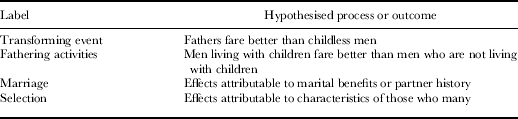
Several hypotheses have been suggested to explain differences in wellbeing between childless men and fathers, as summarised in Table 1. The first is based on the notion that fatherhood is a transforming event (e.g. Akerlof Reference Akerlof1998; Eggebeen and Knoester Reference Eggebeen and Knoester2001; Knoester and Eggebeen Reference Knoester and Eggebeen2006). It is supposed that once they have children, men's behaviour changes: they act more responsibly, become more caring and nurturing, aim to be good providers for their families, want to be good role models, and become involved in causes that benefit their offspring (e.g. community involvement). Men who become fathers are also subject to informal social control (Umberson Reference Umberson1987): they are admonished to eat nourishing meals, to limit their alcohol consumption, and to set a proper example for their children. If fatherhood is a transforming event, we should see contrasts between childless men and fathers (with childless men showing lower levels of wellbeing than fathers), and there also would be no or slight differences among fathers.
Hypotheses of the effects on men of fatherhood
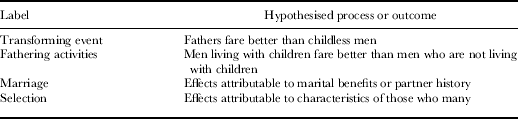
The second hypothesis is based on the notion that men derive benefits from engaging in fathering activities (Lamb Reference Lamb and Lamb1997; Brannen and Nilsen Reference Brannen and Nilsen2006; Skevik Reference Skevik2006); that is, in spending time with their children, being involved in their lives, and doing things together. Opportunities for fathering vary. Fathers do not always live with their offspring (as the result of divorce or because children have left home), and some men are fathers to children with whom they have no biological ties (stepfathers). The assumption here is that the benefits do not derive from fatherhood per se, but rather from the involvement with children. If fathering activities are crucial, then fathers' wellbeing should be higher among those co-residing with children (biological, adoptive and step) than among those who do not have children living at home.
Alternative explanations have been suggested. One is that the differences ascribed to fatherhood are actually attributable to being married (or being in a partner relationship). As already evident in Durkheim's (1951 [1896]) study of suicide, disentangling the effects of marriage and parenthood is difficult. Most studies of childlessness have ignored this issue. To find out whether differences should be attributed to the protective effects of marriage rather than fatherhood, we will include characteristics of men's marital histories in the analyses. Another proposition has been that the differences attributed to fatherhood are actually selection effects. This holds that the benefits are not derived from fatherhood, but rather that fathers have favourable characteristics; in other words, those who are selected into the status of fatherhood have more desirable (or healthier) traits than those who do not have children. Men with poor socio-economic prospects are less likely to become husbands and fathers than are men with good provider potential (Becker Reference Becker1991 [1981]; Bernard Reference Bernard1982 [1972]; Oppenheimer Reference Oppenheimer1994). Given the cross-sectional nature of the data, we cannot determine whether selection plays a role. To correct for the possible confounding effects of pre-existing differences in socio-economic potential, the level of education is introduced as a control in the analyses.
Methods
The Netherlands Kinship Panel Study data
The data are from the public release file of the Netherlands Kinship Panel Study (NKPS). The main nationally-representative sample of 8,160 men and women aged 18–79 years residing in private households in The Netherlands was used. The response rate was 45 per cent, which is comparable to that of other large family surveys in The Netherlands (see Dykstra et al. Reference Dykstra, Kalmijn, Knijn, Komter, Liefbroer and Mulder2005), and the data were collected through face-to-face interviews during 2002–03. Checks of the representativeness of the NKPS sample have revealed under-representations of single men, of men in couple households, and of young adults living in the parental home, and over-representation of women with children living at home. The concerns of the survey may have appealed most to people with children. Residents of the most urban and the most rural areas were also under-represented, a pattern that often occurs in survey research. Detailed information on the respondents' marital and parenthood histories was collected. The interview data were supplemented with self-completion questionnaires that had items on attitudes and other subjective measures. Over 90 per cent of the self-completion questionnaires were returned.
The respondents
The operational definition of childlessness was ‘never having had biological or adoptive children’. Of all men aged 40–59 years in the sample, 18.8 per cent were childless. Some 2.2 per cent were living with step-children (weighted percentages), but this group was not included as a separate category in the regression models because of the small number.Footnote 2Table 2 shows the parenthood status distribution of the 1,467 men in the analyses (the data were weighted to be representative of the Dutch population in 2002–03).
Parenthood status of men aged 40–59 years, The Netherlands 2002–03

Note: Weighted data. Sample size 1,467.
Source: Netherlands Kinship Panel Survey (see text).
Outcome measures
Following Eggebeen and Knoester (Reference Eggebeen and Knoester2001), a wide range of wellbeing variables was used. We examined economic, social and psychological wellbeing using several indicators for each, consistent with the understanding that wellbeing is a multi-dimensional construct (Andrews and Withey Reference Andrews and Withey1976; Walker Reference Walker2005). The economic wellbeing measures included monthly personal income in five quintiles. Income from both employment and social benefits was considered. In addition we used a measure of occupational prestige, based on the international socio-economic index (ISEI) of occupations (Ganzeboom, De Graaf and Treiman Reference Ganzeboom, De Graaf and Treiman1992). The ISEI scores for the sample of men ranged from ‘16’ (low-skilled occupation with little prestige) to ‘88’ (highly skilled occupation with high prestige).
The psychological wellbeing measures included the four-item life satisfaction scale developed by Diener et al. (Reference Diener, Emmons, Larsen and Griffin1985), and the scores ranged from ‘4’ (low life satisfaction) to ‘20’ (high life satisfaction). Examples of the scale items are: ‘My life is ideal in most respects’ and ‘If I could live my life again, I would change very little’. The answer categories ranged from ‘strongly disagree’ (1) to ‘strongly agree’ (5). In addition, we used an indicator of mental health as measured by the five-item Mental Health Index (Berwick et al. Reference Berwick, Murphy, Goldman, Ware, Barsky and Weinstein1991), and the scores ranged from ‘5’ (poor mental health) to ‘30’ (excellent mental health). Examples of scale items are: ‘How often have you felt particularly tense in the past four weeks?’ (item reverse-coded) and ‘How often have you felt happy in the past four weeks?’. The answer categories ranged from ‘never’ (1) to ‘all the time’ (6). Finally we used an indicator of problem behaviour, i.e. whether in the last 12 months the respondent had had ‘serious psychological problems’, ‘been in contact with the police (other than for traffic offences)’, had ‘a conviction in criminal court’, an ‘alcohol or drug addiction’, ‘a bankruptcy or serious financial problems’, or ‘been physically assaulted or abused’. The problem behaviour index was an aggregate of the presence/absence scores, and ranged from ‘0’ (no problem behaviour) to ‘6’ (extreme problem behaviour).
The social wellbeing measures assessed the degree of social isolation, and included the 11-item De Jong Gierveld Loneliness Scale (De Jong Gierveld and Van Tilburg Reference Jong and Tilburg1990), and the scores ranged from ‘11’ (not lonely) to ‘33’ (severely lonely). Examples of scale items are: ‘I miss having a truly close friend’, and ‘I find my circle of friends and acquaintances too limited’. The answer categories were ‘no’ (1), ‘more or less’ (2) and ‘yes’ (3). To assess the quality of the respondents' family relationships, we used a reliance on family scale, and the scores ranged from ‘4’ (poor-quality family relationships) to ‘20’ (high-quality family relationships). Examples of scale items are: ‘When I am troubled I can always discuss worries with my family’ and ‘I can always count on my family’. The scale was newly developed for the NKPS. Note that the guidance to respondents was that ‘family’ included: partner, children, parents, brothers and sisters, grandparents and grandchildren, uncles, aunts, nephews and nieces. The answer categories ranged from ‘strongly disagree’ (1) to ‘strongly agree’ (5). To assess community involvement, we used two measures of help provision. The first was whether in the last 12 months the respondent had ‘provided unpaid help to sick or handicapped acquaintances or neighbours (not family)’. The second was whether in the previous 12 months the respondent had engaged in ‘volunteer work for an association, church or other organisation (not school)’. Answers were ‘no’ (0) and ‘yes’ (1). Scores for the community involvement measure ranged from ‘0’ to ‘2’.
The control variables
We controlled for age (in years), and years of education. Educational attainment was assessed on the basis of the question: ‘What is the highest level of education that you pursued?’ Answers ranged from ‘did not complete elementary school’ to ‘post-graduate’. The level of education was converted to the number of years needed for its completion. The observed years of education varied from ‘5’ to ‘19’.
The analyses
Ordinary least-squares (OLS) linear regressions of the various wellbeing outcomes were run. For each outcome, Model 1 examined the effects of parenthood status. Three dummy variables were used to capture different aspects of parenthood: the first for childlessness (i.e. never having had biological or adoptive children), one for non-co-residence (i.e. not living with one's biological and/or adoptive children (when minors) because of divorce or separation), and one for empty-nest households (i.e. not living with one's biological and/or adoptive children because they had left home). Men living with biological and/or adoptive children were the reference category. For each outcome, Model 2 examined whether partner history accounted for the parenthood differences. Three dummy variables were used for partner status: in a non-marital partnership (consensual union or ‘living-alone-but-together’ relationship), single after the dissolution of a partnership (the majority in this category were officially divorced), and never partnered (i.e. never having lived with a partner either in or outside marriage). Married men were the reference category. The analyses controlled for variations in age and educational attainment.
The results
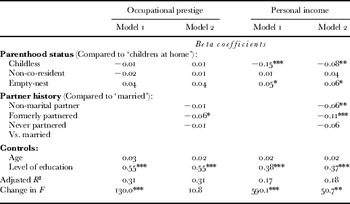
Table 3 shows the results of the OLS regressions of economic wellbeing. Parenthood status had no significant influence on men's occupational prestige, and once differences by age, educational attainment and parenthood status were taken into account, nor did partnering history. The findings for monthly personal income were quite different. Childless men had lower incomes than fathers living with their children, a difference that remained after considering men's partnering history. The opposite was found for empty-nest fathers, for they had higher incomes than resident fathers. The income of the non-co-resident fathers was not significantly different from that of the resident fathers. The relatively high explanations of the economic wellbeing models derive largely from the association between the level of education of the fathers and both their occupational prestige and monthly income.
Differences in economic wellbeing by parenthood status and partner history, men aged 40–59 years, The Netherlands, 2002–03

Notes: Ordinary least-squares regressions. Sample size 1,467.
Significance levels: * p<0.05, ** p<0.01, *** p<0.001.
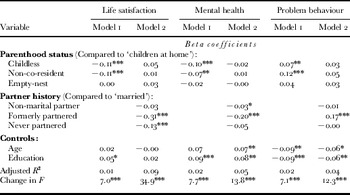
As regards psychological wellbeing, the fathers' partner history rather than parenthood status was found most influential (Table 4). The findings were remarkably consistent across the three measures, i.e. life satisfaction, mental health and problem behaviour. Model 1 for both life satisfaction an mental health revealed lower levels of psychological wellbeing among childless and non-co-resident fathers than men living with their children, and Model 2 indicates that this was largely attributable to not being in a partnership. Once partnering history was taken into account, the psychological wellbeing of the empty-nest fathers and the resident fathers was not significantly different; the majority of men in both categories were married.
Differences in psychological wellbeing by parenthood status and partner history, men aged 40–59 years, The Netherlands, 2002–03

Notes: Ordinary least-squares regressions. Sample size 1,467.
Significance levels: *p<0.05, ** p<0.01, *** p<0.001.
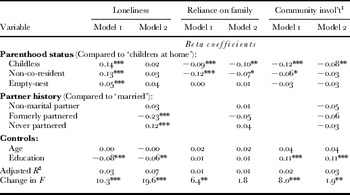
Turning to social wellbeing, parenthood differences were influential (Table 5). Whereas the findings on loneliness paralleled those on life satisfaction, mental health and problem behaviour, in that the differences by parenthood status disappeared once partner history was considered, the associations with ‘reliance on family’ and ‘community involvement’ persisted. Interestingly, differences in ‘reliance on family’ by partner history were not found, but rather parenthood status was the major influence. Childless men and non-co-resident fathers less often reported that they turned to their families when in need than men living with their children. As regards community involvement, childless men helped others less often than either empty-nesters or fathers living with their children.
Differences in social wellbeing by parenthood status and partner history, men aged 40–59 years, The Netherlands, 2002–03

Notes: Ordinary least-squares regressions. Sample size 1,467. 1. Community involvement.
Significance levels: *p<0.05, ** p<0.01, *** p<0.001.
Discussion
The regressions have shown that fatherhood makes a difference in men's lives, but not equally across life domains. Fatherhood has an impact in the economic domain. Fathers, regardless of whether or not they are living with their children, and regardless of their partner history, have higher incomes than childless men. The findings therefore support the hypothesis that men who become fathers are good-providers. Lundberg and Rose (Reference Lundberg and Rose2002) described a ‘fatherhood premium’: men work more hours and earn more per hour after becoming fathers. Using data from the United States Panel Study of Income Dynamics, they showed that men's labour supply and wage rates increased more in response to having sons than to having daughters.
The regressions found no parenthood differences in the psychological domain. Childless men and fathers reported similar levels of life satisfaction, mental health and problem behaviour. As regards men's psychological wellbeing, their partner history counted, not their parenthood status. Being single was associated with low levels of psychological wellbeing. A similar pattern emerged for loneliness (which conceivably is a facet of psychological wellbeing) (Ernst and Cacioppo Reference Ernst and Cacioppo1999). Of course, men's parenthood status is inextricably linked with their partner history: never having married and having gone through an early divorce are common antecedents of childlessness, just as divorce tends to be the reason why men are not living with their school-age children. Nevertheless, when both parenthood status and partner history were entered in the models of psychological wellbeing, only the latter made a difference.
In the social domain, parenthood status made a difference. Childless men and non-co-resident fathers reported poorer quality family relationships. In addition, childless men were least likely to report helping others in the community. The findings evince the socially-integrating function of parenthood (Dykstra Reference Dykstra2006; Nomaguchi and Milkie Reference Nomaguchi and Milkie2003; Offer and Schneider Reference Offer and Schneider2007). Having children brings families and generations together and is a vehicle for expansion of the parents' social networks. The findings also point to fatherhood as an important opportunity for generativity (Erikson Reference Erikson1963 [1950]); that is, a concern to support and guide the next generation. Though we should be careful not to equate generativity with being a parent, men who become fathers appear to be more willing to contribute to broader society.
A central question guiding the analyses was whether fatherhood is a transforming event or the benefits of fatherhood derive more from the practice of fathering. The strongest contrasts that we have found (they were not substantial) were between childless men and fathers, not between men who did and did not live with school-age children. Thus, the findings provide more support for the ‘transforming event’ hypothesis than for the ‘fathering activities’ hypothesis, but there are caveats. The first is that we cannot rule out the possibility of selection. It is important to acknowledge that the more favourable characteristics of the fathers in our study might not be the result of having made the transition to parenthood. The fathers might have been different men to begin with: more sociable, caring and economically advantaged. In fact, these more favourable characteristics might have increased their probability of becoming fathers. Selection versus causation is now a central theme of research on the benefits of marriage (Brockmann and Klein Reference Brockmann and Klein2004; Mastekaasa Reference Mastekaasa1992; Simon Reference Simon2002). Selection into fatherhood requires more attention in future research. Kohler, Behrman and Skytthe (Reference Kohler, Behrman and Skytthe2005) have provided an exemplary and inspiring analysis, using data on twins to unravel the effects of genetic endowment on both subjective wellbeing and the likelihood of forming a partnership and becoming a parent.
A second caveat is that fathering activities were assessed quite crudely by the NKSP. It collected data on sharing a household with under-age children, but that is an indirect indicator of care and relationship building with children. It does not recognise the ‘new father’ who is actively and deeply involved in raising children, a model that is currently being promoted by several European governments (Bergman and Hobson Reference Bergman, Hobson and Hobson2002; Lewis Reference Lewis, Knijn and Komter2004). Across Europe, the proportion of men with part-time jobs has risen (Román Reference Román2006). Though the reasons for working part-time are largely unknown, a desire to spend more time at home with children is likely to be among them. More careful assessments of ‘paternal investment’ will help gain an understanding of the consequences of fatherhood for men's wellbeing (Hofferth and Anderson Reference Hofferth and Anderson2003).
The men in our study will be part of ‘the great grey wave’ that will enter old age in many developed countries between 2020 and 2030. How might they age? Our study shows that today's middle-aged childless men are somewhat disadvantaged socio-economically. Childless men are not a group that immediately comes to mind when drawing profiles of future older adults at risk of having low incomes, but the presented findings suggest that parenthood status warrants greater attention in analyses of socio-economic inequality in old age. We have shown that non-co-resident fathers and childless men are running social risks. They report being less able to turn to their families when in need. The long-term negative impact of divorce on men's social ties has been reported repeatedly (Cooney and Uhlenberg Reference Cooney and Uhlenberg1990; Dykstra Reference Dykstra1998; Kaufman and Uhlenberg Reference Kaufman and Uhlenberg1998). Childless men stand out in that they appear to have individualistic life styles. Men who have never had children seem to be less involved in community activities. As Eggebeen and Uhlenberg (Reference Eggebeen and Uhlenberg1985) pointed out, those without regular ties to children appear to show less concern for the welfare of others.
One hopes that childless men are in circumstances that enable them to be self-reliant as they age. It has been repeatedly shown that older people with no children and very old parents are able to sustain their style of life as long as they enjoy good health (Wenger et al. Reference Wenger, Dykstra, Melkas, Knipscheer, Dykstra and Hagestad2007). When health deteriorates, however, the childless are in a vulnerable position. Older adults without a partner and no children typically have no network members who are willing and able to provide care for extended periods. As a result, those without children are more likely to depend on formal services at the end of life (Aykan Reference Aykan2003; Larsson and Silverstein Reference Larsson and Silverstein2004; Muramatsu et al. Reference Muramatsu, Yin, Campbell, Hoyem, Jacob and Ross2007). Our findings suggest that the support needs of older childless men should be carefully assessed by those responsible for formal care arrangements in the future.
Acknowledgements
The data for this paper are from the Netherlands Kinship Panel Study (NKPS), which is funded through the ‘Major Investments Fund’ of the Netherlands Organisation for Scientific Research (Grant 480-10-009). Financial and institutional support for the NKPS also comes from The Netherlands Interdisciplinary Demographic Institute, the Faculty of Social Sciences (Utrecht University), the Faculty of Social and Behavioural Sciences (University of Amsterdam) and the Faculty of Social Science (Tilburg University). Earlier versions of this paper were presented at the symposium Men Who Are Not Fathers: Who Are They and How Might They Age? at the 58th annual meeting of the Gerontological Society of America, Orlando, Florida, 18–22 November 2005, and at the workshop Minimal Families: Childlessness and Intergenerational Transfers, European University Institute, San Domenico di Fiesole, Italy, 21–23 September 2006. We thank all those who provided valuable comments on earlier versions.