Introduction
The Sociocultural Stress and Coping Model
Research shows that providing care to family members with dementia is associated with negative effects on physical and psychological health for caregivers (Pinquart and Sörensen, Reference Pinquart and Sörensen2003). Considering that dementia caregiving has been described as a chronic stressor (Vitaliano et al., Reference Vitaliano, Young and Zhang2004), it is not surprising that the theoretical framework most commonly used in the caregiving literature is the stress and coping model adapted to caregiving (Haley et al., Reference Haley, Levine, Brown and Bartolucci1987). According to this model, the impact of stressors (such as care recipients' behavioral problems) on caregivers' health outcomes (such as depression and anxiety) may be attenuated or reinforced by resource variables (such as coping strategies). One of these resource variables is the repertoire of strategies which caregivers use to cope with their emotions (emotion regulation strategies). In this regard, research has shown how the use of maladaptive emotion regulation strategies – such as low acceptance or low positive reframing – significantly predicts higher levels of caregiver distress (Cooper et al., Reference Cooper, Katona, Orrel and Livingston2008).
In addition to the dimensions of the stress and coping model referred to above, research has provided support for the inclusion of cultural factors in the model (e.g. Pinquart and Sörensen, Reference Pinquart and Sörensen2005). The addition of cultural variables to the model has led to the development of the Sociocultural Stress and Coping Model (Knight and Sayegh, Reference Knight and Sayegh2010). This model highlights the importance of analyzing the influence that cultural values have on a common core model shared by different cultural groups that considers that caregiving distress is due to the appraisal of caregiving stressors as burdensome (Knight and Sayegh, Reference Knight and Sayegh2010). The main way in which cultural values (e.g. obligation values) have an impact on caregiver outcomes is via its influence on caregivers' resources (e.g. use of coping strategies and social support) (Knight and Sayegh, Reference Knight and Sayegh2010).
Even though the importance of cultural factors in the caregiving process has been highlighted by the literature, most of the studies that have focused on their analysis have used non-theoretical approaches or have analyzed group membership (rather than specific cultural variables) as the only criterion for explaining cultural differences in caregiving (Knight et al., Reference Knight, Silverstein, McCallum and Fox2000; Dilworth-Anderson et al., Reference Dilworth-Anderson, Williams and Gibson2002; Knight and Sayegh, Reference Knight and Sayegh2010).
Motivation for caregiving
Among the cultural variables studied in the caregiving literature are the motives for caregiving. This variable has been defined as the expressions and meanings, derived from culture, that direct particular behaviors, such as the provision of care to older dependent relatives and their families (Dilworth-Anderson et al., Reference Dilworth-Anderson, Brummett, Goodwin, Williams, Williams and Siegler2005). Dilworth-Anderson et al. (Reference Dilworth-Anderson, Goodwin and Williams2004) considered motives for caregiving as a resource, suggesting that they are related to beliefs and attitudes about caring that encourage the use of coping strategies to deal with stressors in the caregiving situation.
Different procedures have been used to assess motivation for caregiving, though most of them have either failed to use validated measures or have used qualitative methodology (e.g. Hsu and Shyu, Reference Hsu and Shyu2003). However, qualitative research has contributed to our understanding of the impact of motivations for caring on caregiver's distress by helping to identify caregiving motives as a first step for creating measures to assess them, as well as finding evidence suggesting that motives to provide care are culture-specific and may change over time (Hsu and Shyu, Reference Hsu and Shyu2003; Quinn et al., Reference Quinn, Clare and Woods2010). Some researchers have analyzed motives for caregiving by developing specific questions about motives (e.g. “to what extent do you think you assist your mother because you feel obligated do so?”) (Walker et al., Reference Walker, Pratt, Shin and Jones1990) or by inferring motives from particular caregiving characteristics, such as living close to the care recipient, which has been interpreted as a sign of caring by default or because there are no other viable choices (Campbell and Martin-Mathews, Reference Campbell and Martin-Mathews2003). Also, specific instruments have been developed for assessing motives for caregiving. For example, Carruth (1996) created the Motivating Factors Index, composed of two factors, which were labeled “care motivated by obligatory feelings” (e.g. duty or avoid feelings of guilt) and “family loyalty/commitment” (e.g. want to show love). Kabitsi and Powers (Reference Kabitsi and Powers2002) developed the Spousal Motivations of Care Inventory. This scale includes two sections, an open-ended question (“why do you provide care for your spouse?”) and an 18-item scale divided into six subscales examining cultural and personal beliefs about different motivations for care (love, gratitude, duty, religious beliefs and family harmony) (e.g. “It is my responsibility as a married person to take care of my spouse”). Low internal consistency indexes (Cronbach's α) were reported in both studies and the scale developed by Kabitsi and Powers (Reference Kabitsi and Powers2002) was specifically designed for spousal caregivers.
More recently, Dilworth-Anderson et al. (Reference Dilworth-Anderson, Goodwin and Williams2004) developed the Cultural Justifications for Caregiving Scale (CJCS) for “assessing a relatively homogeneous construct of reasons for caregiving” (Dilworth-Anderson et al., Reference Dilworth-Anderson, Brummett, Goodwin, Williams, Williams and Siegler2005). This scale showed appropriate psychometric properties and a unidimensional factor structure in a sample of dementia caregivers, suggesting that higher scores on the scale represent stronger cultural reasons for giving care (Dilworth-Anderson et al., Reference Dilworth-Anderson, Brummett, Goodwin, Williams, Williams and Siegler2005). In a study carried out in Spain with a representative sample of caregivers of adults older than 65 years (IMSERSO, 2005), similar motives to those pointed out in the Dilworth-Anderson et al. (Reference Dilworth-Anderson, Brummett, Goodwin, Williams, Williams and Siegler2005) scale were found (e.g. giving care due to religious beliefs or because it is the caregiver's duty). However, in that IMSERSO (2005) study, 50.7% of the caregivers interviewed (N = 1504) reported that they provided care for a motive that was not tapped by the CJCS: “because they had no alternative” (IMSERSO, 2005; p. 49). Although there may exist differences between both studies in the types of motivations due to sample differences (dementia caregivers in the Dilworth-Anderson et al. (Reference Dilworth-Anderson, Brummett, Goodwin, Williams, Williams and Siegler2005) study and a mixed sample of caregivers of relatives with dementia and other disorders in the IMSERSO (2005) study), no differences in motivations for caring between dementia caregivers and non-dementia caregivers were found in the Carruth (Reference Carruth1996) study. Research on motives for caregiving has also suggested that caregivers may have different types of motivations for caring; in other words, motives may not be mutually incompatible (Walker et al., Reference Walker, Pratt, Shin and Jones1990; Kabitsi and Powers, Reference Kabitsi and Powers2002), and different profiles of motivations may exist between caregivers.
Motivation for caregiving and caregiver distress
Regarding the relationship between motives for caregiving and caregiver distress, Dilworth-Anderson et al. (Reference Dilworth-Anderson, Williams and Cooper1999) found no significant associations between these variables. However, in a more recent longitudinal study, they reported that having either very weak or very strong cultural justifications for caregiving predicted poor perceived psychological health over time (Dilworth-Anderson et al., Reference Dilworth-Anderson, Goodwin and Williams2004). Having strong cultural justifications was interpreted in terms of duty and obligation, and having weak cultural justifications was interpreted in terms of necessity (unavailable additional resources of help) (Dilworth-Anderson et al., Reference Dilworth-Anderson, Goodwin and Williams2004).
Support for associations between different motives for caregiving and caregiver distress has been also reported. In this sense, Cicirelli (Reference Cicirelli1993) found that while caregivers with stronger obligation motives for caring reported greater burden, those with stronger attachment motives reported significantly lower levels of burden. Similar results were reported by Lyonette and Yardley (Reference Lyonette and Yardley2003): while motivations related to external pressures to care (i.e. guilt or the older person's expectation of care) predicted significantly greater caregiver stress, those related to internal desires to adopt the caring role (i.e. living up to one's principles or caring nature) were significant predictors of carer satisfaction. An association between obligations to provide care and caregiver's perceived stress and depression has also been found (Losada et al., Reference Losada, Márquez-González, Knight, Yanguas, Sayegh and Romero-Moreno2010).
In summary, the literature analyzing motives for caregiving has received little attention, and much less than would be expected considering the validated measurement instruments available and their influence on the caregiver stress and coping process. Considering that cultural factors can influence motivations to care (Quinn et al., Reference Quinn, Clare and Woods2010), and that differences between cultures have been reported in the dimensional structure of cultural variables (e.g. familism) (Knight and Sayegh, Reference Knight and Sayegh2010), the purpose of the present study is twofold: (a) to analyze the dimensional structure of the Cultural Justifications for Caregiving Scale-Revised (CJCS-R); and (b) to analyze the effect of motives for caregiving on the different dimensions making up the stress and coping model: stressors, caregiver resources and outcomes. Considering the results of the studies by Dilworth-Anderson et al. (Reference Dilworth-Anderson, Goodwin and Williams2004; Reference Dilworth-Anderson, Brummett, Goodwin, Williams, Williams and Siegler2005), we expect to find data supporting a unidimensional structure of the CJCS-R and significant associations between scores, suggesting that care is provided due to obligation/duty or due to necessity and that caregivers having weak or strong scores on the CJCS-R will use poor emotion regulation strategies (e.g. rumination) and experience distress (e.g. depression).
Methods
Participants
Participants in this study were 166 family dementia caregivers living in the community. Inclusion criteria were: age 18 years or over, identifying oneself as the main source of help for their relative, and devoting at least one hour per day to caregiving tasks for a minimum period of three months. Sociodemographic characteristics of the sample (caregivers' age, relationship with care recipient, care recipients' age, time since caring began, hours spent caring per day, and care recipients' illnesses) are shown in Table 1.
Sociodemographic characteristics of the sample

Procedure
Participants were recruited via various Health and Social Centers in Madrid and through announcements in the media. Initial contact was made by telephone to check whether caregivers matched the inclusion criteria. Face-to-face interviews were carried out at the centers involved. All participants gave informed consent to take part in the study, which was approved by the Spanish Ministry of Education and the Ethical Committee of the Rey Juan Carlos University (Madrid).
Variables and instruments
In addition to the sociodemographic variables, and drawing upon the Sociocultural Stress and Coping Model of caregiving, the following variables were assessed:
Culture
Cultural motives for caregiving. Cultural motives for caregiving were assessed using the Cultural Justifications for Caregiving Scale (Dilworth-Anderson et al., Reference Dilworth-Anderson, Goodwin and Williams2004). Considering the above-mentioned study from the IMSERSO (2005), in which a significant percentage of caregivers (50.7%) reported that they provided care because “they had no alternative”, we added the item “I provide care because I have no alternative”, resulting in the Cultural Justifications for Caregiving Scale – Revised (CJCS-R). This scale thus consists of 11 items assessing caregivers’ cultural reasons for caring for elderly relatives and their views on expectations about caregiving (e.g. “I provide care because it is my duty to care for elderly dependent family members”), with response options ranging from 0 “strongly disagree” to 4 “strongly agree”. Dilworth-Anderson et al. (Reference Dilworth-Anderson, Goodwin and Williams2004) found a unidimensional structure of the CJCS, showing that higher scores indicated having strong cultural reasons for providing care, as evidenced by caregivers’ identification with norms, beliefs, and expectations. In the present study, the internal consistency (Cronbach's α) for the scale was 0.89.
Stressors
Frequency of behavioral problems. This variable was assessed with the Revised Memory and Behavior Problems Checklist (Teri et al., Reference Teri, Truax, Logsdon, Uomoto, Zarit and Vitaliano1992), which consists of a 24-item scale that measures the frequency of observable behavioral problems (e.g. “During the past week, how often did your relative forget which day of the week it was?”). Scores range from 0 = “not at all” to 4 = “extremely”. In this study the internal consistency was 0.81 (Cronbach's α).
Resources
Rumination. Rumination was assessed using the short version of the Ruminative Responses Scale (RRS-reduced version; Jackson and Nolen-Hoeksema, Reference Jackson and Nolen-Hoeksema1998), which is a ten-item measure assessing self- and symptom-focused responses to sadness and distress (e.g. “I think about how sad I feel”). Scores range from 0 “never” to 3 “always”. Internal consistency in this study was 0.86 (Cronbach's α).
Cognitive reappraisal. Cognitive reappraisal was assessed using four items selected from the Mood Repair subscale from the Trait Meta-Mood Scale (TMMS-24; Salovey et al., Reference Salovey, Mayer, Goldman, Turvey, Palfai and Pennebaker1995). Items (e.g. “No matter how bad I feel, I try to think about pleasant things”) rate the respondents’ ability to cognitively construct a potentially negative emotion-eliciting situation in a way that changes its emotional impact. Response options range from 0 “never” to 3 “always”. In this study, internal consistency (Cronbach's α) was 0.85.
Outcome variables
Depression. The Center for Epidemiological Studies-Depression Scale (CES-D; Radloff, Reference Radloff1977) was used. It is an instrument consisting of 20 items that assess the frequency of depressive symptomatology during the previous week (i.e. “I felt that everything I did was an effort”), with scores ranging from 0 “rarely or none of the time” to 3 “most or all of the time”. In this study, the internal consistency (Cronbach's α) was 0.89.
Anxiety. Anxiety was measured with the Tension-Anxiety subscale from the Profile of Mood States (POMS; McNair et al., Reference McNair, Lorr and Droppleman1971). This instrument consists of nine items assessing anxiety level during the previous week (i.e. “anxious”). Scores range from 0 “not at all” to 4 “very much”. In this study, the scale presents an internal consistency of 0.91 (Cronbach's α).
Anger. Anger was assessed using the State Anger subscale from the State-Trait Anger Expression Inventory (Spielberger, Reference Spielberger1988). This is a ten-item measure that assesses self-reported levels of anger (e.g. “I fly off the handle”), with response options ranging from 0 “not at all” to 3 “a lot”. Internal consistency (Cronbach's α) of this scale in the present study was 0.88.
Data analysis
Normality and the presence of univariate and multivariate outliers were tested following the Tabachnick and Fidell (Reference Tabachnick and Fidell1996) criteria. An exploratory factor analysis of the CJCS-R scale using principal components analysis (with varimax rotation) was carried out, using Kaiser's rule of retaining factors with eigenvalues greater than 1 (λ ≥ 1). Subsequent analyses (ANOVAs and effect sizes), using the results of the factor analysis, were carried out and are described in the Results section.
Results
Outliers, multicollinearity and normality
Skewness and kurtosis were within the expected values. Neither univariate nor multivariate outliers (Mahalanobis distance at p < 0.001) were found.
Dimensional analysis of the Cultural Justifications for Caregiving Scale-Revised
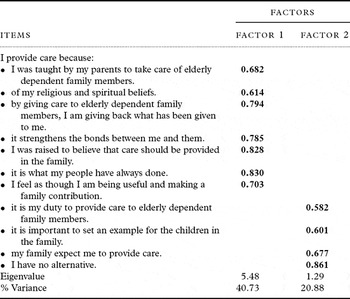
Principal components factor analysis of the 11 items was carried out using varimax rotation. Two factors were obtained with eigenvalues higher than 1, which explained 61.61% of the total variance. Information on item loadings (in all cases, item loadings for each factor were higher than 0.40) is shown in Table 2. The first factor was labeled “Intrinsic motives for caregiving”, as it includes seven items related to internalized and entrenched reasons for providing care that are less influenced by social and obligation-based norms and expectations (e.g. “I feel as though I am being useful and making a family contribution”). The first factor explained 40.73% of the variance. This factor seems to be linked with motives for caregiving that are connected with caregivers’ personal values. The second factor was labeled “Extrinsic motives for caregiving”. It consists of four items that measure reasons to care that are linked to obligation, a sense of responsibility and social pressure (e.g. “I have no choice”). The second factor explained 20.88% of the variance. Extrinsic motives for caregiving are more related with imposed values or external reasons which guide caregivers’ behavior even though they may not be in line with caregivers’ own personal values.
Factor analysis of the CJCS-R items

Note: Numbers in bold in each column represent items clustered to the corresponding factor. Items <0.40 are not shown.
Reliability
The CJCS-R had an internal consistency of 0.89 (Cronbach's α) for the total scale, 0.90 for the Intrinsic motives for caregiving factor and 0.73 for the Extrinsic motives for caregiving factor.
Descriptive data and correlation analysis
Descriptive information about the assessed variables (means, standard deviations and ranges) is shown in Table 3. Correlational analysis (see Table 3) between the obtained motives for caregiving factors and the assessed variables showed that intrinsic motives for caregiving correlated positively and significantly with cognitive reappraisal. Also, higher scores on intrinsic motives were significantly associated with lower scores on rumination. Finally, extrinsic motives were significantly and positively associated with caregiver anxiety.
Correlations, means, standard deviations and ranges of the assessed variables

*p < 0.05; **p < 0.01
Differences between groups in the assessed variables by motives for caregiving
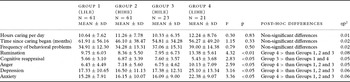
Participants were coded as high or low in extrinsic and intrinsic motives, respectively, based on median splits for each factor. Four groups, corresponding to four different motivation profiles, were created: HIHE = High in Intrinsic Motives and High in Extrinsic motives (n = 61); LILE = Low in Intrinsic Motives and Low in Extrinsic Motives (n = 61); HILE = High in Intrinsic Motives and Low in Extrinsic Motives (n = 23); and LIHE = Low in Intrinsic Motives and High in Extrinsic Motives (n = 21).
With a view to analyzing differences between types of motives for caregiving, ANOVAs were carried out to permit the analysis of differences between these groups in the following variables: (1) stressors (hours caring per day, time since caring began and frequency of behavioral problems); (2) caregivers’ resources (rumination and cognitive reappraisal); and (3) outcome variables (depression, anxiety and anger). In order to test the effect size of between-group differences in the assessed variables, partial eta-squared (ηp2) was used with the usual interpretation (small ~ 0.01, medium ~ 0.06, and large ~ 0.14).
With regard to resource variables, univariate ANOVA analyses revealed main group effects for rumination and cognitive reappraisal (Table 4). The effect sizes (see Table 4) were small for cognitive reappraisal and medium for rumination. In addition, main group effects were found for the assessed outcome variables (anger, depression and anxiety), with a small effect size for anger and medium for both depression and anxiety. Specifically, the LIHE caregiver group showed significantly higher levels of rumination, anger, depression and anxiety than the other three groups (HIHE/LILE/HILE). The HILE group scored significantly higher in cognitive reappraisal than the HIHE and LIHE groups.
Differences between groups in the assessed variables

LILE = Low Intrinsic Motives + Low Extrinsic Motives; HIHE = High Intrinsic Motives + High Extrinsic motives; HILE = High Intrinsic Motives + Low Extrinsic Motives; and LIHE = Low Intrinsic Motives + High Extrinsic Motives.
Discussion
The objectives of this study were to analyze both the structural dimension of the Cultural Justifications for Caregiving Scale-Revised (CJCS-R) and its influence on the different dimensions of the caregiver stress and coping process (stressors, caregiver resources and outcome variables). Inconsistent with our expectations, which were based on previous research suggesting a unidimensional structure of the CJCS (Dilworth-Anderson et al., Reference Dilworth-Anderson, Brummett, Goodwin, Williams, Williams and Siegler2005), the results obtained support a bidimensional structure of the revised scale. Factors were labeled, respectively, intrinsic and extrinsic motives for caregiving, and explained a significant proportion of variance of scores in motives for caregiving. The intrinsic motives for caregiving factor includes reasons to care that are related to sources of caregivers’ internal control, such as emotional bonding, religious beliefs and sense of usefulness (personal values), which reflect some degree of personal choice for providing care on the part of caregivers. Extrinsic motives for caregiving are more related to a sense of obligation and social norms and expectations, which leave less room for caregivers’ personal choice. Acceptable-to-good internal consistency indexes were found for both subscales and for the total scale. These results may be seen to endorse the recommendations of Quinn et al. (Reference Quinn, Clare and Woods2010), who suggested that, rather than exploring specific reasons for caring, it is more appropriate and useful to categorize the different types of motives under dimensions such as egotistic, altruistic, intrinsic or extrinsic (Quinn et al., Reference Quinn, Clare and Woods2010).
Different patterns of associations were found between the identified factors of motives for caregiving and resource-related and outcome variables assessed in the study. Higher scores on intrinsic motives for caregiving were associated with higher scores on cognitive reappraisal, a coping variable which has been found to have positive effects on distress (Gross and John, Reference Gross and John2003). This finding is similar to that reported by Farran et al. (Reference Farran, Keane-Hagerty, Salloway, Kupferer and Wilken1991), who found that caregivers who were less likely to report making personal choices about life and caregiving showed higher levels of burden and more feelings of powerlessness.
Intrinsic motives for caregiving were also associated with lower scores on rumination, an emotional regulation variable that has been shown to act in a maladaptive way in the stress process (Thomsen et al., Reference Thomsen, Jorgensen, Mehlsen and Zachariae2004). Consistent with the findings of Knight and Sayegh (Reference Knight and Sayegh2010), the results of this study suggest that cultural values, such as intrinsic motives for caregiving, have significant influence on the stress process through their influence on the coping strategies that caregivers use to deal with caregiving stressors.
As regards extrinsic motives, a significant and direct association between this dimension and anxiety was found, which is in line with the findings of studies reporting associations between “obligation-based” motives for caregiving and caregivers’ burden and stress (Cicirelli, Reference Cicirelli1993; Lyonette and Yadley, Reference Lyonette and Yardley2003).
However, even though different patterns of association have been found for each motives factor, caregiving motives are not mutually incompatible, as some caregivers may report high scores on obligation motives for caring and, simultaneously, high scores on personal motives for caregiving (Walker et al., Reference Walker, Pratt, Shin and Jones1990). In fact, the importance of considering the specific caregiver motivation profile (the combination of intrinsic and extrinsic motives) is clearly supported by the present study, in particular by the results of the analysis of differences between the motivation profiles of caregivers: those who simultaneously scored low on intrinsic motives and high on extrinsic motives (LIHE) were found to have poorer resources for coping with caregiving demands and to report higher levels of caregiver distress, when compared to the other groups. Specifically, the results suggested that those caregivers who cared for extrinsic motives and presented few intrinsic motives for this role (LIHE) regulated their emotions in a less adaptive way, as they more often used the rumination strategy and less often cognitive reappraisal. These negative influences on their coping resources may help to explain why caregivers from the LIHE group also score higher on distress measures than the other groups. Given that there were no differences between groups in the level of objective stressors, the importance of subjective factors can be deduced from these results.
The results of this study thus support the findings of previous research which stress the utility of considering the construct of caregiving motives in a multidimensional way, assuming that it is made up of reasons representing different degrees of personal choice vs. obligation. Simultaneously considering the two types of motive (intrinsic and extrinsic) may be of greater interest than analyzing their individual effects, given that it may help both researchers and clinicians to identify a profile of caregivers at risk for negative outcomes. According to the present study, this at-risk caregiver profile could be represented by caregivers with low intrinsic and high extrinsic motivation. Thus, detecting caregiving motivation profiles may be of particular relevance to the development, implementation and optimization of interventions with caregivers. In this regard, non-caregiving clinical research is currently highlighting the importance of taking into account people's goals, personal objectives and values in explanations of their behavior (Hayes et al., Reference Hayes, Strosahl and Wilson1999). Therapeutic paradigms such as those of Acceptance and Commitment Therapy (ACT; Hayes et al., Reference Hayes, Strosahl and Wilson1999) may be of especial interest for this purpose (Márquez-González et al., in press). This approach is based on the notion that fostering people's acceptance of negative internal events (emotions, thoughts and sensations) so that they act more consistently with personal values – which promote intrinsic motives – should be the main objective of therapeutic interventions in cases where a pattern of experiential avoidance is identified. This perspective may be of particular interest for dementia caregivers, given that dementia is a degenerative disease involving high levels of suffering, much of which is unavoidable. According to Cooper et al. (Reference Cooper, Katona, Orrel and Livingston2008), while some types of intervention, such as cognitive behavioral therapy, have shown themselves to be useful for reducing caregiver distress by training caregivers to deal with specific stressors, there may be some caregiver situations that are less likely to be changed, making such change-oriented interventions potentially ineffective, and even frustrating. In those situations, it may be more useful to train caregivers in strategies which help them to accept and adapt to their situations (or to give up fighting against them) and keep on living the lives they want to live, that is, with commitment to their goals, values and objectives (for example, increasing intrinsic motives for caring).
The present study has some limitations that should be taken into account. First, caregivers were contacted through different social centers, so that the results may not be generalizable to the entire caregiving population (e.g. to those caregivers who are less likely to ask for formal help). Also, results regarding differences between caregiver motivation profile groups should be interpreted cautiously, given that the sample sizes of the LIHE or the HILE may also affect the generalizability of the findings. In addition, causal inferences cannot be drawn, given the cross-sectional nature of the data. In this regard, Hsu and Shyu (Reference Hsu and Shyu2003), in their analysis of caregiver motivations by rating open questions (e.g. about the decision to care and the manner of doing it), suggested that motives for care may change over the course of the caregiving process; they showed how, at the beginning of care, motives were mainly obligation-based, but that these became progressively substituted by intrinsic motives (e.g. sense of responsibility). It would be interesting in future research to analyze how changes in motives for caregiving may lead to changes in caregiver resources and distress over time. For example, changes from extrinsic to intrinsic motives over the course of the caring process may lead to a reduction in caregiver distress. Given the possibility of motives for caring undergoing changes during the caregiving process (Hsu and Shyu, Reference Hsu and Shyu2003), caregivers with low intrinsic motives and high extrinsic motives to care may benefit more from interventions aimed at identifying or increasing additional sources of intrinsic value. Another limitation of the present study is related to the fact that the scale used for measuring motives for caregiving is not exhaustive, and there may be other motives that could be considered relevant for explaining caregiver distress (e.g. giving meaning to life or growth through adversity). In addition, another potential limitation is related to the distinction of the intrinsic and extrinsic dimensions of the CJCS-R scale as it may be difficult to classify certain motives for caring in one or another category (e.g. “I provide care because it is what my people have always done” as an intrinsic motive). In this sense, we consider that it may be helpful to consider this distinction in a flexible way, according to which extrinsic and intrinsic motives may be regarded as the two poles of an extrinsic-intrinsic (or imposed versus chosen) continuum, rather than a dichotomy of mutually exclusive motives. In this continuum, the motive “I provide care because it is what my people have always done” may be situated in a point between more explicit extrinsic motivations such as “I provide care because my family expect me to provide care” and other motivations related with a sense of utility and spiritual meaning which clearly shows more degree of personal choice. Furthermore, and as indicated by other authors exploring the influence of motives for caring, it would be interesting to analyze differences between the identified motivation profiles as a function of variables such as gender, kinship or quality of relationship (Walker et al., Reference Walker, Pratt, Shin and Jones1990; Dilworth-Anderson et al., Reference Dilworth-Anderson, Brummett, Goodwin, Williams, Williams and Siegler2005). Finally, considering that cultural differences in motivations for providing care have been found (for example, Greek caregivers are more motivated by the desire to maintain family harmony while American caregivers reported financial reasons more frequently; Kabitsi and Powers, Reference Kabitsi and Powers2002), the obtained results may not be generalizable to caregivers of cultures other than the one analyzed in this study.
Examination of the motives for caregiving may have implications not only for caregiver outcomes but also for the care recipients, as suggested by Feeney and Collins (Reference Feeney and Collins2003). These authors found that different motivations for caregiving predicted quality of care through different patterns of caregiving behavior and even the continuation of care: those caregivers who provided care mainly as an obligation were less responsive and more over-involved than those who cared on the basis of altruistic reasons.
In conclusion, the results of this study support the importance of analyzing motives for caregiving, given the potential contribution to the explanation of differences in caregivers’ resources and distress. In particular, this study suggests that intrinsic and extrinsic motives for caregiving are not mutually exclusive, and may combine with one another to provide a better explanation of the impact caregiving has on caregivers’ well-being and adaptation. The consideration of motives for caregiving as a bidimensional construct appears to be especially useful for identifying caregivers at risk.
Conflict of interest
None.
Description of authors' roles
Rosa Romero-Moreno worked on the study implementation, the data analysis and the writing of the paper. María Márquez-González and Andrés Losada designed the study, carried it out and helped write the paper. Javier López helped write the paper.
Acknowledgements
This article was funded by grants from both the Spanish Ministry of Education (SEJ2006–02489/PSIC) and the Spanish Ministry of Science and Innovation (PSI2009–08132/PSIC).