The burgeoning scientific literature on bullying and peer victimization has highlighted the importance of this public health issue, particularly for children and adolescents who are vulnerable to experiencing these problematic peer interactions in school settings (for review see Hong & Espelage, Reference Hong and Espelage2012). However, despite increased media, public, and scholarly attention, the field is plagued by lack of attention to important definitional issues (see Ybarra, Espelage, & Mitchell, Reference Ybarra, Espelage and Mitchell2014) that often fail to make important distinctions between “bullying” and “general aggressive behavior” and neglect conceptual and methodological overlap with related constructs such as peer victimization. In addition, the vast majority of bullying research focuses on physical bullying and victimization, with limited empirical attention to relational forms of these behaviors. The present study sought to advance our understanding of relational bullying, relational victimization, and their co-occurrence dimensionally using a bifactor model. In addition, we investigated the role of physiological and cognitive risk, as well as their interaction, in the development of these peer experiences over time in the understudied period of early childhood.
Bullying and victimization
Involvement in bullying, as either a perpetrator or victim, is associated with negative developmental outcomes across emotional, social, and academic realms of functioning (e.g., Cook, Williams, Guerra, Kim, & Sadek, Reference Cook, Williams, Guerra, Kim and Sadek2010; Haynie et al., Reference Haynie, Nansel, Eitel, Crump, Saylor, Yu and Simons-Morton2001). Bullying as defined historically by Olweus (Reference Olweus1993), and reaffirmed by the Centers for Disease Control and Prevention (CDC) and US Department of Education's uniform definition, is a subtype of intentional aggressive behavior differentiated from general aggression by being (or having the likelihood to be) repetitive in nature and occurring in the context of a power imbalance (Gladden, Vivolo-Kantor, Hamburger, & Lumpkin, Reference Gladden, Vivolo-Kantor, Hamburger and Lumpkin2014). Importantly, whereas all bullying is aggression, not all aggression contains the power and repetition components of bullying (e.g., Ostrov, Godleski, Kamper-DeMarco, Blakely-McClure, & Celenza, Reference Ostrov, Godleski, Kamper-DeMarco, Blakely- McClure and Celenza2015, Reference Ostrov, Kamper-DeMarco, Blakely-McClure, Perry and Mutignani2019; Rodkin, Espelage, & Hanish, Reference Rodkin, Espelage and Hanish2015). Power may manifest in several ways, including the prototypical size or age difference, multiple individuals aggressing against one victim, and other forms of privilege and social or economic status (Gladden et al., Reference Gladden, Vivolo-Kantor, Hamburger and Lumpkin2014).
The CDC definition and bullying scholars (e.g., Bradshaw, Waasdorp, & Johnson, Reference Bradshaw, Waasdorp and Johnson2015; Gladden et al., Reference Gladden, Vivolo-Kantor, Hamburger and Lumpkin2014) have recognized that bullying may take several forms. To date, the majority of bullying and aggression research has focused on physical forms, which use physical force or the threat of physical force to hurt, harm, or injure another person (Crick & Grotpeter, Reference Crick and Grotpeter1995; Ostrov et al., Reference Ostrov, Godleski, Kamper-DeMarco, Blakely- McClure and Celenza2015, Reference Ostrov, Kamper-DeMarco, Blakely-McClure, Perry and Mutignani2019). Less work has investigated relational bullying and aggression, which use the removal or threat of removal of a relationship as the mechanism of harm (e.g., social exclusion, friendship withdrawal threats; Crick & Grotpeter, Reference Crick and Grotpeter1995; Ostrov et al., Reference Ostrov, Godleski, Kamper-DeMarco, Blakely- McClure and Celenza2015, Reference Ostrov, Kamper-DeMarco, Blakely-McClure, Perry and Mutignani2019). Peer victimization occurs when the child is the recipient of relational or physical aggression or bullying (Ostrov & Kamper, Reference Ostrov and Kamper2015). Victimization can occur within the context of a bully–victim relationship (i.e., targets of bullying) as well as in contexts without a power imbalance (i.e., targets of general aggression; Ostrov & Kamper, Reference Ostrov and Kamper2015; Ybarra et al., Reference Ybarra, Espelage and Mitchell2014).
Past seminal work has demonstrated that individuals who are both perpetrators and victims of bullying (“bully-victims”) have unique developmental profiles and are at risk for especially poor outcomes (e.g., Cook et al., Reference Cook, Williams, Guerra, Kim and Sadek2010; Haynie et al., Reference Haynie, Nansel, Eitel, Crump, Saylor, Yu and Simons-Morton2001; see also Schwartz, Dodge, Pettit, & Bates, Reference Schwartz, Dodge, Pettit and Bates1997). Bully-victims are often highly rejected by peers, and are thought to aggress in a dysregulated and impulsive manner (e.g., Cook et al., Reference Cook, Williams, Guerra, Kim and Sadek2010; Griffin & Gross, Reference Griffin and Gross2004; Haynie et al., Reference Haynie, Nansel, Eitel, Crump, Saylor, Yu and Simons-Morton2001). For these children, bullying and victimization may co-occur because bullies elicit negative reactions from peers, including victimization, due to their objectionable behavior (e.g., Griffin & Gross, Reference Griffin and Gross2004). They may also respond to this victimization with bullying behavior in an impulsive manner, mirroring the bullying they have experienced (e.g., Griffin & Gross, Reference Griffin and Gross2004). Further, this research has demonstrated the importance of considering the different profiles of nonvictimized bullies (“bullies”) as well as nonbullying victimized children (“victims”). For example, nonvictimized bullies may aggress in a more strategic, dominant manner and may be less rejected by peers (e.g., Griffin & Gross, Reference Griffin and Gross2004; Veenstra et al., Reference Veenstra, Lindenberg, Oldehinkel, De Winter, Verhulst and Ormel2005), and victims who do not engage in bullying behavior tend to show more passive withdrawal tendencies and may be at particular risk for long-term internalizing difficulties (e.g., Griffin & Gross, Reference Griffin and Gross2004). To date, work in this area has tended to focus on physical forms of bullying and victimization, to the neglect of other forms such as relational bullying (cf. Bradshaw et al., Reference Bradshaw, Waasdorp and Johnson2015; Marsh et al., Reference Marsh, Nagengast, Morin, Parada, Craven and Hamilton2011; Ostrov et al., Reference Ostrov, Godleski, Kamper-DeMarco, Blakely- McClure and Celenza2015, Reference Ostrov, Kamper-DeMarco, Blakely-McClure, Perry and Mutignani2019). Thus, the present study aims to specifically examine potential differentiating predictive factors associated with relational bullying, relational victimization, and co-occurring relational bullying and victimization.
Early childhood
Prior research on bullying and victimization has often neglected key developmental issues, and has focused on later developmental periods, to the exclusion of early childhood. Early childhood (ages 3–5 years in the present study) is an important developmental period for the initiation and navigation of peer interactions. Peer relationships and friendships are emerging as a key developmental task, and these close relationships serve as powerful socialization agents (Sroufe, Reference Sroufe2013). During this developmental period, peer antagonism, conflict, and relational aggression emerge (Casas & Bower, Reference Casas, Bower, Coyne and Ostrov2018). Therefore, from a developmental psychopathology perspective, it is critical to identify, understand, and control these potentially harmful behaviors in early childhood when they may be less intractable than in later periods (Sroufe, Reference Sroufe2013).
Young children engage in both physical and relational aggression and victimization, and these behaviors are relatively common and direct in nature (Casas & Bower, Reference Casas, Bower, Coyne and Ostrov2018), making them easily observed by trained research staff (e.g., Godleski, Kamper, Ostrov, Hart, & Blakely-McClure, Reference Godleski, Kamper, Ostrov, Hart and Blakely-McClure2015; Ostrov, Kamper-DeMarco, Blakely-McClure, Perry, & Mutignani, Reference Ostrov, Kamper-DeMarco, Blakely-McClure, Perry and Mutignani2019). Although limited research to date has investigated relational bullying during early childhood, prior bullying research with adolescents has suggested general relational aggression and relational bullying are moderately correlated (Pepler, Jiang, Craig, & Connolly, Reference Pepler, Jiang, Craig and Connolly2008) and the presence of power differential and repetition components of bullying predict worse functioning than general aggression (Ybarra et al., Reference Ybarra, Espelage and Mitchell2014). Furthermore, a recent study indicated that relational bullying and aggression also have differential associations with social adjustment during early childhood (Ostrov et al., Reference Ostrov, Kamper-DeMarco, Blakely-McClure, Perry and Mutignani2019). Taken together, these findings underscore the need for research focused on the antecedents and consequences of relational bullying and victimization, particularly in the understudied period of early childhood, lending support to the present study's focus on relational bullying specifically.
Psychophysiology
Physiological reactivity to stress may be an important predictive risk factor for co-occurring relational bullying and victimization, as well as unique bullying (i.e., bullying in the absence of victimization) and victimization (i.e., victimization in the absence of bullying). Although work examining associations between psychophysiology and relational bullying is rare, there is a growing literature focused on associations between sympathetic nervous system (SNS) arousal and relational aggression and victimization (see Murray-Close, Breslend, & Holterman, Reference Murray-Close, Breslend, Holterman, Coyne and Ostrov2018 for a review). One commonly studied indicator of SNS functioning, the branch of the autonomic nervous system that coordinates the body's “fight or flight” stress response, is skin conductance level (SCL). SCL reflects activity in the sweat glands (see Dawson, Schell, & Filion, Reference Dawson, Schell, Filion, Cacioppo, Tassinary and Berntson2007), and can be examined both at baseline levels, and as change from baseline in response to stress or challenge (i.e., reactivity; SCL-R). Exaggerated SCL-R to negatively valenced stressors is hypothesized to reflect a tendency to experience dysregulated emotional reactions, such as anger, which in turn may energize aggressive responses (Murray-Close et al., Reference Murray-Close, Breslend, Holterman, Coyne and Ostrov2018). In contrast, blunted SCL is often hypothesized to reflect fearlessness, which may interfere with socialization against aggression through an unconcern about negative consequences of aggression, such as punishment (Frick & Morris, Reference Frick and Morris2004).
The possibility that both exaggerated and blunted SCL-R to stressors may serve as distinct risk factors for aggression is consistent with Frick and Morris's (Reference Frick and Morris2004) suggestion that there are two temperamental pathways to conduct problems, one characterized by difficulties in emotion regulation and heightened autonomic reactivity to stress and the other characterized by deficits in fear and autonomic underarousal. Consistent with this hypothesis, both overarousal and underarousal, as indexed by SCL-R and subjective emotional reactivity, served as risk factors for relational aggression among relationally victimized youth during middle-childhood (McQuade et al., Reference McQuade, Murray-Close, Breslend, Balda, Kim and Marsh2019).
However, less is known about associations between SCL-R and relational bullying behavior specifically. Bullying behavior, particularly when it does not co-occur with victimization, is often goal-oriented and “cold-blooded” (Griffin & Gross, Reference Griffin and Gross2004; Rodkin et al., Reference Rodkin, Espelage and Hanish2015); in fact, Griffin and Gross (Reference Griffin and Gross2004) suggest that bullying is a subset of proactive aggression, or aggression used to achieve instrumental goals. These arguments are consistent with prior findings showing that bullying was differentially associated with proactive/instrumental relational as well as proactive/instrumental physical aggression, relative to reactive functions of aggression (Prinstein & Cillessen, Reference Prinstein and Cillessen2003). Given the emotional deficits hypothesized to underlie bullying and goal-oriented aggression, these behaviors may be related to blunted physiological arousal (Murray-Close et al., Reference Murray-Close, Breslend, Holterman, Coyne and Ostrov2018). For example, past studies have found lower SCL-R to social stress was associated with proactive aggression among men (Armstrong et al., Reference Armstrong, Wells, Boisvert, Lewis, Cooke, Woeckener and Kavish2019), and blunted SCL-R during an exclusion task (i.e., Cyberball) was specifically related to bullying perpetration in adolescents with relational victimization statistically controlled (Lambe, Craig, & Hollenstein, Reference Lambe, Craig and Hollenstein2019). Therefore, we may expect relational bullying occurring without relational peer victimization to be associated with blunted levels of SCL-R.
In contrast, the physiological correlates of bullying may differ when the bullying co-occurs with peer victimization. Some prior work indicates links between victimization and aggression depend on stress system reactivity, although whether the effect is strongest at high versus low reactivity has varied (e.g., Gregson, Tu, & Erath, Reference Gregson, Tu and Erath2014; McQuade et al., Reference McQuade, Murray-Close, Breslend, Balda, Kim and Marsh2019; Pitula, Murray-Close, Banny, & Crick, Reference Pitula, Murray-Close, Banny and Crick2015; Rudolph, Troop-Gordon, & Granger, Reference Rudolph, Troop-Gordon and Granger2010; Ungvary, McDonald, Gibson, Glenn, & Reijntjes, Reference Ungvary, McDonald, Gibson, Glenn and Reijntjes2018). As bully-victims tend to aggress in an emotionally driven, dysregulated manner (e.g., Griffin & Gross, Reference Griffin and Gross2004; Rodkin et al., Reference Rodkin, Espelage and Hanish2015), bully-victims may exhibit physiological overarousal in response to stress, perhaps reflecting dysregulated negative emotional reactions such as anger (Hubbard, Romano, McAuliffe, & Morrow, Reference Hubbard, Romano, McAuliffe, Morrow, Potegal, Stemmler and Spielberger2010). Bully-victim adolescents report particularly high levels of state arousal (Woods & White, Reference Woods and White2005) and physical aggressive-victims exhibited heightened sympathetic reactivity to a social stressor in one study (Kliewer, Dibble, Goodman, & Sullivan, Reference Kliewer, Dibble, Goodman and Sullivan2012).
Similarly, relational victims may exhibit dysregulated sympathetic stress responses. Higher levels of emotional reactivity in victims may be reinforcing to aggressors, leading them to target these reactive victims more often and predicting increases in victimization (Kochenderfer-Ladd, Ladd, & Kochel, Reference Kochenderfer-Ladd, Ladd, Kochel and Harris2009); this emotional reactivity may be reflected in exaggerated physiological reactivity to peer stressors. In fact, Kliewer et al. (Reference Kliewer, Dibble, Goodman and Sullivan2012) found that nonaggressive relational and physical victims exhibited increases in sympathetic arousal to a social stressor (Kliewer et al., Reference Kliewer, Dibble, Goodman and Sullivan2012). However, others have found relational victimization was related to blunted SCL-R to exclusion (Iffland, Sansen, Catani, & Neuner, Reference Iffland, Sansen, Catani and Neuner2014) or that SCL-R was not correlated with victimization experiences (Lambe et al., Reference Lambe, Craig and Hollenstein2019). Given the overlap between bullying and victimization, these mixed findings may in part reflect a failure in many studies to statistically isolate the unique factors of bullying and victimization. There have been recent calls for additional work to disentangle mixed associations between victimization and stress system physiology (Prinstein & Giletta, Reference Prinstein and Giletta2020).
Overall, a significant limitation of prior studies is that they often focus on older children or adolescents, measure aggression generally rather than bullying specifically, focus on physical rather than relational forms of bullying or aggression, fail to adopt a longitudinal approach, and fail to disentangle co-occurring bullying and victimization from what is unique to each of these experiences. Therefore, an aim of this study was to test short-term longitudinal associations between child SCL-R and changes in levels of relational bullying, relational victimization, and their co-occurrence. We hypothesized that SCL-R would exhibit positive relations with relational victimization and co-occurring relational bullying and victimization, but negative associations with relational bullying without victimization.
Hostile attribution biases
Finally, consistent with recent calls for work examining social–cognitive factors as moderators of associations between peer experiences and stress physiology (Prinstein & Giletta, Reference Prinstein and Giletta2020), this study examined the role of hostile attribution biases (HAB) in predicting relational bullying, relational victimization, and their co-occurrence, both overall and as a moderator of effects of SCL-R. The Social Information Processing (SIP) model of children's social adjustment proposes that aggressive youth show HAB, defined as a tendency to interpret neutral or ambiguous cues as threatening (Crick & Dodge, Reference Crick and Dodge1994). HAB are theorized to be associated with tendencies toward anger and approach emotions as well as higher levels of reactive aggressive responding (Crick & Dodge, Reference Crick and Dodge1994; Orobio de Castro, Veerman, Koops, Bosch, & Monshouwer, Reference Orobio de Castro, Veerman, Koops, Bosch and Monshouwer2002). Thus, HAB may directly serve as a risk factor for co-occurring relational bullying and victimization.
Further, HAB may moderate predicted effects of SCL-R on these peer experiences. Although physiological reactivity to relational threat or stress may be associated with victimization, the extent to which someone responds to that victimization by engaging in bullying behavior (i.e., engaging in fight vs. flight responses) may depend on the cognitive interpretation of that arousal, reflected in HAB. Lemerise and Arsenio's (Reference Lemerise and Arsenio2000) emotionally integrated extension of the SIP model suggests that, “Mood, emotions, and/or arousal can affect what is noticed about a social encounter…and the meaning attributed to the situation” (pp. 112–113). Therefore, the extent to which someone is physiologically (i.e., higher SCL-R) and cognitively (i.e., higher levels of HAB) reactive to threat may predict their likelihood of responding to victimization with bullying behavior. In other words, physiologically and cognitively reactive individuals may exhibit higher levels of both victimization and bullying.
In contrast, individuals who are victimized by peers but are not aggressive do not typically demonstrate HAB, and may even under-attribute peer hostile intent (e.g., Gazelle & Ladd, Reference Gazelle, Ladd and Schewe2002; Kochenderfer-Ladd et al., Reference Kochenderfer-Ladd, Ladd, Kochel and Harris2009; Perry, Hodges, & Egan, Reference Perry, Hodges, Egan, Juvonen and Graham2001); these youth may exhibit more internal attributions for negative events, rather than the external attributions of HAB (e.g., Crick & Dodge, Reference Crick and Dodge1994). Therefore, if an individual is physiologically reactive to relational threat, they may be targeted for victimization because their reactivity is reinforcing to aggressors; however, in the absence of cognitive reactivity to threat (i.e., lower levels of HAB), these nonbullying victims may be unlikely to engage in or retaliate with relational bullying behavior.
In short, we predicted HAB would directly predict increases in co-occurring relational bullying and victimization, and that HAB would moderate SCL-R's associations with these constructs such that SCL-R would be associated with increases in co-occurring relational bullying and victimization at high levels of HAB, and with increases in victimization without bullying at low levels of HAB. We did not have specific predictions regarding moderation of SCL-R's relations with relational bullying occurring without victimization by HAB or main effects of HAB on pure relational bullying or victimization.
Bifactor models
A significant limitation of prior investigations into differences in the experiences of those who both engage in and are victims of relational bullying, relative to those who are uniquely relational bullies or victims, is the frequent use of categorical methods (Hymel & Swearer, Reference Hymel and Swearer2015; Marsh et al., Reference Marsh, Nagengast, Morin, Parada, Craven and Hamilton2011). Specifically, prior studies have traditionally categorized children as “bullies,” “victims,” or “bully-victims” based on arbitrary cut-offs (e.g., high bullying as 1 SD above the mean). These categories are sample-specific and therefore can vary drastically, which may contribute to inconsistent results across studies (Griffin & Gross, Reference Griffin and Gross2004). This concern is exacerbated by the fact that investigators often fail to report on the reliability and validity of these categories (Wright & Hallquist, Reference Wright and Hallquist2014). In addition, individuals reporting low or moderate levels of involvement are often excluded or collapsed into an “uninvolved” group, which masks important information regarding the experiences of less severely involved youth (Bosworth, Espelage, & Simon, Reference Bosworth, Espelage and Simon1999; Griffin & Gross, Reference Griffin and Gross2004; Marsh et al., Reference Marsh, Nagengast, Morin, Parada, Craven and Hamilton2011).
Despite long-standing calls for improved measurement in the bullying and victimization literature to capture the dimensional nature of involvement (e.g., Bosworth et al., Reference Bosworth, Espelage and Simon1999; Griffin & Gross, Reference Griffin and Gross2004), few studies have examined dimensional latent-variable approaches to do so. One exception employed exploratory structural equation modeling (ESEM) to examine the structure as well as longitudinal and gender invariance of forms of bullying and victimization in high school students (Marsh et al., Reference Marsh, Nagengast, Morin, Parada, Craven and Hamilton2011). However, although this study examined associations between bullying and victimization factors, their approach did not allow for the explicit modeling of associations with co-occurring bullying and victimization (Marsh et al., Reference Marsh, Nagengast, Morin, Parada, Craven and Hamilton2011).
Bifactor models may provide an appropriate way to model the dimensional nature of involvement in co-occurring relational bullying and victimization, while also allowing researchers to measure “pure” relational bullying and victimization and their associations with various outcomes. Specifically, bifactor models can be used to model both co-occurring relational bullying and victimization (i.e., a general factor) and variance unique to each experience (i.e., relational bullying and victimization group factors). These factors thereby mirror traditional categorical groups of “victims,” “bullies,” and “bully-victims,” but in a dimensional manner that may more accurately reflect children's behaviors and experiences. Therefore, this study (Part 1) tested bifactor models of relational bullying, victimization, and their co-occurrence at two independent time points, and (Part 2) applied these models to test substantive theoretical questions regarding direct and interactive associations with physiological reactivity and HAB.
Method
Participants
In total, 300 participants (44% female, M age = 44.70 months, SD = 4.38 months) from four cohorts were recruited. This full sample was used to address Part 1 of the study. The sample was somewhat diverse (3.0% African American/Black, 7.6% Asian/Asian American/Pacific Islander, 1.0% Hispanic/Latinx, 11.3% multi-racial, 62.1% White, and 15.0% missing/unknown). Based on parental occupation coded using Hollingshead's (Reference Hollingshead1975) four factor method, our sample was on average middle to upper middle class. Part 2 of the study used data from 81 children (45.6% girls; 37 female, M age = 46.32 months, SD = 4.48 months), a subset of the overall sample with psychophysiological data collected in the summer (T2). The physiological data sample was similar to the larger sample for ethnicity/race and socioeconomic status (SES) (ps > .05), although the physiological sample was significantly older than the overall sample [t(80) = 2.25, p = .03, d = .25] due to the age criteria for the laboratory portion of the project (i.e., participants needed to be four years old prior to the psychophysiological session). The physiological data subsample was not significantly different on any other predictor or outcome variables (ps > .05).
Procedures
All aims, methods, and the data analysis plan for this study were preregistered prior to analysis on Open Science Framework (OSF; https://osf.io/x36cz). Explanation and justification for changes from this preregistered plan are presented in Supplementary materials.
Children were recruited from ten National Association for the Education of Young Children (NAEYC) accredited or recently accredited early childhood education centers in a large northeastern city and surrounding suburbs (see Ostrov et al., Reference Ostrov, Kamper-DeMarco, Blakely-McClure, Perry and Mutignani2019 for recruitment details). Four cohorts were recruited over a four-year period (2015–2019) and these data were merged for the purposes of this study. All procedures were approved by the local institutional review board (IRB). Data were collected starting in the spring of children's 3-year-old year, and participants were followed through a lab session in the summer, and in-school data collection in the fall and following spring. This study uses the first spring (T1), summer (T2), and second spring (T3) time points only. Teacher and observer report were collected at T1 and T3, which were approximately 12 months apart, and child report and psychophysiological data were collected at T2. The bifactor model was tested using T1 and T3 observer (RA) and teacher report (TR) data.
All children in participating classrooms were invited to participate and parents provided written consent for their children's participation prior to beginning the study and again prior to the laboratory portion of the study. Ultimately, approximately 56% of eligible families returned consent forms to participate in the study. Children provided assent for the summer lab session and head teachers provided written consent prior to report completion. Teachers were compensated $10–$25 per time point depending on the number of reports they completed. For the summer laboratory session, parents were compensated $30–$40 and children were given a small educational toy.
Given the longitudinal design, school transitions to kindergarten for some participants, and the challenges associated with school-based data collection, missing data was expected. At T1, 7 cases (2%) were missing all data and Little's MCAR test suggested these data were missing completely at random [χ2(17) = 7.71, p = .97]. At T3, 91 cases (30.3%) had missing data. Those with missing data at T3 had significantly lower T1 teacher-reported relational victimization [F(1, 291) = 9.12, p = .003, η 2 = .03], but did not differ on any other predictor or outcome variables. Missing data were handled using FIML in path analyses.
Measures
Physical and relational bullying
Physical and relational bullying were measured using TR and RA reports on the Preschool Bullying Subscales Measure (PBSM; Ostrov et al., Reference Ostrov, Godleski, Kamper-DeMarco, Blakely- McClure and Celenza2015, Reference Ostrov, Kamper-DeMarco, Blakely-McClure, Perry and Mutignani2019). This is an adapted version of the Preschool Proactive and Reactive Aggression – Teacher Report (PPRA-TR; Ostrov & Crick, Reference Ostrov and Crick2007), which uses the CDC's definition of bullying to add components of power imbalance and repetition to distinguish it from general aggression [for example, “If other children hurt this child, s/he often keeps those with less power (e.g., smaller, younger, or has fewer friends) from being in their group of friends”]. The measure includes eight items for each form of bullying behavior (i.e., physical bullying, relational bullying) and two positively toned filler items. Physical bullying was included as a covariate in the present study. Responses were on a on a 5-point Likert scale from 1 (never to almost never true) to 5 (always or almost always true). Items are averaged within each subscale. Teachers completed the form at T1 and T3 about the participating children in their classroom. Trained undergraduate RA's completed the questionnaires after having spent considerable time in the classroom completing observations of children's aggressive behavior and victimization during free play (see Perhamus & Ostrov, Reference Perhamus and Ostrov2021 for more details). Direct observations of aggressive behavior showed good agreement across observers in the present study (T1 intraclass correlations [ICCs]>.70). This observer-report measure of bullying was used successfully in a prior study (Ostrov et al., Reference Ostrov, Godleski, Kamper-DeMarco, Blakely- McClure and Celenza2015), and showed good internal consistency at T1 and T3 in the current study (Cronbach's αs for relational = .94–.97, Cronbach's αs for physical = .90–.95).
Physical and relational victimization
Teachers and observers also completed a revised version (PPVM-TR-R; see Godleski et al., Reference Godleski, Kamper, Ostrov, Hart and Blakely-McClure2015) of the Preschool Peer Victimization Measure (PPVM-TR; Crick, Casas, & Ku, Reference Crick, Casas and Ku1999). This measure includes eight items assessing physical victimization (four items) and relational victimization (four items). Received prosocial items were also collected for the larger project. Teachers indicated how frequently the focal child experienced each event on a 5-point Likert scale from 1 (never to almost never true) to 5 (always or almost always true) and item scores were averaged within each subscale. The relational victimization subscale was the focus in the present study, with physical victimization included as a covariate in path analyses. Past research has demonstrated evidence for acceptable reliability and validity of this measure (e.g., Godleski et al., Reference Godleski, Kamper, Ostrov, Hart and Blakely-McClure2015; Ostrov et al., Reference Ostrov, Godleski, Kamper-DeMarco, Blakely- McClure and Celenza2015), including acceptable internal consistency in a subset of the current sample (Perry, Meisel, Stotsky, & Ostrov, Reference Perry, Meisel, Stotsky and Ostrov2020). Both teacher- and observer-report showed good internal consistency at both T1 and T3 in the current study (relational victimization Cronbach's αs = .87–.91; physical victimization Cronbach's αs = .78–.85).
Skin conductance reactivity
During the interview at T2, skin conductance, heart rate, and interbeat interval were assessed using equipment developed by Biolog (UFI 3991; see Sijtsema, Shoulberg, & Murray-Close, Reference Sijtsema, Shoulberg and Murray-Close2011). Only SNS activity was used in this study, and was measured using SCL (expressed in microsiemens), assessed with two skin conductance electrodes attached to the distal phalanges of the first and second fingers of the child's nondominant hand with adhesive collars. Prior to the session, to facilitate assent, participants were able to apply sham electrodes on a stuffed bear and have any questions answered by research staff. During the application and removal of electrodes children received a sticker for each sensor and placed it on a coloring page depicting the stuffed bear. Leads were positioned on participants in the presence of their parent, followed by a 5-min accommodation period. Parents viewed the session via camera from an adjacent room and were free to stop the session at any point. SCL-R was assessed as the difference between SCL during a baseline period (i.e., a 3-min video clip cartoon of a dog exploring his neighborhood; see Calkins & Keane, Reference Calkins and Keane2004) and depiction of relational conflict (i.e., a 3-min animated video clip of a popular character being excluded from a club). SCLs were highly correlated (r = .90) but significantly different [t(80) = −5.17, p < .001; d = .62] in the baseline and reactivity conditions. In addition, the variance of SCL during the baseline and reactivity videos were statistically equal [t(79) = 1.02, p = .31]. Therefore, following recent recommendations (Burt & Obradović, Reference Burt and Obradović2013), and given our limited sample size which precludes a latent variable approach, a difference-score approach was adopted over a regression-based approach in calculating reactivity scores. Data were cleaned and scored using standard procedures using CardioBatch and CardioEdit software (Brain-Body Center, 2007; Porges, Reference Porges1985, Reference Porges2007; Porges & Bohrer, Reference Porges, Bohrer, Cacioppo and Tassinary1990).
Hostile attribution biases
HABs were assessed through child interviews by trained graduate students at T2 using a modified measure of the Assessment of Intent Attributions (Crick, Reference Crick1995), based on child reports (Casas & Crick, Reference Casas and Crick1999) and further adapted for use with young children (Godleski & Ostrov, Reference Godleski and Ostrov2020). The interview includes eight brief ambiguous vignettes, four assessing relational provocation situations (e.g., not receiving an invitation to a birthday party) and four assessing instrumental provocation situations (e.g., getting bumped from behind by a classmate). Children indicate whether they think the person in the story was “trying to be mean” or “not trying to be mean”. If they indicate “trying to be mean,” the child is then asked if they were being “really mean” or “a little mean”. All responses were made using a picture board with faces representing each response option, and interviewers verbally confirmed each response. Responses were scored from 0 (not trying to be mean) to 2 (really mean), and summed. The scale has shown acceptable internal consistency for HAB subtypes with one story removed from each subtype (Cronbach's αs = .69–.72) and convergent validity between parent and child levels of HAB in an early childhood sample (Godleski & Ostrov, Reference Godleski and Ostrov2020). In the current study, internal consistency values for the subscale assessing hostile attribution to relational provocations (HAB-R Cronbach's α = .64) were below a pre-registered inclusion cutoff of .65. However, an overall index of HAB with all eight items showed acceptable reliability (Cronbach's αs = .67). This overall index was retained as specified in our preregistered contingency plan (see Supplementary materials for additional details).
Analytic plan
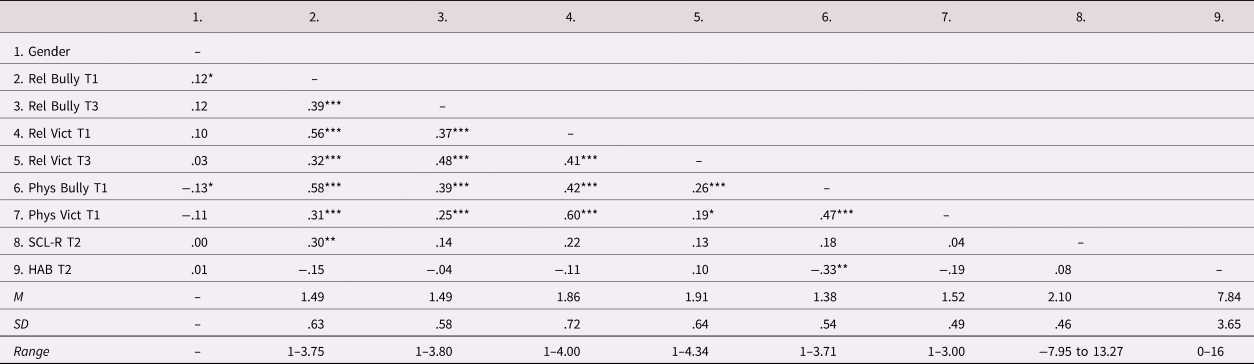
Prior to primary analyses, descriptive data of all measures were obtained. Outliers were modified by adjusting the value to ± 3 SD from the mean (Kline, Reference Kline2016). Skew values ranged from −0.05 to 2.12 and kurtosis values ranged from −0.39 to 4.09, indicating the data generally followed a normal distribution (Kline, Reference Kline2016). Descriptive statistics and bivariate correlations for all variables are presented in Table 1. The maximum likelihood robust estimator (MLR) was used due to relatively small sample size (Li, Reference Li2016), and missing data were accommodated using full information maximum likelihood (FIML) in path analyses. All data analyses were conducted in Mplus Version 8.4 (Muthén & Muthén, Reference Muthén and Muthén1998–2020).
Full sample descriptive statistics and correlations

Note. Rel = Relational, Phys = physical, Bully = bullying, Vict = victimization, SCL-R = skin conductance reactivity levels, HAB = hostile attribution bias. T1 = Time 1, T2 = Time 2, T3 = Time 3. Boys = 1, Girls = 2. Bullying and victimization scores are measured composites of teacher and observer reports. Due to missing data and physiological subsample, ns for comparisons range 62–293.
*p < .05, **p < .01, ***p < .001.
Bifactor models
As described above, bifactor models have a number of advantages over categorical approaches (e.g., latent class analysis). A bifactor model allows for bullying and victimization to be measured dimensionally, can account for measurement error, and can capture the overlap in bullying and victimization while still accounting for the uniqueness among these constructs (Wright & Hallquist, Reference Wright and Hallquist2014). This approach provides a hierarchical model of constructs by allowing items to contribute to latent group factors (i.e., what is unique about the bullying and victimization items) over and above their contribution to a latent general factor across all items (i.e., what bullying and victimization items share; Bornovalova, Choate, Fatimah, Petersen, & Wiernik, Reference Bornovalova, Choate, Fatimah, Petersen and Wiernik2020; Chen, Hayes, Carver, Laurenceau, & Zhang, Reference Chen, Hayes, Carver, Laurenceau and Zhang2012). For example, bifactor models have been helpful in modeling pure and co-occurring forms of peer victimization and aggression in early childhood (Blakely-McClure & Ostrov, Reference Blakely-McClure and Ostrov2018; Perry & Ostrov, Reference Perry and Ostrov2018) and exploring personality variables’ associations with specific (e.g., physical and relational aggression) and general factors of youth antisocial behaviors (Tackett, Daoud, De Bolle, & Burt, Reference Tackett, Daoud, De Bolle and Burt2013). In addition, there are several ways model fit, dimensionality, and reliability are evaluated.
In the present study, bifactor models were estimated separately for T1 and T3 using confirmatory factor analysis (CFA). Initial item-level models using teacher reports provided marginally acceptable fit to the data (Time 1: χ 2 (42) = 178.07, p < .0001, root mean square error of approximation [RMSEA] = .10, comparative fit index [CFI] = .92, standardized root mean square residual [SRMR] = .05; Time 3: χ2 (42) = 123.84, p < .0001, RMSEA = .10, CFI = .94, SRMR = .03; additional details provided in Supplementary materials). Following a preregistered data analysis plan, and consistent with prior work with bifactor models (e.g., Chen et al., Reference Chen, Hayes, Carver, Laurenceau and Zhang2012; Tackett et al., Reference Tackett, Daoud, De Bolle and Burt2013), a parceling technique was then adopted to increase the amount of total variance into the model while decreasing model complexity. Specifically, four relational bullying and four relational victimization parcels were created by averaging similar items across RA and TR questionnaires (details below). Relative to items, parcels decrease the complexity of models, increase communality and reliability of indicators, and reduce the likelihood of correlated residuals and sources of sampling error (Little, Rhemtulla, Gibson, & Schoemann, Reference Little, Rhemtulla, Gibson and Schoemann2013). In addition, the parceling technique reduced discrepancy in the number of indicators representing relational bullying (eight items) relative to relational victimization (four items) in the item-level model, to ensure that the general factor was equally represented by victimization and bullying items
Given prior evidence that parcels of similar items (i.e., homogeneous parcels) are less likely to mask model misspecification than parcels created by distributing similar items (Marsh, Lüdtke, Nagengast, Morin, & Von Davier, Reference Marsh, Lüdtke, Nagengast, Morin and Von Davier2013; Rhemtulla, Reference Rhemtulla2016) the present study adopted a homogeneous parceling strategy. Specifically, victimization parcels were created by averaging parallel (i.e., identically worded) items on teacher and RA report of the four relational victimization items on the PPVM-TR-R (Godleski et al., Reference Godleski, Kamper, Ostrov, Hart and Blakely-McClure2015). Likewise, each bullying parcel was comprised of an average of teacher and RA report on two items from the PSBM (Ostrov et al., Reference Ostrov, Godleski, Kamper-DeMarco, Blakely- McClure and Celenza2015, Reference Ostrov, Kamper-DeMarco, Blakely-McClure, Perry and Mutignani2019) worded identically except for words denoting whether the bullying was occurring in response to a threat (i.e., reactively) or to obtain a desired outcome (i.e., proactively) for a total of four items in each parcel. For example, teacher and RA reports on items “This child repeatedly keeps others with less power from being in her/his group of friends to get what s/he wants” and “If other children hurt this child, s/he often keeps those with less power from being in their group of friends” were averaged to create a bullying parcel. The proactive and reactive bullying items that were combined to create bullying parcels were highly correlated (rs = .68–.92, ps < .001), consistent with prior work that suggested proactive and reactive bullying did not represent unique subscales in this measure (Ostrov et al., Reference Ostrov, Godleski, Kamper-DeMarco, Blakely- McClure and Celenza2015). RA report was significantly, albeit modestly, correlated with teacher report for both bullying and victimization measures at both time points (rs = .16–.28, ps < .05). Following current recommended practices in longitudinal SEM models using parcels, parcels were identical at T1 and T3 (Little, Reference Little2013).
The likelihood ratio χ2 test was used to test overall model fit where p > .05 indicates good model fit. The CFI, where values greater than .95 suggest good fit, the SRMR fit index where values less than .05 represent good model fit (Hu & Bentler, Reference Hu and Bentler1999), and the RMSEA (Steiger, Reference Steiger1990), where values less than .05 represent close fit (Browne & Cudeck, Reference Browne, Cudeck, Bollen and Long1992; MacCallum, Browne, & Sugawara, Reference MacCallum, Browne and Sugawara1996) were also considered.
Bifactor models’ reliability and dimensionality were also examined (see Bonifay, Lane, & Reise, Reference Bonifay, Lane and Reise2017); specifically, omega hierarchical (ωH) and omega hierarchical subscale (ωHS) were examined to determine the amount of reliable systematic variance explained by the general and group factors (Rodriguez, Reise, & Haviland, Reference Rodriguez, Reise and Haviland2016). Explained common variance (ECV) and percentage of uncontaminated correlation (PUC) statistics were used to determine whether the data were best represented within a unidimensional (e.g., model with one bully-victim factor and no group factors) or multidimensional structure (e.g., a bifactor model; Rodriguez et al., Reference Rodriguez, Reise and Haviland2016). ECV provides a measure of the proportion of variance explained by the general factor relative to total variance explained by general and group factors, with higher values representing a stronger general factor (Rodriguez et al., Reference Rodriguez, Reise and Haviland2016). The importance of ECV for determining biased parameter estimates is moderated by PUC, such that both values are needed to demonstrate the extent to which fitting the data within a unidimensional model would result in biased parameter estimates (Rodriguez et al., Reference Rodriguez, Reise and Haviland2016). Considering these in concert, values >.70 can indicate that the common variance is best represented as unidimensional, which would suggest against a bifactor framework (Rodriguez et al., Reference Rodriguez, Reise and Haviland2016). Construct replicability (H) of each factor was also examined, with values >.70 indicating the latent variable's indicators are well represented, and more likely to be relatively stable across studies (Rodriguez et al., Reference Rodriguez, Reise and Haviland2016). Finally, factor score determinacy (FD) was examined to determine whether observed differences in FS are indicative of true individual differences, with scores >.90 indicating good determinacy (Rodriguez et al., Reference Rodriguez, Reise and Haviland2016). Models were analyzed separately for T1 and T3 to validate the model across academic years and informants (most children have different teachers and RAs across the academic years. FS were saved and used for path analyses.
Path analyses
Path analyses were conducted to evaluate relations of SCL-R, HAB, and their interactions in predicting changes in relational bullying, relational victimization, and their co-occurrence as measured in the bifactor models using the subset of individuals with available physiological data. Nested models were run separately predicting levels of each T3 FS (i.e., T3 relational bullying group FS, relational victimization group FS, general FS). Specifically, T3 FS were first regressed on covariates, including gender, T1 levels of physical bullying and victimization (consistent with current best practices to account for overlap between forms of bullying and victimization; Ostrov & Kamper, Reference Ostrov and Kamper2015), and T1 levels of the corresponding FS (e.g., T1 relational bullying group FS). RA and TR of T1 physical bullying and victimization were correlated (rs = .15–.26, ps < .05), and composites were created to be consistent with the relational parcels used in the bifactor models. Second, direct effects of SCL-R and HAB on the outcome variable were entered. Finally, an SCL-R × HAB interaction term was added. At each step, a χ2 test of change in log-likelihood using Satorra–Bentler scaled chi-square, an adjustment for the MLR estimator (Satorra & Bentler, Reference Satorra and Bentler2010), was examined to determine if the addition of terms resulted in significant improvement in model fit. The region of significance (RoS) of significant interaction terms were examined using Preacher and colleagues’ method (Preacher, Curran, & Bauer, Reference Preacher, Curran and Bauer2006), which determines the range of values of the moderator (i.e., HAB) for which the association between the predictor variable (i.e., SCL-R) and the outcome variable are statistically significant. All predictor variables were centered.
Results
Bifactor models
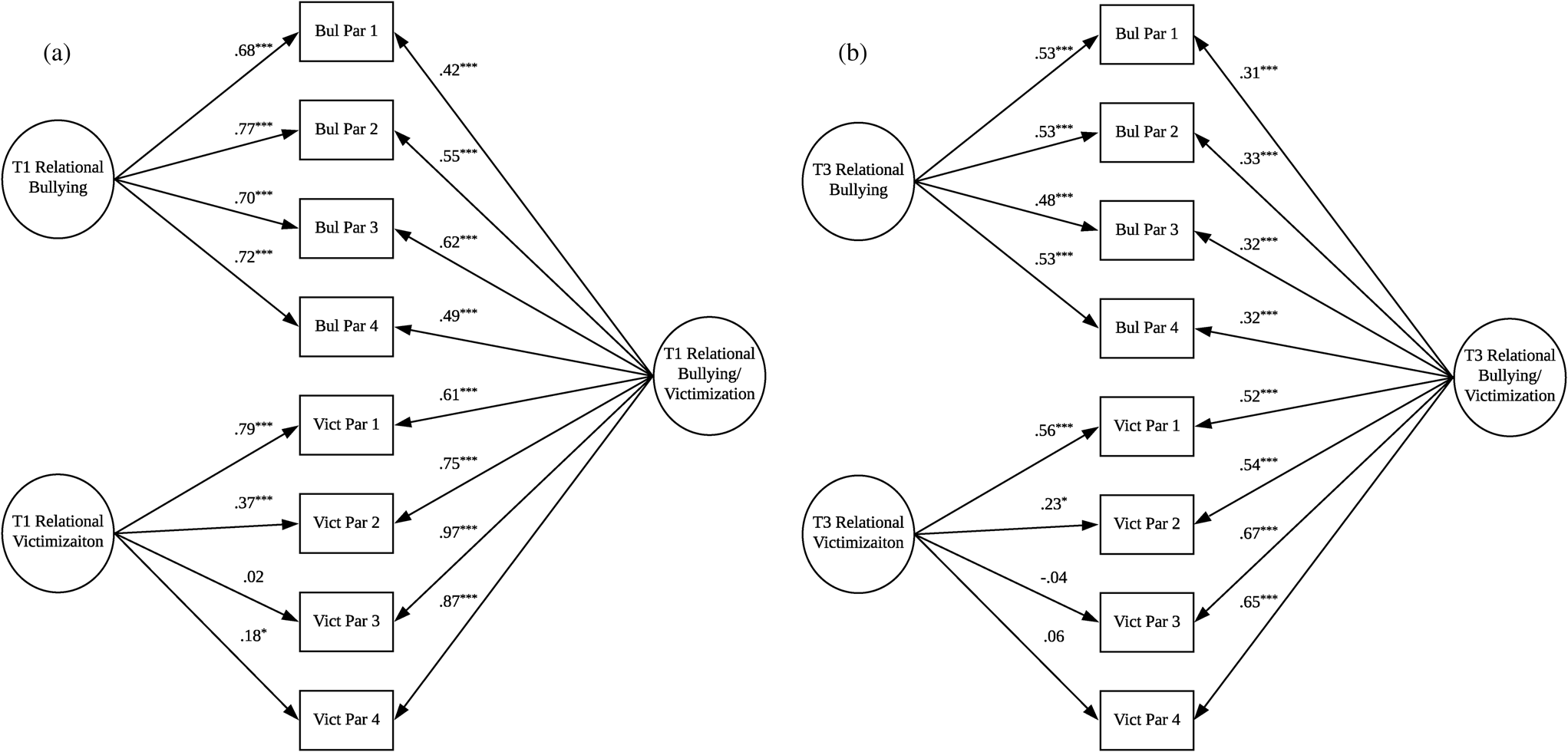
Factor loadings for bifactor models at both time points are presented in Figure 1. Initially, victimization Parcel 1 had a negative residual variance at both time points. The residual terms were small and nonsignificant at both time points (zs = −0.29, −0.07; ps = .77, .94), and confidence intervals contained zero and positive values at both time points. Therefore, these negative residuals were considered to be due to sampling variability rather than model misspecification and were set to zero (Chen, Bollen, Paxton, Curran, & Kirby, Reference Chen, Bollen, Paxton, Curran and Kirby2001).
Standardized factor loadings for bifactor models. Note. (a) shows model at Time 1, (b) shows model at Time 3. Bul = bullying, vict = victimization, Par = parcel. T1 = Time 1, T3 = Time 3. *p < .05, ***p < .001.

The models provided a good fit to the data at T1 [χ2(13) = 20.53, p = .08, CFI = .99, RMSEA = .04, SRMR = .03] and T3 [χ2(13) = 14.28, p = .35, CFI = 1.00, RMSEA = .02, SRMR = .01]. Furthermore, alternative statistics suggested the data were best represented within a multidimensional framework (ECVs = .53, .54; PUCs = .57), and that observed differences in FS were indicative of true individual differences in factors at both time points (FDs = .95–.99). Although the bullying group factors (ωHSs = .61–.69; Hs = .81–.92) and general factors (ωHs = .67–.68; Hs = .87–.96) showed acceptable reliability and replicability at both time points, the victimization group factor did not (ωHSs = .10–.17; Hs = .61–.69). Examination of the factor loadings showed Parcel 3 did not significantly load on the victimization group factor at either time point, and Parcel 4 did not significantly load on the group factor at T1, and only weakly at T3. Notably, these parcels include items involving verbal victimization (e.g., “This child gets told ‘you can't play’ by peers when they are angry at him/her”), whereas others involve actions, such as being ignored or left out of groups. Given a priori hypotheses concerning the victimization group factor, overall fit of the models, and strong FD scores, planned analyses with victimization were still conducted, but should be interpreted with caution.
Path analyses
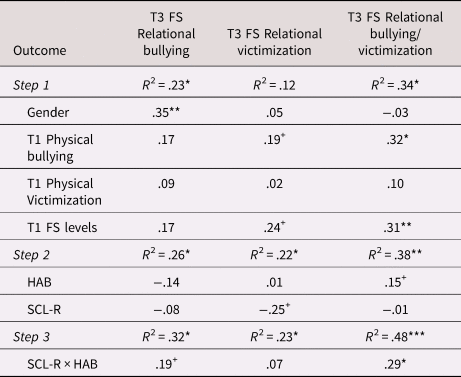
Standardized slopes of path analyses are presented in Table 2. Models predicting change in the relational victimization group factor did not find any significant improvements in model fit from Step 1 to Step 2 with the addition of HAB and SCL-R [Δχ2(2) = 4.05, p = .13], or Step 2 to Step 3 with the addition of the interaction term [Δχ2(1) = 0.55, p = .46], and there were no significant effects of HAB, SCL-R, or their interaction. Models predicting change in the bullying group factor found a significant role of gender, with girls showing greater increases in relational bullying. The log-likelihood of the model did not increase significantly from Step 1 to Step 2 [Δχ2(2) = 0.84, p = .66], and likewise the main effects of HAB and SCL-R were not significant. Although adding the SCL-R × HAB interaction term resulted in significantly improved model fit [Δχ2(1) = 9.00, p < .001], the interaction term was not significant.
Standardized regression coefficients in nested path analyses

Note. HAB = hostile attribution bias, SCL-R = skin conductance level reactivity; T1 = Time 1, T3 = Time 3, FS = factor scores, T1 FS Levels = Time 1 factor score levels of respective outcome variables. Boys = 1, Girls = 2. All variables were centered prior to analyses.
+ p < .10, *p < .05, **p < .01, ***p < .001.
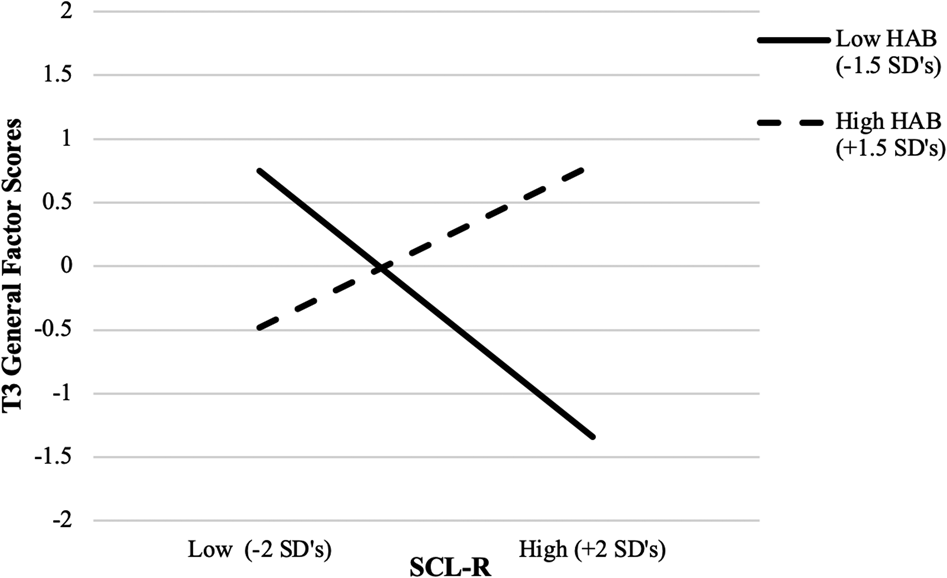
In models predicting change in the general factor, there was no significant change in log-likelihood from Step 1 to Step 2 [Δχ2(2) = 2.67, p = .26], but there was significant improvement from Step 2 to Step 3 [Δχ2(1) = 18.30, p < .001]. There was a marginally significant positive main effect of HAB (β = .15, 95% CI [−.02, .31], p = .08). This effect was qualified by a significant interaction between HAB and SCL-R (β = .29, 95% CI [.05, .52], p = .02). We examined this interaction to see whether the association between SCL-R and change in the general factor was moderated by HAB. The RoS analysis (Preacher et al., Reference Preacher, Curran and Bauer2006) indicated higher levels of SCL-R significantly predicted decreases in the general factor for those with HAB scores below −1.12 SDs from the mean (B = −.43, SE = .22, p = .05) and increases in the general factor for those with HAB scores above 1.45 SDs from the mean (B = .30, SE = .15, p = .05). These slopes, depicted in Figure 2, provide evidence for an underarousal pathway (i.e., blunted SCL-R and low HAB) as well as an overarousal pathway (i.e., heightened SCL-R and high HAB) to increases in co-occurring relational bullying and victimization. In short, increases in the co-occurring relational bullying and victimization general factor appeared to occur among children with blunted SCL-R combined with low HAB (i.e., <−1.12 SDs), as well as among children exhibiting heightened SCL-R combined with high levels of HAB (i.e., >1.45 SDs).
Simple slopes of HAB × SCL-R interaction. Note. This figure illustrates the interaction of skin conductance reactivity (SCL-R) and hostile attribution bias (HAB) at Time 2 predicting change in factor scores on the relational bully/victimization general factor at Time 3 (T3). All depicted slopes are significant (i.e., p < .05). SD = standard deviation.

Although our preregistered data analysis plan called for us to collapse across HAB subtypes given reliability concerns with the hostile attributions for relational provocations (HAB-R) subscale, we opted to examine models using HAB-R only in a post-hoc manner given the potential specific role of HAB-R (rather than hostile attributions for instrumental provocations) in relational bullying and victimization. These models were generally consistent with those using the HAB composite, with the exception that the HAB-R × SCL-R interaction term was marginally significant in general factor models (β = .12, 95% CI [−.006, .25], p = .06). This may reflect the poorer internal consistency of the HAB-R subscale compared to the full composite. More details from these HAB-R models are presented in Supplementary materials.
Discussion
This study investigated the roles of physiological (i.e., SCL-R) and cognitive reactivity (i.e., HAB) in predicting change in relational bullying, relational victimization, and their co-occurrence over one year in early childhood. To address statistical and methodological concerns in the bully-victim literature, we tested the applicability of a bifactor approach for measuring relational bullying, victimization, and their co-occurrence dimensionally.
Overall, the bifactor model approach appears to have several potential advantages, including permitting researchers to examine overlap in bullying and victimization dimensionally in typically developing samples rather than using cutoff approaches, which have been the typical method for examining bully-victims (e.g., Griffin & Gross, Reference Griffin and Gross2004; Haynie et al., Reference Haynie, Nansel, Eitel, Crump, Saylor, Yu and Simons-Morton2001). Notably, the bifactor model provided an acceptable fit to the data at two different time points within the sample, providing evidence for the validity of the model. Alternate statistics provided support for the bifactor model, such that there would be bias in trying to fit bullying and victimization into a unidimensional model, and reliability statistics demonstrated that the general factor and bullying group factor were well represented by the items. However, the victimization group factor was not reliable after controlling for the overlap in victimization and bullying, indicating there is not a sufficient amount of reliable variance left in the victimization factor after controlling for the overlap with bullying, and this victimization factor should be interpreted with caution. Generally, the bifactor model approach provides a novel opportunity to test predictors of dimensional experiences of relational bullying, victimization, and their co-occurrence.
SCL-R and HAB
Consistent with a developmental psychopathology framework which emphasizes the importance of considering multiple levels of analysis (e.g., Sroufe, Reference Sroufe2013), we then examined the interplay of physiological and social–cognitive processes in changes in relational bullying, relational victimization, and their co-occurrence. Contrary to predictions, SCL-R was not associated with change in pure relational bullying. The lack of physiological findings with “pure” relational bullying is contrary to prior work that has suggested bullying perpetration was associated with blunted SCL-R during social stress in adolescence (Lambe et al., Reference Lambe, Craig and Hollenstein2019). However, a growing body of research documents heterogeneity among children that engage in aggressive and bullying behaviors; although some youth may be censured by peers for engaging in these behaviors (e.g., targeted as victims), others appear protected from negative peer outcomes due to factors such as high resource control or likeability (Hawley, Reference Hawley1999; Rose & Swenson, Reference Rose and Swenson2009; Roseth et al., Reference Roseth, Pellegrini, Dupuis, Bohn, Hickey, Hilk and Peshkam2011). In the absence of likely negative peer consequences, individual differences in sensitivity to punishments, such as peer victimization, may play a limited role in the decision to enact relational bullying behavior. Thus, physiological underarousal, and its theoretical ties to fearlessness and insensitivity to punishment, may be particularly relevant in understanding relational bullying behaviors among youth that face the potential for peer punishment, such as victimization (i.e., co-occurring relational bullying and victimization). In contrast, these processes may be less salient to children that are able to engage in pure relational bullying without facing the likely threat of victimization by peers.
Also contrary to hypotheses, we did not find that SCL-R was related to increases in pure victimization, nor was this hypothesized effect stronger at low levels of HAB. These null effects may reflect the limited reliability of the pure relational victimization group factor as described above. This lack of reliability could indicate that victimization rarely occurred without co-occurring bullying in this sample, or could be due to measurement issues within the model. Either way, this may have prevented us from detecting results in path analyses. Further, although some researchers have found that relational victims exhibit dysregulated sympathetic stress responses in adolescence and adulthood, the direction of effect has varied across studies (e.g., Iffland et al., 2014; Kliewer et al., Reference Kliewer, Dibble, Goodman and Sullivan2012), and other work has failed to find associations (e.g., Lambe et al., Reference Lambe, Craig and Hollenstein2019). Although prior work has suggested “pure” victims may underattribute hostile intent to others, these findings have been inconsistent and primarily focused on older samples than the current study (Gazelle & Ladd, Reference Gazelle, Ladd and Schewe2002; Kochenderfer-Ladd et al., Reference Kochenderfer-Ladd, Ladd, Kochel and Harris2009). In addition, little is known about how stress physiology and social-information processing biases may interact in predicting peer victimization experiences (Prinstein & Giletta, Reference Prinstein and Giletta2020). Thus, our findings raise the possibility that physiological and cognitive reactivity may be most relevant to understanding victimization when it co-occurs with bullying, at least in early childhood.
Specifically, as expected, an interaction between SCL-R and HAB emerged in predicting change in the general factor, which represents co-occurring relational bullying and victimization. Consistent with hypotheses, higher levels of SNS reactivity predicted increases in co-occurring relational bullying and victimization at high levels of HAB. These findings are consistent with an emotionally integrated SIP model (Lemerise & Arsenio, Reference Lemerise and Arsenio2000), such that children who are both physiologically and cognitively reactive to threat are more likely to respond to relational victimization with relational bullying. These youth may engage in bullying in response to victimization, with bullying responses characterized by anger and emotional arousal, consistent with past findings in that bully-victims tend to aggress in a dysregulated manner (e.g., Griffin & Gross, Reference Griffin and Gross2004; Rodkin et al., Reference Rodkin, Espelage and Hanish2015). Evidence also emerged for an underarousal pathway, with low levels of both SNS reactivity and HAB also associated with increases in co-occurring relational bullying and victimization (i.e., the general factor). This effect was unexpected, but may be consistent with a fearlessness pathway in which children are unreactive to negative consequences of bullying (Frick & Morris, Reference Frick and Morris2004). Specifically, children that exhibit low levels of cognitive and physiological reactivity to social threats may engage in relational bullying because negative consequences, such as victimization, fail to act as a deterrent effect due to their insensitivity to punishment (Frick & Morris, Reference Frick and Morris2004).
The presence of both overarousal and underarousal pathways to involvement in co-occurring relational bullying and victimization is consistent with past work examining risk for engaging in relational aggression among relationally victimized youth (McQuade et al., Reference McQuade, Murray-Close, Breslend, Balda, Kim and Marsh2019). However, this study presents novel evidence that these effects occurred only when physiological and cognitive arousal were congruently high or low. Both higher physiological reactivity with low HAB and higher HAB with lower physiological reactivity were associated with decreased involvement in co-occurring bullying and victimization. This highlights the importance of considering both of these constructs in future work, and suggests that they may counteract each other in the presence of just one area of arousal to promote more adaptive outcomes.
Limitations
This study has a number of strengths, including preregistered hypotheses and data analysis plans, the use of a short-term longitudinal design, validation of the bifactor model across academic years, and consideration of multiple methods and levels of analysis in keeping with a developmental psychopathology framework. However, there are a number of limitations that should be considered when interpreting these results. First, as described above, the victimization group factor had limited reliability and explained little unique variance at both time points, limiting our ability to test predictors of pure victimization. This may suggest that victimization rarely occurs without co-occurring bullying in early childhood. This is in contrast with past work in older samples suggesting that children are classified as passive victims (i.e., victims who do not also engage in co-occurring bullying) more often than as bully-victims (i.e., victims who also engage in bullying; Griffin & Gross, Reference Griffin and Gross2004). It may be that this reflects the relatively high levels of aggression and bullying in early childhood relative to later ages (e.g., Casas & Bower, Reference Casas, Bower, Coyne and Ostrov2018), such that few children would not engage in some level of these behaviors when experiencing victimization. If this is the case, a bifactor approach may be less applicable in early childhood relative to later ages. However, given the paucity of work examining the co-occurrence of bullying and victimization in early childhood (e.g., only 2% of studies in a relevant meta-analysis; Cook et al., Reference Cook, Williams, Guerra, Kim and Sadek2010), this remains an empirical question. Future work examining the longitudinal course of relational bullying and victimization is needed, including the longitudinal invariance of the bifactor approach proposed here.
Second, best practices for parceling within multidimensional (e.g., bifactor) models are currently lacking, and additional research is needed in this area. In addition, the relatively small subset of individuals with physiological data required us to generate FS to investigate roles of HAB and SCL-R. Although the factor determinacy indices indicated the FS appropriately measured individual differences in standings on each factor, FS are imperfect representations of the factors themselves, and may have different associations with each other and other variables than the true factors (Skrondal & Laake, Reference Skrondal and Laake2001). In addition, we may have been underpowered to detect effects given the small sample size in our path analyses. A sensitivity analysis suggested the smallest effect size we could confidently detect (1-β error prob = .80) in these models is d = .63. Although this means the study was underpowered to detect small effects, past psychophysiology research on peer relations has used similar sample sizes in early childhood (e.g., N = 65 in Study 1 and N = 94 in Study 2, Gower & Crick, Reference Gower and Crick2011) and middle childhood samples (e.g., Lafko, Murray-Close, & Shoulberg, Reference Lafko, Murray-Close and Shoulberg2015; Pitula et al., Reference Pitula, Murray-Close, Banny and Crick2015), and preliminary work with this dataset and physiological variable found significant effects (Ostrov et al., Reference Ostrov, Murray-Close, Blakely-McClure, Perry, Mutignani, Probst and Bresland2018). However, null effects need to be considered within this limitation. This concern is potentially compounded by the modest reliability of our measure of HAB.
Finally, our sample was relatively homogeneous in SES and race/ethnicity, and was recruited from high-quality child care centers. In addition, the sample represents a subset of families from these centers who opted to participate in the study (56% participation rate), which could differ from the full preschool population from which it was recruited, with implications for the generalizability of these findings. Although the sample was of similar racial and ethnic composition as the Buffalo, NY metropolitan area population from which it was drawn, which is approximately 75% non-Hispanic white (U.S. Census Bureau, 2019), this is in contrast to the larger national population, which is increasingly diverse. Greater inclusion of racial and ethnic minority children, as well as consideration of impacts of cultural differences and similarities across racial identity groups, is critical for enhancing the field's understanding of developmental outcomes of youth (e.g., Causadias & Cicchetti, Reference Causadias and Cicchetti2018). In addition, although emotional and behavioral problems were not exclusionary, the majority of the sample was likely typically developing. Therefore, it is unknown whether this study's results would generalize to more diverse samples or preschool settings as well as more problematic levels of these behaviors, and these questions deserve further investigation.
Implications and future directions
Despite these limitations, this paper has a number of novel findings with implications for future work. This study uses a clear and specific definition of relational bullying that distinguishes it from general aggression. There is currently a lack of clarity in the literature surrounding the use of these terms, and future work should aim to be specific in highlighting the repetitive nature and power dynamic involved in bullying in order to continue elucidating effects associated with bullying specifically. This is important given recent work suggesting there may be distinct correlates and outcomes associated with general relational aggression versus relational bullying in early childhood (Ostrov et al., Reference Ostrov, Kamper-DeMarco, Blakely-McClure, Perry and Mutignani2019), as well as prior work with older samples (e.g., Pepler et al., Reference Pepler, Jiang, Craig and Connolly2008; Ybarra et al., Reference Ybarra, Espelage and Mitchell2014). However, additional work is needed to examine the importance and predictive utility of including power differential and repetition components of bullying relative to general aggression, especially in early childhood.
This paper provides initial evidence for the viability of a bifactor model approach to distinguish unique predictors of bullying and victimization, as well as their co-occurrence, in a dimensional manner. This is critical given the especially poor outcomes associated with involvement in co-occurring bullying/victimization (e.g., Cook et al., Reference Cook, Williams, Guerra, Kim and Sadek2010) and relatively low base rates of this behavior, which limits investigations using traditional categorical approaches. Future work should aim to replicate these findings and explore whether this approach could be equally applicable to physical forms of bullying and victimization.
Finally, the interaction between HAB and SNS reactivity in the prediction of involvement in co-occurring relational bullying and victimization has both research and clinical implications. Conflicting findings in the literature concerning relations between SNS reactivity and relational aggression and victimization (e.g., Iffland et al., Reference Iffland, Sansen, Catani and Neuner2014; Kliewer et al., Reference Kliewer, Dibble, Goodman and Sullivan2012) may be partially due to the lack of inclusion of this moderating social–cognitive process in analyses. Further, since higher reactivity was associated with positive outcomes (decreased involvement) at low levels of HAB, but negative outcomes (increased involvement) at higher levels of HAB, this cognitive process could be a useful target in interventions aiming to decrease this particularly negative pattern of peer relations in early childhood, particularly for those who are more biologically reactive. Future work should continue to explore and replicate these findings.
Conclusion
The present study aimed to test the roles of SCL-R, HAB, and their interactions in predicting change in pure and co-occurring relational bullying and victimization in early childhood, applying a novel bifactor model approach to examine dimensional levels of these behaviors. Using a short-term longitudinal design, the study provided evidence for the viability of the bifactor model approach, with replication at two time points over an academic year. Further, the study found initial evidence that HAB and SCL-R interact to predict change specifically in co-occurring relational bullying and victimization, as measured by the general factor of the bifactor model. Overall, this supports the viability of this approach for measuring these problematic behavior patterns in a dimensional manner, and highlights the importance of considering both social–cognitive and physiological variables in understanding contributing factors to their development.
Supplementary Material
The supplementary material for this article can be found at https://doi.org/10.1017/S0954579421000298
Acknowledgments
We thank the PEERS project staff and the participating families for their contributions and support of this project. We would like to thank Dr. Sarah Blakely-McClure, Dr. Kimberly Kamper-DeMarco, Lauren Mutignani, Sarah Probst, Samantha Kesselring, Gabriela Memba, and many research assistants for data collection and coordination. The content is solely the responsibility of the authors and does not represent the official views of the National Science Foundation.
Funding Statement
Research reported in this publication was supported by a grant from the National Science Foundation (BCS-1450777) to the third and fourth authors.
Conflicts of Interest
None.