Introduction
An e-petition to Jacob Zuma, then president of South Africa, protesting against the killing of Cecil the lion and asking for a ban on trophy hunting gathered, at the last count, nearly a million and a quarter signatures.Footnote 1 The petitions studied in this article constitute the polar opposite of this monster petition for a celebrity cat. I examine here petitions that ask for the killing and capture of leopards or tigers in India; they tend to be written by either an individual or a handful of people; none of them has ever attracted the fame or circulation of the petition for Cecil. I do not look at e-petitions, but I do consider how new technologies are changing the modes through which citizens now make appeals to the state. The core objective of this article is to examine those petitions that appealed for the capture or death of big cats and which turned out to be efficacious. The rates of success for any appeal against big cats are low in contemporary India, given the stringent legal regime that is geared almost exclusively towards the protection of the charismatic and endangered big cats as well as the hegemonic position occupied by wildlife conservationism. In such a scenario, how do certain, very specific petitions attain some form of efficacy? By efficacious I do not mean that the demands set out in the petition were necessarily met, but rather that the appeals were given an audience: they were heard and acted upon in some way or another.
My interest in efficacious petitions arises, broadly speaking, from two fronts. The first and foremost is that, in fact, most petitions are not efficacious. For the majority, the normal course of action is quite the opposite—they are dismissed, burned, lost, filed away and forgotten, or deliberately sat upon.Footnote 2 This studious ignoring of petitions arises partly due to the sheer volume and dizzying diversity of petitions received by every wing of the state. This was very evident in my previous research which centred upon the execution of the Mahatma Gandhi National Rural Guarantee Employment Act, 2005 (MGNREGA) which legally enjoins the setting up of cells to redress grievances in its execution in rural India. The grievance redressal cell for most districts in the region I worked in became so rapidly flooded with petitions—or in its language, ‘grievances’—that it could not cope and, in the end, it had to be shut down. This entailed, at its core, the closing of a register of ‘grievances’ in the central district office—the MGNREGA ‘cell’—thus ruling out any form of petitioning around this gigantic welfare programme. Most bureaucrats I encountered, believed that this was the right thing to do, given what they describe as a situation of ‘pathological petitioning’ in India. In a scenario where bureaucrats consider that there are ‘pathological’ levels of petitioning, the question then arises: how do some elicit a response?
What further propels me to think about those petitions that have been efficacious in the specific context of big cats is that in contemporary India it is extremely difficult, both legally and bureaucratically speaking, to take any punitive action against big cats.Footnote 3 From the late 1960s onwards, a series of wildlife conservation laws and measures have been passed that serve to provide a formidable level of protection for all wildlife. This is particularly the case for tigers, leopards, and lions, which feature in Schedule 1 of the Wildlife Protection Act of 1972 and serves to provide them with the strictest protection of all. A powerful wildlife protection lobby exists in contemporary India, as do a plethora of rules and guidelines that are aimed at the conservation of, in particular, big cats. While this conservationist infrastructure has not necessarily been successful in its objective, nor has it ended, the poaching and trafficking of big cats, it has made it extremely difficult for the state to openly and legally capture or kill these charismatic animals.Footnote 4 Central to the governance of big cats in contemporary India is the production of evidentiary proof—in the form of documents—that attests to the aberrance of a specific big cat—in the form of a ‘man-eater’ as they are popularly termed—and thus allows for their capture or death. Petitions by affected or frightened citizens are a key part of this process. When presented to local officials they allow for investigations into a specific big cat to be commenced. They help to prove that the cat in question is, in fact, dangerous and deviant, and hence should be either hunted down or kept in captivity.
The diversity and vast numbers of petitions received by the contemporary state attests to a very long and complicated history and political culture of petitioning in South Asia.Footnote 5 The post-colonial state has institutionalized the practice of petitioning as a legitimate mode of airing what it terms, in its current developmentalist language, ‘grievances’. Thus, Cody notes that from 1969 onwards every Monday (termed ‘Grievance Day’ or ‘Petition Justice Day’) has been set aside at district Collectors’ offices in Tamil Nadu.Footnote 6 In Uttarakhand, the state in northern India where much of the research for this article was done, there is no demarcated day allocated just for the hearing of petitions, but district officials and politicians are encouraged to hold durbars (courts). Thus, I have sat through several janta-ki-durbars (courts with the people) in Uttarakhand when citizens come and petition the state through a face-to-face encounter. While these moments do provide interesting examples of petitions, many of those discussed in this article are not the ones that were presented at set times and through the normal procedures.
This article is rooted in ethnographic research undertaken in Himalayan India over the past decade and draws upon the quotidian and regularized process of petitioning state bureaucrats. An ethnographic focus on efficacious modes of appeal, I intend to argue, expands the very notion of what constitutes a petition. Within the state bureaucracy and in the English language, petitions are most often described as letters, complaints, grievances, applications, or simply petitions.Footnote 7 The word most commonly used in northern India in Hindi and Urdu to refer to petition is arzee.Footnote 8 This is a capacious term that includes requests, representations, appeals, demands, humble desires, and the presenting of information. There is a dense assortment of meanings associated with arzee and its root word—arz—particularly if one is attentive to arzee’s usage in colloquial speech in northern India. An arzee is most commonly a piece of paper on which one types or handwrites an appeal but, through the ethnographic material presented here, I will argue that this is not always the case. To make an arzee means to submit a petition but it also encompasses a whole range of other actions around that act of submission. As the wider anthropology of claims-making has shown, there is a need to be attentive to the various forms an arzee can take.Footnote 9 Beyond the very medium of the arzee—be it on paper or, as I show below, via smart phones—there is a need to capture those moments and utterances through which an arzee is made, the forms it can take, and the types of follow-up actions that need to be, or are, undertaken in order to fully make an arzee. An arzee then is not just a thing—the petitionary message via a specific medium—it is also a process. It is such an understanding of arzee that this article assumes in its quest to understand how a chosen few arzees are heard and, even, acquiesced to.
In short, the ambition of this article is to expand the meaning of a petition, from beyond just a letter or something written down on a piece of paper or a formalized request for something, to a broader, more ethnographically derived understanding of a whole series of practices and processes that exist around the arzee itself. A modern-day petition can be something as simple as a message on WhatsApp or a tweet to a minister or bureaucrat; however, it cannot be understood in isolation from the various processes that accompany it. These processes include chakkar marna (going round and round) of offices; the photocopying and repeated resending of petitions to bureaucrats; the use of connections and social/kin networks; and the staging of dharnas (sit-ins) and jalooses (processions). Important work on democracy and cultures of protest as well as claims-making has highlighted how these practices—be it a dharna Footnote 10 or notions of jugaad Footnote 11—arose and work (or not).Footnote 12 In this article, I make a case for enfolding the petition—presented via various mediums—into these associated practices of appeals-making.
Beyond an expansion of the category of the arzee itself, I ask what happens when we bring the animal into the petitioning process. In the first place, we see a strong questioning of the wildlife conservationist regime that comes across as not just too stringent in its rules and regulations, but also as one that inexplicably ends up valuing big cat lives more than human lives.Footnote 13 Secondly, the animal comes across as highly agentive, more so than the humans, in fact. Animal studies has wrestled, in different ways, with the question of, first, whether animals have agency and, secondly, if the answer is ‘yes’, then how are we to access and describe such non-human agency?Footnote 14 This article, which is drawn from a wider book manuscript on human-big cat relations in India,Footnote 15 presents petitions and narratives that take the capacity of big cats to act and interact for granted. As arzees swing between legal-rational and affective-visceral modalities,Footnote 16 they produce strong imaginaries of the beast in question. He (for man-eaters, even when they are known to be female, are generally referred to as ‘he’) is not just described physiologically as big/small, young/old, healthy/injured, and as possessing particular markings. More importantly, he has a personality and possesses agency which has a form that dwarves the most agentive human. Thus, certain adjectives are used for the animal, such as cunning (chatur), aberrant, vicious, scheming, powerful, dangerous, ill-mannered (badtameez), uncouth, all-knowing, devout, and so on. In the arzees and the speech that accompanies them, we are made aware of a presence that is eerie but also compelling. This feline presence is often anthropomorphized, but very often a non-human terminology is evoked that individualizes the cat and allows for a peculiar beastly intimacy.Footnote 17
Petitioning to capture
We begin with petitions to capture big cats at the hill-station of Shimla. The city is currently the capital of the Himalayan state of Himachal Pradesh. It used to function as the summer capital of the British Raj and, therefore, possesses excellent infrastructure such as roads and rail connections, and lavish constructions in Tudor and neo-Gothic styles.Footnote 18 These colonial-era buildings continue to dominate the city, making it one of India's most popular tourist destination in the Himalaya. In the last two decades, the city of Shimla has witnessed a large urban expansion outwards, with middle and upper class Indians buying cottages and high-rise apartments, and constructing bungalows that function either as retirement homes or summer getaways.
I went to Shimla with a team of wildlife biologists, conservationists, and photographers who were—in collaboration with the Forest Department in Shimla—undertaking a leopard census of the city.Footnote 19 Big cats in India are now being counted through the use of drones and, most commonly, via camera trapping. A camera trap is a remotely activated camera that is equipped with a motion or infrared sensor, or which uses a light beam as a trigger. Set up in strategic locations, camera traps are able to—through their photographic evidence—provide excellent data on the movements, numbers, habits, density, etc. of big cats. Our study indicates that there are approximately five to seven individual leopards in and around Shimla city at any given moment. The human population is approximately 180,000.Footnote 20 As the total area of Shimla is about 25 square km this makes for a fairly dense leopard population and, hence, sightings of the animal are quite frequent.
While many residents of the city—especially those who have lived there for a long time or those who hail from villages in the mountains—are not particularly perturbed by the sight of a big cat strolling around the city, the newcomers to Shimla, especially the retirees and the summer homeowners—most of them hailing from the metros—are not equally sanguine. In the first place, they are unused to seeing wildlife in their own backyards. This shock at seeing big cats out of the supposed-wild by urban dwellers and the belief that they are ‘straying’ out of their own territory have been noted for the metropolis of Mumbai as well.Footnote 21 In Shimla it is not simply that the recently arrived, well-heeled urban dwellers are disturbed by the presence of big cats in proximity to these residents, it is also that they are seeing them in a different way. A large number of them have installed security cameras in their bungalows or in the housing societies in which they live. According to the Forest Department, the regular appearance of leopards on the CCTV images has led to an exponential increase in complaints about the leopards over the last seven to eight years. It is worth pointing out that there have been no deaths by leopards in Shimla in recent times and there has been only one case of a serious attack. In an interview the man involved admitted to me that he had tripped over a sleeping leopard in the dark as he was taking a short cut home one night through a forested area. The leopard retaliated by biting his arm but then she immediately ran away. Despite the almost total absence of conflict—defined as unprovoked attacks or injuries or deaths of humans—for certain specific sections of Shimla residents the very sighting of a leopard in their midst is a cause for worry. For them this is an animal out of place. It has, as they say, ‘escaped’ or ‘strayed away’ from its prescribed beastly place—a jungle or even a village—and mistakenly or cheekily entered their historic city-space.Footnote 22
The most common reaction to a leopard sighting is to pick up the phone to lodge a complaint with the Forest Department. Shimla city has a 24-hour emergency helpline number that you can ring in order to report either the uprooting of trees or the sightings of leopards—two admittedly common problems, even though they appear rather distinct. The complaints register notes the name of the complainant, the time and place of the leopard sighting, as well as the specific objection in a separate column.
The Forest Department responds to a chosen few complaints by installing cages with some sort of live bait—such as a dog or goat—in it to trap the big cats. Most of the time such trapping does not work, much to the relief of the Forest Department officials. In fact, they deliberately position the traps poorly in the hope that they will not capture the leopard. If they do, unfortunately, capture the leopard then it is sent to a zoo or a rescue centre. According to the most recent guidelines issued by the Ministry of Environment and Forests (MoEF), a leopard cannot be kept in captivity for over 30 days unless it has been proven to be dangerous to human life.Footnote 23 As none of these leopards has been thus convicted, they are released back into the jungles adjoining Shimla within 30 days. In other words, within a month of capture these cats come right back to their homes, which we are learning—thanks to some very advanced camera trapping technology—tends to be as much on the fringes of urban areas as in the perceived ‘wild’ of India.Footnote 24 The officials are reluctant to capture the leopards, partly because they have been made nervous by the Wildlife Protection Act and assorted guidelines, but also because they find the whole exercise a bit pointless as, in the end, the leopards, being territorial animals, will return straight back to Shimla, only now they will be—as one of them put it—more grouchy and grumpy (khadoos).
Running through the complaints register of the past five years, it became obvious that the Forest Department ignores most of the sightings other than, broadly, two sorts. The first is when the complainant is a person who possesses powerful contacts with politicians and bureaucrats and, especially, when they have some form of evidence of the leopards’ regular movements in their immediate vicinity. The death of domesticated pet dogs in particular appears to provoke a response (such as the placement of a trap near the dog owner's home). For instance, a retired Supreme Court judge's dog, named ‘Heaven’, was eaten by a leopard and the entire heart-rending episode was captured on CCTV. When I went to interview this elderly person in his colossal colonial-style bungalow in the poshest part of the town, equipped with multiple CCTVs and a 24-hour guard, he obsessively showed me—on loop—the clip. The judge railed against the temerity of the leopard which not only entered Shimla but also bounded over his high bungalow walls, and he reeled out a list of people he had rung to get the leopard captured. In this case a leopard was trapped in a cage placed next to his home and she was sent off to a ‘rescue centre’ for—as the judge put it—‘some time in rehab’.
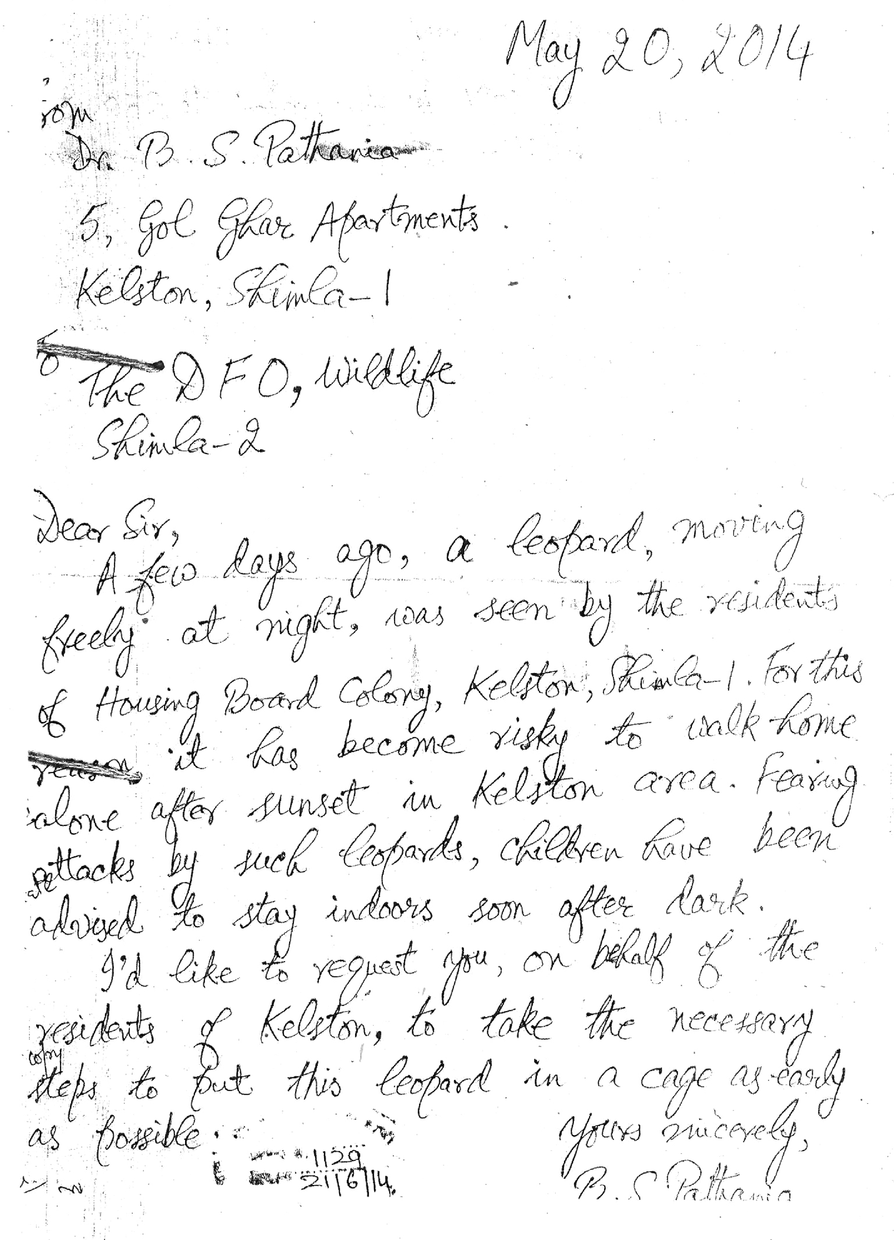
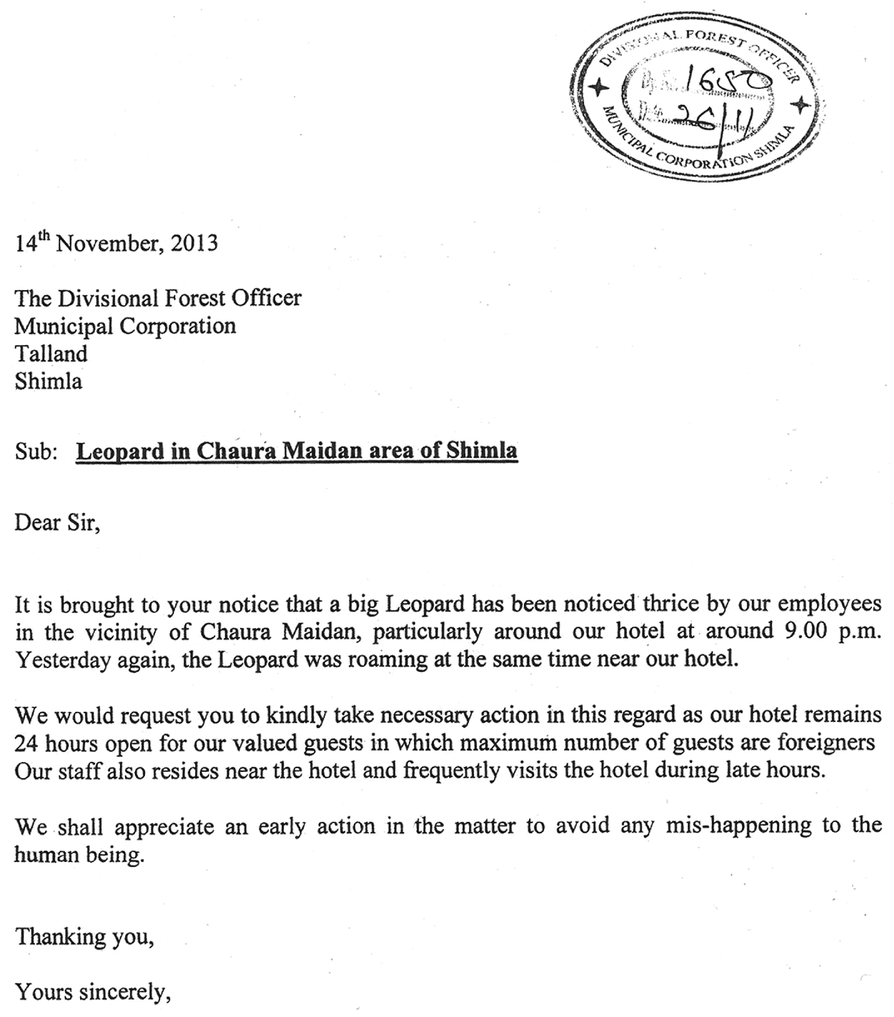
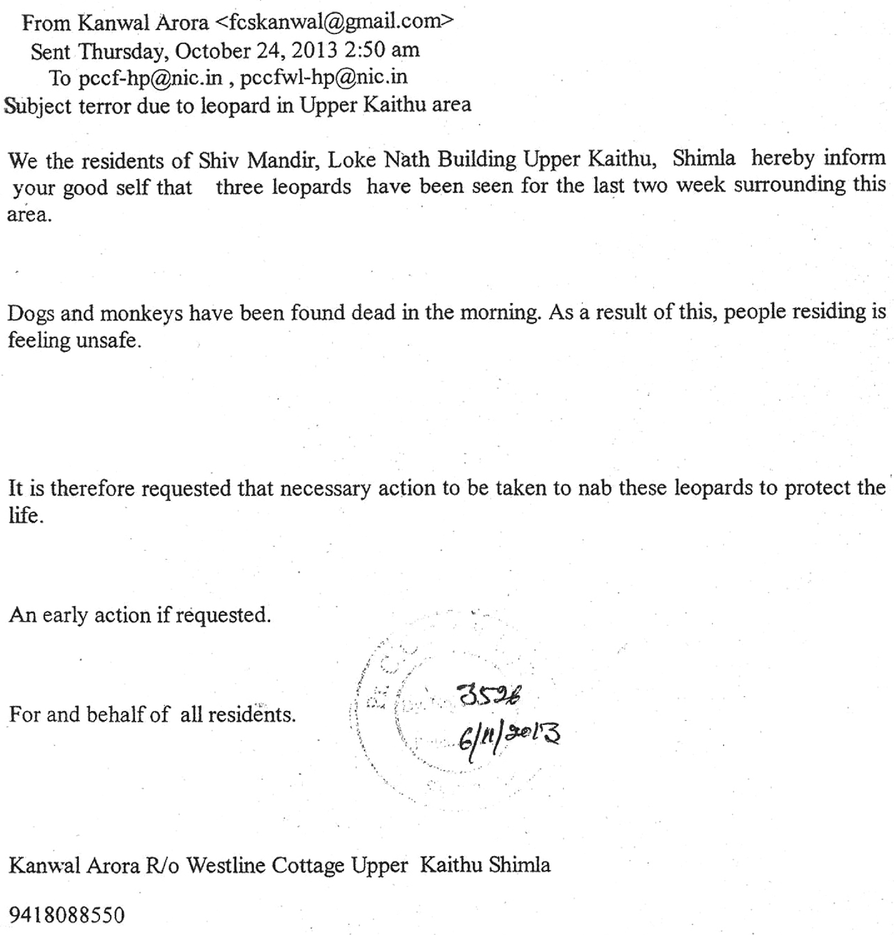
In addition to phone calls, these petitioners follow up with arzees that come very close to what, in the English language, would just straightforwardly be described as letters to the relevant officials. So, for instance, a Dr Pathania from an area called Kelston in Shimla wrote in to request the capture of a leopard in his residential area. He described the leopard as ‘moving freely’ at night and requested that the animal be immediately caged (see Figure 1). This arzee is written in proficient English, by hand, with a clear instruction on what the petitioner requires to be done. It is a petition to the extent that he is requesting the state to do something for him, but it is addressed as if to an equal, if not subordinate, person. A similar tone is adopted by a major five-star luxury hotel in Simla, which has many times captured on its CCTVs leopards walking around its parking lot and, even, taking a dip in the hot pool. So, for instance, in November 2013 the hotel wrote to the forest officer saying a ‘big Leopard’ has been noticed near their hotel and asked for some action to be taken. Part of the justification is that their hotel is open 24 hours a day and that most of their guests are foreigners (see Figure 2). The need to avoid a ‘mis-happening’ as the letter puts it, is emphasized when the leopards prey on dogs and monkeys. As an email from Mr Arora of Westline cottage put it, people felt unsafe due to the sighting of multiple leopards and requested that the big cats would be, as he describes it, ‘nabbed’ (see Figure 3).
‘A leopard moving freely at night’.

A leopard dares to hang around a five-star hotel.

‘Nab the leopard’ arzee.

When it is not a retired Supreme Court judge with powerful contacts or a five-star luxury hotel worried about its foreigner residents, then the Forest Department responds only when there is a huge spike in telephonic complaints. On one day, 36 complaints were registered within four hours. The incident that set this off was a leopard sighting near the Legislative Assembly. Not only is this located in the historic heart of the city—on the Mall Road around which the colonial city was constructed—but it was also seen as a particularly audacious appearance. As a local newspaper put it, ‘the big cat knocks at the door of the temple of democracy’. Every single person I spoke to told me about that day—the day the big cat appeared in front of the Legislative Assembly. Even those who were otherwise unperturbed by leopard sightings in the city seemed to think that this big cat was going a bit too far. The Forest Department appeared to agree and not one but four cages were put up around the Legislative Assembly to trap the leopard. Duly trapped, it was sent to a zoo and now resides there, having gained fame as the Vidhan Sabha-bagh or the Legislative Assembly leopard.
Central to the petitions to capture big cats in Shimla is the emphasis on space. This is not just an idea of urban space but also that of the private and the public as well as sacred spaces. To fully comprehend the relationship between big cats and humans in Himalayan India, arzees need to be located in space, time, and class. The clips of leopards walking around their well-manicured gardens is deeply troubling for many upper class residents. When the same beast is spotted in public spaces, it becomes semi-comical: there are some grainy images of a leopard sitting at a bus stop as if waiting for a bus as well as one near a bank as if intending to withdraw cash from the nearby cash machine. These images, which circulate furiously via WhatsApp and newspaper reports, are perceived as humorous; they become objects of public comedy rather than fear or anger unlike when the private space is transgressed. However, the appearance of a leopard in certain public spaces can become—as the case of the Legislative Assembly leopard demonstrates—a transgression. There are some public spaces such as the sites where democracy in India is enacted that must remain sacrosanct. And, above all, it must be noted—as has been argued by many—that when big cats turn on humans in rural areas or in the perceived jungle, these episodes are made invisible, not just due to a lack of documentation and evidence, but also because of the existence of gradations in the value of human life.Footnote 25 Furthermore, there is a belief that a jungle, or the mountains, and even villages are spaces where wildlife belongs and, thus, such incidents are bound to occur there.
Beyond its spatiality, what constitutes an arzee against big cats in contemporary Shimla also varies. It can sometimes be something as simple as a phone call, often made in English, but not necessarily so. It can be the more regular letter or an appeal put down on paper. It can also be a mere email that is subsequently printed out by state officials, stamped, signed, and filed away. Often it is a combination of various mediums—telephone calls, emails, or a paper petition. Similarly, the complaints register is a space where arzees are recorded in material form. While it possesses tables and a set form for the recording of details, it can exceed that too as further details are scribbled in the borders or some complaints are barely documented. The urbanity of many of the petitioners of Shimla as well as the very nature of the complaints/appeals process allows for these diverse forms of petitions as well as acts that constitute petitioning. As we will see, in the neighbouring Himalayan state of Uttarakhand there appears to be a greater reliance on the ‘traditional’ paper forms of petitions even as the processes associated with petitioning are more complicated.
Petitioning to kill
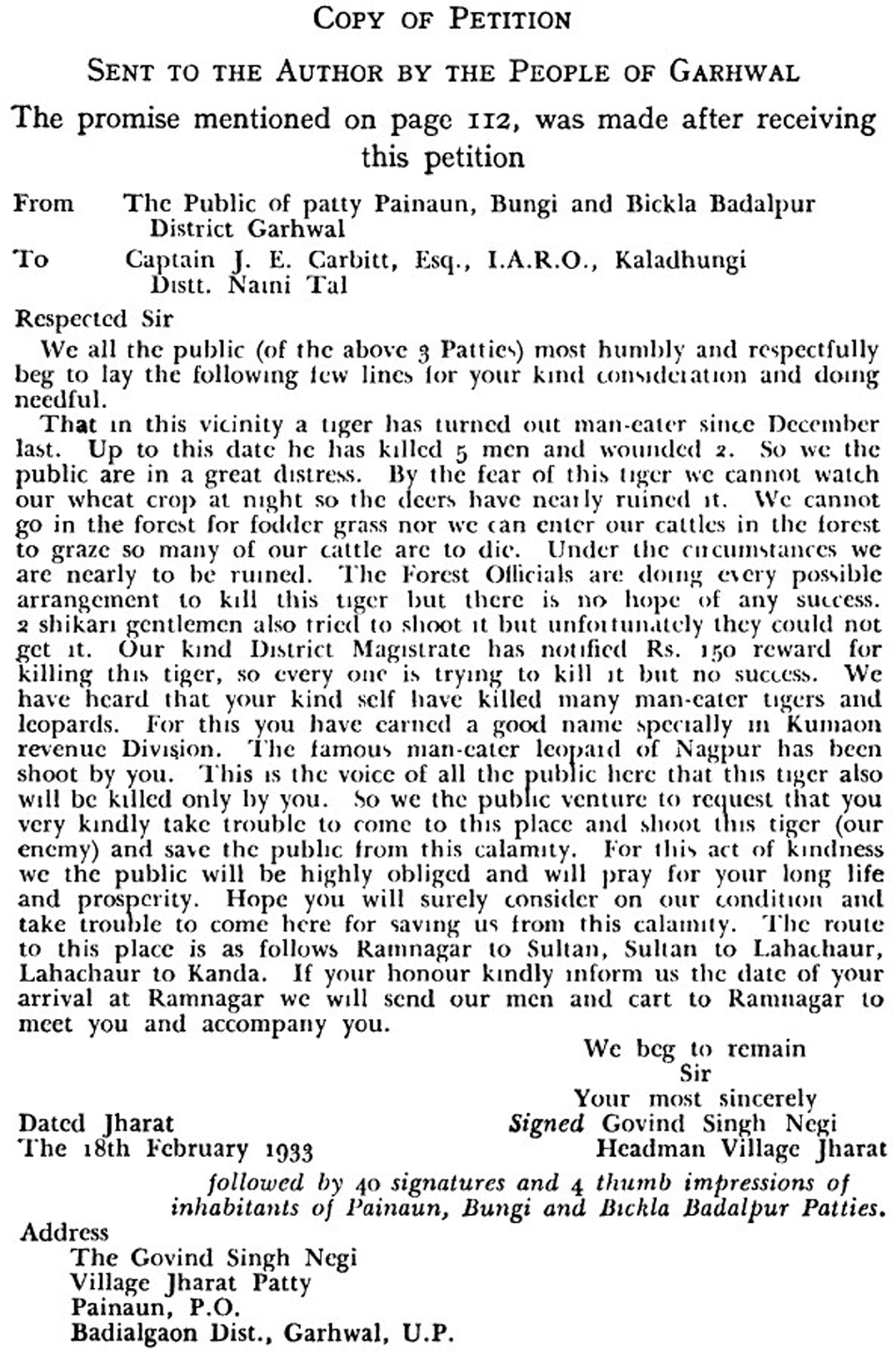
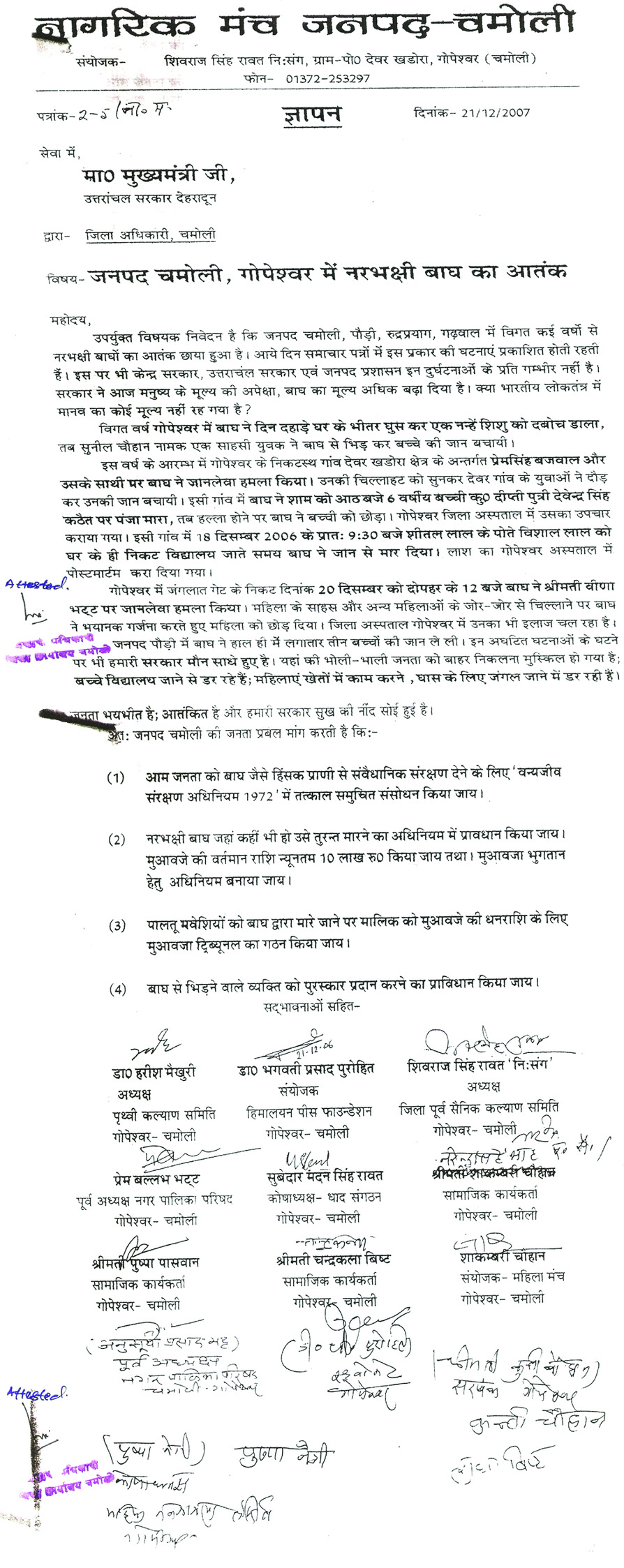
From arzees to capture leopards in Shimla, we move to the neighbouring Himalayan state of Uttarakhand and onto arzees that demand death. The state has a very long history of human–big cat conflict, with the earliest available records from the late nineteenth century showing that leopards were considered ‘destructive’.Footnote 26 One of the best sources for the twentieth century comes from the writings of the hunter-turned-conservationist Jim Corbett.Footnote 27 He authored many best-selling books on his encounters with man-eating tigers and leopards between 1907 and 1938. Corbett makes frequent mentions of arzees written to him by villagers living under the reign of terror of such animals. For instance, a petition published in Corbett's Maneaters of Kumaon (1944) beseeches Corbett (misspelled as Carbitt in the petition) to come and rescue the villagers from a tiger that was subsequently named the ‘Mohan man-eater’. The petition was originally written in Hindi but was translated into English either by Corbett himself or Oxford University Press, the publishers of the book. This is a good example of what is termed ‘a humble petition’ due to the extremely deferential language it utilizes and the faith it reposes in the benevolence of Corbett (see Figure 4). The petitions I encountered in present-day Uttarakhand break from this mould of beseeching and humble requesting, even if they do not entirely abandon some of their elements, especially the expression of faith in the ultimate benevolence of the state. I compare and contrast the arzee to Corbett with an arzee that was submitted in December 2007 requesting the killing of a man-eater (see Figure 5), which was submitted to the district magistrate in Chamoli district, which is located on the border with Tibet and where I lived for close to a year in 2007–2008 for my doctoral fieldwork.
Petition to Jim Corbett, the heroic hunter-turned-conservationist of Uttarakhand.

Reign of terror of a big cat in Gopeshwar city, Chamoli district.

On 21 December 2007, a group of over 100 people took part in a procession (jaloos) under the banner of the Chamoli District's Residents Forum (nagarik manch). Amid the beating of drums and cries of ‘Uttarakhand Shasan Hai Hai’ (Shame on Uttarakhand Administration) and ‘District Magistrate Murdabad’ (Death to the District Magistrate), the procession met the district magistrate to hand over a petition. For the past six weeks a man-eater had been haunting the town of Gopeshwar, which is also the district's administrative headquarters. Over a dozen attacks had already taken place and, thus far, there were three confirmed human deaths. Despite the obvious presence of a man-eater in the town, the district officials had been unable to officially declare the big cat a man-eater and, consequently, to obtain a hunting permit that would allow for it to be legally killed. The district magistrate accepted the letter and made a short speech in which he claimed that he was doing all that he possibly could to regulate the leopard.
All petitions in Uttarakhand that I discuss here were written in Hindi and, barring one, demanded the death of the leopard or tiger. The subject line of the petition shown in Figure 5 reads, in bold and in a large font size ‘The terror of the man-eating big cat in Gopeshwar, district Chamoli’. It begins with a reference to the spread of the terror in different districts of Garhwal, which had been regularly reported in local newspapers. ‘Yet, the central government, Uttarakhand government and district administration do not regard it gravely. The state has today put the worth of bagh greater than the worth of humans. Is there no value left to humans in Indian democracy today?’ (sarkar ne aaj manushya ke moolya kee apeksha, bagh ka moolya adhik bada diya hai. Kya bharatiya loktantra mein manav ka koeen moolya nahin reh gaya hai?).
The letter goes on to list a series of recent attacks by the leopard, with a stress on the manner in which (din dahade) the increasingly fearless leopard was barging into houses and grabbing children or attacking women in broad daylight. ‘After the experiencing of these incredible incidents, too, our sarkar remains mute (in unghatit ghatnaon ke ghatne pe bhi hamari sarkar maun sadhe hooeen hai) . . . the people are frightened; they are terrorized and our sarkar is sleeping a peaceful sleep (. . . janata bhaybheet hai; atankit hai aur hamari sarkar sukh kee neend sau rahin hai).’
The letter sets out four demands (maange) to the chief minister, including making amendments to the Wildlife Protection Act of 1972 and the provision of better compensation for victims.Footnote 28 The petition was signed by over a dozen ‘eminent’ citizens of Chamoli, including social workers (samajik karyakarta) and convenors of associations such as the Himalayan Peace Foundation, the Retired Soldiers Welfare Organization, the Municipal Corporation, and the Women's Forum. Interestingly, it was addressed to the chief minister and not the district magistrate or the forest officer who are more directly responsible for leopards in this region. Mr Rawat, the chief drafter of this arzee, said they were tired of waiting for the district magistrate to act and they knew that the only way to exert pressure on the district authorities was by going over their heads to the ‘big boss’. They also had the petition hand-delivered to the chief minister in the distant state capital, but their chief line of attack was to personally assemble a large number of people, hire drums, and march through the town shouting slogans. They had also made sure that the district magistrate was in his office so that they could personally hand over the petition to him to ensure that later on he could not pretend that the file had never reached him. Indeed, one of the defining features of an arzee is that it is delivered by hand—you do not just send it by post, but you make sure to hand it over yourself to the highest-possible official.Footnote 29 Mr Rawat and the other arzee signatories put great emphasis on the affective charge of the moment at which he and his fellow petitioners confronted the district magistrate in person in front of his office before an assembled crowd of onlookers, presented him with this letter, and related their fear and anger to him. The procession had also roped in some influential members of the local press who stood by with their cameras. The following morning almost all the local Hindi-language newspapers carried photographs of the head of the procession handing over the petition to a somewhat beleaguered-looking district magistrate. The petition and the press coverage around it gave the district magistrate the space to press home his demand for a hunting permit from his superiors in the distant state capital. After he had won the permit, the district magistrate rang up Mr Rawat to inform him of the ‘victory’ and to thank him for his petition.
A recurrent theme in the arzees in Uttarakhand that lie buried in district archives are musings on the value of human life. Members of this particular procession kept repeating the sentences that appeared prominently in this petition: ‘Is there no value to human life in Indian democracy? Can it be that the Indian state values the life of a big cat more than that of a human? Who is bigger, cat or human? (kaun bada hai?).’Footnote 30 One arzee said: ‘You are my mother-father, yet you value the big cat more than my child!’ Another: ‘It would be brave (bahadur) to kill the man-eater; the bravery doesn't lie in protecting it. It is us humans who need protection from this wild beast. Or is it that you are a coward?’ Yet another petition read: ‘But what idiocy is this from you, my lord, who knows so much? It is but the aunt of a cat (billi ki mausi) and I am a human.’
What is striking in the petition sent to Corbett in 1933, in contrast to the petition sent to the chief minister of Uttarakhand in 2007, is the assessment of what the state is doing to alleviate the terror. In the case of the Mohan man-eater, the villagers wrote that the district magistrate, the gentlemen shikari, and the forest officers were doing everything they possibly could. Unfortunately, they did not seem to have had much success and, given Corbett's fame in Uttarakhand, the villagers were writing to request him to kill their enemy, the tiger. In the case of the Gopeshwar man-eater of 2007, the petitioners are furious with the state for doing nothing and for sleeping a peaceful sleep while the people were terrified. There is a constant reference to the (sorry) state of democracy (loktantra) in which the big cat appears to be valued more than a human. The 1933 petition is cajoling and respectful, the 2007 petition is angry and makes demands over and above the mere hunting down of a man-eater. Though both were petitioning for the same cause—the hunting down of a man-eating big cat—the rhetoric employed in both the letters is remarkably different. The wording of the arzees, particularly the veiled or, even, open threats that some carry to revolt against the state, carries import. It allows local officials to use the fear of a breakdown in ‘law and order’ to speed up the process of getting the truant cat killed or captured. Note also the constant comparison between human life versus animal life. The anthropocentric assumption is that humans are valued above animals, at least by fellow humans. But what the petitions I study in Uttarakhand keep mentioning is a species betrayal, whereby a much higher value is placed on the life of a big cat than a human life. The rhetoric of the arzees aside, it is also the accompanying performances that make a big difference to the eventual acceptance or denial of demands. In the context of the petition that was received in December 2007, it was the theatrics around the submission of the petition that allowed the district magistrate to quickly win a hunting permit against that particular leopard.
Chakkar marna
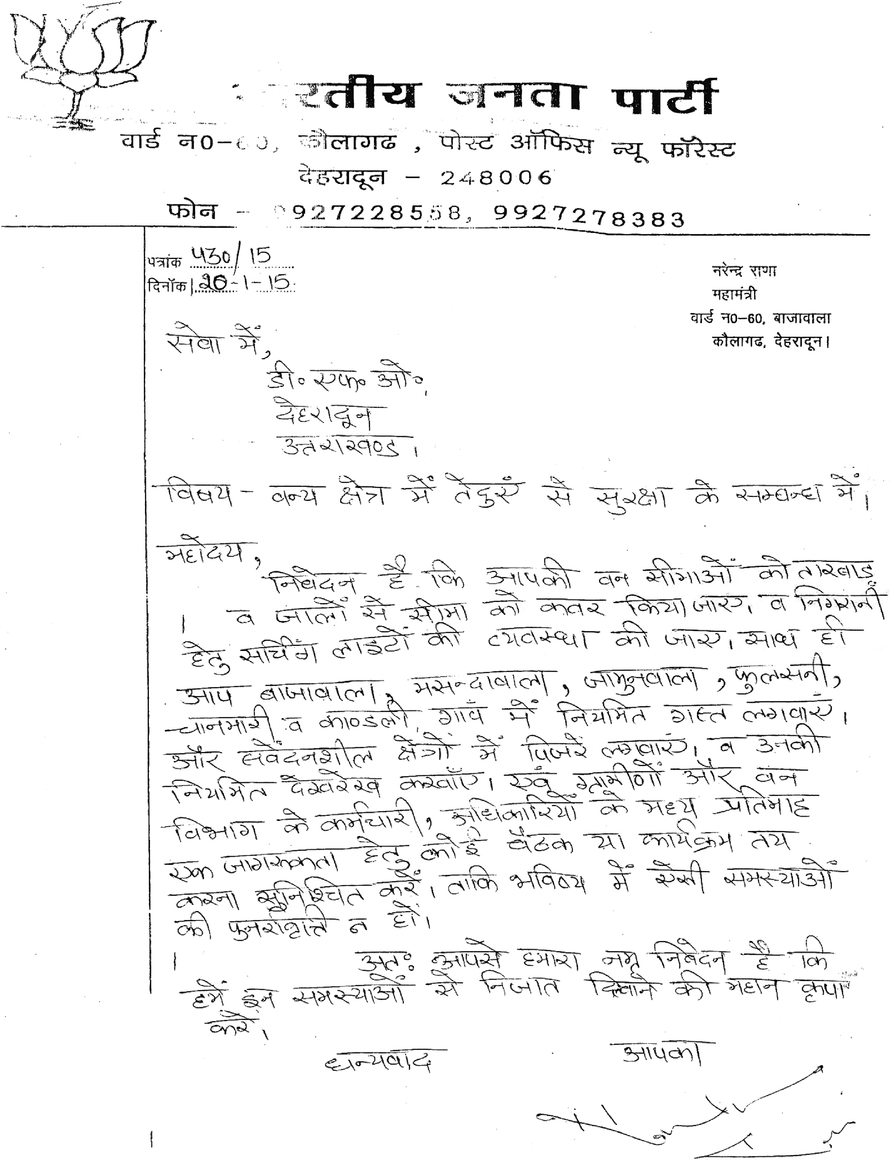
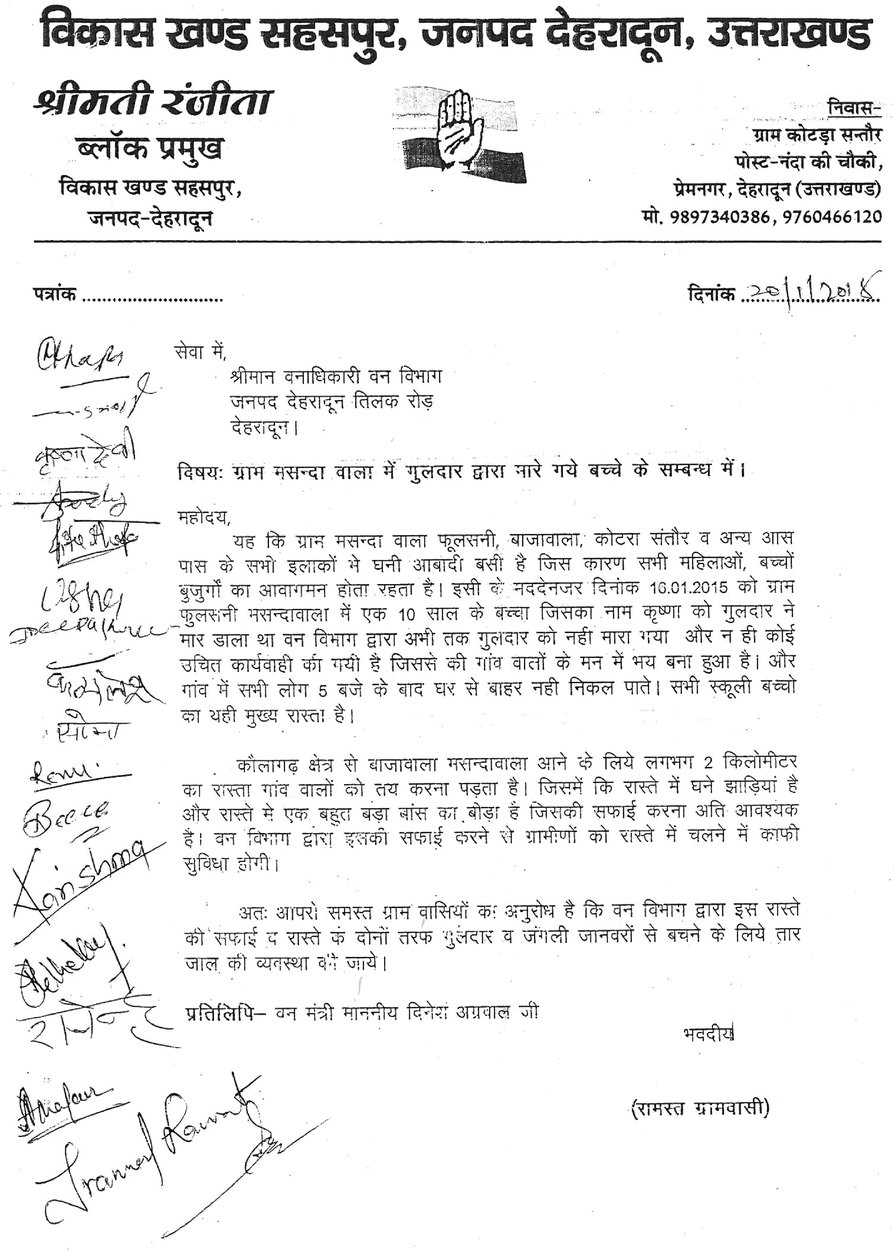
In addition to careful wording and the public spectacle at the point of submission, a key tactic of petitioning the Indian state involves the following up of the original petition with further forms of pressure. The phrase used most commonly to describe this follow-up action is ‘chakkar marna’ or ‘to go round and round’. One would describe the circumambulation of a temple in Hindi as chakkar marna but when used in the context of government offices, it is meant to exude that sense of exasperation as well as an ensuing dizziness. Chakkar marna can, and often does, include follow-up arzees by the same supplicant or new ones for the same cause. There is an interesting trend of what I think of as piggy-back petitions or petitions that ride on the back of the original appeal or grievance but also slip in an extra demand or two (see Figures 6 and 7).
An example of a piggy-back petition.

Another example of a piggy-back petition.

For instance, villagers or residents of a town will send out arzees requesting the death or capture of a predatory leopard or tiger. Their local political representatives—members of the two leading political parties, the Congress and the Bharatiya Janata Party (BJP)—will follow up with petitions requesting the same. They do so on their party's letterheads. As well as requests for the death or capture of the truant cat or a greater alertness on the part of forest and police staff, these arzees also include requests for electrification, clearance of shrubs from roads, or the construction of pukka roads. Piggy-back petitions aside, follow-up action on arzees goes above and beyond a written document that might, indeed, have formed the original arzee. Chakkar marna highlights the processual nature of petitioning: it is, in other words, not just a thing—an arzee that you submit once—but in fact a series of steps taken in the valiant hope of getting your appeal heard.
In the case of hunting down man-eaters, when petitions such as the one described above proved to be ineffective for whatever reason (such as the district was unable to find a hunter or the hunting licence was not issued or the hunters were unable to kill the right leopard), the agitations would gradually increase. Eventually the situation would arise whereby petitioners would dispense altogether with pieces of paper or letters that veer between humble request and outright threats, and adopt other methods to put greater pressure on the state. The most common of these methods is the staging of a dharna and refusing to release the body of a victim.Footnote 31 In my experience this has occurred twice in Uttarakhand. The scenario was as follows: a number of people were killed by a leopard; patently these were not accidental deaths but the work of a man-eater; a petition or a set of petitions was submitted to the district magistrate and the Forest Department, but to no avail. In such situations, a common tactic in the mountains is to not allow the body of the victim to be cremated. The family and other villagers or townspeople will sit around the victim's rapidly decomposing body and chant slogans against the state: ‘Death to the district magistrate, down with the state’. Both the demonstrations took place in key spaces of the town: the first at the entrance to the bazaar and on a major road; the other right outside the Forest Department headquarters. On such occasions, the pressure on local officials to quickly hunt down the leopard—any leopard—and present it to the victim's family becomes extreme. It also allows these officials to ring up their superiors in the capital and beg for reinforcements, be it extra policemen or hunters or both, as the situation might pose a threat to ‘law and order’.
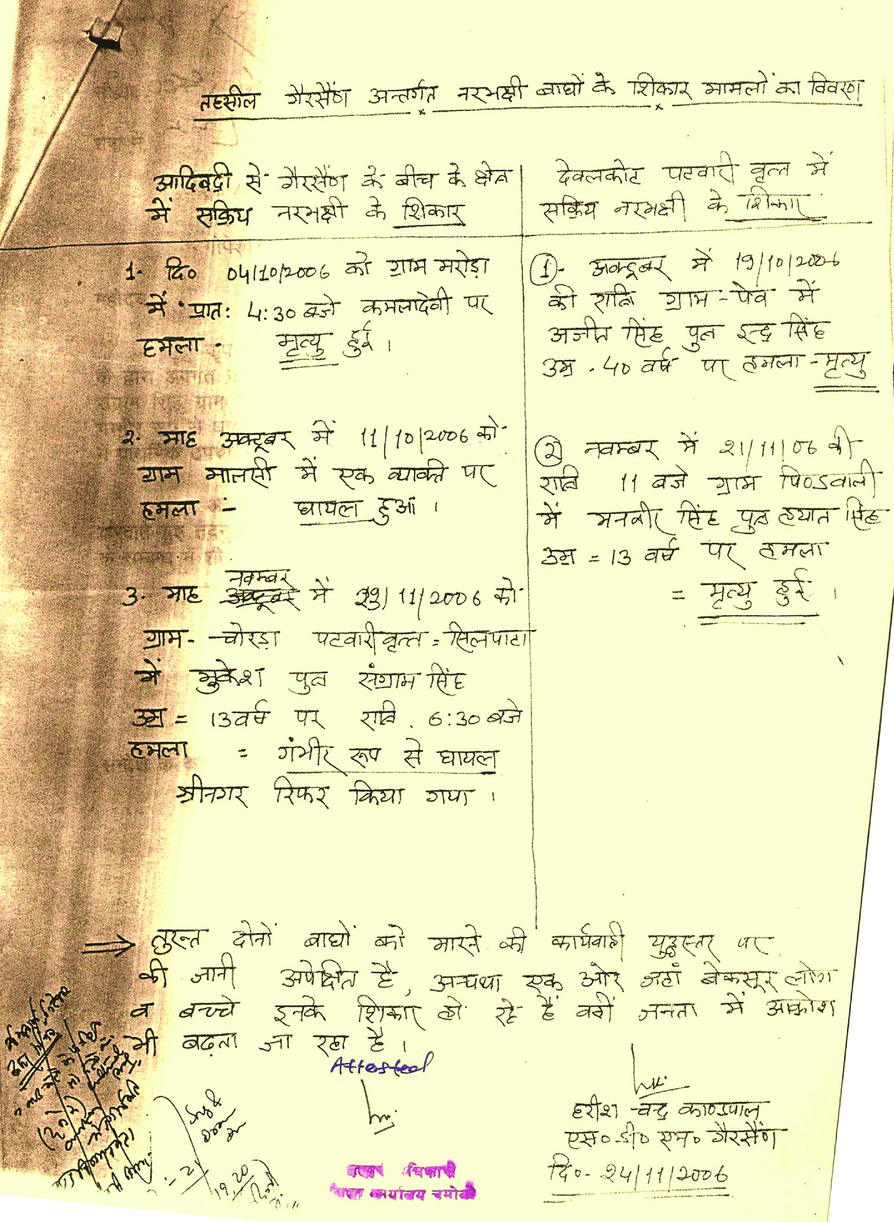
Administrative letters and official accounts in India appear to show a perpetual fear of unlawful and disorderly behaviour. This discourse is mimicked in official letters in Uttarakhand, despite the fact that this behaviour has rarely, if ever, occurred here.Footnote 32 The only experience of this constantly anticipated brute behaviour in the last ten years, at least, took place the district of Chamoli about two years back. There is a particular region in this district that experiences extremely high levels of human–big cat conflict for reasons that remain unclear. As it is a poor region with a small population and is situated far away from the district headquarters, the presence of man-eaters is constantly ignored. This neglect stems partly from an absence of canny petition-writers who can bring the situation to the attention of senior district officials. Instead there are overworked and under-resourced ground staff who are only ever able to send across handwritten reports that list the details of deaths and request some form of action from their superiors (see Figure 8).
Handwritten note on fatalities and injuries by big cats in a ‘remote’ part of Uttarakhand.

Two years ago, attacks were being reported almost every day and nothing was being done. The suspicion was that there were simultaneously not one but three man-eaters in the region. One day, a procession of about 50 people—most of them men—turned up unannounced at the Forest Department headquarters and doused four of its staff in kerosene. These men were dragged out of their offices by the crowd of protestors and the head of the Forest Department was sent a message saying that he had to give them a ‘likhit ashwasan’—a written promise—that the leopards would be immediately hunted down or else the four men would be set ablaze.Footnote 33 The written promise was extracted and, despite the absence of a hunting permit, hunters were immediately sent out who killed a leopard the very next day. We will never know if that hunted leopard was indeed a man-eater but it did have the effect of calming down the residents who released the four men. The official who gave the written promise then ordered that any leopard that was seen could be hunted; he described the situation as one of ‘law and order’ that necessitated the ‘sacrifice of a leopard’. The dead body of the leopard was then presented to the villagers—again, an unheard-of occurrence as the corpses are supposed to be sent to the capital city for post-mortems. The corpse of the dead leopard was then paraded around town. This incident is well known in official circles as well as in the press, largely because it remains, thus far, a relatively rare occurrence. None of this story appears in the government files, of course, making it a quintessential public secret.Footnote 34 But it is not only through the threat of force that arzees to kill big cats are immediately acquiesced to. As the next arzee shows, there are mediums and moments that can unleash a visceral response that culminates in state action.
WhatsApp arzees
In 2015, when I was living in a large town in Uttarakhand I woke up one morning to find a WhatsApp message on my phone. The message, in Hindi, simply said: ‘hume insaaf chahiye’—‘We want justice.’ Accompanying the message was a photograph of a young boy—whom I call Krishna—who had become the latest victim of a leopard in a village adjoining the town. A particularly enterprising young man in this village had come up with the idea of sending a WhatsApp of the horrific image. The simple but powerful text and its accompanying photograph of a half-eaten child circulated furiously in the town and even further. It was sent as a mass message to dozens of people, including senior wildlife and administrative officials. The next day some of the local newspapers carried it too with headlines such as ‘Another innocent has been martyred to the protection of leopards’ and ‘What was his fault?’ (iski kya galti thi?).
The WhatsApp message was also sent to the relevant forest official, who issued a hunting permit—via text message—to three of the state's most accomplished hunters on the very same day. They were rushed into the city and, within a few days, the leopard was hunted down. In normal circumstances, the killing of every leopard and tiger in a big town becomes magnified in the local press, with animal rights activists, wildlife organizations, and other assorted big cat-lovers leaping to the defence of the dead feline. In this case, though, the speed with which the big cat was hunted down and the widespread dissemination of the photograph, with its simple demand for justice, led to a hushing up of the event. Furthermore, there is no paper trace left of the death of this leopard in the official accounts—the ‘arzee’ was a WhatsApp message that was not filed; the hunting permit was a text message that is equally unfileable; and many of the discussions took place via the telephone.Footnote 35 There is a heated, ongoing discussion in India on the extent to which new technologies such as text messages or WhatsApp messages can be used in lieu of conventional paper-based technologies. While it is too early to see where these new technologies will lead and how they might shape the form of government in India, it is worth making an initial observation on the basis of the WhatsApp arzee.
The kaghazi raj that formed the basis of colonial rule and continued into post-colonial South Asia has, I have argued, only been strengthened by the recent push to transparency and accountability—the so-called ‘good governance agenda’ in India.Footnote 36 In an eco-system in which we witness the profusion of paper-based forms of functioning and evidence-making in government offices, text messages and WhatsApp messages, such as the one described above, possess some noteworthy qualities. The first is its power, despite its brevity. Unlike the three-page arzee that details a big cat's heinous actions and bullet-pointed demands, they consist of short and punchy messages. The sheer simplicity of the demand for justice—which is what often lies at the very heart of all arzees—is presented as just that. No details, no remonstrations, not even specific demands beyond insaaf (justice). The power of the message is propped up with the photograph. Together they make for an extremely potent petition. I often observed, during my time in government offices in Uttarakhand, how bureaucrats, especially those in senior positions who felt overwhelmed with petitions and paperwork, never really read the (paper) petitions seriously. They would skim them briefly or even just ask their personal assistant what the missive was about before tossing it in a file or outbox or sending it off to someone, or even, in some cases, ripping it to shreds. Going through the archives in different districts and Dehradun, I saw scores of petitions demanding the capture or hunting of man-eaters or pleas for compensation for attacks and deaths. Many of these petitions, I was certain, had never been even seen by the officials to whom they were addressed. As I mentioned at the outset, there is a similar fatigue with the volume of petitions in the development wing of the state. In such an environment of pathological petitioning and a dizzying volume of paper, what I think of as the ‘WhatsApp arzee’ has the capacity to elicit not just a response but also a quick response.Footnote 37 The second aspect of the arzee through WhatsApp or text message is that both the writing process and the time it takes to evoke a response is much speedier. In the case of the Gopeshwar petition, it was after two kills, several attacks, and a few weeks that the petition was penned. While there was one enterprising person—a Mr Rawat—who wrote it up under the banner of a larger organization, that petition was circulated among several people for their signatures. Once it had been signed and printed, there was plenty of organizational labour involved in the assembling of the procession (jaloos), the hiring of drums and loudspeakers, and the synchronization of the handing over of the petition with the district magistrate's movements. Compare this involved process with the WhatsApp arzee that one young man in the village sent out within an hour of the first death. Again, with the Gopeshwar petition, the district magistrate called an emergency meeting that lasted for hours, letters and telegrams were written, phone calls made, a committee was set up. The hunting licence was eventually granted but the entire process took a long time, despite the state being in ‘emergency mode’, so to speak. With the WhatsApp arzee, the officials met the next morning and sent a text message hunting licence before lunchtime.
Speedy as they might be, arzees and orders sent by phone have the capacity to vanish with greater ease than paper petitions or orders. While there are several cases of paper petitions being torn up or binned (what I call the ‘forgotten letters’ of the Indian state), in general the norm is for them to be filed away. Also, canny petitioners know to send multiple copies of the same arzee to different offices and also to follow up the original petition with frequent reminders until their demands are met. The very system of government is such that even if nobody reads the petition, there is a particular system of filing and archiving that allows for it to remain within state spaces in some way. Furthermore, often petitioners know that in return for their application or demand or grievance, they should be given a material receipt documenting its submission (the receipt is, for instance, a core feature of MGNREGA demands). In contrast, a WhatsApp or text message does not leave a trace in the same way. A text message can be deleted. A WhatsApp message is heavily encrypted and also deletable. Even if the message goes viral, there is no way of making it an ‘official’ submission or to verify that the said official did act upon the arzee. In contrast to emails which can be—and almost always are—printed out, scribbled upon, signed, stamped, and filed away, just like a ‘regular’ arzee, WhatsApp and text messages are a relatively more ephemeral medium. Their transitory nature stems more from the fact that, thus far, they are not routinely included within the practice of quotidian government in India in the same way as documents and files are. While phone recordings and spy cameras have been utilized in high-profile exposés such as the ‘Radia tapes’ or the ‘tehelka stings’, these are exceptional moments. In general and so far, messages sent on smart phones as well telephone calls remain largely off record. This ephemeral quality does not, however, prevent them—especially the WhatsApp arzee—from being a powerful medium of communication. It is a radically new form of making appeals, but it is so far an urban phenomenon. What form it will take in the near future remains open to speculation. At the moment, the vast majority of arzees take the traditional form of writing down one's travails on pieces of paper. I am going to end this article, however, with the story of a long-term petitioner who carried her arzee on her very self, so to speak.
The arzee of this woman, whom I call Uma, relates to the sudden disappearance of her 20-year-old son from a town in Chamoli district. The reasons for his vanishing remain unclear to date. Some suspected he had run away from home and the Himalaya to make a life in urban India in the plains—a very common phenomenon. Others wondered if he had not met with some accident such as falling down a cliff or into the river Ganges or, again a not uncommon occurrence, had been killed and eaten by a big cat. Uma recited her story as follows: she woke up one day and everything was normal in her life. Her son had breakfast, took his lunchbox, and headed off to work—and never returned. She had just one, passport-sized photograph of her son—which had been used for his college ID card—that she attached to an arzee she had had written by a professional petition-writer nine years ago when he disappeared. That arzee went into a fat file on missing persons in the district office as well as to the police.
On the first Tuesday of every month Uma would, without fail, visit the district magistrate's office in Chamoli where I had been undertaking fieldwork. On one of these days I was sitting in his office waiting to speak to him alongside six other people. The other six held documents—petitions or forms—in their hands but Uma walked in without one, merely with her hands folded in supplication. When her turn came, she remained mute. The district magistrate was obviously familiar with her and he quickly, but not unkindly, dismissed her by saying, ‘We will look at your arzee again and do what we can.’ I followed her out to another room where a clerical officer, again, immediately recognized her and automatically took out a thick file. From this he extracted her original arzee, made two photocopies of it, giving her one and marking the other to the police department with today's date and a scribbled note that read ‘please see’. Uma took the copy that was given to her to a Hanuman—the Hindu monkey god—temple located in the office compound. In the temple she muttered a small prayer under her breath and deposited the arzee near the main shrine.
This ritual was repeated every first Tuesday of each month in the year I spent in the district. Even when the district magistrate was transferred and a new one came in, he was informed about the sorry plight of Uma who yearned to be reunited with her missing son. Uma knew that her arzee in the Hanuman temple—like the many others that were deposited there alongside hers—were swept away by the cleaner the next morning and put in the garbage bin. Yet she persisted with her ritual on the day of the week—Tuesday—that is considered the designated day for the Hindu god Hanuman. While her repeat appearances in the offices were more familiar—this is classic chakkar marna—I was curious about the additional trip to the temple. When I asked her about it she shrugged her shoulders and said to me: ‘kya pataa? Kaun kahan sun le?’ (One never knows who might hear you where).
The practice of depositing bureaucratic petitions at shrines or temples, especially those located close to government offices, is not an uncommon practice. In fact, in Uttarakhand there is a famous temple to the god of justice—Golu—that is devoted almost entirely to the submission of official petitions. As Malik has argued, there is a public intimacy that is created through the sharing of these extremely personal testimonials alongside an open expression of faith in Golu.Footnote 38 In November 2015 the New York Times carried a story on (what the journalist considered to be) a peculiar petitioning practice.Footnote 39 The site for this are the ruins of a fourteenth-century fort called Firoze Shah Kotla built by Sultan Firoz Shah Tughlaq in Delhi. The petitions are submitted to a jinn who is believed to live in the ruined fort. Drawing on the work of an anthropologist, this piece notes—in amused and amazed tones—that the petitions are more ‘bureaucratic than worshipful’: they include police reports, detailed contact information, and multiple photocopies of the very same form ‘as if addressed to different department of a modern bureaucracy’.Footnote 40
By way of an arzee-like conclusion, my submission is that an ethnographic account of arzees allows us to drop the incredulous tones of the New York Times article-variety by expanding our imagination of what it means to make an appeal and, relatedly, what forms an arzee can take. Arzees challenge dichotomies; they do not allow for the maintenance of uncontaminated pure spaces where, for instance, the legal is kept safely distinct from the sacred or the bureaucratic from the poetic. They question the assumption of a separation between the sacred—for instance, a Hanuman temple—and the secular—a clerical office, or the difference between a language that is bureaucratic and legal, and a language that is worshipful, or, similarly, documents that are bureaucratic or deeply affective.Footnote 41 An arzee can have long details on which clause of which statute needs to be amended in what manner, even as it simultaneously offers musings on the meaning of life and pontificates on the inevitability of death. Just as arzees can be presented to a state official so too can they be handed over to jinns or simply strung onto temple bells. Equally, arzees work though notions of the durbar or a royal court, through the hope of a darshan of an official—a viewing that holds connotations of the sacred—into much more of-the-moment institutions like a grievance redressal cell or email addresses and phone numbers where you can offer suggestions or WhatsApp your arzees using photographs and emoticons. As far as documents found in bureaucracies and state archives go, arzees are uniquely genre-defying. They carry elements of the humble petition, snatches of the worshipful, but at the very same moment, they can be combative, angry, and even threatening. In the same breath we go from: ‘You are my mother-father but what is this that you have done?’ and ‘I submit to thee my humble lord; but be warned this submission is not absolute and I, too, can roar like a hungry tiger.’ Another arzee, furious in tone and threatening a bloody revolt by Maoists shipped in from neighbouring Nepal, signed off ‘But I shall remain forever your humble servant’. I want to suggest that these are not confused or contradictory petition writers, but rather that ambivalence is written into the very heart of contemporary arzees which, in their quest for justice, find themselves battling big cats as well as the legal and bureaucratic apparatus of the Indian state.
People in these arzees appear to be in a peculiarly vulnerable position especially in regard to the charismatic, non-human animal. The big cats come across as being powerfully agentive in their own right; an agency that is further bolstered by the bureaucracy and legal regime that has been set up to conserve them. In the demands to kill the big cats, power and the right to life are flipped around: it is the big cat that is valued more than humans, claim the latter, even though it should, by all rights, be the obverse. Not only, then, do arzees defy a neat genre or encapsulation within a space, medium, or series of petitioning practices, they can also serve to open up debates on peaceful multi-species coexistence and challenge a conservationist discourse that assumes big cats to be peculiarly agentless and in dire need of human protection. In the arzees described here, it is the human who deserves protection from the beast: be it from even sighting him or from being made his prey.
Finally, what of the efficacious petitions that I have discussed here? There is an element of predictability to them—the possession of English-language skills and the class privilege that comes with it; the habitus of one who can enter a government office or in an even-handed manner pick up the phone and make a call and, as we say, ‘have a word’; and the networks and contacts that can be marshalled to get yourself heard. A closer look, though, suggests a more complicated scenario. Theatrics at the point of submission, ingenious chakkar marna or follow-up action, strategies like piggy-back and WhatsApp arzees, threats of violence, canny lobbying, visceral responses to visuals or words, and sometimes the sheer aching vulnerability of the petitioner can—and, indeed, have—elicited responses. While there are some very real elements of serendipity involved—as Uma puts it, who knows who might hear you where—there is a greater complexity to arzees that, while not entirely defying the lazy and easy narrative of privilege and patronage, do at least illuminate other modalities of engaging the state.