Introduction
Depression is a leading cause of disease burden worldwide and is especially problematic in people with chronic diseases (WHO, 2004; Moussavi et al. Reference Moussavi, Chatterji, Verdes, Tandon, Patel and Ustun2007). Cancer is rapidly becoming one of those chronic diseases as the population ages, cancer incidence rises and cancer mortality falls (Jemal et al. Reference Jemal, Bray, Center, Ferlay, Ward and Forman2011; Siegel et al. Reference Siegel, Naishadham and Jemal2012). In addition to being common in people with cancer, depression is associated with lower adherence to anticancer therapies, satisfaction with care and quality of life, and higher health-care costs and mortality (Colleoni et al. Reference Colleoni, Mandala, Peruzzotti, Robertson, Bredart and Goldhirsch2000; Bui et al. Reference Bui, Ostir, Kuo, Freeman and Goodwin2005; Brown et al Reference Brown, Kroenke, Theobald, Wu and Tu2010; Goldzweig et al. Reference Goldzweig, Meirovitz, Hubert, Brenner, Walach, Perry, Hasson-Ohayon and Baider2010; Kroenke et al. 2010a, c; Pinquart & Duberstein, Reference Pinquart and Duberstein2010; Walker et al. Reference Walker, Holm Hansen, Martin, Sawhney, Thekkumpurath, Beale, Symeonides, Wall, Murray and Sharpe2013). Cancer services are increasingly recognizing that depression is an important problem and many have implemented depression screening programmes (Sharpe et al. Reference Sharpe, Strong, Allen, Rush, Postma, Tulloh, Maguire, House, Ramirez and Cull2004; Fann et al. Reference Fann, Berry, Wolpin, Austin-Seymour, Bush, Halpenny, Lober and McCorkle2009b ). However, screening is only worthwhile if the identified cases are effectively treated (Gilbody et al. Reference Gilbody, House and Sheldon2001, Reference Gilbody, Sheldon and Wessely2006). We therefore need to know which treatments are effective for depression in cancer patients.
We know that depression can be effectively treated in the general population using antidepressant medication and psychological treatments such as cognitive behavioural and interpersonal therapies (NICE, 2009; Taylor et al. Reference Taylor, Paton, Kapur, Taylor, Paton and Kapur2011). However, we cannot simply assume that these treatments produce either the same benefits or the same harms in depressed cancer patients. For example, antidepressant medication could potentially cause more adverse effects in cancer patients through interactions with anticancer therapies, and psychological treatments may be less effective in patients grappling with the psychological sequelae of a cancer diagnosis.
Despite the publication of numerous reviews on the topic, the answer to this question remains unclear. This is because no review has specifically determined which treatments are effective for cancer patients with a diagnosis of depression (Sheard & Maguire, Reference Sheard and Maguire1999; Barsevick et al. Reference Barsevick, Sweeney, Haney and Chung2002; Ly et al. Reference Ly, Chidgey, Addington-Hall and Hotopf2002; Osborn et al. Reference Osborn, Demoncada and Feuerstein2006; Williams & Dale, Reference Williams and Dale2006; Rodin et al. Reference Rodin, Lloyd, Katz, Green, Mackay and Wong2007; Akechi et al. Reference Akechi, Okuyama, Onishi, Morita and Furukawa2008; Fann et al. Reference Fann, Thomas-Rich, Katon, Cowley, Pepping, McGregor and Gralow2008; Jiang et al. Reference Jiang, Mi, Wang and Zhang2010; Rooney & Grant, Reference Rooney and Grant2010; Gordon et al. Reference Gordon, Beesley and Scuffham2011; Ng et al. Reference Ng, Boks, Zainal and de Wit2011; Rayner et al Reference Rayner, Price, Evans, Valsraj, Higginson and Hotopf2011; Craft et al. Reference Craft, Vaniterson, Helenowski, Rademaker and Courneya2012; Hart et al. Reference Hart, Hoyt, Diefenbach, Anderson, Kilbourn, Craft, Steel, Cuijpers, Mohr, Berendsen, Spring and Stanton2012). The most commonly used diagnostic criteria in psychiatry are those of the Diagnostic and Statistical Manual for Mental Disorders (DSM; APA, 1994) and the International Classification of Mental and Behavioural Disorders (ICD; WHO, 1992). These diagnostic criteria describe the nature, severity and duration of symptoms required to make an interview-based diagnosis of depression. Although the majority of published reviews are of interventions intended to improve the quality of life of all cancer patients, two have focused on depression (Williams & Dale, Reference Williams and Dale2006; Rodin et al. Reference Rodin, Lloyd, Katz, Green, Mackay and Wong2007). However, even these reviews have not given us a clear answer because they have included studies of patients with mixed psychiatric disorders and patients with only high scores on depression rating scales that are not equivalent to a diagnosis of depression. There is therefore a need to determine which treatments, if any, are effective for patients with diagnoses of both cancer and depression. We aimed to address this question by conducting a systematic review of randomized controlled trials that had compared the efficacy of any treatment intended to reduce depression with that of an appropriate comparator in adults with diagnoses of both cancer and depression.
Method
Eligibility criteria
We aimed to include as many relevant studies as possible. We judged publications (in any language) to be relevant if they met the following criteria: (1) the publication described a randomized controlled trial; (2) participants were adults (aged ⩾18 years); (3) participants had a definite cancer diagnosis at the time of enrolment (e.g. histological diagnosis or attending for cancer treatment); (4) participants also had a definite depression diagnosis made using standard criteria defined in a widely used psychiatric classification system (e.g. major depression from the DSM or depressive episode from the ICD); (5) the trial evaluated the efficacy of treatments intended to reduce depression; and (6) depression outcomes (any duration of follow-up) were assessed using a standardized measure. We considered trials that included both patients with depression and patients with other psychiatric disorders (e.g. anxiety disorders) if the results for the subgroup of depressed patients were reported separately. We included trials that compared a depression treatment with any other appropriate comparator (placebo, standard care or another depression treatment).
Information sources and search details
We identified relevant published research articles by systematically searching the following electronic databases: Medline (1948–2012), EMBASE Classic + EMBASE (1947–2012), PsycINFO (1806–2012) and The Cochrane Central Register of Controlled Trials (CENTRAL). Searches were run for the combination of ‘cancer’ and ‘depression’ using both standardized subject terms and free text terms, including synonyms and alternative spellings, and we used the Cochrane Collaboration recommended terms for randomized controlled trials. Full details of the searches are given in the online Supplementary Appendix. We also searched manually the reference lists of all trials selected for inclusion and of review articles identified by the electronic searches.
Study selection
We imported articles identified by the searches into a database and screened their titles and abstracts to determine whether they met our selection criteria. We reviewed the full article, with a translator where necessary, if there was any possibility that it was relevant. This process was conducted independently by two researchers and a decision whether to include each trial was made by consensus. When we found relevant trial protocols or abstracts from conference proceedings, we searched for full papers using the authors’ names and, if necessary, contacted the authors for further information.
Data collection
Two reviewers independently extracted data from all the articles judged relevant, using a specially designed standardized data extraction form, with the help of a translator for non-English papers. We extracted data on trial aims, participants, interventions (experimental and control), outcomes and results (benefits and harms).
Assessment of risk of bias
During data extraction we assessed the risk of bias in each trial included in the review using the Cochrane Collaboration's risk of bias tool (The Cochrane Collaboration, 2011). This requires reviewers to evaluate the risk of five types of bias and to judge each of these as either ‘low’, ‘high’ or (usually when there is insufficient information) ‘unclear’. The types of bias are: selection (high risk means that the allocation of participants to treatments is not random or that treatment allocations could have been foreseen in advance by study staff or potential participants); performance (high risk means that there are likely to be systematic differences between the groups in the care provided or in exposure to factors other than the interventions being tested); detection (high risk means that there are likely to be systematic differences between the groups in the way that outcomes are determined, usually because outcome assessors are not blind to treatment allocations); attrition (high risk means that there are systematic differences between groups in study withdrawals or substantial missing outcome data); and reporting (high risk means that the outcomes reported are not adequately prespecified).
Synthesis of results
We categorized trials by treatment type as follows: antidepressant medication, psychological treatment, combined antidepressant medication and psychological treatment, and other treatments. We described the characteristics and results of trials in both narrative and table format and also considered whether statistical synthesis of the findings by meta-analysis was appropriate. The results of the trials are described as follows: first, we reported the differences in mean depression scores between trial groups as this outcome had been reported in all the trial reports included in the review. Second, we reported the authors’ findings regarding statistical significance. Third, we estimated the clinical significance of results using the published data to calculate standardized mean differences (SMDs). The SMD is the difference between the trial groups’ means expressed as a multiple of the standard deviation (s.d.) of the outcome measure in the trial sample. The SMD therefore allows us to compare the results of trials that have used different outcome measures. The SMD can also be described as a distribution-based indicator of clinical significance as it relates observed differences to the underlying distribution of scores: a difference of 0.2 s.d. may be considered small, 0.5 s.d. moderate and 0.8 s.d. large (Sloan et al. Reference Sloan, Frost, Berzon, Dueck, Guyatt, Moinpour, Sprangers, Ferrans and Cella2006). Fourth, we described any harms associated with the treatments that had been reported by the authors.
We followed the PRISMA (Preferred Reporting Items for Systematic Reviews and Meta-Analyses) statement for reporting this review (Moher et al. Reference Moher, Liberati, Tetzlaff and Altman2009).
Results
Literature overview
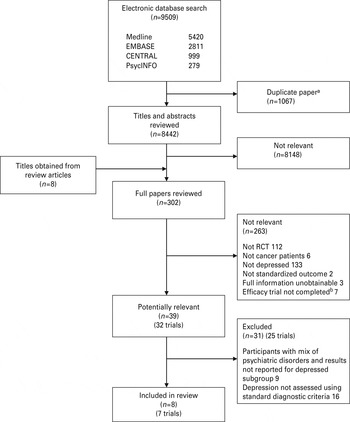
We appraised the titles and abstracts of 8442 publications and found 302 that were potentially eligible for inclusion (see Fig. 1). We read these publications in full, including 14 that required translation into English, and discounted 263, leaving 39 potentially relevant publications that described 32 randomized controlled trials. Eight of these articles (relating to seven trials) met our selection criteria and were included in the review.
Selection of papers for inclusion in the review. a Duplicates of the same paper or conference abstracts for full papers already included. b Trial still in progress (5), unable to recruit (1), feasibility study for main trial (1). RCT, Randomized controlled trial; CENTRAL, The Cochrane Central Register of Controlled Trials.

Characteristics of potentially relevant trials excluded from the review
We excluded 25 trials (described in 31 articles) that were potentially relevant because: (a) the trial included both patients with depression and patients with other psychiatric disorders but did not report separate results for the depressed subgroup or (b) the trial participants did not have a definite diagnosis of depression (i.e. depression was assessed using only a rating scale rather than standard diagnostic criteria). These 25 trials included nine of antidepressant medication, nine of psychological treatment, five of combined antidepressant medication and psychological treatment and two of other treatments. These trials are listed in online Supplementary Table 1 and commented on in the discussion.
Characteristics of trials included in the review
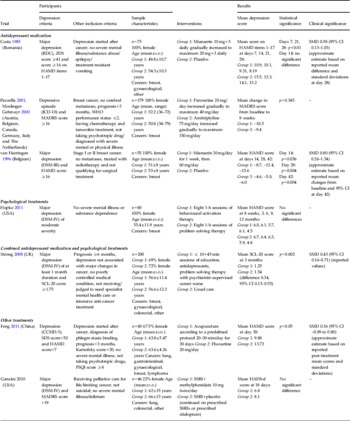
The seven trials included in the review (see Table 1) had all used similar psychiatric criteria to diagnose depression: four used the DSM (APA, 1994), one used the ICD (WHO, 1992), one used the Research Diagnostic Criteria (Spitzer & Endicott, Reference Spitzer and Endicott1978) and one used the Chinese Classification of Mental Disorders (CCMD; Chinese Society of Psychiatry, 2012). The sample sizes were generally small (range 46–200; median 80) and the substantial heterogeneity in the types of participants and treatments did not permit meta-analysis of the trials’ findings. Although the trials used similar measures of benefit (including differences between mean depression scores), the reporting of harms was inconsistent.
Characteristics of trials included in the review

RDC, Research Diagnostic Criteria; ICD, International Classification of Diseases; DSM, Diagnostic and Statistical Manual of Mental Disorders; CCMD, Chinese Classification of Mental Disorders; ZDS, Zung Depression Scale; HAMD, Hamilton Depression Rating Scale; MADRS, Montgomery Asberg Depression Rating Scale; SCL, Symptom Checklist; SDS, Self-rated Depression Scale; HADS-d, Hospital Anxiety and Depression Scale – depression subscale; PSQI, Pittsburgh Sleep Quality Index; WHO, World Health Organization; SSRI, selective serotonin reuptake inhibitor; s.d., standard deviation; SMD, standardized mean difference; CI, confidence interval.
Antidepressant medication
Three trials were of antidepressant medication in depressed female cancer patients, most of whom had breast or gynaecological cancers. Two of these compared the antidepressant drug mianserin with placebo and found statistically significant differences in depression outcomes (Costa et al. Reference Costa, Mogos and Toma1985; van Heeringen & Zivkov, Reference van Heeringen and Zivkov1996). Although these differences may be considered to be of moderate to large clinical significance, the confidence intervals (CIs) around the estimated SMDs were wide because of the small sample sizes. In both trials the proportion of participants who reported side-effects was similar between those allocated to mianserin and to placebo. The most common side-effect associated with mianserin was drowsiness early in treatment. The third trial compared the antidepressants amitriptyline and paroxetine and reported no differences in efficacy between them (Moslinger-Gehmayr et al. Reference Moslinger-Gehmayr, Zaninelli, Contu, Oberhoff, Gutschow, Schindler and Staab2000; Pezzella et al. Reference Pezzella, Moslinger-Gehmayr and Contu2001). Similar numbers of participants reported side-effects from the two drugs although anticholinergic side-effects were noted to be more common in those prescribed amitriptyline.
Psychological treatment
We found only one trial of psychological treatment; this trial compared eight 1-h sessions of behavioural activation therapy with the same duration of problem-solving therapy in depressed women with breast cancer. It found no difference in depression outcomes (Hopko et al. Reference Hopko, Armento, Robertson, Ryba, Carvalho, Colman, Mullane, Gawrysiak, Bell, McNulty and Lejuez2011). Harms were not reported.
Combined antidepressant medication and psychological treatment
We found one trial of combined antidepressant medication and psychological treatment in out-patients with relatively good prognosis cancers. This found that the combined treatment (delivered by cancer nurses with psychiatrist supervision), which included the psychological components of care coordination, patient education, behavioural activation and problem-solving therapy with antidepressant medication, was superior to usual care in reducing depression (Strong et al. Reference Strong, Waters, Hibberd, Murray, Wall, Walker, McHugh, Walker and Sharpe2008). The clinical significance of these results was moderate, with CIs around the SMD that extended from a small to a large difference, reflecting the relatively small sample. Deaths and hospital admissions for depression were the only potential harms reported; there were no psychiatric hospitalizations, one suicide in the usual care group and all other deaths were cancer related.
Other treatments
We found two trials of other types of treatment intended to reduce depression. One compared acupuncture with the antidepressant drug fluoxetine in depressed cancer patients with sleep problems attending a traditional Chinese medicine department (Feng et al. Reference Feng, Wang, Li, Zhang, Wang, Li, Cao, Ye and Zhang2011). This trial reported a statistically significant advantage for acupuncture but the clinical significance was questionable (the SMD was small to moderate but its CI was wide and included zero) and harms were not reported. The other trial (not yet fully reported) evaluated the efficacy of adding either methylphenidate (a psychostimulant) or placebo to antidepressant medication in depressed cancer patients receiving palliative care, and found no significant difference in efficacy between these treatments (Ganzini, Reference Ganzini2006). The researchers noted a high number of deaths during the trial but these were not attributed to trial treatments and no other harms were commented on.
Risk of bias
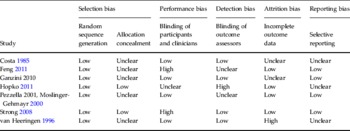
Table 2 shows our assessment of the risk of bias in each trial. We found that the reporting of procedures for participant recruitment, outcome data collection and statistical analysis frequently lacked detail and consequently our rating of the risks of selection bias (due to poor allocation concealment), detection bias (through unblinded data collection) and reporting bias (due to unspecified primary outcomes) was often ‘unclear’. We judged the risk of performance bias to be ‘high’ in trials of psychological and combined treatment due to lack of blinding, which is a common issue in these types of trials.
Risk of bias in trials included in the review

Discussion
We aimed to determine which, if any, treatments are effective for cancer patients with a diagnosis of depression by conducting a systematic review of relevant randomized controlled trials. We found only seven trials, most of which had small sample sizes. Limitations in reporting made assessment of risk of bias difficult. These trials provided limited evidence that antidepressant medication alone or in combination with psychological treatment may be effective. There was, however, no good evidence for the effectiveness of psychological treatment given alone, or for other types of treatment. The reporting of potential harms was limited, particularly in the non-drug trials. Because we included so few trials, we also comment on the findings of the potentially relevant trials we excluded.
We found only two placebo-controlled trials of antidepressant medication. These were both of mianserin, a drug rarely used in current clinical practice. Inspection of the potentially relevant excluded trials suggests that newer antidepressants (fluoxetine and paroxetine) may reduce depressive symptoms in cancer patients, although the published trials have not been unanimous in their findings (Razavi et al. Reference Razavi, Allilaire, Smith, Salimpour, Verra, Desclaux, Saltel, Piollet, Gauvain-Piquard, Trichard, Cordier, Fresco, Gullibert, Sechter, Orth, Bouhassira, Mesters and Blin1996; Fisch et al. Reference Fisch, Loehrer, Kristeller, Passik, Jung, Shen, Arquette, Brames and Einhorn2003; Zhang et al. Reference Zhang, An and Xu2003; Navari et al. Reference Navari, Brenner and Wilson2008). Consequently, although we have limited evidence to support the use of antidepressant medication, we have no useful evidence specific to cancer patients with depression on which to base the choice of a specific antidepressant drug.
In view of the widespread enthusiasm for the provision of psychological treatments in cancer settings, it is surprising that we were unable to find any trials that had compared a psychological treatment either with usual care or with another control condition. Indeed we found only one trial that met our inclusion criteria; this had compared two psychological treatments and found no difference between them. Inspection of the potentially relevant trials we excluded did not provide additional clear evidence to qualify this conclusion. Consequently we still do not know which, if any, psychological treatments are effective for cancer patients with depression or what harmful effects such treatments may have.
The treatment of depression with a combination of antidepressant medication and a psychological treatment is common in clinical practice. We found some evidence (based on only one trial of a collaborative care-type intervention) that this approach is effective in depressed cancer patients. Among the trials we excluded were two of combined treatment in patients with depressive symptoms (included on the basis of high scores on rating scales) and one of combined treatment in patients with depression but without definite cancer diagnoses at enrolment, which provided supportive evidence with similarly positive findings (Ell et al. Reference Ell, Xie, Quon, Quinn, Dwight-Johnson and Lee2008; Fann et al. 2009a; Kroenke et al. 2010b).
We were unable to find sufficient evidence that other types of treatment are effective in treating depression in cancer patients. One trial reported a statistically significant difference in favour of acupuncture over fluoxetine in patients attending a traditional Chinese medicine centre but the clinical significance of these findings are questionable, as is the generalizability to patients in other clinical settings.
We are unaware of any other published reviews of the effectiveness of treatments for cancer patients with a diagnosis of depression. The two most relevant previous reviews were published more than 5 years ago (Williams & Dale, Reference Williams and Dale2006; Rodin et al. Reference Rodin, Lloyd, Katz, Green, Mackay and Wong2007). One of these included trials in cancer patients with various psychiatric disorders and studies of unselected cancer patients (Williams & Dale, Reference Williams and Dale2006). These reviewers focused on the effects of interventions on reducing or preventing depressive symptoms and depression. They concluded that, although there was some evidence for the benefits of antidepressant medication, there was a need for studies of potential harms of these drugs in cancer patients. They also concluded that cognitive behavioural therapy was effective and social support may be beneficial but did not comment on the possible harms of psychological treatments. This review specifically excluded trials of combined pharmacological and psychological treatments despite their frequent use in clinical practice. The other review included studies in patients with various psychiatric disorders and patients with only high scores on depression rating scales (Rodin et al. Reference Rodin, Lloyd, Katz, Green, Mackay and Wong2007). The findings of this review are limited both by the inclusion of patients with a range of problems and by the inclusion of observational studies, which increase the risk of biased conclusions. These reviewers concluded that there was no evidence to indicate whether pharmacological or psychological treatments were superior and hypothesized, on the basis of evidence from other populations, that combinations of these treatments may be most effective. It is a sobering observation that the past 5 years have seen few new data published.
This review has several strengths: we searched for articles systematically and included studies using clearly defined criteria to minimize selection bias, in addition to using rigorous methods for data extraction. It also has limitations: we did not systematically search for grey literature by contacting relevant experts for unpublished manuscripts. However, we did make substantial efforts to find all relevant trials through inclusive search strategies and the use of translators, and we contacted the authors of published trial protocols and conference abstracts to obtain relevant information.
Conclusions
In summary, this new review of the literature provides limited evidence that antidepressant drugs, either alone or in combination with psychological treatments, are effective for cancer patients with depression. It is a major concern that we found only seven relatively small trials in cancer patients with a diagnosis of depression. There are several possible reasons for this dearth of trials: first, a focus of limited research resources on the search for new anticancer therapies that is to the detriment of research into treatments for patients’ symptoms. Although the need to find cures for malignant diseases cannot be overemphasized, the treatment of the complications of cancer, including depression, is arguably of equal importance. Second, researchers have recruited participants with either a range of psychiatric disorders or with ill-defined psychological problems into treatment trials. Although these trial samples may reflect the heterogeneity of those attending cancer clinics, the findings are difficult to apply to individual patients. Third, we suspect an implicit assumption that psychological and other non-drug treatments do not require rigorous evaluation because they do not cause harms. In addition to the obvious cost implications and burden on patients from providing potentially ineffective treatments, the assumption that non-drug treatments are without risk is highly questionable (Nutt & Sharpe, Reference Nutt and Sharpe2008).
In light of the limited evidence, what should clinicians do to help their cancer patients with depression? Although it is probably reasonable for them to use the standard drug and non-drug treatments used in non-cancer patients until better evidence is available, clinicians should be aware that the effectiveness and potential harms of these treatments in cancer patients remain largely unknown. Better evidence from large, well-conducted clinical trials is urgently needed.
Supplementary material
For supplementary material accompanying this paper, please visit http://dx.doi.org/10.1017/S0033291713001372.
Acknowledgements
This work was funded by the charity Cancer Research UK (grant no. C5547/A7375).
Declaration of Interest
None.