Introduction
Etlingera Giseke (Reference Giseke1792) comprises more than 150 species distributed from India in the west, through Southeast Asia and Malesia to Australia and the Western Pacific in the east. It is one of the largest genera of Zingiberaceae in this region, especially as Alpinia Roxb. and Amomum Roxb. are not monophyletic (Kress et al., Reference Kress, Newman, Poulsen and Specht2007) whereas Etlingera is (Pedersen, Reference Pedersen2004). Among the nine genera currently recognised in New Guinea, however, Riedelia has more than 83 published names whereas only 18 are placed in Etlingera. In addition to these, Etlingera australasica (R.M.Sm.) R.M.Sm. is found to the south in Australia and Etlingera cevuga (Seem.) R.M.Sm. occurs in the Pacific further to the east.
A recent revision of Etlingera in the island of Sulawesi (Poulsen, Reference Poulsen2012) increased the number of known species from 5 to 46, and it is expected that fieldwork and a similar revision in New Guinea and adjacent islands will more than double the number of species here. A high percentage of endemism is predicted.
The taxonomy of Etlingera is challenging (Poulsen, Reference Poulsen2006, Reference Poulsen2012) because pickled material of flowers is essential to describing and measuring diagnostic characters accurately. Therefore, fieldwork in known type localities must be carried out to collect pickled material and complete such a revision.
The new species described in this paper was discovered during the Galathea 3 circumnavigation of the world, 2006–2007. Because no species-level revisions of the whole family Zingiberaceae have been carried out since that of Schumann (Reference Schumann and Engler1904), all protologues and available type material of relevant published names in genera with a radical inflorescence (Amomum, 8; Etlingera, 17; and Nicolaia, 2) from the relevant geographical area were scrutinised. In this, we have been greatly helped by the 12 beautifully illustrated descriptions made by Valeton (Reference Valeton and Lorentz1913, Reference Valeton1914), which are so much more informative than purely written descriptions, especially when, in addition, type specimens have been lost.
Taxonomy
Etlingera frederikii A.D.Poulsen, sp. nov. Similar to Etlingera cevuga (Seem.) R.M.Sm. but differs in the larger lamina (83–96 × 18–19 cm versus 30–38 × 6–8 cm), the shape of the inflorescence (narrowly ovoid to cylindrical not hemiglobose), the colour of the bracts (creamish brown not reddish brown) and the colour of the corolla (red versus pale red). – Type: Papua New Guinea, Autonomous Region of Bougainville, Bougainville Island, 1.5 km W of Togarau village, slope of Hirayo Hill, 5°58′S, 155°5′E, 850 m, flowering 21 i 2007, Axel Dalberg Poulsen, Billy Bieso Bau, Thomas Akoitai & Saxon Akai 2593 (holo LAE; iso C, E). Figs 1 , 2 .
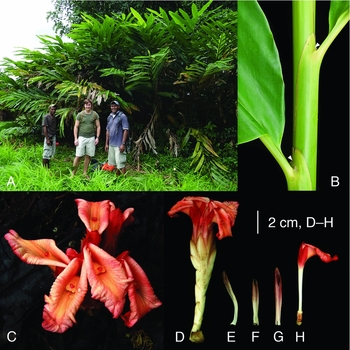
Photographs of Etlingera frederikii. A, Clump of leafy shoots; B, leafy shoot with two ligules (white triangles indicating sericeous bands) and leaf bases; C, inflorescence in situ; D, inflorescence excavated; E, fertile bract; F, bracteole; G, calyx; H, flower, lateral view (calyx removed). A and B, Poulsen et al. 2880, made in Lae Botanic Gardens; C–H, the type, Poulsen et al. 2593. Photographs by A. D. Poulsen.

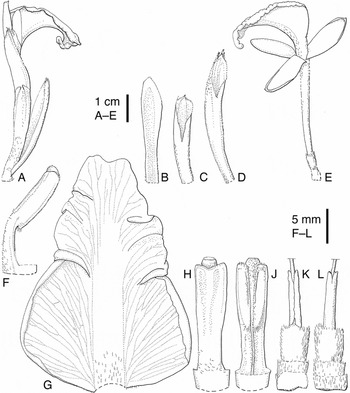
Etlingera frederikii. A, Flower and fertile bract; B, fertile bract; C, bracteole; D, calyx; E, flower, lateral view (calyx removed); F, stamen, lateral view; G, labellum, ventral view; H, stamen, flattened, ventral view; J, stamen, flattened, ventral view; K, ovary and epigynous gland, dorsal view; L, ovary and epigynous gland, ventral view. All drawn from the type by A. D. Poulsen.

Terrestrial perennial herb. Rhizome creeping, axis c.2 cm diam., ± sericeous, more so towards base of leafy shoot; scales to 4–6 cm long, pubescent in lower half; stilt roots absent. Leafy shoots to 5.3 m long, 24–50 cm apart, with up to 26 leaves per shoot; base to 7–9 cm diam., pale brown, densely golden-pubescent at base, green; sheath dark green, smooth; ligule to 15–18 mm long, rounded, entire (but sometimes splitting at apex), mid-green, sericeous in a distinct central band, especially at base and apex, margin brown, ciliate, apex tufted; petiole to 10–20 mm long, mid-green; lamina narrowly elliptic, to 83–96 × 18–19 cm, length:width ratio 4.6–5.1, smooth, mid-green to dark green above, midrib pale green beneath, glabrous, base oblique (by c.13 mm), margin ciliate, especially in upper half, apex acuminate, 1–1.5 cm long. Flowering shoot 12–27 cm long, arising from rhizome, receptacle 1–2 mm long, convex, with 9–16 flowers, 1–6 open at a time; peduncle 6–18 cm long, subterranean, ascending, sericeous, peduncular bracts distichous, to 4.5–5.6 × 1.5–2.5 cm, upper longest and covering base of spike, narrowly obovate, pale brown, ± pubescent near base, otherwise puberulous; spike (including flowers) 6 × 5.5 cm, narrowly ovoid to cylindrical, flowers extending 2–2.5 cm above bracts, spike only including bracts 4–5.5 × 2.5–3.5 cm long; sterile bracts 3 or 4, outer not in line with peduncular bracts, lower to 4–5.5 × 1.2–1.5 cm, upper to 4–5 × 1–1.3 cm, narrowly ovate to spathulate (widest at upper 1/4), cream with brownish margin, pubescent to puberulous, apex a thickened knob (not mucronate); fertile bracts 3.5–4.6 × 1–1.7 cm, broadly spathulate to obovate, apex rounded, lower bracts thickened at apex, translucent cream to pale brown; apex pinkish red, densely pubescent, margin densely ciliate, pedicel to 2 mm long, below bracteole, sericeous; bracteole tubular in lower part, 3.2–3.4 cm long, translucent, cream to pale brown; apex pinkish red, with one fissure of 1.7 cm or two of c.2.5 cm, densely pubescent, apex 2-lobed, close together, tufted-ciliate. Flower to 6.1 cm long; calyx 3.9–4.7 cm, reaching 2 cm longer than bracteole, to base of anther and 11–12 mm short of apex of corolla lobes, translucent, cream to pale brown; apex pinkish red, with two fissures of c.1.6 cm, ± pubescent, especially at base and apex, margin ciliate, apex 3-pointed, close together, tufted-ciliate, floral tube 2.8–3.4 cm long, cream, densely hirsute, tube inside densely pubescent for 5–6 mm up to the point where the lobes are attached on the outside, extending into staminal tube adaxially, lobes red, with scattered appressed hairs in lower half; dorsal lobe reaching longer than calyx and ± same length as stigma but pushed up and away from the stamen, 20–22 × 10–11 mm, obovate, apex rounded, ± cucullate; lateral lobes 18–21 × 5.5–6 mm, narrowly ovate, rounded, cucullate, attached to the tube at an angle, ± at same level as dorsal lobe; staminal tube 5–7 mm long, densely pubescent outside, with scattered hairs inside; labellum 35 × 26 mm, pale pinkish orange; margin and apex darker; paler at margin of lateral lobe, hirsute near base ventrally, lateral lobes erect, margin reflexed, central lobe 15–20 × 15–20 mm, reflexed, extending 20–22 mm beyond anther (when flattened); stamen 13–14 mm long, filament 6 × 3.2–4.5 mm, cream, canaliculate, pubescent outside, slightly tomentose inside, anther 9 × 4 mm, parallel-sided, with scattered hairs near base and apex, angled at 155° to filament, pale yellow, anther crest slightly emarginate (0.5–1 mm) with a narrow red line, thecae dehiscent in upper half for c.5 mm from 3 mm above base to 1 mm below apex, puberulous, with tufted hairs at base; ovary 5 × 3.5–4 mm, pale brown, densely pubescent, obconical barrel-shaped; epigynous gland(s) 6.5–8 mm long, entire, only split to base dorsally and 1.5 mm on opposite side or bilamellate, style 5–5.5 cm long, pubescent, especially in upper 2 cm, stigma 3 mm wide, brilliant red, ± tomentose, ostiole 1.8–2.2 mm wide, narrowly elliptic, facing forwards to upwards. Infructescence not seen.
Etymology
Named in honour of HRH Frederik, Crown Prince of Denmark, who was the patron of the Danish Expedition Fund that planned and executed the Galathea 3 circumnavigation during which this new species was discovered. The Crown Prince has himself participated in expeditions to Central China and Northeast Greenland and has also supported an expedition to Borneo in 2002 led by the first author.
Distribution
Bougainville Island. So far, documented only from the type locality in ridge forest at 850 m. It is likely to occur naturally on the neighbouring island to the south-east, Choiseul, in the Solomon Islands. A cultivated plant with a dried-up inflorescence in a garden in Buka Town, Buka Island (just north of Bougainville Island) is very likely of the same species.
Conservation status
Data deficient (IUCN, 2001). During our survey in primary and secondary forests on the slopes of Mt Balbi in Central Bougainville, we encountered only one population of Etlingera frederikii. This population covered an area of c.50 m2 but was by no means dense. After seeing its vigorous growth in areas with no canopy cover in Lae Botanic Gardens, we expect this species to be tolerant to change in vegetation cover.
Vernacular name
Rurutate (Rotokas language). Uses not known.
Additional specimen examined. PAPUA NEW GUINEA. Cultivated at Lae Botanic Gardens from rhizome collected from the same population as the type of Etlingera frederikii, flowering 20 iv 2013, Axel Dalberg Poulsen, Øystein Lofthus, Bernard Sule & Tiberius Jimbo 2880 (LAE, E, SING).
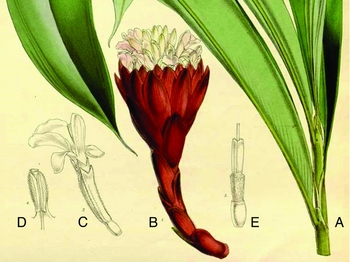
The only really distinctive vegetative character of Etlingera frederikii is the central band of silky hairs on the ligule. The inflorescence partly embedded in the ground with 1–6 open, peach-coloured flowers tinged rosy towards the margin is unlike any other species of Etlingera so far encountered. It is also the first species of the genus discovered on Bougainville Island. So far, Etlingera has not been documented from the neighbouring Solomon Islands, and the only known species occurring further into the Pacific is E. cevuga, first described from Fiji (as Amomum cevuga Seem.), which it most resembles. The protologue of Amomum cevuga (Seemann, Reference Seemann1868, p. 291) is short, and no pickled material from Fiji is available to us, but a study of the colour plate (Fig. 3) and type (Seemann 624, BM, GH) shows that this species lacks the hairy band in the centre of the ligule, and has a much stouter and hemiglobose spike (c.6 cm versus 3.5 cm wide), obviously with many more flowers than Etlingera frederikii. Photographs by the late Ray Baker of plants cultivated in Hawaii (exact origin unknown) match very well the plate in Seemann (Reference Seemann1868) and were very useful to study. The purple bracts of Etlingera cevuga (not creamish brown) may indicate that it is not embedded in the ground.
Etlingera cevuga from Fiji. A, Top of leafy shoot; B, inflorescence; C, flower; D, stamen, style and stigma; E, ovary, epigynous gland and base of style. Lower part of plate 89 of Amomum cevuga, drawn by W. H. Fitch in Seemann (Reference Seemann1868).

Amomum vigneaui Rech., described from Samoa, was placed in synonymy under Etlingera cevuga by Smith (Reference Smith and Smith1979, p. 201). Rechinger (Reference Rechinger1907, pp. 228–229) described a much larger plant (leafy shoots 5–8 m long) with a hemiglobose spike covered by carmine–rose red bracts, but he emphasised that the labellum was red and smaller than that of Etlingera cevuga. Even though the type collected by Rechinger in Savaii Island and deposited at W was lost in the Second World War, the red hemiglobose spike he described seems not to differ from what we have observed in descriptions of Etlingera cevuga. Even if Amomum vigneaui, after more detailed future fieldwork, were to be considered a good species to be combined in Etlingera, E. frederikii differs in the spike (narrowly ovoid to cylindrical with creamish brown bracts) and much longer and differently coloured labellum. New collections with pickled flowers (or dissections made in the field) of Etlingera from both Fiji and Samoa are much needed to understand the floral morphology fully.
We deposited live rhizomes of Etlingera frederikii at Lae Botanic Gardens for cultivation, where the plant apparently thrived in a completely open area, and after a few years dominated several square metres. During a visit in 2013, this clump produced numerous inflorescences, and measurements of this exceptionally informative material were in accordance with those made in the field except that the largest leaf was slightly larger (96 × 19 cm versus 83 × 18 cm).
Acknowledgements
We should like to thank the Papua New Guinea High Commission in London for processing the first author's visa; the Dansk Ekspeditionsfond, TK Foundation, Det Asiatiske Kompagnis Almennyttige Fond, Torben og Alice Frimodts Fond and Carlsbergfondet for support towards the fieldwork costs; staff of the Papua New Guinea Forestry Research Institute, including Herbarium LAE and Lae Botanic Gardens; Peter Nomoreke, the Provincial Forest Officer in Buka; the community at Togarau; the Herbarium of the Royal Botanic Garden Edinburgh; the Sibbald Trust, for funding part of this study; Ray Baker, Karen E. Shigematsu and John Mood for access to photographs and material of Etlingera cevuga cultivated in Hawaii; Randy Smith (MO) for confirming that Figure 3 could be reproduced from the Biodiversity Heritage Library; Ernst Vitek (W) for checking collections; and Ida Nicolaisen and Ib Friis (C) for their support for this paper.