Introduction
Great Plains yucca or small soapweed, is an easily recognized plant commonly found throughout the Central Great Plains (USDA-NRCS 2018). It makes up a small percentage of the plant composition on native rangelands and is found both in areas that have been protected from domestic livestock grazing for decades and in areas that have a long history of livestock grazing (Milchunas and Noy-Meir Reference Milchunas and Noy-Meir2004). Yucca was common on the steep coarse soils adjoining river valleys throughout Kansas, as well as on rocky slopes in the east and on the western plains in association with buffalograss [Bouteloua dactyloides (Nutt.) Columbus] and prickly pear (Opuntia spp.), before the intensive agricultural development in much of Kansas (Carlton Reference Carlton1890). In many sites in Nebraska and Colorado, yucca is often found on steep slopes with coarse soils (Barnes et al. Reference Barnes, Harrison and Heinisch1984; Kinraide Reference Kinraide1984), where deep root structures are required to attain soil moisture.
Yucca species, including Great Plains yucca and soaptree yucca (Yucca elata Engelm.) are generally not widely grazed by livestock. Cattle breeds differ in their preferences for yucca species during the growing season and during the dormant season (Herbel and Nelson Reference Herbel and Nelson1966; Winder et al. Reference Winder, Bailey and Walker1996). Flowering stalks and flowers are also highly selected by beef cattle in the spring (Rosiere et al. Reference Rosiere, Beck and Wallace1975). Heritability estimates in cattle show that the preference for yucca could be passed genetically to offspring (Winder et al. Reference Winder, Bailey and Walker1995). Winter grazing yucca with specific cattle breeds could be one form of suppression to aid other control methods. Studies conducted in Nebraska (Rittenhouse et al. Reference Rittenhouse, Clanton and Streeter1970) and Colorado (Reppert Reference Reppert1960) also reported winter grazing of yucca by livestock.
Fire alone does not control soapweed yucca, as fire resulted in mortality of less than 15% and increased yucca rosette densities in the plant community (Masters et al. Reference Masters, Marietta and Britton1988; Parmenter Reference Parmenter2008). This increase in vegetative reproduction is also the main methodology for yucca to maintain and increase populations among years of highly variable flowering and seed set (Kingsolver Reference Kingsolver1986) due to environmental conditions. However, burning did reduce plant size for up to 2 yr and wildlife browsing on new growth of surviving yucca increased immediately to almost half of the yucca population during the year after burning (Masters et al. Reference Masters, Marietta and Britton1988; Parmenter Reference Parmenter2008).
Suppression through grazing or fire may aid control of dense yucca populations with herbicides. Integrating burning or mechanically shredding yucca before herbicide treatment resulted in better control (Masters et al. Reference Masters, Marietta and Britton1988). For stands of yucca greater than 800 plants ha−1, such control measures are needed to increase yield and soil water storage available for surrounding desirable vegetation (Sosebee et al. Reference Sosebee, Churchill and Green1982). Many foliar herbicides have been effective for yucca control but are no longer available due to environmental and health concerns (Bovey Reference Bovey1964). Oliver (Reference Oliver1984) applied herbicides monthly and concluded that foliar-applied herbicides should be applied during or immediately following flowering. Soil-applied herbicides, including tebuthiuron and hexazinone, were more effective than foliar-applied herbicides in west Texas (Oliver Reference Oliver1984). Newer herbicides are available, although few studies have examined yucca control with newer herbicide combinations. This study was initiated to evaluate Great Plains yucca control using herbicide combinations applied in spring and fall to compare broadcast applications with an individual plant treatment.
Materials and Methods
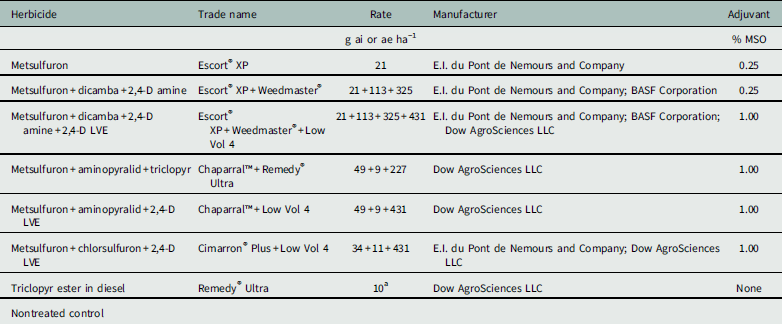
The research site was located in southern Trego County, KS (38.735 N, 99.728 W, on a limy upland ecological site consisting of an Armo loam soil (fine-loamy, mixed, mesic Entic Haplustolls). The dominant graminoid vegetation on the site consisted of blue grama [Bouteloua gracilis (Willd. ex Kunth) Lag. ex Griffiths], sideoats grama [Bouteloua curtipendula (Michx.) Torr.], buffalograss, western wheatgrass [Pascopyrum smithii (Rydb.) Á. Löve], and field brome (Bromus arvensis L.). Common forbs at the site were western ragweed (Ambrosia psilostachya DC), upright prairie coneflower [Ratibida columnifera (Nutt.) Wooton & Standl.], fringed sagebrush (Artemisia frigida Willd.), broom snakeweed [Gutierrezia sarothrae (Pursh) Britton & Rusby], and Russian-thistle (Salsola tragus L). The site also had a high density of Great Plains yucca, averaging 8,167 plants ha−1 across all plots Treatments consisted of four replications, with each plot being 4.1 by 7.6 m. In 2009 herbicides were applied June 24 and September 28, while in 2011 treatments were applied June 18 and September 21. The early-summer application was made to yucca plants that were in the early stages of bolting to early flower development across the site. Fall applications were made during the time period just before the average first frost date for the research site. Seven herbicide treatments and a nontreated control were compared for efficacy on yucca (Table 1). All foliar broadcast treatments included a methylated seed oil at 0.25% or 1.00%, depending on product label, on a v/v basis, and the final spray volume was equivalent to 187 L ha−1 at 172 kPa using TeeJet® 8004 flat-fan nozzles (Spraying Systems, Wheaton, IL). Foliar broadcast treatments were applied with a handheld boom attached to a CO2-pressurized container. The only individual plant treatment was applied using a pressurized handheld sprayer with a cone nozzle tip and was applied to just wet the whorl of each plant. All live yucca plants within each plot were counted before treatment. At 15 or 16 mo after treatment for the spring-applied herbicides and 12 or 13 mo after treatment for the fall-applied herbicides, all live yucca plants were once again counted within each plot. Mortality is based on the percent change between pre- and posttreatment yucca densities. Yucca plants with any visible sign of green foliage were considered live plants.
Seven herbicide treatments and a nontreated control applied to evaluate efficacy on yucca.

a g L−1.
Data Analysis
The experimental design was a modified split plot with year as the whole plot. The subplots were a two-factor factorial arrangement of treatments (2 dates by 8 herbicides) in a randomized complete block with four replications. Percent mortality data were transformed using an arcsine square-root transformation (Steel and Torrie Reference Steel and Torrie1960) and subjected to ANOVA using MSTAT v. 3.00 (Michigan State University, East Lansing, MI). Means presented in the text and tables are from untransformed data. Fisher’s protected LSD was used for mean separation at P≤0.05.
Results and Discussion
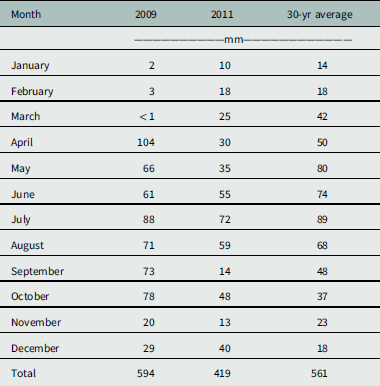
Data are presented primarily based on the presence of an interaction between date and treatment. The year by date interaction was nonsignificant, as was the three-way interaction of year by date by treatment (P>0.31). A significant year by treatment interaction (P<0.01) was caused by metsulfuron at 21 g ai ha−1 providing greater control of Great Plains yucca in 2009 (38%) than 2011 (10%) but is considered irrelevant, because both levels of control are considered commercially unacceptable. All other treatments gave similar Great Plains yucca control between the 2 yr. Average yucca mortality was 44% and 34% in 2009 and 2011, respectively (unpublished data). This difference is probably related to differences in growing season precipitation (Table 2). In 2009, April through September precipitation was 113% of average, whereas in 2011, April through September precipitation was only 65% of average. Foliar-applied herbicides are generally more effective when plants are actively growing and not under moisture stress. All of the foliar treatments contained metsulfuron, and dry conditions may reduce the activity of this herbicide (Anonymous 2015).
Monthly precipitation in Trego County, KS, during 2009 and 2011.

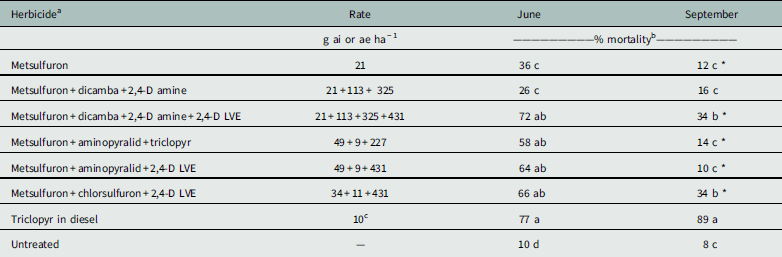
A significant date by treatment interaction occurred (P<0.01), with most herbicides applied in June being more effective than September treatments (Table 3). Superior foliar-applied treatments in June included metsulfuron + dicamba + 2,4-D amine + 2,4-D low volatile ester (LVE) (72% mortality), metsulfuron + aminopyralid + triclopyr (58% mortality), metsulfuron + aminopyralid + 2,4-D LVE (64% mortality), and metsulfuron + chlorsulfuron + 2,4-D LVE (66% mortality). Metsulfuron applied alone in June across both years also gave better yucca control than the September application, but provided only 36% mortality. None of the September foliar-applied broadcast herbicides provided more than 34% control averaged across the 2 yr. Triclopyr in diesel applied to individual yucca plants was equally effective (77% to 89% mortality) in June and September. Even in the untreated control, some yucca plants did not survive from one year to the next. Less than 10% of the yucca population in untreated control plots suffered mortality during the study (Table 3).
Great Plains yucca response to herbicides applied in June and September of 2009 and 2011 in Trego County, KS.

a All herbicides were foliar-applied at 187 L ha−1, except triclopyr in diesel, which was applied to wet the whorl of individual yucca plants.
b Means in a column followed by the same lowercase letter are not different according to Fisher’s protected LSD (P≥0.05). An asterisk (*) indicates a significant difference (P≤0.05) between June and September applications of a herbicide.
c g L−1.
Aerial application of silvex [2-(2,4,5-trichlorophenoxy)-proprionic acid] at 2.2 kg ha−1 using diesel fuel as a carrier provided 80% control of yucca (Bovey Reference Bovey1964). This author noted that substantial yucca resprouting had occurred 2 yr after herbicide application and that repeat treatment would be necessary for best control. Oliver (Reference Oliver1984) concluded that foliar-applied herbicides need to be applied during or immediately following flowering. In his study, yucca was treated monthly on two ecological sites, with yucca control less on sandy soils. The highest control achieved with silvex was 82%. In the current study, a foliar application in June 2009 or 2011, near the flowering stage of Great Plains yucca, with metsulfuron + dicamba + 2,4-D amine + 2,4-D LVE at 21 + 113 + 325 + 431 g ha−1 provided similar control (72%).
At the time the current study was initiated, no foliar treatments were recommended for yucca control (Thompson et al. Reference Thompson, Peterson, Fick, Stahlman and Wolf2009), as 2,4,5-T (2,4,5-trichlorophenoxyacetic acid) and silvex were no longer available. Recommendations included soil application of hexazinone and growing point treatment with triclopyr or triclopyr plus fluroxypyr. These individual plant treatments would be reasonable to use on scattered stands of yucca, but dense stands or yucca growing on steep topography would justify use of foliar-applied herbicides. Repeat treatment with foliar herbicides is necessary to optimize control of Great Plains yucca, with timing near the flowering stage to achieve the greatest control.
Acknowledgments
The authors thank David Hilker for allowing us to conduct this research on his property in Trego County, KS. This research received no specific grant from any funding agency or the commercial or not-for-profit sectors. No conflicts of interest have been declared. This is contribution no. 18-384-J from the Kansas Agricultural Experiment Station.