


Introduction
Although the devastating psychological consequences of betrayal are often depicted in popular culture (Altenberg, Reference Altenberg2015), the relationship between betrayal and psychopathology has remained relatively unexamined. Considering the construct of betrayal in the context of cognitive theories of psychopathology, Rachman has defined betrayal as ‘the sense of being harmed by the intentional actions or omissions of a trusted person’ (Rachman, Reference Rachman2010; p. 304). He proposed five categories of betrayal relevant to mental health problems: harmful disclosure of confidential information, disloyalty, infidelity, dishonesty, and failure to offer expected assistance.
Rachman and colleagues describe several case studies collated during their clinical work with obsessive compulsive disorder (OCD) patients (Coughtrey et al., Reference Coughtrey, Shafran, Lee and Rachman2013; Rachman, Reference Rachman2010), where instances of betrayal seem central to the formulation of the clients’ distress, and to their treatment resistance. A specific link between interpersonal betrayal and mental contamination (MC) in OCD has been proposed (Coughtrey et al., Reference Coughtrey, Shafran, Lee and Rachman2013; Rachman, Reference Rachman2004, Reference Rachman2010; Warnock-Parkes et al., Reference Warnock-Parkes, Salkovskis and Rachman2012).
Mental contamination is a concept introduced by Rachman (Reference Rachman2004, Reference Rachman2006) to describe a clinical phenomenon of OCD patients whereby a sense of contamination is precipitated in the absence of physical contact with a contaminant. Instead, association with a physically, morally or symbolically contaminated person or even by their own thoughts, images or memories can trigger a felt sense of contamination. This MC leads to an often diffuse, internal sense of pollution, rather than being localized to a body part, and therefore is immune to removal by the same methods as contact contamination. Thus MC is distinguished from contact contamination in that it can be evoked by cognitions alone, specifically those relating to the memory of experiences of being humiliated, deceived, violated or degraded by those they trusted, with the perpetrators of these experiences becoming a ‘human contaminant’ (Rachman, Reference Rachman2006). In other words, for some people, being treated like dirt makes them feel dirty. Coughtrey et al. (Reference Coughtrey, Shafran, Knibbs and Rachman2012a) found that 46% of participants with OCD experienced some levels of MC, with 10.2% experiencing MC in the absence of physical contamination and severity of MC being linked to severity of OCD symptoms (see also Coughtrey et al., Reference Coughtrey, Shafran, Lee and Rachman2012b).
Although MC is most associated with OCD, there is some evidence that it may occur across disorders. For example, a correlational study by Coughtrey et al. (Reference Coughtrey, Shafran, Bennett, Kothari and Wade2018) indicated the prevalence of MC in eating disorders, depression and anxiety. Other studies have found evidence of MC in specific phobia and post-traumatic stress disorder (PTSD) (Rachman, Reference Rachman2006). MC has also been observed independent of psychopathology; feelings of MC and the urge to wash have been reported retrospectively by female victims of sexual assault, with a reported increase in feelings of MC and the urge to wash when recalling the memories of the assault experience (Fairbrother and Rachman, Reference Fairbrother and Rachman2004; Ishikawa et al., Reference Ishikawa, Kobori and Shimizu2015) indicating that for women experiencing different kinds of sexual violation, self-reported feelings of MC increased as the appraisal of the severity of the violation increased, with victims of rape reporting higher levels of MC than victims of other kinds of sexual assault. Other studies have investigated whether MC can be evoked using imagined scenarios. For example, a non-clinical sample of undergraduates asked to imagine giving or receiving a non-consensual kiss (‘dirty-kiss scenario’) reported experiencing feelings of MC (Elliott and Radomsky, Reference Elliott and Radomsky2013; Fairbrother et al., Reference Fairbrother, Newth and Rachman2005; Herba and Rachman, Reference Herba and Rachman2007; Rachman et al., Reference Rachman, Radomsky, Elliott and Zysk2012; Radomsky and Elliott, Reference Radomsky and Elliott2009). In these studies, appraisals associated with responsibility, violation and immorality predicted MC responses to an imagined negative event, which included negative moral elements in the absence of imagined physical contamination. Thus, appraisals of immorality can induce a sense of MC.
Through his analysis of case examples, Rachman (Reference Rachman2004) suggests that appraisals of betrayal experiences and the psychological symptoms in response to such betrayals have similarities to those described in PTSD as described by Ehlers and Clark (Reference Ehlers and Clark2000): emotional numbing, avoidance of reminders, rumination, distress, intrusive images and pre-occupation with the betrayal. However, unlike those with PTSD, the betrayed were unlikely to report memory problems such as involuntary re-experiencing (Rachman, Reference Rachman2010). Rachman (Reference Rachman2010) highlights the retroactive nature of betrayal, the negative impact on appraisals of past and future events, and a ruminative pre-occupation with the betrayal and the betrayer. Rachman’s consideration of the emotional and pervasive impact of betrayal as observed in individuals who have experienced betrayal has similarities to a novel form of adjustment disorder first suggested by Linden (Linden, Reference Linden2003): post-traumatic embitterment disorder (PTED)Footnote 1. Modelled on PTSD, PTED is triggered by an ‘ordinary’ negative life event such as divorce, bereavement, dismissal or vilification, resulting in a psychopathological reaction of ‘embitterment’, which is prolonged and unabated. Embitterment is characterised as a feeling of having been let down by trusted systems; of injustice and helplessness together with the urge to fight back; and pathological pre-occupation with the perpetrator and/or revenge, representing systemic betrayal (Linden et al., Reference Linden, Baumann, Rotter and Schippan2007). One novel study indicates that bitterness may indeed be an important construct, conceptually distinct from anger and depression and closely associated with analytical rumination (Mills et al., Reference Mills, Salkovskis and Gillmore2014). Earlier studies suggest that embitterment is distinct from anger on the spectrum of optimism for change and internal/external control attribution (Znoj, Reference Znoj, Linden and Maercker2011); an external locus of control with low optimism for change is related to a higher sense of embitterment. Importantly, the construct of bitterness appears to differ from Rachman’s definition of betrayal because it does not require that the perceived injury be at the hands of a trusted person or persons. As the study of bitterness, like betrayal, is in its infancy, research examining the potential link between bitterness and MC remain unexplored. However, it may be that there is an overlap between bitterness and the impact of betrayal.
Within cognitive theory, the appraisal or interpretation of experiences is central to the development of psychopathology. The cognitive behavioural model of OCD (Salkovskis, Reference Salkovskis1985) states that appraisals of responsibility (for causing or preventing harm) is key to understanding the development and maintenance of the disorder. MC in OCD is postulated to occur because of the appraisal of various thoughts, images and experiences (Rachman, Reference Rachman2004, Reference Rachman2006), and non-clinical research outlined above suggests that appraisals of responsibility, violation and immorality are predictors of MC (Elliott and Radomsky, Reference Elliott and Radomsky2013; Radomsky and Elliott, Reference Radomsky and Elliott2009).
Betrayal occurs alongside MC OCD in clinical accounts but remains to be systematically investigated. Case studies have indicated that for clients for whom a betrayal event was central to the development of MC OCD [see Rachman (Reference Rachman2010) for summary], standard cognitive therapy required modification in order to lead to clinical improvement. This may indicate a need to investigate potential betrayal experiences at clinical assessment and consider adaptations to current protocols.
Aims
The present paper describes two studies: first, the development of a new measure to assess the impact of betrayal; and second, an investigation into the extent to which this is specific to OCD relative to other anxiety disorders and depression. Study 1 describes the development of a novel measure, the Perception of Betrayal Scale (POBS), and the establishment of the psychometric properties of the POBS within a community sample. Study 2 compares the impact of betrayal across three clinical groups and one community group.
The primary hypothesis is that participants in the clinical groups will report a greater impact of betrayal as measured by the POBS, with the greatest impact of betrayal reported in the OCD group.
The secondary hypothesis is that individuals with higher MC OCD would show a greater impact of betrayal as measured by the POBS. As there was a degree of conceptual overlap hypothesized between the impact of betrayal and bitterness (as a measure of systemic betrayal), a recent measure of bitterness was included. A third hypothesis is that scores of the impact of betrayal, but not bitterness, would predict MC.
Study 1: Method
Psychometric development and validation
Participants
Participants were recruited via social media and a University online noticeboard. Participation was completely voluntary and required informed consent.
Test–re-test reliability
A community sample of participants (n = 27) completed the POBS in order to assess the test–re-test reliability.
Scale development and validation
Following the test–re-test phase, a community sample of participants for scale development and validation was recruited (n = 217).
Materials
All participants completed the Perception of Betrayal Scale (POBS)Footnote 2 measure (Pagdin et al., Reference Pagdin, Warnock-Parkes, Nathwani and Salkovskis2015), a 27-item questionnaire that was developed for this study and assesses the impact of betrayal on different dimensions such as interpersonal relationships, self-perception and behaviour.
Content validity
The POBS was developed with input from researchers with experience in OCD and PTSD at the Institute of Psychiatry, Psychology and Neuroscience and the University of Oxford, as well as the University of Bath.
Procedure
Measures were administered via an online survey system, Bristol Online Surveys, powered by the University of Bristol (http://www.survey.bris.ac.uk/).
Reliability: test–re-test
The POBS was piloted as an online questionnaire with a subgroup of participants (n = 27) using a ‘2-week’ test–re-test to establish reliability, and correlations between the test and re-test scores were estimated using the intraclass correlation coefficient (ICC).
Factor analysis
The POBS was completed online by a community sample (n = 217). An exploratory principle components analysis was first performed to examine the dimensionality of the POBS.
Ethical approval
The study was approved by the University of Bath Ethics Panel, reference no. 14-224. All participants gave informed consent to participate, and participation was voluntary.
Study 1: Results
Participants
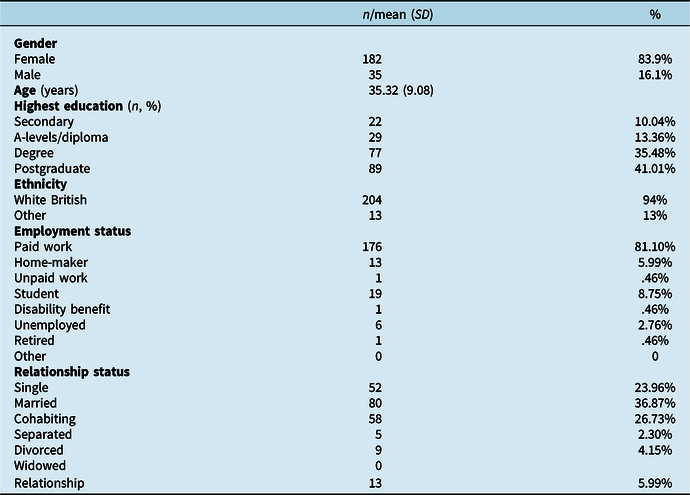
Demographic characteristics of the community sample taking part in Study 1 (n = 217) are summarised in Table 1 below.
Demographic characteristics of participants (n = 217) in Study 1

The community sample included a relatively high proportion of participants with postgraduate (PG) degrees; the UK average number of 26–60 years old holding a PG degree is 11% (Lindley and Machin, Reference Lindley and Machin2013), with the community sample in Table 1 showing that 41% have a PG degree.
Psychometric properties of the Perception of Betrayal Scale
Test–re-test reliability
Data were gathered for 27 participants at a second time point approximately 14 days after the first completion of the measure [mean 16.83 days (SD 2.83)]. The mean age of the pilot subgroup (n = 27) was slightly lower than the larger community sample (32.22 vs 35.32 years) but was otherwise comparable.
ICCs were calculated for each item using these data. The ICC for individual items ranged from the lowest at 0.64 (‘My experience of betrayal has changed the way I think about the world in general’) to the highest at 0.91 (‘My experience of betrayal has changed how I think about myself’).
The POBS showed acceptable to good test–re-test reliability.
Factor analysis
After test–re-test reliability of the instrument had been established, a principal component factor analysis was conducted on the original 42 items with varimax rotation. The Kaiser-Meyer-Olkin measure was .94, indicating that the correlation matrix was adequate for analysis (Kaiser, Reference Kaiser1974). Bartlett’s test of sphericity was significant, again indicating that factor analysis was suitable (Bartlett, Reference Bartlett1954). Tinsley and Kass recommended a minimum of five participants per item (Tinsley and Kass, Reference Tinsley and Kass1979), so factor analysis was deemed appropriate with the dataset (n = 217).
Four factors were retained, which together explained 57% of the variance and a qualitative review of the items indicated acceptable coherence in construct.
The item clustering suggests that factor 1 represents preoccupation with betrayal events (item example: I find myself thinking about past acts of betrayal more than I should); factor 2 represents betrayal causing life change (item example: The choices I make about my life have changed as a result of betrayals I have experienced); factor 3 represents a lack of trust due to betrayal (item example: It’s best not to rely on others as you never know when they’re going to let you down); and factor 4 represents betrayal leading to traumatic responses (item example: When I think about my experiences of betrayal, I still find it hard to believe it really happened).
Fifteen items did not load onto the first four factors and so were not included in any subsequent analysis. Twenty-seven items were retained. All items can be viewed in the version of the POBS included in the supplementary material, along with the item loadings for each of the four factors.
The final 27- item POBS was found to have high overall reliability (internal consistency) in this sample, at Cronbach’s α = .95. The preoccupation with past betrayal events subscale (α = .94), betrayal causing life change subscale (α = .89), lack of trust due to betrayal subscale (α = .88) and the betrayal leading to traumatic responses subscale (α = .81) all showed good reliability.
Study 2: Method
Design
This study used a cross-sectional, between-groups design with four groups: OCD, anxiety disorder (other), depression, and a community control group.
Participants
Three groups of clinical participants were recruited via mental health services (Avon and Wiltshire Mental Health Partnership NHS Trust and 2gether NHS Foundation Trust) and through national charity websites (OCD-UK and Anxiety UK). The community control group was recruited via social media and a University online noticeboard. Participants were excluded if they were under 18 years old, had a self-reported previous episode of psychosis or a previous self-reported diagnosis of bipolar disorder, psychosis, PTSD or substance dependence. Those who self-reported current self-harm were also excluded. The final sample for this part of the study consisted of 83 people, with 23 in the OCD group, 21 in the anxiety group, 18 in the depression group, and 21 in the community control group.
Materials
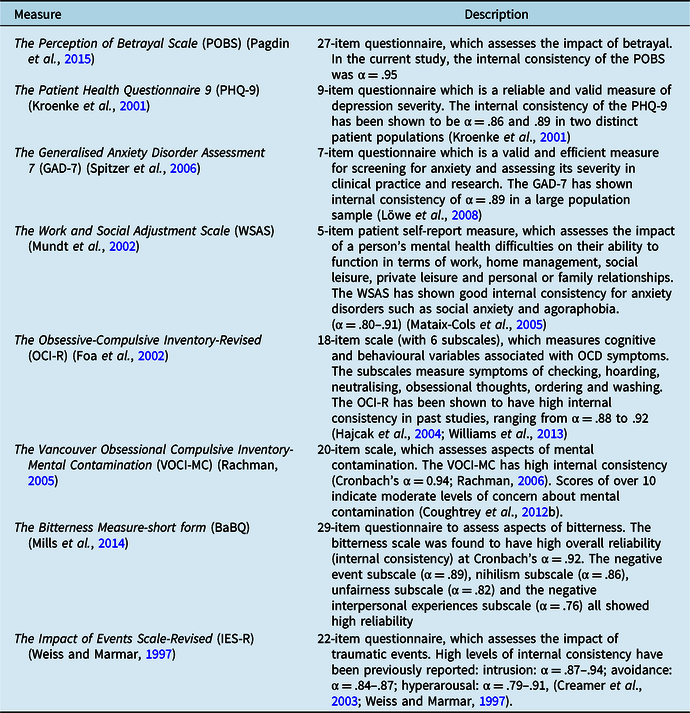
All participants completed the measures included in Table 2.
Description of measures

The Generalised Anxiety Disorder Assessment-7 (GAD-7) and the Patient Health Questionnaire-9 (PHQ-9) were included to assess severity of anxiety and depression, respectively. The Obsessive-Compulsive Inventory-Revised (OCI-R) was included to assess overall OCD severity, and the Vancouver Obsessional Compulsive Inventory-Mental Contamination (VOCI-MC) to assess symptoms of MC. The Work and Social Adjustment Scale (WSAS) was included to compare impairments to social functioning between the groups. The Impact of Events Scale-Revised (IES-R) was included to discriminate between distress attributed to traumatic events and betrayal and/or bitterness.
Procedure
Within NHS settings, potential participants were identified by clinicians in accordance with inclusion and exclusions criteria. Clinicians introduced the study and gave potential participants an information sheet and contact information for the researcher should they wish for more information. If they wished to take part, they were required to complete an online consent form before either accessing the materials online or requesting a paper copy.
Participants recruited via the charity websites accessed the participants information sheet and contact details for the researcher via each charity’s research information page online. Participants were identified by self-report as having received treatment for either depression, anxiety or OCD within the past year, or had been assessed and were awaiting treatment. Participants were screened before inclusion, using either the PHQ-9 (Kroenke et al., Reference Kroenke, Spitzer and Williams2001) and the GAD-7 (Spitzer et al., Reference Spitzer, Kroenke, Williams and Löwe2006) or the OCI-R (Foa et al., Reference Foa, Huppert, Leiberg, Langner, Kichic, Hajcak and Salkovskis2002) to confirm their group allocation. A community control group was recruited via social media.
Participants in treatment for multiple problems were asked to specify their primary problem. Participants were excluded if they had a previous, self-reported diagnosis of bipolar disorder, psychosis, PTSD or current substance abuse or dependence.
The final sample for this part of the study consisted of 83 people, with 23 in the OCD group, 21 in the anxiety group, 18 in the depression group, and 21 in the non-clinical control group.
Ethical approval
Ethical approval was obtained from the NHS Ethics Research Committee (REC reference no. 14/WA/1155), from 2gether Trust and Avon and Wiltshire Mental Health Partnership NHS Trust R&D departments, and the University of Bath Ethics Panel, reference no. 14-224.
All participants gave informed consent to participate. All measures were completed online, as described for Study 1.
Study 2: Results
Demographic and descriptive data were analysed to characterise the samples, followed by the detailed analysis of the clinical group comparisons of the main measure of betrayal (POBS) by subscale.
Participants
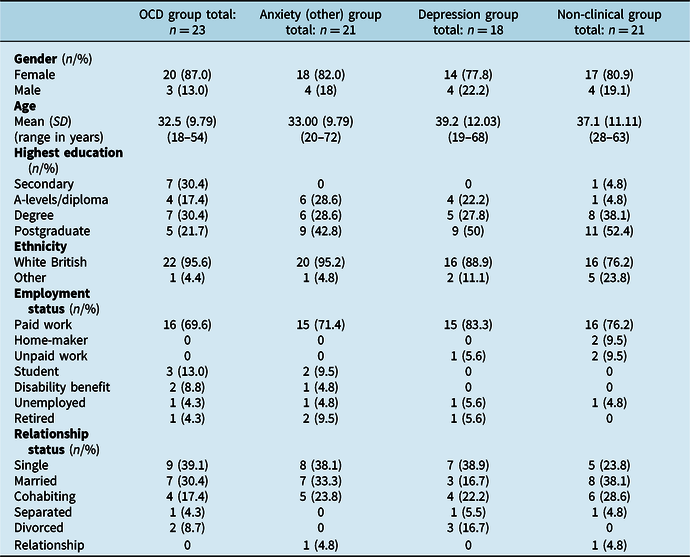
Demographic characteristics of each group are summarised in Table 3.
Demographic characteristics in Study 2

The groups were generally similar in terms of demographic characteristic; no significant difference was found between the groups in age (p = 0.159), gender (p = .88), ethnicity (p = .16), employment (p = .55) or relationship (p = .41). A significant between-groups difference was found for education attainment, χ2 (9) = 22.76, p = .007. Mann–Whitney tests were used to follow up the data. A Bonferroni correction was applied and so all effects are reported at a .0167 level of significance. This indicated that the OCD group had achieved a significantly lower level of education than the non-clinical control group (U = 129, z = –2.35, p = .02, r = .37). The differences between the OCD and anxiety and OCD and depression group were not significant (p > .0167).
Descriptive psychopathology
For measures with a single score, one-way analysis of variance (ANOVA) was carried out. There was a significant main effect of group on: the depression measure (PHQ-9) [F (3,61.38) = 19.32, p <.005, r = .43]; the anxiety measure (GAD-7) [F (3,64.84) = 25.35, p < .005, r = .49]; the work and social adjustment measure (WSAS) [F (3,65.26) = 19.64, p < .005, r = .43]; and the total score for the measure of obsession (OCI-R) [F (3,60.67) = 28.53, p < .005, r = .52].
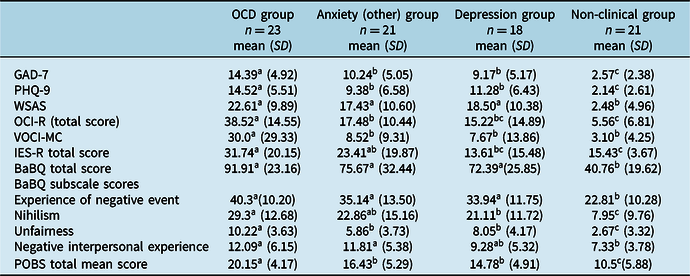
Multiple comparisons showed that the clinical groups differed from the community control group, with between clinical group scores being similar, except for OCD group on the OCI-R (total), GAD-7 and PHQ-9, which showed significantly higher scores. The significant differences between groups are summarised in Table 4.
Mean scores for all measures Study 2

a,b,c Means that do not share a superscript are significantly different from each other (p < .05).
A one-way ANOVA was carried out on the VOCI-MC score. The results showed a significant between-group effect among the four groups on the VOCI-MC [F (3,37.82) =11.34, p = .05, r = .50]. Multiple comparisons showed that the VOCI-MC was significantly higher in the OCD group than the anxiety, depression and non-clinical groups (p = .013, .017 and .001, respectively). All significant differences between groups are given above in Table 4.
The IES-R was analysed using a mixed-model ANOVA with the subscales as within-subject and group as grouping variables.
For the IES-R there was a main effect of group [F (3,79) = 9.23, p = < .001, r = .26] and subscale [F (1.53,121.52) = 5.44, p < 0.05, r = .06], but no significant interaction between group and subscale [F (4.60,121.19) = .42, p = .82].
As the IES-R measures symptoms of distress (caused by traumatic events), it was used to assess whether the main group effect could be explained by the higher anxiety in the OCD and anxious groups; the GAD-7 total score was added as a covariate. Results still showed a main effect of group [F (3,78) = 3.64, p = .018, r = .12], suggesting that the differences noted are not due to differences in anxiety/distress between the groups.
Bitterness
The measure of bitterness (BaBQ) was analysed using a mixed-model ANOVA with the four subscales mean scores as within subject and group as grouping variables. There was a significant main effect of group [F (1,79) = 16.01, p < .001, r =.41] and subscale [F (2.47,194.93) = 58.47, p < .001, r = .43]. These effects were modified by a significant group by subscale interaction [F (7.4,194.93) = 2.48, p = .017, r = .09]. Multiple comparisons showed significant differences on subscales scores between groups, which are summarised in Table 4.
Primary outcome variable
Betrayal measure
A mixed-model ANOVA with the four mean subscale scores as within subject and group as grouping variable was used to analyse the POBS data. This showed a main effect of group [F (3,79) = 15.45, p = <.001, r = .37] and a main effect of subscale [F (1.95,154.39) = 10.31, p <.001, r =.16]. There was no significant interaction between group and subscale.
Multiple comparisons from a one-way ANOVA of the POBS total mean scores show that the OCD group scored significantly higher than the anxiety group (p = .011) and the depression and non-clinical groups (p = <.001). The anxiety and depression groups were significantly higher in score than the controls (p = .001 and p =.006, respectively) but did not differ from each other.
Given the differences in anxiety noted above, with the OCD group showing greater levels of anxiety (as indicated by mean GAD-7 scores) than the depressed and anxious controls, we added the total GAD-7 scores as a covariate. Again, there was a significant effect of group [F (3,78) = 4.82, p = .004, r = .16], suggesting that the differences noted are not due to differences in anxiety.
Relationship between betrayal and mental contamination
Multiple regression
In order to evaluate the relative contribution of aspects of the impact of betrayal in predicting MC scores across the sample, a stepwise linear multiple regression analysis was used. The four POBS mean subscales scores were used as independent variables and the VOCI-MC total score was used as the dependent variable. The first variable to enter was POBS betrayal of trust subscale, accounting for 22% of the variance in scores on the VOCI-MC [F (1,81) = 23.78, p = < 0.001]. The second variable entered was the POBS trauma subscale [F (1,80) = 16.66, p = .007]. The R 2 change attributable to the rumination subscale was .07. Twenty-eight per cent of the variance in scores was accounted for by the POBS trust and trauma subscales. This indicates that betrayal scores are moderately associated with MC, consistent with the hypothesis.
In order to establish the specificity of these effects, the same multiple regression analysis was carried out with OCI-R scores as the dependent variable. The first variable entered was the betrayal pre-occupation subscale, accounting for 31% of the variance in scores on the OCI-R [F (1,81) = 38.52, p <.001]. The second variable entered was the betrayal of trust subscale [F (1,80) = 23.68, p = .014]. The R 2 change attributable to the pre-occupation subscale was .05. The third and final variable entered was the changed by betrayal subscale [F (1,79) =19.25, p = .014]. Forty per cent of the variance was accounted for by the trust and trauma subscales, suggesting that POBS scores show a moderate predictor of OCI-R scores, indicating a relationship between OCD symptoms and the impact of betrayal.
Discussion
Study 1 aimed to define and characterise betrayal and to establish a reliable measure of self-reported perceptions of betrayal. Study 2 used the measure to compare the extent of specificity of perceptions of betrayal across different diagnostic groups to investigate the relationship between OCD and MC, the hypothesis being that a greater perceived impact of betrayal would be associated with MC. Lastly, the study aimed to compare the constructs of betrayal and bitterness in relation to MC – the hypothesis being that the two are distinct constructs.
In Study 1, the POBS had acceptable test–re-test and good internal reliability and consistency. A factor analysis yielded four meaningful subscales, with 27 items from the original measure retained. These factors are, in order: preoccupation with betrayal events, betrayal causing life change, lack of trust due to betrayal and betrayal leading to traumatic responses.
Findings in Study 2 showed that the impact of betrayal scores in the OCD group were significantly higher than in the other clinical and community groups, with the anxiety and depression groups showing a higher score than the community group. Although the OCD group showed higher self-reported anxiety than the other groups, covariance analysis suggested that this did not account for the specificity of betrayal scores in OCD. The main hypothesis predicted a relationship between betrayal and MC. The POBS subscales lack of trust due to betrayal and betrayal leading to traumatic responses were indeed found to be significantly associated with the VOCI-MC scores. We tested the specificity of this effect by evaluating the associations between the POBS and OCD symptoms, finding that although the lack of trust due to betrayal subscale was moderately predictive of general OCD symptoms (as represented by the OCI-R scores), the betrayal leading to traumatic responses subscale was not.
Although the results do not allow the inference of causation in the relationship between betrayal and MC, previous research, such as the ‘dirty kiss’ experiments (Fairbrother et al., Reference Fairbrother, Newth and Rachman2005; Herba and Rachman, Reference Herba and Rachman2007; Rachman et al., Reference Rachman, Radomsky, Elliott and Zysk2012; Radomsky and Elliott, Reference Radomsky and Elliott2009; Waller and Boschen, Reference Waller and Boschen2014) have suggested that feelings of MC, including the urge to wash, may be induced by a situation involving an unwanted sexual kiss. However, Millar et al. (Reference Millar, Salkovskis and Brown2016) note that betrayal itself may not be the important factor in such studies, and that the image of physical contact primarily accounts for the effect; that is, the image, not the transgressive act, induced a sense of MC (Millar et al., Reference Millar, Salkovskis and Brown2016). Interestingly, participants have reported feelings of MC through using imagery that positions them as being betrayed by another, but also through feelings that they have betrayed another (Waller and Boschen, Reference Waller and Boschen2014). Such research does tentatively suggest that the complex emotions of betrayal can lead to feelings of MC, but the mechanism by which MC is induced is unclear.
Although we did identify an association between the occurrence of MC and betrayal, it is not clear what that relationship is and the extent to which this relationship may be similar or not in different clinical groups. What the study does not tell us is if this appraisal of the impact of betrayal is retroactive in our OCD group; that is, are individuals that develop OCD more likely to reinterpret previously more benign incidents from the past as incidents of betrayal? Perhaps the OCD group showed more maladaptive appraisals regarding betrayal events because they are more likely to be pre-occupied with interpersonal events than other clinical groups, or perhaps they approach complex interpersonal interactions differently. There is some evidence that individuals with a diagnosis of OCD show some deficits in self-awareness and in both recognising and verbalising emotions (De Berardis et al., Reference De Berardis, Campanella, Gambi, Sepede, Salini, Carano and Cotellessa2005) and that those with a diagnosis of OCD show more interpersonal submissiveness than healthy controls (Solem et al., Reference Solem, Haaland, Hagen, Launes, Hansen, Vogel and Himle2015). Research by Alonso et al. proposes the existence of a dimensional personality profile associated with OCD and characterized by high harm avoidance and low novelty-seeking, self-directedness and cooperativeness scores (Alonso et al., Reference Alonso, Menchón, Jiménez, Segalàs, Mataix-Cols, Jaurrieta and Pujol2008). This research raises questions about the appraisal mechanisms by which perceived betrayal events can lead to MC in some individuals, and is not addressed by this study.
Limitations
The recruitment of participants relied on self-report of clinical diagnosis, with some validation from self-report measures. Ideally, participants would be screened using a structured clinical interview but that was not feasible in this exploratory study.
For the purpose of this study, OCD was treated as a homogenous group, with a focus on MC scores. OCD is of course a more clinically heterogeneous group than this, with a breadth of symptom dimensions not considered in this study.
The community sample, and the depression, anxiety and non-clinical control groups, all showed a higher than expected number of participants with PG degrees. Within the community sample, which was recruited via social networks, this is probably a result of the homophily principle (McPherson et al., Reference McPherson, Smith-Lovin and Cook2001), and perhaps exemplifies one of the limitations of recruiting in this manner, in that social networks can introduce bias into recruitment. The relationship between educational attainment and common psychopathologies is unclear, as educational attainment is often associated with social economic status. However, the HUNT study indicated that low educational levels were significantly associated with both anxiety and depression, and that higher educational levels appear to have a protective effect against anxiety and depression, which appears to accumulate with age (Bjelland et al., Reference Bjelland, Krokstad, Mykletun, Dahl, Tell and Tambs2008). As such, it may be that the community sample with higher levels of educational attainment might experience less anxiety and depression than a sample with lower levels of educational attainment, and as such experience less of an impact when experiencing betrayal.
The educational achievement levels of the OCD group were significantly lower than the non-clinical control group, with more of the OCD group completing secondary school only, and most of the control group with postgraduate qualifications. This may be expected, though, as many individuals with significant anxiety disorders such as OCD have adverse life course effects such as disrupted education (Breslau et al., Reference Breslau, Lane, Sampson and Kessler2008).
Further research
Despite its generally acknowledged importance as a particularly negative interpersonal aspect of adverse life events, betrayal is an under-researched construct, and the present research raises a number of new questions and avenues for further study. These issues need to be resolved before it can safely be suggested that betrayal experiences should form the focus of therapeutic interventions, both in those experiencing MC and more generally.
Betrayal may be an important factor when assessing and delivering interventions for MC OCD in clinical settings. However, further investigation such as a comparison of individuals with high MC and OCD and people with OCD and low MC in terms of their sensitivity to betrayal would clarify the relationship further.
The present study only looks at the betrayed, rather than perpetrators of betrayal. Research indicates that MC can be induced using tasks where non-clinical participants are asked to imagine being the perpetrators of betrayal (Waller and Boschen, Reference Waller and Boschen2014). It may be useful to explore MC in people who consider themselves to have betrayed others, as well as those who have been betrayed.
Lastly, this study does not explore the emotional and interpersonal complexity of betrayal. Betrayal is an interpersonal construct and it may be that further investigation of the interpersonal styles of individuals in relation to OCD, MC and impact of betrayal can develop our understanding of the relationship between betrayal and psychopathology. Additional qualitative research would further develop an understanding of the emotional impact of betrayal and would assess any themes common to betrayal events.
Conclusion
This is the first study to attempt to measure perceptions of betrayal in both clinical and non-clinical groups and support the hypothesis of a relationship between negative appraisals of betrayal and psychopathology and more specifically between betrayal and MC, adding to a small but growing body of research looking into the impact of betrayal on psychopathology. The results do not allow the inference of causation in the relationship between betrayal and MC. However, in combination with previous research into MC and perceptions of violation, the results from this study do suggest a relationship between the construct of betrayal and MC.
Supplementary material
To view supplementary material for this article, please visit https://doi.org/10.1017/S1352465820000387
Acknowledgements
Thanks to Dr Josie Millar for her review of the final draft.
Financial support
This research received no specific grant from any funding agency, commercial or not-for-profit sectors.
Conflicts of interest
None of the authors has a conflict of interest with respect to this publication.




Comments
No Comments have been published for this article.