Introduction
Many countries in the world (including Singapore) have an ageing population. This is associated with an epidemic of age-related diseases, including presbyacusis and vestibular dysfunction.
Vestibular dysfunction can be defined as malfunction of the vestibular organs. Although it may not be symptomatic, vestibular dysfunction is a cause of falls in the elderly. Studies in the USA have shown that the prevalence of vestibular dysfunction in adults aged 40 years and above can be as high as 35.4 per cent.Reference Agrawal, Carey, Della Santina, Schubert and Minor 1 Presbyacusis is characterised by the progressive loss of hair cells in the cochlea, resulting in bilateral high frequency hearing loss. No convincing evidence has been published to support an association between vestibular and cochlear dysfunction in the elderly. In addition, very little is known about the medical risk factors for vestibular dysfunction.
The current study aimed to determine the prevalence of presbyacusis and vestibular dysfunction in the Singaporean elderly, and their possible links to ageing and other medical risk factors. Given that anatomically linked structures (e.g. the vestibulocochlear nerve) serve both vestibular and auditory functions, the association between vestibular dysfunction and presbyacusis was also evaluated.
Materials and methods
Study setting and study population
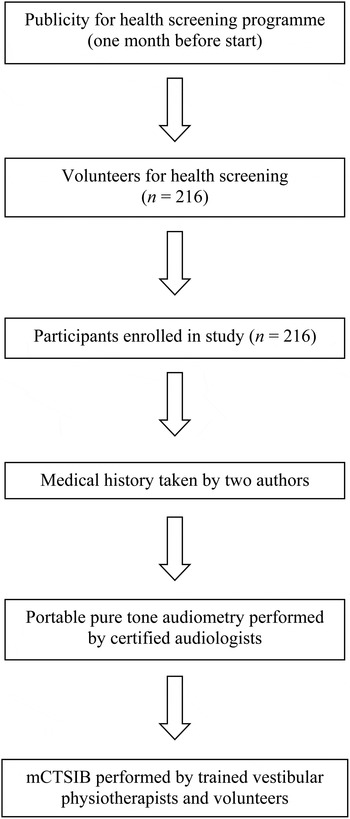
A cross-sectional study was performed in the Otorhinolaryngology (ENT) Department of a Singaporean tertiary teaching hospital and the institution's community-based health screening programme. The study protocol was approved by the Singapore National Healthcare Group Domain Specific Review Board. Figure 1 shows the study workflow.
Flowchart showing patient recruitment and assessment. mCTSIB = modified Clinical Test for Sensory Interaction on Balance

Healthy adults aged 40 years and above who could walk and stand independently were enrolled between March and June of 2010. Those who were unable to stand steadily on their own or had a history of neurological disorders or signs of neurological deficits, active uncontrolled cardiovascular and/or respiratory conditions, spinal or musculoskeletal disorders, uncorrected ocular disorders, mental disorders, or acute illness, or were pregnant, under the influence of alcohol, or taking medication with neuromuscular, ocular, vestibular, or ontological suppressive or toxic effects were excluded.
Demographic data, general medical and ENT histories, and a fall history were obtained from all participants. The main outcomes were pure tone audiometry and vestibular function assessment using the modified Clinical Test for Sensory Interaction on Balance (‘mCTSIB’).Reference Shumway-Cook and FB 2
No standardised questionnaires that fulfilled our objectives were available. Hence, questionnaire and interview procedures were developed by the authors. These included both open-ended and standardised questions, and were designed to distinguish between vestibular vertigo and non-vestibular dizziness. Descriptions of dizziness or vertigo were first recorded in the participant's own words to avoid suggestive questioning, followed by a semi-structured interview. Participants were asked about the type of dizziness, its duration, provoking factors and previous diagnoses. Interviews were conducted by two authors (JLT and JT).
Additional information was collected, including demographic data, a medical history, a fall history (i.e. falls resulting in a hospital stay or impaired mobility for at least three days), and an ENT history of vertigo or tinnitus symptoms.
Audiometry
Pure tone audiometry at 1, 2, 4 and 8 kHz was conducted by audiologists from the institution's audiology department using Amplivox 240 (Eynsham, UK) and Interacoustics AD226 (Assens, Denmark) diagnostic audiometers.
Vestibular assessment
The modified Clinical Test for Sensory Interaction on Balance for determining vestibular dysfunction was conducted by two authors only (JLT and JT) to minimise inter-observer variation. For testing, participants were required to stand with their feet together and arms crossed for 1 minute in four different scenarios: 1, firm surface with eyes open; 2, firm surface with eyes closed; 3, foam surface with eyes open; and 4, foam surface with eyes closed. The foam surface was a universal foam mattress used in the Balance Master (Neurocom NCM Foam Pad by Natus Medical Incorporated, Pleasanton, CA, USA), as used in vestibular rehabilitation. Its purpose was to reduce sensory input from the feet.
The test was designed to vary the different sensory inputs contributing to balance: the vestibular system, vision and proprioception. Failure in any test scenario was defined as participants needing to open their eyes, reaching out for support, stepping off the foam mattress or swinging their arms to enhance balance within a one-minute period. A maximum of two attempts were allowed for each test scenario. The four test scenarios were staged from the easiest to the most difficult, and the preceding stage had to be passed before proceeding to the next scenario. Vestibular dysfunction was defined as passing scenarios 1–3, but failing scenario 4.
Statistical analysis
All data were entered into IBM SPSS Statistics software version 17.0 for Windows (Chicago, Illinois, USA) for statistical analysis. Continuous variables such as age and smoking duration were regrouped into categorical variables. Furthermore, data were stratified to determine the effects of potential confounders or effect modifiers.
The prevalence of vestibular dysfunction was first estimated in the overall population and then stratified by sociodemographic, cardiovascular and otological characteristics. Cross-tabulation and chi-square F-testing were used to obtain odds ratios for binomial variables and vestibular dysfunction, and to test for overall differences in their respective proportions. The Student's t-test was used to compare the means of continuous variables. Binary logistic regression was used to estimate interactions between different variables and vestibular dysfunction, and to account for confounding and independent risk factors. Statistical significance was set at a p value of 0.05.
Results
The initial target for the sample population was 380, which would have provided a 95 per cent confidence interval (CI) with a 5 per cent margin of error. However, practical constraints restricted the number of participants to 216. None of the participants were excluded; data collection was complete for all participants. Slightly more women (52.3 per cent) than men were included. Most participants were Chinese (92.1 per cent). The age range of participants was 40–86 years, with a median age of 60 years. The largest group was the 55–64 year age group (38.9 per cent), but similar numbers were included in the 20–54 and 65–74 year age groups (23.1 per cent and 25.5 per cent, respectively). Participants aged above 75 were in the minority (12.5 per cent).
In total, 13.9 per cent of participants had diabetes mellitus, 39.4 per cent had hypertension and 34.7 per cent had high cholesterol levels. There were insufficient numbers of participants with other diseases for statistical analysis.
In all, 25.5 per cent of the study population had smoked for a continuous period of at least half a year, while only 10.6 per cent were current smokers. Of all smokers, 16.7 per cent had a smoking history of more than 10 pack-years (1 pack-year = 1 packet per day × 1 year of smoking). Audiometric analysis showed that 55.6 per cent of participants had presbyacusis.
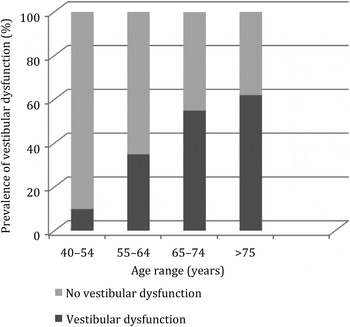
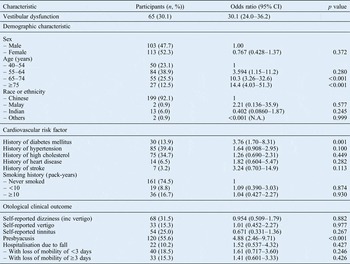
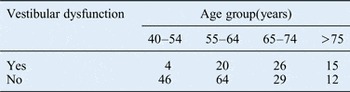
As determined by failure to complete test scenario 4 of the modified Clinical Test of Sensory Interaction on Balance, the overall prevalence of vestibular dysfunction in participants aged 40 years and older was 30.1 per cent (95 per cent CI, 24.0 to 36.2 per cent). The prevalence of presbyacusis in this group was much higher, at 55.6 per cent (95 per cent CI, 49.0 to 62.2 per cent). Table I shows the odds ratios and statistical significance for variables that may contribute to vestibular dysfunction. Table II and Figure 2 show a significant trend toward an increasing prevalence of vestibular dysfunction in older age groups. Apart from increasing age and the presence of presbyacusis, no demographic or otological factors were associated with vestibular dysfunction.
Graph showing the prevalence of vestibular dysfunction by age. Odds ratio per decade = 1.83

Prevalence of vestibular dysfunction in singaporean adults stratified by demographic characteristics, cardiovascular risk factors and outcome

CI = confidence interval
Final model of risk factors with vestibular dysfunction

CI = confidence interval
Among the cardiovascular risk factors, only diabetes was associated with a significantly increased odds ratio for vestibular dysfunction. Hypertension and a history of stroke were associated with an increased odds ratio for vestibular dysfunction, although neither association reached statistical significance.
The influence of age and presbyacusis on the odds ratio for vestibular dysfunction was further evaluated using multivariate analyses (Table II). The powerful influence of age and presbyacusis persisted in all models after adjustment for diabetes. However, diabetes did not increase the odds ratio for vestibular dysfunction in adjusted analyses. In the final model consisting of presbyacusis and age analysed against vestibular dysfunction, presbyacusis was associated with a 3.14 per cent increase in the odds ratio for vestibular dysfunction, and a 6.2 per cent increase in the odds ratio for vestibular dysfunction with every additional year of life.
Multivariate analyses showed that participants with vestibular dysfunction had a significantly increased odds ratio for presbyacusis compared with those without vestibular dysfunction (adjusted odds ratio, 3.14 (95 per cent CI, 1.50 to 6.56); p < 0.05).
Discussion
This study was the first to examine the prevalence of vestibular dysfunction in Singapore. It provides objective evidence for vestibular dysfunction in one in three Singaporeans aged 40 years and above. This finding is comparable to the figure of 35 per cent reported for a US population aged 40 years and above, as measured by the modified Clinical Test for Sensory Interaction on Balance.Reference Agrawal, Carey, Della Santina, Schubert and Minor 1 Interestingly, it is only slightly higher than the 21–29 per cent prevalence rates of self-reported vertigo reported for community-based cohorts from the UK (aged 18–64 years) and Finland (aged 12 years and above).Reference Havia, Kentala and Pyykkö 3 , Reference Yardley, Owen, Nazareth and Luxon 4 The estimate is comparable to the prevalence rate of 25.6 per cent for vestibular vertigo in those aged 40 years and above defined by self-reported symptoms along with neuro-otological examination in a subset of cases, as observed in a national survey of Germans aged 18 to over 80 years.Reference Neuhauser, von Brevern, Radtke, Lezius, Feldmann and Ziese 5
A major source of variability in estimates of the prevalence of vestibular dysfunction is the definition of a case. Most previous studies primarily used questionnaires to define cases of vertigo. A US study of data from the National Health and Nutrition Examination Survey was unique in its use of the modified Clinical Test of Sensory Interaction on Balance.Reference Agrawal, Carey, Della Santina, Schubert and Minor 1 This test was first described by Shumway-Cook and Horak as a bedside alternative to computerised posturography.Reference Shumway-Cook and FB 2 It initially included two scenarios in which a swinging lantern was used to simulate a moving surrounding to provide a discrepancy between the vestibular input stimulated by postural sway and visual flow. The modified test removes this aspect, and Billek-Sawhney (unpublished data) found no differences in the measures of duration and sway amplitude between the eyes closed and visual conflict conditions.
This test has been shown to approximate computerised dynamic posturography testing, one of the instruments used in the clinical diagnosis of vestibular dysfunction.Reference Dobie 6 Both posturography and scenario 4 in this study assess the patient's ability to maintain balance when vestibular information is the only reliable sensory input (i.e. in the absence of parallel visual and proprioceptive cues). In a study of 12 participants aged from 24 to 68 years, test-retest reliability of the modified Clinical Test for Sensory Interaction on Balance using only scenarios 1 and 2 was high (intraclass correlation coefficient for scenario 1 = 0.91, intraclass correlation coefficient for scenario 2 = 0.97).Reference Hageman, Leibowitz and Blanke 7 It should be noted, however, that the study population was much younger than in the present study.
This study found that a substantial proportion of participants without a history of self-reported dizziness (30.4 per cent), vertigo (30.1 per cent) or falling (31.8 per cent) failed test scenario 4. Postural assessment was reported to be more likely to yield an abnormal result compared with other vestibular function tests in both symptomatic and asymptomatic patients (i.e. those with or without a history of vertigo or falls).Reference Girardi, Konrad, Amin and Hughes 8 A possible explanation for the increased sensitivity of postural assessment is that performance in this test is influenced by information obtained from all six semicircular canals along with the utricle and saccule, whereas other tests may have more restricted substrates. For example, the caloric reflex test evaluates the function of only the horizontal semicircular canals.
Postural assessment cannot distinguish between central and peripheral vestibular dysfunction and their different causes; in contrast, vestibulo-ocular reflex tests, such as caloric reflex testing, specifically assess peripheral vestibular function. However, the finding that individuals with vestibular dysfunction were significantly more likely to have presbyacusis suggests that peripheral vestibular structures play a role in auditory function, as measured in this study. A shared susceptibility to vestibular dysfunction and hearing loss probably reflects the common anatomical location of the vestibular and hearing organs, as well as the common blood supply, thus making both systems potentially vulnerable to the same degenerative, ischaemic, traumatic or toxic insults. In contrast to vestibulo-ocular reflex tests, postural tests may be affected by the patient's strength and musculoskeletal status, as well as by motivational and volitional factors that may affect test compliance. However, in this study, these considerations may be mitigated because participants were only tested in scenario 4 if their vestibular system function was adequate to pass the three previous scenarios. Nevertheless, the influence of other non-otological factors is unlikely to be significant because only a few participants failed the test at scenarios 2 (n = 2; 0.93 per cent) and 3 (n = 3; 1.40 per cent).
Trend analysis of vestibular dysfunction by age

χ2 trend = 28.3, p < 0.0001
Consistent with published findingsReference Neuhauser, von Brevern, Radtke, Lezius, Feldmann and Ziese 5 , increasing age was significantly associated with vestibular dysfunction in the current study (Figure 2). This finding is supported by temporal bone studies in animals and humans that demonstrated age-dependent depletion of vestibular hair cells and otoliths, dysfunction of the remaining hair cells, and loss of vestibular ganglion cells.Reference Johnsson and Hawkins 9 However, the age effect appears to be greater in the mid-range than at higher frequencies (data not shown), although this may be a plateau effect or due to the small sample size.
-
• This cross-sectional study investigated the association of presbyacusis and vestibular dysfunction with age and other medical risk factors in the Singaporean elderly
-
• The prevalence of vestibular dysfunction and presbyacusis were 30.1 per cent and 55.6 per cent, respectively
-
• The odds of vestibular dysfunction increased by 6.2 per cent with every year of life and by 3.14 times in the presence of presbyacusis
-
• Vestibular dysfunction was independently associated with increased age and presbyacusis
Finally, this study did not find a significant association between diabetes and vestibular dysfunction, as noted in other studies.Reference Gawron, Pospiech, Orendorz-Fraczkowska and Noczynska 10 Diabetes was postulated to be vestibulotoxic because of its microangiopathic effects, leading to ischaemia of the vestibular structures. In addition, impaired glucose metabolism was suggested to alter the metabolism of inner-ear fluids, leading to labyrinthine dysfunction.Reference Klagenberg, Zeigelboim, Jurkiewicz and Martins-Bassetto 11 Unfortunately, disease duration and severity, complications such as neurological and microvascular involvement, and disease control were not considered in this study. The lack of this information and the small sample size may have prevented the association between diabetes and vestibular dysfunction reaching statistical significance.
Study strengths and limitations
As this was a cross-sectional study, causal inferences could not be established. The sample population was also small due to time constraints resulting from the days available for the community-based health screening programme. An attempt to minimise the potential effects of confounding variables was made by adjusting for all variables significantly related to vestibular dysfunction in the analyses.
Recommendations
This study found a high prevalence of presbyacusis and vestibular dysfunction in the Singaporean elderly. Further investigations should examine the subsequent risk of falls in this age group, with a view to determining the benefit of screening for vestibular dysfunction in presbyacusis patients. Studies designed to incorporate vestibular rehabilitation may help prevent falls in patients with asymptomatic vestibular dysfunction.Reference Schubert, Migliaccio, Clendaniel, Allak and Carey 12
Acknowledgements
We would like to thank the staff of the Department of Audiology, Tan Tock Seng Hospital, for their help in audiometry testing; Ms T L Huan, Department of Physiotherapy, Tan Tock Seng Hospital, for her advice and assistance in conducting the study; and Harvest Care Centre and Foochow Methodist Church for co-organising the screening exercises.