Introduction
Sentence comprehension is believed to include three processes: word recognition, parsing, and semantic integration (Gernsbacher, Reference Gernsbacher1990; Pickering, Clifton & Crocker, Reference Pickering, Clifton, Crocker, Crocker, Pickering and Clifton2000). To understand the meaning of a sentence, a language user must first recognize its component words so that their lexical meanings and syntactic properties become available. In the process of parsing, a user builds a syntactic structure in terms of how words are syntactically related. Based on the information obtained from the first two processes, individuals can then build a semantic representation of the sentence by relating the information to their linguistic, contextual, and real-world knowledge. The present study was pursued to probe the efficiency of sentence comprehension among second language (L2) learners as compared to native speakers at the level of semantic integration.
Abundant research has shown that semantic integration is highly efficient in first language (L1) processing. During sentence comprehension L1 speakers can easily sense semantically unacceptable words (Ardal, Donald, Meuter, Muldrew & Luce, Reference Ardal, Donald, Meuter, Muldrew and Luce1990), actively predict upcoming words (Wicha, Moreno & Kutas, Reference Wicha, Moreno and Kutas2003), and routinely generate mental simulation according to the sentence context in the course of completing the semantic representation.
This last finding, which is particularly relevant to the present study, was demonstrated in several studies published by Zwaan and colleagues (Pecher, Van Dantzig, Zwaan & Zeelenberg, Reference Pecher, Van Dantzig, Zwaan and Zeelenberg2009; Stanfield & Zwaan, Reference Stanfield and Zwaan2001; Zwaan, Stanfield & Yaxley, Reference Zwaan, Stanfield and Yaxley2002). In these studies, participants were asked to read sentences for comprehension. Reading of each sentence was followed by the display of a picture. After reviewing the picture, the participants had to decide whether the displayed object was mentioned in the sentence. For items that required a positive response (i.e., objects that were mentioned in the sentences), the authors manipulated the relationship between the sentence and the picture such that the object implied in a sentence was either congruent or incongruent with the shape or orientation of the object in a picture. For example, a picture of a nail in its horizontal orientation may follow two contrasting sentences, such as those seen in Example 1. Sentence 1a implies a horizontal orientation (compatible) and 1b a vertical orientation (incompatible).
-
1a. John hammered the nail into the wall.
-
1b. John hammered the nail into the floor.
The picture and the first sentence were compatible in the sense that a nail hammered into the wall is likely to appear in a horizontal orientation rather than a vertical one. A picture of a nail in its vertical orientation would be compatible with the second sentence. Reaction time data in these studies showed that the participants were faster in producing a positive response when the object was displayed in a way consistent with what was implied in the sentence, even though the participants were not asked to pay any attention to object orientation or shape. These results suggested that reading a sentence automatically resulted in the generation of a mental image that was consistent with the meaning of the sentence. These findings have been taken as evidence for theories of embodied cognition (for a review of embodied cognition, see Pecher & Zwaan, Reference Pecher and Zwaan2005).
Semantic integration in L2 sentence processing has received only limited attention. One line of evidence for efficient semantic integration in L2 reading comes from research that employed electrophysiological measures. These studies found that participants showed a native-like sensitivity to semantic anomaly in L2 sentence processing. Ardal and colleagues (Reference Ardal, Donald, Meuter, Muldrew and Luce1990) were among the first to demonstrate that both native and non-native speakers showed the N400 effect in responding to semantically anomalous sentences, even though the effect was both delayed and smaller when sentences were in participants’ L2 rather than their L1. This native-like sensitivity to semantic anomaly in L2 sentence processing has been replicated in many subsequent studies (e.g., Hahne, Reference Hahne2001; Hahne & Friederici, Reference Hahne and Friederici2001; Kutas & Kluender, Reference Kutas, Kluender, Heinze, Munte and Mangun1994; Ojima, Nakata & Kakigi, Reference Ojima, Nakata and Kakigi2005; Osterhout, McLaughlin, Pitkänen, Frenck-Mestre & Molinaro, Reference Osterhout, McLaughlin, Pitkänen, Frenck-Mestre and Molinaro2006; Weber-Fox & Neville, Reference Weberâ–Fox and Neville1996).
Additional evidence comes from results reported by Hu and Jiang (Reference Hu, Jiang, Trofimovich and McDonough2011). They asked L2 speakers to perform a lexical decision task on targets that appeared visually on a computer monitor while listening to sentences for comprehension. As shown in Example 2, the target words (underlined in sample sentences) were either semantically congruent or incongruent with the sentence context. The L2 speakers tested in the study showed a reliable sentence context effect in that they responded to the targets incongruent to the sentence more slowly than they did to congruent targets, just as native English speakers did. These results showed that, while listening to sentences, L2 speakers are able to quickly build a semantic representation of the incoming input, which helps them to anticipate the upcoming words.
-
2a. The girl mailed the letter without a stamp.
-
2b. The girl mailed the letter without a stone.
However, there is also evidence suggesting that L2 speakers were less capable of efficient semantic integration – specifically in anticipating upcoming input – in sentence processing. For example, in using sentences such as those in Example 3 below, Martin, Thierry, Kuipers, Boutonnet, Foucart and Costa (Reference Martin, Thierry, Kuipers, Boutonnet, Foucart and Costa2013) tested L1 English speakers and late L1 Spanish–L2 English speakers in a sentence reading task. Semantic integration was assessed by examining the ERP (event-related potential) component N400 a) for the more expected and less expected nouns (chair vs. armchair) and b) for the articles preceding the nouns (a being compatible with the expected noun chair but not an). The latter was more concerned with assessing the participants’ ability to anticipate upcoming input. In line with the findings from previous studies, both L1 and L2 speakers showed a similar N400 for the less predictable nouns. However, unlike native speakers, L2 speakers did not show a difference between the two article conditions. There was no increase in N400 amplitude for the article incompatible (e.g., an) to the more predictable ending (e.g., chair), in comparison to the compatible article (e.g., a). This latter finding was interpreted “as evidence that L2 comprehenders do not actively predict upcoming words during sentence comprehension to the same extent as L1 comprehenders” (p. 574). However, subsequent studies showed that L2 speakers can anticipate incoming information as efficiently as L1 speakers under some conditions (e.g., Foucart, Romero-Rivas, Gort & Costa, Reference Foucart, Romero-Rivas, Gort and Costa2016; Foucart, Martin, Moreno & Costa, Reference Foucart, Martin, Moreno and Costa2014).
-
3a. He was very tired so he sat on a chair.
-
3b. He was very tired so he sat on an armchair.
The present study
In light of the conflicting findings and limited research on this topic, the present study aimed to examine semantic integration in L2 processing by considering the activation of mental imagery in L2 sentence reading. To do so, a sentence-based picture recognition task was designed for L2 Korean speakers. As in the original study (Stanfield & Zwaan, Reference Stanfield and Zwaan2001), participants read each sentence and were then asked to decide whether the object presented in the picture was mentioned in the sentence. They responded using a key press and were instructed to press yes if the object was mentioned, and no if it was not. Reaction time (RT) was measured from the time an image appeared to the time participants pressed the response key.
The test materials included both items that required yes responses and an equal number of items that required no responses. Among the former, a manipulation was made such that an object was displayed in an orientation or shape that was consistent or inconsistent with what was implied by the sentence. Based on the assumption that mental imagery is automatically generated in sentence processing (Barsalou, Reference Barsalou1999) and on findings from previous research (Coppens, Gootjes & Zwaan, Reference Coppens, Gootjes and Zwaan2012; Stanfield & Zwaan, Reference Stanfield and Zwaan2001; Taylor & Zwaan, Reference Taylor and Zwaan2009; Zwaan, Stanfield & Yaxley, Reference Zwaan, Stanfield and Yaxley2002; Zwaan & Yaxley, Reference Zwaan and Yaxley2003), we expected native Korean speakers to show a faster response time when responding to congruent pictures than they did responding to incongruent pictures. More importantly, we wanted to determine if L2 speakers would show a similar congruency effect. If they did, we would take the finding as evidence for efficient semantic integration in L2 sentence processing. Otherwise, we would conclude that L2 speakers were less capable of efficient semantic integration.
Method
Participants
We recruited 60 L2 Korean speakers to participate in the experiment. The majority of participants used either Chinese (n = 32) or English (n = 23) as their native and dominant language. The remainder had French (n = 1), German (n = 1), Japanese (n = 1), Mongolian (n = 1), and Thai (n = 1) as their L1s. All had advanced proficiency in Korean, when measured using the Korean C–test (modified from Lee-Ellis, Reference Lee-Ellis2009). The test consisted of four passages containing 25 incomplete words in each passage with the second half of letters missing. Participants were asked to fill in the blanks. Raw test scores were converted into percentage accuracy scores. These ranged from 60% to 94% with an average of 79%.Footnote 1
Furthermore, all L2 Korean-speaking participants were late L2 learners who began learning Korean at age 18 or older. All were enrolled in institutions of higher education and were taking advanced Korean language courses for academic purposes (e.g., Korean literature, Korean media, and Teaching Korean as a Second Language) at the time of testing. All had at least some experience of staying in Korea, ranging from one month to six years of residency. Their age at testing was 24.9 on average. Table 1 summarizes the participants’ language backgrounds.
Summary of late L2 Korean speakers’ language backgrounds.

The control group was comprised of 36 L1 Korean speakers whose native and dominant language is Korean, and who live in either the United States or Korea. Their age at testing was 30.2 on average. Footnote 2 All participants were paid USD 10 per hour.
Materials and design
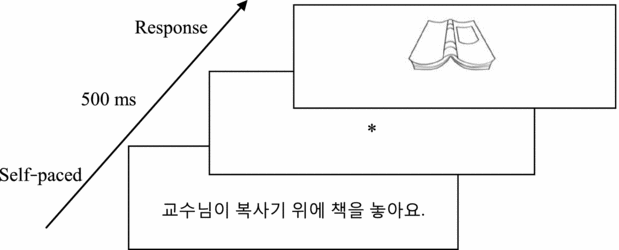
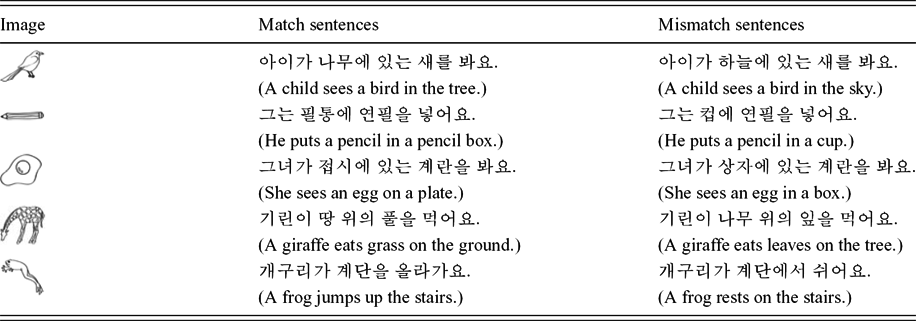
The sentence-based picture recognition task consisted of 192 items. Half (96 items) included a picture of an object mentioned in the sentence and thus required a yes response. The other half included items requiring no response. Of yes-response items, half (48 items) were critical items, and the other half were fillers. For the critical items, two versions of the sentences were created. They were matched to the same picture, such that the picture was congruent with one version of the sentence (i.e., with object orientation or shape) and incongruent with the other version. Example 4 illustrates this manipulation. The two sentences were paired with the same picture, showing an opened book facing down (see Figure 1). Thus, the first sentence (4a) and the picture presented a congruent item (i.e., a match condition). That is, the picture showed an object that was not only mentioned in the sentence, but also congruent in shape to the meaning implied by the sentence. The second version of the sentence (4b) and the picture formed an incongruent item (i.e., a mismatch condition): the object in the picture was mentioned in the sentence but was not in the shape implied by the sentence (i.e., a closed book).
-
4a.

(The professor placed the book on the copy machine.)
-
4b.
(The professor put the book into the backpack.)


The stimulus sequence within a trial of the sentence-based picture recognition task.

An initial list of sentences was created by the first author, including five items from Zwaan's studies (e.g., Stanfield & Zwaan, Reference Stanfield and Zwaan2001). The sentence stimuli were matched in terms of length and position of a target object noun in a sentence across conditions. A professional illustrator drew images as black-and-white line drawings based on information reported in previous studies as sources for typicality, complexity, and familiarity (Snodgrass & Vanderwart, Reference Snodgrass and Vanderwart1980; Zwaan et al., Reference Zwaan, Stanfield and Yaxley2002). Each picture was scaled to fit into a 3-inch square.
The critical stimuli were presented to five L1 Korean speakers who were Korean linguists as well as Korean language instructors with a teaching experience of 10 years on average. They were asked to check (a) whether the proficiency level of the sentences was appropriate for the participants, and (b) whether the congruency status of the sentences in relation to the object pictures was sufficient. For assessing the latter, the five informants were presented with two versions of the same sentence, along with the pictures. The informants had to decide whether the shape or orientation of the object was implied (a) by one version of the sentence, (b) by both versions of the sentence, or (c) by neither version of the sentence. From the initial list of 60 items, 48 items were chosen on the basis that all five informants reached the same conclusion that only one version, the same version, was congruent with the picture.
In addition to the 48 critical items, 48 fillers requiring a yes response were created to direct participants’ attention away from the manipulation of object shape and orientation in the critical items. The test materials also included 96 items that required a no response. Examples 5 and 6 illustrate such filler items; Sentence 5 was followed by an image of a watch, and sentence 6 was followed by an image of a ring.
-
5. 친구가 이 시계를 좋아해요.
(My friend likes this watch.)
-
6. 남자가 식탁 위에 꽃을 놓아요.
(A man puts the flowers on the table.)
Using these items we constructed two presentation lists of 192 items. The 48 critical items were counterbalanced across the two lists such that the same picture appeared only once on any list. It was matched with a congruent sentence on one list and with an incongruent sentence on the other list. The two lists had the same filler items.
As part of the material development, a group of 34 L1 Korean speakers was tested in a pilot study to ensure that a reliable sentence-picture congruency effect could be obtained among native Korean speakers. As expected, a reliable congruency effect was found (r > .78).
Procedure
The participants were tested individually and assigned to one of the two presentation lists randomly. Each trial consisted of several steps. First, a sentence was presented in the center of the computer screen. When the participants finished reading the sentence, they pressed the right shift key on a keyboard. A fixation mark (*) then appeared in the center of the screen for 500 ms, followed by a picture of an object. The participants’ task was to decide whether the object depicted in the picture was mentioned in the sentence. They responded by pressing the right-shift key for yes and the left-shift key for no. The next trial (sentence → * → image) began automatically (Figure 1) after a response was provided.
The task consisted of two phases: a practice phase and a test phase. The participants completed 12 practice trials. When they reached 80% accuracy or higher, they could start a test phase. Among the 192 trials, 48 trials were followed by a comprehension question after participants provided a response to a picture. For example, for the sentence그는 연필을 컵에 넣어요 (He puts the pencil in the cup.), the comprehension question was 그가 연필을 갖고 있어요? (Does he have a pencil?). The purpose of including the comprehension questions was to ensure that the participants were paying attention to sentence semantics, since understanding sentence meaning is essential to successfully examining sentence-picture congruency effects (Jiang, Reference Jiang2012). Data collection was done with DMDX (Forster & Forster, Reference Forster and Forster2003). The experiment took about 50 minutes for L2 Korean speakers to complete. Participants took a post-test vocabulary test to assess whether they were familiar with the words used in the stimuli.
Results
The mixed effects models (MEMs) were used to analyze participants’ RTs on the sentence-based picture recognition task.Footnote 3 In this model, the independent variable of primary interest was a condition with two levels (match and mismatch) set up as a fixed effect. Random effects were imposed on both participants and items to control for the variation across them. We imposed these because participants and items were randomly selected from a larger population, and random sampling can presumably affect the results.
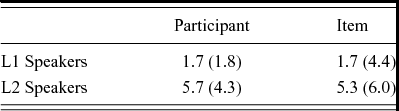
We analyzed 4608 data points that 96 participants (36 L1 and 60 L2 Korean speakers) produced by responding to 48 critical items in the sentence-based picture recognition task. This data set was inspected in terms of error rates per participant as well as item, vocabulary knowledge (a post-test vocabulary check), incorrect responses, and outliers. First, error rates were examined for each participant and item. If a participant had an error rate greater than 20%, he or she was excluded from analyses. If an item had an error rate greater than 40%, it was excluded from analyses. None of the participants or items used in this study was rejected based on this criterion (see Table 2).
Error rates (in mean) of participants and items (standard deviations in parentheses).

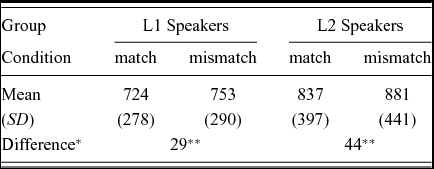
However, two items were rated as very difficult by L2 Korean speakers in the post-test vocabulary check (i.e., #14 and #44, by 5 and 8 participants, respectively). Thus, these two items were removed from further analyses. Furthermore, 286 (6%) reaction times were deleted due to incorrect decision responses, and 346 (7%) reaction times fell outside the range of acceptable latencies (mean +/− 2 SD). The data-trimming procedure accounted for a total data loss of 16%. Table 3 summarizes the means and standard deviations (SD) of the remaining reaction times in each condition and group for the experiment.
L1 and L2 Korean speakers’ RTs (in mean) in the two conditions (standard deviations in parentheses).

Notes: * Difference between match and mismatch conditions.
** Difference significant at a level of α = .05.
All data analyses were conducted with R, an open-source statistical package R (R core team, Reference Core Team2012). The lme4 package (Bates, Reference Bates2005) was used to run MEMs.
Sentence-picture congruency effect in L2 sentence reading
L2 speakers’ RTs were analyzed and compared with L1 speakers’ to determine the mental imagery generation in L2 sentential reading. L1 speakers’ RTs were 29 ms slower in the mismatch condition (753 ms, SD 290) than in the match condition (724 ms, SD 278), and L2 speakers’ RTs were 44 ms slower in the mismatch condition (881 ms, SD 441) than in the match condition (837 ms, SD 397), as shown in Table 3. To test the significance of condition differences and of group difference, the lmer() function in R was used to construct MEMs. The command used in R to run the model was as follows:
-
> Model 1 = lmer (logged RTs ~ condition * group + (1 | subject) + (1 | item), data = SPT)
As shown in Model 1, we used log transformed RTs (i.e., logged RTs in the formula) as a dependent variable to better follow the statistical assumption of the model that the error term follows the normal distribution for a dependent variable. The independent variables of main interest were condition and the interaction effect between the condition variable and the group variable, set up as fixed effects (i.e., condition * group in the formula). The purpose of setting up these two factors as fixed effects was to see whether participants’ picture recognition was significantly different according to the condition, and whether there was any meaningful difference in the degree of condition effects between the groups. Also, participants and items effects were controlled as random effects. The formula (1 | subject) + (1 | item) specifies crossed random effects for participants and items.
The results of Model 1 revealed a significant condition effect on picture recognition in sentential reading or sentence-picture congruency effect among the all participants (|t| ≥ 2.0 at α = .05).Footnote 4
We ran another model in which by-subject random slope for condition was included. Given that participants were repeatedly measured on match and mismatch items, participants may vary in sensitivity to the manipulation (e.g., some participants may respond to the mismatch items much more slowly than to the match items, while other participants’ response times across two conditions may show minimal difference.) Thus, the second model was run using the following formula:
-
> Model 2 = lmer (logged RTs ~ condition * group + (1 + condition | subject) + (1 | item), data = SPT)
The results of the second model showed the significant condition effect as well. That is, even when allowing participants to vary in sensitivity to the manipulation (condition), all participants responded significantly more slowly in mismatch condition than in match condition (0.04184), and the difference was statistically significant (|t| ≥ 2.0 at α = .05).
In addition, we ran a third model that included by-item, as well as by-subject, random slopes for condition. Given that items were repeatedly measured on match and mismatch conditions within minimal pairs of sentences (i.e., a sentence in match condition can be measured in mismatch condition with a minimal pair changed), items may vary in sensitivity toward the manipulation (e.g., some item pairs may trigger much more delayed responses in mismatch condition than in match condition while other item pairs across two conditions show minimal difference.) Thus, the third model was run using the following formula:
-
> Model 3 = lmer (logged RTs ~ condition* group + (1+condition | subject) + (1 + condition | item), data = SPT)
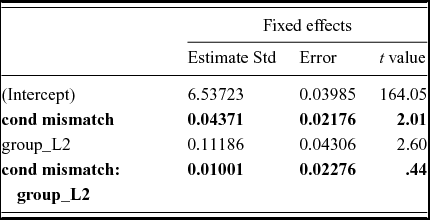
The result of the third model showed the significant condition effect as well. That is, even when allowing different items, in addition to different participants, to vary in sensitivity to the manipulation (condition), all participants responded more slowly in a mismatch condition than in a match condition (0.04371), and the difference was statistically significant (|t| ≥ 2.0 at α = .05), as shown in Table 4.
The sentence-picture congruency effect.

To test whether one model provides a significantly improved fit to the data than the others, likelihood ratio tests were conducted with the anova () function in R. As shown in Table 5, the result, expressed as a chi-squared statistic, demonstrates that the third model provides a significantly better fit to the data than the others (p < .001). This result indicates that the inclusion of both by-subject and by-item random slopes have improved model fit, and thus need to be included in the model for this data set.
Model comparison for the sentence-picture congruency effect.

Signif. codes: 0 ‘***’ 0.001 ‘**’ 0.01 ‘*’ 0.05 ‘.’ 0.1 ‘ ’ 1
Second, the result in Table 4 showed that the difference in sentence-picture congruency effect between L1 and L2 groups was not significant. Specifically, L2 speakers (listed as group_L2 in Table 4) were significantly slower to respond than L1 speakers overall (0.11186, t = 2.60). However, their sentence-picture congruency effect (0.01001) was not significantly different from that of L1 speakers (|t| < 2.0 at α = .05). The non-significant group difference in condition effect (as shown as indicated by cond mismatch: group_L2 in Table 4) indicates that the level of automatic semantic integration of L2 speakers during L2 sentence reading was not significantly different from that of L1 speakers. Footnote 5
In conclusion, the best fitting-model confirmed that L2 speakers’ picture recognition after L2 sentence reading was significantly slower when the object was portrayed in a direction or shape incongruent with implied sentence meaning. Picture recognition was faster when the object was congruent with implied meaning. Also, the degree of the delay in participant responses was similar to that of L1 speakers.
Discussion
The present study was conducted to address the extent to which late L2 speakers can be as efficient as L1 speakers in semantic integration during sentence reading. Semantic integration was observed by examining whether L2 speakers automatically generated mental imageries during reading, a process which we assessed by measuring a sentence-picture congruency effect. A significant sentence-picture congruency effect was found in both L1 and L2 speakers in the sentence-based picture recognition task. When the displayed image did not match the image implied by the sentence meaning in either shape or orientation, they showed a delay in responding to the pictures. This finding suggested that L2 speakers were similar to L1 speakers in their ability to quickly generate a semantic representation of a sentence while reading; this representation included a mental image of an object in its particular shape or orientation as implied by the sentence meaning.
This finding is consistent with those of several previous studies, which demonstrated native-like sentence processing performance among adult L2 speakers. For example, in Hu and Jiang (Reference Hu, Jiang, Trofimovich and McDonough2011), Chinese ESL speakers listening to English sentences showed a delay in responding to an incongruent (as compared to a congruent) ending. In Hahne and Friederici's study (Reference Hahne and Friederici2001), late L1 Japanese–L2 German speakers were compared with L1 German speakers on N400 latency as they listened to semantically correct and incorrect sentences in German. Researchers in this study found that the patterns of N400 produced by semantic anomalies were not significantly different between L1 and L2 speaker groups, suggesting that even late L2 speakers who start learning L2 after puberty can automatically activate and integrate semantic information during L2 sentence comprehension.
In light of the findings of this present study, one may ask whether the lack of native-like sensitivity that researchers such as Martin et al. (Reference Martin, Thierry, Kuipers, Boutonnet, Foucart and Costa2013) found truly reflected L2 speakers’ limitation in semantic anticipation. Instead, it may have resulted from the use of the particular structure used to index anticipation, that is, the difference between the two different forms of the indefinite article of English, a and an, as pointed out by Foucart and colleagues (Reference Foucart, Martin, Moreno and Costa2014). Indeed, when a similar paradigm was used in the latter study, which tested Spanish monolinguals, French–Spanish late bilinguals, and Spanish–Catalan early bilinguals on Spanish sentences such as those in Example 7, late L2 speakers showed a native-like ERP pattern.
-
7a. El pirata tenía el mapa secreto, pero nunca encontró el tesoro [masc] que buscaba. [Expected]
(The pirate had the secret map, but he never found the treasure he was looking for.)
-
7b. El pirata tenía el mapa secreto, pero nunca encontró la gruta [fem] que buscaba. [Unexpected]
(The pirate had the secret map, but he never found the cave he was looking for.)
To conclude, by examining the activation of mental imagery in L2 reading, the present study provided converging evidence for a native-like semantic integration process among non-native speakers in sentence processing, which was already documented in several previous studies that examined semantic integration in terms of anticipation and semantic congruency (Hahne & Friederici, Reference Hahne and Friederici2001; Hu & Jiang, Reference Hu, Jiang, Trofimovich and McDonough2011; Weber-Fox & Neville, Reference Weberâ–Fox and Neville1996). Based on these findings, one may conclude that adult L2 speakers are able to develop an efficient process of semantic integration in sentence processing.
However, we are just beginning to understand semantic integration in L2 processing. Against the background of an overall similarity between L1 and L2 speakers observed in these studies, some differences were already apparent. For example, in several studies that compared L2 and L1 speakers with ERP measures, the N400 component – although present in L2 speakers’ performance – was found to be delayed and smaller in magnitude (e.g., Ardal et al., Reference Ardal, Donald, Meuter, Muldrew and Luce1990). Such differences were sometimes dismissed as being quantitative rather than qualitative in nature. However, whether such differences affect L2 reading in some fundamental ways is yet to be determined. In Hu and Jiang (Reference Hu, Jiang, Trofimovich and McDonough2011), L2 speakers showed a native-like facilitative effect for congruent endings, but they differed from native speakers in that they were unable to produce an inhibitory effect when incongruent endings were compared to neutral endings. Furthermore, it is likely that the native-like performance in semantic integration observed so far may be due in part to the methodological approaches taken. Some qualitative differences may emerge when a more sensitive measure or a more powerful paradigm is adopted.
Samples of the picture and sentence stimuli used in the experiment. English translations in parentheses.